Tag: Wednesday December

  • Gwendolyn Killebrew Has Passed Away

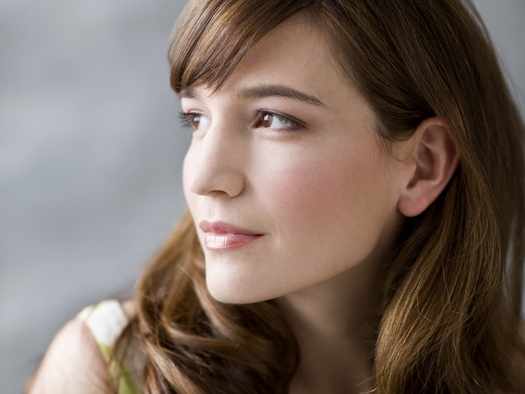
    Killebrew

    Wednesday December 29th, 2021 – Mezzo-soprano Gwendolyn Killebrew passed away on December 24th, 2021, at the age of 80.

    Strikingly beautiful, and with a voice to match, Gwendolyn Killebrew studied at the Juilliard School and was a Met Auditions winner in 1966.

    In 1967, Ms. Killebrew made her Met debut as Waltraute in the Karajan WALKURE. She sang a series of Carmens at The Met in 1979. In 1971, she had also joined New York City Opera, where she sang Ulrica in BALLO IN MASCHERA (debut) and Genevieve in PELLEAS ET MELISANDE. I had the good fortune to see her in both these roles.

    Joining the Deutsche Oper am Rhein, Düsseldorf, in 1976, Ms. Killebrew sang a wide repertoire there including Azucena, Amneris. Fricka, Jocasta, Baba the Turk, Orfeo, and the Monteverdi contralto roles. At the 1978 Bayreuth Festival, she made a striking impression as Waltraute in Patrice Chéreau’s wildly controversial staging of the “centennial” RING Cycle. Listen to her in Waltraute’s doom-ladened narrative from GOTTERDAMMERUNG, from the 1980 international telecast of the Cycle:

    Gwendolyn Killebrew as Waltraute ~ Götterdämmerung – Boulez cond – Bayreuth 1980

    Ms. Killebrew’s appeared at Santa Fe, Cologne, Paris, Stuttgart, Copenhagen, and Geneva, and at the great music festivals of Salzburg, Ravinia, Tanglewood, and Aspen. She worked with such illustrious conductors as Wolfgang Sawallisch, Leonard Bernstein, Seiji Ozawa, James Levine, Pierre Boulez, Herbert von Karajan, Sir George Solti, Zubin Mehta, Fabio Luisi, and  James Conlon.

    Upon retiring from the stage, Ms. Killebrew taught and coached at her studio at Düsseldorf.

    Enjoy this brief delight of a trio from Handel’s TAMERLANO sung by Ms. Killebrew, Alexander Young, and Carole Bogard, and a marvelous At II of TRISTAN UND ISOLDE here, wherein Ms. Killebrew and Jessye Norman each revel in their vocal richness.

    More from Ms. Killebrew:

    Gwendolyn Killebrew – Bella gara che faranno ~ Handel’s TAMERLANO

    Gwendolyn Killebrew – Dammi pace ~ Handel’s TAMERLANO

    Gwendolyn Killebrew – Prendi! É Un Ricordo..Son La Vecchia Madelon ~ ANDREA CHENIER

    ~ Oberon

  • Bronfman’s Bartok @ The NY Philharmonic

    Bronfman

    Above: pianist Yefim Bronfman

    ~ Author: Oberon

    Wednesday December 27th, 2017 – My friend Dmitry and I are fans of Yefim Bronfman, so this evening’s concert by The New York Philharmonic was a perfect classical-music finale for the year 2017.

    The evening opened with the overture to Smetana’s opera THE BARTERED BRIDE. I first heard this overture played live when James Levine chose it to open the Metropolitan Opera’s 100th anniversary gala in 1983. The gala (in two parts – matinee and evening) was telecast worldwide, but I was fortunate to have been in the House for the afternoon program. Let’s just say, they don’t make opera galas like that any more.

    It was great fun to hear the jolly, rambunctious Smetana overture again tonight under Bramwell Tovey’s baton; the Maestro set an exhilarating, ultra-fast pace for this music, and the Philharmonic artists took up his challenge: they played brilliantly and seemed truly to be having fun into the bargain. The music passes thru many modulations along the way, and solo moments sparkle forth – notably from Sherry Sylar’s oboe – as we are danced along in a lively manner. Really, an ideal concert-opener.

    Mr. Bronfman then appeared for the Bartok 2nd piano concerto. Following an ascending flourish from the Steinway, the first movement commences with rather wild brass fanfares. The piano sounds restless, set against winds; the turbulence builds only to subside, and Mr. Brofman’s playing turns subtle. Following another brass and piano build-up, there’s a full stop. Thereafter the music seems more melodious, though droll and ironic. The brass get quite noisy before the pianist silences them with a cadenza that flows up and down the keyboard. After a passage for flutes and piano, the soloist plays a double rising motif.

    Pensive strings introduce the the Adagio which develops into a marvelous duet for piano and timpani. Here Mr. Bronfman and timpanist Marcus Rhoten created an incredible atmosphere: moody and a bit ominous. Suddenly things perk up without warning and we are in a scherzo-like realm with an agitato feeling and with the pianist finding unusual delicacies. Mr. Bronfman then commences a remarkable pianissimo trill that goes on and on over misterioso strings.

    For the concerto’s finale, Bartók gets almost jazzy – in a slightly darkish way – and we hear from the trumpets; a feeling of a kind of war dance evolves. Another piano/percussion duet crops up – this time it’s Steinway vs bass drum – before the music turns unexpectedly dreamy. But the dream is short-lived as the trumpets re-awaken and the concerto ends brightly. Mr. Bronfman was well in his element throughout, his playing agile and multi-hued, with fine dynamic contrasts. The orchestra did their soloist proud.

    By way of perfect contrast to his grand-scale playing of the Bartók, Mr. Bronfman chose for an encore Chopin’s Étude in E Major, Op.10, No.3. The opening melody of this work, thought to have been Chopin’s favorite among the études, was later the source of a vocal song arranged by the soprano Félia Litvinne and recorded famously by Litvinne’s pupil, the tragic Germaine Lubin. This evening, Mr. Bronfman’s poetic rendering of the full étude cast a thoughtful spell over the hall. This magical experience, like so many others in recent years, was sadly spoilt in its most poignant passage by the ringing of a cellphone. Yet Mr. Bronfman continued, unperturbed, and left me a beautiful memory to cherish.

    94-ef6ab60c90ba3fb6a7911b7999dd5f4e

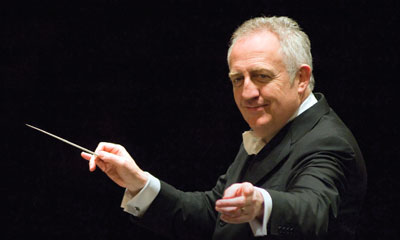
    Above: Bramwell Tovey

    Following the interval, an exciting performance of Mussorgsky’s Pictures at an Exposition (in the Ravel orchestration) again found the orchestra on peak form. Opening with a brass chorale Promenade, which recurs with variations during the first seven movements, the suite conjures up visions of the works of Viktor Hartmann. Upon Hartmann’s death in 1874 at the young age of 39, an exhibition of his work was mounted at St. Petersburg. Mussorgsky visited the exhibit and was inspired by what he saw to write a set of miniatures for piano. In 1922, Maurice Ravel orchestrated the pieces.

    A huge orchestra is in play, including five percussionists, two harps, and celesta. The ponderous Gnome, the child-like and playful Tuileries, the plodding Ox-Cart, the mini-scherzo of the Ballet of Unhatched Chicks, the bustling Marketplace at Limoges, the Roman Catacombs (deep brass), and the fanciful Hut of Baba-Yaga are all evoked in coloristic settings which the Philharmonic players delivered with evident affection.

    The movement which most impressed me was Il Vecchio Castello (The Old Castle) in which flutes, oboe, and bassoon were joined by the mellow, distinctive voice of the alto saxophone. This music was so evocative that I got lost in it. 

    The suite ends on a grand note with The Great Gate of Kiev. Sumptuously played, it brought a year full of music to an imperial finish.

    ~ Oberon

  • Bronfman’s Bartok @ The NY Philharmonic

    Bronfman

    Above: pianist Yefim Bronfman

    ~ Author: Oberon

    Wednesday December 27th, 2017 – My friend Dmitry and I are fans of Yefim Bronfman, so this evening’s concert by The New York Philharmonic was a perfect classical-music finale for the year 2017.

    The evening opened with the overture to Smetana’s opera THE BARTERED BRIDE. I first heard this overture played live when James Levine chose it to open the Metropolitan Opera’s 100th anniversary gala in 1983. The gala (in two parts – matinee and evening) was telecast worldwide, but I was fortunate to have been in the House for the afternoon program. Let’s just say, they don’t make opera galas like that any more.

    It was great fun to hear the jolly, rambunctious Smetana overture again tonight under Bramwell Tovey’s baton; the Maestro set an exhilarating, ultra-fast pace for this music, and the Philharmonic artists took up his challenge: they played brilliantly and seemed truly to be having fun into the bargain. The music passes thru many modulations along the way, and solo moments sparkle forth – notably from Sherry Sylar’s oboe – as we are danced along in a lively manner. Really, an ideal concert-opener.

    Mr. Bronfman then appeared for the Bartok 2nd piano concerto. Following an ascending flourish from the Steinway, the first movement commences with rather wild brass fanfares. The piano sounds restless, set against winds; the turbulence builds only to subside, and Mr. Brofman’s playing turns subtle. Following another brass and piano build-up, there’s a full stop. Thereafter the music seems more melodious, though droll and ironic. The brass get quite noisy before the pianist silences them with a cadenza that flows up and down the keyboard. After a passage for flutes and piano, the soloist plays a double rising motif.

    Pensive strings introduce the the Adagio which develops into a marvelous duet for piano and timpani. Here Mr. Bronfman and timpanist Marcus Rhoten created an incredible atmosphere: moody and a bit ominous. Suddenly things perk up without warning and we are in a scherzo-like realm with an agitato feeling and with the pianist finding unusual delicacies. Mr. Bronfman then commences a remarkable pianissimo trill that goes on and on over misterioso strings.

    For the concerto’s finale, Bartók gets almost jazzy – in a slightly darkish way – and we hear from the trumpets; a feeling of a kind of war dance evolves. Another piano/percussion duet crops up – this time it’s Steinway vs bass drum – before the music turns unexpectedly dreamy. But the dream is short-lived as the trumpets re-awaken and the concerto ends brightly. Mr. Bronfman was well in his element throughout, his playing agile and multi-hued, with fine dynamic contrasts. The orchestra did their soloist proud.

    By way of perfect contrast to his grand-scale playing of the Bartók, Mr. Bronfman chose for an encore Chopin’s Étude in E Major, Op.10, No.3. The opening melody of this work, thought to have been Chopin’s favorite among the études, was later the source of a vocal song arranged by the soprano Félia Litvinne and recorded famously by Litvinne’s pupil, the tragic Germaine Lubin. This evening, Mr. Bronfman’s poetic rendering of the full étude cast a thoughtful spell over the hall. This magical experience, like so many others in recent years, was sadly spoilt in its most poignant passage by the ringing of a cellphone. Yet Mr. Bronfman continued, unperturbed, and left me a beautiful memory to cherish.

    94-ef6ab60c90ba3fb6a7911b7999dd5f4e

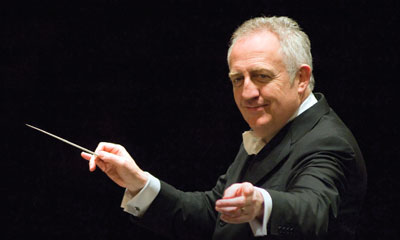
    Above: Bramwell Tovey

    Following the interval, an exciting performance of Mussorgsky’s Pictures at an Exposition (in the Ravel orchestration) again found the orchestra on peak form. Opening with a brass chorale Promenade, which recurs with variations during the first seven movements, the suite conjures up visions of the works of Viktor Hartmann. Upon Hartmann’s death in 1874 at the young age of 39, an exhibition of his work was mounted at St. Petersburg. Mussorgsky visited the exhibit and was inspired by what he saw to write a set of miniatures for piano. In 1922, Maurice Ravel orchestrated the pieces.

    A huge orchestra is in play, including five percussionists, two harps, and celesta. The ponderous Gnome, the child-like and playful Tuileries, the plodding Ox-Cart, the mini-scherzo of the Ballet of Unhatched Chicks, the bustling Marketplace at Limoges, the Roman Catacombs (deep brass), and the fanciful Hut of Baba-Yaga are all evoked in coloristic settings which the Philharmonic players delivered with evident affection.

    The movement which most impressed me was Il Vecchio Castello (The Old Castle) in which flutes, oboe, and bassoon were joined by the mellow, distinctive voice of the alto saxophone. This music was so evocative that I got lost in it. 

    The suite ends on a grand note with The Great Gate of Kiev. Sumptuously played, it brought a year full of music to an imperial finish.

    ~ Oberon

  • SALOME @ The Met

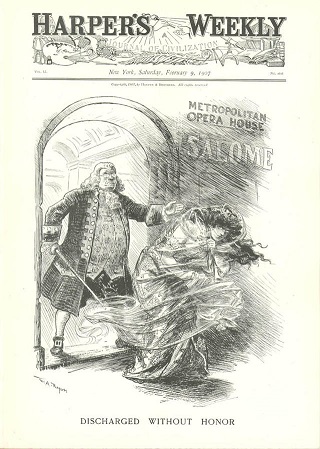
    Salome1

    “You know, there are three kinds of Salomes: those who can sing it, those who can dance it, and those who should be shot!” ~ Leonie Rysanek

    Wednesday December 28th, 2016 – My friend Dmitry and I had really been looking forward to seeing SALOME at The Met this season; it’s among our favorite scores. I bought tickets in advance for two performances, since I wanted to hear both Željko Lučić and Greer Grimsley as Jochanaan.

    Then came the news that the scheduled Salome, Catherine Naglestad, had withdrawn from the title-role, and was to be replaced by Patricia Racette. Racette used to be a particular favorite of mine, going back to her performances as Emmeline in Tobias Picker’s opera at NYCO. She was a marvelous Met Mimi, Violetta, and Ellen Orford, and I very much enjoyed her Elisabetta in DON CARLO. But as the seasons have passed, the wear-and-tear has really begun to show in Racette’s singing. Still, as recently as 2013, she gave a striking performance in Dallapiccola’s IL PRIGIONIERO with The New York Philharmonic.

    Since then, anything I have heard from her has sounded sadly worn and unpleasant. I suppose there’s something honorable about “the sword wearing out the sheath” in the service of art, but after a while the artistry and dedication no longer compensate for the sound being produced.

    I don’t want to dwell on the negative, but much of Racette’s singing was really off-putting. In the lower-to-middle-range passages, she was often covered by the orchestra. The heavy usage the soprano has subjected her voice to really shows in this music: the vibrato has spread so that in the upper range there’s no core to a sustained note; the louder the note, the wider the fluctuation.

    Salome is supposedly a teenager, but Strauss wrote the part in a way that only a mature and experienced soprano can cope with it. Thus the Dance of the Seven Veils must be handled with kid gloves; soprano and choreographer have to find ways for a woman of a certain age who is capable of singing the role to be reasonably credible in the dance-moves. For this famous scene, Racette chose an unflattering get-up: a sort of tuxedo affair with hot pants and a top hat. The choreography was duly carried out by the soprano and two men, but it was about as provocative as an after-dinner mint (to quote from the film CABARET). As the dance ended, Dmitry and I quietly left the theater.

    To briefly note the evening’s positive elements: Greer Grimsley was a powerful Jochanaan – though the amplification of his voice from the cistern was unflattering – and Gerhard Siegel was pretty much perfect as Herod. Excellent singing and portrayals from Nancy Fabiola Herrera as Herodias (great high notes!) and Kang Wang, who was vocally clear and thrilling as Narraboth. I loved seeing John Hancock onstage again, and there was fine work from Carolyn Sproule, Kathryn Day, Nicholas Brownlee, Richard Bernstein (ever the impressive stage figure, as when he kept the prophet on a long leash), Mikhail Petrenko, and Paul Corona. Allan Glassman led a strong quintet of Jews who were well-differentiated as personalities and just as annoying as one imagines Strauss intended them to be.

    The orchestra played superbly, and conductor Johannes Debus did well to highlight the myriad hues of the opera’s marvelous orchestration. Debus did not, however, always maintain an ideal union between pit and stage, sometimes drowning out the singers.

    Neither Dmitry nor I could recall the fanciful fore-curtain of angels, but perhaps we’ve suppressed the memory of it. The audience seemed pretty much captivated by the whole performance, though the woman seated in the adjoining box giggled and commented aloud during the dance. 

    Over the years and through repeated hearing, I’ve found that my favorite passage of SALOME is Jochanaan’s admonition to Salome to seek Christ at the Sea of Galilee. Tonight, Mr. Grimsley and concertmaster David Chan rendered this moment so beautifully; I suppose it’s odd that an atheist should be moved by this affirmation of faith, but to be honest, I often find expressions of deep and simple belief to be truly touching.

    Metropolitan Opera House
    December 28th, 2016

    SALOME
    Richard Strauss
    Salome..................Patricia Racette
    Herod...................Gerhard Siegel
    Herodias................Nancy Fabiola Herrera
    Jochanaan...............Greer Grimsley
    Narraboth...............Kang Wang
    Page....................Carolyn Sproule
    Jew.....................Allan Glassman
    Jew.....................Mark Schowalter
    Jew.....................Noah Baetge
    Jew.....................Alex Richardson
    Jew.....................David Crawford
    Nazarene................Mikhail Petrenko
    Nazarene................Paul Corona
    Soldier.................Nicholas Brownlee
    Soldier.................Richard Bernstein
    Cappadocian.............John Hancock
    Slave...................Kathryn Day
    Executioner.............Reginald Braithwaite

    Conductor...............Johannes Debus

  • Joshua Bell’s Mendelssohn @ The NY Phil

    Josh-bell-violin

    Wednesday December 30th, 2015 – Joshua Bell (above) played Mendelssohn’s violin concerto with The New York Philharmonic tonight on a program that was otherwise an all-Sibelius affair, in celebration of the Finnish composer’s 150th birthday.

    Sibelius’s The Swan of Tuonela, which opened the evening, was originally to have been included in an opera the composer was working on. It later became one of the Four Legendsthe best-known of the four and often played as a stand-alone work.  Tuonela, the realm of the dead in Finnish mythology, is surrounded by a dark-water moat on which the swan of Tuonela floats majestically, singing.

    This is music of somber gorgeousness. Sibelius structures the work on a cushioning of strings; Carter Brey’s mournful cello theme sets the tone. An evocative English horn passage (played, I believe, by Robert Botti – though we didn’t catch sight of him) leads to a brief brightening of mood. But the swan glides back into the gloom and her voice fades away to a mysterious heartbeat. At the composer’s wish, The Swan of Tuonela was performed at his own funeral.

    Alan Gilbert spoke to us before commencing the Sibelius Symphony No. 4. He seemed to veer from personal enthusiasm for the piece to apologizing for its depressing qualities. The symphony was written while the composer was dealing with problems stemming from alcoholism. This probably accounts for the work’s disjointed qualities.

    Forward-looking harmonically, the 4th does not sound like most of the other music that has given Sibelius lasting popularity over the years. Carter Brey again had a leading theme – played with striking lyricism – in the first movement. Later, as the ensuing movements unfold, the oboe, clarinet, and flute will all have their moments to shine forth. Maestro Gilbert referred to the second movement as a Scherzo, but if it’s a joke it stems from a very dark sense of humour; oddly, it includes a brief gavotte motif for flute duo…charming, but it goes un-developed. The big, deep theme of the Adagio comes closest to what we could think of as Sibelian. The agitated opening of the final Allegro – which includes the unexpected introduction of the glockenspiel – does not resolve in a positive way.

    Overall, the Sibelius 4th seemed an odd inclusion on a holiday-season program. Interestingly, it had not been played by the Philharmonic for nearly 30 years. Tonight’s audience reacted with a mixture of admiration for the playing and uncertainty as to whether they really liked the piece or not.

    Following the interval, Joshua Bell appeared for the Mendelssohn violin concerto. This was the composer’s last completed orchestral work: within three years of its premiere in 1845, he had died at the age of 38 following a series of strokes.

    Mendelssohn’s violin concerto is innovative in that its three movements are played without pause, preventing mood-breaking applause. Eschewing gratuitous technical flourishes, the composer instead goes in for heartfelt melody. There are brilliant and demanding passages to be sure, but they are more conscientiously woven into the musical fabric than tacked on to display the violinist’s deftness. 

    The concerto in fact seemed like a conversation between soloist and orchestra and, in the course of playing it, Mr. Bell often turned towards the musicians to keep the dialogue flowing in both directions. It goes without saying that the orchestra played superbly, and that Maestro Gilbert was in his particular element here – especially in the Adagio, where he and Mr. Bell communed in an almost balletic pas de deux.

    Throughout, in fact, the black-clad violinist wove, bent, and swayed in a dance that had just a trace of the satanic about it as he drew the music from his 1713 Stradivarius. Right from the start – in that lovely and rather restless opening theme – Mr. Bell assured us we were in the presence of a musician of matchless technique, inspired artistry, and deep commitment. His capacity for subtle nuance was spine-tingling, and the satiny lustre of his sustained playing in the Adagio was – in a word – magical.

    Among the many felicities in this performance, I particularly liked Maestro Gilbert’s up-sweep of tempo as the first movement neared its conclusion, and some dashing attacks from Mr. Bell in the finale. It was a performance to treasure, and the audience could not suppress their enthusiasm: the applause erupted a split second before the final note could fade away. Mr. Bell was called out three times, and could easily have served up an encore or two: I liked instead that he let the concerto stand as his year-end gift to us. Bravo! 

    Returning to Sibelius to end the evening, Maestro Gilbert and the Philharmonic gave us a soul-stirring rendering of the composer’s Finlandia: a sure-fire crowd-pleaser, performed with resonant grandeur.

  • HANSEL & GRETEL at The Met

    KLsideshot

    Wednesday December 21, 2011 – The presence of a number of intriguing names in the cast (led by Kate Lindsey, above, as Hansel) drew me back to the Met’s dark and not very pleasing production of HANSEL & GRETEL which is playing during the holiday season. It’s a far cry from the Met’s older production with its fanciful gingerbread house and jolly, green-tongued witch, Rosina Daintymouth. In the current incarnation the characterizations of both the witch and the parents are based on infamous British serial killers. There’s little magic to be found visually…

    Met_Opera_Hansel_Gretel_31_medium

    …though a couple of nice images crop up here and there, like the phalanx of chefs (above) who serve a feast to the starving children. But for the most part the production is earthbound and lacking in fantasy.

    What drew us to see it again – in addition to the singers – was the music itself (Humperdinck greatly admired Wagner), as well as a conductor new to the Met podium: Robin Tacciati . He provided appealing orchestral textures all evening and his interpretation brimmed over with emotionally satisfying colours. Unfortunately, his first act seemed rushed and he often let the large orchestra overwhelm the voices.

    HanselGretel1112.06

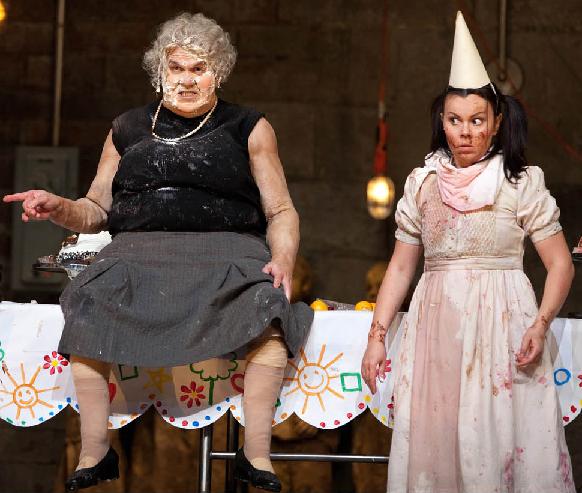
    As the two children, Alexandra Kurzak and Kate Lindsey (above) entered fully into the demanding staging of the work which calls for lots of physicality, dancing and mime…and getting plastered from head to toe with foodstuffs from the witch’s kitchen. Kate was virtually slathered in pudding and jam, then plentifully dusted with cocoa and powdered sugar. Alexandra staggered around the set with a huge platter of melting chocolate cookies and a bowl of custard. She continues to sing while stuffing various sweets into her mouth. Sticky fingers? Who needs Mick Jagger? 

    Despite all the things they are called on to do and eat, both Alexandra and Kate managed to sing very well into the bargain. Alexandra’s voice has girlish, lyrical appeal and even though the orchestral volume forced her to push the voice in a couple of spots, her Gretel was very prettily sung, especially in her exquisite vocalizing of the famous prayer. Kate has one of the truly distinctive voices in the opera business these days and her singing is impeccably tailored, warm and clear. As hansel, she is a truly convincing boy onstage, expanding her repertory of trouser roles: her Cherubino and Nicklausse were perfect, her Siebel’s coming up, and I’m longing for her Octavian. But she shouldn’t spend her whole life in pants, she’s far too pretty: so I hope we will have her Rosina and Dorabella soon, and I’d love to see her as Berlioz’s Beatrice.

    HanselGretel1112.09

    Robert Brubaker, a teriffic Mime in SIEGFRIED at the Met a couple of seasons back, was a huge-voiced and creepy Witch. It’s so eerie to hear his voluminous character-tenor sound emanating from the frumpy old biddy in a fat-suit. Robert was superb and, like Kate and Alexandra, simply threw himself into the production’s food fantasy. Photo above: Robert Brubaker and Alexandra Kurzak.

    HanselGretel1112.02

    As the parents Peter and Gertrude, Dwayne Croft and Michaela Martens (above) excelled. They have authentic Met-size voices and took the waves of sound coming up from the pit in their stride. I’ve always loved Dwayne Croft’s voice since I first heard him as Puccini’s Marcello at Glimmerglass many moons ago. He sounded fabulous tonight. Dmitry and I are very fond of Ms. Martens and she sang with power and attractive tone as the desperate mother. If the Met management had any imagination, Michaela would be doing roles like Fricka, Venus, Brangaene and the Berlioz Cassandra here. I could even imagine her as a very fine Sieglinde.
    HanselGretel1112.07

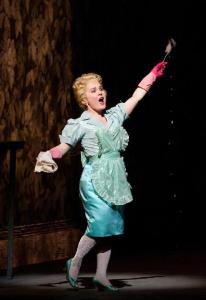
    Ashley Emerson (above) was a delicious Dew Fairy, a petite elfin maiden with tiny Sylphide wings. Her singing was bright and light-filled, a perfect wake-up call. She carries on a tradition – both in-house and on recordings – of casting wonderful singers in the opera’s two cameo solo roles. Her evening counter-part was the Sandman of Jennifer Johnson Cano who sang very nicely indeed.

    The musical pleasures of the evening were offset by the overall drabness of the production. There were lots of empty seats throughout The Met so word must have gotten out that this is not a festive holiday treat with an underlying moral message but rather a grotesque take on a story and score which should be heart-warming but instead leaves us slightly nauseous.

    A major failure of stagecraft comes hear the end when the many children who had been under the witch’s spell are set free. The director apparently couldn’t think of any better way to handle this than to lower the curtain on an empty set and then bring it up again 30 seconds later on a stage filled with two dozen urchins. Then the uplifting melodic benediction launched by Peter as the work comes to an end failed to resonate because there was no context of religiosity anywhere else in the production.

    Act I takes place in a desolate kitchen where Hansel and Gretel seem like manic-depressives and where Gertrude is on the verge of committing suicide. The scene in the forest is instead set in a large empty hall with green-leaf wallpaper. It’s too dim, and nothing seems to be happening til the old Sandman and  – later – the chefs arrive. The witch’s kitchen is drably industrial and she is played like an over-the-top drag version of Julia Child, flingling flour and powdered chocolate all over the place. Candy, pudding and strawberry preserves are smeared on Hansel and Gretel, and Hansel is trussed up for roasting. The scene is vulgar and not funny in the least though it is broadly played. 

    The English translation is very Brit-oriented and, thanks largely to the over-enthusiastic conducting, much of it didn’t register. I’d like to see the Met dump this production and give us a more attractive, kid-friendly look at this opera. It should cast a Christmastime spell of hope and familial love; instead it only reminds us of the American knack for wasting food while children right here in Gotham don’t have enough to eat.

    Production photos: Mary Sohl/Metropolitan Opera.

    Metropolitan Opera House
    December 21, 2011
    In English

    HANSEL UND GRETEL
    Humperdinck

    Hansel..................Kate Lindsey
    Gretel..................Aleksandra Kurzak
    Gertrud.................Michaela Martens
    Peter...................Dwayne Croft
    Witch...................Robert Brubaker
    Sandman.................Jennifer Johnson Cano
    Dew Fairy...............Ashley Emerson

    Conductor...............Robin Ticciati

    The evening ended on a sweet note when I went backstage to see Kate and Ashley; I met both of them when they were in the Lindemann Young Artists Development Program at the Met and I’m very pleased to be following their successful careers. It was also nice to wish happy holidays to Michaela Martens and Dwayne Croft.
  • NYCB NUTCRACKER 2010 #5

    Leftover-candy-canes-by-SpacePotato

    Wednesday December 29, 2010 @ 2:00 PM – Today’s treat: candy canes!

    In the final week of New York City Ballet‘s annual NUTCRACKER season I decided to brave two matinee shows – knowing they’d be packed with tiny tots – in order to see some of my favorite dancers who have taken on new roles in this ballet this Winter. This afternoon I saw Lauren King as the Dewdrop and Vincent Paradiso as Drosselmeyer. Both of these dancers had made their debuts in these roles earlier in the month. Tomorrow I will see our newest Sugar Plum Fairy, Rebecca Krohn who just debuted in this role opposite Zachary Catazaro (another first-timer).

    In the week between Christmas and New Year attendance sometimes falls off a bit at the NYCB NUTCRACKER but today the House seemed pretty well packed. Aside from one terribly loud cellphone ringing, the audience was pretty well-behaved.

    154648_471502694933_504139933_5780163_6419669_n

    Vincent Paradiso’s Drosselmeyer (seen in a backstage photo, above) is dance-oriented in its movement and his characterization is detailed and fully-formed. It seems that, aside from some basic blocking, the NYCB Drosselmeyers can develop the character each in his own way. Vincent leaves off the arthritic old-man stuff; just having white hair doesn’t automatically make you a senior citizen: my hair was completely white by the time I was 30.  Vincent plays Drosselmeyer as a vigorous gentlemen, young and strong enough to lift Austin Laurent’s soldier doll and carry him back to his gift box after his solo. Using his arms and hands beautifully, Vincent’s is clearly a dance-based portrayal, and in fact he broke into a jig at one point and even added a touch of flamenco footwork. His rapport with the individual children and with the party guests was easy and natural. As the party was winding down, Vincent began sizing up the room and planning his magic spells for the upcoming scene where he will make everything grow. It’s good to see such a polished and well-thought-out portrayal – the latest in a long line of Drosselmeyers at NYCB that stretches back to Jerome Robbins and to Balanchine himself.

    The party scene seemed especially pleasant today, perhaps as an antidote to Ramtamsky’s unfortunate concept as presented in the new ABT version. Amanda Hankes as the graceful Frau Stahlbaum and Henry Seth as her spouse welcomed their guests elegantly and worked hard to keep their naughty son under control. Aside from Austin Laurent’s tall soldier, Sara Adams and Callie Bachman were sweet and charming as Harlequin and Columbine. In the snow scene I very much enjoyed watching Lauren Lovette while in the meantime trying to figure out who some of these new faces in the corps belong to.

    Teresa Reichlen’s Sugar Plum Fairy is so dreamy to watch: her beautiful floating-on-air quality in the solo is matched by the gentle radiance of her facial expressions. Her two big jetees just before she leaves the stage to the Spanish dancers were so remarkably stretched out and silky. In the pas de deux, Tess and her cavalier Ask LaCour use their height to exude a regal feeling; they moved securely thru all the many dangers that Mr. B has set in their path and reached a climax with an exciting balance from the ballerina.  If Tess was an opera singer instead of a ballet dancer, she would be one of the great lyric sopranos of all time. I’m looking forward to what the coming Winter repertory season might have in store for her.

    Mary Elizabeth Sell and Daniel Applebaum danced Spanish; Mary looks superb and – speaking of balances – she had one phenomenal one. She reminds me more and more of Alexandra Ansanelli, quite a high compliment in my book. She and Daniel were going great guns with some wonderfully spacious dancing; Daniel had to put a hand-down in the final pose but it really didn’t spoil the effect of their flavorful dancing.

    The long-limbed Gwyneth Muller danced Arabian with evocative fluidity of movement; when viewed from above the dancer in this piece casts a triple shadow. Giovanni Villalobos was a musical and technically precise Tea, and Adam Hendrickson spiced up his Candy Cane by increasing the speed of his hoop-leaps as he came down the center line. Later in the finale Adam added an extra jump thru the hoop as he made his exit. Erica Pereira’s Marzipan reminds us how difficult this solo is – and how easy she makes it look. Cameron Dieck’s Mother Ginger has become a more detailed characterization in the course of the season; I expect we’ll soon see Cameron as lead dancer in Spanish and eventually as the Sugar Plum cavalier. He’s too princely of a dancer to keep him in a hoopskirt for very long.   

    Copy of 15

    Kokyat photographed Lauren King (above) when she appeared in a Zalman Grinberg pas de deux (with Vincent Paradiso partnering her) at the Young Choreographers Showcase at MMAC earlier this year. This fetching young ballerina caught my eye right from her first appearances on this stage and it was simply a great pleasure to watch her Dewdrop today. She was wonderfully quicksilver in her movement and with a smile that so clearly shows her pleasure in being able to dance as she does. After seeing her in the Grinberg duet, I feel certain she will be dancing Sugar Plum – and several other major roles – very soon. Georgina Pazcoguin and Rebecca Krohn were the demi-flowers, both thoroughly lovely.  

    Although the Balanchine NUTCRACKER has had a bit of friendly competition this Winter from the new ABT/Ratmansky setting at BAM, today’s performance at New York City Ballet – coming at a point in time when the dancers, musicians and stage crew are probably suffering keenly from NUTZ-exhaustion – served as a reminder that this timelessly classy version with which Mr. B brought the Tchaikovsky score back to prominence is the one that will endure. Its old-world charm may seem dated to some people, but its perfect fusion of music and choreography makes it indispensable.

    From spotting the cat in the Stahlbaum’s window (who has been sitting there for a half-century) to that stunning moment at the end of the Sugar Plum Fairy pas de deux when the ballerina lets go of her partner’s hand in a sustained balance, the Balanchine NUTCRACKER continues to cast its spell, however often I see it.