Tag: Wednesday January

  • Orchestra of St. Luke’s ~ Bernstein’s ‘Kaddish’

    Samuel-pisar

    Above: Samuel Pisar

    ~ Author: Oberon

    Wednesday January 29th, 2025 – Carnegie Hall marked the 80th anniversary of the liberation of Auschwitz with a performance of Leonard Bernstein’s Symphony No. 3, “Kaddish.” A setting of ‘A Dialogue with God’ by the late Samuel Pisar – who had himself been a survivor of Auschwitz – was spoken tonight by Pisar’s wife, Judith Pisar, and their daughter Leah Pisar, with James Conlon leading the Orchestra of St. Luke’s. The Bard Festival Chorus, directed by James Bagwell, and the Brooklyn Youth Chorus, led by Dianne Berkun Menaker, made the choral passages an integral part of the evening’s performance.

    The reviews were quite harsh when the Boston Symphony Orchestra, conducted by Charles Munch, premiered this symphony on January 10, 1964; it is dedicated to the memory of President John F. Kennedy, who had been assassinated on November 22, 1963.

    Tonight was my first time hearing this work. In preparation, I read some articles and reviews of the piece; these seemed mostly to center on the narrative rather than on the musical setting. My idea was to focus on the music and let the narration flow, but that proved impossible: such is the power of Mr. Pisar’s writing.

    Former Secretary of State Antony Blinken, stepson of Samuel Pisar, made an eloquent introductory speech in which he drew a connection between the substance of Bernstein’s Kaddish and the current situation here in the USA. This of course was surely weighing on the minds of most everyone in the audience.

    Judith and Leah Pisar had taken their places next to the podium, and Maestro Conlon entered to a warm greeting. Most of my experiences with Mr. Conlon’s conducting have been at the Metropolitan Opera, where he debuted in 1976  and went on to preside over nearly 300 performances, the latest having been Shostakovich’s LADY MACBETH OF MTSENSK, more than ten years ago. I’d love to see him on the Met podium again.

    Low humming from the chorus opens the Kaddish, and then Judith Pisar, a petite woman, began to speak. Her voice is deep and profound as she talks of the Age of Anxiety, which seems to be having its second dawning. Leah Pisar’s speaking voice has a sense of passion and urgency which contrasted with Mme. Pisar’s more solemn tones.

    A high violin tone is sustained by concertmaster Krista Bennion Feeney until the xylophone sounds an alarm. A melancholy theme of unison celli turns anxious as the basses join. Following a resounding crash, the music gets wild and fast, with the crack of a horsewhip. The chorus’s rhythmic clapping gets a bit jazzy; their song is accented by the xylophone, and it moves to a big finish.

    Over quiet percussion and choral humming, Judith Pisar speaks long…and movingly; the essence of the work now becomes evident: where was god when these horrible things were happening to his people? What wrongs had they committed to merit such torment and anguish? Was god angry or simply indifferent?

    As questions are raised – “How did the Holocaust, the genocides, and the ethnic cleansings become acceptable?” – and as the spoken words become more haunting and horrifying, the actual music tends to feel less engrossing.

    But then, soprano Diana Newman’s high, sweet voice floats over an accompanying harp: clear and reassuring. The female choristers join, and the music turns grand, only to fade with the xylophone sounding. Ms. Newman resumes, supported by high, spun-out sounds of the violins. Angelic voices hum, whilst scurrying music underscores Leah Pisar’s speaking of “incendiary demagogues”.  

    The music turns delicate; Mme. Pisar speaks until a crescendo obliterates her voice; her daughter speaks of “chaos on Earth”. Aching celli and basses play deep and rich; the music swells with both choruses joining. Stabbing accents turn into an oddly merry passage for clarinet, flute, and bassoon. The Youth Chorus sings; the spoken description of “the warm embrace of democracy” seems ironic now.

    A postlude of strings and brass becomes a lament, with muted trumpet and oboe. The music hesitates; Leah Pisar speaks again, with Ms. Feeney’s violin as solo accompaniment. Now Mme. Pisar issues a plea for peace as horn and trumpet sound. There is a fast and jazzy chorus, which Ms. Newman joins. The finale feels a bit extended, but then a dramatic pause leads to a final Amen.

    Throughout the work, the eternal question hovers overall: why does god allow these things to happen? And why did he abandon the faithful in their hour of direst need? Another such test seems to loom before us now. Perhaps there are no gods, and we’re simply going to have to make it on our own.

    ~ Oberon

  • Omer Quartet | Hanzhi Wang @ YCA

    Hanzhi+Wang

    Above: Hanzhi Wang

    ~ Author: Oberon

    Wednesday January 29th, 2020 – For this concert in their noon-time series at The Morgan Library, Young Concert Artists brought together the Omer Quartet and accordionist Hanzhi Wang in a wide-ranging program.

    Ms. Wang opened the performance with three Scarlatti keyboard sonatas, K. 9, 146, and 159. These amply displayed Ms. Wang’s agile technique and rhythmic control. Her swift filigree passages were deftly dispatched, and the rich sound of the instrument’s lowest range added an earthy dimension; in fact, the music took on an appealing – almost folkish – quality at times. Woven into the accordionist’s exhilarating playing were some wonderful subtle touches. Very quickly, Ms. Wang had audience in the palm of her hand.

    Alfred Schnittke’s Revis Fairy Tale, dating from 1978, is a suite of dances which – truly – made me feel like dancing. In the first of four movements, Chichikov’s Childhood, the music is quite melodious and feels traditional; here Ms. Wang’s broad dynamic range came into play. The second movement, Officials, brought SWAN LAKE to mind…specifically, the ‘four cygnets’ motif. The music takes on a more ‘modern’ feel, with discordant passages of jazzy angularity cropping up. Waltz has a somber start, and the melody is low-lying. Later, one feels the waltzers might be drunk…or dotty. After a rise of passion, the music turns dour and ends with a downward slide. The concluding Polka was a lot of fun, with Ms. Wang breezing thru the composer’s demands and winning a burst of enthusiastic applause. 

    Moritz Moszkowski’s Etincelles figured in Ms. Wang’s 2018 concert at Zankel Hall, and I enjoyed encountering it again today. Full of almost giddy scales, and covering the accordion’s very wide range, the piece is a charming showpiece for Ms. Wang, with a witty ending.

    Omer Quartet

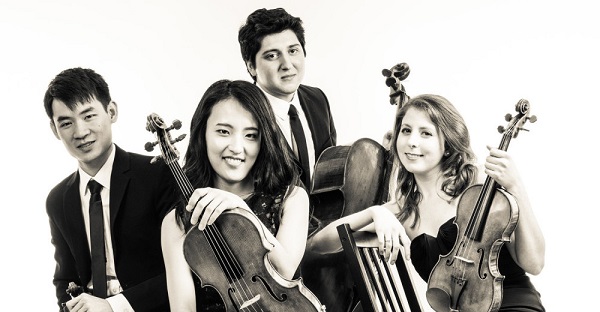
    Above, the Omer Quartet: Mason Yu (violin), Jinsun Hong (viola), Alex Cox (cello), and Erica Tursi (violin).

    The Omer Quartet then took the stage for a very impressive performance of Haydn’s String Quartet in G-minor, opus 20, #3. The opening movement, Allegro con spirito, is full of mood swings. Immediately, the congenial blend of voices these players have achieved together assures us we are in for a treat. First violinist Mason Yu is a master of dynamic subtlety, and he and his colleagues illuminated the music in a perfectly-paced performance, with hints of hesitations here and there an added delight.

    In the Minuetto, Mr. Yu brings sweetness of tone to the poignant violin melody whilst the other players weave harmonies tinged with sadness. In the more optimistic interlude, things cheer up a bit although minor-key twinges continue to intrude. A return to the opening mood carries the music forward, but then it seems to stop in mid-phrase.

    Already at such a high level, the Omer Quartet went beyond in the Adagio, creating a palpably poetic atmosphere with playing of searing beauty. Emerging from the movement’s chorale-like opening, cellist Alex Cox commences a moving line that flows among lovely harmonies. Mr. Yu’s high pianissimo passages waft on the air, and violist Jinsun Hong and violinist Erica Tursi have opportunities to shine. Throughout, the cellist’s glowing tone and expressive phrasing are captivating.

    The final Allegro molto is animated – even agitated – veering between major and minor, with infinitesimal hesitancies along the way. The cumulative effect of the Omer’s Haydn this afternoon was both musically engrossing and emotionally gratifying. 

    Young Concert Artists composer Katherine Balch then introduced her work for string quartet, With each breathing, which she said was inspired by the notion of expressing aspects of the act of breathing in musical terms. The work’s title seemed somewhat ironic, but in fact the composer succeeded in her intent with music ranging from sighs and whispers to more labored and dramatic effects. The work’s exploration of textures was ideally set forth by the musicians of the Omer Quartet: a composer could not ask for better advocates.

    For the afternoon’s finale, excerpts from Five Tango Sensations by Astor Piazzolla brought together Ms. Wang and the Omer Quartet; this music had figured prominently in the accordionist’s 2018 Zankel Hall concert. With an intrinsic feel for both the allure and the danger that threads thru these tangos, the five musicians brought rich, haunting colours and irresistible rhythmic sway to the music.

    This highly enjoyable concert ended with the artists receiving a very warm ovation. The hall’s size and acoustic make it ideal for chamber music. And was that Anne-Marie McDermott seated a couple of rows in front of us?

    The performance was live-streamed, and may be seen here.

    ~ Oberon

  • Gatti/Royal Concertgebouw: Wagner & Bruckner

    Daniele Gatti

    Above: conductor Daniele Gatti

    Author: Oberon

    Wednesday January 17th, 2018 – This long-awaited Carnegie Hall concert by the Royal Concertgebouw under the baton of Daniele Gatti paired two of my favorite composers – Wagner and Bruckner – and my expectations for the performance were very high indeed. Wagner-starved as my friend Dmitry and I have been in recent seasons, hearing the Prelude to Act III and Good Friday Spell from PARSIFAL was alone reason to anticipate this concert for months in advance. That Bruckner’s 9th Symphony would complete the program gave reason to feel this was destined to be a thrilling evening. Both works were played magnificently by this great orchestra, and Maestro Gatti again upheld our esteem for him as one of the greatest conductors of our time.

    But in practice – as opposed to in theory – I felt, as the evening progressed, that putting these two masterpieces on the same program didn’t work out nearly as well as I’d expected. About midway thru the Bruckner, I felt my interest waning. In attempting to reason it out, I came to this conclusion: Wagner is a great composer, and Bruckner is a very good one. This certainly does not mean that Bruckner’s music isn’t wonderful, and meaningful. But there’s a depth of feeling in Wagner’s writing that – for me – eludes Bruckner.   

    Wagner’s two ‘Grail’ operas – one about the father (PARSIFAL) and the other about the son (LOHENGRIN) – both contain music of other-worldly beauty. The composer wrote: “It is reserved for Art to save the spirit of religion.” [“Religion and Art” (1880)]. In these two operas, Wagner’s music expresses the inexpressible in ways that make non-believers like myself wonder if we’ve got it right…or not.

    Maestro Gatti’s gift for evoking mythic times and places (his Metropolitan Opera AIDAs in 2009 were fascinating in this regard) meant that the music from PARSIFAL performed tonight was truly transportive. As with his Met performances of the Wagner opera in 2013, Gatti’s pacing seemed ideal. The gorgeously integrated sound of the Concertgebouw, with its velvety-resonant basses, leads us to Monsalvat, where – with Parsifal’s return – the long Winter gives way to Spring. For a blessèd time, we are far from the dismal present, watching the flowers bloom is that legendary realm, as Kundry weeps. Poetry without words.  

    Bruckner’s unfinished 9th symphony impressed me deeply when I first heard it performed live in 2014, and I expected the same reaction tonight. For much of the first movement, I was thoroughly engaged and experiencing the tingles of appreciation that Bruckner’s music usually produces. I confess that I like the ‘purple’ parts of Bruckner’s music best, and perhaps my eventual zone-out began with the Scherzo.

    In the Adagio, I grew restless; the repetitions became tiresome. A few people got up and left, and others had fallen asleep. I continued to attempt to re-engage with the superb playing and Maestro Gatti’s interpretation, but honestly I could not wait for the symphony to end; and I made a mental note to skip an upcoming performance of it.

    The irony of tonight’s situation struck me as I was pondering the experience on the train going home. How is it that Wagner, a non-believer, is able to put us in touch with the divine whereas the pious Bruckner, a devout Catholic who dedicated the 9th symphony “To God”, seems only to be knocking on heaven’s door?

    Now, more than ever, I look forward to the upcoming PARSIFAL performances at The Met.

    ~ Oberon

  • Gatti/Royal Concertgebouw: Wagner & Bruckner

    Daniele Gatti

    Above: conductor Daniele Gatti

    Author: Oberon

    Wednesday January 17th, 2018 – This long-awaited Carnegie Hall concert by the Royal Concertgebouw under the baton of Daniele Gatti paired two of my favorite composers – Wagner and Bruckner – and my expectations for the performance were very high indeed. Wagner-starved as my friend Dmitry and I have been in recent seasons, hearing the Prelude to Act III and Good Friday Spell from PARSIFAL was alone reason to anticipate this concert for months in advance. That Bruckner’s 9th Symphony would complete the program gave reason to feel this was destined to be a thrilling evening. Both works were played magnificently by this great orchestra, and Maestro Gatti again upheld our esteem for him as one of the greatest conductors of our time.

    But in practice – as opposed to in theory – I felt, as the evening progressed, that putting these two masterpieces on the same program didn’t work out nearly as well as I’d expected. About midway thru the Bruckner, I felt my interest waning. In attempting to reason it out, I came to this conclusion: Wagner is a great composer, and Bruckner is a very good one. This certainly does not mean that Bruckner’s music isn’t wonderful, and meaningful. But there’s a depth of feeling in Wagner’s writing that – for me – eludes Bruckner.   

    Wagner’s two ‘Grail’ operas – one about the father (PARSIFAL) and the other about the son (LOHENGRIN) – both contain music of other-worldly beauty. The composer wrote: “It is reserved for Art to save the spirit of religion.” [“Religion and Art” (1880)]. In these two operas, Wagner’s music expresses the inexpressible in ways that make non-believers like myself wonder if we’ve got it right…or not.

    Maestro Gatti’s gift for evoking mythic times and places (his Metropolitan Opera AIDAs in 2009 were fascinating in this regard) meant that the music from PARSIFAL performed tonight was truly transportive. As with his Met performances of the Wagner opera in 2013, Gatti’s pacing seemed ideal. The gorgeously integrated sound of the Concertgebouw, with its velvety-resonant basses, leads us to Monsalvat, where – with Parsifal’s return – the long Winter gives way to Spring. For a blessèd time, we are far from the dismal present, watching the flowers bloom is that legendary realm, as Kundry weeps. Poetry without words.  

    Bruckner’s unfinished 9th symphony impressed me deeply when I first heard it performed live in 2014, and I expected the same reaction tonight. For much of the first movement, I was thoroughly engaged and experiencing the tingles of appreciation that Bruckner’s music usually produces. I confess that I like the ‘purple’ parts of Bruckner’s music best, and perhaps my eventual zone-out began with the Scherzo.

    In the Adagio, I grew restless; the repetitions became tiresome. A few people got up and left, and others had fallen asleep. I continued to attempt to re-engage with the superb playing and Maestro Gatti’s interpretation, but honestly I could not wait for the symphony to end; and I made a mental note to skip an upcoming performance of it.

    The irony of tonight’s situation struck me as I was pondering the experience on the train going home. How is it that Wagner, a non-believer, is able to put us in touch with the divine whereas the pious Bruckner, a devout Catholic who dedicated the 9th symphony “To God”, seems only to be knocking on heaven’s door?

    Now, more than ever, I look forward to the upcoming PARSIFAL performances at The Met.

    ~ Oberon

  • Back at the Ballet

    6a00d8341c4e3853ef015435034561970c-800wi

    Wednesday January 25th, 2017 – I haven’t been to a New York City Ballet performance since Jennie Somogyi’s farewell in 2015, but I keep running into the dancers and am constantly reminded of how much I miss watching them dance. A few weeks ago, on a whim, I ordered a ticket for tonight’s all-Balanchine program, before casting was announced. A domestic surprise – a nice one – called me home early: I missed FOUR TEMPERAMENTS tonight. But I greatly enjoyed seeing ALLEGRO BRILLANTE and the Balanchine SWAN LAKE again. 

    On entering the theater lobby, I was very happy to see that The Lyre has been restored to a place of honor. Once seated, I watched the musicians warming up while the theater filled slowly. I was not feeling the old sense of anticipation, and I was not sure if my idea of re-connecting with NYCB was making sense: perhaps it’s a chapter best left closed? 

    But then the house lights went down; pianist Susan Walters and conductor Andrew Litton entered the pit for ALLEGRO BRILLANTE and suddenly it felt right to be there. This was my first experience of having Andrew Litton on the podium; the orchestra – apart from a random note or two going astray in SWAN LAKE – played the big Tchaikovsky themes sumptuously. Ms. Walters did a beautiful job with ALLEGRO BRILLANTE; and later in the evening, concertmaster Arturo Delmoni played a ravishing White Swan solo. 

    Tiler Peck was originally listed for ALLEGRO BRILLANTE, but a pre-curtain announcement informed us that Megan Fairchild would be dancing instead. I was pleased with this announcement, as I’d become quite an admirer of Ms. Fairchild over time; I was curious to see how the Fairchild/Veyette partnership would work under the circumstances, but they are both professionals and carried it off in fine style. Megan’s dancing had a lovely lyrical feeling, and I began to realize how very much I have missed her dancing over the past several months.

    When the swans made their entry in the Balanchine SWAN LAKE, it really sank in just how long I’d been away: hardly a familiar ballerina in sight. There was a time when I knew every single person in the Company and could scan a large group of corps dancers with my opera glasses and see one friendly face after another. Tonight the girls seemed beautifully anonymous; I wonder who among them might captivate me as Rebecca Krohn and Ashley Laracey had once done, right from their first performances with the Company?

    The soloists, Megan LeCrone and Lauren King, both danced very well. Teresa Reichlen and Russell Janzen created a true sense of poetry and ill-fated romance in their partnership. Russell looks the epitome of a romantic hero: his sense of wonder at finding this fragile creature by the lake, and his desire to protect and cherish her were beautifully expressed. Tess was an elegant Swan Queen, terrified at first and only slowly surrendering to the calming effects of Russell’s care. The two long-limbed dancers make a striking couple, and their ardent tenderness mirrored the music ideally. They were rapturously applauded, and called out for an extra bow.

    In ALLEGRO BRILLANTE, I was particularly impressed by the dancing of the supporting ensemble of eight dancers; Balanchine gives them plenty to do, and they all looked superb. These are dancers I followed closely back in my days as an NYCB regular, and it was really good to see them all again, looking so attractive and dancing with such assurance and grace: Megan Johnson, Meagan Mann, Gretchen Smith, Lydia Wellington, Devin Alberda, Daniel Applebaum, Cameron Dieck, and Aaron Sanz. Watching them, I was keenly aware of what I’ve been missing.

  • Back at the Ballet

    6a00d8341c4e3853ef015435034561970c-800wi

    Wednesday January 25th, 2017 – I haven’t been to a New York City Ballet performance since Jennie Somogyi’s farewell in 2015, but I keep running into the dancers and am constantly reminded of how much I miss watching them dance. A few weeks ago, on a whim, I ordered a ticket for tonight’s all-Balanchine program, before casting was announced. A domestic surprise – a nice one – called me home early: I missed FOUR TEMPERAMENTS tonight. But I greatly enjoyed seeing ALLEGRO BRILLANTE and the Balanchine SWAN LAKE again. 

    On entering the theater lobby, I was very happy to see that The Lyre has been restored to a place of honor. Once seated, I watched the musicians warming up while the theater filled slowly. I was not feeling the old sense of anticipation, and I was not sure if my idea of re-connecting with NYCB was making sense: perhaps it’s a chapter best left closed? 

    But then the house lights went down; pianist Susan Walters and conductor Andrew Litton entered the pit for ALLEGRO BRILLANTE and suddenly it felt right to be there. This was my first experience of having Andrew Litton on the podium; the orchestra – apart from a random note or two going astray in SWAN LAKE – played the big Tchaikovsky themes sumptuously. Ms. Walters did a beautiful job with ALLEGRO BRILLANTE; and later in the evening, concertmaster Arturo Delmoni played a ravishing White Swan solo. 

    Tiler Peck was originally listed for ALLEGRO BRILLANTE, but a pre-curtain announcement informed us that Megan Fairchild would be dancing instead. I was pleased with this announcement, as I’d become quite an admirer of Ms. Fairchild over time; I was curious to see how the Fairchild/Veyette partnership would work under the circumstances, but they are both professionals and carried it off in fine style. Megan’s dancing had a lovely lyrical feeling, and I began to realize how very much I have missed her dancing over the past several months.

    When the swans made their entry in the Balanchine SWAN LAKE, it really sank in just how long I’d been away: hardly a familiar ballerina in sight. There was a time when I knew every single person in the Company and could scan a large group of corps dancers with my opera glasses and see one friendly face after another. Tonight the girls seemed beautifully anonymous; I wonder who among them might captivate me as Rebecca Krohn and Ashley Laracey had once done, right from their first performances with the Company?

    The soloists, Megan LeCrone and Lauren King, both danced very well. Teresa Reichlen and Russell Janzen created a true sense of poetry and ill-fated romance in their partnership. Russell looks the epitome of a romantic hero: his sense of wonder at finding this fragile creature by the lake, and his desire to protect and cherish her were beautifully expressed. Tess was an elegant Swan Queen, terrified at first and only slowly surrendering to the calming effects of Russell’s care. The two long-limbed dancers make a striking couple, and their ardent tenderness mirrored the music ideally. They were rapturously applauded, and called out for an extra bow.

    In ALLEGRO BRILLANTE, I was particularly impressed by the dancing of the supporting ensemble of eight dancers; Balanchine gives them plenty to do, and they all looked superb. These are dancers I followed closely back in my days as an NYCB regular, and it was really good to see them all again, looking so attractive and dancing with such assurance and grace: Megan Johnson, Meagan Mann, Gretchen Smith, Lydia Wellington, Devin Alberda, Daniel Applebaum, Cameron Dieck, and Aaron Sanz. Watching them, I was keenly aware of what I’ve been missing.

  • Beethoven & Bruckner @ The NY Phil

    JamesEhnes_Filter630x310

    Above: James Ehnes, violinist, performing with The New York Philharmonic tonight

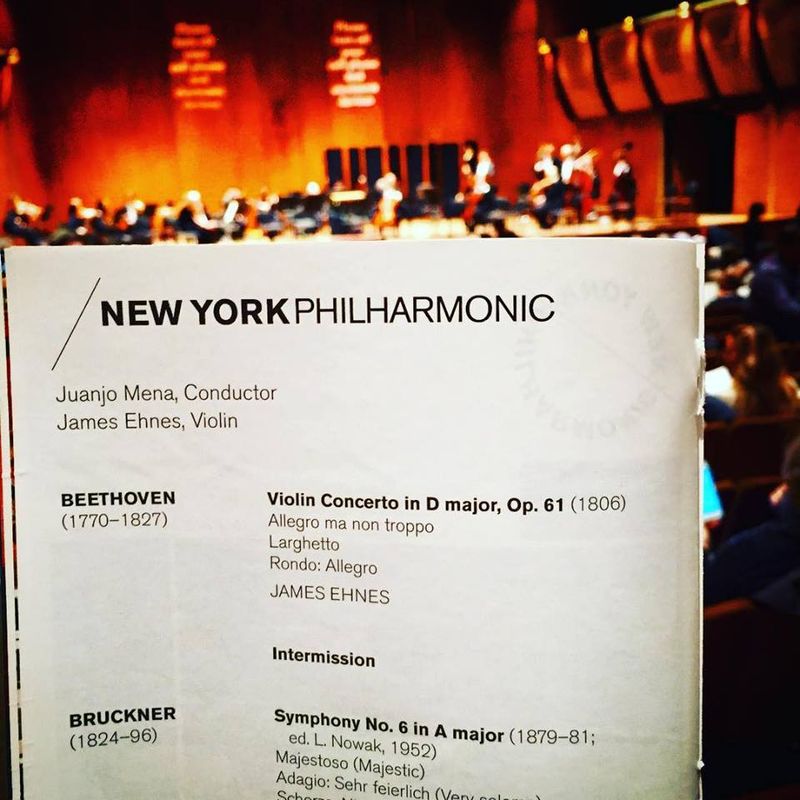
    Wednesday January 27th, 2016 – The New York Philharmonic playing masterworks by Beethoven and Bruckner under Juanjo Mena’s baton, with James Ehnes the featured soloist. 

    The Philharmonic’s been the talk of the town this week with the announcement of the appointment of Jaap van Zweden as the orchestra’s next music director; read more about the good news here.

    Tonight, Mr. Ehnes played the Beethoven violin concerto with silken tone and technical aplomb, evoking an atmosphere of hushed attentiveness in the hall and finishing to a prolonged ovation with a triple “curtain call” and with the artists of the Philharmonic joining in the applause. The tall violinist is as congenial to watch as to hear, and he and Maestro Mena formed an elegant musical affinity as the concerto progressed, sharing a warm embrace at the end.

    Beethoven’s violin concerto was written and first performed in 1806 and – after it’s premiere performance by Franz Clement, the 26-year-old principal violinist and conductor at the Theater an der Wien in Vienna – it took years for the concerto to catch on. That first performance must have been something of a nightmare: Beethoven completed the work just two days before the premiere, and the surviving autograph score is a mess of crossings-out, over-writings, and alternative ‘versions’. The soloist, having had no time to learn and rehearse the long and complex work, had to use the score for the premiere; for much of the time he was virtually sight-reading. One reviewer wrote: “Beethoven could put his undoubtedly great talents to better uses”.

    Prior to publishing the work, Beethoven modified and clarified it following the 1806 premiere. The concerto finally began to work its way into the standard repertoire after a highly-praised performance in London in 1844, conducted by Felix Mendelssohn and played by the 12-year-old prodigy Joseph Joachim. It comes down to us as one of the greatest works of the violin concerto genre.

    James Ehnes gave a lovingly detailed performance; a series of high trills in the opening movement were dazzlingly clear, and his dynamic control throughout was simply exquisite. Maestro Mena sculpted the opening passages of the central Larghetto to perfection, the violinist then joining in with playing of sweetly sustained lyricism. The ‘Kreisler’ cadenzas were spun off with serene virtuosity. At every moment – whether playing fast or slow – Mr. Ehnes maintained an enchanting sheen on his tone. Thus the audience’s grateful show of the enthusiasm at the end was eminently deserved.

    J Mena

    Following the interval, Maestro Mena (above) and the Philharmonic musicians gave a thoroughly impressive performance of Bruckner’s 6th symphony. It’s always pleasing to have Sheryl Staples in the concertmaster’s chair, and to have Cynthia Phelps and Carter Brey leading their sections with such committed artistry. I often wish that the wind players could be seated on risers so we could better savour their individual performances: passages of wind chorale in the Bruckner were beautifully blended.

    The orchestra were at their finest in the compelling themes of the symphony’s Adagio. Both here and in the opening Majestoso, Maestro Mena was deeply involved in drawing forth the inner voices to give a full range of colour to each gorgeous passage. 

    In the third movement, a Scherzo, it seems to me that Bruckner’s imagination flags ever so slightly. The concluding movement – wonderfully played – felt over-long, almost as if the composer was unsure of how he wanted the piece to end. This ‘finale’ was not publicly performed until 1899, three years after Bruckner’s death; perhaps he would have tailored it more concisely if he’d been able to judge the effect in an actual concert performance. We’ll never know. Yet overall, the sonorous grandeur of the 6th makes a vivid impression.

    12573839_10153865541004761_6934836395217370131_n

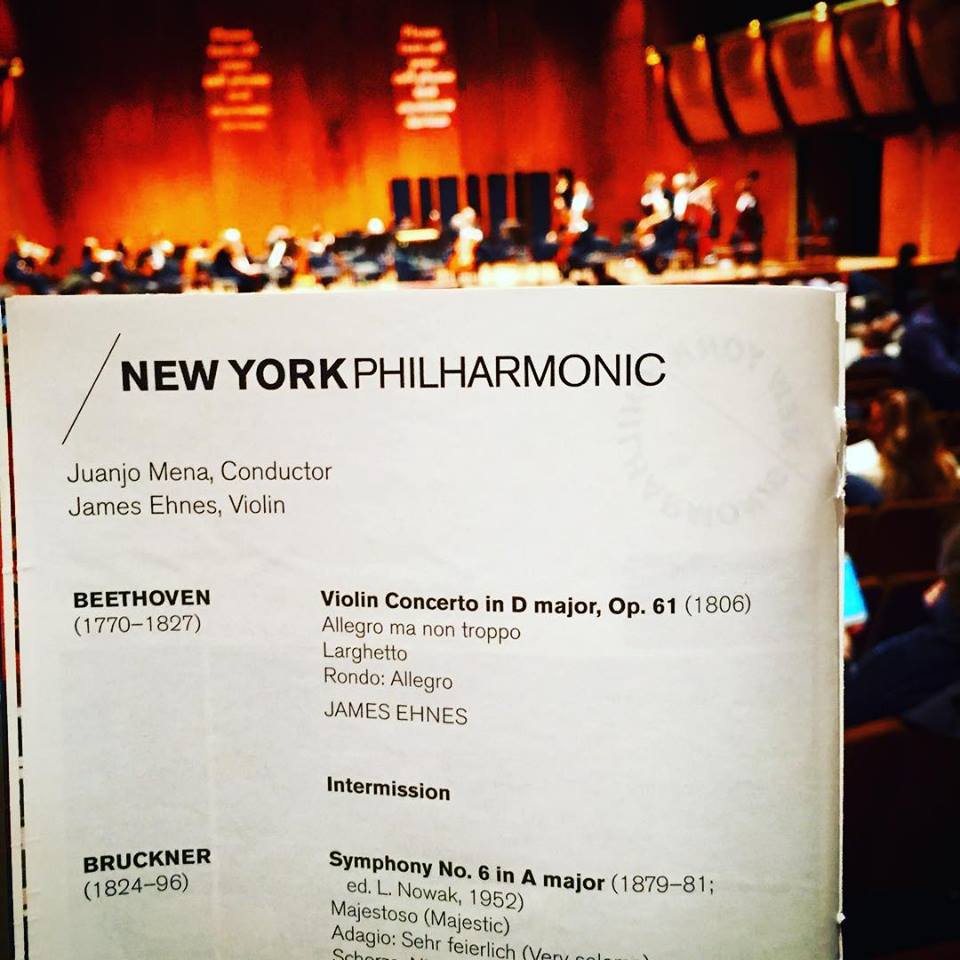
    Pre-concert photo by my friend Dmitry.

  • Beethoven & Bruckner @ The NY Phil

    JamesEhnes_Filter630x310

    Above: James Ehnes, violinist, performing with The New York Philharmonic tonight

    Wednesday January 27th, 2016 – The New York Philharmonic playing masterworks by Beethoven and Bruckner under Juanjo Mena’s baton, with James Ehnes the featured soloist. 

    The Philharmonic’s been the talk of the town this week with the announcement of the appointment of Jaap van Zweden as the orchestra’s next music director; read more about the good news here.

    Tonight, Mr. Ehnes played the Beethoven violin concerto with silken tone and technical aplomb, evoking an atmosphere of hushed attentiveness in the hall and finishing to a prolonged ovation with a triple “curtain call” and with the artists of the Philharmonic joining in the applause. The tall violinist is as congenial to watch as to hear, and he and Maestro Mena formed an elegant musical affinity as the concerto progressed, sharing a warm embrace at the end.

    Beethoven’s violin concerto was written and first performed in 1806 and – after it’s premiere performance by Franz Clement, the 26-year-old principal violinist and conductor at the Theater an der Wien in Vienna – it took years for the concerto to catch on. That first performance must have been something of a nightmare: Beethoven completed the work just two days before the premiere, and the surviving autograph score is a mess of crossings-out, over-writings, and alternative ‘versions’. The soloist, having had no time to learn and rehearse the long and complex work, had to use the score for the premiere; for much of the time he was virtually sight-reading. One reviewer wrote: “Beethoven could put his undoubtedly great talents to better uses”.

    Prior to publishing the work, Beethoven modified and clarified it following the 1806 premiere. The concerto finally began to work its way into the standard repertoire after a highly-praised performance in London in 1844, conducted by Felix Mendelssohn and played by the 12-year-old prodigy Joseph Joachim. It comes down to us as one of the greatest works of the violin concerto genre.

    James Ehnes gave a lovingly detailed performance; a series of high trills in the opening movement were dazzlingly clear, and his dynamic control throughout was simply exquisite. Maestro Mena sculpted the opening passages of the central Larghetto to perfection, the violinist then joining in with playing of sweetly sustained lyricism. The ‘Kreisler’ cadenzas were spun off with serene virtuosity. At every moment – whether playing fast or slow – Mr. Ehnes maintained an enchanting sheen on his tone. Thus the audience’s grateful show of the enthusiasm at the end was eminently deserved.

    J Mena

    Following the interval, Maestro Mena (above) and the Philharmonic musicians gave a thoroughly impressive performance of Bruckner’s 6th symphony. It’s always pleasing to have Sheryl Staples in the concertmaster’s chair, and to have Cynthia Phelps and Carter Brey leading their sections with such committed artistry. I often wish that the wind players could be seated on risers so we could better savour their individual performances: passages of wind chorale in the Bruckner were beautifully blended.

    The orchestra were at their finest in the compelling themes of the symphony’s Adagio. Both here and in the opening Majestoso, Maestro Mena was deeply involved in drawing forth the inner voices to give a full range of colour to each gorgeous passage. 

    In the third movement, a Scherzo, it seems to me that Bruckner’s imagination flags ever so slightly. The concluding movement – wonderfully played – felt over-long, almost as if the composer was unsure of how he wanted the piece to end. This ‘finale’ was not publicly performed until 1899, three years after Bruckner’s death; perhaps he would have tailored it more concisely if he’d been able to judge the effect in an actual concert performance. We’ll never know. Yet overall, the sonorous grandeur of the 6th makes a vivid impression.

    12573839_10153865541004761_6934836395217370131_n

    Pre-concert photo by my friend Dmitry.

  • New Works By Parsons and Skarpetowska

    10666241_1219331334748018_437366971_n

    Wednesday January 20th, 2016 – The opening night of the Parsons Dance 2016 season at The Joyce. New works by David Parsons and Katarzyna Skarpetowska were on offer, as well as Robert Battle’s TRAIN, a revival of David Parsons’ UNION, and two of David’s signature classics: NASCIMENTO and CAUGHT.

    It was a grand night for dancing; each of the six works presented offered ample opportunity for the vibrant Parsons Dancers to dazzle us with their strength, passion, and fearlessness. If it’s true that there’s no rest for the wicked, then these dancers must be very naughty indeed. They danced full-out, with nary a hint of pacing themselves, all evening. The vociferous screams (yes, screams) of delight from the packed house at the end of each piece said it all.

    David Parsons and I go way back, to his dancing days with Paul Taylor’s company and his earliest explorings of the choreographic terrain at Jacob’s Pillow. Read a bit about this history here.

    ParsonsDanceSarahBravermanElenadAmarioEoghanDillonOmarRomandeJesusandGeenaPacare-1

    Above: dancers of Parsons Dance in a © Lois Greenfield photo. (Check out Ms. Greenfield’s latest book, Moving Still, here). These six dancers – Ian Spring, Omar Roman de Jesus, Geena Pacareu (back row), Sarah Braverman, Eoghan Dillon, and Elena D’Amario (foreground trio) comprised the cast of tonight’s opening work: David’s newest creation, FINDING CENTER. Having its New York premiere this evening, the piece is inspired by a series of paintings created in the 1980s by artist Rita Blitt.

    FINDING CENTER is danced to a laid-back score by Thomas Newman. Throughout the work, Ms. Blitt’s oval-shaped images – in vivid, ever-changing colours – are projected behind the dancers. Howell Binkley, David Parsons’ long-time lighting collaborator, again proved his essential value to the on-going success of the Parsons repertory: his lighting is always perfect. 

    Among the many arresting choreographic elements in this new work are unusual lifts of the women in seated positions. An adagio for Elena D’Amario and Ian Spring finds Mr. Parsons’ gift for inventive partnering at full-flourish: not only are there some gorgeous lifts, but twice Ian suspends Elena in a floating plank position, her body parallel to the floor and only inches away from it. Mlles. Braverman and Pacareu, squired by Eoghan Dillon and Omar Roman de Jesus, turned what might otherwise be considered ensemble roles into beautifully expressive moments.

    Photographer Travis Magee and I watched a rehearsal of David Parsons’ UNION a couple of weeks ago. This dancework premiered at the New York State Theatre in 1993 as part of an AIDS benefit gala. It marked a collaboration between the choreographer, composer John Corigliano, and fashion designer Donna Karan. 

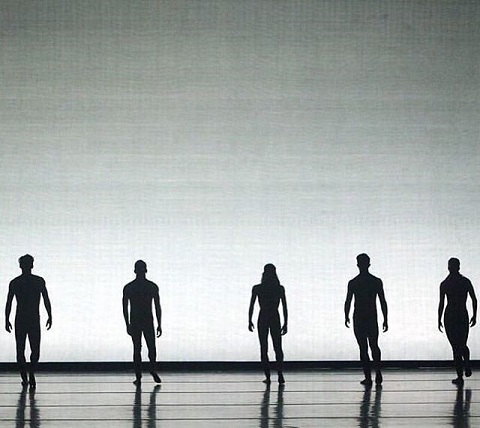
    The elegy from Mr. Corigliano’s Concerto for Clarinet and Orchestra creates an atmosphere of luminously pensive mystery…even before the dancing begins. The eight dancers, clad in Ms. Karan’s provocatively ‘nude’ costumes, enter in slow-motion from upstage left; they cross the diagonal and pause center-stage where they become entwined and entangled. Individual dancers rise out of the dense human hive only to inexplicably vanish again. Suddenly they begin to move faster, though the music maintains is eerie adagio tempo. As the music fades, the tribe gather their energy to continue their diagonal trajectory, moving toward some unknown fate.

    4Q5A7166

    Among the individual dancers in this work, Sarah Braverman stood out – as she had at the rehearsal (above, with Ian and Omar in Travis Magee’s photo) – for her ability to maintain a deeply feminine lyricism every moment she is onstage. Whether she’s dancing fast or slow, or being suspended upside down, Sarah is always hypnotic to watch. 

    It was also in UNION tonight that we met the two newest members of Parsons Dance

    Contemporary-Headshot

    …blonde and luscious Zoey Anderson…

    1bcb59_c1eea316b06946928d630cc7dc11189a

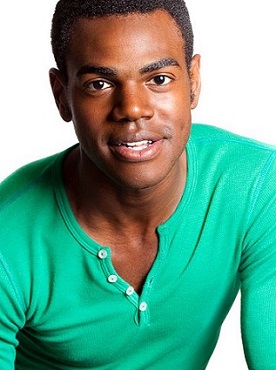
    …and Ahmad Simmons, a pillar of strength and a born mover.

    The evening continued: 

    IMG_7845-L

    Above: Elena D’Amario, in a Travis Magee portrait. Elena’s solo in Robert Battle’s TRAIN was simply thrilling.

    TRAIN is set to a blazing percussion score performed by Les Tambours du Bronx. It’s not about trains as a mode of transportation, but rather about training the body for rigorous sports activity. Here the dancers, whether in marching mode or sailing about the space in free-flowing passages, took on an almost animal intensity. Elena D’Amario’s solo, in which Mr. Battle makes uncanny demands on the dancer, was performed with Ellie’s trademark daring and all-out commitment, winning this beauteous dancer a forte round of cheers when she took her bows.

    Katarzyna Skarpetowska, a particular favorite of mine among choreographers currently on the scene, offered her latest creation, ALMAH, and added yet another feather to her cap with this finely-conceived and musically inspired work. Performing live, the musicians of Ljova dazzled us with their colourful playing. A felicitous soundscape – combining fadolin (an acoustic 6-string violin/viola/cello hybrid made by Eric Aceto), tuba, trumpet, bass clarinet, and drums – evoked beer gardens, country weddings à la LES NOCES, and visions of Russian villages and the people who live there. 

    Ms. Skarpetowska had wonderful dancers to work with – Elena D’Amario, Zoey Anderson, Eoghan Dillon, and Omar Ramon de Jesus – and she used the music as an inspiration for their rich and detailed movement, with some intriguing partnering motifs in the mix.

    12439263_10153886470290816_8879204900077223722_n

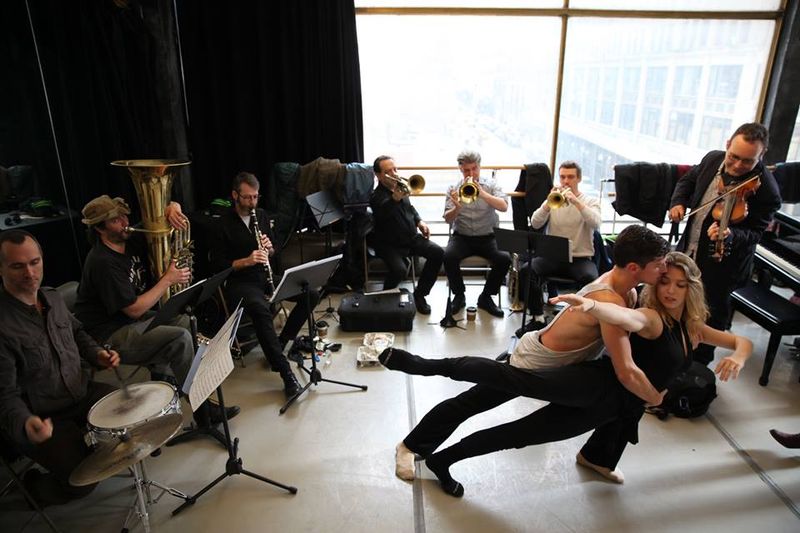
    Two pas de deux for Geena Pacareu and Ian Spring (above, rehearsing with the musicians of Ljova in a David Parsons photo) are high points in this excellent work; in the longer of the two, the voice of Inna Barmash cast a spell over the theatre with her one-word vocalise – talk about creating an atmosphere! – to which Ian and Geena responded with dancing that was truly heartfelt. 

    Ms. Skarpetowska took a bow to warmly affectionate applause at the close of this premiere of her newest piece, her silver shoes a charming touch. How I would love to see Kate working with oh-so-many dancers/dance companies…and most especially with the Martha Graham troupe. Let’s make it happen!

         Sarah1

    Above: beloved dancers Sarah Braverman and Ian Spring, in a Lois Greenfield photo 

    No Parsons Dance evening is complete without CAUGHT, the unique strobe-light solo that includes 100 jumps and leaves audiences in a stupefied state of “how-the-hell-did-he-do-that?” wonderment. I have seen it dozens of times and tonight, as always, I was thinking: “Oh…Caught…again!” and then moments later I was whooping and hollering along with the rest of the crowd.

    Ian Spring gave an astonishing performance; at first he moves slowly from one pool of light to another as Ljova intoned the opening phrases of the Robert Fripp score live. And then Ian takes off, flashing in and out of our vision in a series of perfectly timed snapshots. Like a dreamworld spirit, he pops up uncannily in various parts of the stage, seems to suspend himself above the floor, walks on air. Periodically the ‘real’ Ian materializes, as if he’d been standing still the whole time. Dazzled by the visual magic and by the dancer’s mouth-watering physique, the crowd went absolutely wild at the end while the sweat-drenched Ian – who, during his seasons with Parsons Dance, has developed into one of Gotham’s modern dance icons – basked in a standing ovation, casting a benevolent smile on the adoring throng.

    David Parsons’ sunny and seductive NASCIMENTO (1990) is always a perfect closing work. Here the dancers fill the music of Milton Nascimento – and David Parsons’ casually sexy combinations – with the effortless charisma that seems to be de rigueur for joining this elite dance family. Everyone has ample opportunity to shine – or glow, really – as they leap and sway to the tantalizing music, which includes some spine-tingly vocal passages. Meanwhile, the Binkley lighting scheme with its warm, rich colours, is an ideal setting.

    So many moments give NACSIMENTO its visual appeal: there’s a great passage when the girls race upstage and fly into Ahmad Simmons’ arms. And a simple but savorable section where Sarah Braverman wanders wonderingly among her colleagues who are hailing us from the shore with stylized arm gestures. Overall, it’s an irresistible piece performed by irresistible dancers.

    A few more images:

    Parsons-Dance-EoghanDillonCropped

    Eoghan Dillon, a young Irishman who is carving out his own niche in the Company…

    12301508_10208469285838489_3355607464700896826_n

    …and Geena Pacareu, the Spanish beauty, with Omar Ramon de Jesus, a sweetly sexy guy, and a suave mover; I borrowed this picture of them – on vacation – from Geena’s Instagram.

    4Q5A7096

    And finally…The Boss, getting everything perfect. Photo: Travis Magee.

    Parsons Dance continue their Joyce season thru January 31st. You’d better go see them!

  • Yoo & Dancers at the Korean Cultural Society

    6a00d8341c4e3853ef0148c6db940f970c-800wi

    Above: dancer Yuki Ishiguro, photographed by Kokyat.

    Wednesday January 30, 2013 – These words from the Yoo & Dancers press release piqued my curiosity:

    “Glass Ceiling” turns the audience upside-down and inside out. The dancers defy the audience’s understanding of the traditional physics of dance by performing as if various walls and surfaces in the space were in fact the floor…by shifting traditional notions of orientation for a dance performance, “Glass Ceiling” opens the viewer’s mind to different perspectives, new ways to think of their relationship to the space. New aspects of movement and physicality emerge when the focus is rotated and the audience is no longer the dancers’ focal point. When the dancers are presenting towards imaginary audiences, real viewers are given the opportunity to question their own role in the performance environment.”

    Then I noticed that my friend Yuki Ishiguro was listed among the participating dancers. I decided to attend the performance: I seldom have an opportunity to add new dance groups to my calendar but by chance this evening was open and so I walked over to the East Side on a cool, damp night to see what Yoo & Dancers had to offer.

    The work, at least the part of it that I saw (“Without A Net”) is truly inventive and was expertly performed by Yuki and four fellow-dancers. The far wall of the space has become the floor for the dancers and they balance, stagger and climb across the actual studio floor with disorienting commitment. To live piano music – a collage of familiar and unknown works – real dance elements are woven into the choreography – a tango, a ballet pas de deux – but they are danced inside-out and sideways, so to speak.

    The audience were clearly intrigued by the piece, and of the dancers Yuki seemed most at home in this off-kilter world: often balancing for long periods on one hand, he scrambled about the space with the grace of an earthbound Spiderman. Meanwhile his gestures and expressions were genuinely amusing. Since I’m unfamiliar with these dancers I can’t say who the girls were (the Company’s other male dancer, Sean Hatch, gave an engaging performance) but they all had the spirit of the work well within their grasp.

    The space is perhaps not ideal to present this floor-oriented piece since only viewers in the front row have a clear sightline. Those seated further back had to stand or move about. Nevertheless I truly enjoyed it.

    After the intermission, the seating had been re-configured and I was fortunate to still be placed in the front row – and very eager to see the rest of the performance. But as the lights went down, four very small children came and sat on the floor at my feet. I hastily grabbed my coat and left.