Tag: Wednesday June

  • RIOULT @ The Joyce ~ June 2016

    Nyseason_885x518

    Wednesday June 22nd, 2016 – RIOULT at The Joyce, offering a very pleasing evening of dance from Pascal Rioult’s excellent troupe, with exceptional dancing from both established Company members and relative newcomers. The program was well-varied musically, and the evening was enhanced throughout by fine lighting and canny use of visual effects.

    Tchaikovsky’s Orchestral Suite #2 in C-major is the setting for Dream Suite which opened the program; this coloristic ballet – with gorgeously distinctive lighting by Jim French – is a visual treat. The inimitable Charis Haines is the Dreamer, and her dreams veer from lyrical to witty to mystical.

    Against a backdrop which shifts from pumpkin-coloured to vivid red, ten dancers move thru Charis’s dreamworld in quirky combinations, sometimes stopping to strike amusingly ironic poses. Masked characters appear: a bull, and ancient reptilian birds. Undercurrents of sexual fantasy are woven in and, as is often the case in dreams, things seem disjointed at times.

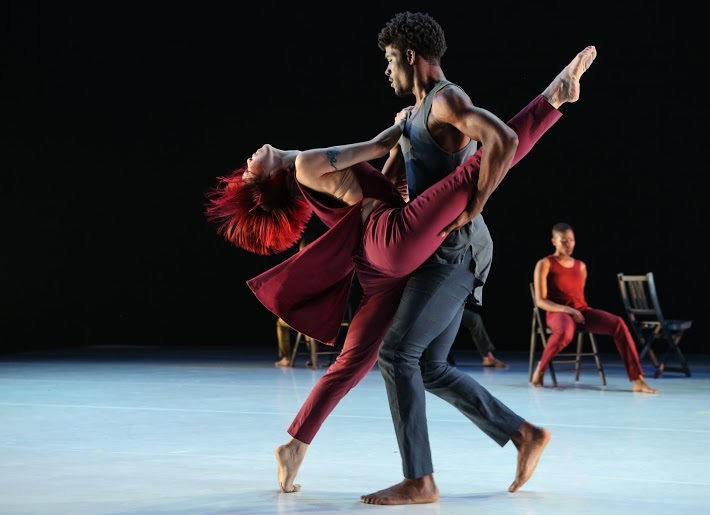
    The choreography overall is disarmingly simple – when the dancers simply form a circle, the effect is stunning – and Charis Haines excels in her solo passages. Colour – radiant and saturated – is everything. The striking image of a woman stretched out in a flat plank and borne aloft by her partner across the upstage space seems to signal a magical end to the ballet, but there’s another movement to come; that image, though, remains fixed in the memory.

    Selected Preludes and Fugues from Bach’s Well-Tempered Clavier (seemingly the Glenn Gould recordings, as there is much extraneous vocalism along the way) are the basis of Polymorphous, a stylized dancework which opened before a gridwork backdrop against neutral colours, with costumes of the same visual texture. Four dancers – Brian Flynn, Charis Haines, Jere Hunt, and Sara Elizabeth Seger – move in sync, almost like automatons. In two duets that follow, the first is accompanied by a ghostly negative-image film of the dancers projected above while during the second, multiple shadow images appear as echoes of the choreography.

    Duets, Sacred and Profane opened the evening’s second half; here we meet pairs of the RIOULT dancers in more personalized settings. In the first duet, from Kansas City Orfeo (1996), Sabatino A Verlezza as Orfeo attempts to revive his dead wife, Euridice (Catherine Cooch), to the appropriate music from the Gluck opera; this put me very much in mind of David Grenke’s powerful duet, Vespers.

    One of the Company’s newest members, Corinna Nicholson, made a really lovely impression dancing a duet from The Great Mass (2009) with Sara Elizabeth Seger. The girls wear gossamer ‘Baroque’ dresses, and they bring an air of courtliness to this charming piece.

    Two of RIOULT‘s most vivid dancers, Jere Hunt and Michael Spencer Phillips, were magnificent in a pas de deux from Te Deum (1995). To the music of Arvo Pärt, Michael – in a dark suit and white shirt – partners Jere, clad in black briefs, in an intimate duet. Though devoid of erotic overtones, the dance is both sensual and spiritual. Various imagined scenarios might be applied – two lovers, two brothers, a father and son, a guardian angel and his charge. Jere Hunt’s muscular physique speaks powerfully in its own right; a vein of poetic vulnerability which runs thru his work as a dancer gives his performances a deeply personal resonance. Michael’s handsomeness and the strength of his movement are captivating to behold: this is a dancer who can express both courage and tenderness. Together, the two men thrilled the audience.

    Something special needed to follow this male duet, and we found it the charismatic pairing of Charis Haines and Holt Walborn in a sublime Bach duet from Views of the Fleeting World (2008). Their expressiveness and their sense of the mutual devotion of this couple created a beautiful atmosphere.

    For a remarkable finale, Pascal Rioult’s unique setting of Ravel’s Bolero sparked an eruption of cheers from the mesmerized crowd at its end. Against a backdrop by Harry Feiner – a fanciful rendering of architecture à lespagnole – eight dancers perform endless repetitions of gestural motifs while periodically moving from one formation to another. Woven into these geometric configurations are illuminated solos which are luxuriantly slow and sometimes self-caressive. The dancers – Mlles. Cooch, Haines, Nicholson, and Seger with Mssrs. Flynn, Hunt, Phillips, and Verlezza – went thru their hypnotic paces with machine-like precision, whilst basking in the more voluptuous solo moments. Brilliant!
  • A Quartet of Female Choreographers

    13407164_3092102065116_6567679795283993630_n

    Wednesday June 15th, 2016 – Works by four prominent contemporary female choreographers were on offer this evening at New York Live Arts. In a well-contrasted program, distinctive dancing and excellent lighting made each piece glow in its own unique way.

    One couldn’t ask for a more engrossing start to an evening of dance than that offered by Molissa Fenley and Company: a duet entitled THE THIRD COAST (Premiere), and MALI, a solo danced by Ms. Fenley. Evocative music by Ryuichi Sakamoto (duet) and Laetitia Sonami (solo), and splendid lighting by David Moodey, were attractive assets to these two works.

    In a violet world, dancers Christiana Axelsen and Rebecca Chaleff dance a stylized duet in-sync. Their moves and gestures imply a secret language. Dawn-light glows as the two continue to mirror one another. In a second, more animated section – to piano music – the lighting goes sea-green. The two dancers bring a compelling grace to the angular movement.

    This mysterious duet leads directly into the solo danced by Ms. Fenley: a captivating experience in every regard as the fusion of the soundscape – clattering, crunching, sloshing – the lighting, and the dancer’s mesmerizing movement held the theatre under a spell. Ms. Fenley’s arms and hands were so expressive, and her sense of commitment gave the work a gorgeous resonance.

    Elisa Monte’s DEXTRA DEI was originally set as men’s quartet: the choreographer’s 1989 response to the devastation of the AIDS epidemic. Ms. Monte has now expanded the work, adding four women to the cast.

    It is a work that is both somber and sexy, full of chiaroscuro effects created by the David Moodey lighting. To atmospheric music by Tibor Szemzo, four men roll onto the stage and form patterns of moving sculpture. The delectable Clymene Baugher rolls on from the opposite corner where she encounters Thomas Varvaro. Their intimate, floor-oriented duet ends in surrender and repose.

    Lithe and supremely feminine, Maria Ambrose appears and is manipulated aloft by the three remaining men; the music is ominous, with deep vocals and bird cries. JoVanna Parks and Shay Bland enter, jungle drums sound softly, reverberating in the rain forest mist. The men withdraw, the woman dance a quartet with fleeting solo passages: an exotic tribal rite of a restless sisterhood.

    The men reappear, repeating the movement motifs that initiated the ballet. Over a sustained note, partnerships form: stylized lifts and turns abound as pulsing music underscores the communal rituals. The work, perhaps just a trifle too long, showed off Monte’s dancers to perfection.

    Margo Sappington’s ENTWINED depicts the melding of bodies and spirits. At once sensual and magical, this on-pointe ballet is set to Erik Satie’s Gnossiennes. I was familiar with this work from having seen Jennie Somogyi and Charles Askegard perform the signature duet from it with Ballet Next in 2011.

    This evening I was particularly delighted to find Lily Di Piazza dancing in the ballet’s opening pas de trois; I remember Lily’s dancing from her SAB days. Ms. Sappington and I had a lovely chat before tonight’s show, and she told me she had originally made this role on Lily. 

    As mists roll by, Lily, Marjorie Fiering, and  Marlon Taylor-Wiles danced with effortless beauty, accenting the classicism of the vocabulary. Marlon’s impressive physique and his powerful charisma were a counterpoise to the elegant feminine allure of the two girls.

    Silken Kelly appears for a solo, danced in pools of light; the lyrical choreography was sublimely articulated by this radiant dancer. The exquisite Chrystyn Mariah Fentroy then joined Mr. Taylor-Wiles for the tender, languid pas de deux; performing with an intimacy which we are permitted to savor, the two dancers fused into a single spirit. The duet’s ensuing, more animated passage gave the dancers space-filling combinations and complex partnering elements.

    Earlier this week, I caught a studio run-thru of Jennifer Muller‘s newest creation, WORKING TITLE.  Consisting of four duets – into which interjections by other dancers sometimes occur – the dancing is accompanied live by Yut Chia and Shayne Lebron Acevedo, of Yut and the Hot Four. Ms. Muller told me that she heard Yut playing in the subway station, approached him, and asked if he’d be up for a collaboration. The result is WORKING TITLE, a dancework about relationships that mixes passionate music and dynamic dance. A row of chairs is the setting for the characters, who come and go throughout the ballet, sometimes observing those who are dancing, sometimes isolated, withdrawn, deep in thought.

    In the opening vignette, Alexandre Balmain pursues Michelle Tara Lynch, setting up a duet of passionate turmoil, superbly performed by this alluring pair of dancers. Ms. Lynch’s hair becomes an active participant in the dance as she sought to steer clear of the young Frenchman’s advances. Alexandre’s line, and his lavish extension, continually lure the eye. Elijah Laurant, Ms. Muller’s newest dancer, turns this duet into a trio: his place in the romantic triangle is a bit ambiguous: we can’t tell if he’s just a troublemaker or if there’s some attraction between him and Alexandre…or him and Michelle. This added dramatic aspect keeps things lively.

    Gen Hashimoto then tries to interest Shiho Tanaka. Who could say “no” to Gen? But Shiho does. Their duet becomes tempestuous: Shiho’s solo marks her desire to be left alone, while Gen covers the space with his trademark sexy, bad-boy bravura. As Shiho continues to resist, the music pounds out a big beat.

    Sonja Chung, Elise King, and Seiko Fujita takes seats to observe the denouement of Gen’s attempted seduction: he and Shiho carry on – to no avail – as the music turns bluesy. 

    Index

    Sonja Chung (above, in a Julie Lemberger photo), a phenomenal dancer and presence, meets her match in height and allure in Elise King. As the two tall women veer between attraction and avoidance, emotions well up and feelings are hurt. Seiko Fujita tries to intervene – again, we don’t know her motive – but Sonja and Elise leave things unsorted.

    Index2

    Suddenly, Elijah Laurant sweeps Seiko Fujita off her feet (Julie Lemberger photo above) as they go wild in a high-energy duet, ripe with power and passion. 

    All the dancers then take seats, to ponder their solitary desires. Gen has another vivid solo, as does Sonja, and then a bit more brilliance from Seiko. All seek resolution. Sonja and Elise move off together; Gen finally persuades Shiho of his sincerity. We can’t be quite sure of the Michelle-Alexandre-Elijah situation. Seiko walks forward alone as the lights dim.

  • Beethoven Piano Concertos @ NY Phil III

    310696_2199382298108_399524588_n

    Wednesday June 25th, 2014 – The New York Philharmonic presenting the final programme of their 2013-2014 subscription season at Avery Fisher Hall; over the past two weeks, the orchestra have offered the first four Beethven piano concertos with Alan Gilbert on the podium and Yefim Bronfman at the Steinway. Tonight Mr. Bronfman played the 5th (‘Emperor’) concerto as the concert’s finale; earlier in the evening, he was joined for the Triple Concerto by the Philharmonic’s soon-to-retire concertmaster Glenn Dicterow, and the principal cellist Carter Brey join Mr. Bronfman. This same programme will be repeated on June 26th, 27th, and 28th, the final evening marking Glenn Dicterow’s farewell performance with the Philharmonic.

    The Triple Concerto (1804) opens with a traditional Allegro in which the solo voices are introduced one by one: the cello, then the violin, and finally the piano. In the Largo which follows (and is rather short), the concerto finds its heart with a melody, introduced by the cello, which displays the expressive richness that characterize the greatest passages of Beethoven’s works. Without pause, the final Rondo alla Polacca commences; again the insistently repeated phrases of the cello are prominent. This rondo features joyful themes seemingly inspired by Polish folk music, with lively shifts from major to minor.

    The performance, though thoroughly enjoyable, somehow never really developed a rapport between the three solo players, mainly due to the fact that Mr. Bronfman, of necessity, had his back to his string-playing collegues. Mssers. Dicterow and Brey were able to communicate directly with one another, whilst Mr. Bronfman was left in his own (beautiful) world.

    20130205193002_la-1337491-et-bronfman-1-lkh

    Following the intermission, Yefim Bronfman’s playing of the ‘Emperor’ concerto this evening was a superb finale to this NY Philharmonic Beethoven Concerto Festival. This majestic work was given a vibrant performance by the pianist and the artists of the Philharmonic, all wonderfully woven together by Maestro Gilbert’s baton.

    By this Saturday, Mr. Bronfman will have played on thirteen evenings over a three week period: an exhausting schedule, yet the pianist’s playing seemed awesomely fresh and vital tonight, with his uncanny mastery of dymanics always giving a shimmer to the sound. For all his technical brilliance, Bronfman’s playing also has a noble, heartfelt quality that makes his playing so deeply satisfying. The waves of applause that have engulfed him at each of these concerts have been very moving to experience. And it’s to our good fortune that he will be back at Avery Fisher Hall in late October 2014 playing the Bartok 3rd with Alan Gilbert on the podium. The dates are already on my calendar.

  • Boylston/Simkin SWAN LAKE @ ABT

    Simkin

    Wednesday June 27, 2012 matinee – Alas that the performance I most wanted to see during ABT‘s week of SWAN LAKEs fell on a Wednesday matinee. I knew it would be a bad audience experience and I was right about that; actually, considering the vast number of children in the audience it wasn’t as bad as it might have been. But of course seated right behind us were a mother and her three kids who whispered and squirmed and ate and drank their way through the matinee. Eventually I gave up my excellent seat and moved to the balcony boxes so I could concentrate.

    ABT‘s SWAN LAKE is overall rather dull; the ‘traditional’ parts – especially the first lakeside scene – are of course quite lovely but there’s a whole catalog of tedious bits that detract from the focus of the narrative. Nonetheless, it serves ABT‘s purpose as a producton into which each principal ballerina and danseur can be plugged for their annual go at Odette/Odile and her Prince. Today, though, the casting  was fresh: soloists Isabella Boylston and Daniil Simkin (photo above) tackled these iconic roles for the first time at The Met and scored a resounding success.

    Daniil, point blank, is a dancer I love. Although I don’t go to ABT all that frequently, I am always happy to find Daniil dancing on a day that I am there. And so when he was listed for his first Siegfried, I immediately put this matinee on my calendar. Having seen many 30-to-40 year old Siegfrieds over the years (not that I’m complaining: they’ve been wonderful!) it was really refreshing to witness Daniil’s youthful elegance in the role. Carrying himself with inborn dignity, Daniil brought a sense of true innocence to the ballet. Heart on sleeve, he went bravely into the uncharted territory of first love; that his passion would lead to his eventual doom never entered his mind. Throughout the performance, his boyish figure and expressive face kept us strongly focused on Siegfried’s story. Daniil’s dancing was fleet-footed, immaculate and supremely musical.

    Isabella Boylston’s Odette/Odile was a lovely creation, beautifully danced. She hasn’t quite found the quality of mystery that will eventually make her Odette truly impressive, but her interpretation is already well-formed and she is quite a sparklingly powerful Odile. Boylston had the crowd with her from the start, reaping a burst of cheers for her fouettes and a huge shout of approval at her solo bow.

    Jared Matthews was superb in Rothbart’s ‘hypnotic’ solo – an unnecessary passage, but Jared made it eminently worthwile. Kristi Boone and Karen Uphoff were luxuriant as the leading swans, but the idea of casting three soloists among the four cygnets didn’t come off: each ballerina seemed to be in her own world and the result was lack of coordination and a rather bumpy traversal of the space. The Act I pas de trois was finely danced by Joseph Gorak, Devon Teuscher and Christine Schevchenko. 

    In the Black Swan act, the national dances are lamely choreographed but I did very much like Simone Messmer in Spanish and thought – watching her watching the proceedings with her own personal mystique in play – what a fascinating Swan Queen she would be.

    Simkin and Boylston taking their bows here.

  • Lydia Johnson Rep Class @ Peridance

    P1240887

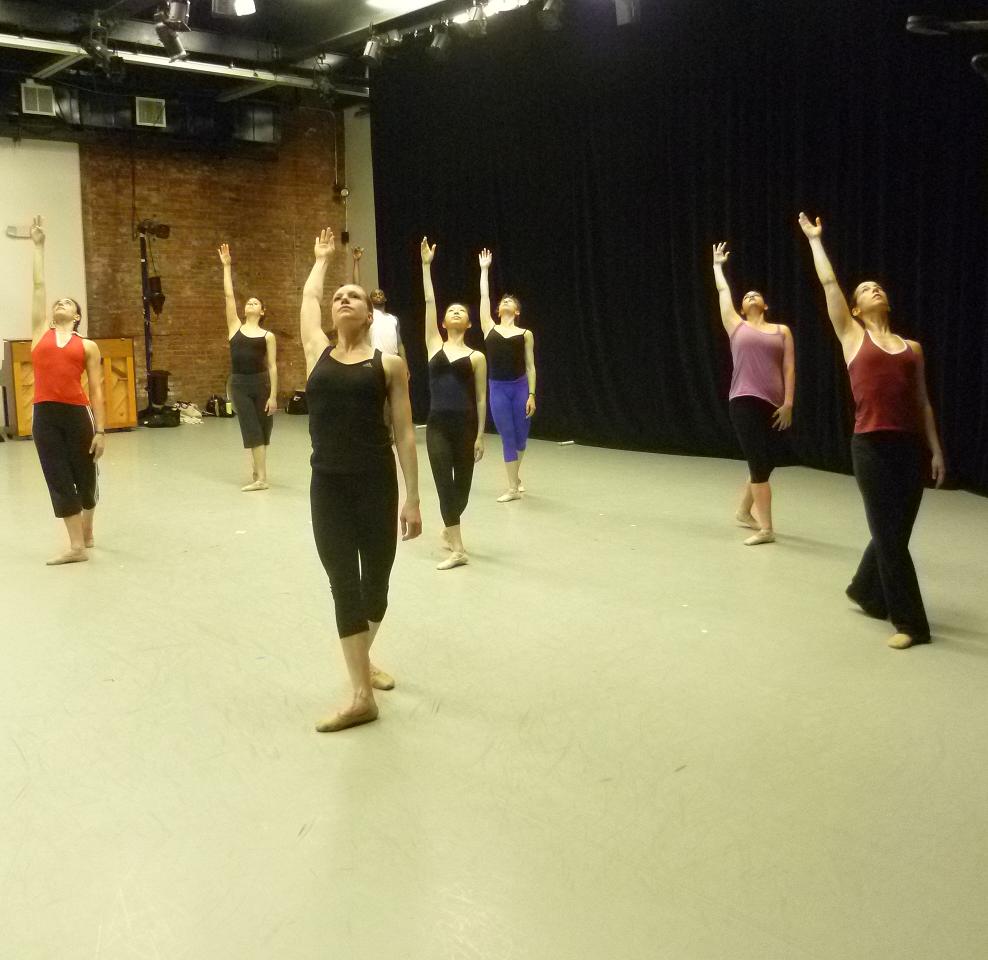
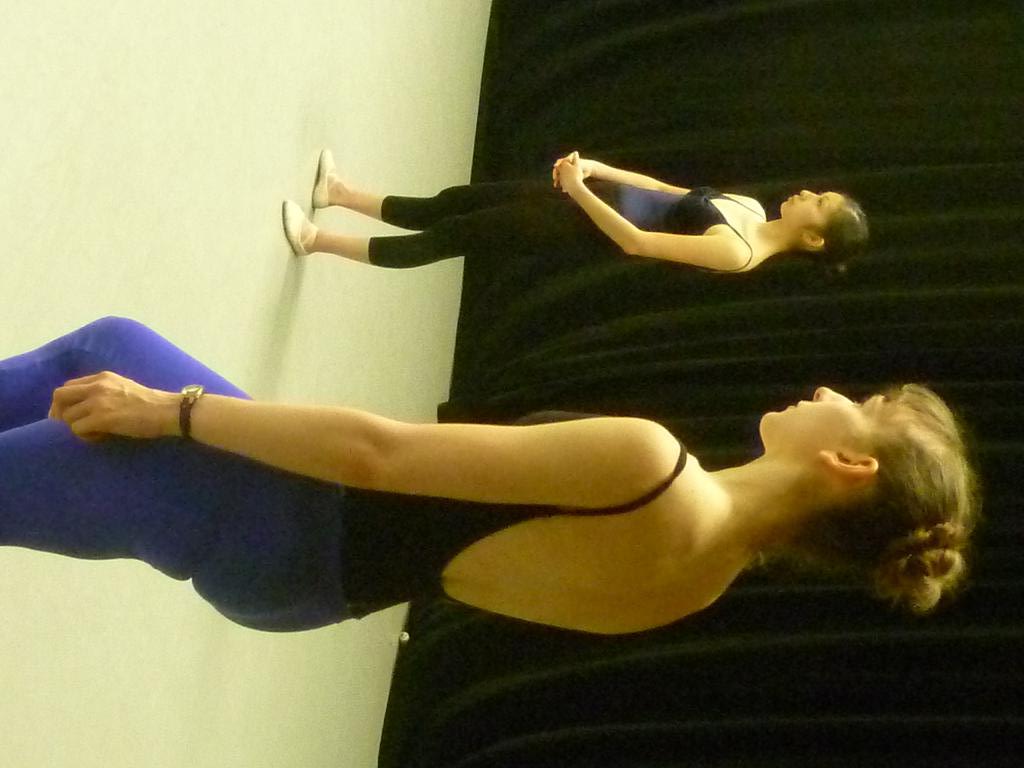
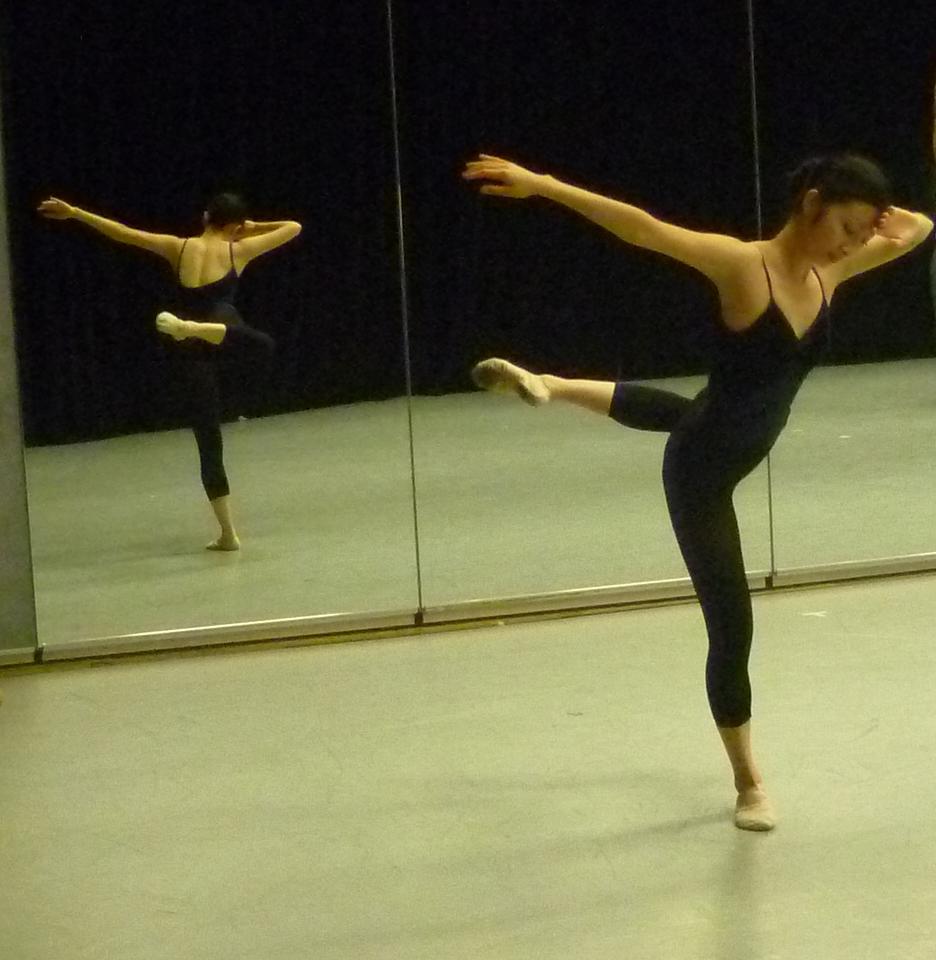
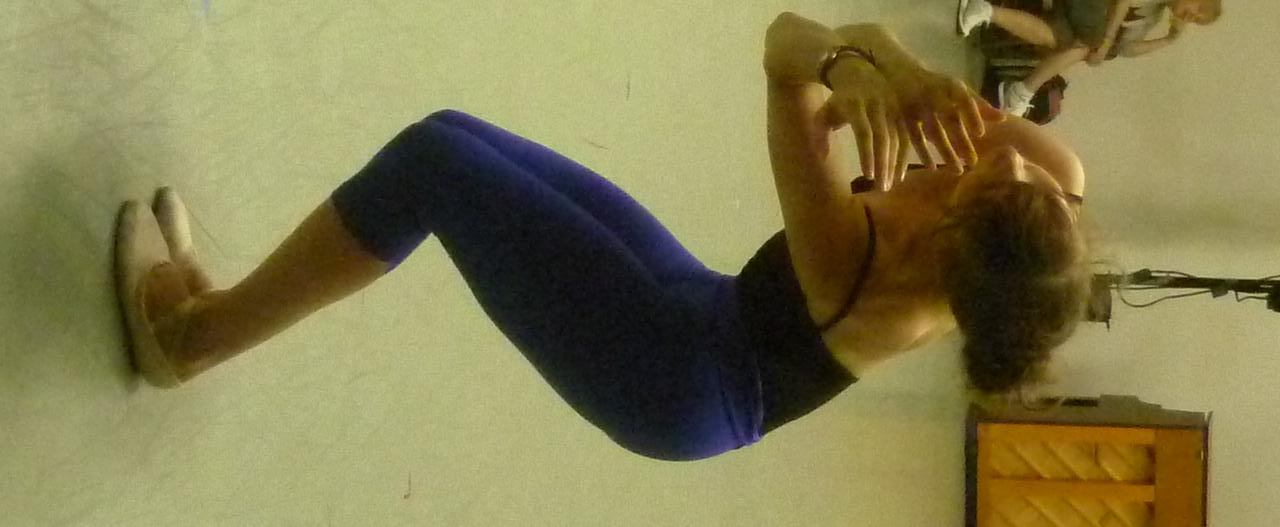
    Wednesday June 29, 2011 – I went over to Peridance today where Lydia Johnson is having late-morning rep classes (11:30 AM start time) all this week. It was a smallish class which in a way was extra-beneficial to those who were there because they got individual attention in detailing and the opportunity to perform passages of dance as a solo experience. Instilled by the music of Beethoven (his quartet #16, opus 132) the atmosphere in the studio became almost churchlike in it solemnity; some of the gestures evoked images of prayer, or of piety.

    The work from which the phrases came is called CODA and was created by Lydia Johnson in 2006. It’s a work of hers I’ve never seen (though I hope I’ll get a chance someday). Three of Lydia’s Company dancers – Lisa Iannacito McBride, Laura DiOrio and Jessica Sand – took turns coaching the dancers as they learned the passage.

    The dancers worked as a group, then in trios and eventually they were dancing the phrase individually. At one point Lydia called on them to dance the passage as a canon, each dancer starting at a different time. This worked out quite beautifully.

    P1250068

    I admired dancer Bryan Longchamp’s seriousness of intent; a hip-hop dancer, Bryan came to Lydia’s class with a desire to experience new modes of movement. It’s a bit like learning a foreign language. As the class progressed, the new style began to work its way into Bryan’s muscles and his dancing looked increasingly persuasive.

    Normally photography is not allowed at Peridance but Lydia obtained special permission and the dancers all agreed to my taking some pictures with my Lumix. I wish they were sharper, but they do catch the nice studio atmosphere and something of the individual expressive qualities of the dancers. Here’s a sampling:

    P1240843

    Lisa Iannacito McBride leads things off.

    P1240915

    Laura DiOrio keeps a watchful eye.

    P1240919

    Lauren Jaegar, Ella Bandes

    P1240911

    Kana Sano, Lauren Jaeger

    P1250032

    Kana                                                                                                                                    

    P1240866

    Angela Guthmiller and Jessica Sand

    P1250057

    Lauren Jaeger

    P1240856

    Ella Bandes

    There are additional photos from this class session in a Facebook album here.