Tag: Wednesday May

  • Shostakovich Sonatas @ Carnegie Hall

    Shostakovich

    ~ Author: Oberon

    Wednesday May 28th, 2025 – Evgeny Kissin was joined by three renowned string soloists for a program of Shostakovich sonatas this evening at Carnegie Hall. It was one of the most thrilling concerts I have ever attended. The atmosphere in the Hall was palpable; aside from some cellphones going off at the the wrong moments, silence reigned. The musicians seemed bent on preventing applause between movements, keeping their bows poised over the strings in order to sustain the atmosphere. The three sonatas were presented in order of their composition: cello first (1934), followed by the violin (1968), with the viola (1975) played following the interval.

    Gautier Capuçon and Mr. Kissin strode onto the Carnegie Hall stage to a warm greeting. Dmitri Shostakovich’s Cello Sonata in D-minor, Op. 40, was composed composed during a period of political and social upheaval in the Soviet Union, and the music reflects the unsettled atmosphere of the time…and of ours, now. The cellist sometimes allowed a touch of grittiness into his tone, which was truly evocative.

    The opening Allegro non troppo is gently introduced by Mr. Kissin at the Steinway. A lovely theme gives way to vivid animation from both players. The mood gets dreamy, with M. Capuçon taking up a gorgeous cello melody that turns passionate. A super-pianissimo moment briefly interrupts the music’s flow, and then a sense of longing grows from repeated cello tones, displaying Mr. Capuçon’s marvelous control. Plucking introduces a dance, and mood swings continue – one such bringing a haunting theme: quiet and mysterious. Single notes from the piano invite deep cello playing; Kissin’s tone takes on an almost grumpy sound. Fantastic!

    Staying in an Allegro mode, scintillating piano and dancing cello illuminate the second movement. Cello glissandi and insistent keyboard rhythms pop up as the dance sails onward. A sudden stop, and then the Largo commences with incredibly hushed music from M. Capuçon’s cello. The players’ quiet intensity creates a mysterious atmosphere. The cello tears at my heart, rising from its lowest range in music filled with longing and then bursting with passion before returning to the depths. A remarkable quietude fills the Hall, then a crescendo before a fade-out, with the piano on high longing for peace. Things darken; spellbinding control from both musicians casts a spell over us.

    With dancing motifs played as if compelled by an unseen force, the final Allegro lets us savour Mr. Kissin’s glorious virtuosity, whilst M. Capuçon produces an amazing stuttering effect with his cello as these two paragons delight us with their magical partnership, bringing the first of the concert’s enthusiastic ovations.

    Gidon Kremer walked out onto the Carnegie stage cautiously, to an welcome. Now 78 (two years older than myself!), the legendary violinist responded to Menthisiastic r. Kissin’s straightforward piano introduction of the Shostakovich opus 134 with a sinuous theme. For a while, simple musical lines are exchanged, and then a sprightly dance emerges. The music is subtly playful until there’s a rise of passion. The buzzy tone of the violin then resumes the dance, somewhat hesitantly. The high-register violin filigree creates an insectuous sound before a slow fade-away.

    The ensuing Allegretto opens with a nervous dance; this movement is lively, witty, and ironic. It’s music that veers high and dips low, with some sparkly effects from the violin. A sense of urgency takes over as the music presses forward, Kissin playing high and bright as Mr. Kremer handles the music with with amazing dexterity. The violin whines, the piano swirls onward: high, fast, phenomenal music-making!

    The sonata concludes with a Largo, the pianist striking single, dotty notes as the violinist plucks away. Mr. Kremer’s playing turns ethereal, poised on high with amazing control. A keyboard dance rhythm draws restless playing from the violin. Now Mr. Kissin introduces a sense of grandeur into the music, leading to an angular violin cadenza. A rocking motif from both players carries them into a series of tremelos as the sonata ends. The Kremer/Kissin duo elicited a fervent ovation from the crowd.  

    After the interval, an artist new to me – the Ukrainian-British violist/conductor Maxim Rysanov – joined Mr. Kissin for a revelatory performance of the Shostakovich Viola Sonata, opus 147. This fascinating work, which I have only heard played live two or three times previously, really got to my soul tonight: the kind of deeply immersive musical experience that happens so rarely. 

    The opening Moderato begins very quietly, with soft viola plucking – slow and pensive – as the piano joins, dark and rather ominous. A dirge-like sense of foreboding develops leading to a burst of power. Restlessness overtakes the music; a piano solo and eerie, shivering resonances from the viola develop into a flash of grandeur before an extraordinarily subtle viola passage is heard, ending with staccati, and a sustained fading away.

    Now comes the Allegretto, commencing with a dance à la Russe. Mr. Rysanov’s playing is so suave and assured. Boldness from the Kissin keyboard and plucking from the violist lead to a heartfelt unison song, which gets quite grand.

    After a pause, the Adagio commences with a sorrowing viola theme which gains poignant support from the piano. Every note from both players seemed like a thing of value, something to treasure…such incredible playing. The spirit of Beethoven hovers on the air as the rhythmic signature of the Moonlight Sonata casts its spell overall. A viola cadenza – lovingly fashioned by Mr. Rysanov – draws us on to the sonata’s magnificent finish. Throughout this movement, I had been in another time and place, far from the chaotic madness of the world. A massive, roaring standing ovation filled the Hall, and it was still resounding as we emerged into the downpour…

    ~ Oberon

  • Limón Dance Company @ The Joyce

    Jose_limon

    Above: José Limón

    ~ Author: Oberon

    Wednesday May 29th, 2019 – The Limón Dance Company‘s program at The Joyce this evening brought us José Limón’s classic masterwork The Moor’s Pavane and his fascinating ensemble piece Psalm, along with Colin Connor’s The Weather in the Room, danced by guest artists Stephen Pier and Miki Orihara, and Radical Beasts in the Forest of Possibilities from choreographer Francesca Harper, in collaboration with composer/performer Nona Hendryx.

    Thumbnail_limonEt2DYiXo

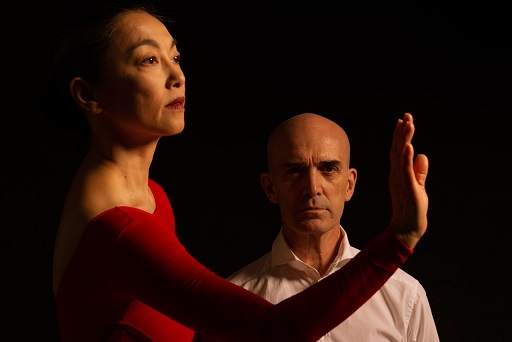
    How wonderful to see dance icons Miki Orihara and Stephen Pier (above) onstage together tonight; the husband-and-wife duo gave a vivid, touching performance in the New York premiere of Colin Connor’s The Weather In The Room, an intimate narrative work which tells us of a long-lasting domestic relationship and shows us what it takes to keep it alive thru the years.

    A couple return home from a formal party; a chair, a stool, and a rug comprise the setting. Shoes come off, and his jacket; they get comfy as what sounds like a scratchy old ’78 record begins to play. Sarah Shugarman’s score is so evocative, and soon memories are in play. Miki’s gestural language is poetry made visible, whilst Stephen looms over his petite soulmate, alternately solicitous and slightly impatient.

    As their danced conversation unfolds, six dancers in white appear, moving restlessly in the background, and running about. A chime sounds, and to a pulsing motif, an argument between the husband and wife springs up. Eventually they withdraw to opposing corners and the space becomes a small theatre where, in a series of duets, the six dancers present dances of memory: chapters from the biography of a marriage. Impetuous youthful gladness, tender moments, and passing anxiousness are depicted to expressive music.

    Thumbnail_limon2019frances  samson&terrencediableinweatherphotobychristopherjones

    Above: Terrence D.M. Diable and Frances Samson in The Weather in the Room; photo by Christopher Jones.

    Gradually, Miki and Stephen have moved closer to one another from their distant corners, and in the end, they are reconciled. But…it’s not quite the end. For the piece has a happy-music coda; the setting reverts to the quiet living room. As the music fades, Miki laughs softly. 

    There are times in an enduring relationship when you will question whether you are in the right place with the right person; it’s happened to me from time to time in recent years. At such moments, drawing from the well of memory reminds us of what we loved about our mate at the start, and makes us ask: what would life be like without him?  Mr. Connor’s thoughtful, sobering dancework resonates with meaning for me and – I am sure – for many who will watch this work. The depth of Miki and Stephen’s performance was so gratifying to experience, and the ensemble of dancers – Terence D.M. Diable, Mariah Gravelin, Gregory Hamilton, Eric Parra, Frances Samson, and Lauren Twomley – sustained the atmosphere with their articulate, committed dancing.

    José Limón’s best-known work, The Moor’s Pavane, is always as meaningful to hear as to see; the choreographer’s choice of Henry Purcell’s music underscores what I have long believed: this music is made to be danced to. Drawing on Shakespeare’s story of The Moor whose love for his faithful wife Desdemona is destroyed thru jealousy sparked by innuendo, the choreographer creates a ballet at once elegant and brutal. This evening it was splendidly danced by Mark Willis (The Moor), Savannah Spratt (His Wife), Jess Obremski (His Friend), and Jacqueline Bulnés (The Friend’s Wife), their dancing alive with nuance and musicality. 

    Over tiime, I have seen many danceworks similar to Francesca Harper’s Radical Beasts in the Forest of Possibilities wherein the dancers dwell in a desolate landscape, with drifting fog. Nora Hendryx has created a collage of electronic sounds ranging from static to sonic pulsars. Among the eight dancers, who move with vivid athleticism in choreography that has an improvisational quality, there seem to be alternating currents of connection or isolation.

    Jacqueline Bulnés (who emerges first from the darkness, as if lighting the way), Terrence Diable, Mariah Gravelin, David Glista, Jesse Obremski, Frances Samson, Lauren Twomley, and Mark Willis all showed the strength and suppleness of their dancing. The work might have ended on a rather desolate note, but then Ms. Hendryx turned from her laptop to the piano keyboard and began to play a lyrical theme. Dancers Lauren Twomley and Jesse Obremski joined in a duet that brought a sense of humanity to the proceedings; both dancers are beautiful movers. The piece ends on a question mark, as Ms. Bulnés returns with her flashlight as if seeking the couple out. Have they done something wrong? 

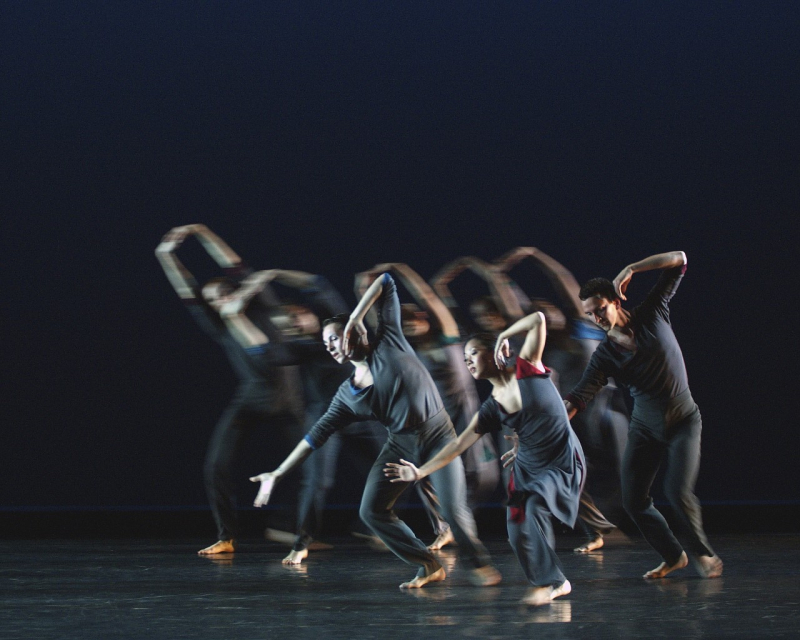
    Thumbnail_limonPsalmphoto_by_Douglas_Cody

    Above: from Psalm; photo by Douglas Cody

    The evening ended with a re-staging of José Limón’s 1967 ritualistic work, Psalm. Carla Maxwell had commissioned a new score for this large-scale dramatic work from composer Jon Magnussen in 2002. I had the opportunity of watching a studio rehearsal of Psalm a week prior to the Joyce performances, and was thrilled and moved by it.

    Without the program note explaining the traditional Jewish belief that all the sorrows of the world rest in thirty-six Just Men, we might have thought of the ballet’s protagonist as an Outcast, a Penitent, or a Christ Figure. In this role, dancer David Glista gave a striking performance, abounding in physical energy and passion, living out the torment of the character with unswerving commitment. Two women, Savannah Spratt and Frances Samson, had prominent roles, and the entire Company filled the space with leaps, turns, and ecstatic gestures as the music ranged from harp and chant to pounding drums, solos for male voice, syncopated Alleluias, and summoning tambourines. Throughout the work, thoughts of Martha Graham’s epic ceremonials continually came to mind.

    Psalm is perhaps a bit over-long, and parts of it are repetitive. But it is as impressive to behold as to hear, and it provides a portal to an ancient world where such rites were an essential element in the life of the community.

    ~ Oberon

  • Shostakovich ~ Beethoven @ The NY Philharmonic

    Mdd-wn-main

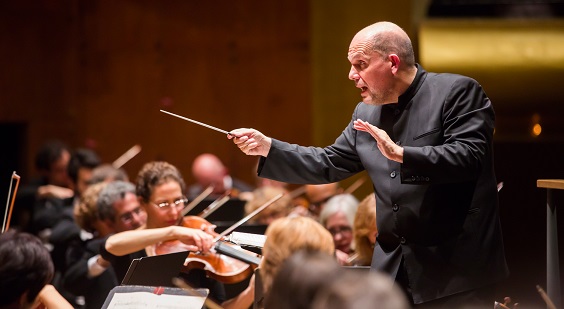
    Above: Maestro Jaap van Zweden; photo by Chris Lee

    ~ Author: Oberon

    Wednesday May 22nd, 2019 – As their 2018-2019 season winds down, The New York Philharmonic offered a well-contrasted pairing of works tonight at Geffen Hall: Shostakovich’s Chamber Symphony and Beethoven’s 3rd symphony: the Eroica. The Philharmonic musicians were on top form, and the orchestra’s Music Director, Jaap van Zweden, led a performance that ended with an enthusiastic ovation.

    For all the concert’s musical excellence, extraneous factors made the evening something of a trial. The lobby at Geffen Hall during the half-hour leading up to the performance’s start time has lately become weirdly chaotic: it has the feeling of an airport, with staff folks yelling at you to go here or there, and long, snaking lines between the velvet ropes to pass thru the “non-invasive” scanner only to be wanded once you’ve gotten the green light. It’s quite stressful, and hardly conducive to the state of mind one hopes to be in when a concert starts: calm, focused, receptive.

    The opening minutes of the Shostakovich featured a chorus of coughers from the audience; the woman next to us coughed throughout the concert while the fellow in front of us nearly busted a lung with one coughing fit: I actually thought he might pass out. Aside from ruining the music, germs are being spread. If you are sick, be courteous enough stay home.

    But the performance of the Shostakovich Chamber Symphony was simply thrilling. This work is an arrangement of the composer’s 1960 String Quartet No. 8, Op. 110, by Rudolf Barshai, a renowned violist and conductor who founded the Moscow Chamber Orchestra in 1956. Barshai’s transcription honors the original instrumentation: it’s set for large string ensemble. And it’s simply magnificent to hear.

    The symphony is in five movements, played without pause. From a somber start emerges a soft, sorrowing violin melody (beautifully played by concertmaster Frank Huang). Six basses bring a sense of grandeur to the music, which is richly layered. Suddenly, a sizzling energy flares up: the basses dig in, with swirling violins and slashing celli, as the music becomes a huge dance. For a spell, violins and violas compete; then the music comes to a sudden halt.

    The violas set the pace for a waltz, played by the violins, which later slows down and fades away. A dirge-like passage is followed by a poignant lament. Carter Brey’s cello sings to us in its highest range, a song which Mr. Huang’s violin takes up. The music meanders a bit, ebbing and flowing, before a magical fading finish.

    This work, and the Philharmonic’s playing of it, was one of the highlights of the season for me. Mssrs. Huang and Brey were enthusiastically applauded as they rose for a bow. I was surprised to read that this was The Philharmonic’s premiere performance of this symphony.

    I must admit that I don’t find Beethoven’s Eroica all that interesting. Its initial theme:

    Images

    …reminds me of a simple melodic scrap I wrote for a compulsory exercise in music theory class in high school. We hear it repeatedly in the symphony’s Allegro con brio, and to me it’s tiresome.

    Sherry Sylar’s oboe solos and some warm-toned horn playing captured my interest in the Adagio assai, but I don’t think Beethoven’s idea of a funeral march shows much imagination. It feels aimless, missing the weighted grief of Chopin’s or the epic grandeur of Wagner’s (and for wit, there’s always Gounod). The hunting horns in the Scherzo again reminded me of high school, where I struggled to be a proficient horn player, but without success. Ms. Sylar and clarinetist Anthony McGill illuminated their solo bits in the Finale, but I found my mind wandering. 

    Whenever a musical work that is highly regarded by many fails to reach me, it makes me feel deficient. What am I not getting? So it was interesting to read in the program notes that Beethoven’s 3rd was not initially regarded as a masterpiece, but seemed instead overly long and lacking a sense of unity.

    Still feeling that the Eroica has eluded me, I went to a classical music chat room to see if anyone else felt as I do about this symphony. Among the many posts heaping praise on Beethoven’s 3rd, someone wrote: “I would never deny the power and genius of the Eroica, but I never want to sit through it again.”

    Anna_rabinova

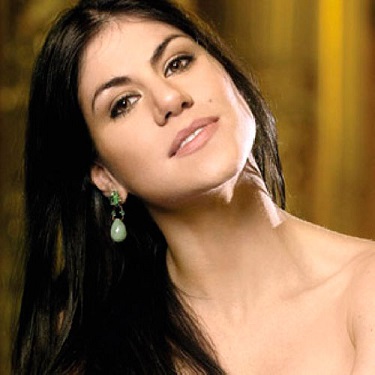
    The evening honored musicians who are retiring from The Philharmonic this season. One who I will especially miss is violinist Anna Rabinova (above), whose dedicated artistry I have come to know thru her appearances at the Philharmonic Ensembles concerts at Merkin Hall. I hope she’ll continue to be part of the City’s musical scene in the coming years.

    ~ Oberon

  • At ABT: Paloma Herrera’s Farewell

    Paloma-herrera

    Wednesday May 27th, 2015 matinee – Farewells are always bittersweet, and this afternoon at ABT as Paloma Herrera took her final bows with the Company, it seemed rather sad that she should be leaving us since she is in gorgeous physical shape, technically polished to perfection, exuding prima ballerina confidence, and wildly popular with audiences.

    Sometimes at a farewell, the occasion overshadows the actual work being performed, but this afternoon’s GISELLE was excellent in every way. Paloma’s Giselle is a classic: the marvelous feet, the expressive hands; the clarity with which she presents the character’s hopefulness, her illness, her devotion to Loys, the devastation of his betrayal, and her fall into madness and death all so perfectly projected in Act I. As a Wili, she is able to portray both spectral remoteness and human tenderness in perfect measure.

    Her Act I solo – the hops on pointe and then a swift, swirling manège – drew screams of delight from the audience, and her Wili solo in Act II literally stopped the show: she was called out twice to ecstatic applause. For all the brilliant surety of her dancing, it was her simple gesture of steadfast love after having saved Albrecht that will always linger in the memory.

    Roberto Bolle is a blindingly handsome Albrecht, and handsome is as handsome does: his dancing and partnering are superb. As he watches Giselle being crowned queen of the harvest, Bolle’s eyes reveal his foresight: “My number’s up, this will all end soon.”  We cannot quite tell if he’s taken his village romance seriously or has viewed it as a lark: whichever is the case, he is almost cripplingly devastated by remorse in Act II. 

    Bolle’s bravura solo in Act II and his long series of entrechats were much admired by the audience; he and Paloma sustained a spiritual link throughout their other-worldly encounter, imbuing the adagio with the palpable sense of a dream from which he hopes never to awaken.

    The most moving moment of the performance came with their final parting. As Herrera/Giselle was about to descend into her tomb, she stretched out her hand to the bereft Bolle/Albrecht to give him a single flower. He can barely reach her, barely grasp the blossom…her token of forgiveness. That’s when I burst into tears.

    The cast was a strong one down the line, with Thomas Forster’s towering Hilarion, Susan Jones’s clearly mimed presage of disaster as Berthe, and Luciana Paris’s luscious Bathilde all making a fine effect. Youthful brio and charm marked the Peasant pas de deux as danced by Skylar Brandt and Aaron Scott, with Skylar bringing a touch of rubato to her first solo.  In Act II, Devon Teuscher’s Myrthe was imperious and sublimely danced, and Melanie Hamrick and Leann Underwood as the principal Wilis floated thru their solo passages with Sylph-like grace.  

    The final ovation was monumental: many of Ms. Herrera’s partners – past and present – and seemingly the entire current ABT roster filled the stage to honor her, heaping flowers at the ballerina’s feet. The applause went on and on, with a group of devoted fans yelling “PA-LO-MA! PA-LO-MA!!” At last she appeared alone before the Met’s gold curtain to a veritable avalanche of applause and cheers.    

  • In the Studio with Breton Tyner-Bryan

    L1420506

    Wednesday May 28th, 2014 – Following my ‘discovery’ of Breton Tyner-Bryan earlier this year when I saw her gorgeous duet Un Tanguito Cualquiera at The Current Sessions, I had the opportunity to meet her on May Day this Spring when she was rehearsing Tanguito with her colleague Catherine Correa for performances at Dixon Place. 

    Today, Breton invited me to her studio again to watch a rehearsal of a new work-in-process, Self, which may be seen June 12th and 13th at the Tisch Summer Residency Festival and on July 9th at the HOT Festival at Dixon Place. For Self, a dancework about gender perception, Breton has teamed up with one of the Gotham dance scene’s most intriguing personalities, Shay Bares, and a dancer who sings (awesomely): Mary Carter. The three are good friends offstage, and they are obviously enjoying their collaboration on Self.

    L1420434

    Breton

    L1420554

    Mary…her rich, natural vocals are incorporated into the dancing, and Breton tells me there’s also a bass player who’ll be involved in Self.

    L1420544

    Shay…in addition to dancing, singing, and being his sexy self, Shay is designing the costumes for Self

    Breton’s plan is that Self will eventually expand into a three-part, full evening dancework. It will be interesting to follow the development of the piece. Meanwhile, for today, it was a pleasure to watch these three friends working together.

    L1420447

  • Benedetti/Jurowski @ The NY Phil

    Vladimir_Jurowski

    Wednesday May 21, 2014 – Vladimir Jurowski (above, in a Matthias Creutziger photo), who led a series of very impressive performances of Strauss’ DIE FRAU OHNE SCHATTEN at The Met earlier this season, was on the podium at Avery Fisher Hall tonight for his New York Philharmonic debut. The programme featured works by Szymanowski and Prokofiev. In the days just prior to tonight’s concert it was announced that the scheduled violin soloist, Janine Jansen, was indisposed and would be replaced by Nicola Benedetti.

    Arts_ents_benedetti__33199b

    Ms. Benedetti (above) hails from Scotland, of an Italian family. She trained at the Yehudi Menuhin School in Surrey and she maintains a full calendar of orchestra, chamber music, and recital engagements worldwide. A Decca recording artists, Ms. Benedetti takes an active role in music education and outreach. Tall and strikingly attractive, she was welcomed warmly by the NY Phil audience tonight following her excellent playing of the Szymanowski violin concerto #1. This was her Philharmonic subscription debut.

    Karol Szymanowski wrote this concerto #1 in 1916. In the course of his musical career, this Ukraine-born but definitively Polish composer progressed from a Late Romantic style of writing thru an embrace of Impressionism (and a flirtation with atonality) to a later period when folk/national music became a strong influence.

    Szymanowski’s violin concerto #1, often referred to as the “first modern violin concerto”  leaves aside the customary three-movement concerto structure and instead unfolds as a tone poem with the violin ever-prominent. Tonight’s performance was entrancing from start to finish, Ms. Benedetti showing great control in the sustained upper-range motifs that permeate the violin part: here she was able – at need – to draw the tone down to a silken whisper. The composer further calls for some jagged, buzzing effects as well as flights of lyricism from the soloist; a long cadenza requires total technical mastery. Ms. Benedetti delivered all of this with thoroughly poised musicality. Meanwhile the orchestra, under Maestro Jurowski’s baton, paints in a brilliant range of colours, periodically breaking into big melodic themes that have an almost Hollywood feel. Both the piece and tonight’s performance of it were thrilling to experience, and Ms. Benedetti truly merited her solo bow and the enthusiastic acclaim of both the audience and the artists of the Philharmonic.

    Following the intermission during which my friend Monica and I were enjoyably chatted up by a young reporter from the Times of London, Maestro Jurowski led a one-hour suite of selections from Prokofiev’s ballet CINDERELLA. This is a ballet I’ve never seen in live performance, though the music’s familiarity comes as no surprise. Tonight’s sonic tapestry of excerpts allowed us to easily follow the narrative, and the Philharmonic musicians gave full glory to the rhapsodic waltzes while individual players took advantage of the ballet’s numerous colorful, characterful solo vignettes. The marvelous, ominous tick-tock leading up to the stroke of midnight and the ensuing mad dash were all terrific fun. The score, full of romance, humour, and irony – and the charming introduction of maracas – provided a superb debut vehicle for Maestro Jurowski. Let’s hope he’ll be back at Avery Fisher Hall soon. And Ms. Benedetti as well.

  • Ian Spencer Bell’s PASTE-UP

    Paste-up (LJ, JT, CL, SO)

    Wednesday May 22, 2013 – Ian Spencer Bell’s PASTE-UP was performed at City Center Studios this evening. On entering the studio, the dancing area has been created: a square has been taped off on the floor, studded along its perimeter with large light bulbs. The viewers are seated along all four sides of the square; as the house lights dim, the self-illuminated space comes to life.

    There is no music for PASTE-UP though one of its sources of inspiration is Benjamin Britten’s Young Person’s Guide to the Orchestra. The only sounds we hear are the voices of the dancers calling out individual words.

    The ballet commences with the ten dancers leaping across the space one by one; they repeatedly execute flying jetés from one side of the square to the other, or on the diagonals. As each dancer’s jump reaches its apex, he/she calls out the word “Lift!”. Yes, I know: it sounds terribly simplistic – even naive – but in fact it weaves a particular spell.

    Paste-up (ISB, LJ, JT)

    A trio evolves, danced by Ian Spencer Bell, Lindsey Jones and Joshua Tuason (above), and the word being said now is “Left!”. The movement vocabulary expands cautiously, with straight-armed salutes and more variety of steps and self-expression.

    Switching to “Loft!”, the full company enter the space; they begin to touch one another, there are partnering elements and lifts along with seemingly improvisational self-contained solos. The work’s opening leaping patterns are repeated, now executed in trios.

    Paste-up (ISB)

    Introspection comes in Ian’s solo; we seem to be eaves-dropping on the dancer as he works alone in the space. He’s talking to himself: musing on Britten and on the music only he can hear, quietly infatuated with the sound of his own voice. Other dancers intrude, calling out things like “a beautiful melody!” where there is none.

    Paste-up (SO, LJ, CL, MD, DB)

    Above: Stevie Oaks, Lindsey Jones and Courtney Lopes

    In an animated quartet – Lindsey, Joshua, Courtney Lopes and Stevie Oakes – the individual instruments of the orchestra are named along with descriptive words. The finale builds with the full ensemble, their voices becoming more urgent and their dancing more extroverted and complex. One by one the dancers exit, leaving Ian alone in the twilight, his voice fading to nothing. 

    I have described the facts of PASTE-UP but it’s rather more complicated to describe the atmosphere of the piece which has an odd intensity and a dreamlike quality. It evokes memories of innocence and of the simplicity of dancing alone, unobserved, discovering oneself with music that comes from within.

    Ian’s works are distinctive and seem to evolve from simple and highly personal musings, finding a connection to the viewer thru the movement and the expressive gifts of his individual dancers. He certainly has a unique place in the current NYC dance scene and I look forward to seeing more of his work. 

    Appearing in PASTE-UP are: Ian Spencer Bell, Lindsey Jones, Courtney Lopes, Stevie Oaks, Mara Driscoll, Debra Bona, Oceane Hooks-Camilleri, Sally Kreimendahl, Vani Ramaraj, Joshua Tuason, and Justin Rivera. The lighting design is by Nicholas Houfek.

    Photos by Taylor Crichton.

  • ABT BAYADERE: Seo/Muntagirov/Boylston

    Hee seo

    Wednesday May 23, 2012 – Tonight was the first of three BAYADEREs I’ll be seeing at ABT. Although this evening’s cast was devoid of top-tier stellar names, the evening turned out very nicely and my friend Kokyat enjoyed his first experience of watching the Kingdom of the Shades. Hee Seo, above, danced the role of Nikiya, with Isabella Boylston as Gamzatti and an ABT newcomer Vadim Muntagirov as Solor. 

    Going to the ballet at The Met is not a particularly rewarding experience. The place is simply too huge and you feel detached from the action; even when I sit in the orchestra, the dancers seem miles away. Tonight we were in Balcony Row A which was fine until a group of young people snatched the seats behind us after the first intermission and were restless and whispery. We moved further back for the last act. Sadly, there were tons of empty seats on every level; the Family Circle was virtually empty.

    There’s also the distracting sound of toe shoes clomping on the Met stage. Mr. B made sure that this would not be a problem at His House, but at The Met – which was built to project sound from the stage – it sometimes sounds like horses are galloping around.

    For all that, the performance succeeded in making a fine impression thanks to the work of the three principals and several fine individual contributions among the smaller roles. Hee Seo was a beautiful Nikiya to behold, her dancing was lyrical and devoid of theatricality. It’s a long and demanding role and the ballerina maintained her dramatic focus and her refined musicality throughout, leaving us with several luminous images.

    Foto Sian Trenbeth

    Vadim Muntagirov (above, photo by Sian Trenbeth) is a slender, elegant danseur with a lovely technical polish. His airy leaps and swift footwork held the opera glasses in place throughout his variations, with deep backbends in the concluding poses making an especially fine impression. He and Ms. Seo created a dreamy partnership as their adagio unfolded.

    Boylstonweb

    Isabella Boylston (above) was Gamzatti. I overheard someone refer to the character as an ‘evil princess’, but is she really evil? Like Amneris in Verdi’s AIDA, she’s entitled – she’s used to having her way. And, it should be pointed out, Nikiya tries to kill her first. Yes, the snake in the basket thing is cruel but you have to admire Gamzatti’s inventiveness. At any rate, Ms. Boylston was excellent both in her dancing and presentation of the character; in the third act especially her pirouettes were radiant. I look forward to her upcoming Odette/Odile.

    Craig Salstein was the Bronze Idol. His technical clarity and vivid delineation of this short but demanding role save me having to publish a disclaimer: he’s one of my opera buddies. I know he’s always thrilled to be on the stage where Tebaldi and Corelli sangs their hearts out. Bravo, Craig! Dancing two roles, including the third solo varation in Kingdom of the Shades, Simone Messmer is one of the most captivating dancers I’ve ever encountered. Technique and presence are abundant, but Simone also has an intangible quality that sets her apart. And it was fun picking out dancers we’ve met in other contexts: people like Sean Stewart, Eric Tamm, Nicola Curry and Puanani Brown.

    Yes, parts of BAYADERE – including much of Act I – are hokey. But once Solor takes up the hookah, we know we’re about to be transported to that elusive Kingdom of the Shades. It’s an experience that always makes ballet-going worthwhile.