Tag: Weill Hall

  • Decoda ~ Verklärte Nacht

    Schoenberg

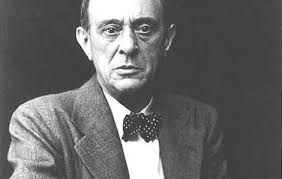
    Above: Arnold Schoenberg

    ~ Author: Oberon

    Tuesday March 11th, 2025 – A rare chance to hear Arnold Schoenberg’s Verklärte Nacht played live drew me to Weill Hall tonight where the work was on a program offered by Decoda, an ensemble of musicians who had first met while playing with Ensemble Connect.

    Songs by two pairs of husband-and-wife composers – the Schumanns and the Mahlers – opened the evening. Pianist Mika Sasaki played Robert Schumann’s “Eintritt” from Waldszenen, a melody that describes entering the forest path. Baritone Thomas Meglioranza and Ms. Sasaki then offered Herr Schumann’s Sehnsucht nach der Waldgegend“; any song with ‘sehnsucht’ (longing or desire) in the title is bound to please me.

    A sextet of string players now joined the pianist for Clara Schumann’s “Geheimes Flüstern“, in an arrangement by Clara Lyon; this brought forth soprano Lucy Fitz Gibbon, her voice light and charming.  

    Mr. Meglioranza stepped forward again for Gustav Mahler’s “Ich ging mit Lust durch einen grünen Wald” (arranged by Brad Balliett), expressively sung.

    Alma Mahler’sLicht in der Nacht” was sung by Ms. Fitz-Gibbon in an arrangement by Terry Cook (could this be the Terry Cook, a popular Met Opera basso who sang nearly 200 performances with the Company from 1983 to 2006?), accompanied by the sextet.

    During this lieder segment of the program, Ms. Fitz-Gibbon and Mr. Meglioranza did not lend an operatic feeling to their singing, but rather sounded like they were performing among friends at the Schumann’s salon.

    [Special note: anyone with an interest in Alma Mahler’s life and work should seek out the film Bride of the Wind.]

    From the concluding Alma Mahler song, the music led directly into the Schoenberg masterpiece, Verklärte Nacht; the players were Anna Elashvili and Clara Lyon (violins), James Thompson and George Meyer (violas), and Hannah Collins and Claire Bryant (cellos).

    The work was inspired by a collection of poems by Richard Dehmel published in 1896. Entitled Weib und Welt (Woman and the World), the saga speaks of a man and a woman as they walk through the moonlit woods on a frigid but clear winter evening. Guilt leads the woman to admit that, craving motherhood, she had become pregnant by another man before meeting and falling in love with her current amour. The woman stumbles miserably on in the silent darkness; but then the man tells her, “Do not let the child you carry burden your soul.” He pledges that he will love and care for the unborn child as if it were his own. They embrace, and they continue their walk on into the night, their love transfigured thru forgiveness.

    Played without break, the score mirrors the five sections of the poem: throughout, Schoenberg continuously transforms themes and motifs into an expressive musical depiction of the poem. The composer travels the road from the opening line of the poem – “Two people walk through bleak, cold woods…” to its marvelous finale: “Two people walk through exalted, shining night….”

    The playing by the Decoda artists was nothing less than sublime; as individual voices, and in their harmonizing and phrasing, the sextet summoned all the magic that the composer packed into his writing. Of special note was cellist Hannah Collins, whose rich-toned playing was both poetic and powerful.

    Despite what seemed to me a riveting performance thus far, audience distractions during the first half of the program were especially annoying, climaxing with a dropped metal water bottle at a particularly poignant moment in the Schoenberg. Although the second half the program certainly sounded interesting –  a work by four composers featuring all the evening’s artists – I decided to head out, taking the memories of the Schoenberg home with me. 

    ~ Oberon

  • Voices from South Africa @ Weill Hall

    Siphokazi-Molteno jpg

    Above: Siphokazi Molteno

    ~ Author: Oberon

    Monday October 28th, 2024 – The Met Orchestra Chamber Ensemble presenting a program of classic and contemporary works at Weill Hall. I was very keen to hear mezzo-soprano Siphokazi Molteno. who represented South Africa at the 2023 Cardiff Singer of The World competition, and who made her Metropolitan Opera debut in 2022 as Flora in LA TRAVIATA.

    Ms. Molteno opened the evening with the Brahms “Viola songs”, a pair of lullaby-like solos accompanied by viola (Shmuel D. Katz) and piano (Thomas Lausmann). The Molteno voice has a marvelous contralto richness as well as a lyrical warmth; to say she put me in mind of the great Florence Quivar is the highest compliment I can give. It’s a voice full of ‘humanity’ and a voice I will hope to hear again…and soon. Her colleagues from the MET Orchestra played sublimely, setting the evening gorgeously on its way.  

    There was then a longish pause while the stage was set for the next work, which involved five musicians: Seth Morris (flute), Tal First (viola), Hannah Cope (harp), Gregory Zuber (marimba), and Jeffrey Irving (percussion). Ndodana-breen

    Above: composer Bongani Ndodana-Breen

    The composer’s choice of instrumentation for his Rain Making really drew me in: if there’s a marimba to be heard, I want to hear it…and likewise the harp. Mr. Ndodana-Breen composed this piece in memory of Queen Modjadi, one in a line of Rain Queens of the Balobedu people in the Limpopo province of South Africa. A Rain Queen is believed to have the power to control the rain and the winds. This mythic association made the music even more intriguing for me.

    The players made a wonderful blend and the evocative sounds included a rhythmical flute, a plucked violin, and a bean bag played by the percussionist. The flute and violin trade melodic phrases, the violin shivers, the melismatic marimba enchants. Then, to a big, pounding beat propelled by the bass drum, the storm comes: the Rain Queen’s magic has succeeded. I loved this music, and watching the musicians as they entered into the spirit of the ritual; my only complaint was that the piece is too short.

    Maurice Ravel’s sultry Chansons madécasses found a most congenial interpreter in Ms. Molteno. I first heard these songs in 1975 when New York City Ballet premiered a Jerome Robbins ballet of the same title; the singer was Lorna Myers. Since then, I have frequently listened to the songs on Mira Zakai‘s marvelous recording. 

    The first of the three songs, Nahandove, has a beautifully sultry feeling: it tells of the seduction of a native woman. Jerry Grossman’s cello opens the piece, and Ms. Molteno’s voice is at its most sumptuous as she begins this tale of longing and ecstasy. Jazzy piano rhythms from Mr. Lausmann and the sound of the piping flute (played by Maron Khoury) develop a rocking feeling; the music turns pensive and then caressive. With the song’s final strophe, “Tu pars...” the tryst ends, though it seems the lovers will meet again at sunset.

    The second song, Aoua!, opens with the singer screeching a warning: do not trust the white men! The piano takes up a swaying rhythm as Ms. Molteno continues with singing of great intensity. This is violent, angry music, though eventually the cello and flute sound forlorn.

    By contrast, the final song – Il est doux – is a languid reflection on the joys of resting the shade of a tree on a late afternoon, while a lover whispers in your ear. The sensuous flute, the eerie cello on high echoing the buzzing insects with a trill, the voice and the cello entwining, solitary notes from the piano…so atmospheric.  Ms. Molteno’s singing was evocative and so pleasing to experience. The song ends with the swiftly spoken dismissal: “Go and prepare the evening meal…” 

    Mvd2022 jpg

    Following a longish interval, an ensemble of eight instrumentalists took the stage for music by Matthijs Van Dijk (above): we heard his extraordinarily powerful oratorio Moments in a Life. I had previously heard one of this Cape Town-based composer’s works [(rage) rage against the] played by the Signum Quartet in this very hall. 

    Thus, I expected a lot from the composer’s Moments in a Life, composed in 2016 for string quintet, clarinet, percussion, piano, overtone singer & narrator. Could lightning strike twice in the same place? The answer is a resounding YES!…Moments in a Life is one of the most powerful works I have ever experienced.

    The oratorio is based on the writings of Denis Goldberg, a native of Cape Town whose parents were politically active. In 1957, Denis joined the (banned) Communist Party and he was arrested and jailed in 1960 for supporting strikers. In the mid-1960s he was with other freedom fighters who were arrested for illegal acts and jailed. He remained a prisoner for 22 years, constantly being tortured and threatened with death.

    Gareth-lubbe

    At this evening’s performance, Gareth Lubbe (above) was the narrator. Mr. Lubbe is also an overtone singer; this is a technique in which the resonance in the mouth and throat are combined with tongue, lip, and jaw movements which create a perception of overtones as being individual notes. It’s a sound that is eerie…and fascinating.

    Moments in a Life, conducted by William Long, gives us so much to take in in its 40-minute duration. Trying to follow the narrative whilst also listening to the music was a bit of a challenge for me, a dedicated note-taker: I filled three pages with notes which barely scratched the surface of the work.

    “I was sure we would not die in prison,” marks the oratorio’s opening line. As the narration moves forward, the writer recalls his first teacher, who he fell in love with. He speaks of not seeing his wife and children for more than two decades while imprisoned. A fellow freedom fighter, Looksmart Ngudle, was tortured to death. Freedom costs.

    Nelson Mandela defends the accused patriots: “An ideal for which I am prepared to die”. Sentenced to life in jail, they are moved to a harsher prison affectionately known as “Beverly Hills”: three thousand prisoners singing hymns as individuals are led away to be hanged. Ironically, a gorgeous musical theme underscores this tragedy.

    Periodically thru the work, Mr. Lubbe’s overtone singing makes a striking impression: an indescribable mixture of humming and whistling.

    As to the music, the opening measures are pensively played by clarinetist Jessica Phillips: a slow, wide-ranging solo, soon joined by piano and strings. Cellist Mariko Wyrick underscores the story of the teacher, Ms. Cook. Andrew Gantzer’s double bass, so impressive throughout the piece, tells of Looksmart’s ordeal.

    Mr. Lubbe’s voice growls deeply; percussionist Jeffrey Irving plays a rollicking ‘cadenza’. Beauteous strings, the clarinet sings again; here are glowering chords and a lament played by violist Shmuel D Katz. Mr. Lubbe has an unaccompanied solo.

    Pianist Katelan Trần Terrell and Mr. Gantzer’s bass establish a beat; Mr. Katz strums his viola. A sudden militant outburst forebodes the assassination of activist Chris Hani; a poignant violin passage (Yurika Mok and Yang Xu) underscores the narrator’s reflections on Chris’s death.

    “A petty exercise of power that harms our people.”

    At last, in the forced-labor setting of The Quarry, where Nelson Mandela and his brother freedom fighters languished, a glorious theme of hope develops: “Let Freedom Reign”. Mr. Lubbe’s otherworldly overtones are heard over a long, sustained chord.

    The audience, who had witnessed the performance is a state of awed silence, now gave the performers a fervent round of applause.  

    Back home, I went to YouTube to see what I could find about this powerful work and immediately discovered this incredible document: Moments in a Life, recorded live in concert in the Endler Hall at the Stellenbosch International Chamber Music Festival on July 16th, 2016. This, I believe, was the work’s world premiere, with Denis Goldberg – then aged 83 – reading the texts (drawn from his autobiography) himself. The great freedom fighter passed away in 2020. 

    The work is so timely right now, when our democracy stands on a precipice. If we falter, our country – and indeed the world – will be forever changed.

    ~ Oberon

  • In Recital ~ Ema Nikolovska @ Weill Hall

    Ema-Nikolovska-Photo-by-Kaupo-Kikkas jpg

    Above: Ema Nikolovska, photo by Kaupo Kikkas

    Author: Oberon

    Thursday March 28th, 2024 – Earlier this year, I was looking to add a vocal recital – by a singer I had never previously heard, in an intimate setting, including some songs that would be brand new to me – to my late-winter calendar.  Flipping thru the Carnegie Hall brochure, I zeroed in on tonight’s offering at Weill Hall: Macedonian-Canadian mezzo-soprano Ema Nikolovska, with Howard Watkins at the piano. I listened to about ten seconds of her singing on YouTube and requested a ticket. I’m so glad I was there.

    I must say at the start that it was a recital wherein the encore proved the highest highlight of the evening. Ms. Nikolovska announced this work, which she had commissioned, prior to singing it, and now I am casting about, trying to find more information about it, since I did not catch the name of the composer. 

    But to begin at the beginning, the mezzo-soprano and her collaborating pianist offered four songs by Franz Schubert. She chose songs somewhat off the well-trodden Schubert path, some of which were brand new to me.

    Im Frühling” was the most familiar. From its opening phrases, I sensed a large voice that had been tamed and polished. It took a few warm-up measures before things began to flow, but within seconds Ms. Nikolovska was ravishing the ear with her keen sense of nuance, and her expressive diction.

    Howard-watkins

    In “Dass sie hier gewesen” it became clear that Mr. Watkins (above) was so much more than an accompanist: his artistry is deep, and he plays from the heart. Ms. Nikolovska here displayed her gift for introducing straight tone into her singing, and the effect was enchanting. Mr. Watkins opened “Herbst” with a rippling restlessness, and then the music took on a sense of urgency. The song has an Erlkönig feel to it. Ms. Nikolovska’s subtle inflections and Mr. Watkins’ marvelous playing drew us deeper and deeper into the music.

    The Schubert set ended with the longest of the songs, “Der Unglückliche” which felt like an intimate mini-opera. The piano opens with a darkish sense of doom, and the voice moves from pensive to intense. We pass thru many moods in this dramatic and engrossing song.

    Ms. Nikolovska then spoke, rather at length, about the program. When the music resumed, it was Richard Strauss’ very brief “Nichts” that re-established the mood with its big piano intro and its final vocal outburst. A thoughtful atmosphere is established in “Gefunden“, which turns melodic and ends with Ms. Nikolovska on a gorgeously sustained, dreamy final note. We remain in dreamland with the opening of “Das Rosenband“, which soon gives way to rapture. Ms. Nikolovska was simply sublime here, her soft singing so engaging, and so beautifully controlled. The straight tone moments were spine-tingling, with awesome dynamic control, and a high-lying passage near the end which was magical. Mr. Watkins, in the piano postlude, was equally impressive.

    Songs of the Seasons, by Margaret Bonds, sets four poems of Lankston Hughes. A touch of jazz inflects Autumn, while a slow sway and dreamily sustained pianissimi evoke a cozy afternoon before the fire as snow falls outside in Winter. Mr. Watkins sets a music hall mood with sparkling motifs for Spring; this song has a big finish, and leaves it to Ms. Nikolovska to spin out a delectable diminuendo. The pianist introduces Summer with animated playing which becomes an infectious rhythm.

    An over-long intermission threatened to break the spell, but at last we were drawn back into the alternate universe by Debussy’s atmospheric Ariettes oubliées. The first song, “C’est l’extase langoureuse“, is aptly named, as its sense of languor is so finely evoked by the composer…and so perfectly captured by pianist and singer. The sweet sadness of “Il pleure dans mon coeur” was immediately conjured up by our two musicians: Ms. Nikolovska exploring the wide vocal range with uncanny dynamic control, and Mr. Watkins at his most poetic. The pianist was exceptional in “L’ombre des arbres“, while the singing was tinged with a sensual glow.

    In a mighty mood-swing. we are suddenly on a carousel for “Chevaux de Bois“; yet even here, the excitement and energy winds down as the circling horses slow their pace. Ms. Nikolovska followed the pianist’s delicate introduction to “Green” with some of her most delicious singing of the evening, finding heaven in her final phrase. For the concluding “Spleen“, the pianist creates a mysterious mood, and the singer ‘speaks’ on one note before a moody melody emerges, which the Nikolovska voice caresses with uncanny pianisssimi.

    Another treat follows with two songs by Nicolas Medtner: “Twilight” and “Sleeplessness“. The first is a hymn to nature, introduced by descending motifs from the keyboard. The song has a lovely lyrical feel, and Ms. Nikolovska’s sustained tones were again an outstanding feature. “Sleeplessness” has a dirge-like start; the singing grows more urgent, then recedes to resignation and ends with a vocalise.

    In a total change of atmosphere, Ms. Nikolovska introduced Nicolas Slominsky’s Five Advertising Songs: cabaret-type numbers that extol, in turn, bed linens, bran muffins, face powder, Fletcher’s Castoria, and Pepsodent toothpaste – the last two very familiar to me from my childhood in the Little Town. Ms. Nikolovska proved a sporting, lively comedienne, moving about the stage and playing to the crowd like a carnival huckster. It was all in good fun, but the best was yet to come.

    The encore – and I will find out its title and composer as soon as I can – was commissioned by Ms. Novolovska and draws on a Macedonian song. The Sun, The Moon, and The Forest are each evoked in turn. The music has an improvisational air, with melismas and winding melodies for the voice. Meanwhile, Mr. Watkins often reaches into the piano to place glissandi like a harp. The vocal line ranges from the subtlety to powerful passion, and it all ends in a whisper. 

    UPDATE: I now have details of the encore. The song, Zajdi, zajdi, jasno sonce, was composed by Aleksandar Sarievski, and arranged for Ms. Nikolovska by Darija Andovska.

    I also found that Ms. Nikolovska gave a second encore at her recital, after I had slipped out to catch my train, Incredibly, it was the Composer’s aria from Strauss’s ARIADNE AUF NAXOS…my favorite opera. I can’t believe I missed it!

    May I suggest to Ms Nikolovska that she make the arrangement of Zajdi, zajdi, jasno sonce an integral part of her recital programs. Everyone should hear it!

    So now, I am in hopes that Ms. Nikolovska will return to our City before too long, and that we might hear her Wesendonck Lieder.

    ~ Oberon

  • Ensemble Connect @ Weill Hall

    Connect = Photo-Credit-Fadi-Kheir jpg

    Above: the artists of Ensemble Connect; photo by Fadi Kheir

    Author: Oberon

    Tuesday February 21st 2023 – Ensemble Connect offering a wide-ranging program at Weill Hall this evening, opening with Jennifer Higdon’s Dark Wood, a work for bassoon and piano trio. Nik Hooks, the Ensemble’s excellent bassoonist, kicked off his busy evening here (he played in three of the four works); for the Higdon, he was joined by pianist Joanne Kang, cellist Laura Andrade, and guest violinist Stephanie Zyzak. The piece’s title refers to the lustrous, deep-dark polish of the bassoon. 

    Dark Wood opens with staccati for the bassoon and piano; the plucking violin and cello soon join. The music is jagged, buzzing with trills and big accents, full of nervous energy. A prolonged note for bassoon launches a sprightly, animated passage; then the piano begins to rumble, the bassoon and cello playing deep. Another long, dark bassoon tone leads to slithering strings and a pulsing piano motif.

    CH11325029

    Above: bassoonist Nik Hooks; performance photo by Fadi Kheir

    The violin and cello sigh, and things turn dreamy. Dotty violin notes sound over a wistful bassoon melody and then the cello offers a rich theme; this is all quite beautiful to hear. Things perk up, with the bassoon trilling and the strings sizzling, and then Ms. Kang at the keyboard takes over, with big playing, agitated and insistent. Heartfelt strings and a forlorn song for bassoon and piano follow; Ms. Kang offers plucked notes with a “prepared piano” sound, the others playing poignantly. Now the music rushes forward, somewhat chaotically, to a brisk finish.

    Ms. Kang and Mr. Hooks were soon back onstage for Mozart’s delightful Quintet for Piano and Winds in E-flat Major, K. 452, joined by three more of the Ensemble Connect’s brilliant wind players: Amir Farsi (flute), Jasmina Spiegelberg (clarinet), and Cort Roberts (horn).

    Mozart apparently thought highly of this piece, and he would doubtless have loved this evening’s performance of it. It opens rather hesitantly; Mr. Roberts plushy, golden tone immediately grabbed me,  frustrated high-school horn player that I am. The blend of wind voices was sonorous, and after the piano introduces a new and more animated theme, it is passed about from instrument to instrument.

    CH11325032

    Above: Cort Roberts (horn) and Jasmina Spiegeberg, clarinetist; performance photo by Fadi Kheir

    The Larghetto brings us a gracious, courtly melody, with Ms. Spiegelberg’s lambent tone and persuasive phrasing leading the way; flute, horn, and bassoon take up the line in succession. A bel canto atmosphere  develops, with the piano offering accentuations; Mr. Roberts’ horn cavatina is so stylish, with the others harmonizing expressively.

    The final Rondo/Allegretto rolls along, each player showing a vibrant sense of virtuosity: a sustained flute trill from Mr. Farsi was but one of many decorative delights.

    Wiancko

    Above: composer Michi Wiancko

    Michi Wiancko’s 7 Kinships, a Carnegie Hall commission, was having its New York premiere this evening. The composer charmingly introduced the work; she spoke of how 7ths and 9ths express a feeling of longing. I could not agree more.

    CH11325030

    Above: The evening’s wind players – Mssrs. Farsi, Hooks, and Roberts, and Ms. Spiegelberg – giving a sterling performance of the Wiancho; performance photo by Fadi Kheir

    In the work’s seven brief movements, Ms. Wiancho’s thoughtful craftsmanship gave the players ample opportunity to revel in their artistry. The music ranges from lyrical to animated, with moods veering from  whimsical to lamenting. The sounds of the instruments entwine to delight the ear, sometimes in strange harmonies, whilst rhythmically the composer displays touches of wit. The musicians seemed to genuinely enjoy playing this music.

    Before commencing the program’s final work, Robert Schumann’s Piano Quintet, violist Halam Kim read one of the composer’s letters to his beloved Clara; I admit this outpouring of love brought tears to my eyes. And then to recall that it was Clara who played the quintet’s demanding piano part at the work’s public premiere, making it all the more touching.

    CH11325026

    Above, playing the Schumann: Mr. Rengel, with Mlles. Zyzak, kang, Andrade, and Kim; photo by Fadi Kheir

    The Ensemble Connect’s marvelous violinist, Rubén Rengel, led the ensemble, with Ms. Kang honoring Clara Schumann with her delectable playing, and Mlles. Zyzak, Kim, and Andrade all sounding gorgeous.

    This beloved work is bursting with magical passages: the ‘dialogue’ for cello and viola in the opening movement, a theme to which Mozart frequently returns, is especially endearing, and in the dirge-like second movement, Mr. Rengel ‘s playing is exceptional. Mlles. Zyzak and Kim take ups this calmly funereal theme, and Ms. Abdrade’s sumptuous tone is ever at the heart of the matter.

    In the bustling Scherzo, Mr. Rengel is again in his element, and Ms. Kang has much to do, her rising scales setting the scene for a fast dance, her music-making on the grand scale. It is Ms. Kang who initiates the final Allegro ma non troppo with her scintillating playing. A hymn-like interlude arises, and then low rumblings from the piano develop into a slow sway; this then accelerates, dancing us on to the finish.

    All performance photos by Fadi Kheir, courtesy of Carnegie Hall.

    ~ Oberon

  • Ensemble Connect Delights @ Weill Hall

    Screenshot 2022-10-25 at 07-45-30 Ensemble Connect

    Monday October 24th, 2022 – When I saw the announced program for this evening’s concert by Ensemble Connect at Weill Hall, I knew I had to be there: what an enticing line-up of composers…and, in the event,  it was all so dazzlingly played!

    The young musicians of Ensemble Connect are exceptionally talented; all the music tonight sounded fresh and vibrant. They are also appealing to watch. The works on this well-contrasted program spanned the years from 1717 to 1994, and it was a sonic feast from first note to last. 

    CH11266821

    Above, playing the Martinů: Yasmina Spiegelberg, Garrett Arney, Laura Andrade, and Cort Roberts; photo by Fadi Khier

    Bohuslav Jan Martinů’s rarely heard Quartet for Clarinet, Horn, Cello, and Side/Snare Drum, H. 139, dates from 1924. This rather quirky mix of instruments does – as hornist Cort Roberts pointed out in his introductory remarks – represent the four ‘families’ of the symphony orchestra: strings, winds, brass, and percussion. What delightful sounds we heard from Mr. Roberts and his colleagues: Yasmina Spiegelberg (clarinet), Laura Andrade (cello), and Garrett Arney (snare drum).

    The work is full of wit and irony, yet in the central Poco Andante comes a poignant lament that is extraordinarily moving. Snare drum and cello lead off the opening Allegro moderato, which becomes march-like as the clarinet and horn join in. A trudging feeling develops, with a horn solo which later shifts to the clarinet. The music seems about to fade away, but there’s a big bang ending.

    As the Andante commences, my companion and I were simply blown away by the depth and beauty of tone that cellist Laura Andrade produced. Ms. Andrade played in all four works this evening, and maintained her beautiful sound and sterling musicality at every moment. Ms. Spiegelberg joins the cellist with a rather mysterious air; Mr. Arney’s snare drum comments on the women’s duet, and then Mr. Roberts’ mellow horn sounded a somber theme. The cello solo returns to the touching opening passages, played with heart-rending beauty.

    At the jaunty start of the concluding Allegretto, the voices enter one by one: drum, cello, clarinet, horn. The music jogs along, with the horn ringing forth. After the instruments have exchanged lively, wry phrases, there is a little unison coda to round things off. Such a wonderful way to open the evening, and what a stroke of genius on Martinů’s part to center the work on that profound lament.

    The petite but hugely talented pianist Joanne Kang now joined the impressive Venezuelan violinist Rubén Rengel and Ms. Andrade for a simply glorious performance of Clara Schumann’s Piano Trio in G-Minor, Op. 17. Their playing was tremendously beautiful and moving, and they are as attractive to watch as to hear; their performance of this masterwork seem so vital and immediate, making it an outstanding musical experience of recent seasons

    Clara Schumann’s writing shows a mastery of counterpoint and a heartfelt gift for melody. It’s music alive with romantic ardor. The opening Allegro moderato begins in a melancholy mood, and soon develops a passionate flow of lyricism, with dramatic outbursts along the way adding a sense of urgency. Ms. Kang kept the momentum going with her perfect timing, whilst Mr. Rengel and Ms. Andrade displayed rich, abundant tone as one lustrous theme after another sprang up.  The Scherzo – “in the tempo of a minuet” – commences with an elegant passage for violin and piano; it is gentle, pensive music, and again Ms. Andrade’s plush sound warmed the soul.

    Ms. Kang lovingly played the Andante‘s waltz-like opening, soon joined by the hushed, poetic sound of Mr. Rengel’s violin; their blend carries them thru captivating harmonies. The music gets a bit wild, only to be calmed by more gorgeousness from the Andrade cello. Achingly beautiful playing from these young artists, with the cellist rounding everything of with a simple descending scale that brought tears to my eyes. 

    The trio’s final Allegretto brought forth more dazzling playing from the three musicians; Ms. Kang in particular shown here with sumptuous, large-scale playing and – later – passages of glistening arpeggios. Following a mini-fugue, the music gets grand, only to simmer down to a melody of longing, then moving onward to its epic finish. My companion and I were so thrilled by this rapturous performance.

    Eleanor+Alberga

    Following the interval, music by the Jamaican-born composer Eleanor Alberga (photo above): her String Quartet No. 2. As violist Halam Kim remarked before the playing started, the entire 18-minute single movement develops from a very brief descending phrase that opens the piece; this Mr. Rengel dashed off for us as an introductory demo: it lasts less than a second.

    From its active start, dance-like with dazzling dissonances, the piece moves on with complex harmonies and rhythmic shifts as well as witty touches, such as a repetitive figuration for the 2nd violin (Brian Hong) that made me smile. Mellowing to an andante section laced with enticing harmonies, we arrive at an intriguing passage where tremolo shivers from Mlles. Kim and Andrade underscore an eerily harmonized theme for Mssrs. Rengel and Hong. Ms. Andrade’s knockout cello playing continues to fascinate us, whilst plucked notes from Ms. Kim and Mr. Hong support a high-flying passage for Mr. Rengel’s violin.

    CH11266889

    Above, playing the Alberga quartet: Rubén Rengel, Brian Hong, Laura Andrade, and Halam Kim; photo by Fadi Kheir

    The music dances on, getting dense and with a big buildup until it turns heartfelt and lush; we seem to be headed to the finish line, but…no: a delightful return of the tremolo viola/cello combo with woozy violins pops up before the music’s energetic final measures. The piece was enthusiastically received; I was hoping Ms. Alberga might be among the audience so we could hail her for her colorful, marvelous score.

    There was a slight delay before the evening’s concluding piece as a technical glitch with the tablets took some straightening out. Ah, for the simple beauty of a paper score!

    CH11266818

    Above: the ensemble playing Bach; photo by Fadi Kheir

    It was with J. S. Bach’s Brandenburg Concerto No. 5 that the evening closed. The large ensemble featured all the players from earlier in the evening, plus bassoonist Nik Hooks – a player with rich, amiable tone and agile technique – and the proverbially “tall, dark, and handsome” Iranian/Pakistani/American flautist, Amir Farsi: limpid of tone, with a personable presence as he bends and sways to the music. Mr. Hooks and Ms. Andrade provided a very high-class continuo, with Ms. Kim and Mr. Hong the supporting strings. Mr. Rengel and Mr. Farsi played magnificently, and there was truly a sense of magic in the hall as the performance unfolded.

    CH11266826

    Above, Joanne Kang at the harpsichord for the Bach; photo by Fadi Kheir

    Of course, this is “the Brandenburg with the harpsichord”, and Mr. Kang gave us a fleet-fingered and fabulous rendition of the long cadenza. The audience, and her colleagues, could not resist breaking in with applause for her stunning playing, one of the highlights of the evening. Other treats in the Bach were the poignant blending of Mr. Rengel’s violin with Mr. Farsi’s flute in the Affetuoso, and the light and lively finale wherein Ms. Andrade and Mr. Hooks put the continuo in the spotlight.

    CH11266799

    Above, the principal players for the Bach: Rubén Rengel, Joanne Kang, and Amir Farsi; photo by Fadi Kheir

    Such a pleasing and deeply satisfying evening! For two hours, the woes of the world and the cares of daily life were forgotten. A thousand thanks to these dedicated musicians, and to the music that makes life worth living.

    All photos by Fadi Kheir, courtesy of Carnegie Hall.
  • Cellist Zlatomir Fung @ Weill Hall

    Zlatomir-Fung

    Tuesday October 19th, 2021 – One of my favorite musicians, Zlatomir Fung, made his Carnegie debut this evening at Weill Hall, a red-letter event for me. Zlatomir, whose unique name derives from his Bulgarian and Chinese-American parentage, was the first American in four decades – and the youngest cellist ever – to win first prize at the International Tchaikovsky Competition in 2019.

    I first heard Mr. Fung in a Young Concert Artists recital at Merkin Hall in February 2019, and was captivated by his remarkable talent. Read about the evening here.

    Mishka

    Joined at Weill Hall this evening by pianist Mishka Rushdie Momen (above), the cellist gave us a marvelous program of classics from the Romantic period. The concert was sold out, and the audience’s rapt attention was a tribute both to the music and to the musicians. 

    Robert Schumann’s Adagio and Allegro, Op. 70, was composed in 1849. The pensive adagio, heart-tugging in its emotional expressiveness, gives way to the lively and passionate allegro, a deft flow of music that sometimes looks back to the opening movement. From note one, I was transfixed by Mr. Fung’s achingly beautiful playing, which drew me – and my fellow audience members – immediately in to the music.

    Franz Schubert’s Sonata in A-Minor, D. 821, “Arpeggione“, was written in 1824, soon after the beloved song cycle Die Schöne Müllerin and shortly before the C-major symphony.

    The sonata’s opening movement is a songful allegro moderato, tinged with a feel of nostalgia. A dance springs up, with a folkish flavor, and a passage of staccati from the cello aligns with sparkling notes from the piano. The movement continues, shifting between sadness and joy…a sort of reflection on the times in which we are living. 

    From its poignant opening, the sonata’s central adagio found Mr. Fung at his most persuasively eloquent as the music carried him across a wide dynamic range, leaving the listener in awe of his sustained, finely nuanced phrasing. Ms. Momen was a ideal companion. This was music-making of the highest calibre.  

    The concluding allegretto is energetic, at times having with a somewhat jaunty feel; both players displayed great  nimbleness, dancing us along to a surprisingly subdued finish. 

    Antonín Dvořák’s “Silent Woods“, Op. 68, No. 5, was – to me – the heart of the evening; subtle dynamic shadings from both players constantly allured the ear, and the astonishing resonance in Mr. Fung’s playing reached the depths of my soul. A dance-like passage gives way to a wave of passion; this subsides only to sweep over us again moments later. Mr. Fung’s glorious descending phrase at the end was thrilling.

    The musicians took only the briefest of breaks between works, but they seemed wonderfully fresh as they returned to the Weill Hall stage for the program’s concluding work: César Franck’s epic and very demanding Sonata in A-major. The cellist Jules Delsart was so moved when he first heard this sonata in its original violin setting that he obtained the composer’s permission to arrange the work for his own instrument. This arrangement was published in 1887.

    The sonata’s opening Allegretto ben moderato joins two themes: one for the cello and one for piano. These themes, especially the cello’s, will return in the following movements. The players seemed to gently bend the melodies, putting a personal stamp on this familiar music. 

    Turbulence rises for the second movement, a dramatic scherzo, in which the restless piano is over-lain with a vivid, dramatic passage for the violin. Lyrical moments, featuring this sonata’s second well-loved theme, come and go. From a veritable feast of notes, passion rises with the great melody sounding forth. Becalmed, deep resonance from the cello lingers briefly, then another rise to a triumphant finish.

    The Recitativo-Fantasia brings back sonic images from the previous movements. There is a feeling of improvisation here which leads in a slow buildup to another haunting melody for the cello. Then the final Allegretto con moto commences with the piano and cello seemingly exchanging thematic thoughts. Things grow turbulent again, and earlier themes resurface, all leading to a vibrant, joyous ending.

    Enthusiastic applause, the audience standing, brought Mr. Fung and Ms. Momen back for an encore: a Nocturne by Alexander Borodin which was unfamiliar to me. This was elegantly played, with appealing dynamic shifts and a spine-tingling tremelo passage from the cellist. As throughout the evening, I loved watching Mr. Fung’s expressive face as he played; he seemed to be communing with Saint Cecilia, all to the greater glory of the music.

    ~ Oberon

  • Sabine Devieilhe as Olympia

    Snapshot sabine

    French soprano Sabine Devieilhe sings Olympia’s showpiece “Les Oiseaux dans la Charmille” from Offenbach’s CONTES D’HOFFMANN. Watch and listen here.

    In January 2019, Mlle. Devieilhe gave a recital at Weill Hall here in New York City that was simply delightful. 

  • Gregory Feldmann|Nathaniel LaNasa @ Weill Hall

    83265515_10157528132085353_8525152423453392896_o

    ~ Author: Oberon

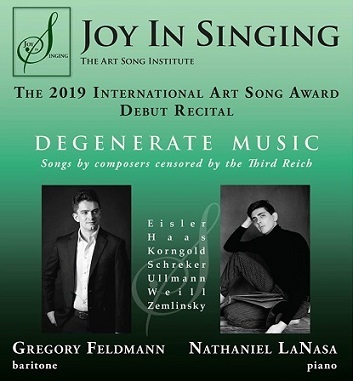
    Thursday February 27th, 2020 – Baritone Gregory Feldmann, recipient of the 2019 Joy in Singing Art Song Award, in recital at Weill Hall. Pianist Nathaniel LaNasa was the singer’s collaborator in a program of songs by composers whose music was suppressed under the Nazi regime.

    The program was particularly timely, living as we are during a period when our own government seems hellbent on destroying our democracy. It’s ironic that we fought Facism in the 1940s – and that in recent years we have sent our soldiers into harm’s way in faraway lands, purportedly to bring democracy and freedom to the oppressed – only to find our country is now under threat from within. With these thoughts in mind, tonight’s concert became much more than just another lieder recital.

    Mssrs. Feldmann and LaNasa, looking dapper in black bow-ties, took the stage to a hearty welcome from the packed house. The first half of their program was given over to songs by such well-remembered composers as Kurt Weill, Franz Schrecker, Alexander von Zemlinsky, and Erich Korngold.

    Kurt Weill’s cabaret-style “Berlin im Licht” opened the evening. Weill had been living in Paris – and then in New York – since 1933. But this song was composed for the Berlin Festival of September 1928 (ten years after Germany’s humiliation in World War I); that event marked a resurgence of German pride in its cultural endurance that would eventually fuel Hitler’s rise to power. Tonight, Mr. Feldmann and Mr. LaNasa gave the song a swinging, optimistic treatment.  

    Franz Schreker had died in 1934, but his music was still proscribed by the Third Reich. In three Schrecker songs, the musical attributes of this evening’s two artists came to the fore. In the Straussian style of Und wie mag die Liebe“, Mr. Feldmann’s handsome lyric baritone – and his persuasive way with words – assured us we were in for a great deal of very fine vocalism tonight. Of equal appeal was Mr.LaNasa’s playing, especially in the song’s postlude. 

    The partnership of the two musicians made for a luminous “Sommerfäden”, wherein the duo showed an affinity for Viennese-style melody. The shimmering piano introduction was enticingly played by Mr. LaNasa; this song has a rapturous mid-section, and then a big, operatic outpouring where Mr. Feldmann’s voice rang true.

    Stimmen des Tages” is darkish and unsettled at first; mood swings carry the two musicians thru to a passionate passage. Following a pause, the song resumes as if from the start. The gorgeous piano postlude was a treat in itself in Mr. LaNasa’s rendering.

    Four Alexander von Zemlinsky songs were most congenial to the Feldmann voice. The composer, who had moved to Vienna in 1933 and then on to New York City in 1938, was largely forgotten in Germany. His songs have long attracted great singers, and in the first three tonight – “Tod in Ähren“, “Nun schwillt der See so bang “, and “Entbietung” – singer and pianist were simply superb. “Tod in Ähren” stood out for me: following its big opening from the keyboard, it becomes a lament. Both musicians were so persuasive in this song’s gentle lyricism, and in the tenderness of farewell.

    The final Zemlinsky offering, “Afrikanischer Tanz” (African Dance), was a complete change of pace: aggressive and blood-stirring!  Mssrs. Fedmann and LaNasa caught the mood perfectly, and the song drew a whooping response from the crowd. 

    Erich Korngold, best-known of the evening’s composers (well, aside from Kurt Weill), was famous for his opera DIE TOTE STADT and for his film scores. He was already established in Hollywood by the time World War II broke out. Tonight we heard a set of four Korngold songs, of which the last – “Vesper” – was of particular appeal, with the piano’s repetitive notes evoking the evening chimes, and a vocal line that took the singer into his upper range. The song’s sustained ending was wonderfully evocative.   

    Following the interval, works by a trio of less fortunate composers: both Viktor Ullmann and Pavel Haas were sent to Theresienstadt, and then on to Auschwitz where they both perished in 1944, whilst Haans Eisler faced trials of a different sort.

    Ullman’s Liederbuch von Hafis consists of four songs, in which jazz influence can be felt. In the bouncy and ironic “Vorausbestimmung”, the music goes deep before one final bounce from the keyboard. In the following song,  “Betrunken” (Drunk), agitation finds a lull before proceeding on its droll trajectory.

    Mr. Fedmann’s lower range settled in nicely for “Unwiderstehliche Schönheit” (Irresistible Beauty), perhaps the most interesting of the Ullmann set: the piano takes up a trudging motif, a sort of tongue-in-cheek march. It is briefly interrupted by some bright, tinkling keyboard phrases before the pacing resumes. This leads immediately into the final song,”Lob des Weines” (In Praise of Wine), a salute to intoxication. Mssrs. Feldmann and LaNasa certainly had fun with this cycle. 

    Pavel Haas, who was Czech, drew on ancient Chinese texts for his Four Songs on Chinese Poetry; their sensual nature immediately won the label “degenerate”, and they offered so much fascination tonight as singer and pianist drew us along Haas’s musical pathway.

    The songs are full of longing – for home and for loved ones – which must have seemed all too poignant to Pavel Haas, who left his wife and child behind when he was deported. A recurring motif in the songs is a four-note musical ‘message’, referring to the Chorale to St. Wenceslaus: representing home and freedom, this small token would have been meaningful to other Czech prisoners at Terezín.

    In these four songs, Mssrs. Feldmann and LaNasa covered a wide spectrum of rhythmic, melodic, and poetic moods. Lines such as “My home is so far away…” and “My yearning keeps me awake…” seemed so poignant, and were so thoughtfully expressed tonight. But all is not gloomy, for the final song – “A Sleepless Night” – suddenly gives way to the sound of a magpie chattering at dawn, depicted by the pianist.

    A native of Leipzig, Haans Eisler spent the war years in Hollywood, where he was a successful composer of film score. His troubles came later, when he was investigated by the House Un-American Activities Committee; his own sister denounced him as a Communist. Eisler was deported in 1948.

    It was with Eisler’s “Friedenlied” (Peace Song) that the concert tonight ended. With a folkish feeling, this ballad sets forth a vision of hope. Despite a very annoying cellphone interruption, Mssrs. Feldmann and LaNasa carried on, with the pianist savouring a final postlude.

    A Zemlinsky encore was the performers’ response to a very enthusiastic ovation.

    These observations by the evening’s two artists are truly meaningful:

    “When we memorialize victims of atrocities such as World War II,” wrote Mr. LaNasa, “we must also remember the conditions that led to such horrors, and the voices of those who tried to tell the world what they feared was approaching.” And Mr. Feldmann said, “We want to commemorate the lives and work of these artists by giving our audience the opportunity to respond to their work. The oppressors of their day prevented society from hearing these words and scores, and it’s a privilege for us to thwart that mission with music that is so beautiful and potent.”

    The vociferous applause at the end of the concert indicated that the price these composers paid is not to be forgotten…and that they live on thru their music.

    ~ Oberon

  • Pierrot Lunaire @ Carnegie Hall

    ~Author: Scoresby

    Thursday April 19 2018 – On a rather chilly Spring day, Carnegie Hall’s Ensemble Connect had one of its last Weill Hall performances of the season. Every two years the ensemble changes over its fellows and this particular set of musicians will move on in June. As this is the last Ensemble Connect concert I was attending this season, it was interesting to see the contrast between when these players first joined and how they play now.

    The program began with Mozart’s incredibly difficult six movement Divertimento for Violin, Viola, and Cello in E-flat Major, K. 563. The program book seemed to have a typo, listing this work as only 15 minutes long (instead of 45) – perhaps thinking of one of the far shorter and earlier Divertimento for String Quartet. This is a virtuosic tour-de-force piece for all involved because it has incredible exposure for all the instruments, here Rebecca Anderson on Violin, Andrew Gonzalez on viola, and Julia Yang on cello. Ms. Yang’s warm, robust sound stood out immediately – she managed to blend well with Ms. Gonzalez and Ms. Anderson matching vibrato perfectly. 

    Screen Shot 2018-05-04 at 12.55.23 PM
    Above: Ensemble Connect

    Stylistically, the group kept the Allegro light and bouncing. During the Adagio Ms. Anderson’s solo passages were played with a touch of sweetness while Ms. Yang’s ascending cello motifs brought a touch of nostalgia. The Andante (the fourth movement) is a charming set of variations – while every instrument gets its line to shine most impressive were the blending between Mr. Gonzalez and Ms. Yang during the active violin variation. They created a supple backdrop for Ms. Anderson to play the sweet melody. In the fifth movement, the group let the music seemed to have fun with the light bouncy textures and brought the music’s humor out by letting the phrases breathe. The duet between Ms. Anderson and Mr. Gonzalez was fully of energy and light-hearted spirit. While there were a few technical glitches – it was a fun performance of a difficult work. 

    The after-intermission performance demonstrated how much the players in ensemble have grown – it was not only a successful performance of Schoenberg’s Pierrot Lunaire – but one of the best performances I’ve heard this year. The instrumentalists were Rosie Gallagher on flute, Bixby Kennedy, on clarinet, Mari Lee on violin, Madeline Fayette on cello, and Mika Sasaki on piano. As is tradition in Ensemble Connect, before the work began there was a short talk about the music – only here Mari Lee interviewed ‘Schoenberg’s Ghost’, who was wearing a Pierrot-like mask. It was a fun and creative way to introduce the music that a more traditional group wouldn’t have dared to do and Ms. Lee’s earnest questions gave both humor and seriousness to it. It seems Ms. Lee adapted some of the material from her own project Salon Séance for the interview.

    Pierrot is one of the landmark works of the twentieth century. Not quite theatre, not quite music – it lies somewhere in-between in a chamber setting. It was Schoenberg’s first major work using free atonality and is before he came up with his twelve-tone system. Musically it is a piece at the height of German Expressionism, set to the brooding poems of Albert Giraud to paint different fragments of the psyche. It feels at once dream-like and nightmarish with extremes of emotion. In order to enhance this feeling, the group used simple lighting to heighten the drama –  they turned off the regular house lights and replaced them with white spotlights during the first section, blood red lights during the second, and back to white spotlights for third. In this darker atmosphere with the glittering Viennese style chandeliers, one really felt immersed into Schoenberg’s world.

    Unfortunately soprano Mellissa Hughes who was originally supposed to sing the soprano part withdrew due to illness. Luckily, Ensemble Connect managed to get one of the most venerable Pierrot singers alive today: Lucy Shelton.  She was simply spellbinding and elevated the level of the young players to match her. In Columbine the Ms. Lee and Ms. Sasaki’s violin and piano duo gave heft to match Ms. Shelton’s Meine banges Leid (my pain) and immediately changed dynamics to match the zu lindern (soothing). Such precise dynamics from moments like that were the hallmark of this performance – but at the same time the players swelled to match the more crazed sections of the piece.  Ms. Shelton for her part, embodied the music taking a no-holds-barred style. Using hand gestures to and acting to portray the different facets of the characters, from the wisps of nostalgia in the last movement to the crazed laughter and anxiety in the Rote Messe to the cackling gossip in the Gallows Song, Ms. Shelton seemed like she was a witch reciting an incantation and with the dream-like lighting she was spellbinding. In the small hall, her voice filled the entire space and one felt completely immersed – it felt like she was telling you a story and drawing you into her world complete with horrors, traumas, sweetness, and nostalgia for the past. Rather than just a “crazy” approach as many singers bring to this piece, Ms. Shelton captured all the nuance of emotions embedded in both the text and music. Her yearning for the past in the end sounded sweet and  wistful as she whispered “And dream beyond for blissful stretches, O old perfume–from fabled times!”

    Screen Shot 2018-05-04 at 12.54.11 PM
    Above: Soprano Lucy Shelton

    The instrumentalists were no less into the music. While perhaps the could have captured some of the softer tones and romanticism in the third book, they were all precise and together.  A powerful moment at the end of the third movement, Ms. Gallagher’s impressive fluttering as Ms. Shelton sung “With a ghostly moonbeam” – Ms. Gallagher capturing the timbres with precise but soft tones. Ms. Fayette during her nervous outburst in Rote Messe mimicked Ms. Shelton’s crazed line. In the interlude before the last song of the second book, Mr. Bixby deep clarinet melded with Ms. Gallagher’s playing. In that last song, Ms. Lee captured the same timbre as Ms. Shelton’s singing – sounding like a dreamed echo. Ms. Sasaki let the piano. During Gemeinheit Ms. Fayette and Ms. Gallagher matched their vibrato perfectly, creating an ethereal dream-like texture. 

    In the Barcarole, Ms. Lee, Ms. Sasaki, and Ms. Gallagher created a disorienting backdrop of what sounded like a drunken boat ride. All in all, this group of musicians worked hard to create an excellent performance – a great end to the last Ensemble Connect performance in Weill.

  • Pianist George Li @ Weill Hall

    Li

    Above: George Li

    ~ Author: Oberon

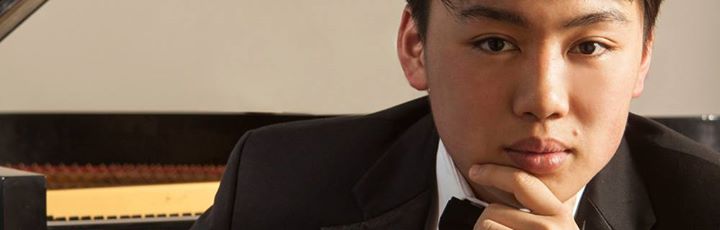
    Friday October 27th, 2017 – I first heard the young Chinese-American pianist George Li when he appeared at the 2015 Young Concert Artists gala; read about his marvelous performance here. Tonight I was glad of an opportunity to hear Mr. Li again, in a solo recital at Weill Hall.

    Small of stature, the 21-year-old pianist is a titan of talent. In a well-devised program this evening, he captivated his large and very attentive audience with playing on the grand scale: and while he is capable of massive volume and of veritable thunderbolts hurled from the keyboard’s lower octaves, Mr. Li also shows expert dynamic control in nuanced phrases and great sensitivity in passages of poetic expression. 

    Mr. Li’s choice of Haydn to open his program proved ideal. In the composer’s B-Minor Sonata (1776), the pianist was able, within moments, to display his broad dynamic range. The opening Allegro moderato alternated subtle turns of phrase with full-bodied, emphatic motifs. The sonata’s Minuet, a simple melody, turns somewhat grander in the trio section; Mr. Li delineated this shift to perfection. In the somewhat rambunctious final Presto, the pianist teased us with charming pauses between scales and trills, tossing off all the coloratura passagework in this unusual and inventive movement with complete clarity.

    The centerpiece of Mr. Li’s program was his interpretation of Chopin’s second sonata, which is built around its famous third movement: the Marche funèbre.

    From its turbulent opening, the opening Grave – Doppio movimento gave us a breathtaking display of the pianist’s gifts. The music is alternately seething and pensive, with a rising theme corresponding to a rise in the player’s passion. My notes on his playing were reduced to “Huge!”, “Thrilling!” and “Epic turmoil!” After a brief display of tenderness, the pianist became so searingly rhapsodic that I simply wrote “DAMN!”. In an electrifying moment, Mr. Li sustained the movement’s concluding chord and then suddenly pulled his hands off the keyboard to his chest. It was a gesture I’ll never forget.

    Following an agitato start and some darkly wild passages, the second movement turns into a slow waltz. Mr. Li wandered beautifully thru this musical landscape, reveling in his dynamic control. After a return to speediness, the music ends on a fading note: more magic.

    The doleful Marche funèbre was poignantly played; we felt the weight of the world upon us in Mr. Li’s deeply mournful phrases. Then a clear, sentimental melody rises from the bleakness. With heartfelt modulations and a caressive softness of touch, the pianist’s playing here was transportive. The march then returns, and gloom settles in once more.

    With a scurrying feeling, the sonata’s concluding Presto seems almost like an afterthought in its brevity. After about a minute, Mr. Li’s nimble hands suddenly hesitate and the sonata ends with a briskly struck chord.

    The Chopin elicited prolonged applause from the audience, and Mr. Li was called back for two bows; he acknowledged our enthusiasm with a lovely hand-over-heart gesture.

    Following a longish interval during which the piano tuner seemed to be performing major surgery on the Steinway, Mr. Li returned with works by Rachmaninoff and Liszt.

    I found Rachmaninoff’s Variations on a Theme of Corelli, written in 1931, to be the least interesting music on the program. The theme itself is nothing to write home about; then Rachmaninoff throws everything but the kitchen sink into the variations. Mr. Li brought all his prodigious gifts to this piece, from the simple setting forth of the theme thru the panoramic rhythms and harmonies of the endless variations. The audience were with him every step of the way, but – for all the delights of his playing – I found myself wishing he had programmed something else.

    Such notions were swept away with Mr. Li’s choices of the concluding works for his recital: ideally contrasted, Franz Liszt’s meditative the Consolation in D-flat Major found its perfect counter-poise in the mad virtuosity of his Hungarian Rhapsody No. 2.

    In the Consolation, the pianist created a dreamlike atmosphere with his delicate, contemplative playing. Then there was a brief silence and Mr. Li launched the Hungarian Rhapsody with its vibrant gypsy themes. Sparkling virtuosity, and a sense of playfulness in his variances of speed and witty pauses, the pianist kept the audience enthralled. The sight of his fingers flying up and down the keyboard at super-speed with mind-boggling.

    Engulfed in waves of heartfelt applause, Mr. Li offered two encores from the operatic repertoire, displaying both his sensitive and his uninhibited sides. In the gentle and simple clarity of the Blessed Spirit theme from Gluck’s ORFEO ED EURIDICE and then in the sexy brilliance of the Chanson bohème from Bizet’s CARMEN, Mr. Li summarized his dual nature: as a poet and a virtuoso.  

    The Program:

    • HAYDN Piano Sonata in B Minor, Hob. XVI: 32
    • CHOPIN Piano Sonata No. 2 in B-flat Minor, Op. 35
    • RACHMANINOFF Variations on a Theme of Corelli
    • LISZT Consolation No. 3 in D-flat Major
    • LISZT Hungarian Rhapsody No. 2 in C-sharp Minor

    ~ Oberon