Tag: Yefim Bronfman

  • Bronfman’s Bartok @ The NY Philharmonic

    Bronfman

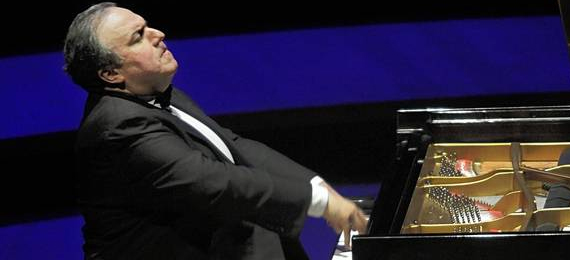
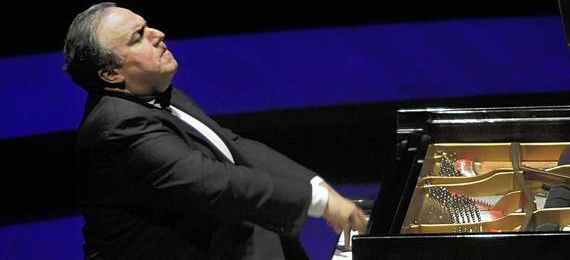
    Above: pianist Yefim Bronfman

    ~ Author: Oberon

    Wednesday December 27th, 2017 – My friend Dmitry and I are fans of Yefim Bronfman, so this evening’s concert by The New York Philharmonic was a perfect classical-music finale for the year 2017.

    The evening opened with the overture to Smetana’s opera THE BARTERED BRIDE. I first heard this overture played live when James Levine chose it to open the Metropolitan Opera’s 100th anniversary gala in 1983. The gala (in two parts – matinee and evening) was telecast worldwide, but I was fortunate to have been in the House for the afternoon program. Let’s just say, they don’t make opera galas like that any more.

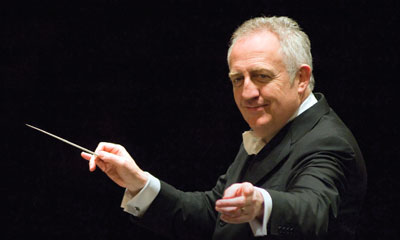
    It was great fun to hear the jolly, rambunctious Smetana overture again tonight under Bramwell Tovey’s baton; the Maestro set an exhilarating, ultra-fast pace for this music, and the Philharmonic artists took up his challenge: they played brilliantly and seemed truly to be having fun into the bargain. The music passes thru many modulations along the way, and solo moments sparkle forth – notably from Sherry Sylar’s oboe – as we are danced along in a lively manner. Really, an ideal concert-opener.

    Mr. Bronfman then appeared for the Bartok 2nd piano concerto. Following an ascending flourish from the Steinway, the first movement commences with rather wild brass fanfares. The piano sounds restless, set against winds; the turbulence builds only to subside, and Mr. Brofman’s playing turns subtle. Following another brass and piano build-up, there’s a full stop. Thereafter the music seems more melodious, though droll and ironic. The brass get quite noisy before the pianist silences them with a cadenza that flows up and down the keyboard. After a passage for flutes and piano, the soloist plays a double rising motif.

    Pensive strings introduce the the Adagio which develops into a marvelous duet for piano and timpani. Here Mr. Bronfman and timpanist Marcus Rhoten created an incredible atmosphere: moody and a bit ominous. Suddenly things perk up without warning and we are in a scherzo-like realm with an agitato feeling and with the pianist finding unusual delicacies. Mr. Bronfman then commences a remarkable pianissimo trill that goes on and on over misterioso strings.

    For the concerto’s finale, Bartók gets almost jazzy – in a slightly darkish way – and we hear from the trumpets; a feeling of a kind of war dance evolves. Another piano/percussion duet crops up – this time it’s Steinway vs bass drum – before the music turns unexpectedly dreamy. But the dream is short-lived as the trumpets re-awaken and the concerto ends brightly. Mr. Bronfman was well in his element throughout, his playing agile and multi-hued, with fine dynamic contrasts. The orchestra did their soloist proud.

    By way of perfect contrast to his grand-scale playing of the Bartók, Mr. Bronfman chose for an encore Chopin’s Étude in E Major, Op.10, No.3. The opening melody of this work, thought to have been Chopin’s favorite among the études, was later the source of a vocal song arranged by the soprano Félia Litvinne and recorded famously by Litvinne’s pupil, the tragic Germaine Lubin. This evening, Mr. Bronfman’s poetic rendering of the full étude cast a thoughtful spell over the hall. This magical experience, like so many others in recent years, was sadly spoilt in its most poignant passage by the ringing of a cellphone. Yet Mr. Bronfman continued, unperturbed, and left me a beautiful memory to cherish.
    94-ef6ab60c90ba3fb6a7911b7999dd5f4e

    Above: Bramwell Tovey

    Following the interval, an exciting performance of Mussorgsky’s Pictures at an Exposition (in the Ravel orchestration) again found the orchestra on peak form. Opening with a brass chorale Promenade, which recurs with variations during the first seven movements, the suite conjures up visions of the works of Viktor Hartmann. Upon Hartmann’s death in 1874 at the young age of 39, an exhibition of his work was mounted at St. Petersburg. Mussorgsky visited the exhibit and was inspired by what he saw to write a set of miniatures for piano. In 1922, Maurice Ravel orchestrated the pieces.

    A huge orchestra is in play, including five percussionists, two harps, and celesta. The ponderous Gnome, the child-like and playful Tuileries, the plodding Ox-Cart, the mini-scherzo of the Ballet of Unhatched Chicks, the bustling Marketplace at Limoges, the Roman Catacombs (deep brass), and the fanciful Hut of Baba-Yaga are all evoked in coloristic settings which the Philharmonic players delivered with evident affection.

    The movement which most impressed me was Il Vecchio Castello (The Old Castle) in which flutes, oboe, and bassoon were joined by the mellow, distinctive voice of the alto saxophone. This music was so evocative that I got lost in it. 

    The suite ends on a grand note with The Great Gate of Kiev. Sumptuously played, it brought a year full of music to an imperial finish.

    ~ Oberon
  • Bronfman’s Bartok @ The NY Philharmonic

    Bronfman

    Above: pianist Yefim Bronfman

    ~ Author: Oberon

    Wednesday December 27th, 2017 – My friend Dmitry and I are fans of Yefim Bronfman, so this evening’s concert by The New York Philharmonic was a perfect classical-music finale for the year 2017.

    The evening opened with the overture to Smetana’s opera THE BARTERED BRIDE. I first heard this overture played live when James Levine chose it to open the Metropolitan Opera’s 100th anniversary gala in 1983. The gala (in two parts – matinee and evening) was telecast worldwide, but I was fortunate to have been in the House for the afternoon program. Let’s just say, they don’t make opera galas like that any more.

    It was great fun to hear the jolly, rambunctious Smetana overture again tonight under Bramwell Tovey’s baton; the Maestro set an exhilarating, ultra-fast pace for this music, and the Philharmonic artists took up his challenge: they played brilliantly and seemed truly to be having fun into the bargain. The music passes thru many modulations along the way, and solo moments sparkle forth – notably from Sherry Sylar’s oboe – as we are danced along in a lively manner. Really, an ideal concert-opener.

    Mr. Bronfman then appeared for the Bartok 2nd piano concerto. Following an ascending flourish from the Steinway, the first movement commences with rather wild brass fanfares. The piano sounds restless, set against winds; the turbulence builds only to subside, and Mr. Brofman’s playing turns subtle. Following another brass and piano build-up, there’s a full stop. Thereafter the music seems more melodious, though droll and ironic. The brass get quite noisy before the pianist silences them with a cadenza that flows up and down the keyboard. After a passage for flutes and piano, the soloist plays a double rising motif.

    Pensive strings introduce the the Adagio which develops into a marvelous duet for piano and timpani. Here Mr. Bronfman and timpanist Marcus Rhoten created an incredible atmosphere: moody and a bit ominous. Suddenly things perk up without warning and we are in a scherzo-like realm with an agitato feeling and with the pianist finding unusual delicacies. Mr. Bronfman then commences a remarkable pianissimo trill that goes on and on over misterioso strings.

    For the concerto’s finale, Bartók gets almost jazzy – in a slightly darkish way – and we hear from the trumpets; a feeling of a kind of war dance evolves. Another piano/percussion duet crops up – this time it’s Steinway vs bass drum – before the music turns unexpectedly dreamy. But the dream is short-lived as the trumpets re-awaken and the concerto ends brightly. Mr. Bronfman was well in his element throughout, his playing agile and multi-hued, with fine dynamic contrasts. The orchestra did their soloist proud.

    By way of perfect contrast to his grand-scale playing of the Bartók, Mr. Bronfman chose for an encore Chopin’s Étude in E Major, Op.10, No.3. The opening melody of this work, thought to have been Chopin’s favorite among the études, was later the source of a vocal song arranged by the soprano Félia Litvinne and recorded famously by Litvinne’s pupil, the tragic Germaine Lubin. This evening, Mr. Bronfman’s poetic rendering of the full étude cast a thoughtful spell over the hall. This magical experience, like so many others in recent years, was sadly spoilt in its most poignant passage by the ringing of a cellphone. Yet Mr. Bronfman continued, unperturbed, and left me a beautiful memory to cherish.

    94-ef6ab60c90ba3fb6a7911b7999dd5f4e

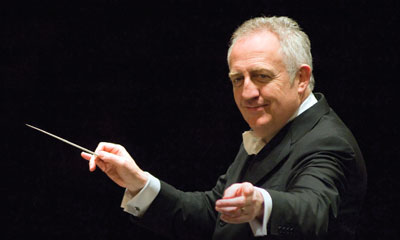
    Above: Bramwell Tovey

    Following the interval, an exciting performance of Mussorgsky’s Pictures at an Exposition (in the Ravel orchestration) again found the orchestra on peak form. Opening with a brass chorale Promenade, which recurs with variations during the first seven movements, the suite conjures up visions of the works of Viktor Hartmann. Upon Hartmann’s death in 1874 at the young age of 39, an exhibition of his work was mounted at St. Petersburg. Mussorgsky visited the exhibit and was inspired by what he saw to write a set of miniatures for piano. In 1922, Maurice Ravel orchestrated the pieces.

    A huge orchestra is in play, including five percussionists, two harps, and celesta. The ponderous Gnome, the child-like and playful Tuileries, the plodding Ox-Cart, the mini-scherzo of the Ballet of Unhatched Chicks, the bustling Marketplace at Limoges, the Roman Catacombs (deep brass), and the fanciful Hut of Baba-Yaga are all evoked in coloristic settings which the Philharmonic players delivered with evident affection.

    The movement which most impressed me was Il Vecchio Castello (The Old Castle) in which flutes, oboe, and bassoon were joined by the mellow, distinctive voice of the alto saxophone. This music was so evocative that I got lost in it. 

    The suite ends on a grand note with The Great Gate of Kiev. Sumptuously played, it brought a year full of music to an imperial finish.

    ~ Oberon

  • Bronfman|Bychkov ~ Tchaikovsky @ The NY Phil

    Bronfman_TchaikovskyFestival_2520x936

    Above: pianist Yefim Bronfman

    Friday January 27th, 2017 – With Semyon Bychkov on the podium and Yefim Bronfman at the Steinway, we were assured of an exciting evening at The New York Philharmonic. Music by Glinka and Tchaikovsky was played in the grand style under Maestro Bychkov’s magical baton, and Mr. Bronfman brought down the house with his splendid account of Tchaikovsky’s 2nd piano concerto. Throughout this à la Russe program, visions of the splendours of the Tsarist courts filled the imagination.

    The first half of the evening was given over to two scores which inspired George Balanchine to create two choreographic masterworks:  Mikhail Glinka’s brief Valse-Fantaisie, and the Tchaikovsky concerto. The two ballets unfolded clearly in my mind as the music, so familiar to me from innumerable performances at New York City Ballet, filled Geffen Hall in all its romantic glory.

    The infectious, lilting rhythm of the waltz propels the Glinka score; originally written for piano in 1839 and later orchestrated, it is rich in melody and intriguing shifts between major and minor passages, evoking the glamour, chivalry, and mystery of a glittering ball at the Winter Palace. Needless to say, it was sumptuously played under Maestro Bychkov’s masterful leadership.

    Tchaikovsky’s 2nd piano concerto has been a favorite of mine for years, thanks to my great affection for the ballet Balanchine created to it. Written in 1879–1880, the concerto was dedicated to Nikolai Rubinstein; but Rubinstein was never destined to play it, as he died in March 1881. The premiere performance took place in New York City, in November of 1881 with Madeline Schiller as soloist and Theodore Thomas conducted The New York Philharmonic orchestra. The first Russian performance was in Moscow in May 1882, conducted by Anton Rubinstein with Tchaikovsky’s pupil, Sergei Taneyev, at the piano.

    Tonight, Yefim Bronfman’s power and virtuosity enthralled his listeners, who erupted in enthusiastic applause after the concerto’s first movement. The eminent pianist could produce thunderous sounds one moment and soft, murmuring phrases the next; this full dynamic spectrum was explored in the monster cadenza, to mesmerizing effect. A word of mention here of some lovely phrases from flautist Robert Langevin and clarinetist Pascual Martinez Fortenza early in the concerto; in fact, all of the wind soloists were very much on their game tonight.

    In the Andante, a sense of gentle tenderness filled Bronfman’s playing, and his rapport with concertmaster Frank Huang and cellist Carter Brey in the extended passages where they play off one another made me crave an evening of chamber music with these three masters. The concerto sailed on thru the concluding Allegro con fuoco, with its gypsy-dance theme brilliantly set forth by both pianist and orchestra. Maestro Bychkov, who had set all the big, sweeping themes sailing forth grandly into the hall throughout, was particularly delightful in this lively finale. At the end, the audience erupted in a gale of applause and cheers, Mr. Bronfman cordially bringing Mssrs. Huang and Brey forward to share in the ovation. 

    Throughout this awe-inspiring performance, the choreography of Balanchine danced in my head, and visions of Viktoria Tereshkina, Teresa Reichlen, Faye Arthurs, and Jonathan Stafford sprang up, the music inspiring the memory of their sublime dancing in Mr. B’s remarkable setting of this concerto.

    Semyon_bychkov

    After the interval, Maestro Bychkov (above) led an epic performance of Tchaikovsky’s 5th symphony. From the burnished beauty of the horn solo near the start, thru the palpable fervor of the Andante cantabile (with its evocation of the SLEEPING BEAUTY Vision Scene), and on thru the Valse, which moves from sway to elegant ebullience, Maestro Bychckov and the artists of the Philharmonic gloried in one Tchaikovskyian treasure after another.

    The symphony’s finale, right from it’s soulful ‘Russian’ opening theme, seemed to sum up all that had gone before: vivid dancing rhythms from Russian folk music, a march-like tread, a brief interlude. Then the brass call forth, and a tremendous timpani roll heralds a mighty processional. One final pause before a stately repeat of the main theme and a swift, four-chord finish. The audience rightly responded to the Maestro and the musicians with a full-scale standing ovation.

  • Bronfman & Braunstein @ Zankel Hall

    Yefim-Bronfman

    Saturday June 18th, 2016 – Yefim Bronfman (above) concluding a Prokofiev piano sonata cycle at Zankel Hall this evening, playing the 5th and 9th sonatas. Violinist Guy Braunstein joined Mr. Bronfman for the two Prokofiev violin sonatas.

    After passing some days in a state of reclusive depression over the Orlando shootings, I ventured out tonight even though I was not really in the mood for it. But Bronfman is one of my most-admired musicians, and Prokofiev among my favorite composers, so I felt a strong desire to be there. Prokofiev’s music is not consoling, as a rule, though there are passages that reach to the soul, especially in the Andante of the second violin sonata, where Mr. Braunstein was at his finest this evening.

    Watching Yefim Bronfman perform is a particularly pleasing experience for me. He walks out, bows genially, sits down, and he and the keyboard become one. There are no frills, and no theatricality in his playing: it’s all about the music and his communing with it. Very brief pauses between movements keep the impetus of the music – and our delight in it – in true focus.

    Bronfman’s rendering of the 5th piano sonata was deeply satisfying, the audience engrossed as he immersed himself in the music’s ever-shifting melodic and rhythmic elements. This was exactly the ‘great escape’ from world-weariness I so desperately needed tonight. From its songful start, the opening Allegro tranquillo was a complete delight: the touches of dissonance adding spice, with wit, irony, and drama all having their say. A delicate march heralds the Andantino, with fetching trills, before things get darker and more emphatic, leading to a low-rumbling of a finish. By turns jaunty, lyrical, and pungent, the concluding Poco allegretto was polished off with Bronfman’s inimitable clarity and grace, the music seeming to vanish into a dream at the end.

    Hqdefault

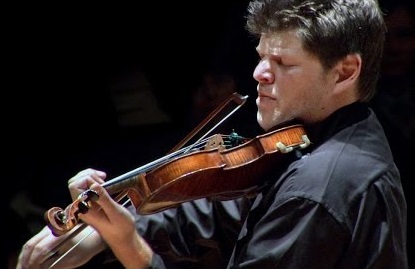
    Above: Guy Braunstein

    Mr. Braunstein then joined the pianist for the violin sonata #1. Here the piano’s somber opening of the Andante assai gives way to a rather hesitant start for the violin, with some buzzing trills before things expand to a rather labored passage. Then the piano’s misterioso murmurs underpin the violin’s sliding scales. The emphatic start of the Allegro brusco drew some energetic foot stamping from Mr. Braunstein as the turbulence envelops us; and then suddenly his violin sings a lusty song. After re-grouping and re-energizing, the music turns more pensive – but only briefly: a riotous dance ensues, subsiding into lyricism before another dramatic surge.

    The Andante features a shimmering piano motif as the violin sings in the alto range; both instruments move to the higher spheres in a unison passage, which eventually goes very high indeed. Back to the alto colourings for more of the violin’s forlorn phrases. High and lilting, the piano signals the movement’s soft ending. A sprightly jig sets off the finale, calming eventually and leading to a delicate pizzicati paragraph. Some lively scrambling makes us think the end is nigh, but instead the violin’s mute goes on and rolling scales summon an impression of “the wind in a graveyard”; the sonata ends sadly.

    The performance drew an enthusiastic response from the sold-out house; a bit of iffy intonation from the violin in places mattered little in the end, since Braunstein’s mixture of poetry and vigor made the music so savorable. 

    Following the interval, Mr. Bronfman returned for the 9th piano sonata. The first movement starts gently, and continues amiably, though there’s an underlying restlessness. More expansive passages, and some low, rumbling scales lead to an eventual quiet finish. The second movement is scherzo-like, with rippling scales and a jogging rhythm; a pensive passage, more jogging, and another soft ending.

    The Andante tranquillo brought forth more Bronfman magic: a wistful melody, followed by a glittering brilliance that subsides to mystery and then to sadness. From deep rumblings, the music rises to a high melancholy. After a big start, the Allegro finale turns ironic; “shining” music gleams forth, surrendering to mirth, percolating on high, whispering a farewell. Here Bronfman’s virtuosity and subtle colorations were at their most alluring.

    To end the evening, Prokofiev’s second violin sonata, which had started life as a flute sonata, and which David Oistrakh had prevailed on the composer to re-cast for violin in 1943. This familiar work was played with a wonderful melding of the two instruments, the players so alert to one another and marking the beauty of the Andante with glowing sound. Traces of my earlier concerns about pitch in the violin line cropped up again, but my pianist-companion seemed to feel that the issue was minor, and so I let the energy and optimism of the Allegro con brio the finale carry me along…together with the rest of the crowd, who swept to their feet at the finish to salute the generous playing and the final expression of joie de vivre from the two players.

  • Bronfman & Braunstein @ Zankel Hall

    Yefim-Bronfman

    Saturday June 18th, 2016 – Yefim Bronfman (above) concluding a Prokofiev piano sonata cycle at Zankel Hall this evening, playing the 5th and 9th sonatas. Violinist Guy Braunstein joined Mr. Bronfman for the two Prokofiev violin sonatas.

    After passing some days in a state of reclusive depression over the Orlando shootings, I ventured out tonight even though I was not really in the mood for it. But Bronfman is one of my most-admired musicians, and Prokofiev among my favorite composers, so I felt a strong desire to be there. Prokofiev’s music is not consoling, as a rule, though there are passages that reach to the soul, especially in the Andante of the second violin sonata, where Mr. Braunstein was at his finest this evening.

    Watching Yefim Bronfman perform is a particularly pleasing experience for me. He walks out, bows genially, sits down, and he and the keyboard become one. There are no frills, and no theatricality in his playing: it’s all about the music and his communing with it. Very brief pauses between movements keep the impetus of the music – and our delight in it – in true focus.

    Bronfman’s rendering of the 5th piano sonata was deeply satisfying, the audience engrossed as he immersed himself in the music’s ever-shifting melodic and rhythmic elements. This was exactly the ‘great escape’ from world-weariness I so desperately needed tonight. From its songful start, the opening Allegro tranquillo was a complete delight: the touches of dissonance adding spice, with wit, irony, and drama all having their say. A delicate march heralds the Andantino, with fetching trills, before things get darker and more emphatic, leading to a low-rumbling of a finish. By turns jaunty, lyrical, and pungent, the concluding Poco allegretto was polished off with Bronfman’s inimitable clarity and grace, the music seeming to vanish into a dream at the end.

    Hqdefault

    Above: Guy Braunstein

    Mr. Braunstein then joined the pianist for the violin sonata #1. Here the piano’s somber opening of the Andante assai gives way to a rather hesitant start for the violin, with some buzzing trills before things expand to a rather labored passage. Then the piano’s misterioso murmurs underpin the violin’s sliding scales. The emphatic start of the Allegro brusco drew some energetic foot stamping from Mr. Braunstein as the turbulence envelops us; and then suddenly his violin sings a lusty song. After re-grouping and re-energizing, the music turns more pensive – but only briefly: a riotous dance ensues, subsiding into lyricism before another dramatic surge.

    The Andante features a shimmering piano motif as the violin sings in the alto range; both instruments move to the higher spheres in a unison passage, which eventually goes very high indeed. Back to the alto colourings for more of the violin’s forlorn phrases. High and lilting, the piano signals the movement’s soft ending. A sprightly jig sets off the finale, calming eventually and leading to a delicate pizzicati paragraph. Some lively scrambling makes us think the end is nigh, but instead the violin’s mute goes on and rolling scales summon an impression of “the wind in a graveyard”; the sonata ends sadly.

    The performance drew an enthusiastic response from the sold-out house; a bit of iffy intonation from the violin in places mattered little in the end, since Braunstein’s mixture of poetry and vigor made the music so savorable. 

    Following the interval, Mr. Bronfman returned for the 9th piano sonata. The first movement starts gently, and continues amiably, though there’s an underlying restlessness. More expansive passages, and some low, rumbling scales lead to an eventual quiet finish. The second movement is scherzo-like, with rippling scales and a jogging rhythm; a pensive passage, more jogging, and another soft ending.

    The Andante tranquillo brought forth more Bronfman magic: a wistful melody, followed by a glittering brilliance that subsides to mystery and then to sadness. From deep rumblings, the music rises to a high melancholy. After a big start, the Allegro finale turns ironic; “shining” music gleams forth, surrendering to mirth, percolating on high, whispering a farewell. Here Bronfman’s virtuosity and subtle colorations were at their most alluring.

    To end the evening, Prokofiev’s second violin sonata, which had started life as a flute sonata, and which David Oistrakh had prevailed on the composer to re-cast for violin in 1943. This familiar work was played with a wonderful melding of the two instruments, the players so alert to one another and marking the beauty of the Andante with glowing sound. Traces of my earlier concerns about pitch in the violin line cropped up again, but my pianist-companion seemed to feel that the issue was minor, and so I let the energy and optimism of the Allegro con brio the finale carry me along…together with the rest of the crowd, who swept to their feet at the finish to salute the generous playing and the final expression of joie de vivre from the two players.

  • New York Philharmonic: Bronfman/Valčuha

    Yefim bronfman

    Above: pianist Yefim Bronfman

    Thursday February 18th, 2016 – In recent seasons, as I’ve gradually moved away from opera and dance and into the realm of symphonic and chamber music, concerts featuring the great pianist Yefim Bronfman have consistently been outstanding events; we still talk about these evenings – and about the pianist – with great admiration and affection. To me, Mr. Bronfman is a unique musician: an artist in the highest echelon of great performers today.

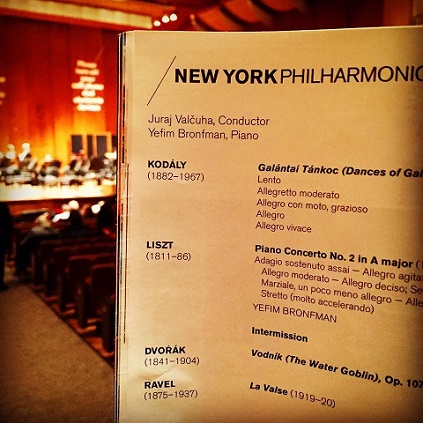
    This evening’s concert at The New York Philharmonic is something my friend Dmitry and I have been looking forward to since it was announced. Maestro Juraj Valčuha was on the podium tonight as Mr. Bronfman performed Liszt’s Piano Concerto #2 on a program that further featured works of Kodály, Dvořák, and Ravel.

    Opening the concert with Kodály’s Dances of Galánta; the Philharmonic had played this piece in 2013 and I was happy to experience this music again: it’s happy music!  Zoltán Kodály wrote his Dances of Galánta to celebrate the 80th anniversary of the Budapest Philharmonic Orchestra. Galánta is a small village in Hungary where the composer spent seven years of his childhood and where, thanks to the town’s popular gypsy band, the young Kodály became aware of of the style and motifs of gypsy music.

    Launched by a clarinet tune from the Philharmonic’s inimitable Anthony McGill, Dances of Galánta has a wonderful lilt and swagger. Flautist Robert Langevin and oboist Liang Wang pipe up charmingly, and the big, passionate main theme is irresistible. Maestro Valčuha – tall, handsome, and with an elegant baton technique – drew out all the vivid colours of the score, which ends with a romping folk dance.

    Mr. Bronfman then appeared, to a congenial welcome from the Philharmonic audience. Meticulous of technique and warmly confident in stage demeanor, the pianist’s performance of the Liszt Piano Concerto No. 2 was impressive in its virtuosic clarity and in its meshing of the piano line with the orchestra. Maestro Valčuha’s feeling for balance and pacing was spot-on. 

    The concerto, which Liszt tinkered with endlessly between 1839 and 1861, is particularly congenial to experience as it sweeps forward in one continuous movement over a span of about 20 minutes; yet it has the feel of a more traditionally structured concerto. Along the way, Liszt pairs the piano with various orchestral voices – a gorgeous piano/cello lullabye; rippling piano motifs as the oboe sings; high and delicate piano filigree over gentle violins; horns and cymbals sounding forth as the piano flourishes triumphantly. 

    Mr. Bronfman’s fluency in the rapid passages was a delight: sprightly in a high-lying scherzo passage, then swirling and cascading up and down the keyboard with joyous bravado. The concerto further alternates moments of big drama with passages of sheer melodic glow, all of which Mr. Bronfman delivered to us with his customary assurance and polish. 

    Audience and orchestra alike embraced the pianist with a prolonged ovation; an encore was given which elicited even more applause, and the affable Mr. Bronfman was called out twice again. Next season, he’s down for the Tchaikovsky 2nd with The Phil: it’s already on my calendar, circled in red. 

    Valcuha-Juraj

    Following the interval, Maestro Valčuha (above) and the Philharmonic players further displayed their cordial rapport in two well-contrasted “tone poems”:  Dvořák’s folkish and finely-orchestrated The Water Golbin (curiously enough, having its Philharmonic premiere tonight – some 120 years after it was written) and Ravel’s darkly magical La Valse, which always makes me think of Rachel Rutherford and Janie Taylor.

    While it seemed a bit odd not to have a symphony on the program, the two shorter works in the second half of the evening worked well together, were beautifully played, and allowed us to savor Maestro Valčuha‘s conducting from both a musical and visual standpoint.

    12742079_10153914529104761_5025851178161479995_n

    Photo by Dmitry.

  • Bartok & Bruckner @ The NY Philharmonic

    Medium_071220_bronfman

    Above: Yefim Bronfman

    Friday October 24th, 2014 – After experiencing Yefim Bronfman’s magnificent renderings of all the Beethoven piano concertos (and the triple concerto!) in a series of New York Philharmonic concerts last season, my friend Dmitry and I were keen to hear the pianist live again. Tonight, Mr. Bronfman’s playing of the Bartok 3rd marked the first of two concerts we’ll be attending this season which feature the pianist, the second being his performance of the Brahms 2nd concerto with the Chicago Symphony under Riccardo Muti at Carnegie Hall on January 31st, 2015.

    Bela Bartok, who had fled Europe for America in 1940 to escape the rise of National Socialism, composed his third piano concerto as a birthday gift for his pianist-wife Ditta Pasztory-Bartok, working on it during the summer of 1945 at Saranac Lake, New York. Already in the final stages of lukemia, the composer returned to New York City where he died on September 26th, 1945, leaving the concerto unfinished. The task of orchestrating the final 17-measures, drawing from Bartók’s notes, eventually fell to the composer’s friend Tibor Serly.

    Tonight’s performance found Mr. Bronfman at his finest, his fleetness of technique to the fore as his hands rippled up and down the keyboard, summoning forth one Bartokian marvel after another. He and Maestro Alan Gilbert formed a very simpatico union over this music, and the orchestra were at their best also: their many colourful eddies of sound swirling around the solo piano line. Mr. Bronfman’s dynamic range, his delightful dexterity, and his wonderfully genial personality combined to make this a truly enjoyable half-hour of music-making. The pianist, basking in enthusiastic applause at the end, bowed graciously to his fellow musicians, celebrating their mutual admiration.

    Following the intermission, a genuinely thrilling experience for me: hearing the Bruckner 8th live for the first time. Everyone who follows my blog knows that, after decades of devoting myself to opera and dance, I’m now exploring the symphonic and chamber repertories; works that are thrice-familiar to most  classical music lovers are new discoveries for me. Of course, having worked at Tower Records for almost a decade before they closed up shop, I did hear a lot of symphonic music day in and day out, some of it subconsciously absorbed; but there was no opportunity to stop and savor anything. So despite the familiarity of many thematic passages in the Bruckner tonight, it was all fresh and fantastic to me.

    At a time when performances of Wagner’s music here in New York seem increasingly rare (The Met has only MEISTERSINGER to offer us this season, following on their ‘No Wagner’ season of 2013-2014) tonight’s Bruckner, with its Wagnerian sonorities, was a welcome treat.

    Bruckner’s 8th opens murmuringly, but soon the composer begins to expand into marvelous arches of sound. The huge orchestra, resonating in the dense textures of intermingling voices of strings and winds, maintained clarity under Alan Gilbert’s steady baton. The 8th’s opening movement has been described as “simply shattering, destroying every attempt at criticism.” And Bruckner himself referred to the passage where the brass ring out the main theme repeatedly as “the announcement of Death…” This is followed by a surprising silence and the gentle, faltering heartbeat of the timpani.

    In the scherzo, a big familiar theme dances forth; and then its in the adagio where I finally lost my heart to this symphony. This incredibe movement, marked in the score as  “Solemn and slow, but not dragging”, opens up great vistas of panoramic sonic-painting. The harps are evocative indeed, and the massive waves of sound wash over us, suddenly to evaporate in a delicate waltz-like theme. The horns then blaze forth majestically; the overall sensation is life-encompassing.

    Throughout this cinematic symphony, the ear and the soul are equally gratified. In the culminating fourth movement Bruckner’s architecture evokes a great cathedral wherein the listener is alternately overwhelmed by epic grandeur or sinks into a state of reverent contemplation.

    In the end, this performance of this massive symphony – surely Wagnerian in its looming grandeur but also at times making me think of Tchaikovsky – gave so much pure satisfaction. I found myself wishing that Bruckner had written operas: what a thrill it would be to hear huge, dramatic voices soaring over his glorious orchestral soundscapes.

  • Beethoven Piano Concertos @ NY Phil III

    310696_2199382298108_399524588_n

    Wednesday June 25th, 2014 – The New York Philharmonic presenting the final programme of their 2013-2014 subscription season at Avery Fisher Hall; over the past two weeks, the orchestra have offered the first four Beethven piano concertos with Alan Gilbert on the podium and Yefim Bronfman at the Steinway. Tonight Mr. Bronfman played the 5th (‘Emperor’) concerto as the concert’s finale; earlier in the evening, he was joined for the Triple Concerto by the Philharmonic’s soon-to-retire concertmaster Glenn Dicterow, and the principal cellist Carter Brey join Mr. Bronfman. This same programme will be repeated on June 26th, 27th, and 28th, the final evening marking Glenn Dicterow’s farewell performance with the Philharmonic.

    The Triple Concerto (1804) opens with a traditional Allegro in which the solo voices are introduced one by one: the cello, then the violin, and finally the piano. In the Largo which follows (and is rather short), the concerto finds its heart with a melody, introduced by the cello, which displays the expressive richness that characterize the greatest passages of Beethoven’s works. Without pause, the final Rondo alla Polacca commences; again the insistently repeated phrases of the cello are prominent. This rondo features joyful themes seemingly inspired by Polish folk music, with lively shifts from major to minor.

    The performance, though thoroughly enjoyable, somehow never really developed a rapport between the three solo players, mainly due to the fact that Mr. Bronfman, of necessity, had his back to his string-playing collegues. Mssers. Dicterow and Brey were able to communicate directly with one another, whilst Mr. Bronfman was left in his own (beautiful) world.

    20130205193002_la-1337491-et-bronfman-1-lkh

    Following the intermission, Yefim Bronfman’s playing of the ‘Emperor’ concerto this evening was a superb finale to this NY Philharmonic Beethoven Concerto Festival. This majestic work was given a vibrant performance by the pianist and the artists of the Philharmonic, all wonderfully woven together by Maestro Gilbert’s baton.

    By this Saturday, Mr. Bronfman will have played on thirteen evenings over a three week period: an exhausting schedule, yet the pianist’s playing seemed awesomely fresh and vital tonight, with his uncanny mastery of dymanics always giving a shimmer to the sound. For all his technical brilliance, Bronfman’s playing also has a noble, heartfelt quality that makes his playing so deeply satisfying. The waves of applause that have engulfed him at each of these concerts have been very moving to experience. And it’s to our good fortune that he will be back at Avery Fisher Hall in late October 2014 playing the Bartok 3rd with Alan Gilbert on the podium. The dates are already on my calendar.