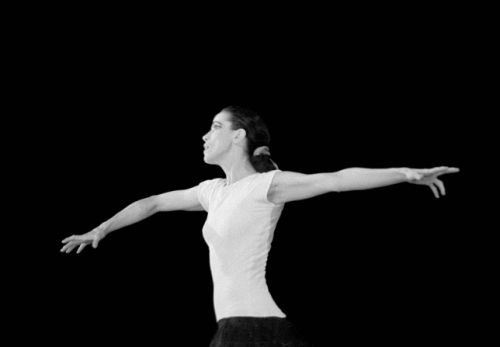
Tag: Ying Xin

  • Graham Gala @ The Joyce ~ 2023

    Ying xin melissa sherwood

    Above: Ying Xin of the Martha Graham Dance Company; photo by Melissa Sherwood

    Author: Oberon

    Thursday April 20th, 2023 – The Martha Graham Dance Company are at The Joyce for a couple of weeks, and tonight was their gala evening. The program offered Graham’s All-City Panorama and Embattled Garden book-ending three excerpts from Canticle for Innocent Comedians (choreographed by Sonya Tayeh with the individual sections by Jenn Freeman, Martha Graham, and Micaela Taylor).

    All-City Panorama is a re-take on Martha Graham’s 1935 work, Panorama, which premiered at a summer retreat in Bennington, Vermont. The original Panorama was 45 minutes long, set to a score by Norman Lloyd, and was performed by student dancers, It served as a rallying call to for social change. Panorama was lost until 1992, when an early film was discovered; from this, the dancework was reconstructed by Yuriko, who passed away in 2022 at the age of 102.

    Panorama rosalie banner

    Above: from All-City Panorama, photo by Rosalie Banner

    Tonight’s performance boasted a large ensemble of teen-aged dancers, all clad in red (Martha Graham had designed the original costumes). Heralded by drums, they take the stage with a youthful energy that is exhilarating. Forming and re-forming in various sub-groups, they move in compelling design patterns – from runabouts to noble processions – employing classic Graham steps and gestures.  

    A central quintet was impressively danced, and at one point, everyone musters into a moving, stage-filling circle: a celebration of community. Following a finale filled with traveling leaps, the stage is emptied. The dancers took their bows to a vociferous ovation from the packed hall.

    Janet Eilber then appeared onstage, hailing the young dancers as the future of Graham; later in the evening, the past was also honored as veteran dancers among the audience were cheered. Overall, the evening felt like a celebration of the proud continuum of the Martha Graham Dance Company, now in their 97th season. It all left me wondering if I will live to see the 100th season.

    I was not impressed with Canticle for Innocent Comedians when I first saw it a year ago at City Center; but last week, I had a chance to see a studio rehearsal which made me alter my opinion. The choreography is demanding and often quite beautiful. I enjoyed it much more with the dancers in practice clothes; the costumes, while visually striking, seemed to detract from rather than enhance the movement, and they sometimes affect the dancers’ line. Tonight, the music, by pianist Jason Moran, also seemed more captivating than I remembered.

    Performed this evening, a suite of excerpts from the work opened with the breath-takingly lyrical duet Moon, choreographed by Martha Graham herself – apparently the only portion of her 1952 the work to have survived more or less intact. Tonight, it was hypnotically danced by So Young An and Jacob Larsen with a gentle sensuality and a feeling of tenderness and trust. 

    Stars, choreographed by Michaela Taylor, was brilliantly danced by two of Company’s charismatic Italian stars, Marzia Memoli and Alessio Crognale. Their partnering is effortless, and their personalities meld persuasively to illuminate the dance.

    The beauteous Ying Xin then appeared for the solo Death/Rebirth, choreographed by Jenn Freeman. This solo is a profound depiction of loneliness, and Ying Xin’s suppleness of movement – and her expressive face – made for a captivating dance experience: paradoxically draining emotionally and uplifting spiritually. 

    Minutes later, Ying Xin was back onstage, portraying Eve in Graham’s iconic Embattled Garden

    At the same rehearsal where Innocent Comedians gave me a second look, Graham’s Embattled Garden had been danced, complete with sets and costumes. The work is always stunning to see, but up close it was simply thrilling. The cast of four must not only be dancers, but also acrobats, actors, and possessed of vibrant personalities.

    Tonight, in the theatrical setting, a slightly different cast made a most powerful impression. The Noguchi sets are masterpieces in their own right, and the Carlos Surinach score seemed fresh and vivid. Ying Xin’s Eve is the epitome of feminine grace, and her partner Lloyd Knight’s Adam is magnificent both as a presence and as a mover.
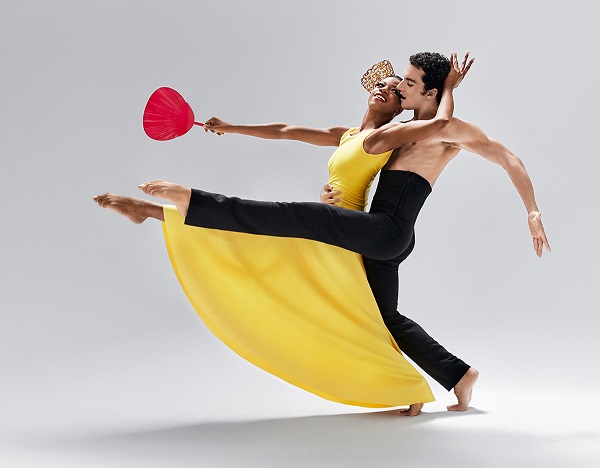
    Garden hibbard nash

    Above, trouble in paradise: Leslie Andrea Williams and Lorenzo Pagano in a Hibbard Nash image

    Observing Adam and Eve from his perch in a fanciful Noguchi tree is the Stranger, danced by Lorenzo Pagano; lounging in the shade, fanning herself, is Lilith, danced by Leslie Andrea Williams. These intruders in Eden are hellbent on destroying the happiness of the young couple…just because they can. Aside from the astonishing flair and virtuosity of their dancing, Leslie and Lorenzo communicate volumes with their facial expressions and especially with their ever-observant, knowing eyes. Brilliant!

    ~ Oberon

  • Martha Graham Dance Company~Immediate Tragedy

    -gvdt0Bg

    Above, clockwise from top left: Graham dancers Ying Xin, Lloyd Knight, Lorenzo Pagano, and Leslie Andrea Williams performing Immediate Tragedy from their homes. Photo by Ricki Quinn.

    Update: You can now watch Immediate Tragedy on YouTube here.

    Friday June 20th, 2020 – In a joint collaboration with The Soraya and Wild Up, the Martha Graham Dance Company today presented the world premiere performance of a digital dance creation, Immediate Tragedy, inspired by Martha Graham’s lost solo from 1937. This freshly-imagined version features the fourteen remarkable artists of the Graham Company performing from their homes to a new musical score composed by Wild Up’s Christopher Rountree (photo below).

    Rountree

    The loss of the 2020 Graham season in New York City was for me one of the saddest after-shocks of the pandemic. Nowadays, I keep wondering if dance, music, opera, and theatre – not to mention museums – can return to what we think of as ‘normal’ in the foreseeable future.

    The members of the Graham Company have, over the past decade or so, become very dear to me, not just as dancers but as human beings. Their energy, commitment, and their unique individual stories make them so appealing. I cannot wait to see them “live” again. But for now, today’s webcast of Immediate Tragedy at least let me behold their beautiful faces and forms again. 

    Host Thor Steingraber, executive director of The Soraya, welcomed viewers. Graham artistic director Janet Eilber and composer Christopher Rountree of Wild Up gave us some background information about the collaborative effort to bring Martha Graham’s “lost” 1937 solo back to life in a new guise nearly eighty years after it was last seen.

    Ms. Eilber spoke of receiving a collection of black-and-white images of Martha Graham performing Immediate Tragedy in 1937. They were taken by Robert Fraser, and it was Fraser’s son who contacted Ms. Eilber to say, “I have these photos…”  One thing led to another, and when the pandemic forced dancers to remain isolated, the idea of a digital dancework in which each Graham dancer would be filmed dancing at home, elaborating on the poses from the Fraser photos, made perfect sense. Each dancer was mailed four of the Fraser images, showing various moments from the original solo. Ms. Eilber oversaw the “new”  choreography, but…there was no music to dance to. Enter Mr. Rountree, who provided an intriguing score which five musicians from Wild Up play superbly.

    The last time Immediate Tragedy was performed, it was paired with another Graham solo, Deep Song. A gorgeous film of dancer Anne Souder performing Deep Song at the Teatro Real Madrid in 2017 opened today’s presentation. The solo, also dating from 1937, was another Graham response to the Spanish Civil War  – a war that raged until 1939 – and its dire effect on the women of Spain. The music is by Henry Cowell. 

    At first glance, the bench employed in Deep Song puts the viewer in mind of Graham’s iconic Lamentation, which was created in 1930. The two solos have an indelible connection, though the sources of inspiration – and the music used – are vastly different. Ms. Souder, striking in a beautiful re-creation of Edythe Gilford’s original black-and-white costume design, is a wonderfully supple and nuanced dancer; she gives a vivid performance. As the solo progresses, the bench becomes part of the choreography. Up-ended, it becomes a chair on which the dancer sits and slowly rotates in place. Later, she takes refuge under it and – momentarily – it has the feeling of a coffin. Then the dancer’s hands tremble: her indomitable spirit cannot be stilled.

    In a solo that runs an emotional gamut from defiance to despair, Ms. Souder’s dancing of Deep Song showed a perfect mixture of vulnerability and resolve.

    KoZuV8aQ

    Above: Wild Up’s Jodie Landau playing Intermediate Percussion; photo credit Ricki Quinn

    Perhaps picking up from the black-and-white of Anne Souder’s gown, the presentation continues with an entr’acte: a black-and-white film featuring Wild Up’s percussionist Jodie Landau playing at home. He employs a kit of drums and cymbals, as well as some household items. Jodie plays in a relaxed, utterly delightful way, pairing two ‘forgotten’ Henry Cowell works to create an interlude entitled Intermediate Percussion. Composer Chris Rountree said that he wasn’t sure if the brief Cowell works had ever been publicly performed, or even published, but that Jodie was playing from the manuscripts. The works are entitled Canto Hondo and Sarabande.

    Intermediate Percussion, far from being an idle filler while the “stage” was being “reset”, was a fascinating and integral part of today’s presentation. The black-and-white film has a refreshing, journalistic feel, and Mr. Landau’s playing was as pleasing to watch as to hear.

    Graham deep song - Copy

    Above: Martha Graham performing Immediate Tragedy in 1937; photo by Robert Fraser, courtesy of the Martha Graham Dance Company

    The black-and-white theme running thru the program now becomes palpable as a collage of the incredible Robert Fraser photos of Martha Graham from 1937 herald the start of Immediate Tragedy. Slowly, each individual photo of Ms. Graham is replaced by a photo of one of the current Graham dancers. Clad in dark colours, against white or neutral backgrounds, they are a sight to see. And then they begin to move.

    The Graham dancers appear in individual frames, sometimes paired, or in trios, or foursomes, and periodically in solo shots. So Young An, Alessio Crognale, Laurel Dalley Smith, Natasha Diamond-Walker, Lloyd Knight, Charlotte Landreau, Jacob Larsen, Lloyd Mayor, Marzia Memoli, Anne O’Donnell, Lorenzo Pagano, Anne Souder, Leslie Andrea Williams, and Xin Ying each dance the Grahamian modes of movement: kneeling, collapsing, contracting, stretching tall, with gestures of longing, supplication, or hopelessness. 

    The quintet of musicians of Wild Up – Jiji (guitar), Richard Valitutto (piano), Jodie Landau (percussion/harpejii/synth/voice), Brian Walsh (clarinets), and Derek Stein (cello) – play Mr. Rountree’s score impeccably. The music sings of loneliness and quiet anguish; thanks to the acoustic guitar and clarinet, there is an aptly Spanish quality about it at times. Cunning use of the harpejii adds a melismatic flavour. As the piece nears its end, there is a slow crescendo and an exciting acceleration of tempo during which the harpejii sounds like a mad, swirling dulcimer. It reaches a mighty climax, and then all falls silent.

    During this final musical build-up, the frames of the dancers move swiftly up the screen, shrinking in size whilst growing in numbers. When the music suddenly ends, the screen goes black. A hauntingly pensive clarinet coda is heard as, one by one, the dancers reappear in their frames. As they slowly attain the work’s final pose – hands clasped behind their heads – the bass clarinet descends to the depths. 

    Snapshot c

    In silence, the frames of the individual dancers all disappear, leaving only Leslie Andrea Williams. Just as Leslie fades from view, her figure morphs into the 1937 image of Martha Graham sustaining the same pose.

    “I was upright, and was going to remain upright at all costs.” ~ Martha Graham

    Though originally a necessary response to the pandemic – a way to keep dancers dancing and musicians playing – Immediate Tragedy has taken on yet another dimension following the murder of George Floyd and the massive international protests opposing racism and injustice. We seem to be living now on the edge of a knife; the coming months will determine the future of our democracy and – no exaggeration – the fate of mankind. For now, music, dance, art, and poetry continue to give solace. Immediate Tragedy – so beautifully performed – today felt like a ray of hope in a chaotic, dimming world.

    ~ Oberon