Tag: Young Concert Artists

  • Pianist Dasol Kim @ The Morgan Library

    5bc8cc9dcb693.image

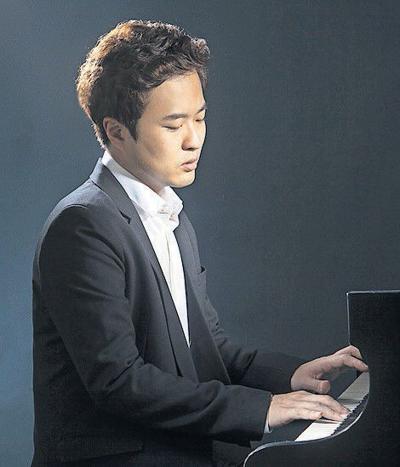
    Above: pianist Dasol Kim, photo by Christian Steiner

    ~ Author: Oberon

    Wednesday February 27th, 2019 matinee – Young Concert Artists presenting pianist Dasol Kim in a noontime recital at The Morgan Library. An imaginative program, superbly played in this intimate, high-ceilinged and sonically alive hall, made for a heart-warming experience on a chilly, overcast day. 

    Mr. Kim has been a prize-winner at numerous competitions. He has been a soloist with major orchestras in Europe and the USA, and his debut disc – of works by Robert Schumann – was released by Deutsche Grammaphon in 2015.

    Opening his recital at the Morgan this afternoon, the lithe-framed pianist displayed a wonderful sense of rhythmic vitality in Beethoven’s Piano Sonata No. 26 in E-flat Major, Op. 81a. The pulse of the music was finely set forth as the atmosphere moves from melancholy to triumphant to joyous. A loud, ill-timed cough from someone in the hall rather spoiled the ending of the first movement, but Mr. Kim was not fazed in the least and proceeded to a perfect rendering of the moody Andante espressivo, which shifts between pensive and hopeful passages. His playing here showed a wonderful delicate touch.  In the sonata’s final movement, the rapid passages were then effortlessly clear and vivid, with big attacks and fiorature aplenty. A sort of coda brings the work to a big end, and brought the first of the afternoon’s volleys of applause from the appreciative audience.

    Chopin’s Scherzo No. 4 in E Major, Op. 54, shows a certain motivic relationship to the Beethoven. Mr. Kim offered fanciful, jewel-like cascades of notes, laced with charming mini-pauses along the way. A sudden shift to sadness is a surprise; the music turns dreamy before returning to this sad theme, which Mr. Kim played so movingly. With a burst of passion, happiness returns. The piece ends grandly.

    Mr. Kim then offered an engrossing – indeed hypnotic – performance of Maurice Ravel’s astonishing Gaspard de la nuit. This most demanding of solo piano works was inspired by a book by Aloysius Bertrand (1807-1841) of the same name which contained verses, prose-poems, and drawings relating to fantasies of imps, devils, nymphs, ill-fated lovers, visions of death, and nightmares. Gaspard de la nuit is a nick-name for Satan.

    The opening movement, Ondine, tells of the attempt of the eponymous water nymph to draw her mortal beloved down to her submerged castle, from which they will rule the deep. Dasol Kim’s playing of the shimmering, rapturous fihurations was so evocative. Music of magical delicacy turns passionate; the pianist plays glittering scales as the sound builds, to be followed by a feeling of dreamlike drifting.

    The incredibly haunting Le gibet (The Gallows) depicts a hanged man silhouetted against the setting sun. This darkly hesitant, eerily beautiful music (so chillingly used in the noir vampire film, The Hunger) was a perfect vehicle for Mr. Kim’s mesmerisingly sustained interpretation: his sublime control here gave me the chills.

    After a sly start, Scarbo (an elusive dwarf who haunts dreams) turns into a high-velocity dance with cunning pauses and crafty mood swings. With dazzling dexterity, Mr. Kim portrayed this sneaky creature; the music turns ghostly before Scarbo vanishes quietly into the night.

    To end his program, Mr. Kim offered Nikolai Kapustin’s ‘Intermezzo’ from Eight Concert Etudes, Op. 40: a jazzy work played with a debonair lilt. The music speeds up, the pianist reeling off the lively, dancing passages with flair. This dazzling finale/encore elicited a standing ovation from the crowd.

    ~ Oberon

  • Young Concert Artists: Zlatomir Fung

    Fung_Zlatomir5CreditMattDine-1140x642

    Above: cellist Zlatomir Fung, in a Matt Dine photo

    ~ Author: Oberon

    Tuesday February 19th, 2019 – Young Concert Artists presenting cellist Zlatiomir Fung in his New York debut recital at Merkin Hall. Tengku Irfan was the pianist for this wide-ranging, thrillingly-played program.

    “Young” was the operative word tonight. And both of these musicians disprove the old adage that ‘youth is wasted on the young’; they have spent their teen years developing their talent, and building impressive performance résumés. Now they are ready for anything.

    Mr. Fung, a native of Oregon, reveals a charming personality in this Q & A from the Violin Channel. Of Bulgarian and Chinese heritage, the earnest 19-year-old cellist was greeted by enthusiastic cheers from the packed house when he walked onstage at Merkin Hall tonight. In the course of his opening work – four of the Eleven Capricci for Solo Cello by Joseph Dall’Abaco – Zlatomir Fung established himself as both a poet and virtuoso of the highest order.

    These Dall’Abaco works are a very pleasant alternatives to the Bach cello suites with which cellists so often open their recital programs. Mr. Fung displayed clean, warmly resonant tone, a gift for dynamic finesse, and a depth of feeling that seemed remarkable in one so young. In the first Capriccio, trills and grace notes were deftly etched into the musical line. To end his set of four, Mr. Fung chose the 11th, which includes passages of demented agitato, played with great fervor. As applause engulfed the cellist, he took a spot among my top five players of the instrument…or maybe even…my top three? 

    Pianist Tengku Irfan – slender of frame and looking far younger than his score of years – then joined Mr. Fung for a revelatory performance of Enest Bloch’s Baal Shem. This music was new to me; the passion and tenderness with which the two artists played it made a direct connection to my soul.

    Ernest Bloch, a native of Switzerland, was a young violinist on tour in the USA when, falling short of money, he got stranded in New York City and decided to stay here. Moved by a Hasidic Jewish service he attended in 1919, Bloch wrote the Baal Shem, subtitled “Three Pictures of Hasidic Life.

    During the opening Vidui, I was so mesmerized by the playing of Mssrs. Fung and Tengku that I couldn’t write even the briefest note about the music; all I can say is that it moved me deeply – both the music itself and the playing of it. The piano introduction to the ensuing Nigun – masterfully played by Irfan Tengku – leads to music-making of searing intensity from both players. A series of descending trills for the cello took my breath away. In a complete mood swing, the concluding Simchas Torah has a very optimistic feel: an almost romantic-style passage leads to dancing and ultimately to passion. With a tumult of cheers and applause, the audience saluted the two musicians after this spell-binding performance. 

    In a remarkable display of what a cello can do, Mr. Fung gave a triumphant performance of Luciano Berio’s Sequenza. From his opening tapping, patting, and slapping of his cello, Mr. Fung creates all manner of sound effects – shivering, squeaking, barking, scratching, gliding – as the piece proceeds. Mixed in are brief touches of whispered pianissississimo, including an ultra-quiet ending. This bravura showcase knocked the audience for a loop; Mr. Fung took a bow amid a din of enthusiasm.

    Following the interval, the pianist and cellist gave the premiere performance of Prelude by Katherine Balch, the current YCA Composer-in-Residence. This was my second hearing of music by Ms. Balch, and again it struck me as finely-crafted music from a composer who has perhaps not yet found her own distinctive voice.

    From a turbulent start, we go on a magical mystery tour and – via some strong accents – to noisy music that works both players into a frenzy. The gimmick of having the pianist reach inside the piano to produce isolated sounds has been done before – I never get the point of it – but a mad cello cadenza gives the piece a spark. An amusing sour taste sets in as some intentionally ambivalent pitches crop up. Drifting onward, Prelude leads without pause into the evening’s final work: the Brahms Cello Sonata in E-minor, Opus 38.

    TengkuIrfanpianolad001_1533856206

    Above: pianist Tengku Irfan, photo by Owee Ah Chun

    In the Brahms, the partnership of cellist and pianist showed yet again how finely matched these two musicians are. It’s a bit of an odd sonata, in that there’s really not a ‘slow’ movement per se. But the opening Allegro non troppo (actually very ‘non troppo’) makes up for it: it has a darkish glow with a poignant, wistful melodic line. The pianist here was a marvel, and Mr. Fung summoned incredible depth of tone from his cello. The second movement is a Menuetto that sometimes teasingly has the air of a waltz; the musicians play at times in unison. Mr. Tengku had the Steinway in full flourish for the concluding Allegro, and Mr. Fung sealed his New York debut triumph with spectacular playing.

    As an encore, these two young artists offered a luminous rendering of Gabriel Fauré’s “Après un rêve“. The sheer enthralling beauty of their playing held the audience in a state of breathless awe.

    ~ Oberon

  • YCA Presents Flautist Anthony Trionfo

    Anthonyhiresmattdine3

    Above: Anthony Trionfo, photographed by Matt Dine

    ~Author: Oberon

    Wednesday March 28th, 2018 – Young Concert Artists presenting flautist Anthony Trionfo at Merkin Hall. Mr. Trionfo is a musician of prodigious talent and scintillating personality; along with the excellent pianist Albert Cano Smit and a quartet of string players, he offered a wide-ranging, adventurous program combining the familiar, the rare, and the new.

    Gabriel Fauré‘s Fantasy in E minor, Op. 79, opened the evening. Mr. Trionfo’s shining tone and his feel for the sensuous undercurrents of the opening Andantino gave way, in the Allegro, to florid passages of crystalline coloratura. Mr. Cano Smit was the ideal partner here, his playing impeccably tailored, his seriousness of intent and commitment most welcome in such a young artist. 

    Returning alone to the stage, Mr. Trionfo gave a superbly confident performance of J.S. Bach’s Partita in A minor, BWV 1013. In this suite of dances, the flautist showed great subtlety and a multi-hued timbre that kept the music ever-alive. The Courante had a feel of birdsong, the Sarabande a forlorn air of touching simplicity. In the concluding Bourrée anglaise, the playing was light-filled and lovely.

    The New York premiere of drip/spin by Katherine Balch, the 2017 YCA Composer-in-Residence, was prefaced by Mr. Trionfo’s remarks about the ‘dew-drop necklace’ – silk threads and mucus droplets – with which the glow-worm attracts and entraps its prey. The perpetual motion of the piano part seems to envision the spinning toils of the glow-worm, whilst the sighs and blips from the flute depict the unsuspecting victim. Some of the piano keys have been ‘prepared’, adding a ghostly quality. The flute lingers on high, until an energy drain occurs. Then the piano begins a rolling motif; in its death throes, the preyed-upon flute goes wild, with harsh accents that finally sputter out.

    Al21165

    For the Chant de Linos by André Jolivet, a string quartet comprised of Mélanie Genin (harp), Aleksey Semenenko (violin), Ida Kavafian (viola) and Sang-Eun Lee (cello) joined Mr. Trionfo onstage. André Jolivet (1905-1974) composed this work on commission from the Paris Conservatoire in 1944 as a compulsory test piece for competitors in the Solo de Concours; the prize was won that year by Jean-Pierre Rampal. The work is a threnody (or lament to the dead) inspired by the story of Linos, son of Apollo. Linos taught Orpheus to play the lyre, and he was later killed by Heracles for criticizing him too much. André Jolivet was a composer inspired by the legends from antiquity; he wrote many chamber music works, eleven concertos, as well as orchestral and vocal music.

    The rich yet transparent textures of the strings are quite contemporary in sound yet they evoke a distant, mythic past. A dreamy passage for flute and harp draws us in; the music can veer from lyrical to explosive in the twinkling of an eye. A subtle flute solo leads to a darkish dance played by all. Things get a bit woozy before turning to lament; following a cadenza, the music dances onward with the flute trilling and piping. What a great idea to program this ensemble piece tonight: a wonderful opportunity to hear this music, and so beautifully played.  

    Albert cano smit

    Above: pianist Albert Cano Smit

    A fascinating performance of Lowell Liebermann’s Sonata for flute and piano, Op. 23, followed the interval. The opening Lento con rubato soon wraps us in the strange beauty of its misterioso atmosphere. Delicate sounds from the piano’s upper register are followed by a big outburst which subsides into ghostliness. Single notes struck by the pianist underscore a sinuous flute motif; then the flute sound turns big and piercing. Rippling piano figurations summon the flautist back to song, a gentle flow becoming a percolation. The haunting melody returns in all is mystery, and Mr. Trionfo’s flute makes a final ascent to a remarkably sustained note that tapers away.

    In the ensuing Presto energico, there is much bouncy, lively coloratura from the flute which Mr. Trionfo conveyed brilliantly, with lots of body English; meanwhile the piano writing is animated…almost wild. The music sails forward, with virtuosic playing from Mr. Cano Smit whilst Mr. Trionfo spins high flourishes with his flute. This work drew a very warm audience response, with the composer taking a bow to waves of enthusiasm.

    Ian Clark’s Zoom Tube again gave Mr. Trionfo the opportunity to demonstrate some of the various sound effects his flute could produce…like the Balch, but more extroverted and pop-oriented. He sometimes seemed to be producing two different sounds at the same time, ‘speaking’ or blowing air, playfully jazzing things up, even emitting a whooping scream at one point.

    Mr. Trionfo’s arrangement of the traditional Carnival of Venice provided an immensely enjoyable showcase for his virtuosity. After a captivating trill, the flautist embarked on a series of variations on the familiar tune: the blues, bel canto, jazz, a Latin lilt, ‘Casta diva‘, and on and on. Mr. Cano Smit was the perfect accomplice in this imaginative tour de force as the two players kept the audience thoroughly engaged with their technical dazzle and well-contrasted personalities.

    As an encore, Mr. Trionfo offered Debussy’s Syrinx, ending on a sustained, gossamer pianissimo.

    ~ Oberon

  • YCA Presents Samuel Hasselhorn

    SamuelHasselhorn

    Wednesday February 15th, 2017 – Baritone Samuel Hasselhorn (above) presented by Young Concert Artists in recital at Merkin Hall. With Renate Rohlfing at the Steinway, the evening was a definitive success for both the tall singer and his lovely, expressive pianist. The imaginative program, which included both the familiar and the rare, was both beautifully sung and emotionally engaging.

    In my 50+ years of recital-going, baritones have invariably giving me lasting memories: Wolfgang Holzmair, Dmitri Hvorstovsky, the two Thomases (Allen and Hampson), Bo Skovhus, Matthias Goerne, Sanford Sylvan, Kurt Ollmann, Christopheren Nomura, Randall Scarlata, Keith Phares, John Michael Moore, David Won, Shenyang, Thomas Cannon – their voices echo in the mind and heart. Mr. Hasselhorn now joins that distinguished list.

    In their opening Schumann set, Mr. Hasselhorn and Ms. Rohlfing explored a wide range of moods: from the urgency of Tragödie I and the pensive resignation of Tragödie II, they progressed to the vivid narrative of Belsazar (Mr. Hasselhorn operatically powerful, with Ms. Rohlfing excelling), and the rather unusual Mein wagen rollet langsam. The effect of the defeat of Napoleon on two of his faithful foot-soldiers was marvelously depicted in song by Mr. Hasselhorn in Die beiden Grenadiere, with its sounding of the Marseillaise. Passionate desire fills Lehn’ deine Wang, and the contrasts of poetic and turbulent love were superbly expressed by baritone and pianist in Du bist wie eine Blume and Es leuchtet meine liebe, the latter ending with Ms. Rohlfing’s finely-played postlude.

    In charmingly accented and very clear English, Mr. Hasselhorn delighted us with Britten’s ironic Oliver Cromwell and The foggy, foggy dew. The singer’s exceptional control was manifested in his poignant rendering of O waly, waly with Ms. Rohlfing giving tender support. A long comic Britten narrative, The Crocodile, ended the evening’s first half.

    Addressing the audience before commencing the evening’s second half, Mr. Hasselhorn spoke of the woes of our planet today, thrown into further chaos by recent events. The plight of refugees worldwide, and the threats posed by war and terrorism to a hopeful humanity prompted the baritone to devise a set of works especially meaningful to him on a personal level; these he now offered to us with singing of real sincerity and depth of feeling.

    The juxtaposition of Hugo Wolf’s madly dramatic Die Feuerreiter (‘The Fireman’) and Franz Schubert’s haunting Litanei auf das Allerseelen (‘Litany for All-Saints’) was a masterstroke of programming beyond anything I’ve ever experienced in a recital. The fierceness and wild desperation of the Wolf was memorably contrasted with the sublime prayer for peace penned by Schubert. Mr. Hasselhorn and Ms. Rohlfing were simply thrilling: the pianist in a virtuoso rendering of the Wolf whilst the singer’s urgency in the narrative reached a feverish level. By contrast, the Schubert was heart-rending in its lyricism and spirituality. By taking only a brief pause between these two, our two artists cast a veritable spell over the house.

    Renate-Rohlfing

    Above: pianist Renate Rohlfing

    Three Poulenc songs, reflections on the Nazi occupation of Paris, showed the Hasselhorn/Rohlfing partnership at its most persuasive. The pre-dawn removal of (fictional) freedom-fighter André Platard in La disparu, a prayer to the Virgin in Priez pour pays (the pianist truly sublime here), and the return from the front of an exhausted sergeant in Le retour de sergent made a triptych – painted in the inimitable Poulenc style – which perfectly encapsulates a specific time and place. 

    The singer and pianist then sent chills thru me with the devastating emotional power of their performance of Schubert’s Erlkönig. Mr. Hasselhorn summoned up the three contrasting characters of the narrative with subtle rather than overly-theatrical variants of tone-colour – simply splendid singing! – and Ms. Rohlfing gave the piano’s role, with its contrast of relentlessness, desperation, and cruel seduction, full rein. A luminously intense performance.

    In the brief Wanderers Nachtlied II, poetry seeped gently into the air from Ms. Rohlfing’s keyboard, to be handsomely taken up by Mr. Hasselhorn like a benediction. Lingering on the heights of expressiveness, singer and pianist brought me to tears with the poignant song of Der blinde kind (‘The Blind Boy’), a youth who refuses to wallow in self-pity over his affliction. Mr. Hasselhorn’s gestures, stance, and expressive features portrayed the boy’s physical and emotional state movingly, evoking understanding rather than pity: such a touching song, superbly rendered.

    Schubert’s last song, Die taubenpost (‘The carrier-pigeon’), seems like a simple avowal of young love as the poet sends his trusty pigeon bearing messages to his beloved. The pigeon’s name Sehnsucht – that magical word for ‘longing’ – and he is the messenger of fidelity. For those of us who love from afar, the song takes on a sweet depth of meaning. True to all that has gone before, Mr. Hasselhorn and Ms. Rohlfing were perfect here. Their encore, the blessed An die musik (‘To Music’), served as a summarizing of this exceptional evening of song.

    I shall hope to hear Mr. Hasselhorn here in New York City again soon; how I should love to hear his voice in Schumann’s Dichterliebe! It also seems to me that there are many operatic roles in which he could shine at The Met. For this evening, I again express gratitude to Susan Wadsworth and Young Concert Artists for bringing us another in their series of exemplary recitals.

  • Huang/Schwizgebel @ The Morgan Library

    Huangschwizgebel

    Wednesday April 22nd, 2015 – Violinist Paul Huang and pianist Louis Schwizgebel (above) in a noontime recital at the Morgan Library, presented by Young Concert Artists in collaboration with the Morgan Library and Museum.

    Earlier this year I heard Paul Huang playing in a Young Concert Artists Composers Series concert at Merkin Hall. His artistic maturity seemed remarkable in one so young. Shortly after that concert, it was announced that Paul was one of five recipients of an Avery Fisher Career Grant.

    Swiss-Chinese pianist Louis Schwizgebel won the Geneva International Music Competition at the age of seventeen, and two years later, he won the Young Concert Artists International Auditions in New York. In 2012 he was awarded the Arthur Rubenstein Prize in Piano at the Juilliard School, and in 2013 he was announced as a BBC New Generation Artist.

    Franz Schubert’s Rondo brilliant in B Minor, D. 895 (Op. 70) opened the programme, with both the musicians looking dapper in black suits with red silk handkerchiefs in their breast pockets. Gilder Lehrman Hall at The Morgan is a wonderful venue for chamber music, with its comfortable, steeply-raked seating and its fine acoustic which gives the music real immediacy. Displaying ‘Olde World’ warmth of tone and depth of sensitivity, the Huang/Schwizgebel duo gave an exhilarating performance of this demanding Schubert showpiece.

    Thematically rich, with an upward-leaping signature motif, the Rondo (composed 1826) showed the two young musicians in a fine rapport, mining both the dramatic and the virtuosic passages with flair. Shifts of key and pacing were astutely mastered, and Mr. Huang’s technical command was impressive. Incidentally, the manuscript score of this work is housed at The Morgan.

    Arvo Pärt’s Fratres is well-known to Gotham’s ballet lovers since it was used by Christopher Wheeldon for his 2003 ballet LITURGY at New York City Ballet. After a twitchy, nervous passage for solo violin, the piano makes an emphatic entrance. Thereafter we are taken on a musical/spiritual journey that veers from urgency to pensiveness, rises to a passionate cry to heaven, and develops into a soulful hymn. A repeated, rising theme for the violin seems to depict souls ascending to heaven before the work reaches its ethereal finish. Mssrs. Huang and Schwizgebel gave an engrossing performance of this piece which is surely among Pärt’s finest and most memorable compositions.

    Cesar Franck’s Sonata for Violin and Piano in A Major is so poignantly familiar; right from the start we are drawn into its melodic soundscape. Louis Schwizgebel’s playing of the first solo piano passage radiated romantic tenderness, and the piano introduction to the second movement was superbly played. Paul Huang brought intense beauty to each theme that Franck so generously gives to the violin; the clarity and expressiveness of his playing was something uplifting to experience.

    Responding to very warm applause from the large audience, Paul and Louis offered a heartfelt rendition of Robert Schumann’s Träumerei as an encore, thoughtfully dedicating it to Susan Wadsworth, the director of Young Concert Artists, and to everyone involved in the organization. The recital celebrated a beautiful Spring day in high style; I felt so fortunate to have been there.

  • YCA Young Composers Concert @ Merkin Hall

    ComposersConcertslideSW_edited_output..fw_1

    Tuesday February 17th, 2015 – Young Concert Artists presenting an evening of chamber music by young composers at Merkin Hall. I invited my choreographer-friend Claudia Schreier to join me, as she is always in quest of music to set dances to.

    It was a cordial and wonderfully satisfying evening of music, the four composers showing an expansive range of styles and influences, and a fine mastery of writing for the chosen instruments. The level of playing was high and mighty, and how lovely to re-encounter Ursula Oppens, who throughout her career has been a champion of new music.

    3f573b6e43ae27169d0dd8cde6c2d7f6

    Things got off to a shining start with BENJAMIN C.S. BOYLE‘s Sonata-Cantilena (NY premiere) performed by pianist Charles Abramovic and flautist Mimi Stillman (above). This four-movement work opens with a Debussyian shimmer; it wends its way thru melodious passages – sometimes doleful and sometimes evoking the warblings of exotic birds – with some sprightly, witty cascades of impetuous coloratura added to the mix. Ms. Stillman, in a fetching pale-violet frock, played beautifully and Mr. Abramovic was a congenially artful partner. 

    Ursula oppens pianist

    Ms. Oppens (above) was then joined by violinist Paul Huang and clarinetist Narek Arutyunian for DAVID HERTZBERG‘s Orgie Céleste (Premiere), a fantastical evocation of heavenly delights. Complex and ear-tingling in its textures, much of the music has an ethereal quality as the piano and violin linger in their high registers; meanwhile the clarinet murmurs a two-note motif endlessly, like a subtly pulsing heartbeat. Mr. Huang showed extraordinary technical control as he met all the composer’s demands with alacrity, including some ironic glissandi. The intermingling of the three voices kept everything in a constant state of freshness, Ms. Oppens was wonderfully vivid in her silvery filigree and Mr. Arutyunian seizing melodic opportunities his mellow, expressive tone. The audience responded enthusiastically to both the music and the musicians.

    The only one of tonight’s composers previously familiar to me was KENJI BUNCH, who I had met several years ago while I was working at Tower Records. Since then I have heard quite a bit of his music, but I had not had the pleasure of hearing him play live. He’s a superb violist, with a marvelous mastery of the instrument, making it sing for him is two very contrasted works.

    Bunch (Kenji)--Monica Ohuchi(sm)

    Above: Kenji Bunch and pianist Monica Ohuchi

    In I Dream in Evergreen, Kenji revealed the viola’s depth of lyricism in a poignant reflection on the sundering aspects of death, when mortal friendships end and are transformed into memory. Ms. Ohuchi’s gently shimmering opening theme is soon joined by the viola intoning its poetic recollection of past affection and regret. Together the two musicians provided a reflective interlude, impeccably played.    

    Kenji’s Étude No. 4 (from a set of twelve études he composed for his wife, Ms. Ohuchi, under the title Monica’s Notebook) is a brief and brilliant piece. Lasting all of 90 seconds, it sends the pianist’s hands rippling up and down the keyboard in a delightful display of dexterity. Ms. Ohuchi nailed it, and she was rightly given sustained applause which wouldn’t quit til she returned for a solo bow (personally, I was hoping for an encore of the piece!)

    In Étouffée for solo viola, Kenji’s panoramic exploration of the viola’s possibilities was truly impressive and enjoyable; his playing is mesmerizing – there’s no other word for it. Inspired by a favorite dish from the Cajun culture, the work opens with a hazy, out-of-focus quality as if the viola was drunk on Southern Comfort. This evolves into a big country dance-tune, captivating in its combination of rhythmic drive and sexy rubato. Bravo, Kenji! His entire set was really impressive.

    OpusOne

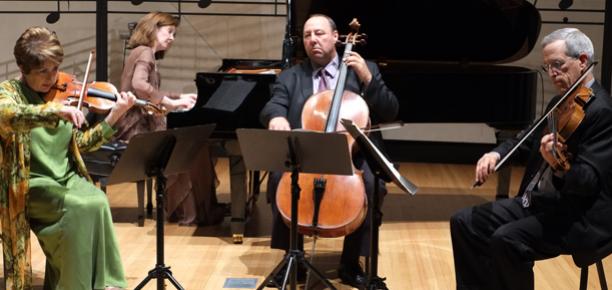
    Having musicians of the caliber of the Opus One quartet (above) play the New York premiere of your work must have given composer CHRIS ROGERSON a thrill. His Summer Night Music for Piano Quartet is full of musical marvels and how superbly it was played tonight by the Opus One artists: Ida Kavafian, violinist; Steven Tenenbom, violist; Peter Wiley, cellist; and Anne-Marie McDermott, pianist.

    In four movements, Summer Night Music opens with a sense of quietude at Twilight. First the cello, then viola, and then the violin introduce themselves in gentle motifs. Ms. McDermott reaches inside the body of the Steinway to pluck the piano’s strings as the cello murmurs plaintively and the violin plays high and pensive. In Fireflies, the piano spins forth with fluttering restlessness and sparkling little interjections. There’s a dense passage from all four players until, until – with a high fade-away from violin and piano – the memory of a Summer night slips away.

    The third movement, Evening Prayers, sounds like a gentle lullabye; the violin lingers on high and the viola and cello blend thru the music in simpatico phrases. The concluding Sleep Music commences with a gently vibrant quality, soft and high; a mellowness of cello and viola evoke deepening night. There is a broad melody for unison strings – and a passionate piano theme – before the music finally vanishes into thin air on Ms. Kavafian’s violin strings.

    10885560_575110625952729_3334037620464024949_n

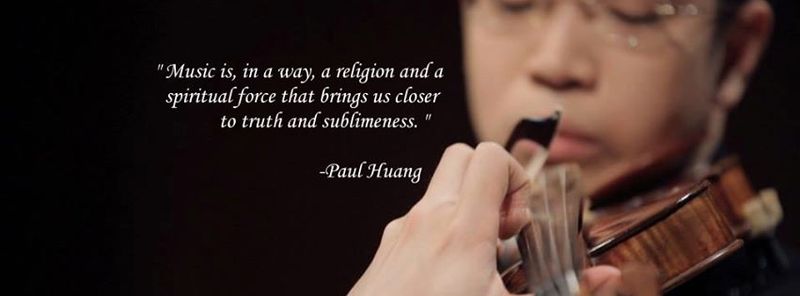
    In researching some of the participating artists, I came upon the above quote from the young violinist Paul Huang. He has expressed something here that I have always felt.