Tag: Yuja Wang

  • Yuja Wang ~ Rachmaninoff @ Carnegie Hall

    Yuja wang

    Above: pianist Yuja Wang

    Author: Ben Weaver

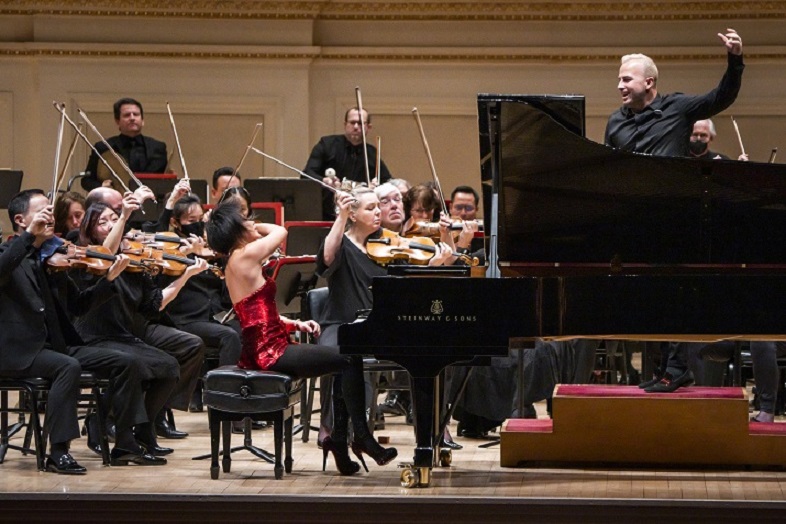
    Saturday January 28th, 2023 – Sergei Rachmaninoff’s four piano concertos are among the most challenging works in any pianist’s repertoire. Today, at Carnegie Hall, pianist Yuja Wang raised the bar for her colleagues by playing all four – plus Rhapsody on a Theme of Paganini – in one afternoon, accompanied by the Philadelphia Orchestra under the baton of Yannick Nézet-Séguin. These kinds of Olympic feats are rare; I’ve heard of the complete Beethoven Symphonies being conducted in a single day and Brahms’ two Piano Concertos in one concert, but I’m unaware of a single soloist taking on 5 concertos in one afternoon. Overall, the concert lasted nearly 5 hours, with two intermissions. Carnegie Hall was completely sold out, and, as a testimony to the artists and to the music, no one seems to have left early.

    One unscheduled extended pause was caused by a member of an audience collapsing and, apparently, dying just as the second movement of the 2nd Concerto ended. The man was revived in the hallway before the performance resumed. Maestro Nézet-Séguin informed us before performance of the 3rd Concerto that the gentleman was out of surgery and was expected to make a full recovery. That’s how long the concert lasted: a man died, was brought back to life, and was out of surgery at the 2/3 point of the afternoon!

    The marathon started with Rachmaninoff’s most enduring work and one of the most beloved works in the classical repertoire: the Piano Concerto No. 2 in C minor, Op. 18, composed in 1900-01 after an extended composers’ block Rachmaninoff suffered because of the disastrous premiere of his Symphony No. 1. After seeing a psychiatrist in France – which included hypnosis – Rachmaninoff composed this magnificent, melodic work which decades later would have pop-songs written to its tunes. (Eric Carmen’s “All By Myself” being perhaps the most successful chart-topper.) Ms. Wang’s strong, incisive solo introduction was a preview of the muscled playing that dominated the entire afternoon. She easily produced massive sounds from the Steinway, rising above Rachmaninoff’s dense orchestrations. Even on recordings, the piano sometimes gets lost in the famous melody at the beginning of Second Concerto’s Moderato movement. Not with Wang, who summoned torrents of sound that cut through the orchestra.

    Rachmaninoff was quite fond of the clarinet and wrote a number of magnificent music for it in his works, including in the Adagio sostenuto of this concerto. (The clarinet’s dark hues are also prominently featured in the contemporaneous Symphony No. 2). Clarinetist Ricardo Morales’ playing was invaluable here. I did feel the tempi in the first two movements were perhaps a bit too languorous; momentum seemed to be lost. But (after the performance resumed following the incident with the ill audience member), the closing Allegro scherzando was an exhilarating conclusion.

    Rachmaninoff’s Piano Concerto No. 1 in F-sharp minor, Op. 1 (composed 1890-91 and revised extensively in 1917) and Piano Concerto No. 4 in G minor, Op. 40 (composed in the US in 1924-26, and premiered by the composer with Leopold Stokowski and the Philadelphia Orchestra) are his least known concertos. Perhaps their melodies are not as hummable as the other works, but they are filled with melodies nonetheless, and wonderful writing for the piano. Ms. Wang met every obstacle with ease and bravura. Concerto No. 1, composed when Rachmaninoff was only 17, has all the trademarks that would define his style as he matured, including expansive, romantic melodies and dark orchestrations. And though Rachmaninoff always maintained that he was a romantic composer through-and-through (and was criticized for it by the modernists), his Concerto No. 4 sometimes echoes – intentionally or not – Ravel’s Piano Concerto and Gershwin’s Rhapsody in Blue (which Rachmaninoff heard at its 1924 world premiere performance.) So while he never became a modernist, Rachmaninoff was certainly influenced by the sounds of his contemporaries. I’ve heard Ms. Wang play a magnificent Ravel Piano Concerto live, and I was getting flashes of some of those moments as she played the Fourth here.

    The Rhapsody on a Theme of Paganini, Op. 43, composed in 1934 and premiered by the composer with Stokowski again conducting the Philadelphia Orchestra, is one of Rachmaninoff’s most brilliant works. Using the same Paganini Caprice that inspired numerous others to compose variations (Schumann, Brahms (two separate works), Liszt, Lutosławski, Schnittke), Rachmaninoff’s compact work never flags. It is a magnificent, tenacious bulldozer of invention. The original tune is shaped, reshaped, stretched in every imaginable way, and yet each variations is a beautiful thing of its own. The most famous of these, the immortal 18th Variation, is the original melody played upside down. The joy maestro Nézet-Séguin took in conducting of this section was clear: he seemed to be floating off the podium. Ms. Wang – needless to say conquered every technical challenge – but also the poetry, the beauty of her playing was unmatched.

    The concert ended with the Mount Everest of the concerto repertoire, the towering Piano Concerto No. 3 in D minor, Op. 30. Composed in 1909, while Rachmaninoff still lived in Russia, he intended it to be his calling card in the West, as he was embarking on his first American tour. And so the concerto was premiered in New York with the New York Symphony Orchestra, conducted by Walter Damrosch. (Six weeks later Raxhmaninoff played it again in New York, this time with the New York Philharmonic- the two orchestras later merged into one – under the baton of Gustav Mahler. There are stories that Mahler was not entirely happy with the collaboration.)

    I don’t know if this concerto actually drove David Helfgott to madness, but it is certainly enough to scare anyone into an asylum, and for Ms. Wang, playing it after roughly 4 hours of performing, was a brave decision. Fortunately for us her hands seem to be made of steel. This was not an example of someone crawling across the finish line: Ms. Wang crossed it at full speed. I noticed her hanging her hands down between playing, seemingly resting/stretching. But her playing did not show any sign of fatigue. Every note was crystal clear, and she – and Maestro Nézet-Séguin – did not shy away from the grandness and romanticism of Rachmaninoff’s music. And there is no better orchestra to play Rachmaninoff than his own favorite Philadelphians. They have this in their blood.

    One thing Yuja Wang is known for – outside of her extraordinary pianism – is outfits (she wore 5, one new ensemble for each work), but another is encores. She is very generous with encores: as long as the public wants more, she is happy to provide. I joked to a friend that really this concert was just a performance of the Second Concerto followed by encores of the rest of Rachmaninoff’s concertos. In the end – after such a grueling afternoon – she gave just one encore, an achingly beautiful “Dance of the Blessed Spirits” from Gluck’s Orfeo ed Euridice, transcribed by Giovanni Sgambati.

    There is so much to admire in Yuja Wang’s artistry. Some people seem to be distracted by her showmanship and outfits. I’m struck by her genuine love of performing live and love for her audience. It’s why she’s so happy to keep playing encores as long as her audience is on their feet. Another great pianist I recently saw live at Carnegie, after an extraordinary concert, offered an encore of just literally a few notes (something by Schoenberg.) Really, it was a joke, but it was also rude. Ms. Wang’s joy at being on stage is infectious. We’ve read about Liszt and Paganini’s shenanigans. Why can’t a contemporary artist do more than roll out, play, and leave? Brava, Ms. Wang, for treating this music as a living, breathing being and engaging with your audience with such generosity.

    ~ Ben Weaver

    Here’s a gallery of performance images by photographer Chris Lee documenting this unique evening:
    CH11298876

    CH11304127

    CH11304129

    CH11304132

    CH11304130

    CH11298873

    CH11298875

    Above: Maestro and soloist at the close of the evening; performance photos by Chris Lee, courtesy of Carnegie Hall

  • Yuja Wang @ The NY Philharmonic

    Thumbnail_Photo by Caitlin Ochs

    Above: pianist Yuja Wang with the NY Philharmonic, photo by Caitlin Ochs

    ~ Author: Ben Weaver

    Wednesday March 27th, 2019 – March 27th was supposed to be an extra-special evening at the New York Philharmonic: the orchestra had announced a one-night-only performance by legendary pianist Maurizio Pollini in honor of the 40th anniversary of his debut with the orchestra (also functioning as a Pension Fund Benefit Gala). Pollini’s appearances with the orchestra have been infrequent over the years, though he did play Chopin’s Piano Concerto (same one as his 1969 debut, Op. 11) in 2015. Alas, it was not to be: the orchestra announced that because of an illness, Mr. Pollini would not be able to appear. Though Mr. Pollini is truly irreplaceable, the Philharmonic did manage to secure a starry replacement: Yuja Wang, in town for appearances at Carnegie Hall, agreed to step in on short notice. The program remained the same: Schumann’s ever popular Piano Concerto in A minor was the centerpiece and Ms. Wang did not disappoint. 

    Though it is alleged that many pianists do not like performing Schumann’s sole piano concerto because they do not find it sufficiently technically demanding, sometimes finding the heart of music can be more demanding than any technical fireworks. Ms. Wang, dispatching every note with ease, also plumbed the depths of Schumann’s great work from the opening moments. The solo section at the beginning of the concerto was played quietly, wistfully, almost regretfully, before the orchestra surged forth. Maestro Jaap van Zweden, always a considerate accompanist, allowed Ms. Wang plenty of leeway to shape her solo moments. Ms. Wang summons a clean, beautiful and strong sound from the Steinway. The lovely slow movement was full of feeling and grace, and the exciting finale was playful and rhythmically alive.

    Ms. Wang is beloved by NY audiences and they demanded encores: she is famous for generous amounts of encores, though tonight she may have been asked to limit it to only two (the audience wanted more.) A gorgeous transcription (by Liszt) for solo piano of Schubert’s heartbreaking Lied Gretchen am Spinnrade kept the audience holding its collective breath. And pianist Arcadi Volodos’ entertainingly jazzy/bluesy arrangement of Mozart’s famous Rondo Alla Turca from the Piano Sonata No. 11 brought down the house. (My companion, whose husband is an established jazz musician who regularly performs with artists like Norah Jones, said approvingly: “You go girl!”)

    The Schumann concerto was sandwiched between two orchestral works. Johan Wagenaar’s forgotten Cyrano de Bergerac Overture, Op. 23 opened the program. This very melodic and entertaining 1905 composition, with its echoes of Wagner and Richard Strauss, deserves more attention than it gets. (Before Maestro Zweden reintroduced it to the Philharmonic’s rep in 2018 it was last performed by the orchestra in 1921 under Willem Mengelberg.) 

    The concert closed with a familiar rendition of Beethoven’s Symphony No. 7, which Wagner once called “the apotheosis of dance.” Maestro Zweden and NY Philharmonic musicians played, one could inelegantly say, the hell out of it. The moody opening quickly gave way to a series of rapturous melodies and dances. The famous Allegretto – many conductors go much too heavy, others speed through it thoughtlessly – was perfectly judged by Zweden. The rest of the symphony built to a thrilling, breathtaking and breathless finale.

    ~ Ben Weaver

  • Percussion and Piano @ Carnegie

    ~Author: Scoresby

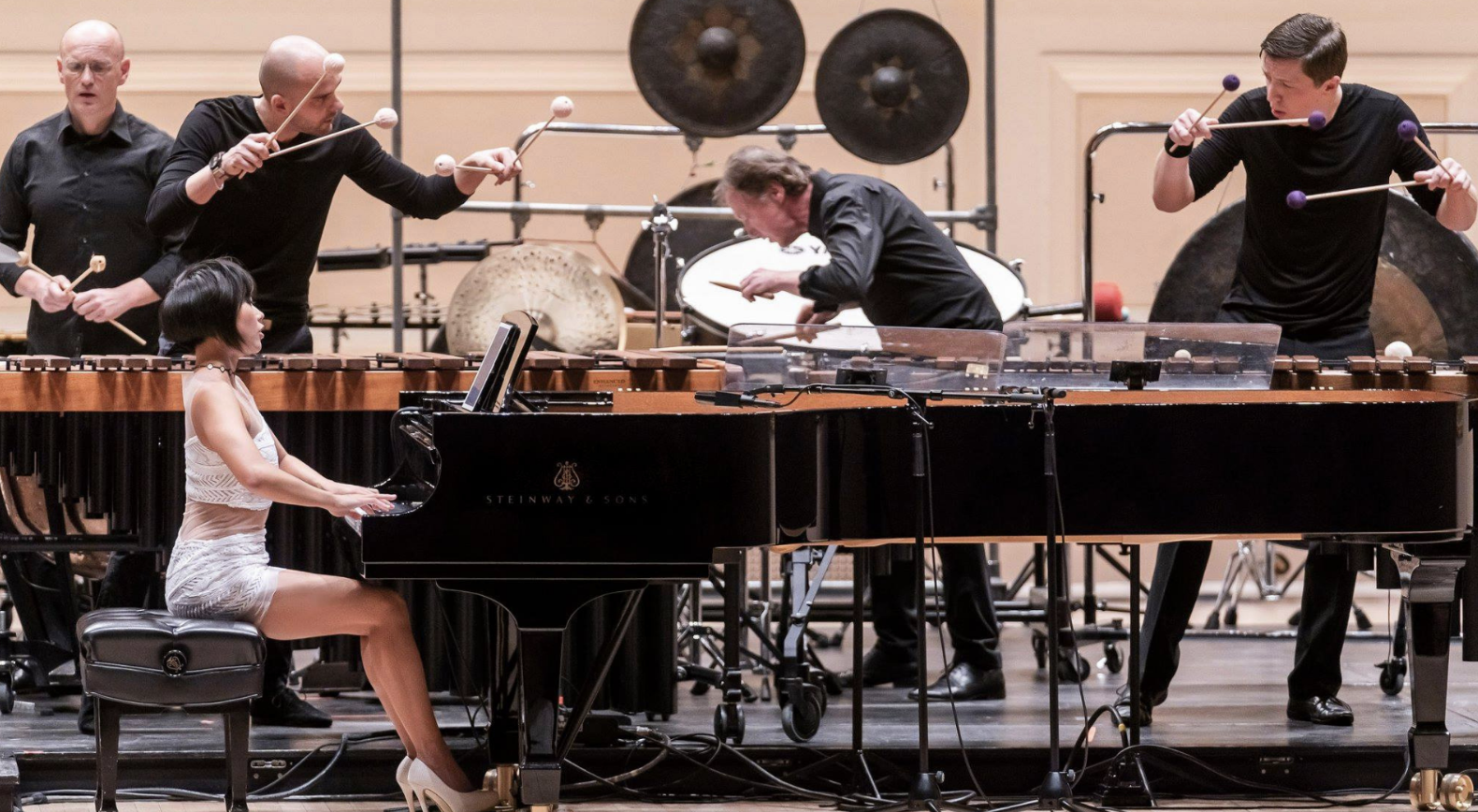
    Friday October 26 2018 – As the first concert in her six-part Perspectives residency at Carnegie Hall, Yuja Wang decided to do a thought-provoking collaboration with percussionists. It is great that instead of playing standard repertoire, Ms. Wang is using her platform to push her audience into more unfamiliar repertoire, such as her recital in Carnegie last season and this performance. Here, she was working with some of the all-stars of the percussion world: Martin Grubinger, his father Martin Grubinger Sr, Alexander Georgiev, and Leonhard Schmidinger for an incredibly fun evening. Unfortunately, the performance was billed as “Yuja Wang, piano and Martin Grubinger, percussion” with the other percussionists relegated to small lettering. The program didn’t even mention which percussionists played on which of the works. Oddly, no instrumentation was given for each work, instead just “piano and percussion”, despite a litany of different percussion instruments used. Nonetheless, Ms. Wang and Mr. Grubinger did give credit to their colleagues and this truly was a collaborative performance between all five musicians.

    Screen Shot 2018-10-31 at 8.19.36 PM
    Above: In the throes of the Bartók (from left to right): Leonhard Schmidinger, Alexander Georgiev, Yuja Wang, Martin Grubinger Sr, and Martin Grubinger; Photo Credit: Chris Lee

    The program began with Bartók’s Sonata for Two Piano and Percussion arranged for one piano and percussion by Martin Grubinger Sr. This was the most successful of the arrangements of the evening. Along with the Music for Strings, Percussion, and Celesta, this is Bartók at his most avant-garde with many references to jazz, interesting instrumentation, and spiky melodies. The biggest change to the score in this arrangement was splitting one of the piano parts into two marimbas played by exceptionally like one instrument by Mr. Grubinger and Mr. Georgiev – their coordination was almost surreal. The traditional percussion was played by Mr. Schmidinger and Mr. Grubinger Sr. The impact that this changed the entire timbre of the piece, becoming less incisive in a way but far more colorful. In a way it made the music sound even more avantgarde. In the mysterious opening chords after the rumbling timpani played by Martin Grubinger Sr, the aggressive playing of Ms. Wang was contrasted with the light tremolos on the marimba.

    With two pianos this texture sounds more like an attack, but the woodiness of the marimbas added a lighter atmosphere and made Ms. Wang’s piano seem more percussive. It was a brilliant play to highlight the piano playing while improving the music making. Ms. Wang for her part seemed to naturally get the score switching from whacking chords for emphasize to lyrical furtive blending into the ensemble. In the second movement, Bartók employs his night music in a classic tenary form. Ms. Wang’s evocative playing here with the military-esque sound of the percussion and softness of the Marimbas worked well in tandem to produce an unusual Messiaen-like ethereal sound.

    Mr. Grubinger and Mr. Georgiev exchanged more and more agitated lines with Ms. Wang leading into the virtuosic agitato with ripples of arpeggios punctuated by chords. Ms. Wang silvery sound moved through the dead hits of percussion, a dialogue less apparent in the original score. The group whipped its way through the Stravinsky-esque finale capturing a raw energy.

    The sold-out crowd seemed somewhat confused by the music, perhaps a little too avant-garde for their taste – but to me it was thrilling. Luckily for most of the crowd the group came back onstage to play Martin Grubinger Sr.’s arrangement of John Psathas’s Etude from One Study for three percussionists and piano. This work is a virtuosic piece that riffs through a bunch different sequences and Mr. Grubinger Sr. made sure that each instrument got its own fun solo to show off. It was the perfect piece for some levity after the serious Bartók and genuinely sounded more in the idiom of a rock concert by the end of the etude, causing the crowd to roar with applause.

    The second half of the program began with another Martin Grubinger Sr. Arrangement: this time of The Rite of Spring for one piano and three percussionists. Mr. Grubinger Sr.’s arrangement of this was magical, using elements of the two piano and one piano versions of the piece combined with marimba, vibraphone, chimes along with Stravinsky’s percussion of timpani, woodblock, washboard etc… to produce a completely unique sound that still paid homage to the original. It is incredibly unfortunate that the Stravinsky Estate decided a few weeks before this tour to ban this group from performing the work anywhere in which the copyright of the piece is still in effect (US being the only place where it is lifted), so this ended up being the second and last performance of the tour.

    Screen Shot 2018-10-31 at 8.09.33 PM
    The group after the final applause (left to right): Martin Grubinger, Leonhard Schmidinger, Alexander Georgiev, Yuja Wang, and Martin Grubinger Sr. 

    The opening was flush with color using the vibraphone as the bassoon mixed with humming tremolos from the piano and marimba to slowly build into the percussive attacks of the Augurs of Spring. The explosive last few movements such as the Ritual of the Rival Tribes and the Dance of the Earth of the first part were where this arrangement really shined, sounding at once razor-sharp and still managing to capture Stravinsky’s innovative instrumentation. In the introduction to Part II, the primordial timbres were still achieved by Mr. Georgiev bowing the vibraphone (and perhaps bowed glass too?) producing an eerie metallic sound mixed with the light woody marimba of Mr. Grubinger and a base structure of Ms. Wang’s piano playing the string part of the score.

    After those first two movements of Part II, the balance seemed quite off with the percussion absorbing all of Ms. Wang’s sound. Nonetheless, all four performances gave a virtuosic and energized performance. Interestingly, the percussion seemed less precise than Ms. Wang’s piano, particularly in the final section of the piece during the complicated rhythmic playing. The percussion chosen wasn’t able to stop its vibration quick enough, so some of the crisp beats sounded muddier from the bleeding sound. Still, the group seemed in perfect sync with one another, this was true ensemble playing.

    To end the performance (personally it seemed odd to me to have anything after The Rite, given how climactic it is already), the group played Mr. Grubinger Sr.’s arrangement of Leticia Gómez-Tagle’s solo piano arrangement the popular orchestral work by Arturo Márquez Danzon No. 2. This poppy but fun piece was thoroughly enjoyable if a little light after The Rite. Ms. Wang seemed to really dig into the opening tango and enjoy the many different Latin American rhythms that come as the piece develops. The group did a good job keeping this fun and energized. After a thunderous applause Ms. Wang and Mr. Grubinger gave an encore of the two of them playing Jesse Sieff’s Chopstankovich, which essentially a virtuosic snare drum part added to Shostakovich String Quartet’s No. 8’s intense second movement (in this case, the string part performed by Ms. Wang on piano). It was a fun little encore to cap the evening’s eccentric program. It was a wonderful collaborative program that broke the more staid conservative environment with some of the best musicians around.

    — Scoresby

  • Wang @ Carnegie

    ~ Author: Scoresby

    Thursday May 17th, 2018 – It is truly a rare occasion to see Carnegie Hall‘s Stern Auditorium completely sold out. It is even rarer to see this happen with stage seating too as was the case with pianist Yuja Wang‘s recital last week. Only Ms. Wang could do so with an unrelenting program like the one she played, with dark, not necessarily crowd pleasing works by Rachmaninoff, Scriabin, Ligeti, and Prokofiev. I haven’t enjoyed Ms. Wang’s solo performances as much in the past, but this felt like a completely different atmosphere than her usual fair. For one, the repertoire was much more intellectual and music lover oriented than her usual programs. For another, this program really seemed to be a statement. If it was any indication of how Ms. Wang’s Perspectives series will be at Carnegie Hall next season, I look forward to being able to attend the many events. 

    Capture
    Above: Pianist Yuja Wang; Photo Credit: Kirk Edwards

    Ms. Wang began the performance with a series of seven Rachmaninoff’s smaller works, all in minor keys and repeated keys back to back (except for the opening g minor prelude). Despite clapping from the audience in-between the works, it was obvious Ms. Wang wanted to play them as one giant set. These set up the rest of the concert incredibly well – she drew in the crowd with a sense of mystery, making Rachmaninoff’s writing sound much more modern than it typically is treated. Emphasizing dissonances and unstable textures, Ms. Wang’s Étude-tableau in C minor, Op. 39 No. 1 sounded like a torrent in the right hand with crisply articulated left hand percussion. But here the blurs and ripples took control – while the notes were clear, Ms. Wang managed to make the voicing fade behind the accompaniment making the piece more modernist.

    In the Prelude in B Minor, Op. 32 No. 10, Ms. Wang’s sensitive dynamic range and languid playing made the romantic climax seem less important than the surrounding, Debussy-like material. The best part of the evening was the Étude-tableau in E-flat Minor, Op. 39 No. 5 which ended the set. Here Ms. Wang had an unparalleled light touch which managed to let the melody sing through the storm of darker undercurrent. This was the opposite of virtuoso playing – many pianists hammer this etude out without much subtlety. Instead, Ms. Wang let the music’s storminess speak for itself, which led perfectly into the Scriabin that came next.

    The next work on the program was Scriabin Sonata No. 10, Op. 70. This is one of Scriabin last five pieces written for piano and has his characteristic mystical sound world in the extreme. While work is in much stricter sonata form than the other late piano sonatas, it still has a mysterious, almost ghostly atmosphere. Ms. Wang wove through the dense textures with ease, making both the structure clear and letting the ambiguous atmosphere seem full of color. Her notes never sounded crisp or grounded; they instead were washed with an ethereal sheen. Just as the magical trills that appear before the work launches into its second theme began to be played, someone’s cellphone ringer featuring a trilling bird went off.

    Capture
    From the Archive: Alexander Scriabin

    While admirably Ms. Wang continued to play, it was a funny indication of the music. The trills begin to take over the more melodic portions of the piece before the climactic recapitulation where tremolos and trills rule in all registers – as Scriabin put it “a blinding light”. Ms. Wang’s glossy playing made this piece seem remote in the best way possible – someone taking you into their isolated world. Adding to this effect was the stage seating. In order to accommodate everyone on the stage without disrupting the performance, Carnegie lowered the lights so there was just a small circle of light around Ms. Wang – making her seem in that same realm as Scriabin.

    ​To finish the first half of the program, Ms. Wang performed three short, but difficult Ligeti Etudes: No. 3 Touches bloquées, No. 9 Vertige, and No. 1 Désordre. To be clear, the Ligeti Etudes are some of the hardest pieces for piano ever written, but each one is also a musical world into itself. After the otherworldly Scriabin piece, Touches bloquées offered a different kind of isolation: that of machinery. The work sounds like a giant machine jerking around – Ligeti gets this odd rhythmic effect by having the pianist strike some keys silently in order to build in a particular rhythm to the piece.

    Ms. Wang gave a committed performance that captured all of this convulsive sound. Vertige is modeled after a falling Shepard’s Tone with many chromatic notes lined up and falling forever. Ms. Wang player her way through this exhausting etude with verve – plucking out each of punchy chords in-between the falling. Finally, the first half ended with the jazzy and punchy disorder, a funny musical joke by Ms. Wang after such a dark/intellectual first half. 

    Capture

    From the Archives: Composer Györg Ligeti

    After what seemed more like a 30 or so minute intermission, the final work on the program was Piano Sonata No. 8 in B-flat Major, Op. 84. Despite the program notes saying that this was Prokofiev’s most optimistic of the war-time sonatas – the sprawling first movement of this piece a moody, wandering work. Ms. Wang’s performance captured the eccentric melody lines and temperamental well. She used a similar remote style of playing that she used in the Rachmaninoff and Scriabin here, but with well timed percussive outbursts in the bass that gave a contrasting mood.

    In the Allegro moderato sections of the first movement Ms. Wang’s rapid fire style of playing was thrilling to watch, bringing the movement to a climax. More impressive though was Ms. Wang’s sense of space and silence at the end of the movement. In the romantic second movement, Ms. Wang seemed at her warmest of the night in the lighthearted theme before plunging into the electric final movement. Here, Ms. Wang plucked out precise articulation with a lithe sound, speeding through the virtuosic sections. The highlight was the mysterious coda-esque moment before the last outburst. Here Ms. Wang seemed relish in the atmosphere before the crashing ending (which had all the tight control of the rest of the performance).

    While a thrilling recital from start to finish, I do wonder if her diverse crowd found it as satisfying. In many ways this was her at her most introspective – no crowd pleasing works like her usual programs and while certainly virtuosic playing, emphasizing the ephemeral instead of flash. Ms. Wang has a history of extensive encores, as such the crowd didn’t seem surprised when she brought out five of her favorite show-stopper type pieces. The crowd seemed enthused with these – much more so than the pieces on the actual program. While Ms. Wang wasn’t indifferent to her crowd, she certainly seemed all-business this evening with brusque bows and a sense of pushing forward. As a final gesture she played Liszt’s transcription of Schubert’s Gretchen am Spinnrade, going back to that dark place of the rest of the concert and seemingly shunning the audience there to hear her – it was like magic.

    ~ Scoresby