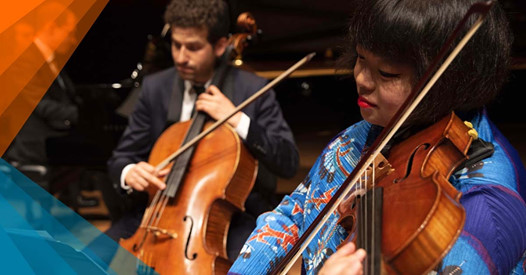
Above: cellist Nicholas Canellakis and violist Yura Lee
Sunday November 21st, 2021 – This evening at Alice Tully Hall, Chamber Music Society of Lincoln Center gave us a wonderfully satisfying program of music by composers from Russia, Germany, Hungary, and France. The works were all composed between 1849 and 1890.
A very high level of playing is maintained by the Society, making it almost impossible to single out certain concerts as being of particular merit; but tonight was surely one of the most impressive and enjoyable programs have experienced since I started going to CMS concerts regularly a few seasons back.
The program opened with the Andante Cantabile from Tchaikovsky’s String Quartet No. 1, performed in a 1888 arrangement for solo cello and strings. “Cantabile” is an Italian word meaning “singable” or “song-like”, and that’s exactly how cellist Nick Canellakis performed it: as if singing an operatic cavatina.
From the work’s tranquil start, Nick gave us impeccable playing: warm of tone and alive with dynamic subtlety. Seated next to him, the Society’s co-Artistic Director David Finckel threaded a lovely line to compliment his cellist-colleague. Mr. Finckel and violist Misha Amory offered a gentle plucking accompaniment as Nick’s cello continued to sing a melody with a vaguely Asian feeling. Violinists Cho-liang Lin and Alexi Kenney gave silken textures to the music. The work ends on a sweetly blended pianissimo. Mr. Finckel urged Nick Canellakis to stand first; then the other players refused to rise, leaving Nick with a solo bow, much to the delight of the crowd.

Above: Cho-liang Lin
Johannes Brahms’ Quintet in G-major for Two Violins, Two Violas, and Cello, Op. 111, was written in 1890, at the start of the last decade of the composer’s life. It provides a veritable feast for the ear to listeners who – like me – love the sound of stringed instruments. Mssrs. Lin, Kenney, Amory, and Canellakis were joined by that delectable violist, Yura Lee. Ms. Lee, who always delights with her choice of footwear, tonight wore white pumps; her one-shoulder black frock showed off some beautiful tattoos.
The opening movement, marked Allegro non troppo, ma con brio (“…fast, but not too fast, but with a lively feeling…”) gets off to a joyous start, the violas begin duetting in a passage taken up by the violins. The music is so melodious and congenial, with Cho-liang Lin’s poignant violin theme standing out. The music turns mysterious; then Yura Lee’s passionate playing leads back to a reprise of the earlier pairings of violins and violas. Meanwhile, Mr. Canellakis’s cello is giving everything a velvety cushion. The entire movement kept me entranced: simply fantastic playing from everyone.
The ensuing Adagio, in D-minor, has a feeling of melancholy as Yura Lee leads off with a familiar melody. Soon the music had me so engrossed that the rest of the world seemed to vanish: they were playing this music sublimely, and playing it just for me. Yura’s ‘cadenza’ near the end was hypnotically beautiful.
Mr. Lin’s violin sets the third movement, Allegretto, in motion. This is essentially a scherzo, and the melodies flow merrily on. Inspired by Hungarian folk dances, the quintet’s finale is marked Vivace ma non troppo presto (“…lively, but not too fast…”). Yura Lee’s viola is aglow, and Mr. Lin relishes his opportunities to spin more silk with his subtle playing. Suddenly the pace doubles, and the players break into an exultant dance. The crowd went wild: the only possible reaction to this kind of playing.

Pianist Inon Barnatan (above) kept the audience under a spell with his magical playing of Franz Liszt’s “Funérailles” from the Harmonies poétiques et religieuses, written in 1849. The pianist, who in 2016 gave us a mesmerizing performance of Ravel’s Gaspard de la Nuit in this very hall, was spell-binding again this evening.
This piece, which my companion Monica Wellington soon recognized as the music to which the late Liam Scarlett’s 2014 ballet for New York City Ballet, Funérailles, is set. I did not see that pas de deux, costumed by Alexander McQueen, but hearing the music tonight, it’s hard to image a dancework set to it: the music seems to wander thru many mood swings, but Mr. Barnatan’s playing made it cohesive.
The piece opens with gloomy funeral chimes in the slow register. A plodding rhythm reminds us of mourners in a cortège; this stops, and a somber fanfare-like passage is heard. The sense of doom lessens, and then a nostalgic melody is heard, which gets rhapsodic. Animated figurations for the left hand give rise to militaristic passages, followed by a great rise in passion, Full stop. A soft, sad tune is played, whilst low-register rumblings are heard. The music ends suddenly. All this was splendidly played by Mr. Barnatan.
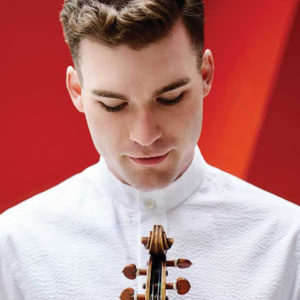
Above: Alexi Kenney
The concert concluded with Gabriel Fauré’s Quartet No. 2 in G-minor for Piano, Violin, Viola, and Cello, Op. 45. The piece premiered on January 22nd, 1887, at the Société Nationale de Musique; it is dedicated to Hans von Bülow, the pianist and conductor who was the first husband of Cosima Liszt who later married Richard Wagner.
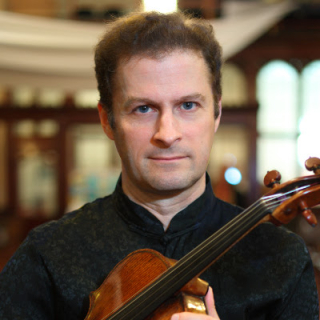
Above: Misha Amory
Inon Barnatan returned to the Steinway for this evening’s de luxe rendering of the Fauré; he was joined by violinist Alexi Kenney and violist Misha Amory, both displaying exceptional beauty of tone, whilst Nick Canellakis rounded off his stellar evening with still more phenomenal playing.
The opening Allegro molto moderato commences dramatically, and with passion. The restless piano supports unison strings; the violin, and then the viola, have solo melodies, exquisitely played. Mr. Barnatan continues to work his magic with the music, whilst the strings bring us gorgeous blends, with Mr. Kenney’s upper register truly affecting. Nick Canellakis keeps the cello line prominent without being over-bearing. The opening restive piano and unison strings return, moving to a sublime finish.
The Scherzo: Allegro molto contains lively string pizzicati heard over the piano’s dazzling agitato; though the music is tinged with a strange sense of worry, there is a forward impetus. Marvelous flourishes from the keyboard lead to a sudden stop.
In the Adagio non troppo, in which the composer drew on childhood memories of the sound of church bells, provides lyrical passages for each instrument. There is much subtlety and also much passion in their playing. A curious little interlude develops into a feeling of yearning. This quietens, as piano and viola converse; then the violin takes over. Cello and piano, soon joined by the higher strings, bring us a dreamy ending.
The Finale : Allegro molto has a vibrant start; again Mr. Kenney’s heavenly high-range lures the ear. The music gets bouncy, and then quite grand, as the quartet sails on thru shifting moods. The audience expressed their delight in the music – and with the the playing of it – with a joyous ovation, calling the artists back for a second bow. I felt elated as I headed out into the chilly evening air.
~ Oberon
 Oberon's Glade