~ Author: Kevin DallaSanta
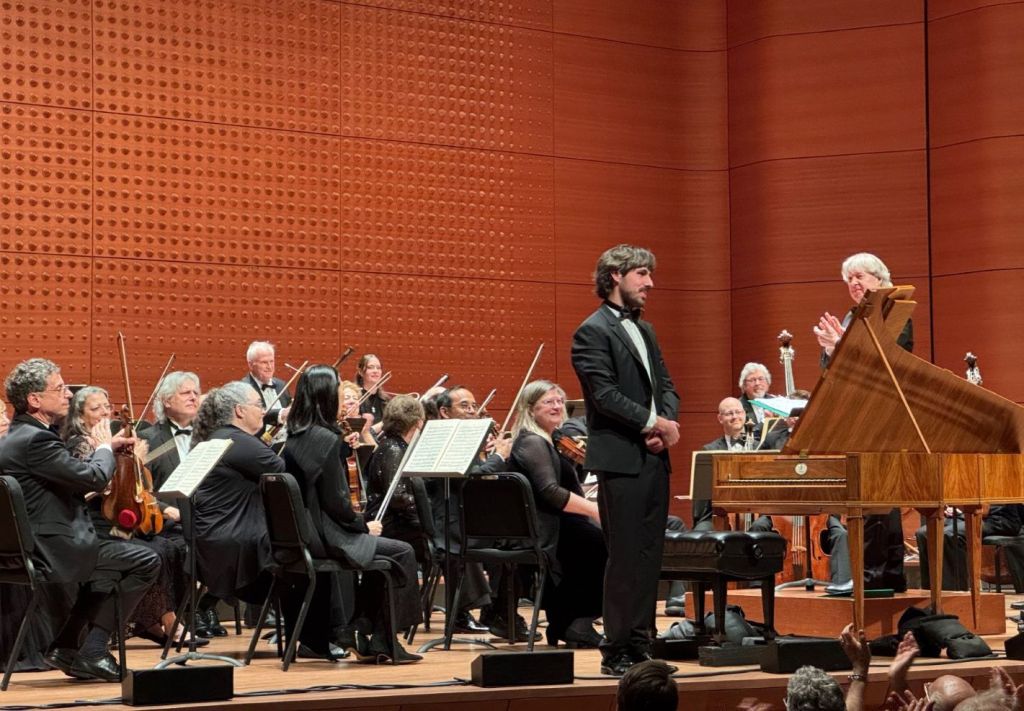
Above: pianist Matthew Figel, Maestro Crawford, and members of the ACO; photo by Kevin DallaSanta
Tuesday May 5th, 2026 – Continuing their multi-season survey of Beethoven’s nine symphonies, the American Classical Orchestra presented the ‘Eroica’ at Alice Tully Hall, alongside Mozart’s Piano Concerto No. 17, performed by Matthew Figel on fortepiano.
Conducted by Thomas Crawford, the New York-based orchestra pursues historically informed performance, both in instrumentation and in interpretation. The enthusiasm of its musicians was infectious, as their delight in the pieces—and the quirks of their historical instruments—gave fresh perspective on familiar favorites.
Mozart’s Piano Concerto No. 17 is associated with his starling, who could purportedly whistle the tune of the final movement, save for one wrong note. Missing none himself, Figel performed on the fortepiano, a keyboard instrument which ironically often appears to modern audiences as lacking broad dynamic range. It is thus a challenge for pianists, who must coax expression out of a limited tonal palette, while dealing with the oddities in balance that emerge.
Figel dispatched these issues with focused and sensitive playing, giving clarity and direction to the melodies without the loss of buoyancy that often accompanies fortepiano performances. The cadenzas were particularly enchanting, as Figel brought out their lyrical and operatic aspects. It is often said that the Eroica ushered in a Romantic era with colorful harmonies and richer emotions; yet Mozart’s language is certainly colorful and emotional.
The fortepiano gives insight into Mozart’s original intent: bass notes resound with surprising volume, and extended trills—which on a modern Steinway drown out the action like a ringtone—become wonderfully delicate and transparent. Numerous cellphones in the audience were initially fortunate to coincide with the work’s key of G. Unfortunately, like the starling, they eventually went out of tune.
The period experience is somewhat different in purely orchestral works, and the historical performance debate typically centers around the symphonic repertoire. Critics highlight the vast uncertainties in how Beethoven originally sounded or what he originally meant. Proponents argue that, similar to the pianoforte, the use of period instruments naturally ground the performance; and that modern ensembles are probably not what Beethoven heard, at least while he could.
For the American Classical Orchestra, period performance evidently involves a number of historical instruments, sparing rubato, and little to no vibrato. Crawford conducted with brisk tempi and a focus on Beethoven’s rhythmic nature, giving liberty to the musicians without over-dictating their movements. His interpretation was careful but not overly conservative, a difficult balance for such a well-known work.
The ‘Eroica’ is often lauded as the giant leap for humankind into the Romantic era. But this comes with the benefit of hindsight: Beethoven’s first two symphonies had their own progressive aspects, and many other works in the repertoire were innovative upon premiere. In some ways, the ‘Eroica’ is a convenient pivot at which to draw a border between eras, all the more because of its enduring popularity among audiences.
A highlight of the period approach to the third symphony was the natural horns, which are stopped with the hand to reach notes outside of the tonic triad. The result is a nuanced and dynamically inflected rendering which particularly shines in the horn trio of the third movement. The “heroic” horn entrance in the first movement recapitulation also seems more striking: its major triad is in the unstopped, loud register.
The performance was characterized throughout by strong string playing, all the more remarkable given their limitations on vibrato. To modern ears, the orchestration can seem somewhat spindly at times. But in many passages, the timbre feels right—suggesting a whiff of authenticity for which historical performance orchestras strive.
The reduced ensemble, small hall, and apparent joy of the musicians further contributed to the feeling of authenticity. In a city with numerous full-time ensembles, and innumerable visiting ones, it is refreshing to hear music made by smaller orchestras with limited performance calendars. Rarely does one get to sit behind the soloist during the second half of the program as they listen intently to Beethoven. If their expertise is any indicator, there is something worthwhile happening onstage.
~ Kevin DallaSanta

