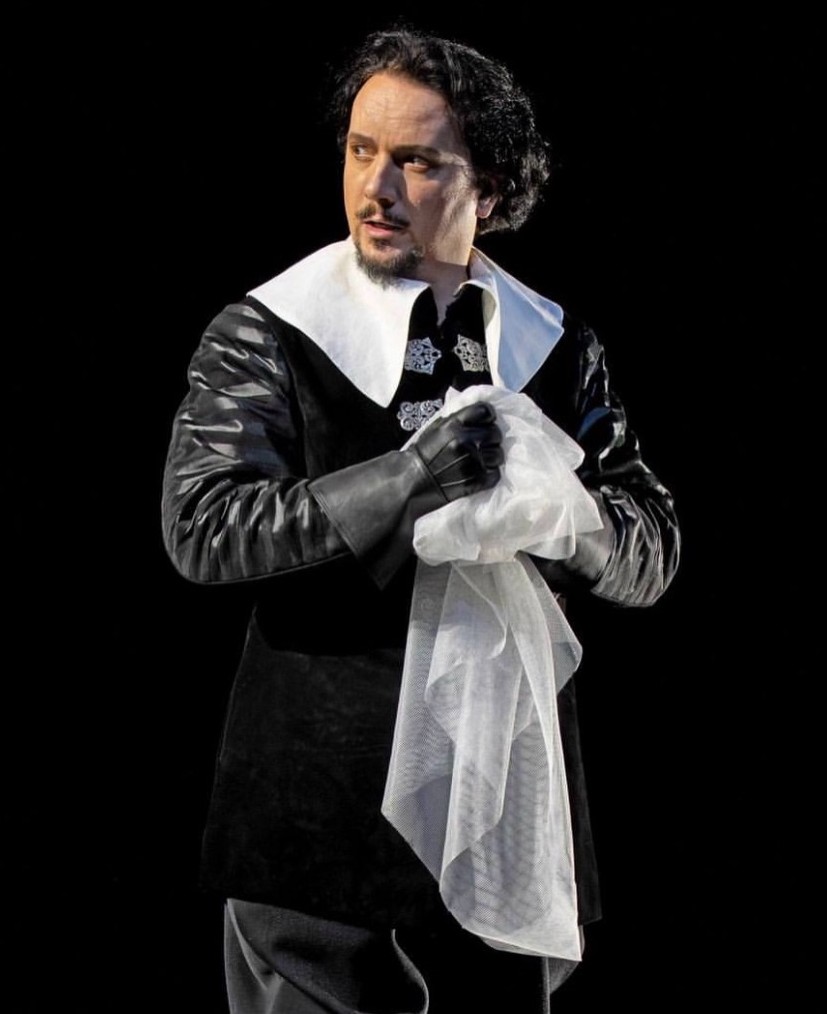
Above: Artur Ruciński as Riccardo/a MetOpera photo
~ Author: Oberon
Sunday January 18th, 2026 matinee – This afternoon marked the Metropolitan Opera’s final performance of Bellini’s I PURITANI this season. The production has been much disparaged, but the vocalism has been – for the most part – fantastic. There were illnesses (announced or not) among the cast, and the singers had to deal with over-loud playing from the pit…a trend nowadays at the world’s biggest opera house.
The house was literally sold out, and enthusiasm ran high all afternoon. The conducting was not inspiring, and the volume from the pit often caused voices to be covered. There’s a lot of filler in the score; unlike NORMA – where every bar of music counts – there are passages in PURITANI that, while aurally appealing, keep the story – such as it is – from flowing.
Eve Gigliotti (Queen Henrietta), Tony Stevenson (Bruno), and David Pittsinger (Gualtiero) repeated their strong performances.
The great Polish baritone Artur Ruciński, having missed the HD performance due to illness, was simply magnificent as Riccardo today. His opening aria was so appealingly phrased, his timbre warm and rich, and his technique so assured. In the exciting cabaletta that follows, the singer brought down the house by sustaining an incredible high-G throughout the orchestral postlude. Mr. Ruciński’s scene of aiding and abetting the escape of Queen Henrietta – thus improving his chances with Elvira, the object of his desire – was most impressively sung, and he and Christian Van Horn gave the performance some of its greatest thrills with their big duet, finishing with super-charged vocalism in “Suoni la tromba…”
Mr. Van Horn had a grand afternoon, his tone pouring forth, his marvelous singing of the gentle aria “Cinta di fiori…” – and its more intense passages – was a highlight of the afternoon. Despite its house-filling power, even this voice was at times blunted by the orchestra.
The bel canto duo of Lisette Oropesa and Larry Brownlee captivated the audience with their lyrical compatibility and their derring-do in rising to their interpolated – or in some cases, written – extreme high notes. Both singers are masters of beautiful dynamic shadings, long vocal lines, and compelling turns of phrase. Their singing of this opera put them in an echelon with the Sutherland/Pavarotti pairing – or, perhaps more aptly, with Sills/Gedda.
A prolonged ovation marked the end of the opera, the audience screaming and carrying on excitedly as each singer stepped forward to bow.
Then, after this kozmically demanding afternoon of singing, the principals had to sit onstage for another twenty minutes to chat with Peter Gelb. Do these sessions really do anyone any good? And I have a feeling the singers don’t get paid overtime.
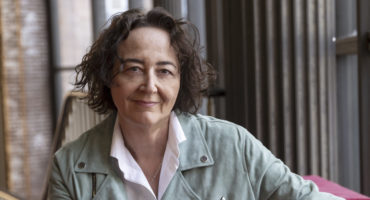
This performance of a rarity, the Hymne an die Nacht #2 by Alphons Diepenbrock, captured my interest on first hearing. I’ve sent it on to several friends.
Nathalie Stutzmann (above, photo by Daniele Ratti) is the soloist, with the Concertgebouw Orchestra under the direction of Riccardo Chailly. The concert took place in October 1997, at the Royal Concertgebouw.
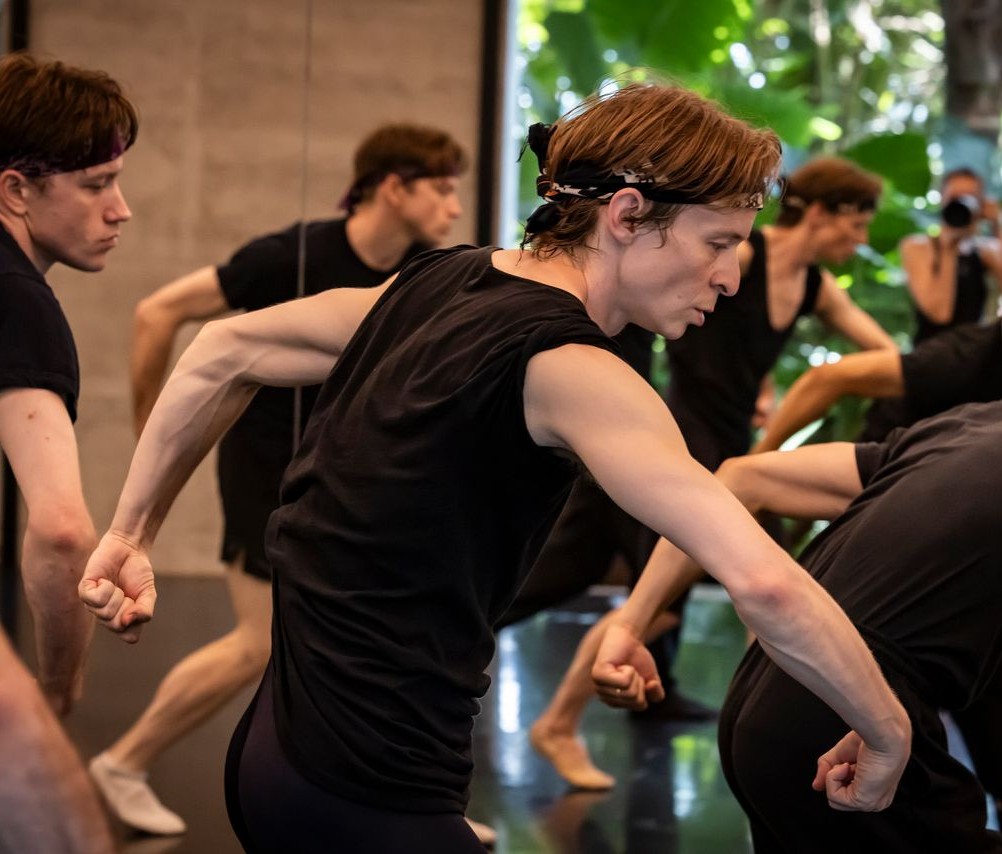
Wednesday January 14th, 2026 – SONS OF ECHO, a new program from international ballet star Daniil Simkin, brings together five male principal dancers at the height of their careers – Jeffrey Cirio (Boston Ballet), Osiel Gouneo (Bayerisches Staatsballett), Alban Lendorf (Royal Danish Ballet), Siphesihle November (National Ballet of Canada), and Mr. Simkin – in works choreographed by Lucinda Childs, Drew Jacoby, Tiler Peck, and Anne Plamondon.
Tonight’s opening drew a packed house; the show started with a ‘ballet class’ in which the five dancers – joined by ballerina Maria Korchetkova – went thru their paces in a campy setting. Vladimir Rumyantsev was the intrepid pianist.
The pianist remained at his post to play (beautifully) pieces by Matteo Myderwyk for Lucinda Childs’ gorgeous trio NOTES. The three dancers – Mssrs. Cirio, Lendorf, and November – were costumed by Amy Page in long skirts, and Manuel Da Silva’s lighting designs (all evening, actually) were a key element in the dance’s visual appeal. The dancers moved thru the ritual’s stylized passages with hypnotic grace. This captivating dancework could be performed by either men or women; either way, I’d love to see it again.
Mr. Da Silva’s lighting was especially striking in REAL TRUTH, a trio for Mssrs. Gounea, Lendorf, and Simkin, choreographed by Tiler Peck, and having its world premiere this evening. Gregory Porter’s song “Real Truth” – the text both spoken and sung – carried the dancers thru some beautiful combinations, and there were partnering motifs of brotherhood and tenderness woven into their dancing.
My companion (relatively new to the dance world) and I agreed that Anne Plamondon’s WILL YOU CATCH MY FALL (world premiere) was our favorite work of the evening. To an original composition by Ouri, and once again finely lit by Mr. Da Silva, Jeffrey Cirio and Siphesihle November played out a relationship into which the viewer might read various scenarios; the piece is both edgy and consoling, the two men captivating in their charismatic performance. The lighting draws the dancers to a perfect ending, but the piece goes on – needlessly, in my view. Still, the power of this dancework is indisputable.
I remember Drew Jacoby from her days of dancing with Rubinald Pronk – an electrifying dance duo – and I loved seeing her in the house tonight, her presence so vivid. Her 2019 quartet, JACK, ended the program this evening, danced by Mssrs. Cirio, Gounea, Lendorf, and Simkin. A musical collage, including scratchy old LPs of Gershwin tunes, set the mood, and again Mr. Da Silva’s lighting (in this case dazzlingly theatrical in its chiaroscuro effects) was an eyeful. A solo by Jeffrey Cirio was especially impressive. The entire piece made for a visually and aurally satisfying finale to the evening, though it would have been more meaningful to have all five dancers involved. If I was going to take this show on the road, I would ditch the “Class” segment and have someone cook up a closing piece for all of the participating dancers.
The curtain calls were fun, and Ms. Childs looked particularly luminous taking her bow. The program wasn’t at all what we were expecting, but then – these days – nothing is.
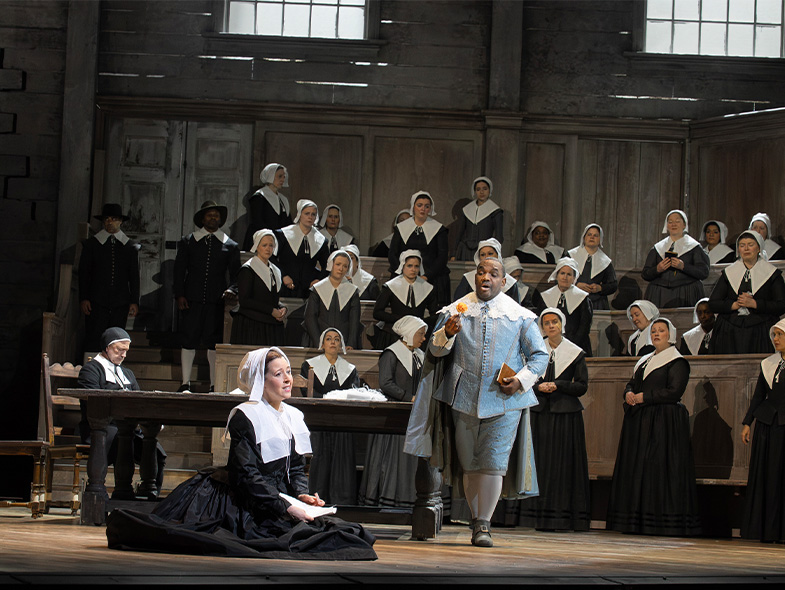
Above: Lisette Oropesa as Elvira and Larry Brownlee as Arturo; a MetOpera photo
~ Author: Oberon
Saturday January 10th, 2026 matinee – It’s been a while since I last attended a performance of I PURITANI; it’s not an opera I listen to very often…and when I do, I am reminded that there are stretches of ‘filler’ that are not very interesting. This afternoon’s Met performance featured a cast change, and much spectacular singing. Unfortunately, lacklustre conducting was a serious – thought not unexpected – detriment.
I ‘learned’ PURITANI from the first Sutherland recording; whenever I’d play thru it, I’d find myself skipping over certain parts. Among these were the prelude, opening chorus, and the prayer-quartet; hearing these ‘tracks’ today reminded me of why I used to pass them by and start my listening with the baritone’s aria and cabaletta. Stepping in for Artur Ruciński as Riccardo this afternoon was Ricardo José Rivera, a handsome fellow with a handsome voice, who had debuted at the Met earlier this season in ARABELLA.
Mr. Rivera’s singing was immediately engaging, his cavatina covering an impressive dynamic range, the cadenza expertly handled. The orchestra was too loud during the exchange between the baritone and tenor Tony Stevenson as Bruno; Mr. Rivera then clinched his success with his finely-sung cabaletta, winning sustained applause.
Lisette Oropesa (Elvira) and Christian van Horn (Giorgio) made a vocal feast out of the duet in which she persuades her “secondo padre” to let her marry the man she loves. Both singers sounded fabulous, Lisette’s coloratura and delicious trills illuminating the music; her stunning crescendo at “O padre mio!” was thrilling to the ear. Thru all this, the orchestra continued to menace the voices rather than support them; passages of col canto accompaniment were too brassy. But the singers prevailed, completing the duet with a dazzling top note from the soprano; a pointless orchestral postlude delayed the applause.
Greeted by an overly-long choral segment, Larry Brownlee as Arturo commenced his afternoon of incredible vocalism with the surpassing beauty of his “A te, o cara...” in which his tonal allure and poetic phrasing cast a spell. Mr. van Horn and basso David Pittsinger (who I hadn’t heard for quite a long time) made striking interjections, and Lisette’s response to Brownlee’s courting lyricism was a series of heavenly, floated notes. The singers’ bel canto perfection drew fervent applause.
Eve Gigliotti as Queen Henrietta made a vivid vocal impression; if only Bellini had given her more to sing. In her desperation to be saved from execution, the hapless queen wins Arturo’s support, but before they can escape, Elvira bursts in to sing her polonaise, “Son vergin vezzosa“, whererin Lisette treats us to a captivating display of bel canto charm. Her polished trills and festoons of fioratura – including some simply mad embellishments – are intoxicating. Ms. Gigliotti joins in the fun. A clunky postlude delays the applause.
Mr. Rivera’s Riccardo now attempts to prevent the queen’s escape with some big, menacing vocalism. Mr. Brownlee replies in kind, tossing in a super high note along the way, ignoring the orchestra’s noise fest. Riccardo lets the queen and Arturo leave, thinking their departure will enhance his chances with Elvira. The orchestra continues at high volume, over which Lisette strives valiantly to be heard. Aren’t these roles difficult enough as written? Do these orchestral assaults do anything other than add surface excitement?
Lisette’s “O vieni al tempio” – the first phase of her descent into madness – is so touching; she turns the scene into a highlight of the performance, overcoming the conductor’s indifference with her sensational vocalism. The over-extended choral finale counts for naught.
The prelude and opening chorus of Act II give us pleasant music for a “fatal day”; there’s no tinge of ‘dolor‘ here. What was Bellini thinking? Mr. van Horn’s “Cinta di fiori” is simply superb, his singing so full of colour and feeling; but even his powerful voice is not immune to the orchestra’s volume. A tedious – though finely sung – chorus of concern for Arturo’s fate goes on a bit, but now Lisette takes the stage for the Mad Scene. At “Qui la voce…” her warm lower register and beautiful dynamic palette are marvelously displayed, and she does so much with the words: “Ah, toglietemi la vita…”.” is heart-rending. A touching cadenza with a sustained B-flat leads into the coloratura display of “Vien, diletto” in which the fluency of her trills and her dizzying decorations of the vocal line are magical. Another idiotic postlude, which some conductors omit, dampens the applause somewhat.
A gorgeously-played horn solo sets up the great duet for Riccardo and Giorgio in which Mssrs. Rivera and Van Horn pulled out all the stops. The basso’s final plea to the baritone to forgive Arturo for Elvira’s sake is followed by a harmonized section and Van Horn’s impassioned “Ricccardo! Riccardo!!” which finally wins Rivera over. Their singing in the glorious “Suoni la tromba” (with its brilliant trumpet solo) was excellent, despite the orchestra pouring it on.
Now the house lights came up to half, halting the impetus of the drama. Then there’s some storm music (who cares?) before Elvira and her beloved are reunited. This scene is a bit superfluous, but it does give the tenor a lovely passage: “Corre a valle…” with Mr. Brownlee again enchanting to hear. At last they get things straightened out and launch the great duet “Vieni fra queste braccia…”. Here the Oropesa/Brownlee duo – a match made in heaven – revel in the passion of the music and its amazing high notes. Despite continued over-playing from the pit, the singers stopped the show.
Lisette pulls a cadenza out of the air, but the tenor still has one more mountain to climb: the demanding “Crediasi, misera” in which Mr. Brownlee summoned unbelievable reserves of tone. He was further tested by having to sing the repeat, but he carried it off brilliantly, right up to F above high C. Bravissimo!!
While I, and several other opera lovers, longed to hear the ‘lost’ soprano aria, “Ah! sento, o mio bel angelo…”, a more conventional ending was provided. The curtain calls were great fun, and at the stage door a big crowd waited patiently for the stars to appear.
~ On a snowy night, in her mansion deep in the forest of a Northern Country, Vanessa awaits the return of her lover, Anatol. They had parted twenty years previously, and now he has come from afar, seeking her out.
Alone in her drawing room, she turns her back to him and – without looking at him – pours out her feelings…feelings which have been pent up inside her for so many years. ~
“Do not utter a word, Anatol, do not move; you may not wish to stay.
For over twenty years in stillness, in silence, I have waited for you.
I have always been sure, I have always known you would come back to me, Anatol;
I have scarcely breathed so that Life should not leave its trace and nothing might change in me that you loved;
alone, apart, unseen, I have waited for you.
Oh, how dark, how desperate, how blind, to let the days go by unmarked, unheeded!
How endless, how lonely, how wrong to rob a beating heart of time and space!
Beauty is the hardest gift to shelter, harder than Death to stay. All this I have done for you.
Now listen, listen,listen well: Unless you still love me, I do not want you to see me, Anatol.
Without love, do not dare look in my eyes! Because all change…all change begins when Love has died…when Love had died.
Tell me, Anatol, do you love me? Do you still love me as once you did?
For if you do not, I shall ask you to leave my house this very night!“
Tuesday January 6th, 2025 – Opening night of the return of Compagnie Hervé KOUBI to The Joyce with the choreographer’s masterpiece, What The Day Owes to the Night; the presentation is supported by Dance Reflections by Van Cleef & Arpels.
When I first saw this piece back in 2018, I was simply bowled over by it. Unfortunately, my write-up of it was lost in the transfer from the Grove to the Glade. Every element of the production is simply stunning: music, movement, lighting, and – above all else – the dancing.
From the program notes: “What The Day Owes To The Nightfeatures a highly physical, stunningly fluid, gravity-defying piece that combines capoeira, martial arts, urban, and contemporary dance with powerful imagery evocative of orientalist paintings and the stone filigree of Islamic architecture. Through its mystical, enchanting, and hypnotic choreography, French-Algerian choreographer Hervé Koubi retraces his own history by relating it to the story of a young boy from a novel by Yasmina Khadra.”
The 13 men from Koubi’s company who take the stage for this piece hail from Algeria and Morocco; they are powerful athletes, a blood-brotherhood of fearless dancers who are also poets of movement. The fact that they are incredibly charismatic adds another dimension to their dancing. The musical score is a collage of sufi sounds – drawing on Islamic mysticism and recorded by the Kronos Quartet – with music by J S Bach, and by the Egyptian composer Hamza El Din. Lighting designs by Lionel Buzonie create an atmosphere of vast deserts and forgotten ruins. The all-white costuming by Guillaume Gabriel evokes images of angels…or ghosts.
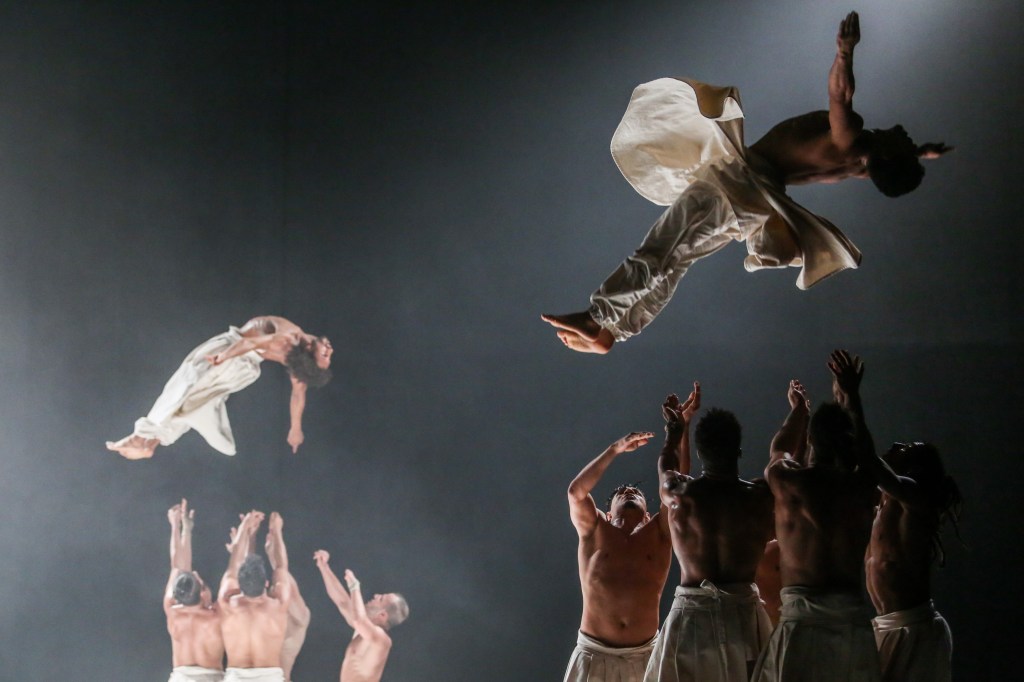
The music commences with a feeling of mystery; the slumbering men, huddled together on the ground, awaken slowly and commence dancing as if compelled by unseen forces. Fantastical hand-turns and bounding leaps precede an explosion of music; rhythmic variety supports the movement, which ranges from eye-boggling somersaults and flying back-flips to dreamy, hypnotic expressiveness.
Silence falls; the men reach skyward. In a solo to a plucked rhythm, a man dances with his shadow. Pools of light illuminate the space as the men dance onward to the sexy sway of the music. The dancers seem randomly to spin on their palms or whirl endlessly on their heads; how they mastered these moves is beyond comprehension.
Airy flute sounds signal a new phase: a quintet of dancers are slowly joined by the others. Chimes sound, along with distant chanting : an anthem of voices. Things get noisy, then subside, only to rebound. More dare-devil stunts fill the stage; young men are flung into the air and caught by their brothers. Silence falls, sounds of Bach fade, the flute warbles. Night comes.
As with so many artistic masterworks, M. Koubi’s signature work eludes description; it has to be seen…and felt. For me, What The Day Owes To The Night is a dance for eternity.
The audience reaction at the end was thrilling to be part of. The dancers basked in waves of applause and shouts from the packed house; they took a double curtain call, some of them tossing in an impromptu air-somersault, as if they simply could not stop dancing. The choreographer appeared, much to everyone’s delight.
It wasn’t until this morning that I noticed a poem, in very small print, in the playbill. I assume M. Koubi wrote it after his first visit to Algeria (he had been born and raised in France). I keep reading it…and crying.
“I went there to the other side of the sea which saw me grow up on an unknown land which was nevertheless mine./ I went there to see the streets, the houses and the tombs./ I went there without knowing what I was looking for./ I went there to face the emptiness./ I went there to meet my lost brothers./ I went there and my tears flowed at the oblivion and the cruel time that had passed./ I went there and brought back to my heart my finally found brothers./ I went there full of brotherly love nowhere else known./ I went there out of love for them and for mine./ I went there because I believe in the power of love and spirit./ I went there./ I went there.”
Jamie Barton sings Johannes Brahms’ Alto Rhapsody from a 2016 concert given by the Iceland Symphony Orchestra. The conductor is Hannu Lintu, and the Karlakórinn Fóstbræður Male Choir is under the direction Árni Harðarson.
Saturday January 3, 2026 matinee – I ended 2025 with an all-Mozart concert and started 2026 today with a matinee of Julie Taymor’s MAGIC FLUTE at The Met. This afternoon’s cast was different from the one I attended 2 weeks ago, and a conductor new to me was on the podium.
It was not a happy afternoon at the Met. After several days of cold, dry weather, some of the voices seemed out of sorts. The 12:00 noon start time didn’t help matters. The house was packed, and parents made little attempt keep their small children from talking loudly during the music.
The conducting of Erina Yashima was sure and steady; as the overture and other orchestral passages are cut, it’s not easy to form an impression of her work from this production. She did seem to respect the voices, which is a good thing.
The opening arias of Tamino and Queen of the Night are so pared down that Joshua Blue and Aigul Khismatullina couldn’t really get their voices in gear before their arias ended. Mr. Blue did some very fine singing as the afternoon progressed, especially in his scene with the magnificently sung Speaker of Le Bu. Ms. Khismatullina’s vengeance aria later in the show was not perfect, but it had the right dramatic feel.
Of the Three Ladies, Emily Treigle was of particular interest to me, as she is a third-generation opera singer: her mom is soprano Phyllis Treigle, and her grandfather was the inimitable Norman Treigle, both of whom sang at New York City Opera during its heyday. Emily’s sidekicks today were soprano Kathleen O’Mara (a delightful Berta in BARBIERE last season) and Daryl Freedman. All three have fine voices, though somehow their blend was not always persuasive. The opera’s other trio, the Genii (here called Spirits), were vocally pallid today.
Erin Morley’s Pamina had some of her trademark beauty of phrasing and expression, though this character – more than any other – is robbed of so many vocal possibilities in this reduced scoring that she becomes a cipher.
The music of Monastatos is so severely trimmed down that tenor Zhengyi Bai had little opportunity to actually sing, though in the final scene where the Queen and her Ladies stage an assault on the Temple, his voice was clear and fine.
Joshua Hopkins as Papageno was first-rate: engaging at every moment, and with his voice warm and expressive. He and the ever-impressive basso Matthew Rose as Sarastro – along with Le Bu’s awesome Speaker – gave the afternoon its finest singing.
I’d planned to visit the stage door at the end, but the frigid dry air blowing thru the tunnel decided me to head home and have some tea and hot soup instead.
I’ve always attended this mini-MAGIC FLUTE more than once each season since it entered the Met repertory; it offers a fine opportunity to check out many voices in a 90-minute setting. But today I realized that the magic is not always palpable. The Met now has a truly engaging and meaningful ZAUBERFLOETE, which I hope will be in the repertoire again in the next two or three seasons. Unless there’s some irresistible casting in the Taymor next Yuletide, I think I’ve seen it for the last time today.



 Oberon's Glade