Author: Philip Gardner
-
Berio Sinfonia@NY Phil
Author: ~Scoresby
Thursday May 24 2018 – “The unexpected is always upon us. Well, I must have said this before since I say it now” says Berio’s sprawling five movement work for orchestra and microphoned vocal octet: Sinfonia. 2018 marks the 50th anniversary of Berio’s opus magnum. It was commissioned by the NY Philharmonic for its 125th anniversary (Berio delivered the score a year late) and the work, more than most, feels like a stamp of its time. Written for Leonard Bernstein and the jazzy pop group the Swingle Singers originally, the music has a wide range references, from Mahler to Boulez. The text draws from Beckett, Lévi-Strauss, and Berio’s own writings. Some of the words are purposely difficult to hear, moving in and out of focus at Berio’s will. With music that is both funny and saturated with anxiety of events of 1968, the meaning of this piece is purposely obscured.

From the Archives: Composer Luciano Berio
It is a commentary both in a universal sense and a musical sense (the performers even narrate the music in real time, almost like a sports commentator in the third movement). 50 years later, it feels both relevant and a glimpse into a specific period. Philosopher Walter Benjamin wrote in his Thesis on the Philosophy of History:
This is how one pictures the angel of history. His face is turned toward the past . . . The storm irresistibly propels him into the future to which his back is turned, while the pile of debris before him grows skyward.
I never thought I’d hear a musical representation of Benjamin’s words, but Berio is able to so in this piece.
Each of the first four movements (the fifth was added a few years later) has its own feel and exists in a completely different sound world then the others. The fifth ties the disparate entities together in a sort of amalgam of the movements. This evening, the New York Philharmonic presented the work with Seymon Bychkov conducting his second week in a row and the young new music ensemble Roomful of Teeth in its New York Philharmonic debut. It should be said, because this work has such a textual importance it was surprising that the NY Philharmonic opted to not use either supertitles or issue a libretto – particularly for the third movement of the piece. While in English, Berio’s tricky text is important and purposely difficult to hear at times.
In the mysterious opening of first movement, Mr. Bychkov managed to guide the orchestra with an incisive sound while blending with the organ-like Roomful of Teeth. Speech is incredibly important to Berio, in his works he always mimics it. Here, the Philharmonic took this to heart. As a singer would finish a line, the instrumentalists would pick up the melody imitating the singer’s timbre and speech pattern. It was an impressive transformation from speech to music and vice versa, making the weaving textures of the piece wonderful to hear. This magical effect reminded me a lot of Boulez’s Répons, composed nearly twelve years later. This is the only performance of the work I’ve heard where I could clearly hear all of the singers – the Philharmonic’s sensitive accompaniment surely the reason. The second movement comprises of a memorial to Martin Luther King Jr. The precise and pouncing brass/percussion outbursts balanced the more Gregorian chant-like singing texture that sits below – at once given the impression of being static and lurching forward. Mr. Bychkov drew a wide range of color from the orchestra, balancing the many textures while still making the outbursts sound percussive. The music briefly devolves into a march near the end before dissipating and here the orchestra seemed to blend into quietness of the hall.
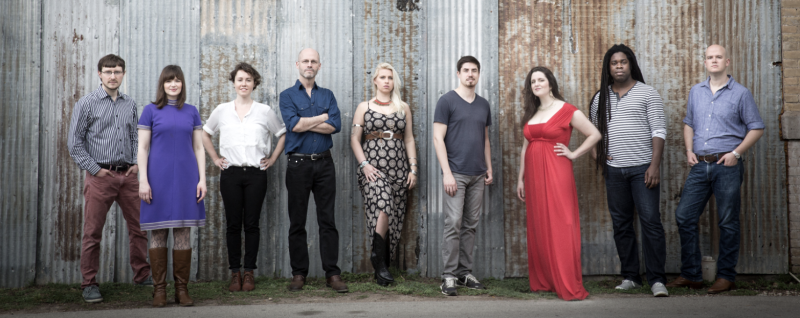
Above: Some of the members of vocal group Roomful of Teeth; Photo Credit: Bonica Ayala of BONICA AYALA PHOTOGRAPHYThe third movement is the most experimental music Berio wrote. It has the third movement of Mahler’s Symphony No. 2 underlying it (which is in itself a setting of Mahler’s St. Anthony’s Sermon to the Fish from Das Knaben Wunderhorn) with many additions. Berio makes sure that the Mahler is never lost through the entire movement, but it comes in out of focus while the singers do everything from congratulating the conductor to singing about the anxiety of the role of art in politics. Mr. Bychkov managed to untangle the chaos of the music by making each texture transparent and audible, even in the most cacophonous sections. Whether through melody or rhythm, the Mahler was easily heard as were the slew of extra-musical references. Roomful of Teeth for their part, made the movement at once entertaining and somber, even getting laughs from some audience members. During the serious moments, such as questioning the point of art, they took a dedicated tone. This is incredibly difficult music to perform, but I can’t imagine it being rendered better.
In the fourth movement which has many short outbursts and feels comparatively sparse and calm, Mr. Bychkov’s precise conducting and the orchestra’s sharp sound provided a respite. The fifth movement’s recollections brought in bits of each of the other movements, almost like a summary of the entire work. It was wonderful to hear because it felt like a retrospective that tied everything together. The much younger looking crowd than usual (many hipster looking men in their late 20’s/early 30’s, likely do to Roomful of Teeth’s dedicated following) gave a well-deserved enthusiastic applause. Mr. Bychkov, Roomful of Teeth, and the NY Philharmonic couldn’t have performed the piece better, showing why at 50 this remains one of the most important symphonic works composed.
Returning from intermission, the New York Philharmonic did its annual Milestones speeches, honoring members of the New York Philharmonic who are retiring and who have been a part of the orchestra for a certain number of years. This year, they honored the 25th anniversaries of Oboist Robert Botti, Principal Violist Cynthia Phelps, violist Robert Rinehart, and horn player R. Allen Spanjer. They also retiring members Mark Schmoockler (44 years), Vladimir Tsypin (35 years), and Archivist Barbara Haws (34 years). Ms. Haws gave a stirring speech about the importance of history and the connections that occur from a true institution like the New York Philharmonic. Her speech dovetailed perfectly with the Sinfonia, “The present honors the past. 100 years ago, seems like today.”
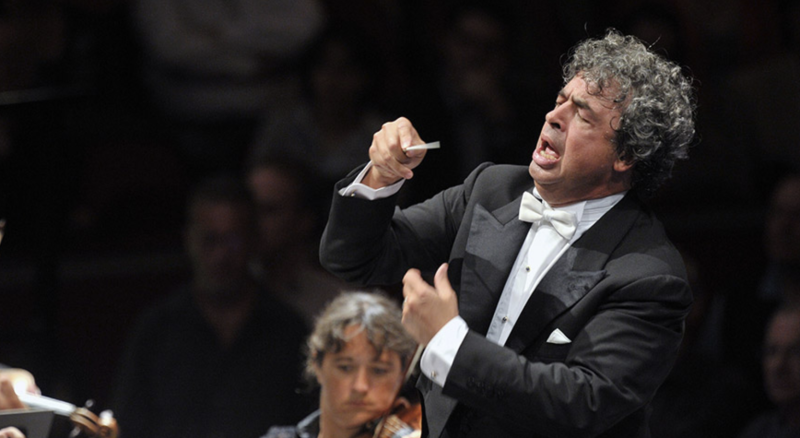
Above: Conductor Semyon Bychkov; Photo credit: Chris ChristodoulouAfter, the group performed Strauss’s last tone poem: An Alpine Symphony. The pairing of these two seemingly unrelated works comes from a line in the Sinfonia when the main narrator in the third movement makes a sarcastic jibe about the Alpine Symphony, saying something the effect of maybe a grand work like the Alpine Symphony will grow flowers (while discussing the lack of political potency music has). Mr. Bychkov and the Philharmonic were in top form. While this is personally my least favorite Strauss piece, Mr. Bychkov gave one of the best interpretations one could want. He made the strings sound vigorous, the brass warm, and the music layered. The orchestra crafted a round, gentle, and rolling sound – which contrasted the first half’s incisiveness well. During the exciting stormy sections, it was fun watching the percussionist get up to play the Thunder Sheet for its brief appearance. It was clear after this performance that Mr. Bychkov can get this orchestra to sound its best – I look forward to hearing him again soon.
-
Philharmonic Ensembles|Reinecke Rules!

Above: composer Carl Reinecke (1824 – 1910)
~ Author: Oberon
Sunday May 27th, 2018 – The last in this season’s Philharmonic Ensembles series at Merkin Hall. These concerts, in which artists from the New York Philharmonic perform masterpieces, rarities, and contemporary works from the chamber music repertory, are always highly enjoyable. Today’s expertly-devised program introduced me to the delightful music of Carl Reinecke, and works by Vivaldi, Penderecki, and Brahms were also superbly played.
Harpsichordist Paolo Bordignon introduced the opening work, Vivaldi’s Trio Sonata, Op.1, No. 3, in which he was joined by Duoming Ba (violin), Peter Kenote (viola) and Satoshi Okamoto (bass). Hearing this music on a gloomy day, following a distressing week, was a perfect palliative. In this four-movement work (the third being very brief), both the playing and the communication between the musicians drew us immediately into the elegant and lively world of Vivaldi, far from the madding crowds and disconcerting headlines of daily life.
I was particularly intrigued by the beautiful instrument Mr. Okamoto was playing with such agility and charm. You can see it, and hear him playing, in this brief film.
In a striking contrast, we next had Krzysztof Penderecki’s Duo concertante for violin and double bass, which was composed in 2010 on a commission from violinist Anne-Sophie Mutter. It was played this afternoon by Kuan Cheng Lu, violin, and Rion Wentworth, bass. The composer devised the piece as a sort of conversation between the two instruments; Ms. Mutter described it as two voices “evading each other”: while one soloist is developing a musical theme, the other falls nearly silent.
With their expert timing, and a clear sense of enjoyment in what they were doing, the two musicians gave a performance full of vitality, precision, and wit. Among the words I jotted down along the way: agitation, brooding, mini-scherzo, jazzy bass, plodding, shimmering, almost a march, soft and high, ultra-sustained bass note, pensive violin, a dance, tapping and stamping at the end. The audience were clearly much taken with this piece, and the playing of it: loud, enthusiastic applause followed.
The afternoon provided an opportunity to make the acquaintance of a composer new to me, Carl Reinecke. How his music has eluded me until now is inexplicable. He was a prolific composer of operas, symphonies, concertos, and chamber music, as well as a highly regarded conductor, pianist, and pedagogue. Franz Liszt hired Reinecke as piano teacher for his daughter, Cosima, who later married Richard Wagner. In 1904, at the age of 80, Reinecke made recordings of seven works playing on a piano roll; thus he was the earliest-born pianist to have his playing preserved in any format.
Reinecke’s Trio for oboe, horn, and piano was composed in 1886. The Philharmonic’s principal oboist Liang Wang was joined by Howard Wall, horn, with Zhen Chen at the piano for today’s performance of this work, steeped in the Romantic spirit. This is music that’s terrifically appealing.
The piece also moved me on a personal level, for my sister played oboe and I the horn back in our youthful years in the little town. The sounds of these two instruments today, played with such tonal richness and impeccable musicality by Mssrs. Wang and Wall today, pleased me deeply.
The composer’s cordial theme for the opening Allegro moderato must have greatly pleased the composer, for he repeats it over and over. Gorgeously played by Mr. Wang, the melody has an exotic feel. The horn joins and the music expands. A romance-tinged piano solo brings Mr. Zhen into the mix, his playing colourful and alert. A great horn theme, abundantly toneful in Mr. Wall’s ‘singing’ of it, leads to a grand passage. The voices entwine, and after a martial bit, melodies flow on with increased drama. A da capo develops a sense of urgency, which eventually subsides.
The Scherzo, Molto vivace has charm of its own; it’s witty and bubbly, and gets a five-start rating as scherzi go. The players relished every turn of phrase, with the pianist having a lot to do. This scherzo has a sudden end; you could almost hear the audience smiling.
The melodic warmth of the cavatina-like Adagio brought forth a rich horn theme upon which Mr. Wall lavished the kind of tonal plushness that turned a frustrated horn player like me green with envy. And he has such prodigious reserves of breath at his command. When Mr. Wang joined, a fabulous tone-fest filled the hall. More sonic glamour from Mr. Wall in a glorious mix with the piano followed; sumptuous harmonies abounded as the movement came to its conclusion.
In the opening passages of the Rondo finale, Mr. Zhen had just the right feeling for what sounds like a forerunner of the piano rag. The music, full of mirth and magic, gave all three players abundant opportunity to shine, singly and as a collective. The audience response was heartfelt, as the music and playing merited. This was one of the great musical treats of the season which is now nearing its end.
Sustaining the Romantic aura of the Reinecke, the concert concluded with the Piano Trio No. 1 of Johannes Brahms, played by Hannah Choi, violin, Patrick Jee, cello, and Steven Beck, piano. Mr. Jee spoke with great affection of this music, which clearly means so much to him. When the performance ended, he seemed in a highly emotional state – a state reflected in his rich, resonant playing.
The work begins pensively. After a brief piano introduction comes the marvelous cello solo theme of which Mr. Jee had spoken. His playing of it reflected what the music means to him: sheer beauty. Ms. Choi and Mr. Back prolonged the atmosphere which the cellist had established, savouring the themes and reveling in the the blendings of their voices. This long first movement, with its achingly lovely melodies and modulations, gave a great deal of pleasure.
The Scherzo made me think of hunters on the chase; it becomes exuberant before being overtaken by an almost pastoral theme which becomes quite grand before a da capo takes us back to the hunt.
The Adagio is like a meditative dream from which we don’t want to awaken. Woven in are luminous solo passages for each of the three instruments whilst in blended passages their tonal appeal was most affecting.
The final Allegro is waltzy and minorish, a perfect opportunity to cease note-taking and just enjoy watching Ms. Choi and Mssrs. Jee and Beck playing their way thru this melodious music. How can we thank such artists? Only by standing and cheering.
Emerging from the hall, the wind had kicked up – brisk and refreshing. The afterglow of this concert is strong and lasting.
~ Oberon
-
Immortal Longings
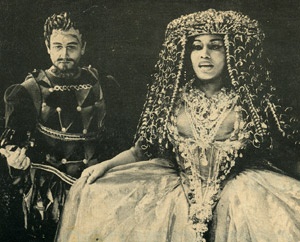
Above: Justino Diaz and Leontyne Price in Samuel Barber’s ANTONY & CLEOPATRA at The Met, 1966
~ Author: Oberon
By chance, I came upon this film of Leontyne Price singing Cleopatra’s final aria from Barber’s ANTONY & CLEOPATRA at a 1984 concert at Juilliard, conducted by Jorge Mester. Ms. Price’s singing here shows some of the vocal idiosyncrasies that crept into her performances as the 1970s progressed into the 1980s. But the sheer sound is glorious, the upper notes sustained, steady, and thrilling. What I love most about her in this brief video is her stillness – she doesn’t flail her arms about melodramatically; it’s all contained in the music – and her great sense of personal dignity.
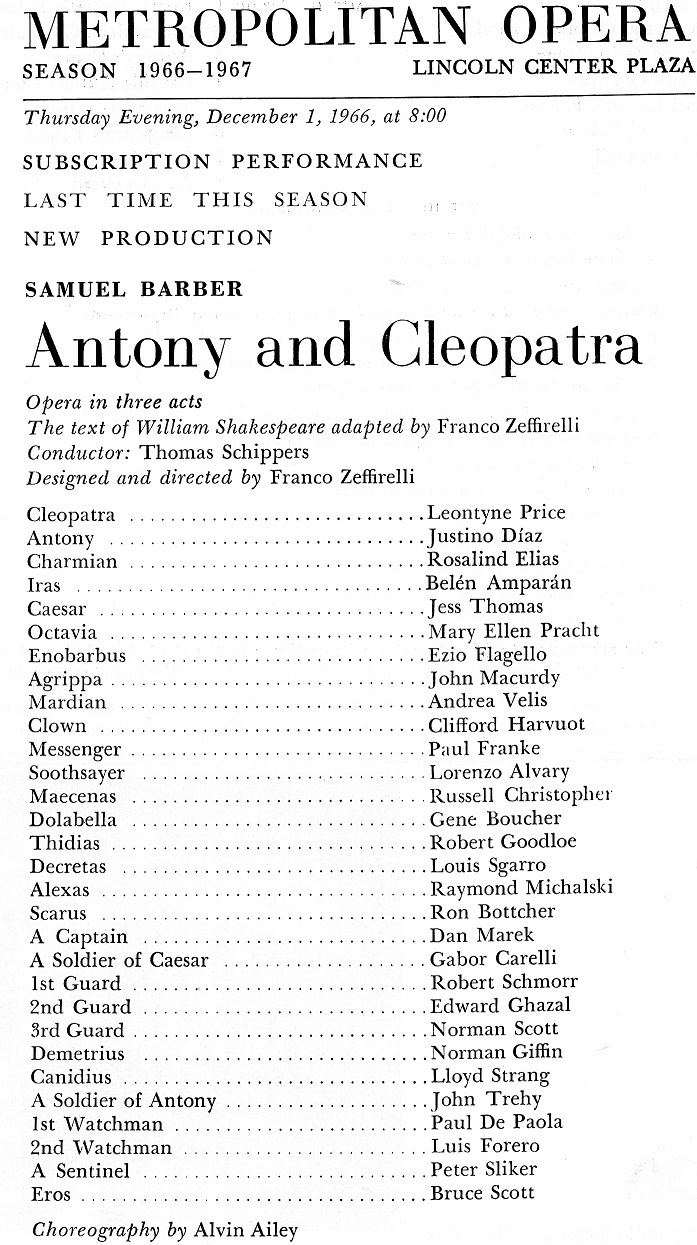
Barber wrote Cleopatra’s music specifically with Leontyne Price’s voice in mind. After the run of performances that opened the New Met in 1966 – of which I attended the last – the opera vanished from the Met repertoire. The composer devised a concert ending for the great final aria so that Ms. Price, and others to follow, might include it in their appearances with symphony orchestras.
A revised version of ANTONY & CLEOPATRA was given at Juilliard in 1975, a performance of which I attended:

The European premiere of the opera (in concert form) took place at the Théâtre des Champs Elysées, Paris, in 1980. Chicago Lyric Opera gave the opera in 1991 with Richard Cowan and Catherine Malfitano in the title-roles. There was a telecast, which I watched – really impressive – and which you can watch here and here!
In 2009, New York City Opera gave the opera in concert form at Carnegie Hall with Teddy Tahu Rhodes and Lauren Flanigan as Antony and Cleopatra. I was there, and the cumulative effect of the opera was powerful.
Writing about this opera gives me an opportunity to bring forth one of the great rarities from my collection: a performance of the final aria of Cleopatra by mezzo-soprano Beverly Wolff from a concert at Cincinnati in 1971. Martina Arroyo was to have been the vocal soloist that evening, but she was taken ill and Ms. Wolff stepped in on very short notice; musical revisions were made to accommodate the switch from soprano to mezzo-soprano.
Beverly Wolff ANTONY & CLEOPATRA aria Cincinnati 1971
~ Oberon
-
Wang @ Carnegie
~ Author: Scoresby
Thursday May 17th, 2018 – It is truly a rare occasion to see Carnegie Hall‘s Stern Auditorium completely sold out. It is even rarer to see this happen with stage seating too as was the case with pianist Yuja Wang‘s recital last week. Only Ms. Wang could do so with an unrelenting program like the one she played, with dark, not necessarily crowd pleasing works by Rachmaninoff, Scriabin, Ligeti, and Prokofiev. I haven’t enjoyed Ms. Wang’s solo performances as much in the past, but this felt like a completely different atmosphere than her usual fair. For one, the repertoire was much more intellectual and music lover oriented than her usual programs. For another, this program really seemed to be a statement. If it was any indication of how Ms. Wang’s Perspectives series will be at Carnegie Hall next season, I look forward to being able to attend the many events.

Above: Pianist Yuja Wang; Photo Credit: Kirk EdwardsMs. Wang began the performance with a series of seven Rachmaninoff’s smaller works, all in minor keys and repeated keys back to back (except for the opening g minor prelude). Despite clapping from the audience in-between the works, it was obvious Ms. Wang wanted to play them as one giant set. These set up the rest of the concert incredibly well – she drew in the crowd with a sense of mystery, making Rachmaninoff’s writing sound much more modern than it typically is treated. Emphasizing dissonances and unstable textures, Ms. Wang’s Étude-tableau in C minor, Op. 39 No. 1 sounded like a torrent in the right hand with crisply articulated left hand percussion. But here the blurs and ripples took control – while the notes were clear, Ms. Wang managed to make the voicing fade behind the accompaniment making the piece more modernist.
In the Prelude in B Minor, Op. 32 No. 10, Ms. Wang’s sensitive dynamic range and languid playing made the romantic climax seem less important than the surrounding, Debussy-like material. The best part of the evening was the Étude-tableau in E-flat Minor, Op. 39 No. 5 which ended the set. Here Ms. Wang had an unparalleled light touch which managed to let the melody sing through the storm of darker undercurrent. This was the opposite of virtuoso playing – many pianists hammer this etude out without much subtlety. Instead, Ms. Wang let the music’s storminess speak for itself, which led perfectly into the Scriabin that came next.
The next work on the program was Scriabin Sonata No. 10, Op. 70. This is one of Scriabin last five pieces written for piano and has his characteristic mystical sound world in the extreme. While work is in much stricter sonata form than the other late piano sonatas, it still has a mysterious, almost ghostly atmosphere. Ms. Wang wove through the dense textures with ease, making both the structure clear and letting the ambiguous atmosphere seem full of color. Her notes never sounded crisp or grounded; they instead were washed with an ethereal sheen. Just as the magical trills that appear before the work launches into its second theme began to be played, someone’s cellphone ringer featuring a trilling bird went off.

From the Archive: Alexander ScriabinWhile admirably Ms. Wang continued to play, it was a funny indication of the music. The trills begin to take over the more melodic portions of the piece before the climactic recapitulation where tremolos and trills rule in all registers – as Scriabin put it “a blinding light”. Ms. Wang’s glossy playing made this piece seem remote in the best way possible – someone taking you into their isolated world. Adding to this effect was the stage seating. In order to accommodate everyone on the stage without disrupting the performance, Carnegie lowered the lights so there was just a small circle of light around Ms. Wang – making her seem in that same realm as Scriabin.
To finish the first half of the program, Ms. Wang performed three short, but difficult Ligeti Etudes: No. 3 Touches bloquées, No. 9 Vertige, and No. 1 Désordre. To be clear, the Ligeti Etudes are some of the hardest pieces for piano ever written, but each one is also a musical world into itself. After the otherworldly Scriabin piece, Touches bloquées offered a different kind of isolation: that of machinery. The work sounds like a giant machine jerking around – Ligeti gets this odd rhythmic effect by having the pianist strike some keys silently in order to build in a particular rhythm to the piece.
Ms. Wang gave a committed performance that captured all of this convulsive sound. Vertige is modeled after a falling Shepard’s Tone with many chromatic notes lined up and falling forever. Ms. Wang player her way through this exhausting etude with verve – plucking out each of punchy chords in-between the falling. Finally, the first half ended with the jazzy and punchy disorder, a funny musical joke by Ms. Wang after such a dark/intellectual first half.
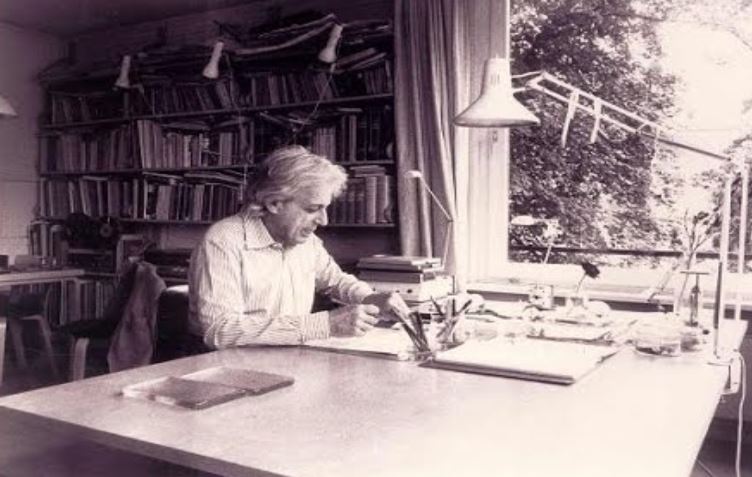
From the Archives: Composer Györg Ligeti
After what seemed more like a 30 or so minute intermission, the final work on the program was Piano Sonata No. 8 in B-flat Major, Op. 84. Despite the program notes saying that this was Prokofiev’s most optimistic of the war-time sonatas – the sprawling first movement of this piece a moody, wandering work. Ms. Wang’s performance captured the eccentric melody lines and temperamental well. She used a similar remote style of playing that she used in the Rachmaninoff and Scriabin here, but with well timed percussive outbursts in the bass that gave a contrasting mood.
In the Allegro moderato sections of the first movement Ms. Wang’s rapid fire style of playing was thrilling to watch, bringing the movement to a climax. More impressive though was Ms. Wang’s sense of space and silence at the end of the movement. In the romantic second movement, Ms. Wang seemed at her warmest of the night in the lighthearted theme before plunging into the electric final movement. Here, Ms. Wang plucked out precise articulation with a lithe sound, speeding through the virtuosic sections. The highlight was the mysterious coda-esque moment before the last outburst. Here Ms. Wang seemed relish in the atmosphere before the crashing ending (which had all the tight control of the rest of the performance).
While a thrilling recital from start to finish, I do wonder if her diverse crowd found it as satisfying. In many ways this was her at her most introspective – no crowd pleasing works like her usual programs and while certainly virtuosic playing, emphasizing the ephemeral instead of flash. Ms. Wang has a history of extensive encores, as such the crowd didn’t seem surprised when she brought out five of her favorite show-stopper type pieces. The crowd seemed enthused with these – much more so than the pieces on the actual program. While Ms. Wang wasn’t indifferent to her crowd, she certainly seemed all-business this evening with brusque bows and a sense of pushing forward. As a final gesture she played Liszt’s transcription of Schubert’s Gretchen am Spinnrade, going back to that dark place of the rest of the concert and seemingly shunning the audience there to hear her – it was like magic.
~ Scoresby
-
Wagner’s 205th
May 22nd, 2018, marked the 205th birthday of Richard Wagner. His operas remain – for me – the most absorbing in the repertoire.
Here are some highlights to celebrate his unique genius:
Anja Silja – Dich teure halle – TANNHAUSER – Cologne Radio 1968
Bernd Weikl as Amfortas – w Jan-Hendrick Rootering – Levine cond – Met bcast 1992
Gertrud Bindernagel sings Isolde’s Liebestod
Nicolai Gedda – In fernem land ~LOHENGRIN – Stockholm 1966
Wagner led a fascinating life. It is said that more books have been written about him than any other historical figure except Jesus.
-
Wagner’s 205th

May 22nd, 2018, marked the 205th birthday of Richard Wagner. His operas remain – for me – the most absorbing in the repertoire.
Here are some highlights to celebrate his unique genius:
Anja Silja – Dich teure halle – TANNHAUSER – Cologne Radio 1968
Bernd Weikl as Amfortas – w Jan-Hendrick Rootering – Levine cond – Met bcast 1992
Gertrud Bindernagel sings Isolde’s Liebestod
Nicolai Gedda – In fernem land ~LOHENGRIN – Stockholm 1966
Wagner led a fascinating life. It is said that more books have been written about him than any other historical figure except Jesus.
-
Concerto Night @ CMS
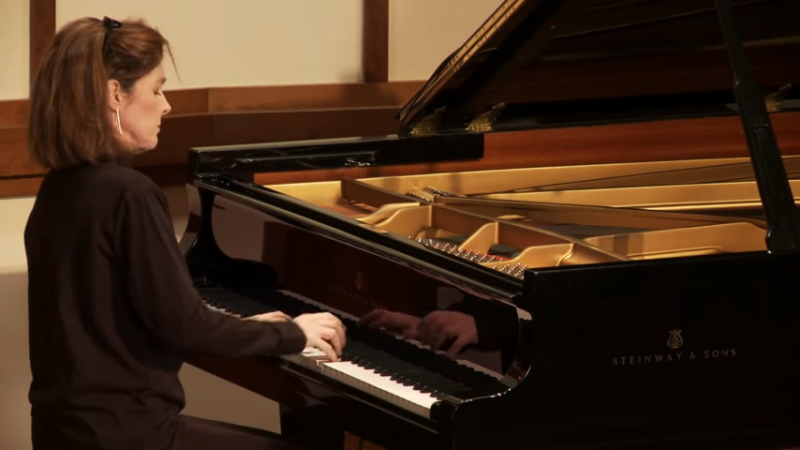
Above: Anne-Marie McDermott at the Steinway; she delivered a phenomenal Mozart K. 466 at Chamber Music Society of Lincoln Center‘s end-of-the-season performance at Alice Tully Hall tonight.
Author – Oberon
Sunday May 20th, 2018 – For the final offering of their 2017-2018 season, Chamber Music Society of Lincoln Center presented five concerti, each calling for a varied ensemble of players; an impressive group of artists came together to assure yet another great CMS evening of music-making. A surprise addition to the program, in the second half, was an added treat.
Jean-Marie Leclair’s Concerto in B-flat major for Violin, Strings, and Continuo, Op. 10, No. 1 was a wonderful program-opener, bringing forth a sterling performance from violinist Bella Hristova. This was my second Leclair encounter this Spring: in April, the composer’s Sonata for Two Violins in E-minor was played by artists from the New York Philharmonic at a Merkin Hall matinee. Today, again, Leclair’s music seemed truly fresh and vivid.

Ms. Hristova (above, in a Lisa-Marie Mazzucco portrait) looked gorgeous in a gunmetal grey gown, styled à la Grecque. Gilles Vonsattel was ready to play at the harpsichord and, with an ensemble of string players – Aaron Boyd, Sean Lee, Mihai Marica, Paul Neubauer, and Timothy Cobb – ranged around her, Ms. Hristova and her colleagues created a picture that somehow represented everything I love about Chamber Music Society. And then they began to play.
Ms. Hristova has always played beautifully, but there was some intangible quality in her artistry tonight that gave her performance a special glow. In this elegant, cordial music, she sounded splendid in both the lyrical passages and in the abounding coloratura. The poignant melody of the Andante was particularly appealing, where Mr. Cobb’s genial and rich bass also made a fine impression. In the concluding Gigue, veering between major and minor, Ms. Hristova the capped her triumph. As waves of applause swept thru the hall, Ms. Hristova strode back onto the stage for a bow, assuming that her colleagues were right behind her. But the men had held back, so that she could bask in the warm reception that she so truly deserved.
For Mozart’s Concerto in D minor for Piano and Strings, K. 466 – composed in 1785 and played tonight in Carl Czerny’s arrangement – Anne-Marie McDermott took her place at the Steinway, joined by Tara Helen O’Connor (flute), Sean Lee and Ms. Hristova (violins), Paul Neubauer (viola), Mihai Marica (cello), and Timothy Cobb (bass). The audience, poised to hear great music-making, experienced a revelatory performance from Ms. McDermott.
The concerto’s opening Allegro has an almost sneaky start, and then proceeds thru alternating modes of storm and calm. From the piano’s first entrance in a solo passage, it was clear we were in for exceptional playing from Ms. McDermott. The movement has a da capo with added piano roulades and an exchange of phrases between Sean Lee’s violin and Ms. O’Connor’s flute. The piano part becomes increasingly prominent. After a second da capo, Ms. McDermott trilled her way into a big cadenza; then the music again moved thru major/minor variants.
The Romance begins with the piano in straightforward phrases which develop over a gracious pulsing motif from the strings. Ms. McDermott’s gift for nuance, and her suave turns of phrase, were abundantly pleasing to hear. In the da capo, Ms. O’Connor’s flute adds a sparkle to the harmonies; modulations, masterfully handled by Mozart, carry thru to the finish.
Agitated bowing sets up the Rondo-finale, and as Ms. McDermott sailed thru delicious virtuoso passages with technical dazzle and amazing grace. One could sense the audience’s pent up excitement was about to burst. And burst it did. Thunderous applause filled the hall, with the pianist’s colleagues joining in and refusing to stand until she had stepped forward for a bow. The delirium continued, everyone on their feet, as Ms. McDemott and her fellow artists returned for two more bows.

To open the evening’s second half, Gilles Vonsattel (above) treated us to an immaculate performance of the Bach Concerto in G minor for Keyboard, BWV 975 (after Vivaldi RV 316). The oldest music on the program (dating from 1713-14), it sounded brand new: so alive and clean. In the Largo, especially, Mr. Vonsattel’s hushed pianissimi phrases and his rippling figurations played over a gentle pulse made an enchanting impression. Pianist, piano, Bach…a wonderfully intimate performance, the audience keenly attentive and appreciative.

Above: violist Paul Neubauer
Still on a high from experiencing The New York Philharmonic’s extraordinary performance of the Shostakovich 5th under Semyon Bychkov’s baton a few days ago, I was happy to hear Wu Han announce a surprise addition to the scheduled program this evening. Recently when she was in Saint Petersburg, Wu Han heard that the manuscript of a very short Shostakovich piece for viola and piano had just been discovered. Somehow she managed to bring a copy of this two-page work back to New York City with her. Paul Neubauer learned it in a day, and – with Wu Han at the piano – gave us what was most likely the first public performance (and for sure the US premiere) – of Shostakovich’s Impromptu for Viola and Piano (1931).
This Impromptu is in two movements, a sad and very Russian melody – soft and sorrowing – which displayed Mr. Neubauer’s finely-controlled tone – and then a lively, folk-like dance kicked off by Wu Han at the piano, her bright-red shoes tapping the floor. A little musical gem, this would seem a perfect encore piece for Mr. Neubauer in future.
Leos Janáček’s Concertino for Clarinet, Bassoon, Horn, Two Violins, Viola, and Piano (1925) is a quirky delight of a piece. As if the unusual instrumentation was not enough on its own, the full complement of musicians do not play in the first and second movements. The opening Moderato involves only the piano and horn (Ms. McDermott and burnish-toned Stewart Rose), and for the second – Più mosso – only clarinet (Tommasso Lonquich) and piano are heard, until the strings add a couple of chords at the finish.
Mr. Lonquich had brought three clarinets to the stage, switching from one to another as the music progressed. His lively trills danced the music on to a string finish. The Concertino moves on: a rocking, swaying mode, an off-kilter march, slashing bows, dancing or jogging along, vigorous plucking, extended string trills, a misterioso piano, a fast finale.

Above: percussionist Ayano Kataoka
The evening closed with the most recently-written work on the bill: Micro-Concerto for Solo Percussion, Flute, Clarinet, Violin, Cello, and Piano, composed 1999 by Steven Mackey. Ayano Kataoka moved from place to place on the stage where her various percussion instruments were arrayed. A superb “supporting cast” had been assembled: Tara Helen O’Connor (flute, and piccolo), Tommaso Lonquich (clarinet, and bass-clarinet), Sean Lee (violin), Mihai Marica (cello), with Gilles Vonsattel at the Steinway. The musical ensemble has their work cut out for them, as the writing seemed quite tricky and they were sometimes called upon to make unusual sound effects.
Ms. Kataoka played several ‘legit’ percussion instruments, plus a few that she and composer John Mackey apparently found under the proverbial kitchen sink, including whistles and clickers. Often she played two or three of these at a time. A petite woman with giant talent, Ms. Kataoka had choreographed herself to always be in the right place at the right time, and the audience seemed genuinely intrigued by her every move and by all the varied sounds she produced.
The work opens with an extra-terrestrial quality. Tara Helen O’Connor had 2 flutes and a piccolo at her fingertips; the composer calls on her for everything from low sputtering to piccolo pipings. Two passages have special appeal: one for bass clarinet (Mr. Lonquich) and Ms. Kataoka’s vibraphone, and a second where Mihai Marica’s expert cello playing meshed with the marimba to sensuous effect.
The composer bounded onto the stage for a bow at the end, thanking all the players, and embracing Ms. Kataoka. The percussionist’s frock was a contemporary take on traditional Japanese dress with a shortened skirt and a fanciful obi.
~ Oberon
-
An Evening With Freiburg Baroque

~ Author: Ben Weaver
Saturday May 19th, 2018 – The period instrument ensemble Freiburg Baroque Orchestra (above) has been a favorite of mine on records for some time. I was glad to finally be able to hear them live – along with one of my favorite pianists, Kristian Bezuidenhout at the fortepiano. This concert of works by Haydn, J.C. Bach and Mozart was part of Lincoln Center’s Great Performers series.
Conducting from the keyboard in the uncomfortably warm Alice Tully Hall, Mr. Bezuidenhout launched the Freiburg Barockorchester into the opening chords of Haydn’s Symphony No. 74 (composed in 1781) with great enthusiasm. The musicians, standing around the fortepiano, all wore black and played beautifully.
Period instruments can be an acquired taste. These instruments can go out of tune easily, and there is sometimes a nasal quality to the sound of the strings. But personally I love it, errant pitches and all. Though it should be noted that for the Freiburg Baroque musicians pitch was not an issue. Their ensemble work is flawless and the small number of players do not surrender anything in fullness and richness of sound. For this concert the orchestra was made up of 9 violinists, 3 violas, 2 cellos and 1 double-bass; with an assortment of winds and 2 horns.
Haydn’s 74th Symphony was one of the first works he was able to publish independently and for his own profit while working for the Esterházys in Eisenstadt, Austria. It may be true that many of Haydn’s symphonies can be a bit workmanlike, but the 74th is one of his finest works, filled with lovely melodies and inventive orchestration. The second movement especially is lovely: an Adagio of muted violins playing lovely theme and variations over the cello playing a repeated motif, like a guitar accompanying a serenade. A lively Trio leads to an exciting whirlwind of the Allegro finale.
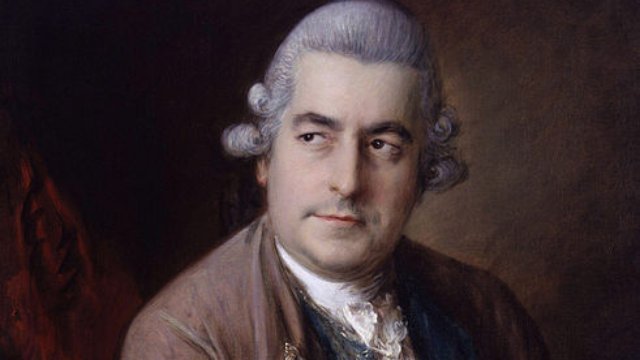
Johann Christian Bach (above) was the youngest of Johann Sebastian Bach’s sons and formed a direct link from the great Baroque master to the soon-to-be most important composer of the Classical era. When the Mozarts visited London in 1764, Wolfgang was 8 years old and J.C. Bach, recognizing talent in the young boy, played duets with him on the harpsichord and let him borrow music. Two years later, when Mozart tried his hand at composing piano concertos, he used J.C. Bach’s music as the foundation: 10 year old Mozart’s first 3 Piano Concertos are based on Johann Christian’s themes. And when Mozart heard of J.C. Bach’s death in 1782 he was in the middle of composing his 12th Piano Concerto. Mozart paid tribute to his old friend by basing the slow movement of the concerto on a melody from one of Bach’s operas, La calamità del cuore.
While Johann Christian could never eclipse his father – a true titan – as a composer, he nonetheless became a very respectable musician in his own right. More than that, Johann Christian’s Symphony in G minor, Op. 6, No. 6 is something of a trailblazer of the symphonic repertoire. Composed some time in the 1760s, the G minor Symphony went beyond the usual sunny allegros and dances of other composers. Johann Christian offered something of a “sturm und drang” darkness in this work that would reach the peak of passion with Beethoven. The symphony opens with stormy strings and horns’ call to arms. There is an urgency to the music that an older Mozart and then Beethoven would bring over the edge. The slow movement, the Symphony’s longest movement, brings respite from urgency, but not darkness. Menacing horns return in the final Allegro molto. In this movement you can hear the winds Beethoven would one day raise in his Pastoral Symphony. But strangest of all is the Symphony’s conclusion: it simply stops, unresolved, in the middle of a thought. This is something no composer would seriously attempt until the end of the 19th century.
Both Haydn and J.C. Bach were friends and mentors to the young Wolfgang Mozart. All 3 men composed memorable piano concertos, but Mozart’s compositions in the genre surpassed anyone who came before. Mozart’s 9th Piano Concerto, composed in Salzburg in 1777, is one of his most important compositions. It was the largest and most substantial composition of his to date, and it launched Mozart’s extraordinary development of the Piano Concerto into a centerpiece of not only his own output, but of the genre overall. The musicologist Alfred Einstein once called it “Mozart’s Eroica.”
For many years the concerto was incorrectly called “Jeunehomme.” Nobody really knew who Jeunehomme was and it is only in 2004 that historian Michael Lorenz established that the confusion arose from the incorrect spelling of Victoire Jenamy, the highly regarded pianist and daughter of famous dancer and balletmaster Jean-Georges Noverre. The Mozarts had known the Noverres for some time, and Wolfgang gave the concerto to Ms. Jenamy as a gift of friendship between the two families when she stopped in Salzburg on her way to Paris from Vienna in 1777.
The concerto opens with an unusual, almost instant entry of the fortepiano. Typically concertos began with extended orchestral introductions; indeed, most of Mozart’s own piano concertos do. But here Mozart wasted no time for the soloist. It’s a feature other major composers would not attempt until Beethoven’s 4th and 5th Piano Concertos a quarter century later. Composers like Grieg, Tchaikovsky and Rachmaninoff celebrated this invention with unforgettable results in their own times. The second movement, a lovely Andantino, contains magnificent writing for the piano, written almost like for a singing voice, and the final Rondo contains a surprising slow Minuet, perhaps Mozart’s nod to Ms. Jenamy’s father’s dancing career.
The 17th Piano Concerto, written in 1784, may be from the early stages of Mozart’s maturity as a composer, but it is a fully developed and wonderful work. The orchestra begins the piece with a lively and extended introduction, like most of Mozart’s concertos. But once the pianoforte enters, Mozart displays an unerring sense of balance between the solo instrument and orchestra, the play between them, passing of melodies from one to the other – and to other solo instruments within the orchestra – was something few could do with the confidence of Mozart. The beautiful Andante is in a long line of unforgettable Mozart slow movements, at once charming and sad, with flashes of light and sudden clouds. Beautiful writing for the winds in the movement is particularly moving as well. The exuberant final movement is a reminder that Mozart often sounds easy – effortless – but, in fact, requires extraordinary virtuosity.
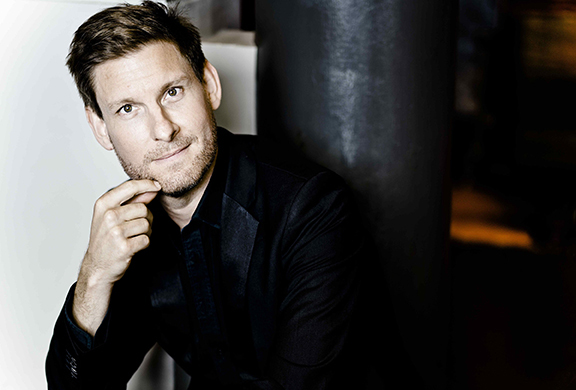
Kristian Bezuidenhout (above, in a Marco Borggreve) portrait played these works magnificently. He played, of course, on a period fortepiano and hearing these concertos played on an instrument Mozart would have recognized is a fascinating experience. We are so used to the behemoth sound created by the modern Steinway Grand in a concert hall (accompanied by a far larger ensemble) that we forget how light and almost fragile these sounds originally were. The instrument (alas, the Playbill does not mention the specific period it replicates) has a pearly, mildly hollow sound. There are, of course, no pedals, so the sound produced is uniform and it is up to the player to truly create the effect he/she wishes to present. Mechanical trickery is not an option. Mr. Bezuidenhout is a magician in this regard. He may well be our most brilliant interpreter of Mozart’s music today. Undaunted by technical demands, he manages to conjure universes out of a small wooden box and a few strings. The rapport between him and Freiburg Baroque players is obvious; they have perfectly synced tempos and dynamics, and there were the warm glances and smiles exchanged as cues and between movements.
The players all sat down on the risers to hear Mr. Bezuidenhout play an encore, a magical Allemande from Mozart’s unfinished Suite in C major (sounding like Papa Bach by way of Mozart).
~ Ben Weaver


 Oberon's Glade