Author: Philip Gardner

  • Lisa Batiashvili|ORPHEUS @ Carnegie Hall

    P1010052_preview

    Above: violinist Lisa Batiashvili, rehearsing for this evening’s concert with ORPHEUS; photo by Matt Dine

    ~ Author: Oberon

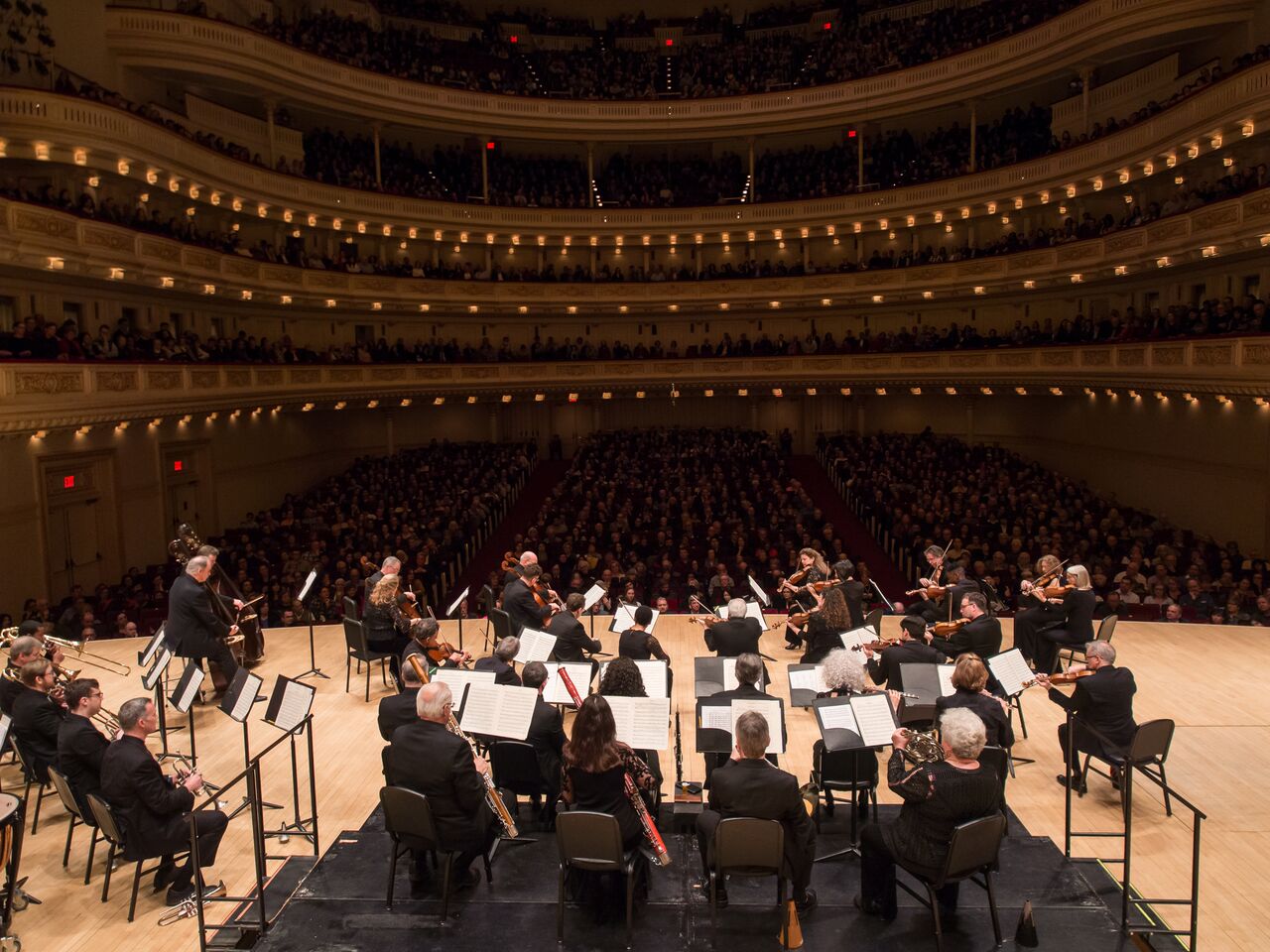
    Saturday March 24th, 2018 – My friend Dmitry and I are big fans of Lisa Batiashvili, so we were excited by this opportunity to hear her play the Prokofiev second concerto with ORPHEUS at Carnegie Hall. The program successfully blended works by Schubert and Prokofiev, and the comely violinist basked in a rock-star ovation after her dazzling performance.

    In 1823, Franz Schubert composed incidental music for Helmina von Chézy’s play, Rosamunde. The play was a failure, but Schubert’s music has come down to us across nearly two centuries. ORPHEUS opened their concert tonight with the play’s Entr’acte No. 1, commencing with a big, resonant sound that gave the illusion of a full symphony orchestra. The music has an air of theatrical drama, and there’s some lovely writing for clarinet. 

    Paul Chihara’s persuasive arrangement of Prokofiev’s Schubert Waltzes Suite, created specially for ORPHEUS, was highly enjoyable, and attractively played. Solo passages for oboe, flute, clarinet, and trumpet stood out. Mr. Chihara was present, and took a bow from the audience.

    P1010100_preview

    Above: ORPHEUS onstage at Carnegie Hall, a Matt Dine photo

    The two existing movements of Franz Schubert’s Symphony No. 8 in B Minor, D. 759 (Unfinished) were given plush treatment by the ORPHEUS forces, and again the clarinet, oboe, and flute soloists seized on their opportunities to delight us with melodious gems. The ensemble sound overall was vividly textured, with notable sonic warmth from the cellos, and the frequent repeats of the familiar theme of the Allegro moderato were so cordially played. A cellphone interrupted the Andante – twice! – spoiling the atmosphere; and no sooner had that distraction faded, than some poor bloke had a terrible coughing fit. It took all my powers of concentration to endure.

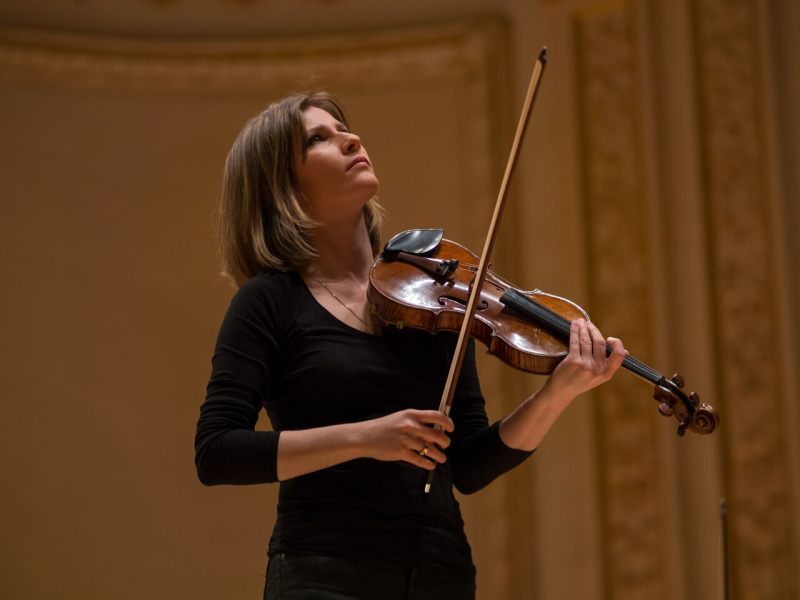
    After the interval, Ms. Batiashvili strolled onto the Carnegie Hall stage along with the ORPHEUS musicians – eschewing a star’s entrance – and proceeded to enthrall us with her commanding and emotionally vivid performance of the second Prokofiev violin concerto, Op. 63.

    P3240077_preview

    Above: Lisa Batasthvili playing the Prokofiev 2nd this evening; photo by Matt Dine.

    From her opening solo passage, Ms. Batiashvili’s playing seemed wonderfully at home, both in the embracing acoustic of the venerable hall and in the decidedly à la Russe qualities of the music. Her luminous tone in the sustained melodic passages and the clarity and deftness of her coloratura flourishes were captivating. A spidery motif over plucked accompaniment was subtly delivered, and – after a lamenting theme from the cellos and a march-like intrusion – she produced lively swirls of notes over a descending orchestral figure. As the violinist returned to the sweet, poignant melody heard earlier, we were on a Batiashvili high when the mood was broken by a moaning baby somewhere in the upper tiers. At moments like this, I seriously think about giving up concert-going.

    But Ms. Batiashvili drew us back into her world with her simply gorgeous playing in the Andante assai; the theme has a nostalgic glow and it sings over a plucked accompaniment. Sailing higher and higher, with spine-tingling glamour of tone, the violinist provided for us a transfusion of tranquility in a world going mad. The ensemble then take up the melodic passage as the violin plays pizzicati.

    The final movement, Allegro, ben marcato, brings us elements of the wit that Prokofiev can so magically integrate into his music: yet another reason he’s one of my top favorite composers. The castanets here always make me smile. Throughout this dance-like movement, it was as much fun watching the pretty violinist as listening to her. As this concerto reaches its lively finish, I always wish it had been longer.

    Ms. Batiashvili, looking lovely as ever in her wine-coloured gown, won an enraptured ovation from the crowd. She treated us to a delightful encore: the March from Prokofiev’s LOVE OR THREE ORANGES.

    P3240344_preview

    Above, mutual admiration: Lisa Batiashvili and the players of ORPHEUS. Photo by Matt Dine.

    ~ Oberon

  • Lifits @ Weill Hall

    ~ Author: Scoresby

    Friday March 23rd, 2018 – It is always a pleasure going to Carnegie Hall’s Distinctive Debuts series to hear new young musicians. This evening had the Uzbeckistani-German pianist Michail Lifits performing a short and somewhat eclectic program. The evening began with the last piano sonata that Schubert published in his lifetime: Piano Sonata in G major, D 894. Interestingly, this work was Schumann’s favorite Schubert piece. It is an unusual for younger musicians to program this work as it is one of Schubert’s most understated. Typically I am wary of hearing this piece played, as it can sound utterly repetitive in the wrong hands. Mr. Lifits proved otherwise, providing one of the most probing performances I’ve heard of the piece.

    The work commences with a serene chord pattern that serves as the base for the entire first movement. Mr. Lifits used a quiet and refined style of playing. There wasn’t much pedal; however, all of the voices were even. His tempo was quicker than some, but this only emphasized the song like quality of the music. After each restatement of this main theme, Mr. Lifits would slightly alter his voicing, throwing a different shade of color to this chord pattern. Over the course of the few minutes leading up to the dramatic downward scale that launches the piece forward, Mr. Lifits hand began to focus on clarifying the lower notes and murky inner-voices. Thus, with the tension set, he launched into that fateful downward scale creating one of the most dramatic moments of the evening. His sensitivity in dynamics let that moment feel like an awakening of sorts, after all the quiet lead up.  

    Screenshot 2018-03-25 at 2.35.22 PM

    Above: Pianist Michail Lifits, Photo Credit: Felix Broede

    After finally moving into this broader dynamic range, Mr. Lifits took full advantage. Through the first movement there are beautiful lieder-like sections. Here the piano had a softer sound, the melody in the right hand sounding like a singer playfully skirting atop a charming accompaniment. Each time the downward motif was repeated, Mr. Lifits increased the drama by adding slightly louder dynamics propelling the music forward.  

    In the main repeated chords, the lower basses gradually came into its own melancholy identity. Mr. Lifits wistful playing made this tinge become apparent through all the gracefulness above it. Finally, after transforming the almost repetitious theme for the last time the first movement came to delicate close. The audience was so enthused that they gave him a loud clap before letting him begin the second movement. I’ve never heard such a creative performance of that movement, that let each chord shine while at the same time pushing the music forward.  

    Mr. Lifits took a slightly faster approach for the second movement than one typically hears, which just increased the song-like quality inherent in this music. In the second minor theme that takes over this was particularly present. Despite some smudges in some of the scales and some technical issues, as a whole the second and third movements were still lovely.  

    Not pausing between any of the movements (perhaps out of fear that the audience would clap again, a good problem to have), he took a naïve jolly tempo for the last movement. Enjoying each ornamentation in the right hand and letting the music pop. I couldn’t but think that Schumann must have been inspired by this in his own Carnival. Regardless, I look forward to listening to Mr. Lifits’ Schubert CD (which includes this sonata). According to his biography he is recording an entire cycle of Schubert’s music and I look forward to hearing it all. 

    In the second half of the concert, there was a transition from the serene to the circus. First was the Shostakovich 24 Preludes, Op. 34 performed in succession without a break with Shostakovich Prelude and Fugue in D minor, Op. 87, No. 24. The Preludes are an earlier set of pieces which are classic Shostakovich joke-type pieces. While there are some serious moments, they are a study in comical miniatures for the most part. While I enjoy hearing a few of these, hearing all of them in succession was a little much for my taste (even as a devout Shostakovich lover).  

    Nonetheless, Mr. Lifits gave as good of a performance as one can expect, emphasizing the humorous sections of these pieces. In the second movement which is a burlesque sort of waltz, Mr. Lifits indulged in its off-kilter quality. He played up the various extreme dynamic changes in the wild moments. In the eighth movements riffs on jazzy themes, the piano here sounded like in a cabaret. The best part of the second half was the organ-like prelude and fugue. Mr. Lifits managed to coax all of the difficult voicing out of the fugue to create an intricate web of layers.  

    After such a well-played concert, Mr. Lifits offered Rachmaninoff’s showy arrangement of Kreisler’s Liebesleidwhich seemed inappropriate after all that came before. As a panacea to the Rachmaninoff, Mr. Lifits finished the concert with a second encore of Chopin’s posthumous Nocturne in C-sharp Minor which he played as well as the Schubert.

    ~ Scoresby

  • Celebrating Michael Trusnovec @ Paul Taylor

    PTDC-yellow-3

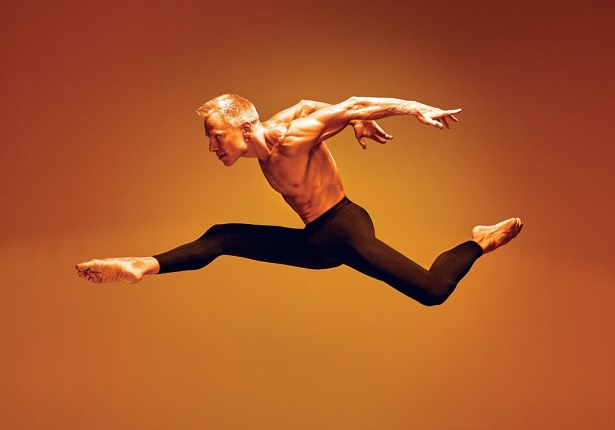
    Above: Michael Trusnovec

    ~ Author: Oberon

    Friday March 23rd, 2018 – This evening, at Mr. B’s House, we celebrated Michael Trusnovec’s 20th anniversary with the Paul Taylor Dance Company. Michael, one of the greatest dancers of our time, danced in all three works on tonight’s program. No one who has ever experienced a Michael Trusnovec performance needs to be told about his classically handsome face, his to-die-for physique, his complete command of every role he’s cast in, his peerless partnering skills, his musicality, his generosity of spirit, and his humble grace in acknowledging big ovations. All of this was wonderfully in evidence tonight. To be a star in an all-star Company, and to dance night after night the works of a master choreographer: what more could a dancer ask?

    The three ballets on offer tonight were strongly contrasted in music, movement, and style. The program showed off the vast range of the Taylor dancers, and their priceless gift for keeping the Taylor masterworks ever-fresh whilst being ready, willing, and able to tackle new choreography and make it their own. 

    PT Half Life

    Above: from Doug Varone’s HALF LIFE, a Paul B Goode photo

    Doug Varone’s HALF LIFE, set to a score by Julia Wolfe, with lighting by James Ingalls and costumes designed by Liz Prince, opened the evening. This ballet premiered earlier this season. It begins with Eran Bugge and George Smallwood dancing in-sync, in silence, on a bare stage with over-head fluorescent lighting. Then the music begins: vibrant and driven, it propels the dancers into a veritable whirlwind of motion and commotion. Fear seems to be the driving force behind all this activity as they dash about, full of apprehension, making fleeting contact with one another before rushing off in another direction. Terror has descended upon them as they push and pull, fall and rise, entangle and break free, twist, turn, and fling themselves about the space. Periodically, a dancer will raise his arm towards heaven, imploring god’s intervention. Like billions of prayers down the centuries, these remain unanswered.

    The fluorescent lights have turned to a toxic, lurid yellow as they begin to descend, flattening the space as the dancers run away, hopefully to a fallout shelter. The lights sputter out.

    HALF LIFE might be viewed as a ballet for the new nuclear age that threatens us now as today’s world leaders seem to be moving towards a “my bomb’s bigger than your bomb” mentality. While Mr. Varone’s choreography – so relentless, filled with an almost random dynamism – is exciting to behold in and of itself, watching the dancers thru my strong opera glasses added another whole dimension: their intense facial expressions, the fear and wariness in their eyes, and their desperation to communicate with one another brought the panic and dread of these uncertain times into sharp focus. HALF LIFE isn’t just a bunch of people rushing about with manic energy, but a commentary on the human condition as our planet experiences a second Age of Anxiety.

    There were countless passages in which to focus on the individual dancers; clad in simple off-the-rack style clothing, they all look beautiful, even in their distress. The men – Mr. Trusnovec, Robert Kleinendorst, Sean Mahoney, Michael Novak, Mr. Smallwood, Lee Duveneck, and Alex Clayton – flung themselves into fast-paced moves and tricky, split-second partnering. Yet my opera glasses were continually lured by the women: Michelle Fleet, Parisa Khobdeh, Eran Bugge, Laura Halzack, and Heather McGinley. Ms. McGinley, the Company’s knockout redhead, danced up a storm. They all did, in fact.

    There was a gigantic roar of applause as the curtain fell, and as pairs of dancers stepped forward during the bows, screams of epic proportion filled the hall: all so eminently deserved. At a time when so much new choreography seems simply to be going thru the motions, Mr. Varone – richly abetted by Ms. Wolfe’s tumultuous score – gives us an unnervingly timely piece. The dancers took it and ran with it. Thrilling! 

    Eventide-4

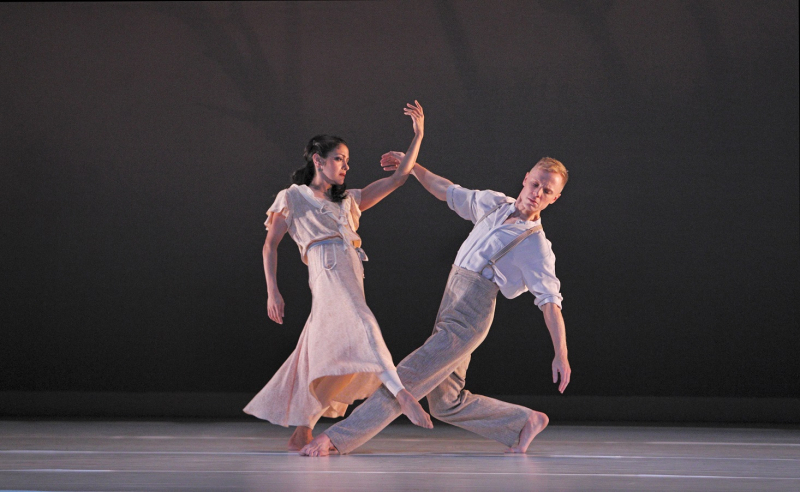
    Above: Parisa Khobdeh and Michael Trusnovec in EVENTIDE, a Paul B Goode photo

    EVENTIDE, one of Taylor’s most lyrical works, unfolds before a backdrop of hazy trees on a late-Summer afternoon in the English countryside. The Ralph Vaughan Williams score brought forth idyllic playing from the Orchestra of St Luke’s and violist David Cerutti.

    The ensemble dance a graceful and courtly Prelude, then individual couples appear in a series of duets. In the first, Parisa Khobdeh and Michael Trusnovec summon feelings of slightly hesitant tenderness; it finishes with Ms. Khobdeh perched on Mr. Trusnovec’s shoulder. There’s a bit of playfulness in the second duet, with Jamie Rae Walker and Sean Mahoney clearly attracted to one another but not quite sure of how to express it. I really like their partnership.

    In a gorgeous, adagio/pas de quatre Heather McGinley and Michael Novak simply radiate gentle romance, Ms. McGinley’s eyes sweetly downcast so as not to be blinded by the handsomeness of her cavalier, whilst Mr. Novak shows a quiet pride at having such a distinctive beauty as Ms. McGinley on his arm. It’s a duet of mutual admiration and reassurance.

    Deep and heartfelt emotion seems to fill the air as Laura Halzack and James Samson danced together in sublime harmony, casting tender looks into one another’s eyes; a moment when Laura simply touched James’s cheek was just unbearably lovely. This stage has been home to some very charismatic partnerships – Suzanne and Peter, Wendy and Jock – but few have moved me as much as watching Laura and James together this season. 

    A shadow falls over the meadow as Eran Bugge enters, wary but oddly hopeful: she’s being pursued by a quietly predatory Robert Kleinendorst, and as their duet ends, Robert leaves Eran on her own…a very significant moment, as she is both safe but perhaps also just a bit sorry. Together, Eran and Rob told this story so expressively.

    Heather McGinley and Michael Novak bring a sense of open-hearted richness to their second duet. It’s a long pas de deux, but with these two dancing it could have been twice as long and remained thoroughly mesmerizing. Finally Ms. Khobdeh and Mr. Trusnovec re-appear in a poignant pas de deux, finding solace in their romance: elegant and sustaining dance, awash with fond devotion.

    EVENTIDE concludes with an extended promenade for the entire cast. As ever, this ballet left me musing on my own romantic choices over the years, filled with notions of what might have been.

    CLOVEN KINGDOM is a ballet I never tire of seeing. It was given a magical glow tonight, with everyone incredibly finding an extra iota of energy, commitment, and inspiration in honor of their colleague, Mr. Trusnovec. 

    Michelle Fleet, Jamie Rae Walker, Eran Bugge, and Parisa Khobdeh ease thru high-toned samba sways one minute, and then they’re flipping cartwheels the next. I just loved watching them thru my trusty binocs. Laura Halzack and Christina Lynch Markham are bound together by some mythic spell: we don’t quite know what their story is, but I never tire of trying to figure it out. Madelyn Ho periodically flashes across the stage in pursuit of Heather McGinley, who remains confidently self-absorbed as she carries on with her jetés

    Tonight, Mr. Trusnovec had Mssrs. Samson, Apuzzo, and Smallwood as his fellow tuxedoed teammates for the men’s pas de quatre that’s at the epicenter of this cloven kingdom. Their fearless athleticism and bizarre rituals underscore the Spinoza quote that always accompanies this ballet’s listing in the Playbill: “Man is a social animal.” 

    A whooping ovation greeted the first CLOVEN KINGDOM curtain call, a full-cast bow. Then the curtain rose again with Mr. Trusnovec alone onstage, clutching a huge bunch of flowers. Massive applause and cheers: the audience simply went crazy as Michael’s fellow dancers pelted him with bouquets from the wings.

    Of Michael Trusnovec, Robert Gottlieb wrote in the New York Observer: “He’s the greatest male dancer we’ve had in America since Mikhail Baryshnikov, with whom he shares an immense range and a selfless devotion to his art. Trusnovec never demands your attention, but he always has it.” I couldn’t agree more.

    ~ Oberon

  • Mitsuko Uchida @ Carnegie Hall

    4929_6093_Uchida-Mitsuko_Decca_Marco

    Above: Mitsuko Uchida, photographed by Marco Borggreve

    ~ Author: Oberon

    Monday February 26th, 2018 – Mitsuko Uchida in an all-Schubert recital at Carnegie Hall. I had only heard Ms. Uchida performing live once before, on Bastille Day, 1989, at Tanglewood; that evening, she played the Ravel G-major concerto, with Seiji Ozawa conducting. In 2009, some twenty years after that Tanglewood encounter, Mitsuko Uchida was named Dame Commander of the British Empire by Queen Elizabeth II.

    This evening, Dame Mitsuko walked onto the Carnegie Hall stage to an affectionate round of applause. Clad in a black trouser outfit with a golden sash and gold shoes, she bowed formally to the crowd, put on her eyeglasses, and sat down at the Steinway. For the next two hours, the pianist filled the hall – and our hearts – with her renderings of three Schubert sonatas. Her playing was by turns dramatic and poetic, and there was a wonderful feeling that her interpretations were very much at home in the venerable space: we were literally enveloped in the music.

    Mitsuko Uchida is a true artist. She isn’t here to dazzle us with theatrics or with her own personality, but to bring us great music in all its clarity and richness.

    The ongoing discussion in the realm of classical music as to whether Schubert’s piano sonatas belong in the same echelon as Beethoven’s was continued in tonight’s Playbill and in remarks overheard in intermission  conversations around us. My feeling, based on limited experiences to date, is that Beethoven’s sonatas more often reach a spiritual depth which Schubert’s – for all their beauty and fine structuring – never quite attain.

    The evening opened with the C-minor sonata, D. 958. Ms. Uchida immediately commanded the hall with the sonata’s crisp, dramatic start. As she moved forward, I initially felt she was giving too much pedal; but this notion was soon dispelled. Flurries of scales were exhilarating, and dancing themes ideally paced. The movement ends quietly.

    The Adagio brings us the first of many melodies heard throughout the evening that remind us of Schubert’s stature as a lieder composer. From its melancholy, soft start, one can imagine a voice taking up the melody; Ms. Uchida’s songful playing underscored this vocal connection throughout the concert. Some unfortunate coughing infringed on the quietest moments, but the pianist held steady and the atmosphere was preserved.

    Following a Menuetto – its unusually somber air perked up by the Allegro marking – the sonata’s dancelike final movement feels almost like a tarantella. A marvelous lightness moves forward into alternating currents of passion and playfulness. Ms. Uchida’s tossing off of several flourishing scales was particularly pleasing. 

    The A-Major sonata, D. 664, published posthumously in 1829, has variously been dated between 1819-1825. Referred to as “the little A-major” it was the shortest of the three sonatas on offer tonight, and it’s a real gem.

    This sonata’s opening Allegro moderato commences with another ‘song without words’. The pianist moves from high shimmers to dusky depths of turbulence and back again. A hesitant, sighing start to the Andante soon develops gently into minor-key passages. Ms. Uchida’s playing has a rapt, dreamlike quality and a lovely sense of mystery here; this evolves to a heavenly finish. The final Allegro commences with rippling motifs; emphatic downward scales lend drama, while waltz-like themes entice us. Throughout, the pianist’s feeling for nuance continually intrigued.
     
    Following the interval, we had the longest of the program’s three sonatas: the G-Major, D. 894 (often referred to as the Fantasie-Sonata‘), which was composed in the Autumn of 1826.

    The ultra-soft opening of this sonata found Ms. Uchida at her most compelling. As the Molto moderato e cantabile unfolds, there are high, decorative passages interspersed with big, rumbling downhill scales and waltzy motifs. Again the pianist’s scrupulous attention to detail and her control of dynamics kept the hall mesmerized. In the Andante, Ms. Uchida savoured the calm of the opening measures. Then grand passions spring up, alternating with lyrical flows from minor to major. The soft ending of this Andante was magical.

     
    Heraldry sets off the Menuetto, Allegro moderato, which later lures us with a waltz. Ms. Uchida’s caressing of the notes as the music softens was sublime. The Allegretto, full of repeats, again reminded us of how marvelous this music sounded in the hall.
     
    Greeted with an exceptionally warm standing ovation, Ms. Uchida delighted us with a miniature encore – one of Arnold Schoenberg’s “Six Little Piano Pieces” Op. 19 – which took a about a minute to play. This witty gesture was a perfect ending to a great evening of music-making.  

    ~ Oberon

  • Cantanti Project’s EURIDICE: Gallery

    Euridice by Cantanti @ NYC_Rush Selects-web_16

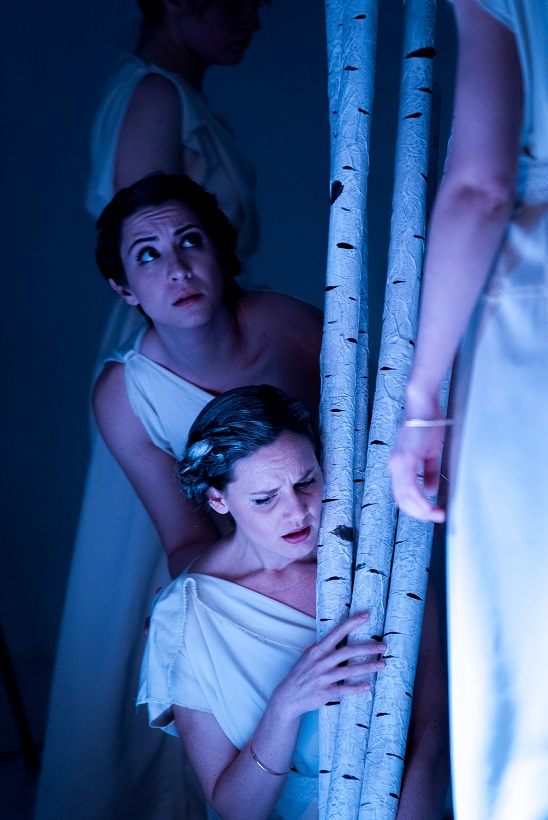
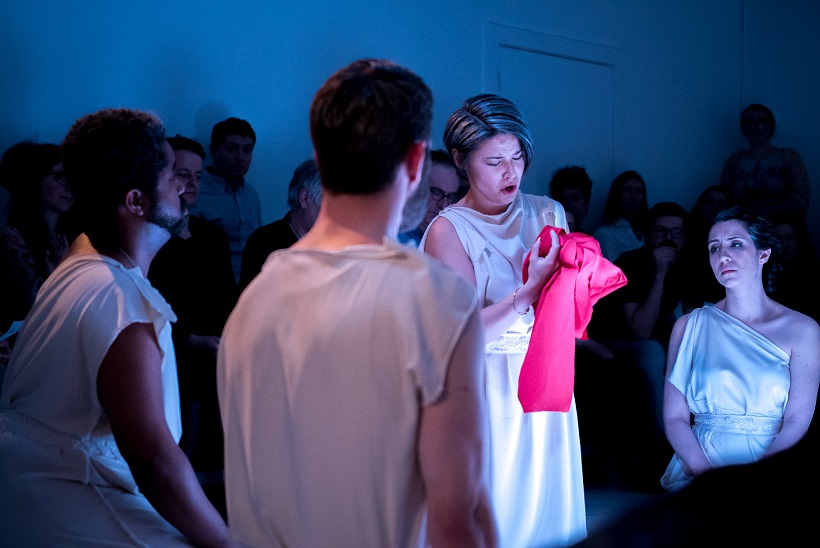
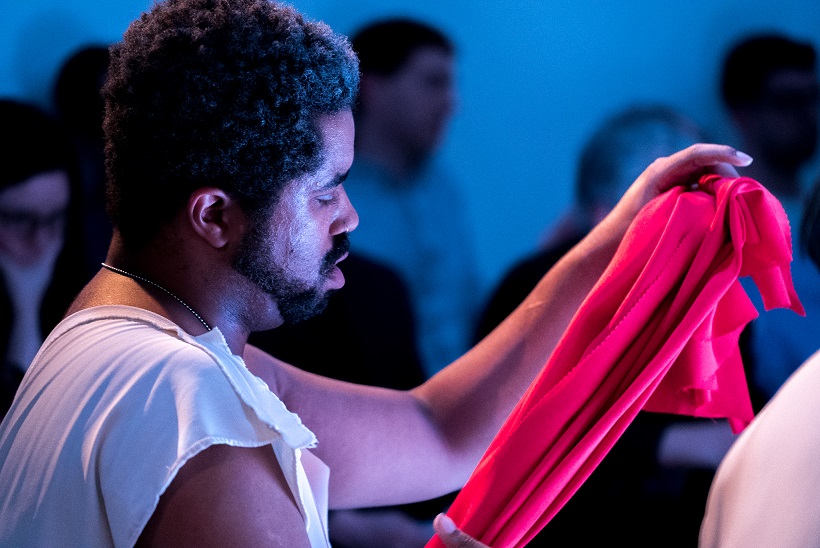
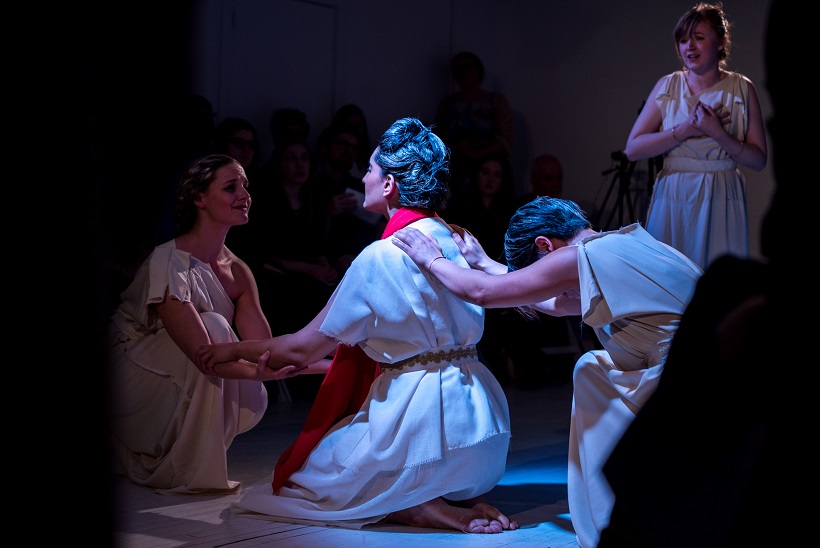
    A gallery of images from the Cantanti Project‘s recent production of Giulio Caccini’s EURIDICE. The photos are by Lucas Godlewski of LGod Photography. Read about the performance here, and about a rehearsal that I got to watch here.  

    Often referred to as “the first opera”, Caccini’s EURIDICE is a take on the classic story of Orfeo, the mythic singer who descends to the Underworld to rescue his beloved Euridice. Caccini gives us a happy ending: a triumph of love over death.

    Euridice by Cantanti @ NYC_Rush Selects-web_1

    La Tragedia: Fiona Gillespie Jackson

    Euridice by Cantanti @ NYC_Rush Selects-web_2

    Euridice as bride-to-be: Joyce Yin

    Euridice by Cantanti @ NYC_Rush Selects-web_3

    Nymphs: Brittany Fowler, Sara Lin Yoder

    Euridice by Cantanti @ NYC_Rush Selects-web_5

    Tom Corbeil

    Euridice by Cantanti @ NYC_Rush Selects-web_7

    Bachelors cavort before the story turns dark: Aumna Iqbal, Michael Celentano, Marques Hollie

    Euridice by Cantanti @ NYC_Rush Selects-web_8

    Dafne (Elyse Kakacek) brings news of Euridice’s death

    Euridice by Cantanti @ NYC_Rush Selects-web_11

    Daniela DiPasquale and Elyse Kakacek

    Euridice by Cantanti @ NYC_Rush Selects-web_14

    Lamenting the death of Euridice: Marques Hollie, Tom Corbeil, Brittany Fowler, Sara Lin Yoder

    Euridice by Cantanti @ NYC_Rush Selects-web_15

    Marques Hollie

    Euridice by Cantanti @ NYC_Rush Selects-web_18

    Laura Mitchell (Arcetro) with Fiona Gillespie Jackson

    Euridice by Cantanti @ NYC_Rush Selects-web_22

    Urging Orfeo to seek Euridice in the Underworld: Elyse Kakacek, Aumna Iqbal, Brittany Fowler, Fiona Gillespie Jackson

    Euridice by Cantanti @ NYC_Rush Selects-web_24

    Brittany Fowler as Venere

    Euridice by Cantanti @ NYC_Rush Selects-web_40_preview

    Lydia Dahling as Prosperina

    Euridice by Cantanti @ NYC_Rush Selects-web_25

    Aumna Iqbal as Orfeo

    Euridice by Cantanti @ NYC_Rush Selects-web_29

    Friends reunited

    Euridice by Cantanti @ NYC_Rush Selects-web_31

    Lovers reunited: Aumna Iqbal and Joyce Yin

    All photos by Lucas Godlewski/LGod Photography.

  • Cantanti Project’s EURIDICE: Gallery

    Euridice by Cantanti @ NYC_Rush Selects-web_16

    A gallery of images from the Cantanti Project‘s recent production of Giulio Caccini’s EURIDICE. The photos are by Lucas Godlewski of LGod Photography. Read about the performance here, and about a rehearsal that I got to watch here.  

    Often referred to as “the first opera”, Caccini’s EURIDICE is a take on the classic story of Orfeo, the mythic singer who descends to the Underworld to rescue his beloved Euridice. Caccini gives us a happy ending: a triumph of love over death.

    Euridice by Cantanti @ NYC_Rush Selects-web_1

    La Tragedia: Fiona Gillespie Jackson

    Euridice by Cantanti @ NYC_Rush Selects-web_2

    Euridice as bride-to-be: Joyce Yin

    Euridice by Cantanti @ NYC_Rush Selects-web_3

    Nymphs: Brittany Fowler, Sara Lin Yoder

    Euridice by Cantanti @ NYC_Rush Selects-web_5

    Tom Corbeil

    Euridice by Cantanti @ NYC_Rush Selects-web_7

    Bachelors cavort before the story turns dark: Aumna Iqbal, Michael Celentano, Marques Hollie

    Euridice by Cantanti @ NYC_Rush Selects-web_8

    Dafne (Elyse Kakacek) brings news of Euridice’s death

    Euridice by Cantanti @ NYC_Rush Selects-web_11

    Daniela DiPasquale and Elyse Kakacek

    Euridice by Cantanti @ NYC_Rush Selects-web_14

    Lamenting the death of Euridice: Marques Hollie, Tom Corbeil, Brittany Fowler, Sara Lin Yoder

    Euridice by Cantanti @ NYC_Rush Selects-web_15

    Marques Hollie

    Euridice by Cantanti @ NYC_Rush Selects-web_18

    Laura Mitchell (Arcetro) with Fiona Gillespie Jackson

    Euridice by Cantanti @ NYC_Rush Selects-web_22

    Urging Orfeo to seek Euridice in the Underworld: Elyse Kakacek, Aumna Iqbal, Brittany Fowler, Fiona Gillespie Jackson

    Euridice by Cantanti @ NYC_Rush Selects-web_24

    Brittany Fowler as Venere

    Euridice by Cantanti @ NYC_Rush Selects-web_40_preview

    Lydia Dahling as Prosperina

    Euridice by Cantanti @ NYC_Rush Selects-web_25

    Aumna Iqbal as Orfeo

    Euridice by Cantanti @ NYC_Rush Selects-web_29

    Friends reunited

    Euridice by Cantanti @ NYC_Rush Selects-web_31

    Lovers reunited: Aumna Iqbal and Joyce Yin

    All photos by Lucas Godlewski/LGod Photography.

  • Cantanti Project: Caccini’s EURIDICE

    Caccini
    ~ Author: Oberon

    Friday February 23rd, 2018 – Taking us back to the very beginnings of opera – back to where it all began – the Cantanti Project bring us a rare opportunity to experience Giulio Caccini’s EURIDICE. Last Autumn, when I first read of these performances, I knew I would want to be there.

    In 1600, Jacopo Peri had written an opera to Ottavio Rinuccini’s libretto based on the story of Orfeo and Euridice; but Peri’s opera has not yet been published when Giulio Caccini took up the same libretto, and his setting of it was performed at the Pitti Palace, Florence, on December 5, 1602. Thus Caccini’s EURIDICE is often referred to as ‘the first opera’.

    Joyce Yin, soprano and Artistic Director of the Cantanti Project, kindly arranged for me to watch a rehearsal of EURIDICE a week prior to the performances. This was a great introduction to the opera, and provided me with an opportunity to get a handle on who’s who in the cast.

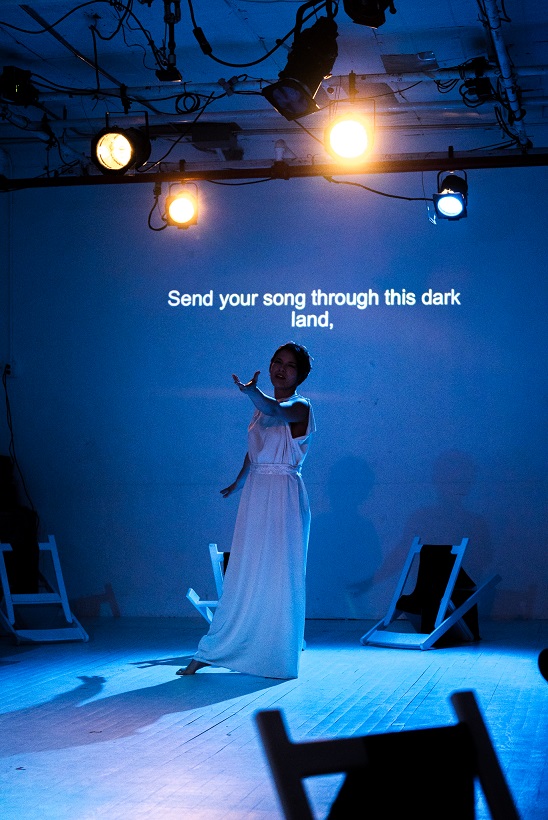
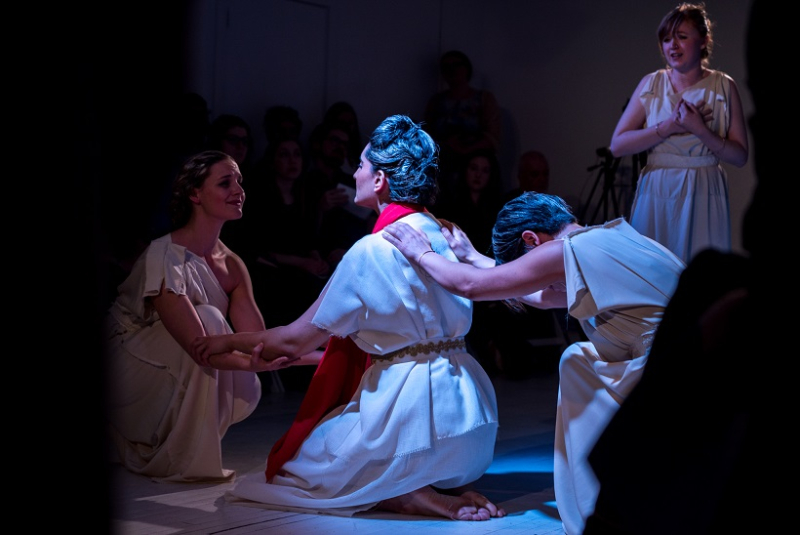
    The performance took place in the ‘white box’ studio of the Alchemical Studios on West 14th Street. This long and rather narrow space was well-utilized, with seating along the walls on either side, the musicians of Dorian Baroque tucked into one corner, and the singers making the most of the central playing area.

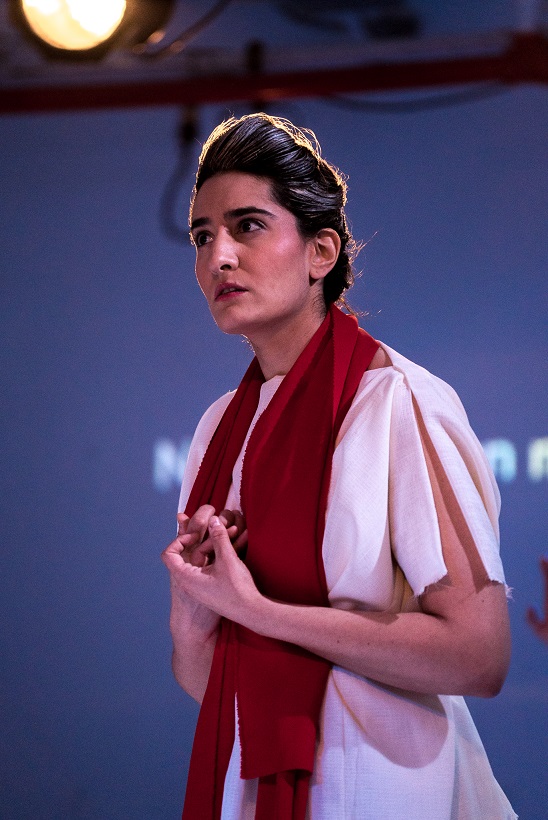
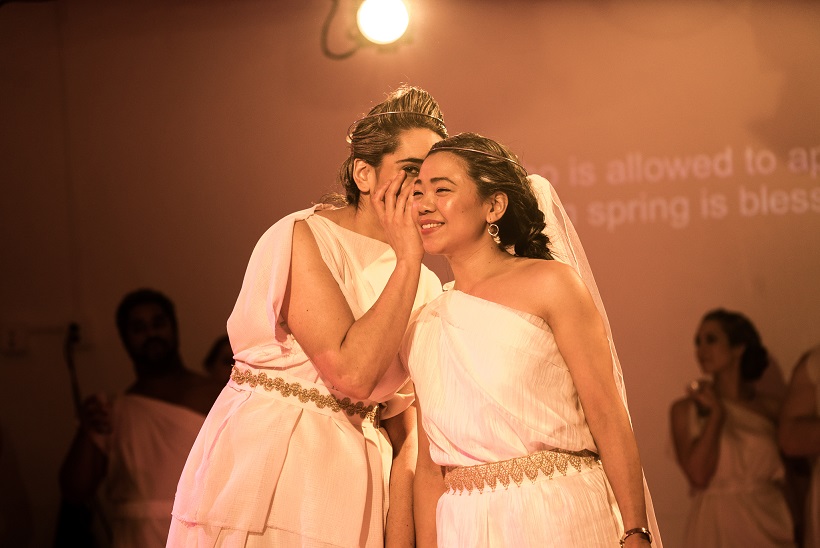
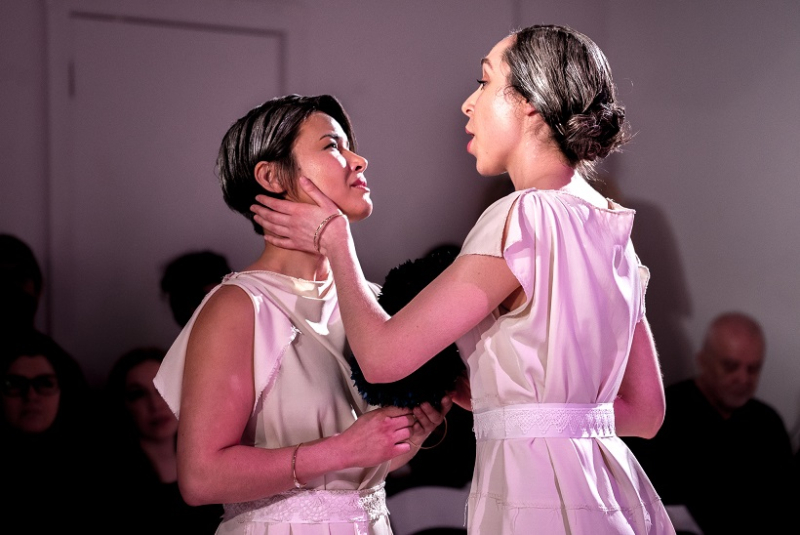
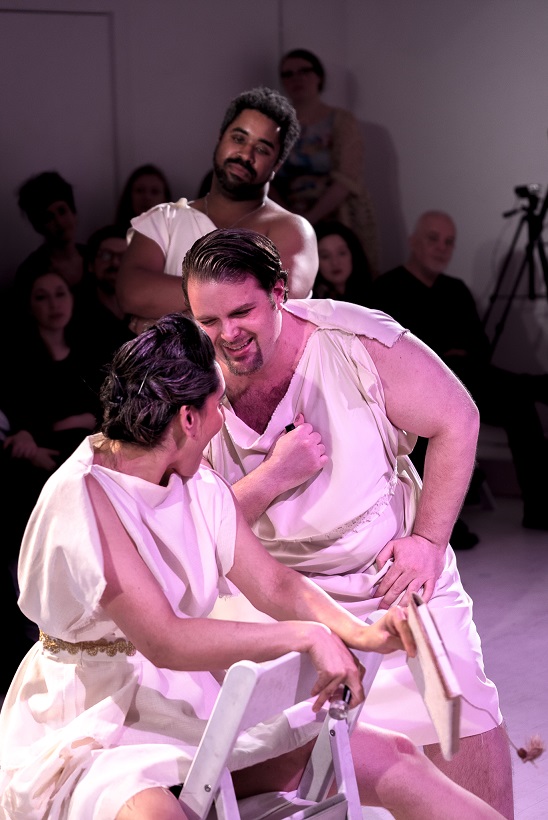
    Director Bea Goodwin’s savvy – and often touching – stage direction told the story clearly, with elements of dance woven in and all the characters vividly drawn. Stylized gestural language was beautifully rendered, especially in the scene where Orfeo pleads with Pluto to restore Euridice to life. Alexandria Hoffman’s simple and elegant Grecian-tunic costuming – all white – and the lighting design by Michael Celentano and Emma Clarkson enhanced the performance at every turn. The audience – wonderfully silent and attentive – were clearly taken with the entire presentation.

    Let me first praise the excellent quartet of musicians whose contribution to the performance’s success was vital. Dylan Sauerwald – conducting from the harpsichord – was joined by Paul Holmes Morton (theorbo), John Mark Rozendaal (viola da gamba), and Christa Patton (harp). Their instruments are beautiful, and beautifully played, giving a timeless feeling to the music. Caccini’s EURIDICE may be four centuries old, but tonight is seemed fresh and new.

    Aside from Orfeo and Euridice, the cast all do double-duty; each singer has an assigned name-role whilst doubling as nymphs and shepherds. Where to begin with the singers? At the beginning: as La Tragedia, Fiona Gillespie Jackson’s sweet, clear soprano drew us in to the story and the musical style with her lovely rendering of the Prologue. Her words – and the assignment of this music to a melodious soprano rather than a darker contralto – foretell a happy ending, despite intervening trials and sorrows.

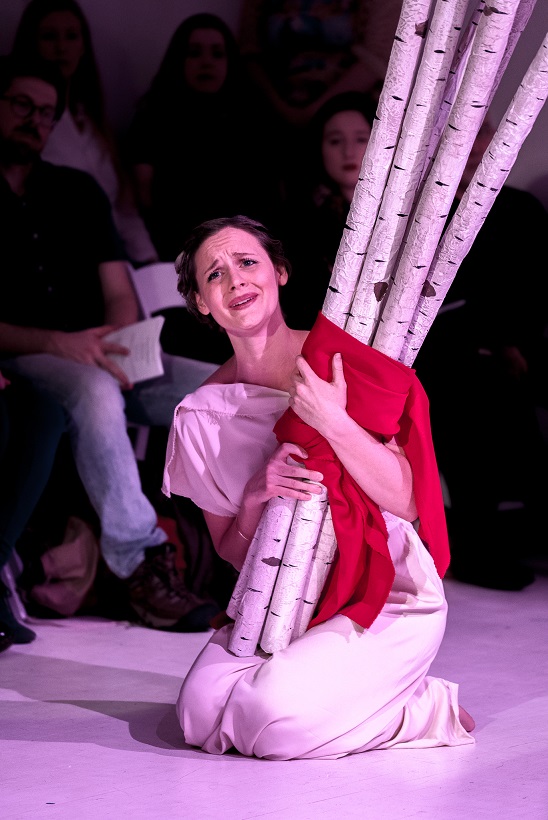
    Joyce Yin’s lyrical and well-projected soprano, and the youthful joy of her portrayal, were just right for Euridice. At times called upon to dance, Ms. Yin took that in stride as well. Her radiant happiness a being reunited with Orfeo was lovely to behold. As Orfeo, the tall and slender Aumna Iqbal combined authoritative acting with a distinctive voice; she was thoroughly at home in the recitativo style, shading her words and colouring the tone with impressive command. As a relaxed bridegroom-to-be, Orfeo at first carouses with friends and makes a ribald reference to his wedding night. Then, Ms. Iqbal consummately caught the character’s descent from light-heartedness to despair when news of his Euridice’s demise arrives.

    As Dafne, the bearer of those sad tidings, soprano Elyse Kakacek excelled. Her vocalism combined clarity of tone with depth of feeling, and her facial expressions told of the grief her message cost her. An intrinsic sense of hesitancy in her presentation made clear her reluctance to tell the tale of Euridice’s fate. Later, though, as his friends urged Orfeo to seek his beloved in Hades, Mr. Kakacek circled the space in authentic dance moves, exhorting everyone to optimism and the hope of a happy resolution. 

    As Venere, goddess of Love, Brittany Fowler’s striking presence and commanding singing made her the perfect advocate for Orfeo at Pluto’s court. Tall and austere, Tom Corbeil as Pluto seemed thoroughly implacable at first, his singing powerful and his stature intimidating. Lydia Dahling, as Prosperina, surprisingly takes Orfeo’s side in the debate, her singing warm of tone yet urgent. Michael Celentano and Marques Hollie, with contrasting tenor voices, are Charon and Radamanto in this key scene, wherein Ms. Iqbal was superb. These are the opera’s most powerful moments, with Orfeo supplicating himself before Pluto to beg for Euridice’s return. The characters’ varying gestures of supplication, implacability, and intercession were done with authority: engrossing staging, very well-played.

    Mr. Hollie’s power and wide-range were utilized when – as Amyntas – he sought to reassure his friends that Orfeo had indeed been successful in his bid to regain his beloved and that the couple would soon appear among them again. Mr. Celentano’s lyrical sound was pleasing to hear in his interjections as the story moved to its resolution.  

    Two singers who particularly intrigued me were Laura Mitchell (Arcetro) and Sarah Lin Yoder (Nymph). Ms. Mitchell’s attractive singing was made the more ingratiating thru her lovely use of piano and her nuanced delivery of the words. Ms. Yoder, a unique beauty, displayed a voice of natural power and expressiveness.  

    Aside from the scene in the Underworld, another vignette in the opera which made a particularly strong impression on me occurred as the assembled nymphs and shepherds knelt in a circle to mourn Euridice’s death. Handsomely lit, this passage calls for finely-harmonized ensemble singing interspersed with solo lines. The blend of voices was really enchanting, both here and at the opera’s happy end. 

    ~ Oberon

  • Cantanti Project: Caccini’s EURIDICE

    Caccini
    ~ Author: Oberon

    Friday February 23rd, 2018 – Taking us back to the very beginnings of opera – back to where it all began – the Cantanti Project bring us a rare opportunity to experience Giulio Caccini’s EURIDICE. Last Autumn, when I first read of these performances, I knew I would want to be there.

    In 1600, Jacopo Peri had written an opera to Ottavio Rinuccini’s libretto based on the story of Orfeo and Euridice; but Peri’s opera has not yet been published when Giulio Caccini took up the same libretto, and his setting of it was performed at the Pitti Palace, Florence, on December 5, 1602. Thus Caccini’s EURIDICE is often referred to as ‘the first opera’.

    Joyce Yin, soprano and Artistic Director of the Cantanti Project, kindly arranged for me to watch a rehearsal of EURIDICE a week prior to the performances. This was a great introduction to the opera, and provided me with an opportunity to get a handle on who’s who in the cast.

    The performance took place in the ‘white box’ studio of the Alchemical Studios on West 14th Street. This long and rather narrow space was well-utilized, with seating along the walls on either side, the musicians of Dorian Baroque tucked into one corner, and the singers making the most of the central playing area.

    Director Bea Goodwin’s savvy – and often touching – stage direction told the story clearly, with elements of dance woven in and all the characters vividly drawn. Stylized gestural language was beautifully rendered, especially in the scene where Orfeo pleads with Pluto to restore Euridice to life. Alexandria Hoffman’s simple and elegant Grecian-tunic costuming – all white – and the lighting design by Michael Celentano and Emma Clarkson enhanced the performance at every turn. The audience – wonderfully silent and attentive – were clearly taken with the entire presentation.

    Let me first praise the excellent quartet of musicians whose contribution to the performance’s success was vital. Dylan Sauerwald – conducting from the harpsichord – was joined by Paul Holmes Morton (theorbo), John Mark Rozendaal (viola da gamba), and Christa Patton (harp). Their instruments are beautiful, and beautifully played, giving a timeless feeling to the music. Caccini’s EURIDICE may be four centuries old, but tonight is seemed fresh and new.

    Aside from Orfeo and Euridice, the cast all do double-duty; each singer has an assigned name-role whilst doubling as nymphs and shepherds. Where to begin with the singers? At the beginning: as La Tragedia, Fiona Gillespie Jackson’s sweet, clear soprano drew us in to the story and the musical style with her lovely rendering of the Prologue. Her words – and the assignment of this music to a melodious soprano rather than a darker contralto – foretell a happy ending, despite intervening trials and sorrows.

    Joyce Yin’s lyrical and well-projected soprano, and the youthful joy of her portrayal, were just right for Euridice. At times called upon to dance, Ms. Yin took that in stride as well. Her radiant happiness a being reunited with Orfeo was lovely to behold. As Orfeo, the tall and slender Aumna Iqbal combined authoritative acting with a distinctive voice; she was thoroughly at home in the recitativo style, shading her words and colouring the tone with impressive command. As a relaxed bridegroom-to-be, Orfeo at first carouses with friends and makes a ribald reference to his wedding night. Then, Ms. Iqbal consummately caught the character’s descent from light-heartedness to despair when news of his Euridice’s demise arrives.

    As Dafne, the bearer of those sad tidings, soprano Elyse Kakacek excelled. Her vocalism combined clarity of tone with depth of feeling, and her facial expressions told of the grief her message cost her. An intrinsic sense of hesitancy in her presentation made clear her reluctance to tell the tale of Euridice’s fate. Later, though, as his friends urged Orfeo to seek his beloved in Hades, Mr. Kakacek circled the space in authentic dance moves, exhorting everyone to optimism and the hope of a happy resolution. 

    As Venere, goddess of Love, Brittany Fowler’s striking presence and commanding singing made her the perfect advocate for Orfeo at Pluto’s court. Tall and austere, Tom Corbeil as Pluto seemed thoroughly implacable at first, his singing powerful and his stature intimidating. Lydia Dahling, as Prosperina, surprisingly takes Orfeo’s side in the debate, her singing warm of tone yet urgent. Michael Celentano and Marques Hollie, with contrasting tenor voices, are Charon and Radamanto in this key scene, wherein Ms. Iqbal was superb. These are the opera’s most powerful moments, with Orfeo supplicating himself before Pluto to beg for Euridice’s return. The characters’ varying gestures of supplication, implacability, and intercession were done with authority: engrossing staging, very well-played.

    Mr. Hollie’s power and wide-range were utilized when – as Amyntas – he sought to reassure his friends that Orfeo had indeed been successful in his bid to regain his beloved and that the couple would soon appear among them again. Mr. Celentano’s lyrical sound was pleasing to hear in his interjections as the story moved to its resolution.  

    Two singers who particularly intrigued me were Laura Mitchell (Arcetro) and Sarah Lin Yoder (Nymph). Ms. Mitchell’s attractive singing was made the more ingratiating thru her lovely use of piano and her nuanced delivery of the words. Ms. Yoder, a unique beauty, displayed a voice of natural power and expressiveness.  

    Aside from the scene in the Underworld, another vignette in the opera which made a particularly strong impression on me occurred as the assembled nymphs and shepherds knelt in a circle to mourn Euridice’s death. Handsomely lit, this passage calls for finely-harmonized ensemble singing interspersed with solo lines. The blend of voices was really enchanting, both here and at the opera’s happy end. 

    ~ Oberon

  • Through The Great War @ CMS

    Ww I

    ~ Author: Oberon

    Tuesday February 20th, 2018 – When I was in school, The Great War was rather glossed over by my history teachers; they always seemed to focus on World War II, which had ended just two decades before I graduated from high school. But my sixth grade teacher made us study World War I, which he felt had been a “stupid war” in that it solved nothing in itself but set the stage for Adolf Hitler’s rise. My teacher had served in World War II, and one day he brought in some big picture books which included horrific photos from the liberated concentration camps. This was my introduction to the Holocaust: those images have haunted me ever since as my first encounter with “man’s inhumanity to man”.  My sixth grade teacher teacher eventually committed suicide.

    This article helped me put The Great War in context by relating it to the world situation some 100 years on. For a more personal view of life during the war years, Vera Brittain’s TESTAMENT OF YOUTH – and the deeply moving film based on it – brings the lives (and deaths) of men who served and the women who waited for them vividly to life. 

    The glory and horror of wars thru the centuries have inspired works in all forms of literature and art, from poems to operas to paintings and architectural monuments. Wartime has given rise to great music, much of it painfully beautiful. It was just such music that we heard tonight at Alice Tully Hall as Chamber Music Society of Lincoln Center presented works by Hungarian, French, and English composers written during the time of the Great War. 

    ErnőDohnányi1905

    Above: composer Ernő Dohnányi

    The evening opened with Ernő Dohnányi’s Quintet No. 2 in E-flat minor for Piano, Two Violins, Viola, and Cello, Op. 26 (1914). I admit to being unfamiliar with this composer’s music, but after hearing this sumptuously-played quintet tonight, I agree completely with violinist Alexander Sitkovetsky’s remark in his program note that Dohnányi is seriously underrated. The composer, who passed away in 1960, left a sizeable catalog of works – from operas, symphonies, and concerti to chamber and solo piano pieces. Hopefully the enthusiastic reception of the quintet tonight will prompt the Society to program more of the Hungarian composer’s music in future.

    Mr. Sitkovetsky was joined for this evening’s performance by fellow violinist Cho-Liang Lin, violist Paul Neubauer, cellist Keith Robinson, with Orion Weiss at the Steinway. 

    From its doleful – almost chantlike – opening, the Allegro non troppo moves on the pulsing of Mr. Lin’s violin to an anticipatory piano theme, in which Mr. Weiss reveled, with the strings in rich harmonies. The piano grows rhaosodic, and Mr. Sitkovetsky takes up a wistful melody, then Mssrs Neubauer and Lin carry it forward. The music elevates to the grand scale, full of passion. Blissful piano music is heard, while the sound of Paul Neubauer’s viola kept breaking my heart. Tenderness and mystery entwine towards a gentle ending.

    The viola inaugurates the Intermezzo with a cordial invitation to dance, the music waltz-like with a Viennese lilt. A sprightly dance pops up, led by brilliantly decorative playing from Mr. Weiss; things turn light and witty. Over rolling waves from the piano, the violin and viola sing again. Pulsing strings lead on to a quiet finish.

    The Finale opens with the lamenting song of Mr. Robinson’s cello; in canon, the viola, violin-2 and -1 fall in. The mood is somber, reflective, with dense harmonies. A reverential theme from Mr. Weiss carries us to a sublime string passage. Thru modulations, we return to the opening canon-theme. A rising tempo means rising passion, which expands only to subside into a reunion with the cello’s theme over misterioso piano. The atmosphere becomes achingly beautiful, with sweet sailing on high from the Sitkovetsky violin. Lush, rhapsodic music tears at the heart. Then comes a gentle, descending motif from the piano as the music evaporates into thin air. Magnificent playing from all, with the enraptured audience savoring every moment.

    Maurice Ravel’s Le Tombeau de Couperin was originally composed for solo piano; the composer orchestrated it in 1920, and it was this version that George Balanchine used for his 1975 ballet Le Tombeau de Couperin which I have seen – and loved – countless times over the years. The music was later arranged by for wind quintet by Mason Jones, using four of the original six piano movements. It was this setting for wind instruments that we heard tonight.

    With these pieces, Ravel honored the memory of six friends he’d lost to the war. But rather than convey feelings of doom or despair, the pieces are by turns charming, noble, and even witty: what wonderful people these six friends must have been to inspire such music.

    Chamber Music Society put together yet another first-class ensemble for these Ravel gems: Sooyun Kim, with her flûte enchantée, Romie De Guise-Langlois (clarinet), James Austin Smith (oboe), Marc Goldberg (bassoon), and Eric Reed (horn). To say that they made beautiful music together would be an understatement.

    The Prelude is wonderfully ‘busy’ music, with swirling motifs from the oboe and silvery piping from the flute. Ms. De Guise-Langlois, who gets such glamorous tone from her clarinet, always delights me – I was so happy to hear her again tonight – and the mellow bassoon and dulcet horn bring more colours to the mix. Birdsong hovers as the Fugue begins, again with the fluent playing of Mssrs. Goldberg and Reed varying from rich to subtle as the music flows along. James Austin Smith’s oboe was gracefully prominent in the Springlike Menuet, the theme taken up by the flute. Near the end, Romie’s clarinet sings as the music concludes on a rather jazzy note, with a bassoon trill. Sooyun Kim’s sparkling flute opens the Rigaudon, with Eric Reed’s horn clear and warm-toned. An interlude brings a sinuous oboe passage with a Mideastern feeling, the bassoon in a downward tread, before a brief resumption of the opening rigaudon tune comes to a quick, witty end.

    Edward Elgar’s Quintet in A minor for Piano, Two Violins, Viola, and Cello, Op. 84, dating from 1918-19, begins hesitantly before weeping violins set a mood, gorgeously sustained by Mr. Robinson’s cello. A lovely slow dance develops a sense of irony from Mr. Lin’s violin. Emerging from a big tutti comes the deep voice of the cello in a descending motif: more marvelous playing from Mr. Robinson. Mr. Weiss sets out big piano statements met by agitated strings as passions arise, subsiding for phrases from viola and violin-2 (Mr. Sitkovetsky). Close harmonies and a long, out-of-the-air cello note herald yet another cello highlight, full of longing. The initial hesitancy of the movement returns before a quiet plucking signals an end.

    There’s nothing quite like an Elgar Adagio, and this one finds Paul Neubauer at his most ravishing in a sustained viola theme of heartrending beauty. Continuing gorgeousness as viola, cello, and Steinway exchange phrases; Mr. Lin’s violin passage is lovely hear. The glorious mix of voices becomes overwhelming: this music goes right thru me, it’s so heartfelt as Mr. Weiss’s intoxicating playing propels it along. Turning bittersweet, and then to a hymn of peace, the vibrant, emotional playing of the five artists made this a deeply moving experience.

    In the concluding Moderato-Allegro, with the developing passion of its opening, there’s a forward impetus. The ebb and flow of dynamics and harmonies is magically sustained by the players, carrying us thru a misterioso moment, a violin duet, a tremelo motif from the viola, and an animated yet poignant passage to sustain our emotional involvement. It’s the piano again that urges the music forward; a great restlessness looms up, and then subsides, only to re-bound to a triumphant yet dignified finish.

    A great night of music-making, in terms of both programming and playing: just what we’ve come to expect from Chamber Music Society

    ~ Oberon

  • PARSIFAL @ The Met

    Parsifal1213.11

    Above: the Grail revealed: Peter Mattei as Amfortas and Rene Pape as Gurnemanz in Wagner’s PARSIFAL; a Ken Howard/Met Opera photo

    ~ Author: Oberon

    Saturday February 17th, 2018 matinee – A powerful and thoroughly absorbing matinee performance of PARSIFAL, the only Wagner in the Metropolitan Opera’s repertory this season. This dark, barren, and brooding production premiered in 2013, at which time the total absence of a Grail temple from the scenic narrative seemed truly off-putting. All of the action of the outer acts takes place out-of-doors, whilst the second act – as we were told by someone who worked on the production at the time it was new – is set inside Amfortas’s wound.

    Not everything in the production works, and the desolate landscape of the final act – with its open graves – is dreary indeed. But the devotional rites of the Grail brothers in Act I and the stylized movements of the Flowermaidens in the blood-drenched ‘magic garden’ of Act II are engrossing – especially today, where I found a personal link to both scenes.

    Musically, it was a potent performance despite a couple of random brass blips. Since the 2013 performances, I’ve been going to a lot of symphonic and chamber music concerts and this has greatly enhanced my appreciation of the orchestra’s work whenever I am at the opera. From our perch directly over the pit today, I greatly enjoyed watching the musicians of the Met Orchestra as they played their way thru this endlessly fascinating score.

    The Met’s soon-to-be music director, Yannick Nézet-Séguin, was on the podium this afternoon, and he seemed to inspire not only the orchestra, but also the principals, chorus, dancers, and supers all of whom worked devotedly to sustain the atmosphere of the long opera. While I did not feel the depth of mystery that I have experienced in past performances of this work conducted by James Levine or Daniele Gatti, in Maestro Nézet-Séguin’s interpretation the humanity of the music seemed to be to the fore. This meshes well with the physical aspects of the production, which strongly and movingly depicts the fraternity of the Grail and the desperate suffering of Amfortas. The orchestra’s poetic playing as Gurnemanz sings of the slaying of the swan was but one passage of many where I felt the music so deeply. And the transformation music of Act I was particularly thrilling to hear today.

    The singing all afternoon was at a very high level, with the unfortunate exception of the Kundry of Evelyn Herlitzius. We’d previously heard her as Marie in WOZZECK, but Kundry’s music – especially in Act II – needs singing that has more seductive beauty than Ms. Herlitzius delivered. The soprano’s one spectacular vocal  moment – “Ich sah Ihn – Ihn – und…lachte!“, where she tells how she had seen Christ on the cross and laughed – was truly thrilling, but not enough to compensate for her tremulous, throaty singing elsewhere.
    1600x1200_parsifal3

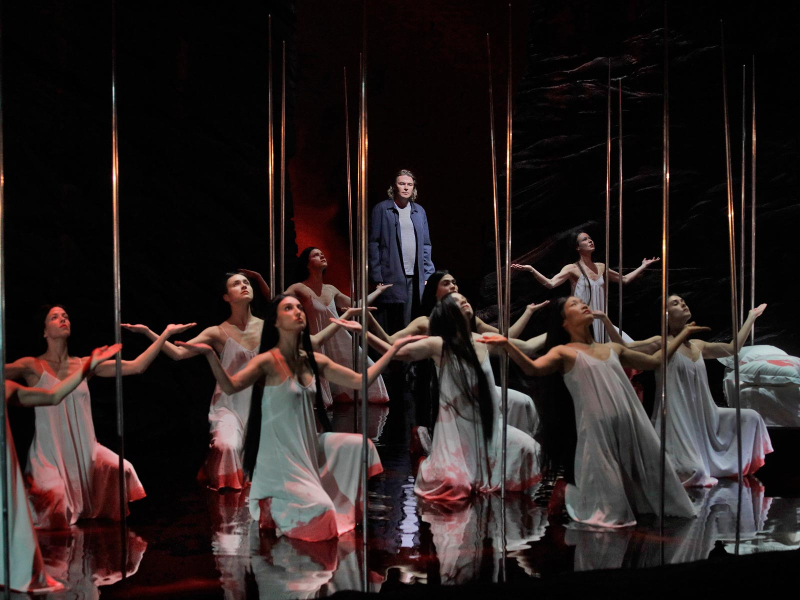
    Above: In Klingsor’s Magic Garden, tenor Klaus Florian Vogt as Parsifal; a Met Opera photo

    In 2006, Klaus Florian Vogt made an unforgettable Met debut as Lohengrin, and this afternoon as Parsifal the tenor again sang lyrically in a role that is normally sung by tenors of the more helden- type. The almost juvenile sound Vogt’s voice underscored Parsifal’s innocence; this worked especially well in Act I, and also  brought us some beautiful vocalism in Act II. As Kundry’s efforts to seduce become more urgent, Vogt’s singing took on a more passionate colour. In his struggle between steadfastness and capitulation, the tenor’s cry of “Erlöse, rette mich, aus schuldbefleckten Händen!” (‘Redeem me, rescue me from hands defiled by sin!’) pierced the heart with his dynamic mastery. 

    Kundry’s wiles fail her, and with an upraised hand, Parsifal fends off Klingsor’s spear-wielding assault. Seizing the weapon that wounded Amfortas, the young man cries out “Mit diesem Zeichen bann’ ich deinen Zauber!” (‘With this Sign I banish your magic!’); the bloody back-lighting dissolves to white and Klingsor is cast down. Turning to Kundry, Mr. Vogt’s Parsifal has the act’s final line of premonition: “Du weisst, wo du mich wiederfinden kannst!” (‘You know where you can find me again’) and he strides out into the world  to commence his long, labored journey back to the realm of the Grail. In the final act, Mr. Vogt’s expressive singing was a balm to the ear, lovingly supported by the conductor and orchestra.

    Parsifal

    Above: Rene Pape as Gurnemanz, in a Ken Howard/Met Opera photo

    Repeating the roles they created when this production premiered in 2013, Rene Pape (Gurnemanz) and Peter Mattei (Amfortas) were again superb. Mr. Pape now measures out his singing of this very long part more judiciously than he has in the past, at times allowing the orchestra to cover him rather than attempting to power thru. But in the long Act I monolog, “Titurel, der fromme Held…”, the basso’s tone flowed like honey; and later, at “Vor dem verwaisten Heiligtum, in brünst’gem Beten lag Amfortas...” (‘Before the looted sanctuary, Amfortas lay in fervent prayer’) Mr. Pape’s emotion-filled delivery struck at the heart of the matter. Throughout Act III, leading to the consecrational baptism of Parsifal, Mr. Pape was at his finest.

    Parsifal1213.40

    Peter Mattei’s Amfortas (in a Ken Howard/Met Opera photo above) is truly one of the great operatic interpretations I have ever experienced, for it is not only magnificently sung but acted with matchless physicality and commitment. The guilt and suffering Mr. Mattei conveys both with his voice and his body is almost unbearable to experience in its intensity and sense of reality.

    After a desperate show of resistance to calls for the Grail to be revealed in Act I, Amfortas – in abject anguish – performs the rite; his strength spent, he staggers offstage and as he does so, he locks eyes with Parsifal, the man who will succeed him as keeper of the Grail: one of the production’s most telling moments. And in the final act, Mr. Mattei throws himself into the open grave of his father, Titurel, as he begs for death to release him from his eternal suffering; this horrifies the assembled Grail knights. Such moments make for an unforgettable interpretation, yet in the end it’s the Mattei voice that sets his Amfortas in such a high echelon.

    P015nkzb

    Evgeny Nikitin’s Klingsor (above), creepy and thrilling in 2013, incredibly was even better in this revival. The voice was flung into the House with chilling command, and the bass-baritone’s physical domination of his bloody realm and his hapless female slaves was conveyed with grim authority. His demise was epic.
    Alfred Walker sang splendidly as the unseen Titurel, and I was very glad that he appeared onstage for the bows so I could bravo him for his wonderful outpourings of tone. Another offstage Voice, that of Karolina Pilou – who repeats the prophetic line “Durch Mitleid wissend…der reine Tor!” (‘Enlightened through compassion, the innocent fool…’) to end Act I – had beauty of tone, though the amplification was less successful here.

    The Squires ( Katherine Whyte, Sarah Larsen, Scott Scully, and Ian Koziara) were excellent, especially as they harmonized on the emblematic “Durch Mitleid wissend…” theme, and the Flowermaidens sounded lovely, led with ethereal vocal grace by Haeran Hong. Mark Schowalter and Richard Bernstein were capital Knights, and I must again mention Mr. Bernstein’s terrific voice and physical presence as a singer underutilized by the Met these days. His lines ths afternoon were few, yet always on the mark; and in Act III, helping to bear the shrouded body of his late lord Titurel to its grave, Mr. Bernstein seemed to carry the weight of the world on his shoulder.

    What gave the performance a deep personal dimension for me today was finding two dancers I have known for some time – David Gonsier and Nicole Corea – onstage in Acts I and II respectively. By focusing on them – Mr. Gonsier as a young Grail knight and Ms. Corea as a delicious Blumenmädchen – the ‘choreography’ given to these two groups became wonderfully clear and meaningful.

    I first spotted Mr. Gonsier seated in the circle of knights; my imagination was immediately seized by the rapture evident in his eyes. For long, long stretches of the first act, I could not tear my gaze away from him as his mastery of the reverential gestural language and the deep radiance of his facial expressions spoke truly of what it means to be a knight of the Holy Grail. Amazingly, out of all the men I might have zeroed in on among the brotherhood, Mr. Gonsier was the last of the knights to leave the stage as Act I drew to an end: he received a personal blessing from Gurnemanz and their eyes met ever-so-briefly. So deeply moving.

    Ms. Corea is beloved in the Gotham danceworld for her work with Lar Lubovitch; I ran into her on the Plaza before the performance today and she assured me I’d be seeing her this Spring at The Joyce as Mr. Lubovitch celebrates his 50th anniversary of making dances. Incredibly, within two seconds of the Act II curtain’s rise on the identically clad and be-wigged Flowermaidens standing in a pool of blood, I found Nicole right in my line of vision. Both in her compelling movement and her captivating face, Nicole became the icon of this band of bewitching beauties.

    Whilst hailing some of the unsung cast members of the afternoon, mention must be made of the two heroic supers who literally keep Amfortas alive and mobile, frequently taking the full weight of the ailing man as he struggles to fulfill his dreaded duties as Lord of the Grail. Great work, gentlemen!

    Much of the libretto of PARSIFAL‘s outer acts today seems like religious mumbo-jumbo. It’s the music – especially the ending of Act I – that most clearly speaks to us (and even to an old atheist like me) of the possibility of God’s existence. Perhaps He has simply given up on mankind, as His name – and his word – have been sullied in recent years by those very people who claim to revere him. Wagner may have foreseen all this, as he once wrote: “Where religion becomes artificial, it is reserved for Art to save the spirit of religion.”

    At the end of Act I of today’s PARSIFAL, I momentarily questioned my disbelief. But then the applause – which I’ve always hated to hear after such a spiritual scene – pulled me back to reality. I’d much rather have stayed there, in Montsalvat.

    Metropolitan Opera House
    Saturday February 17th, 2018 matinee

    PARSIFAL
    Richard Wagner

    Parsifal................Klaus Florian Vogt
    Kundry..................Evelyn Herlitzius
    Amfortas................Peter Mattei
    Gurnemanz...............René Pape
    Klingsor................Evgeny Nikitin
    Titurel.................Alfred Walker
    Voice...................Karolina Pilou
    First Esquire...........Katherine Whyte
    Second Esquire..........Sarah Larsen
    Third Esquire...........Scott Scully
    Fourth Esquire..........Ian Koziara
    First Knight............Mark Schowalter
    Second Knight...........Richard Bernstein
    Flower Maidens: Haeran Hong, Deanna Breiwick, Renée Tatum, Disella Lårusdóttir, Katherine Whyte, Augusta Caso

    Conductor...............Yannick Nézet-Séguin

    ~ Oberon