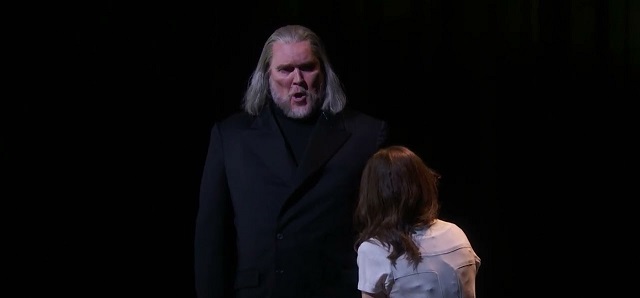
Above: Christine Goerke as Marie, Maestro Andris Nelsons on the podium, and baritone Bo Skovhus as Wozzeck; photo by Steve J Sherman, courtesy of Carnegie Hall
Click on each image to enlarge.
~ Author: Oberon
Tuesday March 15th, 2022 – The Boston Symphony Orchestra presenting a concert performance of Alban Berg’s WOZZECK at Carnegie Hall, conducted by the BSO’s Music Director, Andris Nelsons.
There were several elements that drew me to this performance: first, there’s the score itself, and the opportunity to hear the Bostonians play it – which they did with glistening power and spine-tingling subtlety – under Maestro Nelsons’ masterful baton. Then there was the intriguing cast, featuring two singers who were making return appearances in New York City after long absences: Bo Skovhus (Wozzeck) and Franz Hawlata (The Doctor). Last, but certainly far from least: Christine Goerke was singing Marie.
Above: Bo Skovhus as Wozzeck; photo by Steve J Sherman
Mr. Skovhus made a welcome return to the New York scene, scoring a great success tonight as Wozzeck. He debuted at the Met in 1998 and last appeared there in 2009. I didn’t see him at The Met, but I did hear him in recital at Tanglewood years ago. An intense singing-actor, Mr. Skovhus brought Berg’s tragic character to life thru his vivid declamation of the text and the surety of his singing. His swift downward spiral into complete madness was fascinating to behold…and to hear.
Above: Christine Goerke as Marie, with Linus Schafer Goulthorpe as her son; photo by Steve J Sherman
As Marie, Ms. Goerke developed the complex character persuasively, veering from maternal warmth to sex-mad sleaziness to deep guilt and remorse with complete naturalness of expression. Her singing was strong and incisive, with her unpredictable high range alternately effortful and blazing forth. Ms. Goerke was the only singer to use a score, either at a music stand or thru pages she carried with her. This was an unfortunate distraction to her otherwise compelling performance.
Above: Toby Spence as the Captain and Franz Hawlata as the Doctor; photo by Steve J Sherman
Franz Hawlata, whose Met career encompassed Baron Ochs, Sarastro, and Fasolt, was also heard there as the Doctor in WOZZECK in Hildegard Behrens’ final Met performances in 1999; Mr. Hawlata’s last sang at The Met in 2001. Tonight, some 20 years on, he sounded wonderfully authoritative, making the most of every word and note. As his sidekick, the Captain, tenor Toby Spence’s voice at first seemed too light-weight for the role; but he soon persuaded us otherwise with his creepy lyricism and pungent diction. In the opera’s penultimate scene, where the Doctor and the Captain are out for a stroll by the lake where Wozzeck has murdered Marie, Mssrs. Hawlata and Spence appeared at the foot of the stage; on hearing the death moans of the drowning Wozzeck, the two rushed up the aisle in terror.
Above: Renée Tatum as Margret, Linus Schafer Goulthorpe as the Child, and Christine Goerke as Marie; photo by Steve J Sherman
Renée Tatum made a deliciously dishy Margret, savouring her Swabia song. Christoper Ventris was a handsome, strong-toned Drum Major, swaggering and full of himself, and tenor Mauro Peter displayed a very pleasing Italianate voice as Andres.
As the two Apprentices, bass-baritone Zachary Altman and baritone David Kravitz, were scene-stealingly splendid and sang very well indeed. Alex Richardson sang the eerie lines of The Fool effectively, and boy-soprano Linus Schafer Goulthorpe was outstanding as the hapless young son of Wozzeck and Marie; his playmates in the final scene took their roles seriously, and with complete assurance, speaking their lines clearly.
The magnificent playing of the Boston Symphony Orchestra wove for us a spectacular sound tapestry; Maestro Nelsons brought out Berg’s myriad textures, and the orchestra’s wonderful principals made their solo opportunities glow.
I have been very fortunate in my WOZZECK experiences over the years, and tonight’s performance was truly rewarding.
Above: bass-baritone Tomasz Konieczny, who sang Jochanaan this evening; like on the image to enlarge
Saturday March 1st, 2014 evening – The Vienna State Opera have provided two evenings of opera-in-concert at Carnegie Hall this week: last night we had Alban Berg’s WOZZECK and tonight Richard Strauss’s SALOME was performed. The WOZZECK was very good; the SALOME was sensational, even though the soprano singing the title-role was far from ideal. But such is the epic, perverse magnificence of this music – especially played as it was tonight – that even an imperfect performance of the name character couldn’t deter from my great pleasure in having been there.
En route to Carnegie Hall, I asked my friend Dmitry which he preferred: SALOME, or ELEKTRA? The latter, he replied…and that’s my feeling also. But I have to say this performance almost persuaded me otherwise. ARIADNE AUF NAXOS and ELEKTRA have for years now been my top two favorite operas, with SALOME, FRAU OHNE SCHATTEN and ROSENKAVALIER just slightly further down the list. That’s a lot of Strauss!
For tonight’s performance the same unfortunate stage setting was used as for last night’s WOZZECK: the principal singers were ranged on high platforms at the far sides of the stage. Dmitry had paid a goodly sum for our tickets but I could barely see the protagonist as she sang; anyone seated to my left would not have seen her at all.
The Vienna Philharmonic gave an absolutely thrilling account of the music, with the animated conductor Andris Nelsons doing a superb job of illuminating all the multi-coloured layers of sound that Strauss so thrillingly developed in this huge, complex score. From the most ominous bass notes to the marvelous playing of the flutes and piccolo, the orchestra players were astonishing; a special bravo! to the percussionists, kept ever so busy all evening, and doing a first-rate job of it.
The soprano Gun-Brit Barkmin was totally unknown to me, having never heard her name let alone any sample of her singing. She began very lamely, the voice small and colourless and mostly covered by the orchestra. We sometimes hear of ‘baby-doll’ Salomes: lyrics who can linger in the high range but lack the sheer gutsy power to truly satisfy in the role; Lisa Della Casa was considered by some to be in this category when she tackled the role in 1961. Ms. Barkmin, having to deal with the thundering orchestra onstage rather than in a pit, sang on, unfazed. As the evening progressed, she began to make something of an effect in the upper-lying passages, and perhaps I had gotten accustomed to listening for her rather than having her voice sail out to me. In the end, I did not find her a complete disaster – but her outfit, a mid-East version of the Disney character Maleficent – was pretty absurd.
The theatrical brilliance of Gerhard Siegel and Jane Henschel – as well as their potent singing – brought the roles of Herod and Herodias to high prominence in this performance. Though dressed in concert garb, these two fabulous singing actors carried on as if in a fully-staged performance: their caustic bickering was a delight from the moment they came onstage. And Mr. Siegel nailed a blazing top note in his final phrase ordering the execution of Salome.
Carlos Osuna was a lyrical Narraboth and Ulrike Helzel looked slender and sang richly as a superlative Page. All of the smaller roles were ideally handled by a contingent of top-flight character singers.
Replacing Falk Struckmann as Jochanaan, the Polish bass-baritone Tomasz Koniecny was a revelation as Jochanaan. Mr. Konieczny has a voice of exceptional power which he unleashed with unflagging vitality, establishing the character as a vocal bulwark of godliness in a perverse and vulgar world. His thundering condemnations of Herodias sung from offstage built our anticipation for the great dialogue between Salome and the prophet.
Once onstage, Mr. Konieczny’s voice seemed to quadruple in amplitude; the louder Maestro Nelsons drove the orchestra, the more powerful the bass-baritone’s voice seemed to become. But the singer was also capable of deeply-felt lyricism, as in the great passage where he tells the princess: “Go seek Him. He is in a boat on the sea of Galilee, and He talketh with His disciples. Kneel down on the shore of the sea, and call unto Him by his name. When he cometh to thee, and to all who call on Him He cometh, bow thyself at His feet and ask of Him the remission of thy sins.” Mr. Konieczny was so incredibly persuasive here that I thought I might start going to church again. But Jochanaan’s gentle aspect swiftly vanishes as Salome continues to tell him of her lascivious desires for him. In a rage of towering indignation, Jochanaan hurls his final imprecation at her: “Du bist verflucht!” (“You are accursed!”) and here Mr. Konieczny unleashed a final note of staggering power which he then, as the orchestral tidal wave came crashing in, amazingly sustained with a phenomenal crescendo. As he made his exit, I sensed that the audience desperately wanted to burst into applause; of course it didn’t happen, but it should have.
Vienna State Opera
Vienna Philharmonic Orchestra Andris Nelsons, Conductor
Gun-Brit Barkmin, Soprano (Salome)
Tomasz Konieczny, Bass-Baritone (Jochanaan)
Gerhard A. Siegel, Tenor (Herodes)
Jane Henschel, Mezzo-Soprano (Herodias)
Carlos Osuna, Tenor (Narraboth)
Ulrike Helzel, Mezzo-Soprano (Page)
Norbert Ernst, Tenor (First Jew)
Michael Roider, Tenor (Second Jew)
James Kryshak, Tenor (Third Jew)
Thomas Ebenstein, Tenor (Fourth Jew)
Walter Fink, Bass (Fifth Jew)
Adam Plachetka, Bass-Baritone (First Nazarene)
Marcus Pelz, Bass (Second Nazarene)
Dan Paul Dumitrescu, Bass (First Soldier)
Il Hong, Bass (Second Soldier)
Jens Musger, Bass (A Cappadocian)
Gerhard Reiterer, Tenor (A Slave)
In passing I must note that Carnegie Hall is a physically uncomfortable venue. An article recently appeared condemning The Met for its lack of outer-lobby space; well, Carnegie is much worse, and before the gates open people are packed into the confining ‘foyer’ like sardines. Once inside and having scaled the heights to the balcony, one finds the auditorium staircases steep and uneven; and there is so little leg-room that – especially with a long ‘sit’ for something like SALOME or WOZZECK – muscle cramps are inevitable. Nevertheless it was worth it tonight just to hear such an orchestra, and to experience the great performances of Ms. Henschel and Mssers. Konieczny and Siegel.
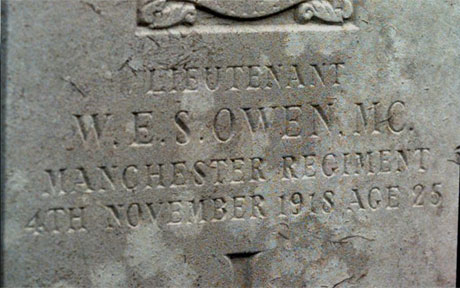
Sunday October 23, 2011 – As mankind continues to wage war upon itself, the poignant and often stark beauty of Benjamin Britten’s WAR REQUIEMstands as a reminder of the human side of the great conflicts between governments and religions. Britten dedicated his REQUIEM to the memory of four friends who died during World War II – three of them killed in action and a fourth who subsequently committed suicide. The composer considered the work as secular despite using passages from the Latin Mass for the Dead as part of his libretto; these spiritual texts are meshed with poetry by Wilfred Owen, a British soldier who perished in World War I, one week before the Armistice. His gravestone is shown above.
Britten sets the massive works for three soloists, chorus, boys choir, organ, full orchestra and chamber orchestra. This afternoon these elements combined in a performance of thrilling musical impact while the work itself hits like a sharp blow to both the mind and the spirit. After experiencing such a performance it is inconceivable that any thinking or feeling human being would ever again consider warfare as the solution to anything. But the people who need to hear and ponder this work would have neither the inclination nor the ability to understand it. This is perhaps the saddest commentary on mankind’s current state.
But, to the matter at hand: the three vocal soloists:
Ian Bostridge, known (and sometimes disparaged) for his highly individual interpretations of German lieder, was simply magnificent this afternoon. The tall and very slender tenor uses his entire body to project the music and text, unafraid of physical expression to convey the drama of the words. The voice, so clear and so eerily shaded with the colours of despair, regret or consolation, created phrase after phrase of miraculous beauty leaving the resonance of human thought expressed in song lingering on the air. His singing of what is perhaps the most singularly moving passage of the entire work “Move him into the sun“…was heart-rending; and his single utterance in Latin, ‘Dona nobis pacem‘, was the summation of all that the WAR REQUIEM seeks to tell us.
Baritone Simon Keenlyside was an ideal counter-point to Bostridge; Keenlyside’s singing – while brimming with subtle inflection – is more straight-forward in delivery, providing an Earthly contrast to the tenor’s other-worldly sound. The Keenlyside voice was in robust state, powerful and showing fine dynamic control. In one of the work’s most inspired passages, “And lo! an angel called him…” the combined artistry of Bostridge, Keenlyside and the LSO‘s harpist Bryn Lewis made for a spine-tingling aural experience. Later, when the two vocalists are cast as soldiers from opposing sides dying together in some dark, god-forsaken ditch, the entire fallacy of war comes to a head: they expire together as brothers, murmuring “Let’s sleep now…”
Slovenian soprano Sabina Cvilak‘s was a voice new to me. Her sound is a bit more lyrical than we sometimes hear in this music though she projected well from her perch near the back of the stage. A couple of high-lying entires at first were a trifle hesitant, as if the voice was not entirely ready to co-operate; but soon Ms. Cvilak was singing with radiant confidence. She was particularly impressive in the Sanctus where her voice mingled with Britten’s airy ensemble of bells and chimes. The soprano looked striking in a black silhouette gown.
Gianandrea Noseda led the London Symphony Orchestra and the massed choral forces in this deeply satisfying performance; a conductor with such elegant hands, Noseda seemed to summon the music up from very souls of his musicians. He crafted the great span of the work with an ardent feeling for both the overall architecture and for the individual moments where Britten illuminated the message of the work with unique instrumental colours. The LSO‘s playing, from earth-shattering fortes to moments of crystalline delicacy, was first-rate.
The two choruses – adult and boys choir – created the vibrant tapestries of sound which give the WAR REQUIEM its vocalized humanity. Singing the Latin texts, the voices seemed to be crying out to gods who can no longer hear, or who no longer care. In war, the Individual is sacrificed on the altar of some nationalistic collective “bawling its allegiance to the State”; in the REQUIEM the composer seems to juxtapose these great choral outpourings with the moving simplicity of expression of the individual voice. Although many of his works have a sacred context or source of inspiration, Britten himself largely withdrew from organized religion in the 1930s.
Aside from a single glaring intrusion by a cell-phone, the performance today was experienced in reverential silence. After a long and truly-deserved ovation at the end, audience filed out; it was an older crowd, people who would likely remember World War II and would surely recall Korea and Vietnam. It’s the younger generations who are now experiencing today’s wars – both declared and simmering – at a safe remove, who need to experience Britten’s timeless score and contemplate its message.
“Move him into the sun – Gently its touch awoke him once, At home, whispering of fields unsown. Always it woke him, even in France, Until this morning and this snow. If anything might rouse him now The kind old sun will know.
Think how it wakes the seeds, – Woke, once, the clays of a cold star. Are limbs, so dear-achieved, are sides, Full-nerved,- still warm,- too hard to stir? Was it for this the clay grew tall? – O what made fatuous sunbeams toil To break earth’s sleep at all?”
Above, Ben Bliss as Tamino with MET Orchestra flautist Chelsea Knox; a MET Opera photo
Click on images to enlarge.
(This production, which I had kind of been dreading, turned out to be fascinating.)
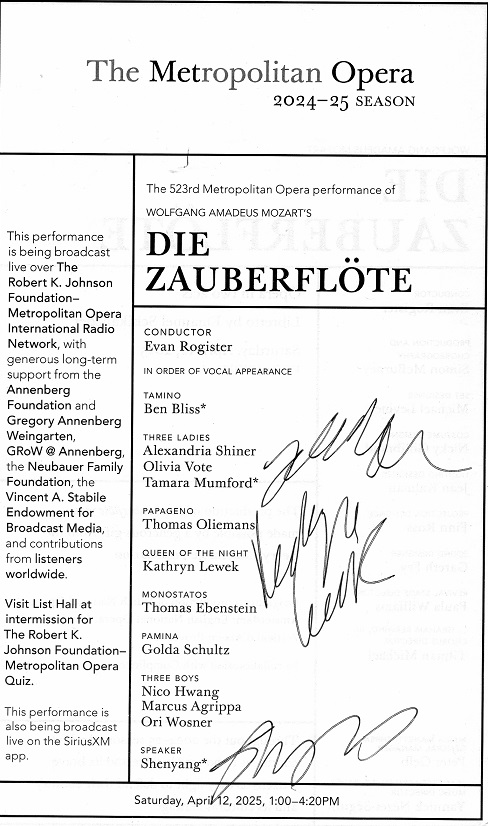
Saturday April 12th, 2025 matinee – I have been looking forward to this afternoon’s performance of the McBurney Zauberflöteat The Met ever since I saw parts of it back in 2023. I had not expected to be so taken with the production, and I was glad today to have an opportunity see all of it, and to hear some fine singing. I will admit that, in the second act, a sense of longuers sometimes crept over me, possibly a result of not sleeping well in the past few nights. I was rather surprised to see so many empty seats in the House today.
Evan Rogister, who has previously conducted the Taymor Zauberflöteand Fire Shut Up In My Bones at The Met, was on the podium. His pacing and control over orchestral volume were mostly spot on, but he did not really illuminate the score, as Nathalie Stutzmann had done when the production premiered. The overture seemed brass-heavy at times. Favorite parts in the score, such as the “Bei Männern” duet and the Chorus of the Priests – which are cut in the Taymor English-language production – are right where they are meant to be, and seemed especially welcome this afternoon. The Taymor also cuts a lot of the spoken dialogue, which today felt overly long.
There were several hold-overs from the 2023 cast, including Thomas Oliemans as Papageno, Kathryn Lewek as the Queen of the Night, Stephen Milling as Sarastro, Alexandra Shiner, Olivia Vote, and Tamara Mumford as the Three Ladies, and Richard Bernstein and Errin Dwayne Brooks doubling as Guards and Priests. New this season are the Pamina and Tamino (Golda Schultz and Ben Bliss), with Shenyang as the Speaker, Thomas Ebenstein as Monastatos, and Magdalena Kuzma as Papagena. The Three Genii today were Nico Hwang, Marcus Agrippa, and Ori Wosner.
On opposite sides of the stage, Foley artist Ruth Sullivan produced sound effects from her booth whilst Blake Haberman showed us the writing on the wall with his amusing drawings and titles. In this production, the singers have lots of very physical acting to do, whilst still managing to deliver some very appealing singing.
Ben Bliss (above), an outstanding Tamino, made his frantic entrance being pursued by serpents; he is saved by the (excellent) trio of Ladies – Alexandra Shiner, Olivia Vote, and the delicious Tamara Mumford – who then proceed to gang-rape him while he’s passed out. The Ladies are a well-balanced trio vocally, though I admit it was mostly on Ms. Mumford whose singing I focused upon. Ben Bliss revives, but spends the remainder of the scene in his underwear, meanwhile giving us a gorgeous ‘portrait’ aria.
Above, a man with his ladder: Thomas Oliemans as Papageno in a MET Opera photo
Meanwhile, Papageno – in the person of Thomas Oliemans – has made his entrance, toting a step ladder that he will lug around throughout much of the evening. His opening aria, hilariously staged, was interrupted for some theatrical by-play, only to resume with his flock of paper birds swarming about; even members of the orchestra participated here.
Now the Queen of the Night, Kathryn Lewek, appears: a disheveled queen, down on her luck and living with her minions in squalor. Decrepit and care-worn, she relies on a cane and her wheelchair to navigate the stage. Ms. Lewek delivered a spectacular recit & aria, “O zittre nicht“, the andante hauntingly phrased with shimmering piano notes etched in, and then bursting into the bravura ‘cabaletta‘, rising up to a sustained top-F.
A melodious quintet (Mlles. Shiner, Vote, and Mumford with Mssrs; Bliss and Oliemans) sends the men on their quest to rescue the Queen’s daughter, Pamina. We first meet the princess (lyrically sung by Golda Schultz) as she attempts to escape captivity, pursued by men with flashlights. Her guardian, Monastatos (played by Thomas Ebenstein, an excellent singer and actor) encounters Papageno, and they have a comic duet. The bird-catcher now meets Pamina, and they join in the sublime duet “Bei Männern” – sadly omitted in the English language/Taymor production.
The Genii, as guides, now appear: they are boys but appear elderly, limping about with canes. Tamino stands before a wall of huge books where his attempts to enter Sarastro’s temple are thwarted by cries of “zurück!!” from within.
Shenyang, as the Speaker (above, in a MET Opera photo), emerges from Sarastro’s domain, and my favorite scene in the opera commences. Shenyang, with his mellifluous bass-baritone timbre and finely-inflected diction, is a tall and noble onstage presence, always carrying a book with him. He tells Tamino what must happen in order for him to gain entry to Sarastro’s realm. Between his verbal subtlety and his powerful voice, Shenyang brings the character – often a cipher in other productions – vividly to life. As the opera moves forward, the Speaker has much speaking to do…long passages in which we can savor Shenyang’s expressive German diction. In later scenes, the towering bass-baritone carries with him an oil lamp with an open flame.
Left alone before the forbidden temple, Ben Bliss sings with ravishing clarity of Tamino’s pain at being thwarted in his quest. The words of the Speaker have turned Tamino’s world upside down: is Sarastro really evil? In this pensive mood, he turns to the magic flute for solace. Chelsea Knox, the Met’s luminous flautist, joins Ben onstage. The birds flock around them, enchanted by the sounds. Ben, such a persuasive singer, introduces a mini-cadenza whilst Ms. Knox’s fluting casts a spell.
Pamina and Papageno, attempting escape, rush in, pursued by Monastatos. The slave and his flunkies are enchanted by Papageno’s music box, played by Katelan Trần Terrell from the edge of the stage. The slaves break into a dance, with a contemporary accent tossed in.
Above, Stephen Milling as Sarastro; a MET Opera photo
Sarastro, in the towering person of the marvelous Danish basso Stephen Milling, now marches down the Met aisle with his acolytes and ascends to the stage to question Pamina. Golda Schultz offers an honest defense, bravely sung. Sarastro, with the Speaker ever near him, sets the rousing Act I finale on its way.
During the interval, the stage has been set with rows of chairs; here Sarastro’s loyal followers gather. Mr. Milling, standing at the orchestra railing, addresses them before taking the stage. A large conference table rises from the floor; Sarastro addresses the faithful using a microphone while the orchestra plays. Shenyang then speaks further, before Mr. Milling delivers one of Mozart’s greatest arias, “O Isis and Osiris” with a reverential tone which becomes even grander in the melody’s repeat.
Above, Ben Bliss as Tamino and Gilda Schultz as Pamina, with Stephen Milling as Sarastro looming in the background; a MET Opera photo
Pamina and Tamino are told of the trials they must endure; Mr. Milling joins Golda and Ben in a trio. Shenyang has lots of speaking to do.
The stage clears; Monastastos limps on, having been tortured for lying. Finding Pamina slumbering also, Mr. Ebenstein sings incisively of his plan to have her. But just as he is about to pounce, the Queen of the Night wheels in, banishes the wily slave, and orders her daughter to kill Sarastro. Kathryn Lewek commences the brilliant “Der Hölle Rache“, which is practically soprano’s theme song. The soprano gives us all the fiorature and top Fs with brilliance, then delivers the knockout punch with her sustained and powerful vow of vengeance, crushing Pamina’s feeble resistance with a top note of searing intensity. The audience erupted with applause and cheers.
Above: Kathryn Lewek as the Queen of the Night; a MET Opera photo
Sarastro’s anger with Monastatos causes the slave to become deranged; he will go over to the Queen of Night’s side. Mr. Milling then treats us to more beautiful bass singing with “In diesen heil’gen Hallen“; the opening verse perfect, the second even more so.
Shenyang greets Mssrs. Bliss and Oliemans as they prepare for their test. After the Speaker leaves, the men ignore a vow of silence, burstng briefly into “New York, New York!” The Genii arrive to sing an admonishing trio…
…and then Ms. Schultz (above, in a MET Opera photo) arrives but is grief-stricken by Tamino’s silence. Her plaintive aria, perhaps taken a bit to fast for maximum effect, was touchingly sung.
Mozart’s incredibly beautiful Chorus of the Priests – another omission in the Taymor/English version – was lovingly voiced. Tamino almost chickens out as he is led off for the tests of fire and water. Papageno/Oliemans stays behind for a long and chatty scene as he prepares his glass harmonica, amiably pissing in one to bring it to proper pitch. “Ein Mädchen oder Weibchen” is then delivered with many witty touches.
The bird-catcher now meets Papagena, played by Magdalena Kuzma, but their destined union is delayed. The Genii appear to console and encourage the despondent Pamina. Ms. Schultz will join her prince for the trials of fire and water, which are depicted by projections of a massive blaze (firemen arrive!) and later by the lovers floating in a pool.
Papageno’s suicide attempt is halted by the Genii, who tell the birdcather to put his magic music box to use again. It works!…and after their charming ‘Pa-pa-pa-pa‘ duet, the merry couple rush blithely up the Met aisle.
The Queen, her Ladies, and Monastatos are thwarted, and – as Sam Gamgee once said – “All’s well as ends better!” Sarastro heals the Queen and she joins in the opera’s joyous finale.
At a time when hatred runs rampant in the world, it was so meaningful today to experience this Mozart masterpiece wherein love triumphs.
After a rousing ovation, I went to the stage door to say hello to Tamara Mumford and Shenyang, both of whom I had met back in their days as MET Young Artists. They both look happy and healthy, and it was so nice to see them again after so many years. I also talked to Kathryn Lewek, a petite and friendly woman; when I asked if she would would sing Donizetti’s Lucia for us someday, her eyes lit up: “I would love to!!” (She does have Met engagements coming up in roles other than Mozart’s star-flaming queen, which she has sung here 80 times!)
(I brought this over from Oberon’s Grove…a really beautiful evening of music-making.)
Above: Evgeny Kissin and Renée Fleming at Carnegie Hall; photo by Chris Lee
Author: Oberon
Wednesday May 31st, 2023 – Renée Fleming and Evgeny Kissin in recital at Carnegie Hall. This was a very nostalgic evening for me, as my humble connection with Renée goes way back to the concert that introduced her to the world: the Met National Council Auditions winners concert of 1988: it was a heady afternoon, wherein three soon-to-be superstars – Renée, Susan Graham, and Ben Heppner – shared the stage with some other excellent singers who went on to fine careers. Renée’s singing won everyone’s attention with Micaela’s aria from CARMEN, and then brought the house down with her ravishing “Song to the Moon” from RUSALKA, which became sort of her theme song over time. It was clear from that moment on that Renée was headed for super-stardom.
Inn the ensuing years, I saw her many times at The Met; among her wide-ranging roles, Tatyana in EUGEN ONEGIN, Carlisle Floyd’s Susannah, and Desdemona in OTELLO were my favorites. While I was working at Tower Records, I met her a few times: a very down-earth, friendly woman.
Everyone knows about Renée’s remarkable voice teacher, Beverley Peck Johnson, and the enormous role that Mrs. J played in Renée’s career. With my friend, the late Japanese contralto Makiko Narumi, I spent a lovely afternoon having tea with Mrs. J; she was incredibly proud of Renée. When Mrs. J passed away in 2001 at the age of 96, Makiko brought me along to the memorial service. Renée sang Rachmaninoff, and she nearly broke down from emotion.
All of these memories were playing in my head as we waited for the concert at Carnegie Hall to begin tonight when I saw another of Mrs. J’s prize pupils, Anthony Dean Griffey, taking his seat. I ran down the aisle to greet him and meet his partner. This sent my emotional state into overload, recalling the thrilling performance of Carlisle Floyd’s SUSANNAH at The Met in 1999, with Renée, Tony, and Sam Ramey all on spectacular form.
Photo by Chris Lee
Then the house lights dimmed, and the packed Hall erupted with applause and cheers as Renée Fleming and her “accompanist” sans pareil, Evgeny Kissin, took the stage. Renée was wearing the most elegant gown I ever saw: a cinnnamon-rose frock with a back-button bodice and a regal train: a complete knockout.
Silence fell over the house, and then that voice stole into our hearts; it has always been a voice of unique warmth and colour: a sound of blessèd reassurance in a troubled world. I could only imagine Mrs. J looking down on us from the heavens, so pleased to hear that the voice she helped to mold is still in immaculate condition: finely-sustained breath, no wobble, no sagging pitch…just so distinctly and utterly Renée.
Photo by Chris Lee
Four Schubert songs opened the evening: Suleika, Die Vögel, Lied der Mignon and Rastlose Liebe. Mr. Kissin played the opening of Suleika with great delicacy, and then the Fleming voice began to work its magic, singing with an increasing sense of ecstasy before calming to a state of resignation. This is a voice that sits serenely in the venerable Hall, with an immediacy that is captivating. It brought back memories of hearing Victoria de los Angeles in this Hall many years ago: it’s as if she was singing just to me.
In Die Vögel (The Birds), we hear fluttering birds soaring above the jealous earthbound humans below. The Fleming voice sails over the pianist’s animated accompaniment. Lied der Mignon is a song full of longing; here Renée brought a haunting pianissimo atmosphere to the second verse, before a passionate outburst.
Written when Schubert was just 18, Rastlose Liebe (Restless Love) is the song of a tormented lover caught up in shifting emotions that veer from despair to unbounded joy. Ms. Fleming and Mr. Kissin gave it a wild and passionate performance.
Next, Mr. Kissin brought us two solo pieces by Franz Liszt: Sposalizio (Marriage) and the Valse oubliée, No. 1. The first is pensive, with a lovely softness and mystery that soon turns passionate. A simple melody returns us to a dreamy state, but uncertainty hovers before the music becomes poignant and – finally – grand. The ‘forgotten waltz’ is a virtuoso piece in which Mr. Kissin reveled; even an annoying cellphone could not deter the pianist: his playing speedy, yet always nuanced.
Renée (above, photo by Chris Lee) returned for three Liszt songs followed: Freudvoll und leidvoll, Über allen Gipfeln ist Ruh, and Im Rhein, im schönen Strome. Throughout this set, Mr. Kissin’s vast dynamic palette was deftly applied.
Written in a single day, Freudvoll und Leidvoll (Full of Joy, Full of Sorrow) is a song of extreme mood swings: between joy and sorrow, resignation and exultation. This is a song for all lovers, and Renée brought so many lovely vocal hues into play. Über allen Gipfeln ist Ruh (Over Every Mountaintop Lies Peace) is a hymn to nature and to peace, starting in a hushed tone, quietly supported by the piano. As the music develops, his became some of Renée’s most thrilling singing of the evening. Passion reigned in Im Rhein, im schönen Strome, the voice in full flourish and the pianist at his most epic.
Following the interval, the artists returned – Renée now in a golden gown, which brought forth a burst of applause – but then she left the stage; she seemed to have forgotten that Mr. Kissin was going to play a piano transcription of Rachmaninoff’s Lilacs to open the second half. Following that, the soprano returned and the program continued.
When I first heard Renée singing Rachmaninoff at the memorial service for Mrs. Johnson in 2001, it seemed to me that her voice was wonderfully suited to Russian music; this notion was amplified when she sang Tatyana at The Met, and it was re-affirmed tonight with two Rachmaninoff songs: Lilacs and A Dream.
When Sergei Rachmaninoff wrote Lilacs in April 1902, he was about to be married, and the song expresses his delight. It is a light-filled song which begins delicately and soon turns to a soaring melody. The accompaniment is a bit restrained yet passionate. Together, our artists used the dynamic shifts to evoke a blooming love.
In A Dream, Renée’s voice had a distinctive clarity, rising deliciously to the highest notes. Mr. Kissin was extraordinary here, especially in the song’s long postlude.
Mr. Kissin then offered two Rachmaninoff gems from Morceaux de fantaisie: “Mélodie in E Major” and “Sérénade in B-flat Minor”. These showed off many facets of the great pianist’s artistry, especially in terms of color and dynamics.
Ms. Fleming returned for two of my favorite Liszt songs: the delectable “S’il est un charmant gazon” and the ecstatic “Oh! Quand je dors“. The first of these was so persuasively sung, and then she went full goddess with the heavenly “Petrarch” song: ravishing sound, remarkable control…a sensuous delight.
The program concluded with Duparc: Extase, with its lovely piano introduction and wry turnabout in the first vocal phrase, was sublime; and the dramatic Le manoir de Rosemonde, with its rhythmic fluctuations, to me always has a tinge of the vampiric about it. Here, Renée yet again bewitched us.
Taking a bow: Evgeny Kissin and Renée Fleming; photo by Chris Lee
Despite a fervent full-house standing ovation, Renée sang a single encore, Schubert’s Ave Maria: sustained phrases, luminous tone, so deeply felt – like a benediction.
All photos by Chris Lee, courtesy of Carnegie Hall.
(A 2008 article about a new production of PETER GRIMES at the Met; Anthony Dean Griffey, a longtime friend of mine, enjoyed a special triumph.)
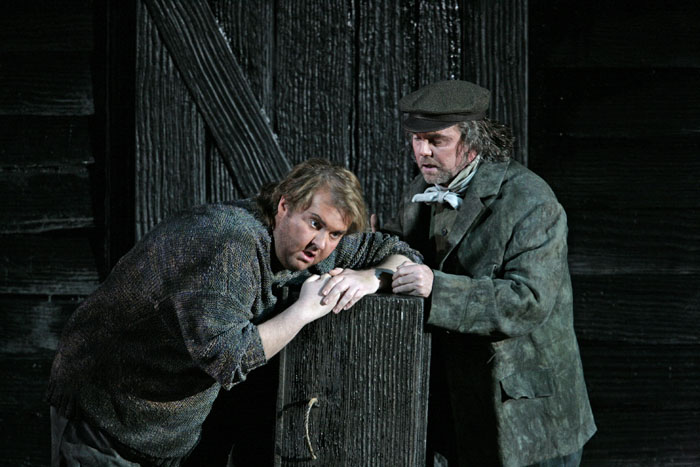
Above: Anthony Dean-Griffey as Grimes and Anthony Michaels-Moore as Balstrode; a MET Opera photo.
Monday March 3, 2008 – The Met’s new production of PETER GRIMES is a very uneven affair; I found myself tonight alternating between feeling keenly drawn into it and then being slightly bored. I thought it was musically more satisfying than visually; the orchestra played very well and the chorus excelled.
I’m not sure if the new production will gain many new admirers for the opera; GRIMES has never been ‘popular’ at the Met and it seems to get revived there more out of a sense of obligation than because of audience demand. Last night the house showed many empty seats on each level at the start and became emptier after each intermission. The unit set, based on the fishermen’s huts in this photo from Hastings, England, is meant to show us the claustrophobic atmosphere of the unpleasant community known as The Borough. The walls isolate and close in on Grimes as the community becomes more and more fearful and enraged. The upright, up-tight citizens, clad in black (the women all seem to be widows) have chosen Grimes as their focus of hatred because he is different. The drunkenness, drug addiction, prostitution and hypocrisy of several of the other townsfolk are simply overlooked because the drunks, addicts and prostitutes are ‘normal’ and Grimes isn’t.
Dramatically the new production is largely a stand-and-sing affair. The chorus just lines up in rows and belts out the music (very nicely!) while the characters stand or sit in front without creating any real tension or showing the dynamics of the relationships. The dark wooden wall which fills the stage is pierced by doors on various levels which open and close distractingly to let characters comment from above. The quartet for Ellen, Auntie and the Nieces which usually shows a nice cross-class female unity here finds each woman standing alone in a doorway and singing to the audience. The scene of the populace gathering in the inn during the violent storm was pretty effective thanks to the lighting which allowed light (and wind) to flash in whenever the door was opened.
A visual weakness from my point of view was that the sea is never seen; the whole story and the music with its thrilling orchestral interludes revolve around the sea – the source of livelihood for the townspeople…and Peter’s ultimate grave. Each act began with blue spotlights shining on the wall; Dmitry said, “There’s your sea!” The production does end with a visual coup as the walls move away exposing the stark white drop and the chorus, all in black but no longer in character, intone the final “To those who pass the Borough…” as a sort of benediction on themselves. The outcast has been cast out; light shines on the community; life goes on.
Is Grimes a murderer? A child molester? Has he really committed any crime or is he simply an unlucky, unloved fellow with rough manners and an inability to express himself? I’ve always thought that Grimes is an innocent victim of happenstance. But in this production Grimes does rough up the apprentice and the boy is clearly terrified of him; in other interpretations I have seen their relationship handled differently – Peter’s brusque treatment simply a way to help toughen the boy for the work to be done – an awkward way of reaching out – and even subtle signs of tenderness between them: that they might have gotten on well eventually and made a success of their work if the villagers had just left them alone. In the current staging, Peter loses something of our sympathy when he seems on the verge of strangling the boy.
The Met has put on a strong cast including Patricia Racette as Ellen Orford, Anthony Dean Griffey as Grimes and Anthony Michaels-Moore as Balstrode. Racette’s vibrato is getting to the point where it’s almost an impediment even though she can usually control it; a few phrases had an unpleasant edge but she managed to offset this with her sympathetic phrasing and use of dynamics.
Tony Griffey’s voice is more lyrical in scope than that of Jon Vickers or Philip Langridge. Once or twice, Tony seemed a bit pressed vocally, but then he would deliver something absolutely stunning in its expressive beauty. His eerie head-voice in the trance-like phrases of “Now the Great Bear and the Pleiades” and his haunting rendering of the final mad scene were splendid. His big, lumbering presence and his facial expressions – which indicated that he was not totally in touch with his surroundings – were assets in his characterization. The evening was a great personal success for him, and so well-merited.
Anthony Michaels-Moore was a magnificent Balstrode with his vocal warmth, unerring sense of dynamics and nuance and the clarity of his diction scoring in every phrase.
The last time I saw GRIMES, in the Met’s prior production, the character roles which make or break the opera were reduced to comically over-played caricatures. It seemed that the stage directors simply left the performers to their own devices, and the opera was seriously weakened. The people of the Borough are eccentric but they are not funny. In the present production we have a powerful group of singing actors, each of them making a vivid mark. Teddy Tahu Rhodes elevated the role of Ned Keene to star status. Rhodes, known for doffing his shirt – and more – in many productions, turns out to be much more than a singing PLAYGIRL centerfold. This guy has a grand-scale voice, rivetingly clear diction, and fantastic stage presence.
The inimitable Felicity Palmer was a fearsome busybody as the laudanum-addicted Mrs. Sedley and she sang with crusty authority. Greg Fedderly was a superb Bob Boles, his voice sailing out into the house with assurance and nailing the words – a potential Grimes himself? Dean Peterson not only sang powerfully as Hobson but played the ominous drumbeats with flair. Jill Grove reveled in the low-lying phrases of Auntie and her two pretty nieces – gowned in the only colours the production affords – were well played and voiced by Leah Partridge and Erin Morley. John Del Carlo’s big old licentious Mr. Swallow was grandly sung and Bernard Fitch’s pointed vocalism was another masterful contribution from this excellent character tenor. Logan William Erickson’s very natural acting as the Apprentice was moving; but why did his scream on falling down the cliff turn into a long whistle?
My friend Dmitry seemed displeased with Donald Runnicles on the podium; my only slight complaint was that a sense of the ethereal that can make certain high-lying phrases in the strings seem transporting was not quite there, and that at times Runnicles pushed the lyric voices of his cast a bit too hard. But the playing was superb, and the conductor won enthusiastic cheers from the house each time he entered the pit and also at the end.
(Meagan Miller, a soprano I met during her time at Juilliard, made an exciting Met debut in 2013 as the Empress in Strauss’s FRAU OHNE SCHATTEN.)
Above: soprano Meagan Miller, photographed by Christian Steiner; click on the image to enlarge.
Saturday evening November 16th, 2013 – Meagan Miller won the Met Auditions in 1999 and tonight she conquered both the audience and one of opera’s most difficult roles in her long-awaited Met debut (and role-debut) as the Empress in Richard Strauss’s DIE FRAU OHNE SCHATTEN.
Tonight’s performance surpassed overall the thoroughly satisfying season prima of this titanic opera; one can hardly blame conductor Vladimir Jurowski for occasionally succumbing to a desire to unleash the orchestra’s full force, even when he covered the singers. For the most part, Jurowski’s handling of the score was a marvel; the Met musicians were on peak form and the outstanding solo passages for cello and violin were played with poignant beauty by Jerry Grossman and David Chan respectively.
The production looks superb – it is one of the Met’s glories – and the large cast of singers threw themselves into the performance with unstinting generosity of voice and physicality.
The smaller roles, all of which are quite demanding, were very well taken and I took special delight in having a bird’s-eye view of the delicious Ashley Emerson as she and a quintet of other young women huddled into the far corner of the pit to sing the high-lying music of the Unborns. Once again the trio of David Won, Jeongcheol Cha and Brandon Cedel sang resonantly as the Nightwatchmen – their heartfelt ‘hymn’ closes the first act on a soulful note. Richard Paul Fink simply hurled the Spirit Messenger’s pronouncement’s into the House with venomous tone, and Maria Zifchak made her mark in the very brief solo passage of a Voice from Above.
Torsten Kerl held steady as the Emperor, one of the most brutally demanding tenor roles in the whole of operatic literature; Maestro Jurowski sometimes pushed the singer to extremes, but Mr. Kerl wisely refrained from shouting. His two arias – most particularly the riveting Act II monolog with cello solo – were very well crafted in terms of singing and dramatic expression. Johan Reuter’s Barak was sung with a lighter timbre than we sometimes hear in this music: the bass-baritone mined the music’s lyrical aspects with touching results and more than held his ground in the more stentorian passages. In the opera’s most haunting melody, Reuter sang ‘Mir anvertraut’ with spine-tingling warmth and tenderness.
As the Nurse, Ildiko Komlosi, who was something of a vocal cipher at the prima, came into her own tonight. After some parched sounds in the first scene, the mezzo got the voice in gear and delivered a subtle and keenly nuanced performance of this fiendish music. A mercurial actress, the slender and agile Ms. Komlosi held our focus whenever she was onstage. She managed the wide-ranging music with skill, applying her rather fluttery tone with canny dexterity and seizing comfortably on the role’s high notes and its many opportunities for verbal expression. Ms. Komlosi made a vivid impression tonight; the audience seemingly impressed by both her singing and acting.
Christine Goerke as the Dyer’s Wife was, if anything, even better than she had been at the prima, and that is saying a great deal. The role is vocally very congenial to the Goerke voice and her acting had a remarkably natural feel: she simply inhabited the persona of this bitchy but ultimately golden-hearted woman with every fiber of her voice and being. Her great success has opened The Met’s doors for her in no uncertain terms, and we can now look forward to experiencing her in some of opera’s most glorious roles.
From photographs and film, we know that Maria Jeritza, who created the role of the Empress at the premiere of FRAU, was a ravishingly beautiful woman. Meagan Miller matched Jeritza in this regard: her face and form are ideal for the role, and watching her was quite mesmerizing. But in the end it’s the voice that must count, and Ms. Miller had the power and vast range to give the music its due.
With an interesting quality of vibrant focus, Ms. Miller’s voice pings out into the large space with ease. Strauss makes unusual demands on the singer of the enigmatic Empress, including a high-D within moments of her first entry: Meagan Miller sustained this note for an extra miliisecond. From there, she sailed forward, leaping over one vocal hurdle after another like an Olympic champion. Deploying a glassy power which suits the cool character well, the entire first act went admirably; this was followed by a passionate rendering of the Nightmare Scene in Act II.
Faced with a choice between attaining her personal desire – the ability to bear children – and destroying the happiness of the kindly Barak, the character’s dilemma reaches its apex and its vocal pinnacle in the third act. Following the searing scene of dismissing her Nurse, Ms. Miller delivered a powerful performance of the Fountain Scene in which her inner conflict is voiced in mounting anxiety. The forces of her omni-present but unseen father Keikobad urge her to fulfill her feminine destiny while the despairing cries of Barak and his wife tug at her heart. In a stunning “Ich will nicht!” the Empress makes her choice, embracing her humanity. Throughout this long scene, Ms. Miller used her voice with exacting gradations of dynamic and with an expressive gleam of tone that easily filled the large hall, held in rapt silence by the power of the drama and by the singer’s radiant presence. The opera ends happily: the Empress and her husband are re-united and the Dyer and his wife will live happily ever after. Ms. Miller’s Met debut ended happily as well, with a sustained high-C to cap the opera’s final quartet and a very warm ovation at her solo bow.
(Imported from Oberon’s Grove: an excerpt from a much longer article about a performance of Strauss’s FRAU OHNE SCHATTEN at The Met on November 7, 2013.)
Tonight’s FRAU was a great personal triumph for Christine Goerke (above) as the Dyer’s Wife. This singer has now ventured into opera’s heaviest soprano roles – Ortrud, Elektra, the Brunnhildes – and she is an exciting exponent of this repertoire. The voice is vibrant and expressive, and she knew how to use it to maximum effect to sustain this demanding Strauss role from start to finish.
Power and subtlety were both Goerke’s to command, and while the fiery outbursts of this high-strung character (the role starts on a high B-flat) were delivered with total assurance, it was in the more reflective passages where Goerke showed that there’s more to the role than bitchy selfishness. In fact, the Dyer’s Wife’s transformation is actually more moving than that of the Empress; Goerke seemed to realize this and put a lot of colour and nuance into her vocalism, drawing on the more sympathetic aspects of the unhappy wife.
Ms. Goerke’s first illuminating passage came as she quietly tells Barak that, while they have been married for over three years, she has not become pregnant: in this scene, less than a minute long, the soprano touched on the rift between husband and wife with candid simplicity. Soon after, dazzled by the prospect of jewels and a handsome young lover that the Nurse has conjured up, Goerke sailed brilliantly into the magnificent “Welt in der Welt, traum im wachen!” (‘World within the world, o waking dream!’) with searing power.
Moving on to the character’s most vivid and powerful scene, at Act II’s hair-raising conclusion, the Dyer’s Wife reveals that she has nearly sold her shadow (“Barak! Ich has es nicht getan!”) but she has stopped short of the act, and – overcome by guilt – she begs her husband to kill her. Goerke whipped up tremendous excitement in this scene, both in terms of vocal generosity and emotional fervor. In Act III, the soprano reached yet another high point in the great duet ‘Mir anvertraut’; she and Johan Reuter sounded wonderful together and their joint melodic outpouring was nothing less than thrilling.
Christine Goerke’s solo bow at the end of the evening was very pleasing to behold – and to be a participant in the avalanche of cheers that greeted her was its own reward. She had given her all, and the audience repaid her with massive enthusiasm. I look forward to my second FRAU – which will feature Meagan Miller’s Met debut as the Empress – and to actually seeing the Goerke Farberin. Ms. Goerke, a soprano who once blew up a harpsichord on the stage of the State Theater, always delivers. And now may we ask for her Isolde, Elektra and Ortrud at The Met?
(This article first appeared on Oberon’s Grove in 2017.)
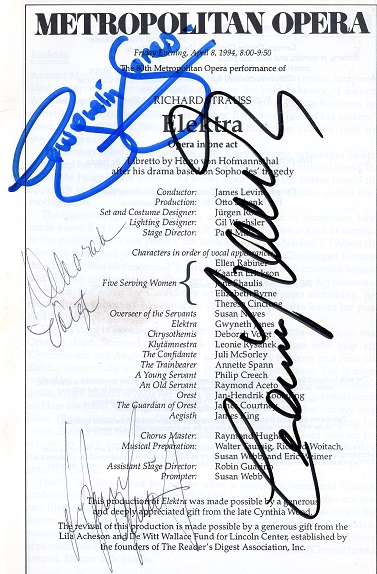
(Click on the above cast page for a better view!)
On April 8, 1994 I attended a performance of ELEKTRA at the Met. It somehow seemed to me to be the final vestige of the last golden age in that theatre which had continued from the mid-Bing years through the 1980s {with some decrease in splendour} to this night when two of the greatest divas I ever experienced shared the stage on an evening when the atmosphere in the house made me think back to they heyday of Nilsson, Corelli, Tebaldi, Tucker and Caballe. Dame Gwyneth Jones and Leonie Rysanek as Elektra and Klytamnestra reminded us of the rare emotional power great voices can generate. It was a night when the mammouth ovations of the past were recalled as the audience went into a delirium saluting the singers and Maestro James Levine.
This is what I wrote in my diary about an hour after the performance:
“…a magnificent evening, reminiscent of the kind of excitement we knew 25 years ago. The opera is almost unbearably beautiful and Levine and the orchestra were at full sail, alternating monstrous thunderbolts of sound with lyric passages of exquisite clarity. The set and lighting are ideal and I am happy to say that the stage direction has been altered so that now the Old Servant approaches and kneels before Orest, just before the recognition…
The cast, right down to the train-bearer and confidante (wonderfully coddling of Rysanek) were deeply involved and the vocalism had the scale and intensity needed at every point so that I was thoroughly involved in the drama at every moment. James Courtney, Philip Creech and Raymond Aceto gave strong portrayals in the vocally brief but important roles of the Guardian and the Young and Old Servants respectively. The maids were excellent: Shaulis was notable and Theresa Cincione a strongly sung 5th Maid. Susan Neves made a massive, big-voiced Overseer. James King repeated his matchless, blustering Aegisthus amd Jan-Hendrik Rootering was again the hulking, voicey Orest – a veritable tower as he finally held his sister in his arms.
The women were sensational: Deborah Voigt was really ‘on’ vocally, soaring over the orchestra with her rich, warm sound. She tries hard to be an actress but with the likes of Jones and Rysanek onstage she is outclassed histrionically. Vocally, she fully held her own which, in this company, is high praise.
Leonie Rysanek was just shattering as Klytamnestra; she eschewed the campy or grotesque elements some other singers have shown in their portrayals. Rysanek strives to hold onto her dignity right to the edge as Elektra seems to gain the upper hand. A whispered message from the confidante and the tables are turned: Rysanek reenters the palace as a Queen, momentarily triumphant as she heads to her doom. Rysanek has always lived her roles to the core and if anything she is more intense now than ever. The voice sounds astonishingly powerful, like she could go on for another ten years at least. Aside from the customary Rysanek power, there were ravishing piano passages supported to perfection by Levine. It was wonderful to see this beloved soprano – MY diva! – and it was a portrayal to cherish. Bravissima!
Dame Gwyneth Jones surpassed my very highest expectations as Elektra; I expected to be THRILLED but the vocal thrust, the house-filling power, the overflowing femininity and the sheer beauty of this woman made for an evening of endless magnificence. She looked incredible, very slender and wearing a long dark wig which set off the pale complexion and luminous eyes; one doesn’t think of Elektra as being a beauty, but tonight she truly was. Jones hurled out her first ‘Allein!’ and the house seemed to shudder at the sound of her voice. All night she just poured the tone out, very little in the way of wobble: just big, rich, glorious sound!
Levine would drive the orchestra to a frenzy and the trumpets would blaze out and then, coming over it all like strokes of lightning, the Jones voice would soar up to the heavens. Impossible to believe that anyone mortal could produce these glistening walls of sound. I cannot single out the most exciting moments of her portrayal because there was not a moment’s respite all night: the voice soaring, the actress unstinting in her physical response to the drama. The great scene with Rysanek was as fascinating to watch as to hear as the two great divas traded phrases, trumping one another. Who knows from what depths Dame Gwyneth summoned her astounding cry of ‘Orest!’ when it finally dawned on her exactly who this stranger was; she shuddered violently and seemed on the verge of collapse. And in the stillness which follows the unbearable intensity of the moment of recognition – as it sinks into Elektra that her brother is indeed there with her – Jones sang with such tender beauty as tears glistened on her cheeks…wondrous! Dame Gwyneth played Elektra bare-footed and her feet seemed to start the dance of their own free will. If I say that vocally she equaled her perfect first Met RING – one of my greatest memories – that says it all. There have been some big, thrilling voices at the Met over the years but I do think Dame Gwyneth is the all-time winner in terms of the sheer scope of delivery…magnificent!
Huge ovations, the divas and Levine were all cheered with great warmth. There were many bows and then they had to raise the drop curtain and there were many more. The ‘good old days’ came clearly to mind as the crowd gathered at the orchestra railing and there were frenzied screams into a state of hoarseness and the long-forgotten burning sensations in the hands as the celebration went on and on.
For the first time in years, a performance moved me to go to the stage door and attempt to express my gratitude to the singers. I met Rootering, Voigt (lovely eyes), Rysanek (so diminutive and full of life) and the gorgeous Dame Gwyneth. It was great to feel really involved again and fun hanging out with the fans, some of whom I remembered from a quarter-century ago. Among the latter was Z, the first boy I’d loved…and the first to break my heart. I had not seen him for over a decade. We shook hands as the memories flashed thru my mind.
Such a great evening – but a real ‘end of an era’ feeling also!”
(From a 2007 post on Oberon’s Grove about being a Beverly Sills fan.)
I can’t remember now exactly when it started but sometime during the Autumn season of 1969 at the New York City Opera, the Beverly Sills Snowstorm Crew was formed. It began as a spontaneous gesture: a group of her loyal young fans(myself among them) spent intermissions shredding programmes; then, and when she stepped before the curtain to bow at the end of the opera, we tossed enormous quantities of paper confetti from the front of the 5th Ring. We then raced to the stage door to see what effect our efforts had on our favorite soprano. Did she like it? “Yes, but Julius says I have to stay late and sweep it all up!”
For five or six years starting with her sensational Cleopatra in Handel’s GIULIO CESARE (1966) the Crew were among the demented vanguard of the enormous Sills fan club which eventually included everyone in the USA (even my mother) and most of the rest of the known world. Night after night our beloved nightingale came out and trilled and spun her way through everything from Queen of the Night to the HOFFMANN heroines. We could not get enough of her roulades and her spectacular forays in alt.
{In fact, I had seen Beverly before she became BEVERLY; she sang Rosalinda in FLEDERMAUS when NYCO toured to Syracuse a year before her big break. I remember her dazzling high notes and splendid bosom.}
Constanze, Donna Anna, Marguerite in FAUST, Manon…she drove us to distraction. In 1969 an ultra-complete LUCIA DI LAMMERMOOR was mounted for her in which not just the soprano but her male colleagues added fiorature and cadenzas to their vocal lines. On the opening night, Beverly had a 103 degree fever but sang anyway and took five solo bows after the Mad Scene while we buried her in our biggest snowstorm ever. During the run of performances she had fun slightly varying her ornaments on each night.
One special evening was her return to the title role of Douglas Moore’s BALLAD OF BABY DOE; it was a birthday present for her mother who wanted to hear her sing the role again. The Willow Song that night was beyond ravishing and in the midst of our snowstorm we launched a rousing chorus of ‘Happy Birthday Mrs. Silverman!” while Beverly beamed up at us from the stage.
“Close, but no cigar!” we used to joke with her after every show; and then once after the most magical St. Sulpice scene in Massenet’s MANON in which the Sills pianissimi seduced an entire theatre, we ran out at intermission and bought her a cheroot. After yet another huge curtain-call blizzard we rushed backstage to tell her for the hundredth time how much we loved her. She good-naturedly popped the cigar in her mouth while word trickled down the line of autograph seekers that Beverly’s crazy fans had surpassed themselves. However, I think our best effort came when we all went to the five & dime before a matinee and bought those small bottles of soap bubbles with the little plastic blowers inside. We perched outside the stage door and filled the air at what is now Jerome Robbins Place with millions of bubbles prompting the real Bubbles to cry, as she stepped out of her cab: “You bunch of nuts!”
In the days before e-mail and cellphones, we gathered at one Crewman’s apartment waiting for a trans-Atlantic phone call on the morning after Beverly’s La Scala debut in Rossini’s L’ASSEDIO DI CORINTO. We were furious when the caller read one review to us that referred to the Sills instrument as “una vocina” (“a little voice”) and were thrilled a few days later when the tapes arrived, full of some of the most remarkable singing we ever heard. Beverly sent me a letter saying how much she missed her snowstorms at Scala that she was getting plenty of roses.
She sometimes sent little postcards, or she jotted notes to me and sent them via friends. Now when I look at them, they remind me so much of that carefree time and of the heyday of the all-American diva. Like every other heyday, it was doomed to end and it did so sooner than I would ever have imagined.
By 1972 my diaries were beginning to be full of comments about the Sills tone becoming drier and more metallic. Her unstinting vocalism in the Donizetti Tudor trilogy took a heavy toll on her instrument in my view, though the results were exciting to be sure. Slowly, I began to feel that the edgy and increasingly unsupported quality of her singing and her tendency to flatten in mid-range were offsetting any joy I might derive from listening to her. Hearing her Met broadcast of L’ASSEDIO DI CORINTO was so painful for me, such a pallid and bitterly disappointing shadow of her Scala performance just a few years earlier.
To my mind there were several factors affecting her decline. Her success had come quite late in a long career; she was already forty when she made her splash as Cleopatra and had sung for two decades. When she hit the big time, NYC Opera cashed in on her success and she sang three or four nights a week for 5 or 6 years; on her off nights she would pop out to Boston or DC and sing concerts. She would get on TV with Carson or Cavett and gab away endlessly. All this put a lot of mileage on her cords. Her brutally self-abusive vocal approach to one of her greatest roles, Elisabetta in ROBERTO DEVEREUX, wore several layers of velvet off the tone each time she sang it. It was a sad time for her devoted fans.
In the years after her retirement, I sometimes found it quite amusing – in a sad way – when people cited various of Beverly’s post-prime performances as representative of her standards. Hardly any of her commercial recordings give a really satisfying idea of what she sounded like though some of them are OK. You really have to turn to things like her Scala debut or her phenomenal FILLE DU REGIMENT from Carnegie Hall on February 13, 1970 (both these performances are available on the Opera D’Oro label) to hear what it was that drove audiences to the brink.










 Oberon's Glade