Author: Philip Gardner

  • Gallant’s RETROGRADE UNIVERSE @ Danspace

    G

    Above: Loretta Thomas and the ensemble, photo by Melanie Futorian

    Thursday June 23rd, 2016 – The high-vaulted space of St Mark’s Church can become oppressively warm on a Summer evening, but it was worth this minor discomfort tonight as the engaging dancers of Catherine Gallant/DANCE and Dances by Isadora, under the artistic direction of Ms. Gallant, presented a program offering a wide-ranging musical experience, choreography both new and venerated, and dancing that unfailingly found the heart of each piece presented. The performance affirmed both the power and the poetry of the feminine spirit, seen tonight in its many aspects.

    L1730727

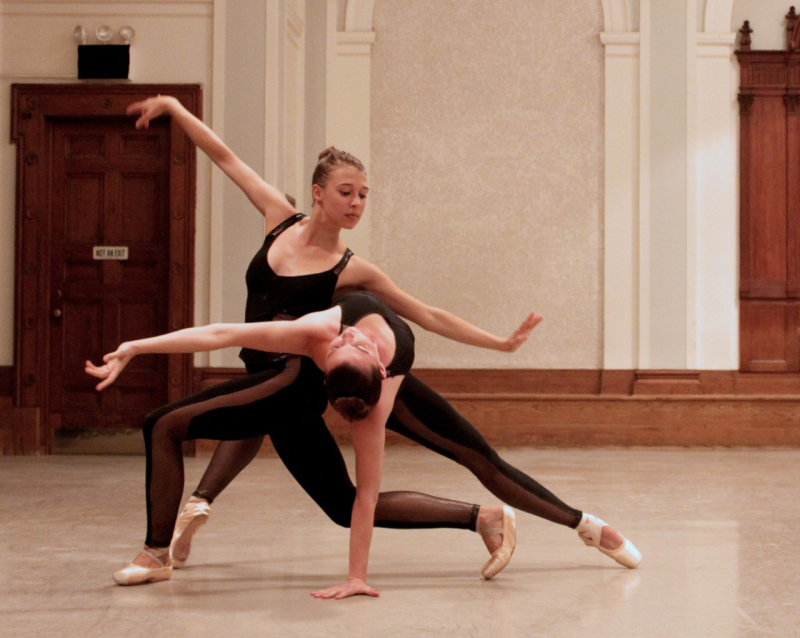
    Above: Janete Gondim and Eleanor Bunker rehearsing Catherine Gallant’s The Secret

    The evening could not have a had a more propitious start than Ms. Gallant’s The Secret; like white-clad angels, the two dancers – Janete Gondim and Eleanor Bunker – continually conveyed the sense of wonder which permeates this dancework like a delicious fragrance.

    With Ygor Shetsov at the piano, playing the Scriabin Poeme in F-sharp major, the two dancers moved about the space with a sort of quiet urgency, pausing to marvel at the treasure they had found, and which they were holding in the palms of their hands. The choreography flows gorgeously on the music: simple moves which take on a poetic resonance in the personalities of the two women; Janete and Eleanor were captivating to watch, and The Secret joins a short list of danceworks I’ve encountered in the past 20 years that ideally meld music, mood, and movement, leaving a lasting impression.

    C

    The premiere of Ms. Gallant’s Retrograde Universe (above, in Melanie Furotian’s photo) offered a fine contrast to The Secret. Alternating passages of silence with music of Steve Reich, this piece found excellent interpreters in Michelle Cohen, Megan Minturn, Erica Lessner, and Charlotte Henrickson. The girls periodically flung themselves to the floor, or burst into paroxysms of anxious movement, whilst at other moments they simply stand stock still, striking sculptural poses. Whimsical projections of newsprint and of an airplane whose pilot had clearly lost his sense of direction added a touch of mystery to the work, which seemed at times to be going on a bit too long, but which was kept on track by the energies of the four dancers.

    Finally, a Gallant work created in 2009, features a score by Rome prize-winning composer Lisa Bielawa. Using texts from Franz Kafka, the composer creates music of haunting sonic textures as performed by violinist/vocalist Christina Courtin. Loretta Thomas danced this solo tonight, swathed in a long black veil. Her body ‘spoke’ the music, expressing an almost desperate loneliness. Ms. Courtin, in addition to being an emotive violinist, has a voice – plaintive and clear – which makes a poignant effect. At the end, Ms. Thomas, an artist to her fingertips, walked slowly upstage as the lights faded.

    Pogoplug.com d

    Above: Alvaro Gonzalez and Michelle Cohen in Meeting #12; photo by Melanie Futorian

    A domestic drama, Meeting #12, opens with the dancers Michelle Cohen and Alvaro Gonzalez seated at a table. Much of this work is danced in silence, with interjections from Schubert’s E-flat major trio occasionally cropping up. The couple are enmeshed in a quarrel which becomes tempestuous, and the table and chairs eventually become part of the choreography. The beauteous Ms. Cohen and the scruffily handsome Mr. Gonzalez are ideally cast, and they make every moment of the work count. In the end, they find that actually conversing with one another may be the best solution. Projections of puffy clouds against a bright blue sky provide a visual counterpoint to the cramped kitchen in which the lovers have been arguing.

    The second half of the program was given over to works of Isadora Duncan.    

    Pogoplug.com e

    Above: from Valse Brillante, photo by Melanie Futorian

    Loretta Thomas has staged Isadora’s Valse Brillante (created c. 1910) for the Company, and it was danced this evening with lively grace by Jessie King, Amelia Sanders, Ella Lang, and Chanda Cragnotti. At the piano, Yegor Shetsov reveled in the ebb and flow of the Chopin Grande Valse Brillante.

    Three solos – each set to a Scriabin étudewere engrossing in their contrasting moods, and in the committed interpretations of the dancers.

    In Crossing, Scriabin-turbulence buffeted the hesitant anxiousness of Catherine Gallant, who danced with great physical devotion, mirroring the stormy music. The pain of loss and the thought of “nevermore” were movingly evoked by Loretta Thomas in her sorrowful performance of Mother, one of the Duncan works recalling the tragic death of Isadora’s two young children. Personifying feminine strength and the courage of resistance, Kristen Foote, a guest artist from the Limón Dance Company, gave a performance of radiant authority in Revolutionary. Mr. Shetsov played the three Scriabin études which accompany these solos with virtuosity and dramatic nuance.

    Catherine Gallant and Loretta Thomas have been working on the reconstruction of two movements of an untitled work – set to movements of the Beethoven 7th symphony – which Isadora performed as a solo between 1904 and 1909 on US and European tours.    

    L1730931

    Ms. Gallant (clad in white in the above rehearsal photo) danced the leading role tonight in her re-imagining of the symphony’s Allegretto, and Loretta Thomas has choreographed the Presto. Watching the Gallant dancers in this evening’s performance, we are reminded of the unique position held by Isadora Duncan in the history of dance, and of the continuing necessity of seeing her dances lovingly revived and maintained, so that new generations can both honor and enjoy her work, both for its historical value and its continuing resonance in modern times.

    Here are some Melanie Futorian images from the two Beethoven movements, the Presto of which closed tonight’s performance on a joyous note.

    Pogoplug.com b

    A

    Loretta Thomas (in white) and the ensemble

    Pogoplug.com h

    Pogoplug.com j

    Pogoplug.comf

  • Gallant’s RETROGRADE UNIVERSE @ Danspace

    G

    Above: Loretta Thomas and the ensemble, photo by Melanie Futorian

    Thursday June 23rd, 2016 – The high-vaulted space of St Mark’s Church can become oppressively warm on a Summer evening, but it was worth this minor discomfort tonight as the engaging dancers of Catherine Gallant/DANCE and Dances by Isadora, under the artistic direction of Ms. Gallant, presented a program offering a wide-ranging musical experience, choreography both new and venerated, and dancing that unfailingly found the heart of each piece presented. The performance affirmed both the power and the poetry of the feminine spirit, seen tonight in its many aspects.

    L1730727

    Above: Janete Gondim and Eleanor Bunker rehearsing Catherine Gallant’s The Secret

    The evening could not have a had a more propitious start than Ms. Gallant’s The Secret; like white-clad angels, the two dancers – Janete Gondim and Eleanor Bunker – continually conveyed the sense of wonder which permeates this dancework like a delicious fragrance.

    With Ygor Shetsov at the piano, playing the Scriabin Poeme in F-sharp major, the two dancers moved about the space with a sort of quiet urgency, pausing to marvel at the treasure they had found, and which they were holding in the palms of their hands. The choreography flows gorgeously on the music: simple moves which take on a poetic resonance in the personalities of the two women; Janete and Eleanor were captivating to watch, and The Secret joins a short list of danceworks I’ve encountered in the past 20 years that ideally meld music, mood, and movement, leaving a lasting impression.

    C

    The premiere of Ms. Gallant’s Retrograde Universe (above, in Melanie Furotian’s photo) offered a fine contrast to The Secret. Alternating passages of silence with music of Steve Reich, this piece found excellent interpreters in Michelle Cohen, Megan Minturn, Erica Lessner, and Charlotte Henrickson. The girls periodically flung themselves to the floor, or burst into paroxysms of anxious movement, whilst at other moments they simply stand stock still, striking sculptural poses. Whimsical projections of newsprint and of an airplane whose pilot had clearly lost his sense of direction added a touch of mystery to the work, which seemed at times to be going on a bit too long, but which was kept on track by the energies of the four dancers.

    Finally, a Gallant work created in 2009, features a score by Rome prize-winning composer Lisa Bielawa. Using texts from Franz Kafka, the composer creates music of haunting sonic textures as performed by violinist/vocalist Christina Courtin. Loretta Thomas danced this solo tonight, swathed in a long black veil. Her body ‘spoke’ the music, expressing an almost desperate loneliness. Ms. Courtin, in addition to being an emotive violinist, has a voice – plaintive and clear – which makes a poignant effect. At the end, Ms. Thomas, an artist to her fingertips, walked slowly upstage as the lights faded.

    Pogoplug.com d

    Above: Alvaro Gonzalez and Michelle Cohen in Meeting #12; photo by Melanie Futorian

    A domestic drama, Meeting #12, opens with the dancers Michelle Cohen and Alvaro Gonzalez seated at a table. Much of this work is danced in silence, with interjections from Schubert’s E-flat major trio occasionally cropping up. The couple are enmeshed in a quarrel which becomes tempestuous, and the table and chairs eventually become part of the choreography. The beauteous Ms. Cohen and the scruffily handsome Mr. Gonzalez are ideally cast, and they make every moment of the work count. In the end, they find that actually conversing with one another may be the best solution. Projections of puffy clouds against a bright blue sky provide a visual counterpoint to the cramped kitchen in which the lovers have been arguing.

    The second half of the program was given over to works of Isadora Duncan.    

    Pogoplug.com e

    Above: from Valse Brillante, photo by Melanie Futorian

    Loretta Thomas has staged Isadora’s Valse Brillante (created c. 1910) for the Company, and it was danced this evening with lively grace by Jessie King, Amelia Sanders, Ella Lang, and Chanda Cragnotti. At the piano, Yegor Shetsov reveled in the ebb and flow of the Chopin Grande Valse Brillante.

    Three solos – each set to a Scriabin étudewere engrossing in their contrasting moods, and in the committed interpretations of the dancers.

    In Crossing, Scriabin-turbulence buffeted the hesitant anxiousness of Catherine Gallant, who danced with great physical devotion, mirroring the stormy music. The pain of loss and the thought of “nevermore” were movingly evoked by Loretta Thomas in her sorrowful performance of Mother, one of the Duncan works recalling the tragic death of Isadora’s two young children. Personifying feminine strength and the courage of resistance, Kristen Foote, a guest artist from the Limón Dance Company, gave a performance of radiant authority in Revolutionary. Mr. Shetsov played the three Scriabin études which accompany these solos with virtuosity and dramatic nuance.

    Catherine Gallant and Loretta Thomas have been working on the reconstruction of two movements of an untitled work – set to movements of the Beethoven 7th symphony – which Isadora performed as a solo between 1904 and 1909 on US and European tours.    

    L1730931

    Ms. Gallant (clad in white in the above rehearsal photo) danced the leading role tonight in her re-imagining of the symphony’s Allegretto, and Loretta Thomas has choreographed the Presto. Watching the Gallant dancers in this evening’s performance, we are reminded of the unique position held by Isadora Duncan in the history of dance, and of the continuing necessity of seeing her dances lovingly revived and maintained, so that new generations can both honor and enjoy her work, both for its historical value and its continuing resonance in modern times.

    Here are some Melanie Futorian images from the two Beethoven movements, the Presto of which closed tonight’s performance on a joyous note.

    Pogoplug.com b

    A

    Loretta Thomas (in white) and the ensemble

    Pogoplug.com h

    Pogoplug.com j

    Pogoplug.comf

  • RIOULT @ The Joyce ~ June 2016

    Nyseason_885x518

    Wednesday June 22nd, 2016 – RIOULT at The Joyce, offering a very pleasing evening of dance from Pascal Rioult’s excellent troupe, with exceptional dancing from both established Company members and relative newcomers. The program was well-varied musically, and the evening was enhanced throughout by fine lighting and canny use of visual effects.

    Tchaikovsky’s Orchestral Suite #2 in C-major is the setting for Dream Suite which opened the program; this coloristic ballet – with gorgeously distinctive lighting by Jim French – is a visual treat. The inimitable Charis Haines is the Dreamer, and her dreams veer from lyrical to witty to mystical.

    Against a backdrop which shifts from pumpkin-coloured to vivid red, ten dancers move thru Charis’s dreamworld in quirky combinations, sometimes stopping to strike amusingly ironic poses. Masked characters appear: a bull, and ancient reptilian birds. Undercurrents of sexual fantasy are woven in and, as is often the case in dreams, things seem disjointed at times.

    The choreography overall is disarmingly simple – when the dancers simply form a circle, the effect is stunning – and Charis Haines excels in her solo passages. Colour – radiant and saturated – is everything. The striking image of a woman stretched out in a flat plank and borne aloft by her partner across the upstage space seems to signal a magical end to the ballet, but there’s another movement to come; that image, though, remains fixed in the memory.

    Selected Preludes and Fugues from Bach’s Well-Tempered Clavier (seemingly the Glenn Gould recordings, as there is much extraneous vocalism along the way) are the basis of Polymorphous, a stylized dancework which opened before a gridwork backdrop against neutral colours, with costumes of the same visual texture. Four dancers – Brian Flynn, Charis Haines, Jere Hunt, and Sara Elizabeth Seger – move in sync, almost like automatons. In two duets that follow, the first is accompanied by a ghostly negative-image film of the dancers projected above while during the second, multiple shadow images appear as echoes of the choreography.

    Duets, Sacred and Profane opened the evening’s second half; here we meet pairs of the RIOULT dancers in more personalized settings. In the first duet, from Kansas City Orfeo (1996), Sabatino A Verlezza as Orfeo attempts to revive his dead wife, Euridice (Catherine Cooch), to the appropriate music from the Gluck opera; this put me very much in mind of David Grenke’s powerful duet, Vespers.

    One of the Company’s newest members, Corinna Nicholson, made a really lovely impression dancing a duet from The Great Mass (2009) with Sara Elizabeth Seger. The girls wear gossamer ‘Baroque’ dresses, and they bring an air of courtliness to this charming piece.

    Two of RIOULT‘s most vivid dancers, Jere Hunt and Michael Spencer Phillips, were magnificent in a pas de deux from Te Deum (1995). To the music of Arvo Pärt, Michael – in a dark suit and white shirt – partners Jere, clad in black briefs, in an intimate duet. Though devoid of erotic overtones, the dance is both sensual and spiritual. Various imagined scenarios might be applied – two lovers, two brothers, a father and son, a guardian angel and his charge. Jere Hunt’s muscular physique speaks powerfully in its own right; a vein of poetic vulnerability which runs thru his work as a dancer gives his performances a deeply personal resonance. Michael’s handsomeness and the strength of his movement are captivating to behold: this is a dancer who can express both courage and tenderness. Together, the two men thrilled the audience.

    Something special needed to follow this male duet, and we found it the charismatic pairing of Charis Haines and Holt Walborn in a sublime Bach duet from Views of the Fleeting World (2008). Their expressiveness and their sense of the mutual devotion of this couple created a beautiful atmosphere.

    For a remarkable finale, Pascal Rioult’s unique setting of Ravel’s Bolero sparked an eruption of cheers from the mesmerized crowd at its end. Against a backdrop by Harry Feiner – a fanciful rendering of architecture à lespagnole – eight dancers perform endless repetitions of gestural motifs while periodically moving from one formation to another. Woven into these geometric configurations are illuminated solos which are luxuriantly slow and sometimes self-caressive. The dancers – Mlles. Cooch, Haines, Nicholson, and Seger with Mssrs. Flynn, Hunt, Phillips, and Verlezza – went thru their hypnotic paces with machine-like precision, whilst basking in the more voluptuous solo moments. Brilliant!

  • Laundresses

    Larger

    Laundresses, by Natalia Goncharova (1911)

  • Bronfman & Braunstein @ Zankel Hall

    Yefim-Bronfman

    Saturday June 18th, 2016 – Yefim Bronfman (above) concluding a Prokofiev piano sonata cycle at Zankel Hall this evening, playing the 5th and 9th sonatas. Violinist Guy Braunstein joined Mr. Bronfman for the two Prokofiev violin sonatas.

    After passing some days in a state of reclusive depression over the Orlando shootings, I ventured out tonight even though I was not really in the mood for it. But Bronfman is one of my most-admired musicians, and Prokofiev among my favorite composers, so I felt a strong desire to be there. Prokofiev’s music is not consoling, as a rule, though there are passages that reach to the soul, especially in the Andante of the second violin sonata, where Mr. Braunstein was at his finest this evening.

    Watching Yefim Bronfman perform is a particularly pleasing experience for me. He walks out, bows genially, sits down, and he and the keyboard become one. There are no frills, and no theatricality in his playing: it’s all about the music and his communing with it. Very brief pauses between movements keep the impetus of the music – and our delight in it – in true focus.

    Bronfman’s rendering of the 5th piano sonata was deeply satisfying, the audience engrossed as he immersed himself in the music’s ever-shifting melodic and rhythmic elements. This was exactly the ‘great escape’ from world-weariness I so desperately needed tonight. From its songful start, the opening Allegro tranquillo was a complete delight: the touches of dissonance adding spice, with wit, irony, and drama all having their say. A delicate march heralds the Andantino, with fetching trills, before things get darker and more emphatic, leading to a low-rumbling of a finish. By turns jaunty, lyrical, and pungent, the concluding Poco allegretto was polished off with Bronfman’s inimitable clarity and grace, the music seeming to vanish into a dream at the end.

    Hqdefault

    Above: Guy Braunstein

    Mr. Braunstein then joined the pianist for the violin sonata #1. Here the piano’s somber opening of the Andante assai gives way to a rather hesitant start for the violin, with some buzzing trills before things expand to a rather labored passage. Then the piano’s misterioso murmurs underpin the violin’s sliding scales. The emphatic start of the Allegro brusco drew some energetic foot stamping from Mr. Braunstein as the turbulence envelops us; and then suddenly his violin sings a lusty song. After re-grouping and re-energizing, the music turns more pensive – but only briefly: a riotous dance ensues, subsiding into lyricism before another dramatic surge.

    The Andante features a shimmering piano motif as the violin sings in the alto range; both instruments move to the higher spheres in a unison passage, which eventually goes very high indeed. Back to the alto colourings for more of the violin’s forlorn phrases. High and lilting, the piano signals the movement’s soft ending. A sprightly jig sets off the finale, calming eventually and leading to a delicate pizzicati paragraph. Some lively scrambling makes us think the end is nigh, but instead the violin’s mute goes on and rolling scales summon an impression of “the wind in a graveyard”; the sonata ends sadly.

    The performance drew an enthusiastic response from the sold-out house; a bit of iffy intonation from the violin in places mattered little in the end, since Braunstein’s mixture of poetry and vigor made the music so savorable. 

    Following the interval, Mr. Bronfman returned for the 9th piano sonata. The first movement starts gently, and continues amiably, though there’s an underlying restlessness. More expansive passages, and some low, rumbling scales lead to an eventual quiet finish. The second movement is scherzo-like, with rippling scales and a jogging rhythm; a pensive passage, more jogging, and another soft ending.

    The Andante tranquillo brought forth more Bronfman magic: a wistful melody, followed by a glittering brilliance that subsides to mystery and then to sadness. From deep rumblings, the music rises to a high melancholy. After a big start, the Allegro finale turns ironic; “shining” music gleams forth, surrendering to mirth, percolating on high, whispering a farewell. Here Bronfman’s virtuosity and subtle colorations were at their most alluring.

    To end the evening, Prokofiev’s second violin sonata, which had started life as a flute sonata, and which David Oistrakh had prevailed on the composer to re-cast for violin in 1943. This familiar work was played with a wonderful melding of the two instruments, the players so alert to one another and marking the beauty of the Andante with glowing sound. Traces of my earlier concerns about pitch in the violin line cropped up again, but my pianist-companion seemed to feel that the issue was minor, and so I let the energy and optimism of the Allegro con brio the finale carry me along…together with the rest of the crowd, who swept to their feet at the finish to salute the generous playing and the final expression of joie de vivre from the two players.

  • Bronfman & Braunstein @ Zankel Hall

    Yefim-Bronfman

    Saturday June 18th, 2016 – Yefim Bronfman (above) concluding a Prokofiev piano sonata cycle at Zankel Hall this evening, playing the 5th and 9th sonatas. Violinist Guy Braunstein joined Mr. Bronfman for the two Prokofiev violin sonatas.

    After passing some days in a state of reclusive depression over the Orlando shootings, I ventured out tonight even though I was not really in the mood for it. But Bronfman is one of my most-admired musicians, and Prokofiev among my favorite composers, so I felt a strong desire to be there. Prokofiev’s music is not consoling, as a rule, though there are passages that reach to the soul, especially in the Andante of the second violin sonata, where Mr. Braunstein was at his finest this evening.

    Watching Yefim Bronfman perform is a particularly pleasing experience for me. He walks out, bows genially, sits down, and he and the keyboard become one. There are no frills, and no theatricality in his playing: it’s all about the music and his communing with it. Very brief pauses between movements keep the impetus of the music – and our delight in it – in true focus.

    Bronfman’s rendering of the 5th piano sonata was deeply satisfying, the audience engrossed as he immersed himself in the music’s ever-shifting melodic and rhythmic elements. This was exactly the ‘great escape’ from world-weariness I so desperately needed tonight. From its songful start, the opening Allegro tranquillo was a complete delight: the touches of dissonance adding spice, with wit, irony, and drama all having their say. A delicate march heralds the Andantino, with fetching trills, before things get darker and more emphatic, leading to a low-rumbling of a finish. By turns jaunty, lyrical, and pungent, the concluding Poco allegretto was polished off with Bronfman’s inimitable clarity and grace, the music seeming to vanish into a dream at the end.

    Hqdefault

    Above: Guy Braunstein

    Mr. Braunstein then joined the pianist for the violin sonata #1. Here the piano’s somber opening of the Andante assai gives way to a rather hesitant start for the violin, with some buzzing trills before things expand to a rather labored passage. Then the piano’s misterioso murmurs underpin the violin’s sliding scales. The emphatic start of the Allegro brusco drew some energetic foot stamping from Mr. Braunstein as the turbulence envelops us; and then suddenly his violin sings a lusty song. After re-grouping and re-energizing, the music turns more pensive – but only briefly: a riotous dance ensues, subsiding into lyricism before another dramatic surge.

    The Andante features a shimmering piano motif as the violin sings in the alto range; both instruments move to the higher spheres in a unison passage, which eventually goes very high indeed. Back to the alto colourings for more of the violin’s forlorn phrases. High and lilting, the piano signals the movement’s soft ending. A sprightly jig sets off the finale, calming eventually and leading to a delicate pizzicati paragraph. Some lively scrambling makes us think the end is nigh, but instead the violin’s mute goes on and rolling scales summon an impression of “the wind in a graveyard”; the sonata ends sadly.

    The performance drew an enthusiastic response from the sold-out house; a bit of iffy intonation from the violin in places mattered little in the end, since Braunstein’s mixture of poetry and vigor made the music so savorable. 

    Following the interval, Mr. Bronfman returned for the 9th piano sonata. The first movement starts gently, and continues amiably, though there’s an underlying restlessness. More expansive passages, and some low, rumbling scales lead to an eventual quiet finish. The second movement is scherzo-like, with rippling scales and a jogging rhythm; a pensive passage, more jogging, and another soft ending.

    The Andante tranquillo brought forth more Bronfman magic: a wistful melody, followed by a glittering brilliance that subsides to mystery and then to sadness. From deep rumblings, the music rises to a high melancholy. After a big start, the Allegro finale turns ironic; “shining” music gleams forth, surrendering to mirth, percolating on high, whispering a farewell. Here Bronfman’s virtuosity and subtle colorations were at their most alluring.

    To end the evening, Prokofiev’s second violin sonata, which had started life as a flute sonata, and which David Oistrakh had prevailed on the composer to re-cast for violin in 1943. This familiar work was played with a wonderful melding of the two instruments, the players so alert to one another and marking the beauty of the Andante with glowing sound. Traces of my earlier concerns about pitch in the violin line cropped up again, but my pianist-companion seemed to feel that the issue was minor, and so I let the energy and optimism of the Allegro con brio the finale carry me along…together with the rest of the crowd, who swept to their feet at the finish to salute the generous playing and the final expression of joie de vivre from the two players.

  • A Quartet of Female Choreographers

    13407164_3092102065116_6567679795283993630_n

    Wednesday June 15th, 2016 – Works by four prominent contemporary female choreographers were on offer this evening at New York Live Arts. In a well-contrasted program, distinctive dancing and excellent lighting made each piece glow in its own unique way.

    One couldn’t ask for a more engrossing start to an evening of dance than that offered by Molissa Fenley and Company: a duet entitled THE THIRD COAST (Premiere), and MALI, a solo danced by Ms. Fenley. Evocative music by Ryuichi Sakamoto (duet) and Laetitia Sonami (solo), and splendid lighting by David Moodey, were attractive assets to these two works.

    In a violet world, dancers Christiana Axelsen and Rebecca Chaleff dance a stylized duet in-sync. Their moves and gestures imply a secret language. Dawn-light glows as the two continue to mirror one another. In a second, more animated section – to piano music – the lighting goes sea-green. The two dancers bring a compelling grace to the angular movement.

    This mysterious duet leads directly into the solo danced by Ms. Fenley: a captivating experience in every regard as the fusion of the soundscape – clattering, crunching, sloshing – the lighting, and the dancer’s mesmerizing movement held the theatre under a spell. Ms. Fenley’s arms and hands were so expressive, and her sense of commitment gave the work a gorgeous resonance.

    Elisa Monte’s DEXTRA DEI was originally set as men’s quartet: the choreographer’s 1989 response to the devastation of the AIDS epidemic. Ms. Monte has now expanded the work, adding four women to the cast.

    It is a work that is both somber and sexy, full of chiaroscuro effects created by the David Moodey lighting. To atmospheric music by Tibor Szemzo, four men roll onto the stage and form patterns of moving sculpture. The delectable Clymene Baugher rolls on from the opposite corner where she encounters Thomas Varvaro. Their intimate, floor-oriented duet ends in surrender and repose.

    Lithe and supremely feminine, Maria Ambrose appears and is manipulated aloft by the three remaining men; the music is ominous, with deep vocals and bird cries. JoVanna Parks and Shay Bland enter, jungle drums sound softly, reverberating in the rain forest mist. The men withdraw, the woman dance a quartet with fleeting solo passages: an exotic tribal rite of a restless sisterhood.

    The men reappear, repeating the movement motifs that initiated the ballet. Over a sustained note, partnerships form: stylized lifts and turns abound as pulsing music underscores the communal rituals. The work, perhaps just a trifle too long, showed off Monte’s dancers to perfection.

    Margo Sappington’s ENTWINED depicts the melding of bodies and spirits. At once sensual and magical, this on-pointe ballet is set to Erik Satie’s Gnossiennes. I was familiar with this work from having seen Jennie Somogyi and Charles Askegard perform the signature duet from it with Ballet Next in 2011.

    This evening I was particularly delighted to find Lily Di Piazza dancing in the ballet’s opening pas de trois; I remember Lily’s dancing from her SAB days. Ms. Sappington and I had a lovely chat before tonight’s show, and she told me she had originally made this role on Lily. 

    As mists roll by, Lily, Marjorie Fiering, and  Marlon Taylor-Wiles danced with effortless beauty, accenting the classicism of the vocabulary. Marlon’s impressive physique and his powerful charisma were a counterpoise to the elegant feminine allure of the two girls.

    Silken Kelly appears for a solo, danced in pools of light; the lyrical choreography was sublimely articulated by this radiant dancer. The exquisite Chrystyn Mariah Fentroy then joined Mr. Taylor-Wiles for the tender, languid pas de deux; performing with an intimacy which we are permitted to savor, the two dancers fused into a single spirit. The duet’s ensuing, more animated passage gave the dancers space-filling combinations and complex partnering elements.

    Earlier this week, I caught a studio run-thru of Jennifer Muller‘s newest creation, WORKING TITLE.  Consisting of four duets – into which interjections by other dancers sometimes occur – the dancing is accompanied live by Yut Chia and Shayne Lebron Acevedo, of Yut and the Hot Four. Ms. Muller told me that she heard Yut playing in the subway station, approached him, and asked if he’d be up for a collaboration. The result is WORKING TITLE, a dancework about relationships that mixes passionate music and dynamic dance. A row of chairs is the setting for the characters, who come and go throughout the ballet, sometimes observing those who are dancing, sometimes isolated, withdrawn, deep in thought.

    In the opening vignette, Alexandre Balmain pursues Michelle Tara Lynch, setting up a duet of passionate turmoil, superbly performed by this alluring pair of dancers. Ms. Lynch’s hair becomes an active participant in the dance as she sought to steer clear of the young Frenchman’s advances. Alexandre’s line, and his lavish extension, continually lure the eye. Elijah Laurant, Ms. Muller’s newest dancer, turns this duet into a trio: his place in the romantic triangle is a bit ambiguous: we can’t tell if he’s just a troublemaker or if there’s some attraction between him and Alexandre…or him and Michelle. This added dramatic aspect keeps things lively.

    Gen Hashimoto then tries to interest Shiho Tanaka. Who could say “no” to Gen? But Shiho does. Their duet becomes tempestuous: Shiho’s solo marks her desire to be left alone, while Gen covers the space with his trademark sexy, bad-boy bravura. As Shiho continues to resist, the music pounds out a big beat.

    Sonja Chung, Elise King, and Seiko Fujita takes seats to observe the denouement of Gen’s attempted seduction: he and Shiho carry on – to no avail – as the music turns bluesy. 

    Index

    Sonja Chung (above, in a Julie Lemberger photo), a phenomenal dancer and presence, meets her match in height and allure in Elise King. As the two tall women veer between attraction and avoidance, emotions well up and feelings are hurt. Seiko Fujita tries to intervene – again, we don’t know her motive – but Sonja and Elise leave things unsorted.

    Index2

    Suddenly, Elijah Laurant sweeps Seiko Fujita off her feet (Julie Lemberger photo above) as they go wild in a high-energy duet, ripe with power and passion. 

    All the dancers then take seats, to ponder their solitary desires. Gen has another vivid solo, as does Sonja, and then a bit more brilliance from Seiko. All seek resolution. Sonja and Elise move off together; Gen finally persuades Shiho of his sincerity. We can’t be quite sure of the Michelle-Alexandre-Elijah situation. Seiko walks forward alone as the lights dim.

  • The Lovers

    Couple-orlando_2

    “With drooping wings, ye cupids come
    and scatter roses on their tomb.
    Sweet and loving were their hearts…
    Keep here your watch, and never part.”

  • The Lovers

    Couple-orlando_2

    “With drooping wings, ye cupids come
    and scatter roses on their tomb.
    Sweet and loving were their hearts…
    Keep here your watch, and never part.”

  • At Catherine Gallant’s Rehearsal

    L1730590

    Saturday June 11th, 2016 – I stopped in at the Ailey Studios this afternoon where Catherine Gallant and her very attractive troupe of dancers were in rehearsal, preparing for their upcoming performances at Danspace (St. Mark’s Church, 131 East 10th Street. New York, NY). Performance dates are June 23rd – June 25th, 2016, and you can purchase tickets here.

    Retrograde Universe is the title of this world-premiere production presented by Catherine Gallant/DANCE and Dances by Isadora, led by Artistic Director and Choreographer Catherine Gallant. Retrograde Universe includes four pieces by Gallant and three Isadora Duncan works. From Isadora, we will have an historical re-animation of Duncan’s Beethoven No. 7, which has not been performed since 1979; Three Scriabin Etudes, danced by Kristen Foote of the Limón Company on opening night; and Valse Brillante. Gallant’s Retrograde UniverseFinally, The Secret and Meeting #12 will show the contemporary aspects of the Company. The performance will feature musicians Christina Courtin and Yegor Shevtsov, and a visual creation from Nadia Lesy.

    In observing these lovely women today – going about their work with such dedication and such beauty of movement and expression – one feels a direct connection both with the well-spring of modern dance and with the indomitable feminine spirit. Gallant’s company is a collective of generational diversity and highly individual personalities molded into a community by their shared devotion to dance. 

    Today’s rehearsal included detailed work on some of the pieces to be shown at Danspace as well as a run-thru of the program. The woman swiftly changed costumes between works, while speaking quietly to one another and sharing a feminine bond: the atmosphere serious, but also light of heart and spirit.

    Here are some images that I was able to capture in the studio; much of the dancing was simply too fast-paced for me to capture, but I think the distinctive personalities of this bountiful band of women show thru.

    L1730455

    L1730489

    L1730541

    Ella Lang

    L1730657

    Francesca Todesco in Isadora Duncan’s Mother

    L1730671

    L1730687

    Janete Gondim and Eleanor Bunker in Catherine Gallant’s The Secret

    L1730697

    Janete and Eleanor in The Secret

    L1730706

    Eleanor Bunker

    L1730721

    Janete and Eleanor in The Secret. I was particularly moved by this dancework, and look forward to writing more about it after seeing it in performance.

    L1730737

    Michelle Cohen in Retrograde Universe

    L1730746

    The ensemble in Retrograde Universe

    L1730753

    Michelle Cohen

    L1730775

    Loretta Thomas

    L1730766

    Loretta Thomas

    L1730801

    Catherine Gallant

    L1730825

    Loretta Thomas

    L1730834

    Loretta Thomas

    L1730886

    Michele Cohen, Janete Gondim, and Margherita Tisato

    L1730889

    Catherine Gallant

    L1730913

    L1730925

    L1730931

    L1730946

    Michelle Cohen

    L1730952

    Catherine Gallant, Michelle Cohen

    L1730956