(Rescued this from the soon-to-disappear Oberon’s Grove. And speaking of rescues, that’s what Lisette Oropesa did that evening: she flew in from Europe to replace an ailing Nadine Sierra.)
Above: Johannes Brahms
Author: Oberon
Thursday June 15th, 2023 – The Met Orchestra in concert at Carnegie Hall. The centerpiece of the evening was the Brahms REQUIEM, in which soloists Lisette Oropesa (stepping in for Nadine Sierra) and Quinn Kelsey joined the Met chorus and orchestra. This was preceded by the New York premiere of Oraison, by the Cuban composer Luis Ernesto Peña Laguna. Yannick Nézet-Séguin, the Met’s Music Director, was on the podium.
If anyone had told me a week ago that I’d be sitting in Carnegie Hall tonight, listening to one of the dearest friends I have ever had sing Brahms, I would have have rolled my eyes in disbelief. But on Sunday came a message from Madrid, and on Tuesday Lisette Oropesa was sitting opposite me at our old haunt, Pain Quotidien, where we spent endless hours – talking, laughing…and sometimes weeping – when she was a Met Young Artist.
I will never forget hearing Lisette’s voice for the first time: in a tiny role in Mozart’s IDOMENEO. I contacted her, met her, and we quickly became fast friends. She is a true kindred spirit, a radiant light in an often dismal world. It seemed inevitable from that first moment that her career would skyrocket; and it did, much to my delight. The only problem with that is that sometimes months pass without my seeing her. But it makes the times when we meet all the more special.
Above: composer Luis Ernesto Peña Laguna
As music goes, the evening’s highlight for me was the piece by Luis Ernesto Peña Laguna. Oraison is a work that moved me from note one: a gentle heartbeat from the timpani and very soft singing from the chorus (including whisperings) drew me in right away, as did sound of the inevitable word “Miserere” – something we are all in need of.
The women’s voices blend with the harp and a lovely flute/oboe/clarinet motif. Plucking celli and dense choral harmonies lend a pensive air, and then the male voices take over, and the music becomes more ominous. Trumpet calls summon a triumphant passage before the heartbeat timpani resumes. The choir by now is sounding simply celestial, but darkness hovers: with dolorous celli and the eternal timpani beat, the voices fade to whispers and – finally – to the sound of breathing.
The composer, a dapper gentlemen, rose in the audience to very warm applause. Now I will go in search of more of his music, whilst imagining what sort of opera or song cycle he could write for Ms. Oropesa.
Tonight was only my second ‘live‘ experience of the Brahms REQUIEM; over time, the music of Brahms has lost much of its appeal for me (aside from the Alto Rhapsody, of which I never tire) and while the REQUIEM abounds in sheer gorgeousness, I can’t connect to it emotionally on the same level as I do to the Verdi or Mozart settings, which transcend mere beauty and take us on a true spiritual journey. And so tonight, as this this flood of music washed over me, I became curiously bored.
While the score was marvelously played by the Met musicians and sung spectacularly by the Met chorus, Yannick Nézet-Séguin on the podium seemed to be doing everything he could to make the evening all about himself…to the extent of hiding the vocal soloists among the strings, just as he did to Pretty Yende when she sang the Mahler 4th for him. Maybe in time he will outgrow this need for drawing attention to himself; probably not in my lifetime, though.
Both Lisette and baritone Quinn Kelsey sounded wonderful in their solos, and the audience surely deserved the chance to enjoy their singing – and to actually see them! – under better circumstances. Even at the end, during a prolonged and tumultuous ovation, Yannick would not bring the singers forward for bows, which is the very least he could have done.
After several “curtain calls”, we went up to the greenroom, which has completely changed since the last time I was there – years ago, visiting Evelyn Lear and Martina Arroyo after a gala. Gone is the signature wallpaper; it’s much more spacious and relaxed. And so we fell into a very long conversation with Lisette, her mom, and a couple of other friends, whilst a lovely minder who had been assigned to the soprano kept watch over us but never made us feel rushed.
It was well after an hour since the concert had ended when we left via the stage door, only to find a crowd of fans who had patiently waited for Lisette. With typical generosity, she took time with every single person, and posed for endless photos, whilst her mom and I looked on proudly.
Sunday September 21st, 2025 matinee – My 2025-2026 opera/concert/dance season opened with a bang this afternoon at The Joyce, where the dancers and musicians of Indigenous Enterprise were giving their final performance of a week-long run. The packed house responded vociferously to each number, and the afternoon ended with a thunderous standing ovation and screams of delight from the audience as the participants took their bows.
When we moved up to Inwood in 2003, I began spending a lot of time in the beautiful park two blocks away. There I found a rock which marked the spot where a venerable tree had stood for decades. It was in the shade of this tree that the Dutch are thought to have purchased Manhattan from the Lenape Indians. The location of the transaction is often disputed, but in my romantic heart, I’ll stick with the idea. It’s clear that the native peoples hunted the forests of northern Manatus, and whenever I am hiking up the wooded path and under the Henry Hudson Bridge and down to the river, or gazing out at Spuyten Duyvil, I imagine I hear their hunting cries and bird calls. If it’s a dream, don’t want nobody to wake me.
So my fascination with that story, and with the beautiful day when Kokyat and I were out photographing and I discovered the discovered the poignant “We Are Still Here” poster (at the top of this article) stuck on a graffitti-covered wall, I have kept these timelessly beautiful people in my mind.
Today, at the Joyce, we learned a great deal about the various Native American dance-styles that were shown as the all-too-brief hour sped by: the Fancy Dance, the Jingle Dance, the Grass Dance, the Smoke Dance, and the Hoop Dance. The dancers were Desirae Redhouse, Dezi Tootoosis, Kenneth Shirley, Josiah Enriquez, Jamaal Jones, Manny Hawley, Logan Booth, Jackson Rollingthunder, as well as a young woman from the Seneca Nation – whose name I didn’t catch – who did a lovely, swirling Smoke Dance. Drummers on the soundtracks (drumming being the heartbeat of the native peoples) included the Northern Cree, Calling Eagle, The Descendants, Wild Band of Comanches (!), and Blazing Bear. Mind-boggling rhythms supported the cacophony of celebrant voices, and a trio of onstage musicians – Daisy Jopling (violin), Adrian Thomas (flute), and Tristan Field (guitar) – were excellent, though they could have played much more…in fact, the entire show seemed way too short: another half-hour would have been more than welcome. On top of all this, there were the magnificent, elaborate costumes.
Central to the production is an animated film: a touching story of a grandfather introducing his young grandson to the various styles of dancing whilst adding stories of his own youthful dancing days, and of courting the boy’s grandma. When the boy’s mom comes to pick up her son, she finds that her father his given the boy a drum of his own: this is how the old traditions are kept alive. Lovely as the animated story-telling film was, I think it could be even more touching made into a film with real, human actors.
Later, films are shown as the back-drop to a Grass Dance duet; on the screen, dancers from years long past suddenly fade out and vanish: a reminder of the spirit world that summons us all away in time. At the start of the perfomance, dance and drumming were spoken of as a way of evoking our ancestors. As the years speed ever onward, we want to keep such meaningful traditions alive, passing memories from generation to generation.
As with most dance productions, there is inevitably one performer who makes a particularly vivid impression: this afternoon, a stand-out in an outstanding gathering of artists was a Hoop Dancer named Josiah Enriquez (photo above). This 22-year-old has mastered the art of Hoop Dancing, and his solo near the end of the show, in which he managed six hoops with immaculate skill, brought down the house.
…why this blog seems so randomly organized , it’s because the job of moving articles from my original blog, Oberon’s Grove, to the current one – Oberon’s Glade – became more complicated than expected.
A friend helped me to roll several years of stories from the Grove onto the Glade, but in scrolling thru the results, I found many entries that I especially enjoyed writing had not made the trip.
Currently, I am doing a copy-and-paste project to save some of these ‘missing’ entries that have special meaning for me. I only have a few more days remaining before the Grove disappears.
Meanwhile, the 2025-2026 opera/concert/dance season has started and my first review of the current season will be posted shortly. And then, on September 27th, I have my first opera of the season at The Met. After that, things should resume the usual chronological format.
(Still transferring individual articles from Oberon’s Grove to the Glade. There’s only a few more days before the Grove will shut down.)
January 13th and 14th, 2024 matinees – Back-to-back Puccini matinees at The Met: Saturday was the classic Zeffirelli BOHEME, and Sunday was the Minghella BUTTERFLY.
NOTE: the production photos in this article are by Ken Howard/MET Opera. Click on the individual images to enlarge.
The BOHEME, which played to a packed House, was overall a satisfying performance, though it could have been so much more with an inspired conductor. Marco Armiliato fits in well with the current Met trend for “loud and fast”; he managed, at various points, to nearly drown out even such hefty voices as Adam Plachetka’s and Krzysztof Bączyk’s, whilst the lighter voices in the cast were left to fend for themselves. Loud, punctuating brass accents seem to be the stock in trade of most of the Met’s conductors these days. I guess they think this makes the operas more exciting.
At any rate, the BOHEME was strongly cast, down to the clear-toned Parpignol of Gregory Warren and the hearty Benoit/Alcindoro of veteran baritone Donald Maxwell. Kristina Mkhitaryan had a success with Musetta’s Waltz, and capped the ensuing ensemble with a Met-sized top B. She also made something of the character’s kindness as she prayed for her friend Mimi in the opera’s final moments.
The quartet of Bohemians were vocally distinctive, having fun with their scenes of camaraderie but also showing the necessary vocal appeal when Puccini hands them melodies to sing. Rodion Pogossov’s darkish timbre made the most of all of Schaunard’s music: odd that the composer does not give the musician in the story an aria of his own. But Mr. Pogossov managed to turn his Act I narrative into something of vocal importance…and he was warmly cheered at his curtain call. The impressive Polish basso Krzysztof Bączyk was an outstanding Colline; his ‘Coat Aria’ was poetically sung…and very moving.
Adam Plachetka’s Marcello was another winning role for the tall and lovable Czech singer; he has become a Met favorite…one who gains new fans whenever he sings. The voice today was ample, warm, and congenial, billowing forth in the ensemble ‘encore’ of Musetta’s waltz tune in Act II, and making his scene with Mimi in Act III a vocal highlight of the day.
Stephen Costello’s Rodolfo ranks with the finest I have heard. Poetry pervades everything that Stephen sings: his Italian diction and sense of the flow of the words were a joy to experience all afternoon. He never throws a line away. Example: his hauntingly quiet observation “Che viso d’amalata…” as he tries to revive the fainted Mimi in Act I casts a long shadow over events to come.
Stephen’s “Che gelida manina” was magical; so ardent and so ideally phrased and coloured. When Armiliato encroached on the dreamy atmosphere the tenor had established, Stephen stuck to his guns. His top-C was spine-tingling, and what a gorgeous pianissimo finish with “Vi piaccia dir!” The love duet was superb, capped by a sustained and steady joint top-C with Ms. Stikhina.
Mr. Costello continued to make every phrase of his role memorable; his singing as he introduced Mimi to his comrades at the Cafe Momus was filled with shining pride, and as he struggled in Act III to tell Marcello why he wanted to leave Mimi, his despair was palpable. The Act IV duet for tenor and baritone was gorgeously sung, though here again the conducting was lacklustre.
Stephen Costello was apparently celebrating his 100th Met performance this afternoon, and at his solo bow he was pelted with carnations: a fitting finish to his luminous performance.
Above: Elena Stikhina
Ms. Stikhina was for me the unknown quantity in the afternoon’s performance, and I am happy to say that it only took a line or two for me to be seduced by the unusual chiaroscuro qualities of her voice – a voice that speaks well in the big House. Her “Mi chiamano Mimi“ was full of enticing colours, with a sense of rapture at “...ma quando vien lo sgelo…” that was delightful to hear. Mr. Costello launched the love duet “O soave fanciulla...” fervently, and then the soprano came in big: a spinto outpouring. Their joint high-C pleased the audience with its clarity…and duration.
The soprano’s melodious singing filled each of Mimi’s lines in the Momus scene, and then she and Mr. Plachetka sang richly in their great duet at the Barrière d’Enfer. Ms. Stikhina’s ‘Addio‘ was tenderly sung, using a nice mix of dynamics; the act’s concluding quartet was spoilt somewhat by the over-playing of the orchestra.
Ms. Stikhina’s simple, touching “Sono andante” in the final scene progressed to the tragic expression of her eternal love for Rodolfo; and her soft, sighing repeat of “Che gelida manina” made a poignant end to this sad love story.
BOHEME is one of the two remaining Met productions where the curtain calls are taken before the once-iconic Great Gold Curtain.
The soprano won a vociferous ovation at her solo bow; I went to the stage door, specifically to meet Ms. Stikhina…and she’s a lovely lady…and very kind.
The next day, I was back for the BUTTERFLY; this time, my score desk was on the ‘even’ side of the House. The first several minutes of the performance were spoilt by people up in my area stumbling around in the darkness, trying to find their seats. It wasn’t until the arrival of Sharpless that everyone had settled in.
Later, there was one charming moment when a lone stagehand came out during the intermission to vacuum up the cherry blossoms that were strewn onstage during the love duet, winning a round of applause when the job was done.
Derrick Inouye was on the podium this afternoon, for the most part keeping the orchestral volume level under control; the multi-hued beauty of Puccini’s orchestration could be savoured whilst the voices emerged clearly. There were a few bloopers from the players, most likely due to mid-season fatigue.
The cast was uniformly fine, down to the fleeting but essential roles of the Commissioner (Christopher Job), the Registrar (Christian Jeong), and Kate Pinkerton (Edyta Kulzak); Robert Pomakov was a strong-voiced Bonze, and Jeongcheol Cha an impressive Yamadori. Tony Stevenson was the excellent, voicey Goro.
Baritone Davide Luciano as Sharpless (above, in the letter scene with Ms. Kurzak) deployed his resonant, darkly handsome voice to superb effect as the kind-hearted US Consul, whose prophetic lines in Act I go unheeded. What a great pleasure to hear this singer’s opulent voicing of the role in his native tongue, making the character’s music essential.
Knowing the despair that will ensue when he brings Pinkerton and his American wife to Butterfly’s refuge, Mr. Luciano caught all the drama of the situation with his attempts to iron things out, but to no avail. He upbraids Pinkerton, who rushes away, leaving the Consul to deal with the consequences. Mr. Luciano’s thoughtful portrayal and bountiful voice won a volley of bravos when he took his bow at the end.
Elizabeth DeShong (above, with Ms. Kurzak) as the faithful Suzuki sang splendidly Her large, rich voice easily covers the range from a strong top to a glorious chest voice, so that every note and phrase of Suzuki’s role became something to cherish. Her harmonizing in the Flower Duet was simply gorgeous. Then, as fate closes in on her mistress, everything Suzuki says and does becomes essential to the drama: she immediately grasps who Kate Pinkerton is and knows in a flash how things will turn out, as her deeply felt “Che giova?” tells us.
Ms. DeShong joined Matthew Polenzani and Davide Luciano in making their trio a highlight of the afternoon: they simply poured their hearts into the music. But Ms. DeShong still had more heartache to sing of: her “Piangeròtanto…tanto!” is devastating, and her very last desperate line – “Resto con voi!” – is cruelly dismissed by Butterfly, who is summoning the steely resolve to end her own life. Ms. DeShong was magnificent, and she rightly drew a fervent reaction from the crowd at her bow.
Matthew Polenzani (above, with Ms. Kurzak in a Ken Howard/MET Opera photo) today sang what might be considered opera’s most thankless leading role: Benjamin Franklin Pinkerton. No matter how well you sing it, the audience is going to hold your cruelty to Butterfly against you; sure enough, after Mr. Luciano and Ms. DeShong had basked in a sea of acclaim during the curtain calls, the decibel level decreased noticeably when Mr. Polenzani appeared for his bow. But this was in no way a reflection on his performance.
He had sung very well indeed, bringing a perfect blend of tenderness and passion to his vocalism. The topmost notes sailed out over the orchestra, but as he started “Addio, fiorito asil” a hushed and anguished tinge of regret seeped into his tone. So expressive. Earlier, in the opera’s 20-minutes of ecstasy – the Act I Love Duet – Mr. Polenzani and Ms. Kurzak found a beautiful blend of timbres, whilst the poetry of romance flowed sweetly from their lips. Butterfly’s fears are overcome by the ardent, urgent words her beloved sings to her.
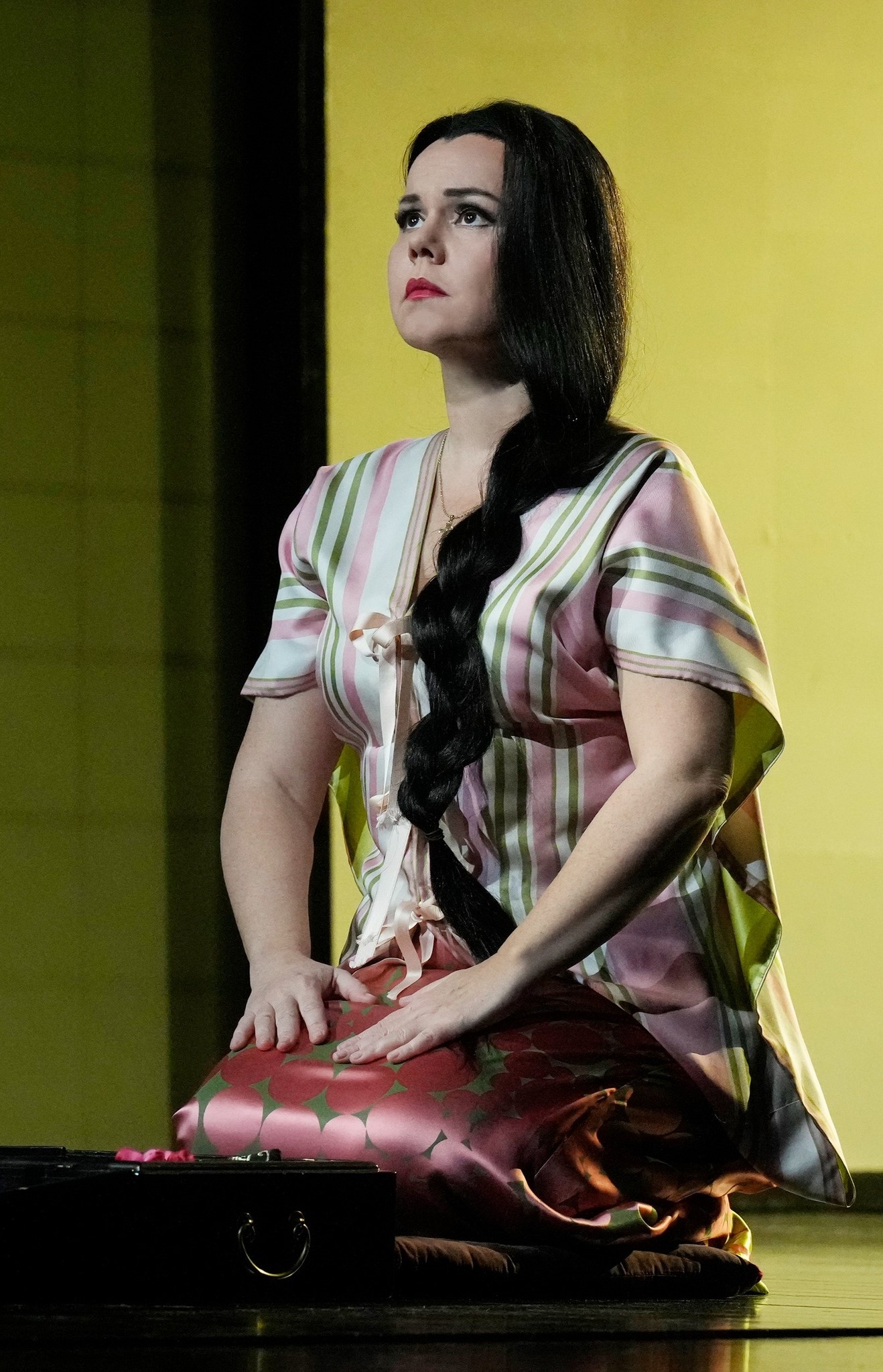
Aleksandra Kurzak (above) impressed me with her Tosca at The Met in 2022; she really made something of the role vocally, despite being constantly harassed volume-wise by another Met routinier, Carlo Rizzi. For her Butterfly today, Ms. Kurzak was in the far more capable hands of Maestro Inouye.
The Kurzak Butterfly caused quite a stir at the Met prima earlier in January, and from note one she seemed to have the ideal blend of vocal weightiness and spun-out legato delicacy to create one of the most memorable Butterflies in my long history with the opera.
Clarity of tone in phrase after sublime phrase made her entrance aria the enthralling experience it should be: “I am come at the call of love!“…what could be more operatic than that? As the act progressed, traces of sharpness sometimes cropped up, but by the Love Duet all was not merely well, but thrilling.
Above: Ms. Kurzak as Butterfly
The soprano’s inspired phrasing of ‘Un bel di’ was captivating, the tone lovingly shaded as she sang of the long-awaited return of her husband. She ended the aria with a stunningly sustained final note, eliciting a burst of bravas. As Act II continued with the consul’s arrival and with a visit from the hopelessly-smitten Prince Yamadori, Ms. Kurzak made girlish, coy replies. But the moment that Sharpless suggests she should consider the Prince’s offer, a dark pall descends.
Now Ms. Kurzak digs in to the drama in no uncertain terms. With her aghast, tortured cry of “Ah! m’ha scordata!”, Butterfly rushes off and returns with her child. “No! Questo mai!“, she cries: she can never return to the life she knew as a geisha.
After a clash with the marriage broker, Goro, Ms. Kurzak embarks on the scene that is the heart of the opera: “Vedrai, piccolo amor!” she reassures the child…his father will come back from across the sea. Suddenly the harbor cannon sounds. There is a tremendous build-up of tension and hope, and at last the soprano unfurls the opera’s killer line: “Ei torna e m’ama!!” There should have been a torrent of applause and cheers for Ms. Kurzak here.
The flowers are strewn as Butterfly and Suzuki harmonize, and then comes the poignant Humming Chorus as they settle in to wait. Bringing the house lights to 1/4 here really kills the atmosphere: people began to chat, or make a dash for the restroom.
After the atmospheric prelude, and Butterfly’s haunting lullaby (up to a silken top-B), the heart-rending finale unfolds. “Under the great bridge of heaven, there is no happier woman than you…!”, Butterfly tells Kate. The pain now becomes unendurable; Suzuki is cruelly dismissed. Butterfly steels herself, bids an anguised farewell to her adored son, and kills herself with her father’s dagger.
My Butterflies go way back: it was a televised performance of excerpts from the opera sung by Renata Tebaldi first captured my imagination. In fact, it led me to where I am today.
At the Old Met, I chanced to see Licia Albanese’s last Butterfly ever in November 1963. Yet, even before that, I saw a wonderful soprano named Maria di Gerlando in the role in Syracuse, NY. Over the years, Teresa Zylis-Gara, Maralin Niska, Diana Soviero, and Liping Zhang have made outstanding impressions in the role. And now, Aleksandra Kurzak can be counted in the highest echelon.
(A beautiful Autumn day at Storm King with my Malaysian friend, Kokyat. Please click on his images in the story to enlarge them.)
Above, Kokyat’s photo of the five stone columns which loom over the fields of Storm King; they were once part of the veranda of Danskammer, Edward Armstrong’s 1834 mansion which stood above the Hudson River north of Newburgh, NY.
The pillars were salvaged when the mansion (above) was torn down and they eventually came to be a permanent part of the Storm King property. On our visit to the site yesterday, I was particularly intrigued by these Ionic columns which lend an ancient air to the otherwise very 20th-century feel of the Storm King collection. They preside over this 500-acre junction of nature and art with a timeless beauty and mystery.
Click on each image to enlarge:
Made of weathering steel, Charles Ginnever‘s 1979 Prospect Mountain is one of those works that keeps revealing more and more about itself as you move around it. It looked especially striking against the golden leaves of Autumn.
Eight Positive Trees (1977) by Menashe Kadishman are so unobtrusively placed along the side of the walking path that we nearly passed by; but stopping to investigate we found them delightful and Kokyat took many photos from various perspectives. This is one thing about the art at Storm King: the more time you invest in studying each individual work the greater the reward.
This was a favorite of mine: Ursula von Rydingsvard’s For Paul (1990-1992) which appears to have shot up out of the Earth fully formed. Approaching it, it seemed hewn from stone but is in fact made of wood and graphite. It stands about 14 feet high. All day I was telling Kokyat that I regretted there were so many people around because I wanted to have images of the works without a human presence. He kept saying that having people in the pictures would give a perspective as to their size. He was right. As always.
Alexander Calder’s 1975 The Arch looms up out of the field like a towering Trojan Horse…
…and took on a Darth Vaderish feel when viewed from a different perspective.
The late-afternoon light gave this grove of trees an Impressionistic feeling.
I spent much of the following day looking over the images Kokyat sent me from our Storm King excursion and recalling the pleasure of being with him while he took his time finding the best angles and light.
Above, the ridge at the top end of the Storm King Wall. This construction threads down to the pond, is submerged and then snakes out of the water and up the far hill finally falling to ruin in the forest (photo below). It was one of Kokyat’s favorite aspects of the Storm King landscapes…
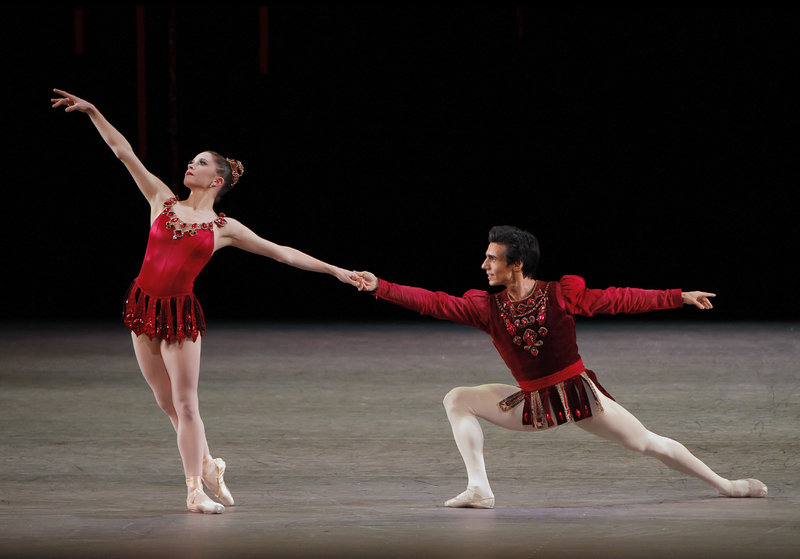
Above: Megan Fairchild & Joaquin de Luz in Balanchine’s Rubies; photo by Paul Kolnik
~ Author: Oberon
Sunday October 14th, 2018 matinee – This afternoon, ballet lovers from near and far gathered at the House of Mr. B to bid a fond farewell to one of the brightest and best-loved dancers of our day: Joaquin de Luz.
Joaquin was already an established favorite with New York balletomanes from his performances with American Ballet Theatre when, in 1997, the Madrid-born danseur made the leap across the Plaza to join New York City Ballet.
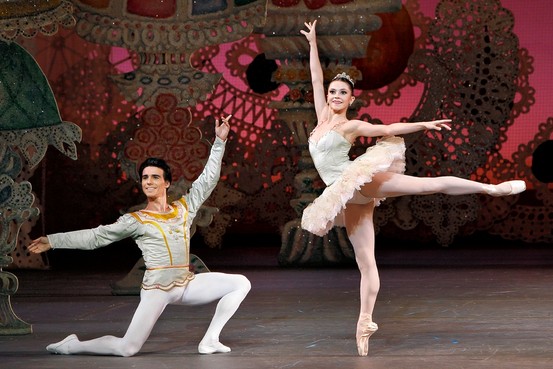
Above: Joaquin with Megan Fairchild in NUTCRACKER; a Paul Kolnik photo
At NYCB, Joaquin formed a partnership with Megan Fairchild, then a fledgling ballerina. They were paired in many ballets, and in the ensuing seasons they developed into one of the New York ballet scene’s favorite dancing duos.
Above: Joaquin with Maria Kowroski in Balanchine’s Midsummer Night’s Dream; photo by Paul Kolnik
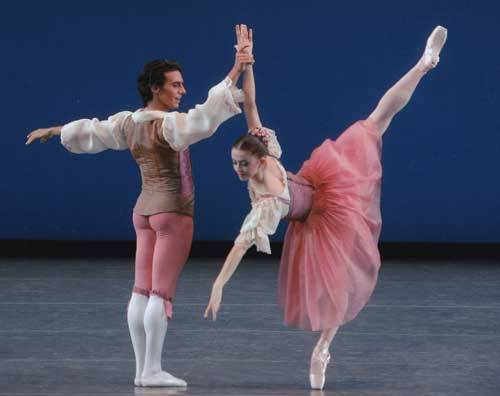
Covering a vast repertoire, Joaquin became an indispensable star in a Company that supposedly doesn’t have ‘stars’. His Balanchine rep alone is mind-boggling: Ballo della Regina, Coppélia. Divertimento from ‘LeBaiser de la Fée’, Donizetti Variations, George Balanchine’s The Nutcracker (as Cavalier, Tea, and Candy Cane); Harlequinade (both as Harlequin and Pierrot), A Midsummer Night’s Dream (as Oberon), Prodigal Son, Raymonda Variations,”Rubies” from Jewels, La Source, Sonatine, Symphony in C (Third Movement), Tarantella,Theme and Variations, Tchaikovsky Pas de Deux, and Valse-Fantaisie.
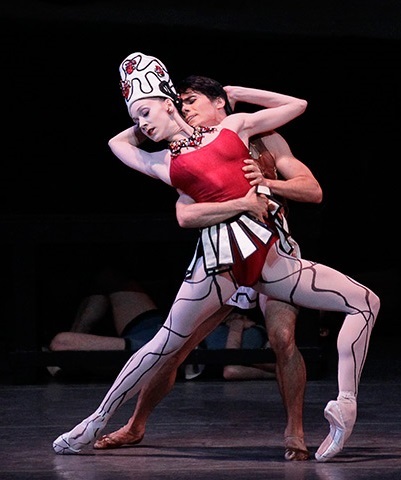
Especially admired for his sparkling virtuosity and lively stage presence, Joaquin took on a very different role in 2008 – that of the Prodigal Son (above, with Maria Kowroski) – and made it his own. He talks about his journey with this dramatic role here, with some danced highlights here.
Above: in Jerome Robbins’ Dances at a Gathering, with Tiler Peck; a Paul Kolnik photo
From the Robbins catalog, Joaquin made an indelible mark on his roles in The Concert, Dances at aGathering, Dybbuk, Fancy Free, The Four Seasons (always outstanding in ‘Fall’), Other Dances, and the solo work ASuite of Dances. The last-named work was part of today’s farewell program.
Above: Daniel Ulbicht and Joaquin practice sword-fighting for Romeo and Juliet
Joaquin created the role of Tybalt in Peter Martins’ Romeo and Juliet, and danced the classic roles in Peter’s Swan Lake and Sleeping Beauty. It was in a Martins work, Todo Buenos Aires, that Joaquin took his final bows at NYCB this afternoon.
One of my favorite Joaquin creations was in Ratmansky’s Concerto DSCH, a sprightly role with a unique finish.
A packed house erupted in the first of this afternoon’s many ovations as the curtain rose on Balanchine’s Theme and Variations with Tiler Peck and Joaquin de Luz (above, in a Paul Kolnik photo) center-stage, backed by a bevy of ballerinas. A partnership that always has a particular lustre, Tiler and Joaquin danced gorgeously yet again. After one of his solos, as the house exploded with applause, a woman sitting behind me sighed aloud: “Why is he retiring?”
Watching Theme today provided a sharp reminder to me of how much the Company has changed since I stopped going frequently: so many faces on that stage that I could not put names too. But I was really glad to see Brittany Pollack, radiant as ever among the demis, and Devin Alberda and Aaron Sanz as cavaliers. Two relative newcomers to the corps caught my eye: Gilbert Bolden III and Roman Mejia. The curtain calls after Theme were wonderful, with Joaquin and the corps applauding one another while Tiler beamed.
Following the first intermission, an elegant performance of Concerto Baroccowas conducted by Daniel Capps with Arturo Delmoni and Nicolas Danielson as violin soloists. Maria Kowroski and Russell Janzen danced the pas de deux with serene confidence and lovely line, and Abi Stafford was delightful; the two women exchanged sisterly glances as they moved in sync.
As my seat was in the third row, I hadn’t expected to need my opera glasses. But watching the Barocco corps I realized how bad my eyesight’s becoming. Lydia Wellington, Mary Elizabeth Sell, Kristen Segin, Sarah Villwock, and Claire Kretzschmar from my ‘younger days’ were joined by Laine Habony, Miriam Miller, and Mimi Staker in Balanchine’s unique and demanding choreography.
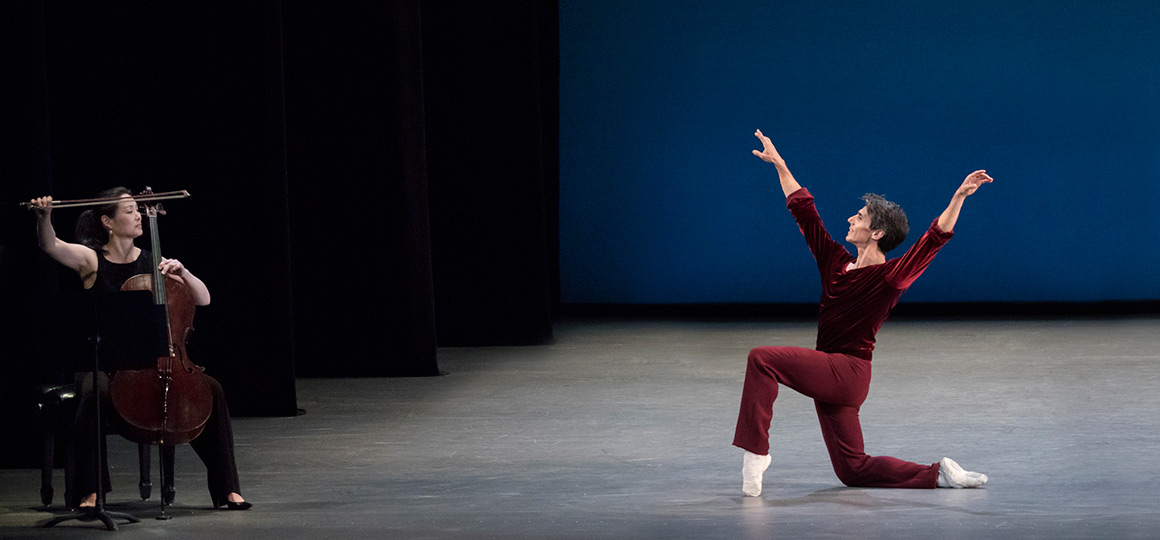
Above: cellist Ann Kim with Joaquin de Luz in Jerome Robbins’ A Suite of Dances. Joaquin relished every step, gesture, and mood of this extended solo today while Ms. Kim brought freshness to the familiar music. The audience could barely contain themselves during the allegro passages, which Joaquin tossed off with devil-may-care charm.
For the finale, Peter Martins’ tango-ballet Todo Buenos Aires (premiered in 2000) was brought back for a single performance. We had liked it in its inaugural season, danced by Julio Bocca with fun roles for Wendy Whelan and Darci Kistler; but it hasn’t held up well. Apart from providing Joaquin with a bravura/sexy vehicle, the choreography doesn’t sustain our interest, even though it was finely danced today by Joaquin with Maria Kowroski, Sara Mearns, Jared Angle, Taylor Stanley, Ask LaCour, and Andrew Veyette. A quintet of musicians onstage played the Piazzolla score impressively.
The curtain fell on this shadowy Argentine nightclub and thunderous applause filled the State Theater. Joaquin bowed humbly, and then there commenced a long procession of well-wishers coming onstage to present flowers and embrace the beloved Spaniard.
The one ‘missing person’ from today’s gala farewell program was Megan Fairchild, who has been Joaquin’s most frequent partner. Ms. Fairchild is about to become a mother – very soon, by the evidence – and she was vociferously applauded as she appeared onstage during the final ovation to present Joaquin with an enormous bouquet and a warm embrace.
Above: the Fairchild-de Luz partnership in Balanchine’s Donizetti Variations; photo by Paul Kolnik.
As the applause roared on, Gonzalo Garcia and Joaquin staged a mock bullfight; after the City Ballet folks had made their tributes, honored guests filed in – some of whom I did not recognize. Carlos Lopez, Angel Corella, and Sascha Radetsky greeted their former ABT colleague, and Victor Ullate appeared, which clearly meant a lot to Joaquin.
Last to join the celebration was Joaquin’s mom; after a big embrace, they swept into a lively tango of their own. The audience went wild.
Curtain call: Joaquin de Luz faces the roar of the crowd; photo by Flavio Salazar
Aside from his dancing and his sunny disposition, there’s another thing I love about Joaquin: he’s a fellow Rafa Nadal fan.
I have begun re-reading Prince of Virtuosos, Charles Timbrell’s biography of the pianist Walter Morse Rummel. It was in Peter Kurth’s biography of Isadora Duncan that I first read about Mr. Rummel: he had been Isadora’s music director (and lover) for about three years, starting in 1918. When the pianist took up with one of the “Isadorables”, Anna Duncan, he and Isadora parted company.
It wasn’t until my third or fourth reading of Mr. Kurth’s book that Mr. Rummel’s middle name – Morse – captured my attention. Morse was my mother’s maiden name, and she – like the great pianist – could trace her line back to Samuel F B Morse, inventor of the telegraph. This information made me feel – strangely enough – a mystical connection with Isadora, whose life and danceworks fascinate me.
Now, taking up the Rummel biography again, I’ve stumbled upon the briefest mention of the pianist’s niece – thru his first marriage to pianist Thérèse Chaigneau – soprano and film actress Irène Joachim. Another bond, however obscure, that the Prince of Virtuosos gives me…this time, within the realm of opera.
Irène Joachim was born in 1913 and, after studying violin and piano, began voice lessons at age 20. She entered (and won) a competition to study at the Conservatoire de Paris; near the end of her time there, Mlle. Joachim recorded some Brahms and Mozart songs.
In 1939, she made her stage debut at the Opéra Comique, where she sang such roles as Marguerite in FAUST, Micaela, and Contessa Almaviva as well as premiering several contemporary operas. In 1940 she took on what was to be her signature role: Debussy’s Mélisande. In 1941, Mlle. Joachim became the first singer to record the complete opera, opposite tenor Jacques Jansen. Her fame increased following the release of this marvelous recording, and she was invited to sing in Berlin for the Nazis in 1942. She declined.
Mlle. Joachim continued her singing career – her 1936 recording of songs by Carl Maria von Weber won the Grand Prix du Disque – and from 1936 to 1959 she appeared in several feature films. Following her retirement, she taught privately, and later became a professor of voice at the Conservatoire de Paris in 1963. She passed away in 2001.
Among her many recordings, Irène Joachim’s exquisite rendering of Gabriel Fauré’s Le Secret stands out…listen here.
[Note: I am re-reading this fascinating book about a distant relative of mine who was an acclaimed concert pianist, the god-son of Mathilde Wesendonck, a student of Hans von Bülow, a friend of Debussy, and a lover of Isadora Duncan. The book has become even more intriguing for me since discovering another quite obscure – but delightful – connection within my extended family.]
Here is my original article:
It took me several readings of Isadora Duncan’s biography over the years before it sank in that pianist Walter Morse Rummel and I are distantly related. Walter Morse Rummel’s mother, Cornelia, was the daughter of Samuel F B Morse, inventor of the telegraph. My mother, Nancy Morse Gardner, also descends from Samuel F B Morse, and she sustained the connection by giving my brother Jeffrey the middle name Morse.
One aspect of Walter Morse Rummel’s life that particularly intrigues me is his rather obscure but fascinating connection to Richard Wagner: for Rummel’s god-mother was Mathilde Wesendonck (above, click on image to enlarge), from whose poetry Wagner drew for his gorgeous Wesendonck Lieder. Details of the life of Mathilde Wesendonck were not widely known, but that situation has now been at least somewhat remedied by the appearance of this book. The exact nature of the relationship between Wagner and Mathilde – whether it was sexual or merely spiritual – is unclear, but their mutual interest was the proximate cause of Wagner’s separation from his first wife.
But, back to the matter at hand: currently I am reading Prince of Virtuosos, a biography of Walter Morse Rummel by Charles Timbrell.
Walter Rummel was born in Germany in 1887. His father was the then-well-known British pianist Franz Rummel, and his mother – as noted previously – was American. Walter studied piano first in Washington, DC, and thereafter in Berlin where he trained with Leopold Godowsky. Walter Rummel held American citizenship, although his career was entirely in Europe.
By 1908, Walter Rummel was in Paris, where he belonged to Debussy’s inner circle. As a pianist, Rummel toured the countries of Europe, becoming well known for his cycles of ‘one-composer’ recitals which he repeated at many venues across the continent. He was especially admired for his Chopin and Liszt interpretations, though critics were divided sharply over his artistry. As a friend of Debussy, Rummel premiered ten of the composer’s piano works. He performed as soloist under the baton of many famed conductors, including Felix Weingartner and Reynaldo Hahn. Renowned as a pianist of immense creative power, Rummel specialized in the music of J S Bach; he transcribed several cantatas by Bach, as well as many pieces by Bach’s forerunners.
Charles Timbrell’s book is thoroughly and lovingly researched, especially in its detailing of Walter Rummel’s career as a major star in the pianistic firmament of his day: what he played – and where – is painstakingly cataloged. Against this factual background we read reviews of Rummel’s performances that veer from lauds worthy of a god to stark dismissiveness. It’s seems clear that Rummel was an erratic performer, which accounts for the wide range of critical reactions; audiences, however, tended to idolize him.
Above: Antoine Bourdelle’s fanciful depiction of Walter Rummel and Isadora Duncan; click on the image to enlarge
Rummel’s affair with Isadora Duncan began in 1919 when he signed on as musical director and accompanist for her frequent tours. Their collaboration resulted in some of Duncan’s best work, but when the pianist became enamoured of one of the Isadorables, Anna (Denzler) Duncan, things became very rocky between Walter and Isadora, and they went their separate ways.
Walter had a reputation as a womanizer, and one young lady seems to have committed suicide when she found her passion for the pianist was unrequited. In 1932, following two failed marriages, Walter Rummel married Francesca Erik, a Russian poetess who claimed to be a daughter of the last tsar. Francesca subsequently became the mistress of King Leopold of the Belgians; their liaison lasted five years during which time she remained married to Rummel, returning to him as the first winds of impending war began sweeping across Europe.
Above: Walter and Francesca Erik Rummel
Rummel’s unfortunate lapses of judgement in the late 1930’s and early 1940’s, when he performed in Germany and in Nazi-occupied France during the war, did serious damage to his career. He even filed for German citizenship, giving up his American citizenship. In 1944, venturing to Austria with Francesca, their papers were confiscated and he became a man without a country.
He thereafter had considerable difficulty explaining to Allied officials that he was apolitical and had performed during the war years wherever he was invited because music was his life. Eventually, he resumed his career but he was already experiencing the onset of spinal cancer from which he eventually died in 1953. Francesca, suffering from Parkinsons disease, went insane but lived on until 1976, dying in Montreux at the age of eighty.
One story recounted in the Timbrell biography which I found particularly moving was of Rummel’s encounter with Bernard Gavoty, critic of Le Figaro, who, in 1949, had given the pianist a severe review for what turned out to be his last concert with orchestra. Gavoty wrote years later that he had received a phone call from Rummel following the publishing of the review; Rummel asked the writer to meet him.
When they met in a small cafe, Gavoty was shocked by the appearance of the once-handsome pianist. Rummel began by saying, “Your review hurt me because it was correct, and it hit me at a time in my career and in my life when I have reason to doubt both. At certain moments, nothing is more unbearable than the truth.”
Gavoty felt uneasy, but said nothing. Rummel went on: “I once was an artist, of that I am sure. You were hearing me for the first time, weren’t you?” Gavoty nodded. “What a pity you hadn’t heard me earlier. I’m sure you would have liked my sound, which pleased Debussy…yes, it’s too bad…it’s too late.” Rummel then signed to the waiter and paid for Gavoty’s cup of tea, which the writer had not touched. He shook Gavoty’s hand and slowly walked away.
“The memory of my article burned my eyes…” Gavoty wrote, “…and I remained there in a stupor, prey to a vague discomfort, and understanding – a little late – that, between a cruel duty and an inadmissable compliance, there are cases when one should prefer silence.”
Walter Morse Rummel’s mystical recording of the Liszt transcription of Wagner’s Liebestod seems to me an ideal summation of my distant but curiously thrilling connection to him, and to Isadora. It is also – reportedly – the last piece of music he ever played: for Francesca, just before his final hospitalization. Listen to it here.
Lithuanian-born soprano Lilian Sukis (above) emigrated in 1950 to Canada with her family. From 1962, she studied voice at Toronto with – among others – Irene Jessner. In 1964, she appeared as Lady Billows in Britten’s Albert Herring for the opening of the MacMillan Theatre at the University of Toronto. Later that year, Ms. Sukis made her Canadian Opera Company debut as Kate Pinkerton in Madama Butterfly.
Moving to New York City in the mid-60s, she was contacted by the Metropolitan Opera where she debuted in 1966 and sang small roles in Parsifal, Frau ohne Schatten, Rigoletto, Elektra, Aida, and Peter Grimes. On March 17, 1967, Ms. Sukis created the role of Helen Niles in the world premiere of Marvin David Levy’s Mourning Becomes Electra at The Met. Thereafter, she was Woglinde in the Karajan Walkure, and sang Gluck’s Euridice, Nedda, and Pamina before leaving The Met in 1972.
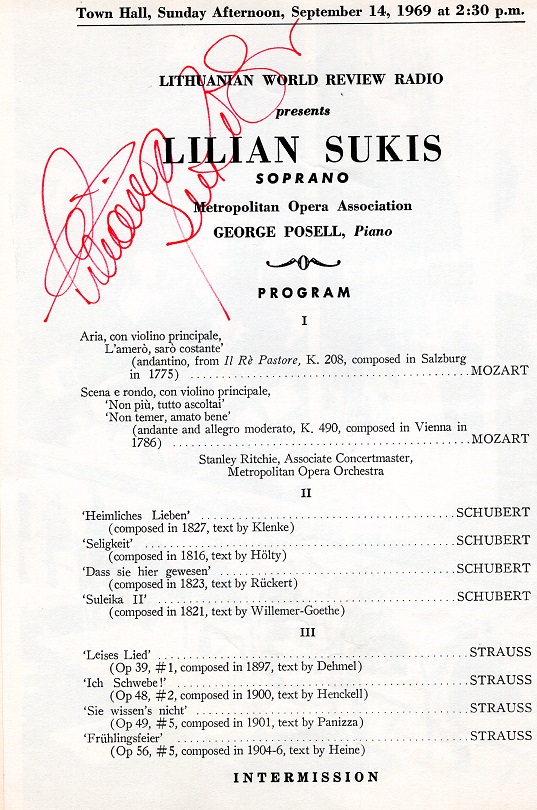
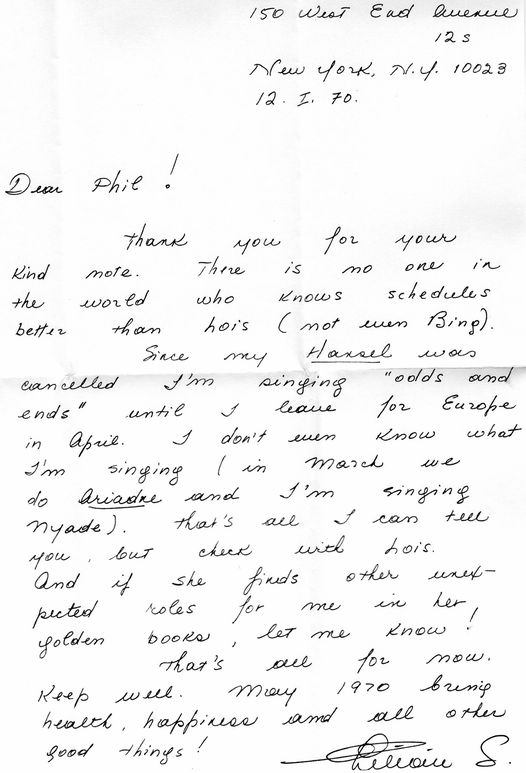
I met Lilian Sukis after a performance of Mourning Becomes Electra; soon after, I found myself sitting next to her at a Sills evening at New York City Opera. She remembered me, and we chatted thru the intermissions. We kept in touch, and when she made her New York Town Hall recital debut in 1969, she invited me:
(I took the photo of her at the top of this article after the recital.)
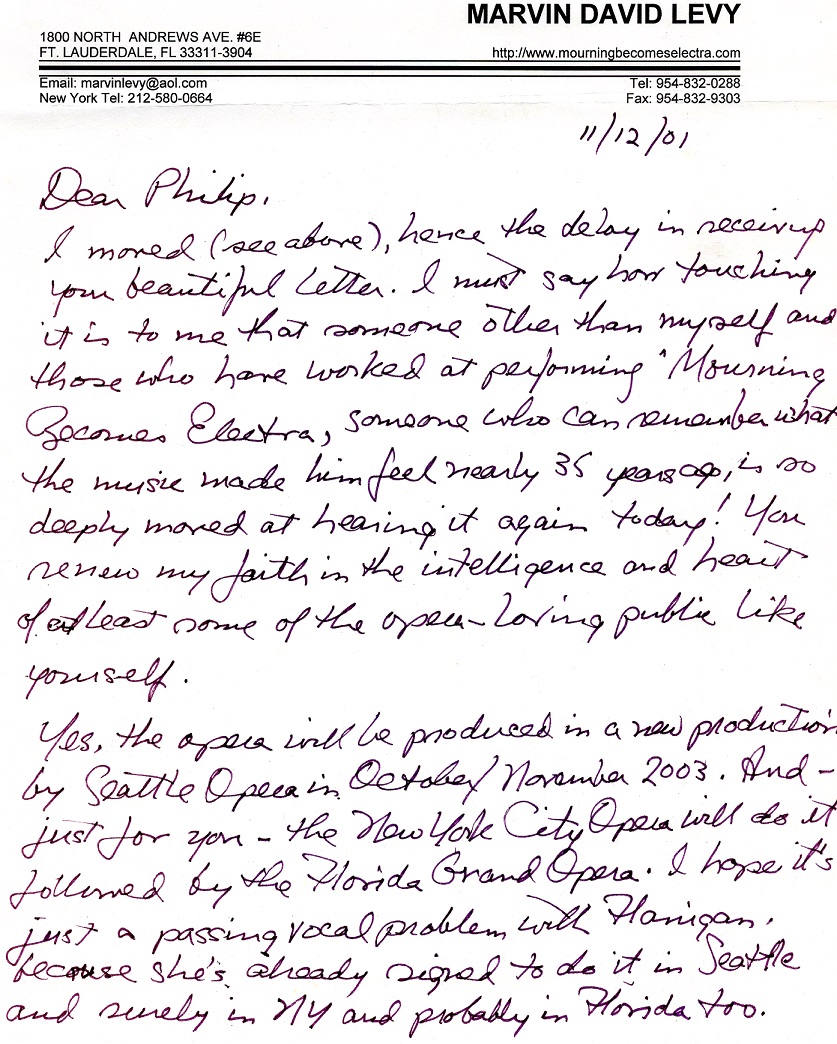
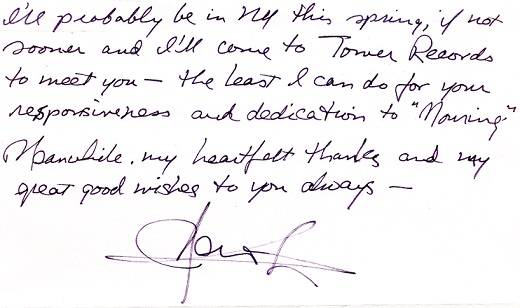
Ms. Sukis had told me (see letter above!)that she was going to be joining the Munich State Opera; for a couple of years, she sang at both Munich and The Met. At the Munich Olympic Festival (1972) she sang the title-role in the premiere of the Korean composer Isang Yun’s opera Sim Tjong, which had been written for her.
Following that success, her career centered in Europe, and we eventually lost contact. During the 1970s Ms. Sukis sang at the opera houses in Bayreuth, Frankfurt, Graz, Hamburg, Munich, Salzburg, and Vienna. Her roles included the Countess in Strauss’s Capriccio, Fiordiligi in Cosi fan tutte, Miss Jessel in The Turn of theScrew, Leila in Les Pêcheurs de perles, Mélisande in Pelléas et Mélisande, Micaëla in Carmen, Mimi in La Bohème, Pamina in The Magic Flute, Servilia in La Clemenza di Tito, Violetta in La Traviata, and the title roles in Strauss’ Daphne and Dvořák’s Rusalka. In 1977 she played Frau Fluth in a film version of Nicolai’s Merry Wives of Windsor. In 1979 she sang Lisa in The Queen of Spades at Festival Ottawa. Her career continued into the 1990s as a leading soprano with the Bavarian State Opera.
Above: Lilian Sukis in a film of Der Graf von Luxembourg
(This article was a labor of love; it didn’t make the jump from the Grove to the Glade in the big transfer, but I’ve copied and pasted it to the Glade, in memory of Marvin David Levy, who I had the great please of meeting and getting to know. Thank you, Marvelo!)
Please click on each photo enlarge.
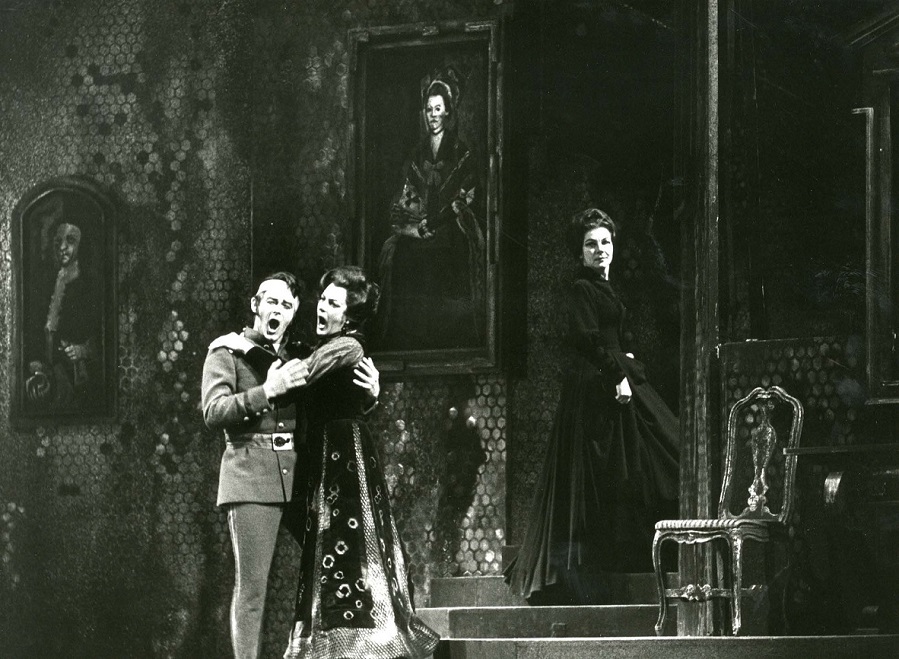
Above: Marie Collier and Evelyn Lear in MOURNING BECOMES ELECTRA at the Met, 1967
Author: Oberon
Marvin David Levy’s MOURNING BECOMES ELECTRA is, for me, the great American opera. Everything about the work is American: the composer and librettist (Henry Butler) were Americans who based their opera on the epic drama of the same name by the great American playwright Eugene O’Neill, and the opera is set in a small New England town, during the years 1865-66.
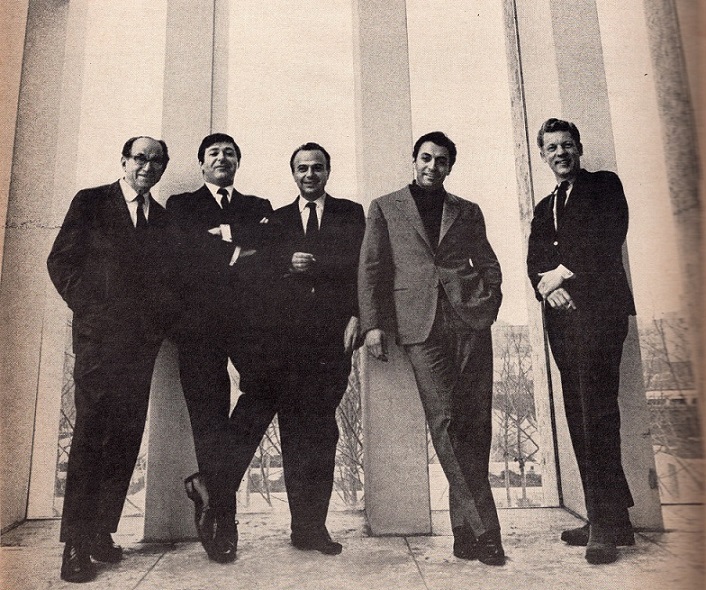
Above, the Met’s MOURNING team: Boris Aronson (designer), Marvin David Levy (composer), Michael Cacoyannis (director), Zubin Mehta (conductor), and Henry Butler (librettist)
MOURNING BECOMES ELECTRA was premiered at the Metropolitan Opera House on March 17th, 1967 during the first season at the new opera house at Lincoln Center. Though often described as a ‘failure’, audience enthusiasm ran high both times I saw it, with extended ovations; and I’ve found many positive reviews.
The Met put forward a powerful cast of singing-actors, especially for the two diva roles: Marie Collier as Christine and Evelyn Lear as Lavinia, both in their Met debuts. These two sopranos provided plenty of vocal and dramatic fireworks. It was a production that gave Sherrill Milnes, then a relative newcomer to The Met, a great opportunity in the role of Adam Brant. John Reardon made a striking impression as the hapless Orin, teetering on the brink of madness. Bassos John Macurdy and Raymond Michalski excelled as General Ezra Mannon and the servant Jed respectively; and I fell in love with soprano Lilian Sukis, who sang Helen Niles (read more about Lilian, further down). The young lyric baritone Ron Bottcher made his mark as Peter Niles, Lavinia’s hopeful suitor. On the podium, Zubin Mehta brought out the melodic aspects of the score as well as the eerie themes associated with a family on the verge.
The score contains themes that might almost be thought of as leifmotifs. They have remained in my mind over all these years, associated with the words from the libretto: “Adam, my love, your face…so pale…so strange…”; “How death becomes the Mannons…”; “You bring the gift of love, Christine…”; “No, Adam, no…not like this…”; and “A long and lonely life…”. These melodic fragments, often cinematic in feeling, are first heard in the prelude, after which the story – of an ongoing duel between mother and daughter – begins to unfold.
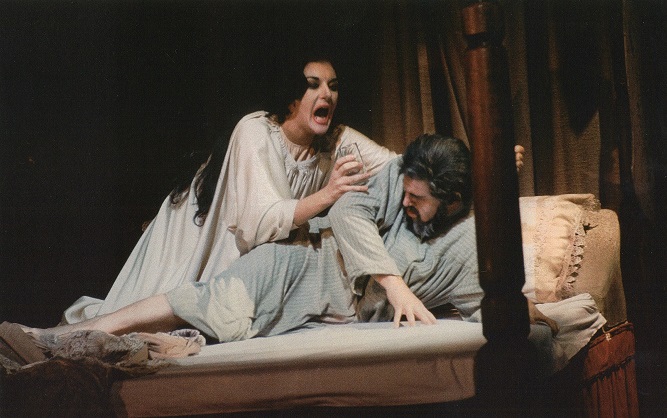
[Note that the colour photos below – from what appears to be a costumed rehearsal at The Met – were given to me by Marvin David Levy. No photographer was credited. The composer wrote notes in the border of each photo.]
The opera opens before the facade of the Mannon house, which looms up out of the shadows as the curtain rises. General Ezra Mannon is returning home from the Civil War. His wife Christine has been having an affair with the sea captain Adam Brant, who comes to the house under the guise of courting the Mannons’ daughter, Lavinia. Lavinia, who adores her father and hates her mother, knows about the Christine/Adam liaison:
A key factor in the drama has been revealed by the servant Jed: that Adam Brant is the bastard son of Ezra Mannon’s brother David and a servant girl, Marie Brantôme.
After Lavinia tells her mother and Brant that they must renounce their affair or she will tell her father of it, she leaves the lovers to say a final goodbye. But Christine has a plan in mind, and tells Brant that she will find a way to come to his ship so they can plan their escape together.
Ezra’s return home is celebrated by the townsfolk with a torchlight gathering. When Ezra and Christine are alone that night, she reveals her love for Adam. Ezra is stricken with a heart attack. He cries out for his medicine, but Christine gives him poison instead. As Ezra dies, Lavinia rushes into the room in time to hear her father accuse Christine of murder.
Christine (Marie Collier) reveals her deceit to Ezra (John Macurdy).
Above: Watched by Lavinia (Evelyn Lear, far right), Orin Mannon (John Reardon) returns home for his father’s funeral and is lovingly greeted by his mother, Christine (Marie Collier). Orin has sustained a head wound in battle. Christine is thrilled to see her son, as are his young friends Helen and Peter Niles (brother and sister).
Lavinia draws her brother away from the amiable chatter and sends him into the library. Orin stands stands before his father’s coffin, torn between guilt and hatred:
Orin: “How death becomes the Mannons… My duty is to pray for you but not to mourn. You taught me that a soldier does not weep. How death becomes the Mannons. You never cared for me, nor I for you… but we might meet as friends now that you are dead.”
Lavinia tells Orin about the poison; she places the empty vial in her father’s dead hands. Entering, Christine sees it and goes berserk. She collapses, muttering “…cast me down, but Adam must not die…Adam must not die…!”
Orin adores his mother, but now sees her as an adulteress and murderer. He and Lavinia secretly plan to follow Christine to a rendezvous with Brant aboard his ship.
Waiting for Christine to arrive, Brant sings his tormented aria “Too weak to kill the man I hate”; Sherrill Milnes later recorded this aria, and as far as I know it is the only commercial recording of any part of MOURNING. (It seems Naxos recorded the entire opera from a live performance – possibly the Seattle production – but Mr. Levy had misgivings about one of the singers as did not approve its release).
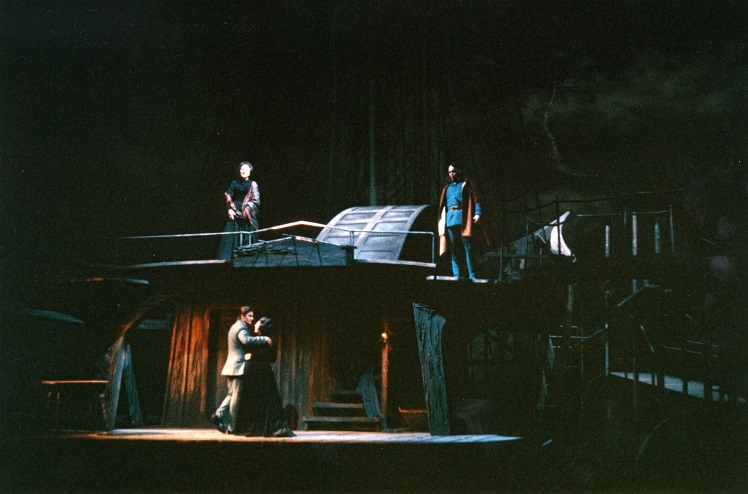
Above: the shipboard quartet: Christine arrives; she and Brant go below as Lavinia and Orin listen thru an open hatch from above. They hear their mother describe Ezra’s murder to Brant. The lovers plan to meet when things have settled, and sail away.
This scene contains two of the opera’s most haunting musical moments: when Adam tells his beloved, “You bring the gift of love, Christine…the rest is simple price.” And later, as she departs. Christine turns to Brant and, looking at his face in the moonlight, sings: “Adam, my love…your face, so pale…so strange. If I leave you, shall I ever see you again?” Listen for these motifs below:
Once Christine has departed, Orin goes below and stabs Brant to death. Lavinia sends Orin into the adjoining cabin to ransack it, so that theft appears the motive. Alone, she gazes at Adam’s body and realizes her feelings towards him. The music becomes almost cinematic as she sings, “No, Adam, no…not like this!” Then she curses him – “May the soul of our cousin Adam Brant rest in peace…and burn in Hell!” – and then flees with her brother into the night:
Returning home with the first light of dawn, Orin finds his mother pacing restlessly in front of the house. He callously tell her that Adam Brant is dead.
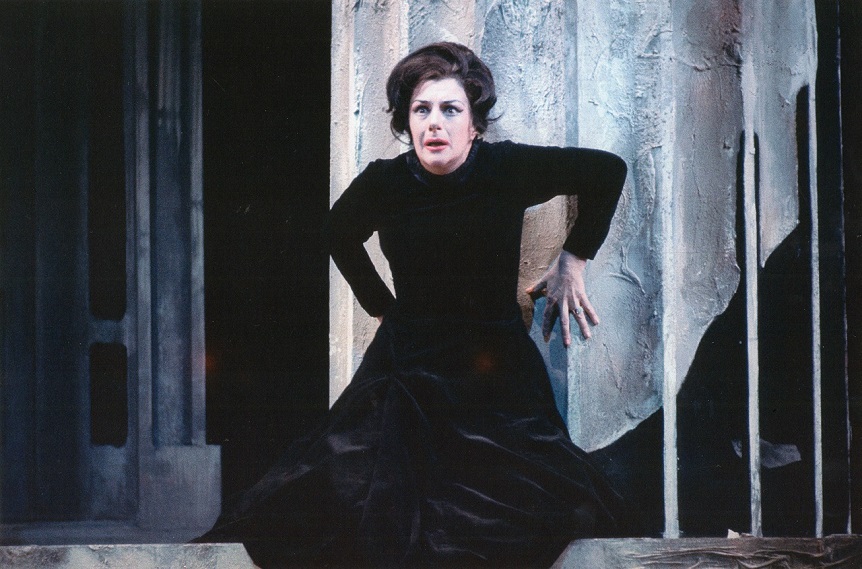
Christine (Marie Collier, above) goes mad with grief, enters the house, and shoots herself:
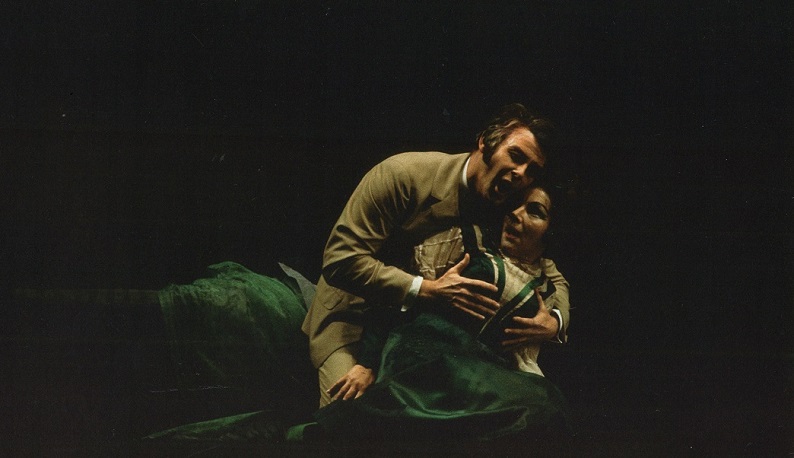
After a year, Orin and Lavinia (Evelyn Lear and John Reardon, above) return from a long sojourn in the tropics. Lavinia comes back rejuvenated, having cast off her inhibitions among the islanders; but Orin is consumed by guilt…
…and longing. He tries to force himself on his sister sexually (above). Lavinia’s resistance drives Orin mad, and he shoots himself with the gun she has handed him:
A few days later, after Orin has been buried, Peter Niles comes to ask Lavinia to marry him. She accepts, and clings to him passionately. But then, she accidentally calls him “Adam”, and Peter withdraws.
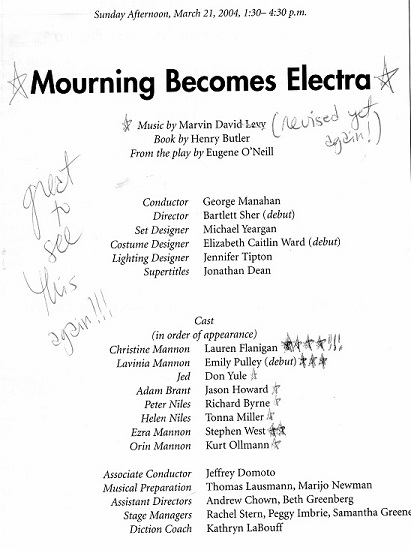
Here’s my cast page from the first time I saw the opera:
It’s lovely to have Lilian Sukis’s signature from that performance. Although the role of Helen is quite brief, the young woman is coaxed by Christine to sing a favorite song of Orin’s when he has returned from the war…to which Ms. Collier harmonized:
Lilian and I met by chance not long after at a Beverly Sills performance at New York City Opera, where she invited me to her New York solo recital debut, which I attended. I took her photo there:
Singing Helen in MOURNING put Lilian on the map with some of the Met fans in my circle. She eventually left the Met and became a popular artist at the Bavarian State Opera at Munich.
The Met thought well enough of MOURNING BECOMES ELECTRA to give it in a second season, and I attended what turned out to be the last performance (to date) of the opera at The Met. During the prolonged applause and numerous curtain calls, I was at the orchestra railing with Matthew Epstein – who went on to become a major force in the opera world as a manager of singers – and we agreed that the Great American Opera had been written. I believe Matthew attended every performance of MOURNING given at The Met.
Above: the cast page from my second MOURNING performance, signed by Mssrs Reardon and Milnes, and by the composer. That evening, the two prima donnas signed the photo that appears at the top of this article. Mr. Levy had made major revisions to his opera for this second Met run – and he would continue to do so over the ensuing years. Myself, I remained faithful to the original.
~~~~~~~~~~~~~~~~~~~~~~~~~~~~~~~~~~~~~~~~~~~~~~~~~~~~~~~~~~~~~~~~~~~~~~~~~~~~~~~~~~~~~~~~~~~~ It would be thirty years before MOURNING would be staged in the United States again, but it did have its European premiere at Dortmund, Germany, in 1970 (production poster above). While I could recall that soprano Colette Lorand sang Lavinia, I could not find more information about this production on-line. I contacted the Dortmund Opera to see if they could provide cast and production details. I received a gracious reply from the Company’s librarian, Kerstin Witt, who sent me what little was available in their archive about the production.
Madame Lorand, who gained fame singing Mozart’s Queen of the Night, later took on a vast repertoire that included many 20th-century works. How I wish I could have met her and talked to her about singing Mr. Levy’s opera; having had such a busy and eventful career, I wonder if she would have remembered it at all. She passed away in 2019.
Above is the cast of the Dortmund production. Most of these singers names are completely unfamiliar to me, though I know that Joy McIntyre was a leading soprano with major opera houses in Europe during the 1960s and 70s. She sang at Munich, Vienna, Salzburg, Rome, Berlin, Hamburg, Düsseldorf, Geneva, Barcelona and Copenhagen; her portrayals of Ortrud, Kostelnicka, and the Dyer’s Wife were praised. Ms. McIntyre sang under such conductors as Wolfgang Sawallisch, Marek Janowski, Bruno Maderna, Christoph von Dohnanyi, Leopold Hager, Carlos Kleiber and Olivero di Fabritis, and was acclaimed for her Ortrud in a production of LOHENGRIN staged by the composer’s grand-daughter, Friedelind Wagner.
Seeing the name of Guillermo Sarabia listed for the role of Adam Brant brought back memories of the very fine performances I saw him give: twice as Wagner’s Dutchman – in semi-staged concert performances in Houston (1972) and at Springfield, Massachusetts (opposite Klara Barlow’s Senta) – and as Verdi’s Macbeth, with Cristina Deutekom and Ferruccio Furlanetto, at The Bushnell in Hartford in 1982. Mr. Sarabia died at the young age of 49 in 1985.
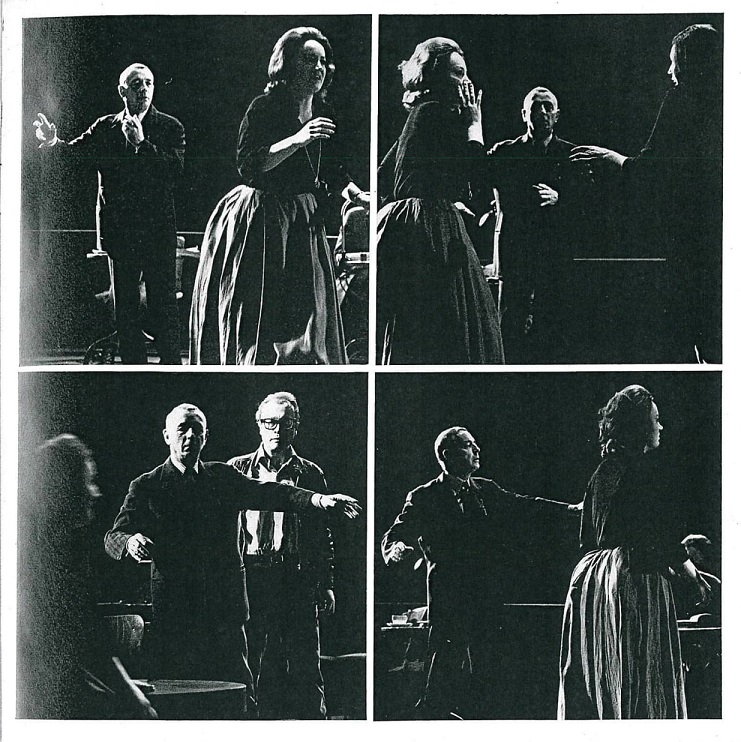
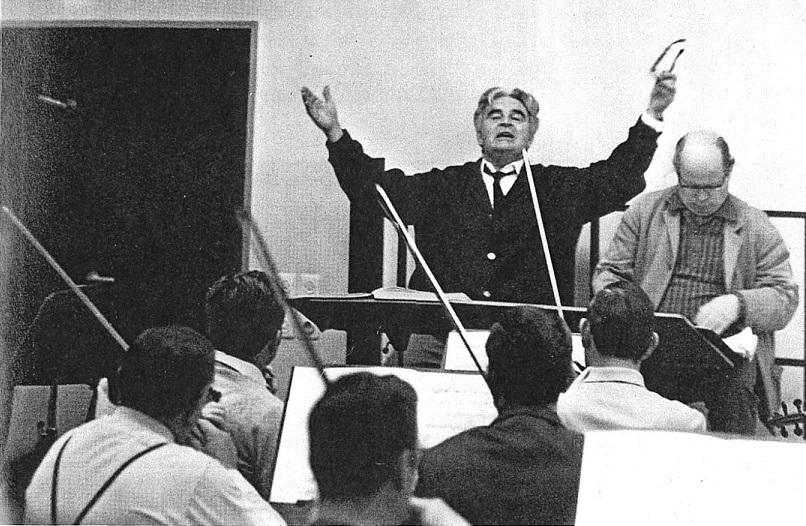
Above: some rehearsal images from the Dortmund production of MOURNING..
Above: more Dortmund rehearsal images; I believe that’s Ms. McIntyre on the left and Ms. Lorand on the right, directly above.
Above: set design for the façade of the House of Mannon, for the Dortmund premiere
~~~~~~~~~~~~~~~~~~~~~~~~~~~~~~~~~~~~~~~~~~~~~
In 1998, the Chicago Lyric Opera mounted a gorgeous production of MOURNING, which the composer had revised still further. It was a big success with press and public alike, and there was renewed interest in the piece. The Chicago cast featured Lauren Flanigan as Christine, Cynthia Lawrence as Lavinia, Randolph Locke (a tenor) as Orin, Jason Howard (Adam Brant), and Kevin Langan (Ezra Mannon).
Here are some images from the Chicago production:
Lauren Flanigan as Christine and Cynthia Lawrence as Lavinia
Mother and daughter (Lauren Flanigan and Cynthia Lawrence) nearly come to blows
Jason Howard as Adam Brant and Cynthia Lawrence as Lavinia
Jason Howard as Adam Brant and Lauren Flanigan as Christine. Here is the scene from Act I where Christine tells Adam of her plan to kill her husband, Ezra. Lauren Flanigan is at her most thrilling here:
On the verge of homicide: Lauren Flanigan as Christine goads her husband Ezra Mannon (Kevin Langan) with the truth about her affair with Adam Brant.
In the opera’s final scene, with her parents and brother dead, Lavinia is on the verge of accepting Peter Niles’ proposal of marriage (Brett Polegato and Cynthia Lawrence, above); but when she inadvertently calls Peter, “Adam…”, that plan is undone.
1998 was the year I moved to New York City, and thru my job at Tower Records I met someone in 2001 who was a great MOURNING enthusiast; he gave me a cassette of the Chicago performance of MOURNING. This prompted me to locate Mr. Levy’s website; there was a mailing address on the site, to which I sent a long fan letter. After some months, I received this reply:
We e-mailed back and forth for a bit; at that time I had no idea of the terrible health issues he was dealing with, so when he stopped writing I simply figured he was busy. The New York production was to be shared with Seattle Opera, and I knew he was doing some revisions.
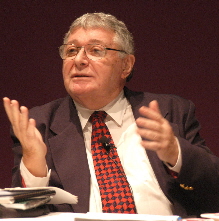
Then one day in late February 2004, I was paged to pick up a phone call in the opera room at Tower. “Philip! It’s Marvelo!” Long pause. “Marvin David Levy!” He was coming to New York for rehearsals of the NYC Opera production of MOURNING. It was a 2-minute conversation we had that day: he asked about my work schedule and said he would see me ‘soon’.
Sure enough, one March day, he came in to meet me. From my diary: “…he is a wonderful, kind man who is unfortunately suffering from a terrible disease that is affecting his spinal column, causing severe nerve damage and excruciating pain. But he stood and talked with me for several minutes about his opera that I love, and about the NYCO cast and production. Despite his upbeat chatter, his pain was so evident that I dismissed my idea of taking him to lunch. Instead I helped him down to the main floor, and got him a cab. ‘Which performance will you be at?’ he asked me as he slowly sank into the cab’s seat. I told him the dates. ‘Twice!! You are a good man!’ “
As the cab pulled away, I thought to myself that I might not ever meet him again. But I was wrong.
Above: Lauren Flanigan as Christine at the New York City Opera
The City Opera’s production was visually impressive, though lacking in the dark, brooding feeling that made the Met’s staging so effective. Lauren Flanigan was simply magnificent as Christine, using her intriguingly flawed voice to optimum emotional effect. She made the character overwhelmingly sympathetic. Emily Pulley was likewise very fine as Lavinia; she had been singing at The Met, but nothing she had done there prepared me for her riveting performance in Mr. Levy’s opera.
Jason Howard’s handsome Adam Brant made the spell he was able to cast over the Mannon women thoroughly understandable, and Kurt Ollmann as Orin sang beautifully though he did not quite find the expressive colours of dementia in his vocalism that made John Reardon so mesmerizing in the part. Stephen West was a splendid Ezra Mannon, and NYCB veteran Don Yule scored yet again with a strong portrayal of Jed. As the Niles siblings, Tonna Miller and Richard Byrne did what they could with the roles, which in this revision have been marginalized. The orchestra played very well indeed under George Manahan’s baton.
I attended the New York City Opera’s production of MOURNING twice; at the prima, I did not see Mr. Levy until he appeared onstage for a bow at the end of the performance. I brought my friend Rob Scott to the second performance (we sat in the front row!), and Mr. Levy saw us in the lobby as we entered the theatre. He made a beeline for us, and chatted us up delightfully.
In all honesty, I did not like most of the revisions that Mr. Levy had made to the score. Especially disappointing were the interjections (both vocal and dramatic) of Christine and the Mannon ghosts into Lavinia’s chilling final aria, which Evelyn Lear had sung so tellingly. But it was truly exciting to hear MOURNING again, and with an excellent cast.
Marvin David Levy’s MOURNING BECOMES ELECTRA was performed for the last time – to date – in 2013 by the composer’s “home” company, Florida Grand Opera. Lauren Flanigan (above) repeated her searing performance as Christine, and the production – and the opera itself – drew very positive critical response.
Marvin David Levy passed away at Fort Lauderdale, Florida, in 2015.
Something I had not known at the time I met Mr. Levy: a few years after the Met’s performances of his opera, Marvelo had been convicted of serving as a bag-man for a drug syndicate, and he served time in prison. He told an interviewer that the experience changed his view of life completely.
Thanks to both Kerstin Witt, archivist of the Openhaus, Dortmund, and Clark Rahman of the Metropolitan Opera Guild who provided valuable documentation about MOURNING.
So here, dear Marvelo, is the article I have been working on (for over a year) about your thrilling opera. I hope that – wherever you are – you will find it, read it, and recall the conversations and correspondence we shared. And I hope that you are writing song cycles for Evelyn and Marie, and enjoying champagne brunches with those Mannon women.





































 Oberon's Glade
