
Alfredo Kraus and Barry McDaniel sing the great duet “Au Fond du Temple Saint” from Bizet’s Les Pêcheurs de Perles from a televised concert.
Watch and listen here.
Alfredo Kraus and Barry McDaniel sing the great duet “Au Fond du Temple Saint” from Bizet’s Les Pêcheurs de Perles from a televised concert.
Watch and listen here.
…with bringing posts from the Grove to the Glade…

Above: composer Ferruccio Busoni
Coro Filarmonico Trentino perform Ferruccio Busoni’s Missa in Honorem Beatae Mariae Virginis. Listen here.
It’s difficult for me to be moving my 19-year-old blog called Oberon’s Grove to a new platform, and giving it a new name. But the prior server has become unreliable, and no longer offers maintenance or help. So, to keep blogging, I have to make a change.
The original platform I’d been using was so easy to use, and now I am going thru a period of adjustment. “You can’t teach an old dog news tricks,” as the saying goes, but I have to give it a try or give up altogether.
I’d like to keep the new blog, Oberon’s Glade, alive for a few years if possible. Luckily, some techie-friends have offered to help.
In the summer of 1963, my parents took me to see an English-language production of Rossini’s BARBER OF SEVILLE given by the Lake George Opera Company; this was my third live opera performance. I still remember how cold it was in the small theater, how much I liked the Berta (played by Ellen Berse, who later joined the short-lived Metropolitan Opera National Company), and that my favorite part of the opera was the “Frigid and motionless” ensemble.
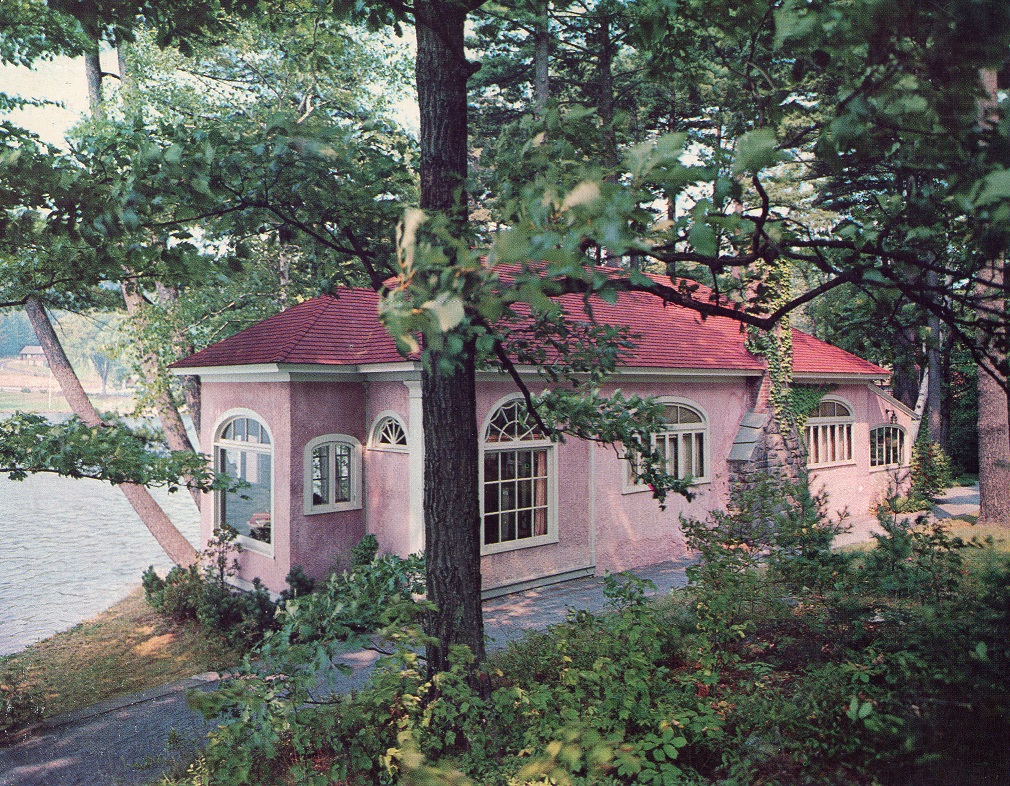
We spent an extra day on Lake George, which included a visit to the Marcella Sembrich Museum; this was housed in a pink cottage at Bolton’s Landing, NY, where the legendary Polish soprano spent her off-seasons from The Metropolitan Opera, giving voice lessons.
The main thing I remember about our time at the museum was that it was far briefer than I had anticipated. Although I was fascinated by all the opera artwork, old photographs, scores, even some of Sembrich’s costumes and accessories, my parents seemed oddly tense. It took me a few minutes to realize that the middle-aged man who was overseeing the place was subtly eyeing me; whenever I stopped to examine a particular photo or artifact, he would hover nearby and comment on whatever it was I was looking at. My mother would then materialize out of nowhere.
We’d only been there for 15 minutes when my father announced that it was time to go; I was not anywhere near done looking around, and I had also wanted to ask if I could play the piano (I was sure it was forbidden) and then sit outside the cottage, enjoying the sun and the lake view. The man then suggested that my parents leave me there and come back and pick me up in an hour. My mother turned frosty, and we left a few seconds later. Once in the car, I complained that there was so much I hadn’t gotten to see. They quickly changed the subject: where should we have lunch?
Of course. I knew perfectly well what was going on: they viewed the man as a predator and me as an innocent victim. I wasn’t exactly innocent anyway; I’d been fooling around with one of the neighbor boys for a while. But I sometime think back on that afternoon; it would be another ten years, filled with fantasies and frustrations, before I took the leap.
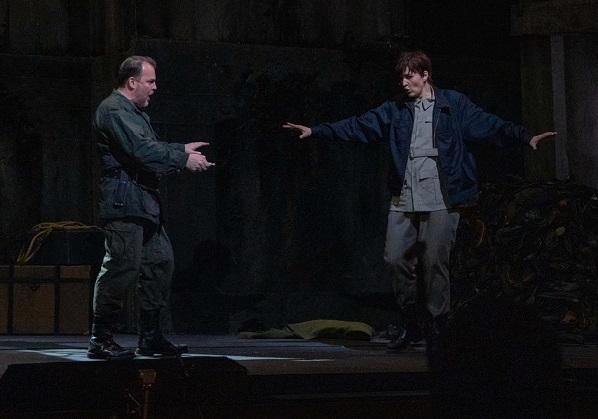
Above: Tomasz Konieczny and Lise Davidsen in Act II of FIDELIO; a MET Opera photo
~ Author: Oberon
Saturday March 15th, 2025 matinee – I’ve never really been drawn to Beethoven’s FIDELIO. I’ve only seen it a few times; my first Leonore was Shirley Verrett (!), later followed by Hildegard Behrens, Karita Mattila, and Waltraud Meier in the title-role. I love the drama of Leonore’s rescue of her beloved Florestan, but I don’t like the ‘operetta’ couple who are quite silly; they hold up the action in what could otherwise be a potent drama.
This afternoon’s performance of the Beethoven opera was sold out, and overall it was a good FIDELIO. Susanna Mälkki’s conducting seemed on the fast side, and at times she seemed to succumb to the current Met trend of swamping the singers. The orchestra were on peak form, with excellent work from the horns. The chorus likewise excelled.
In the briefest roles, tenor Jonghyun Park’s sweet lyricism made his mark as the First Prisoner; Jeongcheol Cha was equally fine as the Second Prisoner, though he has less to sing. Ying Fang as Marzelline and Magnus Dietrich as Jaquino both sang beautifully, but their characters are cardboard…and if they were absent from the narrative, it wouldn’t matter.
The impressive Danish basso Stephen Milling (above, in a MET Opera photo) is ever welcome at The Met. Today he had the brief but pivotal role of Don Fernando, and he sang with authority; I look forward to his Sarastro later in the season.
Rene Pape, who turned 60 last Autumn, retains the power and firmness of his cherished voice; he has given me so many wonderful memories in my opera-filled lifetime, and he sang handsomely and effortlessly today. His Act I aria, and his scene with Leonore as they prepare for their gruesome task, were highlights of the afternoon.
Tomasz Konieczny was a vivid Don Pizarro; his first spoken lines had a sense of urgency, and he displayed the meanness of the character in his sinister inflections. Joining Mr. Pape in duet, the sheer amplitude of their sound defined the description “Met-sized…”. Later, Mr. Konieczny’s taunting of the hapless Florestan was unsettling.
Following a superb prelude to Act II from the MET Musicians under Ms. Mälkki’s baton, tenor David Butt Philip emitted an uncanny, sustained tone with his opening “Gott!” The intensity of Florestan’s suffering was strikingly voiced by the English tenor, who has an impressive list of European achievements to his credit. His trio with Ms. Davidsen and Mr. Pape had a palpable feeling of terror. Rescued by his wife’s cry “Töd’ erst sein Weib!” as she holds Pizarro at gunpoint, Florestan joins Leonore in the blazing “O namenlose Freude!” But I did miss hearing Florestan’s haunting spoken line, “Was hast du für mich getan?”
Lise Davidsen was the star of the afternoon, just as Leonore is the heroine of the story. The tall Norwegian soprano is pregnant with twins, and this run of FIDELIO at the Met will be her last performances until after the babies arrive. She was in excellent voice today, and her strikingly clear and shining top notes seemed truly to stun the audience. Her singing of the great aria “Abscheulicher!” had remarkable power but also some incredible subtleties, and the prayerful passage “Komm, Hoffnung” moved me deeply. The soprano then went on to a blazing, prolonged top B at the aria’s climax, drawing cries of brava! from the Hall. In the opera’s finale, more of the soprano’s high notes lit up the afternoon.
Following a benedictive passage from Mr. Milling’s Don Fernando, the minister then asks Leonore to remove her husband’s shackles. In this moving moment, I glanced up at the sculpture that hangs over the Met’s proscenium; created by American sculptor Mary Callery, it was described at the time the House opened in 1966 as having been inspired by the opened shackles of Florestan, rescued by his devoted wife.
~ Oberon
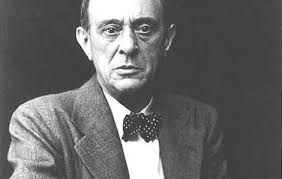
Above: Arnold Schoenberg
~ Author: Oberon
Tuesday March 11th, 2025 – A rare chance to hear Arnold Schoenberg’s Verklärte Nacht played live drew me to Weill Hall tonight where the work was on a program offered by Decoda, an ensemble of musicians who had first met while playing with Ensemble Connect.
Songs by two pairs of husband-and-wife composers – the Schumanns and the Mahlers – opened the evening. Pianist Mika Sasaki played Robert Schumann’s “Eintritt” from Waldszenen, a melody that describes entering the forest path. Baritone Thomas Meglioranza and Ms. Sasaki then offered Herr Schumann’s Sehnsucht nach der Waldgegend“; any song with ‘sehnsucht’ (longing or desire) in the title is bound to please me.
A sextet of string players now joined the pianist for Clara Schumann’s “Geheimes Flüstern“, in an arrangement by Clara Lyon; this brought forth soprano Lucy Fitz Gibbon, her voice light and charming.
Mr. Meglioranza stepped forward again for Gustav Mahler’s “Ich ging mit Lust durch einen grünen Wald” (arranged by Brad Balliett), expressively sung.
Alma Mahler’s “Licht in der Nacht” was sung by Ms. Fitz-Gibbon in an arrangement by Terry Cook (could this be the Terry Cook, a popular Met Opera basso who sang nearly 200 performances with the Company from 1983 to 2006?), accompanied by the sextet.
During this lieder segment of the program, Ms. Fitz-Gibbon and Mr. Meglioranza did not lend an operatic feeling to their singing, but rather sounded like they were performing among friends at the Schumann’s salon.
[Special note: anyone with an interest in Alma Mahler’s life and work should seek out the film Bride of the Wind.]
From the concluding Alma Mahler song, the music led directly into the Schoenberg masterpiece, Verklärte Nacht; the players were Anna Elashvili and Clara Lyon (violins), James Thompson and George Meyer (violas), and Hannah Collins and Claire Bryant (cellos).
The work was inspired by a collection of poems by Richard Dehmel published in 1896. Entitled Weib und Welt (Woman and the World), the saga speaks of a man and a woman as they walk through the moonlit woods on a frigid but clear winter evening. Guilt leads the woman to admit that, craving motherhood, she had become pregnant by another man before meeting and falling in love with her current amour. The woman stumbles miserably on in the silent darkness; but then the man tells her, “Do not let the child you carry burden your soul.” He pledges that he will love and care for the unborn child as if it were his own. They embrace, and they continue their walk on into the night, their love transfigured thru forgiveness.
Played without break, the score mirrors the five sections of the poem: throughout, Schoenberg continuously transforms themes and motifs into an expressive musical depiction of the poem. The composer travels the road from the opening line of the poem – “Two people walk through bleak, cold woods…” to its marvelous finale: “Two people walk through exalted, shining night….”
The playing by the Decoda artists was nothing less than sublime; as individual voices, and in their harmonizing and phrasing, the sextet summoned all the magic that the composer packed into his writing. Of special note was cellist Hannah Collins, whose rich-toned playing was both poetic and powerful.
Despite what seemed to me a riveting performance thus far, audience distractions during the first half of the program were especially annoying, climaxing with a dropped metal water bottle at a particularly poignant moment in the Schoenberg. Although the second half the program certainly sounded interesting – a work by four composers featuring all the evening’s artists – I decided to head out, taking the memories of the Schoenberg home with me.
~ Oberon
Above: Patricia Brooks
One of my dearest memories from my early opera-going experiences is of my first PELLEAS ET MELISANDE, in a lovely production at New York City Opera in 1970. Debussy’s haunting score moved me, even though it was not always easy to comprehend. And the poetry of the words conveyed a sense of mystery; since I had studied French in high-school (with a native-born Frenchwoman as my teacher) it was engrossing to listen to the language being sung.
One of the most memorable portrayals in the superb cast was that of the mysterious, fragile Mélisande by Patricia Brooks. Apart from her iconic Violetta, Mélisande was the Brooks role that I recall most vividly. I was so excited to find this recording on YouTube.
Read more about this soprano here.
Julius Rudel is the conductor, with the following cast:
Arkel – Malcolm Smith; Geneviève – Francis Bible; Golaud – Louis Quilico; Pelléas – André Jobin; Mélisande – Patricia Brooks; Yniold – Robert Puleo; Physician – Don Yule; Shepherd – William Ledbetter
The above names may be largely forgotten by now, some 55 years on. To me they were remarkable artists who played a part in my abiding passion for opera.
If you are not familiar with the Brooks voice, this will give you an idea of her unique qualities as a singer:
Patricia Brooks as Violetta – w Molese – NYCO – 9~28~69
Above: Korean baritone Gihoon Kim with Met Opera fan Sophia Cerovsek
~ Author: Oberon
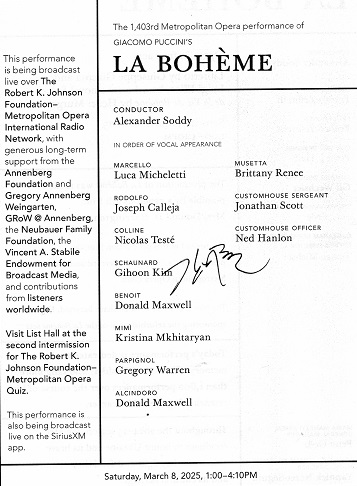
Saturday March 8th, 2025 matinee – I wanted to catch Gihoon Kim’s Schaunard in the Met’s BOHEME a second time. Since watching the Korean baritone take the title Cardiff Singer of the World at the 2021 competition, where his Tanzlied from Korngold’s DIE TOTE STADT brought the beloved soprano Roberta Alexander (one of the judges) to tears, I have followed Gihoon’s career, and even befriended him on Facebook. He has a wonderful voice and a sunny, life-embracing personality.
Although I was at a score desk, I’d heard about Gihoon’s dance routine (and the ensuing duel) in Act IV, so this time I stood up and took in all the action. Hilarious! Later in the act, it is Schaunard who first realizes that Mimi has breathed her last: “…è spirata…” , which Gihoon spoke in a hushed voice. After the performance, I went to say hello to him at the stage door.
Aside from Gihoon, the only singers in the cast whose work I was familiar with were Joseph Calleja (Rodolfo) and Kristina Mkhitaryan (Mimi, who I’d previously seen as Musetta). Brittany Renee (Musetta), Luca Micheletti (Marcello), and Nicolas Testé (Colline) took the other leads today, and the British conductor Alexander Soddy was on the podium.
Although there was sometimes a feeling that the cast was under-rehearsed, overall the performance came off quite well; Maestro Soddy did cover the voices at times (a trend at the Met these days), but his tempi were nice, and I liked the energy he developed as the military parade passes by the Café Momus.
I had not heard Joseph Calleja (Rodolfo) in the House since his 2019 Pollione. The voice has always had a fast but fascinating vibrato, and that was in play today; for me, it adds a special appeal to his singing. Today, his highest range seemed somewhat compromised; he may have been ill, or perhaps this is how he sounds now, after having sung, in recent years, some roles that stretched his essentially lyrical voice. Whatever the trouble, he managed to find a work-around, keeping the higher notes brief, or trying a headier resonance. At the end of the love duet, he at first harmonized with the soprano, but then went for the concluding top note which was a bit husky but which his Mimi’s clear note helped to masque. Thereafter, Mr. Calleja was a truly poetic Rodolfo; his singing has a vulnerable trace that is most appealing. His most magical moment came at the end of Act III when he produced a gorgeous falsetto tone on “…la stagione dei fiori…” Really exquisite. Earlier, at the end of “Che gelida manina…” he had created the same intimate atmosphere with his delicate “Via piaccia dir?“, sustained down to a whisper.
Today’s two sopranos both have vibrant voices, capable of filling the Met (so long as the Maestro kept the orchestra’s volume agreeable). Both Kristina Mkhitaryan and Brittany Renee have a bit more vibrato in their tone than I could wish, but other opera friends of mine feel this is a trend nowadays, and they are not bothered by it.
Ms. Mkhitaryan’s Mimi made her entrance after a lovely flute solo; oddly, for the first time, I sensed that a shadow of doom lies over the seamstress right from her hesitant “Scusi…”. As her narrative-aria unfolded, the vibrato became less intrusive; her singing was poetic. The orchestra slowed a bit, so she could make the most of the lyrical “Ma, quando vien lo sgelo...”; and in the lingering phrases that follow, the soprano was most persuasive. In their classic duet, she and Mr. Calleja beautifully expressed their blooming love. The tenor’s haunting “Che m’ami, di...” was met by the soprano’s delicate “Io t’amo!“. Nothing in the world compares to falling in love at first sight; I’ve done it hundreds of time thru the years…usually in vain.
Ms. Mkhitaryan’s singing in the Act III duet with Marcello was tinged with desperation, and her “Donde lieta usci...” was truly touching, especially her hushed “Bada, sotto il guanciale c’è la cuffietta rosa…” which made me choke back tears. The aria had a ravishing, sustained ending. In the final minutes of Mimi’s life, Ms. Mkhitaryan summoned a lovely palette of vocal pastels; she even introduced a touch of playfulness as she and Rodolfo recalled their first meeting. But then the fatal cough sets in, her final lines trailing off into eternity.
Ms. Renee’s Musetta, like most takes on this role, is an extrovert. Her noisy disruption of the Momus party was laced with moments of shrill shrieking, but she settled in for the Waltz, especially nice in the insinuating subtleties of the second verse, and then capping off the ensemble with a bright top note. At the end of the third act, Musetta again gets shrewish as she and Marcello indulge in name-calling. Ms. Renee was at her most compelling when we see the other side of her as she prays for Mimi’s recovery, and she and Marcello comprehend the depth of their love for one another.
From note one, Luca Micheletti was a superb Marcello; this can really be a star role – when it’s truly well sung and acted – and that’s what this baritone made it. Every note and line counted for something, so that even the big moments – like leading the Act II ensemble, singing the melody of Musetta’s waltz – are part of a grander scheme. In his Act III duet with Ms. Mkhitaryan, and again in his Act IV duet with Mr. Calleja, the singer sounded just the way you want an Italian baritone to sound: passionate, expressive, and assured. I will look for him in the future…bravissimo!
No less impressive than his painter/colleague, Nicolas Testé as the philosopher Colline excelled. Taking every opportunity to make his mark, the French basso highlighted such moments as joining Micheletti/Marcello in a commanding “Abbasso, abbasso l’autore!” as they dismiss Rodolfo’s feeble effort to get a fire going in the stove of their frigid garret. His observations of the two ‘loving’ couples at Momus were spot on. But of course it was in the Coat Aria of Act IV that M. Testé (abetted by excellent horn playing from the pit) struck vocal gold. Really beautifully done…grand merci!!
It was not a perfect performance, but it was extremely moving; and sometimes that is all that matters. I found myself thinking of my sister’s passing last July; like Mimi, she slipped away quietly – with loved ones watching over her – at the end of her battle with cancer. Ironically, LA BOHEME was one of only two operas my sister ever saw – at the Old Met in her college days. I was always jealous that the cast she had seen included Dorothy Kirsten, Carlo Bergonzi, and Anneliese Rothenberger.
Sitting at my score desk, people often come up to talk to me during intermission; they’ve spotted me from Family Circle, with my reading lamp on, my score open, and taking notes. Today, three young engineering students from Columbia University stopped by, each wearing a necktie and all looking very dapper. They were all seeing their first opera; they asked me many questions, and I found my usually-reticent self babbling away about how wonderful opera is, and how it changed my life (literally!). Once I get started on the topic, it’s impossible to shut me up.
Earlier, I’d been chatting with the young woman seated in front of me; she was seeing her second opera this afternoon, and she asked for suggestions of what other operas she should try. In the course of our chat, she apologized for mispronouncing the names of the great operas, and of the characters in them. I assured her that all opera lovers start out that way; you can only imagine how I mangled the title of Leonora’s great aria “Pace! Pace, mio dio!” for several weeks before I heard the correct pronunciation. To this day, I still blush to myself when I think of it.
~ Oberon

Above: cellist Michal Korman and harpist Sivan Magen
~ Author: Oberon
Thursday February 27th, 2025 – My previous encounter with the Israeli Chamber Project, in April of 2024, was nothing short of revelatory. Read about that concert here. Hoping to be similarly transported tonight, I was settling in when I realized there was no heat in the hall. It was so uncomfortable that I actually considered leaving at the intermission. Thank goodness I stayed, as the concluding Shostakovich was simply spectacular.
This evening’s program, entitled ORPHEUS’ HARP, featured four works in which the Project’s harpist, Sivan Magen, regaled us with his extraordinary artistry. Completing the program were piano trios by Shostakovich and Paul Ben-Haim.
To open the concert, Mr. Magen was joined by violinist Itamar Zorman and the lovely cellist, Michal Korman, for Orpheus, Symphonic Poem for Violin, Cello and Harp by Franz Liszt/Camille Saint-Saëns. String chords sound, soon joined by the rhapsodic harp: Mr. Magen’s playing is truly delectable, his mastery of dynamics and his agility are spellbinding. The music begins to flow, with alternating currents of major and minor. The plush blend of timbres is a balm to the ear: the unison strings are rapturous, the harp magical. Large scale tremelos from cello and violin lend a sense of drama. The cello goes deep, heralding a lamenting passage; through a series of chords, the piece reaches a pianissimo conclusion.
Jacques Ibert’s Two Interludes for Clarinet, Cello and Harp dates from 1946. Tibi Cziger’s clarinet joins Ms. Korman and Mr. Magen in the wistful opening of the Andante espressivo; the music becomes increasingly sensuous, with the dusky sound of the Korman cello wonderfully alluring. Mr. Cziger’s rich timbre, his savorable piani, and his ravishing trills are entwined with Mr. Magen’s entrancing harp passages. The second interlude, Allegro vivo, has a Spanish lilt; it is music both lively and mysterious. The cello sounds sexy, the clarinet enticing, the harp exotic; their harmonies are so evocative.
Paul Ben-Haim’s Variations on a Hebrew Melody for Piano Trio was composed in 1939. Read about the Munich-born composer here. Pianist Assaff Weisman joins Mr. Zorman and Ms. Korman in the work’s tumultuous opening; the doom-ladened cello, sizzling violin, and darkling piano create a creepy – even ominous – atmosphere. Unison, sighing strings give way to an enchanting piano solo, wherein Mr. Weisman slowly darkens the atmosphere before a rise of passion brings forth his trills and high filigree. Mr. Zorman introduces a dance filled with mood swings; the music turns waltzy. The piano sneaks up on us, suddenly sounding alarms. This is fabulous music, marked by an epic piano glissando.
The violin plays high over cello staccati, the pianist regales us with more magic before launching another dance, which comes to a dramatic halt. Mr. Weisman now introduces Ms. Korman, whose cello takes up a poignant lullaby in which Mr. Zorman joins. The music turns dreamy as this bittersweet work reaches its sublime finish.
Following the interval, Robert Schumann’s Three Fantasy Pieces, Op. 73 for Clarinet and Harp were presented by Mssrs. Cziger and Magen. In the first movement we could enjoy the clarinetist’s dulcet tone and his elegant finesse. The music is spellbinding; Mr. Magen’s playing is nothing less than sublime, and the music finds a magical finish. Fanciful harping and lyrical themes from the clarinet mesh in the second movement, which proceeds with some expert coloratura from Mr. Cziger. The third song has an exuberant start which calms to a melodic flow. An interlude veers into minor mode before we come to a swift, sweet finish. The communication between the two artists was delightful to watch from my front-row seat.
Mssrs. Magen and Weisman then took up Carlos Salzedo‘s Sonata for Harp and Piano which dates from 1922. A harpist himself, the composer ironically played the piano for the work’s premiere. The music leans towards modernism; from its fast, fun start, the piano plays a major role. A delicious sense of mystery develops, with subtle, intriguing harp motifs and trilling from both, as the instruments converse. Dynamic variety keeps the music ever-engaging; drama takes over with some extroverted keyboard passages, and then subtleties emerge. Mr. Weisman regales us with cascades of notes, and Mr. Magen has a passage with ‘prepared’ strings that alter the mood. Melismas herald an ethereal, pianissimo mood wherein a mystical atmosphere pervades. Some very delicate plucking follows; after a brief speed-up, a pacing motif leads to a dirge until some violent slashings seem to portend a dramatic finish; instead the music fades, as if it had all been a dream.
The concert ended with a thrilling rendering of Dmitri Shostakovich’s Piano Trio No. 1 in C-minor, Op. 8, played to perfection by Ms. Korman and Mssrs. Zorman and Weisman. Cast in a single movement, this music has an immediate beauty; a pensive start turns playful as the fiddle commences a dance. Order is restored, but then things again get jaunty…and briefly urgent. A charming violin passage leaves Ms. Korman to a heartfelt cello solo, with the delicate piano lending support as Mr. Zorman then takes over, his high register shining. A more animated mood evolves, and Mr. Weisman’s playing gets quite grand. Buzzing strings intrude, and some wild violin measures turn into a dialogue with cello.
There is a full stop, and then a caressive melody is passed from violin to piano before the cello joins. In cantabile mode, Mr. Zorman sounds divine…and then Ms. Korman takes up the theme, with the Weisman piano adding more colours. Lush, melodious music for the strings is embellished with shimmering sounds from the piano. Passion now rises, almost to madness; epic grandeur leads on to a swift finish.
This concert reassured me of the power of music – especially when it’s so gorgeously played – to sustain us in an increasingly dismal world. I fear so much will be lost to us in the months ahead, but music can always help us find light in the darkness. Thank you, artists of the Israeli Chamber Project, for a truly uplifting evening.
~ Oberon




 Oberon's Glade