Author: Philip Gardner

  • Orchestra of St. Luke’s ~ Bernstein’s ‘Kaddish’

    Samuel-pisar

    Above: Samuel Pisar

    ~ Author: Oberon

    Wednesday January 29th, 2025 – Carnegie Hall marked the 80th anniversary of the liberation of Auschwitz with a performance of Leonard Bernstein’s Symphony No. 3, “Kaddish.” A setting of ‘A Dialogue with God’ by the late Samuel Pisar – who had himself been a survivor of Auschwitz – was spoken tonight by Pisar’s wife, Judith Pisar, and their daughter Leah Pisar, with James Conlon leading the Orchestra of St. Luke’s. The Bard Festival Chorus, directed by James Bagwell, and the Brooklyn Youth Chorus, led by Dianne Berkun Menaker, made the choral passages an integral part of the evening’s performance.

    The reviews were quite harsh when the Boston Symphony Orchestra, conducted by Charles Munch, premiered this symphony on January 10, 1964; it is dedicated to the memory of President John F. Kennedy, who had been assassinated on November 22, 1963.

    Tonight was my first time hearing this work. In preparation, I read some articles and reviews of the piece; these seemed mostly to center on the narrative rather than on the musical setting. My idea was to focus on the music and let the narration flow, but that proved impossible: such is the power of Mr. Pisar’s writing.

    Former Secretary of State Antony Blinken, stepson of Samuel Pisar, made an eloquent introductory speech in which he drew a connection between the substance of Bernstein’s Kaddish and the current situation here in the USA. This of course was surely weighing on the minds of most everyone in the audience.

    Judith and Leah Pisar had taken their places next to the podium, and Maestro Conlon entered to a warm greeting. Most of my experiences with Mr. Conlon’s conducting have been at the Metropolitan Opera, where he debuted in 1976  and went on to preside over nearly 300 performances, the latest having been Shostakovich’s LADY MACBETH OF MTSENSK, more than ten years ago. I’d love to see him on the Met podium again.

    Low humming from the chorus opens the Kaddish, and then Judith Pisar, a petite woman, began to speak. Her voice is deep and profound as she talks of the Age of Anxiety, which seems to be having its second dawning. Leah Pisar’s speaking voice has a sense of passion and urgency which contrasted with Mme. Pisar’s more solemn tones.

    A high violin tone is sustained by concertmaster Krista Bennion Feeney until the xylophone sounds an alarm. A melancholy theme of unison celli turns anxious as the basses join. Following a resounding crash, the music gets wild and fast, with the crack of a horsewhip. The chorus’s rhythmic clapping gets a bit jazzy; their song is accented by the xylophone, and it moves to a big finish.

    Over quiet percussion and choral humming, Judith Pisar speaks long…and movingly; the essence of the work now becomes evident: where was god when these horrible things were happening to his people? What wrongs had they committed to merit such torment and anguish? Was god angry or simply indifferent?

    As questions are raised – “How did the Holocaust, the genocides, and the ethnic cleansings become acceptable?” – and as the spoken words become more haunting and horrifying, the actual music tends to feel less engrossing.

    But then, soprano Diana Newman’s high, sweet voice floats over an accompanying harp: clear and reassuring. The female choristers join, and the music turns grand, only to fade with the xylophone sounding. Ms. Newman resumes, supported by high, spun-out sounds of the violins. Angelic voices hum, whilst scurrying music underscores Leah Pisar’s speaking of “incendiary demagogues”.  

    The music turns delicate; Mme. Pisar speaks until a crescendo obliterates her voice; her daughter speaks of “chaos on Earth”. Aching celli and basses play deep and rich; the music swells with both choruses joining. Stabbing accents turn into an oddly merry passage for clarinet, flute, and bassoon. The Youth Chorus sings; the spoken description of “the warm embrace of democracy” seems ironic now.

    A postlude of strings and brass becomes a lament, with muted trumpet and oboe. The music hesitates; Leah Pisar speaks again, with Ms. Feeney’s violin as solo accompaniment. Now Mme. Pisar issues a plea for peace as horn and trumpet sound. There is a fast and jazzy chorus, which Ms. Newman joins. The finale feels a bit extended, but then a dramatic pause leads to a final Amen.

    Throughout the work, the eternal question hovers overall: why does god allow these things to happen? And why did he abandon the faithful in their hour of direst need? Another such test seems to loom before us now. Perhaps there are no gods, and we’re simply going to have to make it on our own.

    ~ Oberon

  • Les Arts Florissants/Zankel Hall Center Stage

    CH11515039

    Above: William Christie, photo by Richard Termine

    ~ Author: Lane Raffaldini Rubin

    Tuesday January 28th, 2025 – Tonight,  Les Arts Florissants made what has become the rare appearance of an early music ensemble on a Carnegie Hall stage.

    To celebrate the eightieth birthday of its founder and co-musical director William Christie, the group presented selections from the core of its repertory, including scenes from the operas of Marc-Antoine Charpentier (1632-1704), Jean-Baptiste Lully (1632-1687), and Jean-Philippe Rameau (1683-1764). Christie has been a champion of these composers since the 1970s and it was with a 1986-87 production of Lully’s Atys – an opera that had not been staged since 1753 and whose music was excerpted at Tuesday’s performance – that Les Arts Florissants made its first big break.

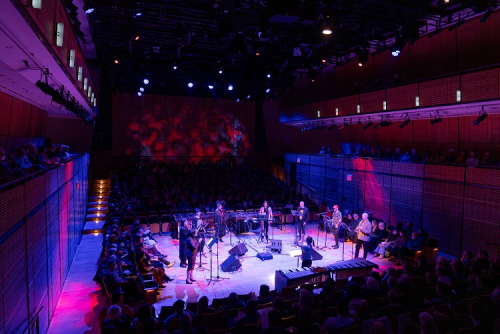
    Seeing the thirteen players and six vocalists take the stage of Zankel Hall’s intimate in-the-round configuration, one might get the sense that Les Arts Florissants is simply a small group of musicians dedicated to the French Baroque. Back in France, however, this group is just one component of a multifaceted institution that includes early music performance, music pedagogy, professional development for young singers and instrumentalists, a historic country house with fanciful Baroque-style gardens (themselves home to many of the group’s activities), training for gardeners, and a garden studies research center. Christie himself (an American, mind you, who left the States as an objector to the Vietnam War) is the godfather of this musical-cultural web.

    Tuesday’s performance was a testament to the group’s decades-long legacy of learning and teaching, its total grasp of this body of music, and the kinship of its members, who played and sang together like family.

    CH11515040

    The chosen excerpts reveal the dramatic directness and emotional turbulence of French Baroque opera. We heard none of the repetitive music of Italian da capo arias or strophic forms. Instead, we heard through-written works that interweave recitative dialogues and monologues with airs and duets. The transitions between air and recitative were at times fitful and at times seamless, but always served a clear dramatic function. That formal range and psychological charge were on display in the excerpts from Charpentier’s 1693 Médée, where a dialogue between Médée and her confidante Nérine is interrupted by outbursts of jealousy and vengefulness. This all culminated in the aria “Quel prix de mon amour”, sung by mezzo-soprano Rebecca Leggett, a lamentation undergirded by fleeting but searing dissonances in the orchestra.

    Another characteristic of this music is its emphasis on French diction. Lully, the favorite composer of Louis XIV, explicitly sought to differentiate his music from the florid and opaque sounds of Italian opera of the time. In excerpts from the later acts of Atys of 1676, the tenor Bastien Rimondi sang with clarity and shapely elegance as he communicated his character’s yearning and anguish.

    The highlight of the program was Rimondi’s “Règne, Amour” from Rameau’s Pigmalion (1748). Rameau’s opera music, which dominated the evening, was presented simultaneously as a development of Lully’s legacy as well as an innovation upon and a perversion of it. In the Pigmalion excerpts we hear varied instrumental colors, free-spirited use of the recorders and reeds, heavy basso continuo inversions that drive harmonic motion, and a Handelian rhythmic motor. Rimondi sang his part with pure joy. His exquisitely crisp diction permeated ornate passages and more straightforward melodic lines, never hindering a sweet, clear tone and blooming vibrato on sustained notes.

    The program concluded with two scenes from Rameau’s 1735 Les Indes galantes, the flagrantly cancelable opera-ballet featuring unrelated tales of exotic places and their inhabitants. Both scenes were drawn from the act “Les sauvages” depicting North American landscapes and natives. One might think the inclusion of the “Forêts paisibles” chorus to be pandering to the New York audience, but this scene also includes the famous dance of the savages which serves as Les Arts Florissants’s frequent sendoff at the end of their concerts. They tossed off this music with swung beats and confident restraint.

    CH11515089

    As an encore, Christie and Les Arts Florissants offered the quartet “Tendre amour” from the third act of Les Indes galantes (which Rameau cut from the opera after its first performances). Christie described this music as “one of the most beautiful pieces of the eighteenth century” and indeed it was gorgeous and pastoral with vocal lines floating high in the air. It was a birthday gift from Christie to the audience.

    CH11515067

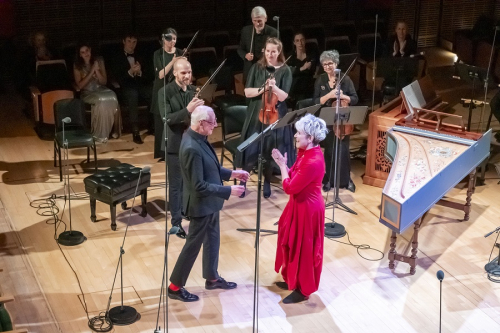
    Above: Maestro Christie greets Joyce DiDonato; photo by Richard Termine

    But the ensemble members had something else up their sleeve. The star mezzo-soprano Joyce DiDonato emerged onto the stage and lavished praise on Christie, whom she met while rehearsing for his 2004 production of Handel’s English-language opera Hercules. In tribute to Christie, she and the ensemble presented “As with rosy steps the morn” from the oratorio Theodora (why didn’t they choose something from Hercules?). After a full program of Charpentier, Lully, and Rameau, DiDonato’s Handel seemed monumentally scaled, possessing a different species of substance and intensity. The strophic form of this piece (repeating sections of music with new verses of text) set an obvious contrast with the French music of the main program and put the French works’ organic, dramatic, and transparent value into focus.

    The program was, after all, a didactic showcase of French Baroque music and its performance techniques. Among early music groups, Les Arts Florissants is a champion of craft, forgoing the temptations to produce the highly biting, peppery sound that is so en vogue these days. Surrounding the ensemble on all sides, it was as if we the audience could simply enjoy overhearing a reading of this music being shared among friends.

    Performance photos by Richard Termine, courtesy of Carnegie Hall

    ~ Lane Raffaldini Rubin

  • Roomful of Teeth/Tambuco Percussion Ensemble

    CH11514760

    Above: performance photo by Jennifer Taylor

    ~ Author: Lili Tobias

    Saturday January 25th, 2025 – Tonight, I had the joy of hearing Roomful of Teeth and Tambuco Percussion Ensemble perform at Carnegie Hall’s Zankel Hall. Between the two ensembles, I got to hear music by six different composers, from familiar favorites of mine like Caroline Shaw, to names that were completely new to me (but who I will certainly listen to again)

    Both Caroline Shaw’s and William Brittelle’s pieces were exceptionally chaotic—which is completely on brand for Roomful of Teeth! The eight singers performed a vast variety of vocal techniques and styles, including but not limited to guttural croaking sounds, throat singing, really really high notes, muttering repeated syllables, low glissandos, and speaking normally. Shaw’s piece, The Isle, in which she set text from Shakespeare’s The Tempest, also contrasted the chaos at times with more homophonous singing—hearty choral triads and flowing solo melodies—which provided a good balance so we could still hear the words.

    The text of Brittelle’s piece, Psychedelics, was very different. He explains in the program notes that the surreal collection of words in this music are “meant to form a swarm of images, not a literal, linear narrative.” And they certainly did just this! As I listened, I caught snippets of the words, such as “I watch for dogs,” and these fragments created a very joyful experience in their meaninglessness. Throughout this piece, I never knew what to expect in the best possible way!


    The bridge between the vocal portion of the concert and the percussive potion was the composer Gabriela Ortiz. Ortiz is Carnegie Hall’s composer in residence this year, and both Roomful of Teeth and Tambuco Percussion Ensemble performed a piece of hers in this concert.


    In Canta la Piedra-Tetluikan (of which this would have been a world premiere performance if not for the group of elementary school kids who got to sit in on a rehearsal), Ortiz set the words of poet Mardonio Carballo. And these words were in Nahuatl! Nahuatl is a language (sometimes considered a group of languages) spoken in Central Mexico, and I was very excited to hear it in a musical context. Ortiz’s setting of Carballo’s poem was joyously animated. The mesmerizing repetitions—“atl, atl, atl” (water, water, water), “tlitl, tlitl, tlitl” (fire, fire, fire), and more—and energetic (and very difficult!) rhythms grounded the music in the natural world. 


    I had been especially looking forward to hearing the voiceless alveolar lateral affricate (tɬ), since that sound is common in many variants of Nahuatl (and doesn’t appear whatsoever in English), but if the singers were singing it, the distinctly fricative sound didn’t come across prominently. Perhaps they were singing in a variety of this language that doesn’t include this consonant though, and no matter what, it was very exciting to hear music in Nahuatl!


    CH11514773


    Photo by Jennifer Taylor


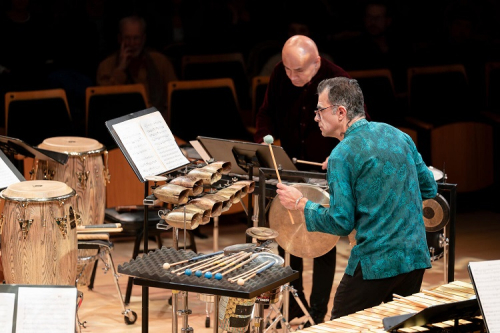
    After intermission, Tambuco Percussion Ensemble performed the movement “Liquid City,” from Ortiz’s 2014 piece, Liquid Borders. The four members of the ensemble played facing each other in a circle (the perfect set-up for the central stage!) and the blooms of sound radiated outwards into the hall. The diverse timbres of the instruments certainly reflected the diverse borders of urban and rural Mexico which Ortiz aimed to reflect in this music, the sounds mixing and shifting into unique and beautiful shapes.


    CH11514777


    Photo by Jennifer Taylor


    The other three pieces on the program were very different in that they were far more homogenous in terms of the instrumental inventory: Jorge Camiruaga’s Cuarteto en chico for four drums, Leopoldo Novoa’s Sábe cómo e’? for four guacharacas (and briefly one marímbula), and Steve Reich’s Mallet Quartet for two vibraphones and two marimbas. While these pieces were certainly reigned in the chaos compared to the first half of the program, they also proved that you could still create a wide variety of sounds and musical textures even among more similar instruments. 


    CH11514766


    Above: Gabriela Ortiz, photo by Jennifer Taylor


    It was especially fun to see how many of the composers on the program were in the concert hall enjoying the music alongside me and the rest of the audience! I enjoyed this concert so much, and I have a feeling they did too.

    ~ Lili Tobias

  • Ensemble Connect ~ Up Close

    CH11514851

    Above, composer/curator Gabriela Ortiz welcomes the crowd; photo by Chris Lee

    ~ Author: Oberon

    Monday January 27th, 2025 – Ensemble Connect is a joint program of Carnegie Hall, The Juilliard School, and the Weill Music Institute in partnership with the New York City Department of Education. In tonight’s Up Close presentation, curated by composer Gabriela Ortiz, the young artists of the Ensemble performed at the Hall’s Resnick Education Wing, an intimate venue which I’d never been aware of until Carnegie’s Meg Boyle gently twisted my arm into giving it a try.

    CH11514901

    Above: Chelsea Wang and Ryan Dresen playing Ortiz; photo by Chris Lee

    The evening opened with the New York premiere by of Pigmentum by Ms. Ortiz, a four-movement work presented in collaboration with visual artist Martirene Alcántara that was performed by Ryan Dresen (horn) and Chelsea Wang (piano) whilst a film by Ms. Alcántara was shown on a hanging screen.

    Each of the work’s four movements is named for a shade of blue, the first being Indigo. This music veered from dreamy to jazzy; some of the piano’s tones had been ‘prepared’, giving a quirky, off-kilter sound. Mr. Dresen’s playing has beauty and power throughout the range, and passages played with a mute were intriguing. Chime-like piano notes introduce Lapislazuli, with horn calls leading to a duet in the instruments’ lower ranges. The music gets wild, and a sudden ending takes us by surprise. The rippling delicacy of Ms. Wang’s playing in Cobalto is joined by the dusky sound of the horn. The music gets grand, then pensive. In the concluding Ultramar, Mr. Dresen’s horn rambles and stutters. There is a false ending, and then the enigmatic sound of toneless air being blown thru the horn. 

    CH11514949

    Mexico’s Carlos Carlos Sánchez-Gutiérrez presented Luciérnagas (photo above Chris Lee) for which three alumni of the Ensemble – Yasmina Spiegelberg (clarinet), Joanne Kang (piano), and Mari Lee (violin) – joined percussionist de luxe Oliver Xu and cellist Frankie Carr, who introduced the piece. A chord introduces the insectuous music of a swarm of fireflies, whilst the cello vibrates. The clarinet trills, the sneaky piano intones, cello and clarinet sound in unison. The xylophone heralds an explosion causing the violin to go crazy. A rhythmic passage turns spacey, thunder rolls, the bass clarinet rumbles deeply whilst awesome percussion motifs sound. An intriguing marimba solo is interrupted by an urgent one-note motif from the violin, and then the xylophone goes off like a fire alarm; the insistent piano sounds urgently. Silence falls. This seemed like a perfect place to end, but no…we go on, savouring some rhapsodic playing from Ms. Kang at the piano. But then the music turns dark and scary; a cymbal crash leads to a total wipe-out. Somehow, thru all of this, it was the cellist who seemed the central figure, both thru his noble playing and his poetic face.

    For “La Hamaca” from La Hamaca (NY Premiere) by the Venezuelan composer Ricardo Lorenz, the players were Chelsea Wang (piano), alumna Mari Lee, and cellist Thapelo Masita. The music opens softly with the piano joined by the violin; the cellist enters with a pinging motif before taking up a gorgeous theme wherein Mr. Masita’s tone was matched by the sweetness of the violin and magical sounds from the piano. The music turns passionate, then staccati introduce new themes, with rich playing from the cello. The staccati resume before Ms. Lee’s violin sings on high; dense harmonies emerge before an agitato outburst. A bouncy rhythm springs up…fabulous playing from the trio as the music wafts to heaven and then fades away.

    CH11514870

    Above, in a Chris Lee photo: Joanne Kang and Oliver Xu playing the Cuban composer Ileana Perez Velazquez’s Light echoes, having its New York premiere this evening. This piece gave us a virtuoso percussion display from Oliver Xu, who moved amidst his array of instruments with assured grace, as if in a choreographed solo. No less marvelous was Ms. Kang, who was back at the piano to make more magic. Bass drum rolls, bongo beats, and gong tones set off a jazzy piano theme. The swaying rhythm gets big as Mr. Xu moves swiftly from xylophone to ancient hanging bells to every type of drum. Ms. Kang  commences a keyboard interlude, laced with various percussive comments. Suddenly, there’s a kind of cabaletta, fast and florid, before things quieten and the mysterious gong sounds; a rhythmic coda ensues. Brilliant playing from start to finish!

    CH11514918

    The Costa Rican composer Alejandro Cardona’s Axolotl (a US premiere) brought three wind players to prominence: Ms. Spiegelberg (clarinet), Anjali Shinde (flute), and Joseph Jordan (oboe) with Joanne Kang at the piano, Mr. Carr with his cello, and the lovely violinist Isabelle Ai Durrenberger (photo above by Chris Lee).  

    CH11514915

    Above: Joseph Jordan and Anjali Shinde, photo by Chris Lee

    The piece develops gradually clarinet and oboe are heard in sync, and the piano music is jazzy. Stillness, and then a haunting flute passage is heard over delicately sustained string tones creating a wonderful air of mystery. The clarinet gets jazzy as a sexy beat rises; more jazz from the violin, whilst the cello is strummed like a guitar. Wailing clarinet and oboe slowly sputter out, and a thoughtful flute solo ensues, with piano and cello commenting. Bass clarinet and flute converse over the deep cello and piano; these voices then make an incredible fade-away.

    CH11514944

    The concert ended with the world premiere of Gritos de fuego, patrias de papel by the Colombian composer Carolina Noguera (above, photo by Chris Lee). This work brought together the largest ensemble of the evening, with Leonardo Pineda conducting. Joining Mlles. Shinde, Spiegelberg, Wang, Ai Durrenberger, and Mssrs. Jordan, Dresen, Xu, and Masita were flautist Catherine Boyack, bassoonist Marty Tung, violist Ramon Carrero-Martinez, and bass-player Marguerite Cox.

    CH11514858

    Photo: the ensemble playing the Noguera, photo by Chris Lee

    From an explosive start, announced by three massive strikes of the bass drum, eerie strings emerge; the flutes blow air as more thunder claps, wailing winds, and rumbling piano depict the storm, which gives way to the amazingly subtle and sustained violin supported by cello tremelos. A long flute trill sounds as the oboe blows air and a quiet sense of ecstasy settles overall. The piano and eerie shimmers from the violin bring on a repetitive 4-note rising motif from the violin. From a perpetual quietude, raindrop piano notes accompany a sweet and serene solo from Ms. Ai Durrenberger’s violin. The bassoon chimes in, the viola plays a repeated phrase. Big chords are repeated, and then the music vanishes into thin air as a sensationally sustained cello tone from Mr. Masita fades to silence.

    CH11514920

    Above: the composers take a bow; photo by Chris Lee

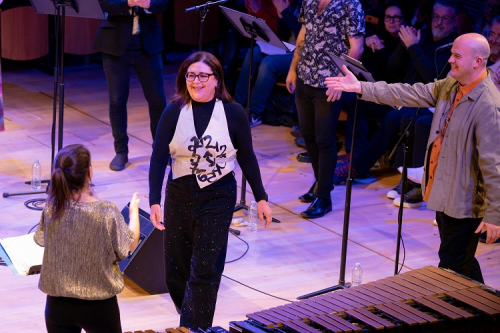
    Audience members lingered to greet the artists and the composers; except for congratulating Mr. Masita, I was too shy to speak to anyone. But I did have a chance to meet and thank photographer Chris Lee, whose remarkable gift for capturing the essence of Carnegie Hall concerts I have been lucky enough to share on my blog these past few years.

    CH11514895

    Above, the finale: this, and all the performance photos, are by Chris Lee, courtesy of Carnegie Hall

    ~ Oberon

  • Paola Prestini/Magos Herrera ~ Primero Sueño

    Prestini herrera

    Above: Paola Prestini and Margos Herrera

    ~ Author: LiIi Tobias

    Friday, January 24th, 2025 – My evening began with a pilgrimage to the Met Cloisters to attend the world premiere of Paola Prestini and Magos Herrera’s opera Primero Sueño. After traveling for an hour and a half on the subway from Queens up to Washington Heights, I then trekked uphill along a perilously icy pathway into Fort Tryon Park. As I neared the museum, the stone towers emerged majestically above the bare treetops in the night sky. I had never been to the Cloisters at night, not to mention in the Winter either, and it was certainly an experience unlike any of my daytime, Summer excursions. But it was pleasantly warm inside, though dimly lit which created an air of mystery for the music to come….

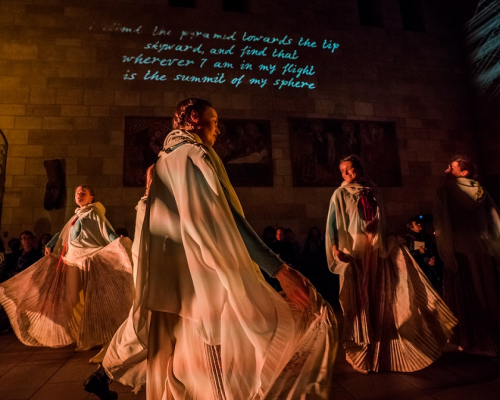
    As the audience mingled in the entry room, we were greeted by a group of ghostly singers, draped in translucent white veils. These were the sjaella (sisters) – the nuns living in Sor Juana’s convent. The sisters sang on a sustained “ah,” the tones drifting to and fro, wavering gently between consonance and dissonance. They then beckoned us to walk up the stairs where they had first appeared and into the adjacent room, which bordered a candle-filled colonnade encircling a dark garden. 


    As a “procession opera,” this production gave prominence to the spatial aspect of sound. As we walked into this first room, the singing of the nuns faded as it was gradually overtaken by the gentle plucking of a harp and theorbo. Later in the opera too, we were separated into two groups and led by the nuns around the circumference of the colonnade, while they performed a processional chant. Their voices, singing the refrain “Santa Maria,” reverberated through the corridors and around the corners of the space, and their shadows were projected on the stone walls as they walked. I imagine it must have been an entirely different experience for almost every audience member,  just based on where they were standing within the group!


    Primero Sueño at The Cloisters_1049_


    Production photo by Jill Steinberg


    Movement and dance were both incredible forces of expression in this performance—just as important as the music. In the second room that the singers and musicians traveled to, Sor Juana (performed by co-composer and librettist, Magos Herrera), lead the other nuns in song and dance as she worked on writing her poem, “Primero Sueño.” The rhythmic nature, expressed through both the music and dance, created an exuberant atmosphere as the women worked together helping Sor Juana write. 


    However, their happiness and safety was suddenly challenged by the appearance of the god Morpheus (danced by Jorrell Lawyer-Jefferson), who struck fear in the nuns. He didn’t sing, but his unsettling movements, accompanied by a distorted recording, came across as otherworldly and dangerous. Lawyer-Jefferson appeared later in the opera as well, both as Quetzalcoatl and Phaeton – both much more positive and comforting mythical figures compared to Morpheus. The abundance of mythical figures in this opera was really interesting, given that Sor Juana and the sisters are nuns, so Christian figures such as Mary coexisted with the indigenous deity Quetzalcoatl, as well as with the Greek Nyctimene, Morpheus, and Phaeton. 


    Primero Sueño at The Cloisters_0599_


    Production photo by Jill Steinberg


    The juxtaposition of multiple very different religious and cultural traditions was just one of many intriguing juxtapositions in this production. The opera also created a space where music from many different traditions—classical choral, jazz, electronic, folk, etc.—could exist at the same time. While much of the time, the music felt extremely mystical and otherworldly, there were also many sudden shifts back to the mundane. Back in the first room, the sisters broke into song as they complete their daily tasks, such as sewing and gardening. Their simple call and response, accompanied by recorded birdsong, grounded the scene in the present world, rather than the mystical realm Sor Juana was inhabiting just a few moments before. The final number, when Sor Juana has ultimately returned to her poem is also a joyous return to the real world after her encounter with Phaeton in the cosmos. The music here has a folk-like feel, as Sor Juana recites the verses to the audience, performing her words like telling a story.


    PHOTO-2025-01-22-16-58-38


    Production photo by Jill Steinberg


    I was constantly captivated, surprised, and inspired by every aspect of Primero Sueño. The production worked so well in the Cloisters, and I hope that it can be performed there again, or even in another similarly gorgeous location. At the end of the production, all the performers, joined by Paola Prestini and who I believe was Louisa Prouske, the director, were celebrated with raucous applause and (literally!) danced their way out of the final room.

    ~ Lili Tobias

  • Three Masterpieces @ Chamber Music Society

    Cms

    ~ Author: Oberon

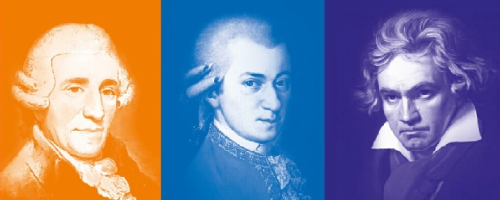
    Sunday February 26th, 2025 – A packed house at Alice Tully Hall for this evening’s concert of works by Haydn, Mozart, and Beethoven presented by Chamber Music Society of Lincoln Center. For me, it was a revelatory experience since I was hearing – for the first time – the Viano Quartet. Founded in 2015, the group soared to prominence after winning first prize at the 2019 Banff International String Quartet Competition.

    Viano jpg 2

    Above, the artists of the Viano Quartet: Tate Zawadiuk, Aiden Kane, Lucy Wang, and Hao Zhou. They opened this evening’s program with Haydn’s Quartet in F-major. Op. 77, No. 2, which dates from 1799. This was the last quartet the composer wrote.

    The opening Allegro moderato has a gracious start; this is music that’s full of charm. It speeds up, with delightful swift passages alternating with more lyrical ones. Each voice of the Viano Quartet has its say, and each is distinctive; but the magic is in the way they are blended. An excursion into minor mode brings new emotional responses before resuming the opening mood; the movement finds a brisk finish.

    The Menuetto, placed second, has a swift, witty start. Mood swings between major and minor are gorgeously negotiated by the players, whilst ironic pauses and cunning rhythmic figurations are added delights. An interlude, filled with sweet harmonies, leads on – with more clever hesitations – to a sudden finish: all so deftly played..

    The Andante opens with violinist Hao Zhou and cellist Tate Zawadiuk engaged in a courtly duo; they are such wonderfully attentive and expressive artists, as pleasing to watch as to hear. The other voices join, with Mr. Zhou and Ms. Wang offering harmonized violin passages. The playing from all is detailed, but never fussy. Hao Zhou plays a decorative theme over a melodious blend from Mlles. Wang and Kane (the quartet’s excellent violist) and Mr. Zawadiuk; the latter then takes up the melody, sounding supremely lovely. Zhou then plays an exquisite ‘accompanied’ cadenza, bringing the Andante to a serene finish.

    An emphatic chord kicks off the scampering Vivace assai; Zhou’s virtuosity here is so impressive, inspiring vivid animation from his colleagues. A whimsical section – like a rhythmic game – leads on to the uninhibited finale of what was destined to be Haydn’s last completed quartet. Simply terrific music-making from the Viano players, who were called back for a second bow; in the 25-minute span of the Haydn, they had soared into my upper echelon of favorite quartets.

    Maintaining their high standards, the Viano Quartet then offered magnificent Mozart: the Quintet in E-flat major, K. 614, was the Master’s final chamber work, composed in April 1791, the year of his death.

    Joining the quartet, one of the Society’s best-loved artists, Arnaud Sussmann, brought his viola into the scheme of things; for the program’s concluding Beethoven, he would return in his more customary role as violinist.

    Mozart commences his quintet with an Allegro di molto, launched by the two violas; Mr. Sussmann and Ms. Kane immediately formed a most congenial duo, communicating artfully, and harmonizing to perfection. As this indescribably delicious movement continued, Hao Zhou displayed his silken tone and impeccable technique to striking effect.

    The Andante has a prim and proper start; a theme with four variations ensues. Mr. Zawadiuk’s cello playing is particularly fine here, his tone the basis for alluring harmonies; Ms. Kane’s  likewise has a special glow. The music’s enticing little pauses tempt the imagination.

    The Menuetto breezes along, with repetitive descending phrases lending a playful air. A waltz-like passage ensues, with Mssrs. Sussmann and Zawadiuk setting the pace and communicating amiably.

    Mozart’s finale feels like an hommage to Haydn. It has a sprightly start, and offers some perfect opportunities to savour Hao Zhou’s sweet and subtle tone. With playful pauses along the way, this Allegro leaves us pondering – as so often – what wonders Mozart might have wrought had he lived as long as Haydn did.

    Following the interval, Mr. Sussmann joined cellist Paul Watkins and pianist Gilles Vonsattel for a perfect rendering of Beethoven next-to-last trio: his Opus 70, No, 2. The piece has a poignant start, with cello, violin, and piano introduced in turn. The timbres of the Sussmann violin and the Watkins cello compliment one another ideally in a duetting flow and in phrases passed back and forth. Meanwhile, from the Steinway, Mr. Vonsattel’s shimmering sounds provide a luminous contrast to the blendings of the strings. The movement has a curious finish.

    With the second movement, an Allegretto, Beethoven seems to honor both Mozart and Haydn; it opens with a rather sentimental melody; then animated string passages waft over a tinkling piano accompaniment. Amusing as this was, it went on a bit longer than my interest span could sustain; yet the playing was pristine.

    Another Allegretto opens with Mr. Sussmann in a violin melody played over lulling piano motifs; the Watkins cello joins the blend as sheer beauty prevails. The music gets quite quiet.

    The finale gets off to a fun start with all three musicians on top form, Mr. Vonsattel especially impressive in the music Beethoven has given him; for here, after the strings have been slightly dominant in the first three movements, the piano part offers us stunning passages in which to savour the virtuosity and grandeur of the Vonsattel artistry.

    As sometimes happens to me, even in the music of the greatest masters, a sense of detours and culs-de-sacs began to creep in. An ending seems to loom, only to recede as the music soldiers on.

    But it was all so wonderfully played, as – in fact – was the entire program.

    ~ Oberon

  • Björling & Merrill: FORZA DEL DESTINO ~ Duet

    Merrill & bjorling

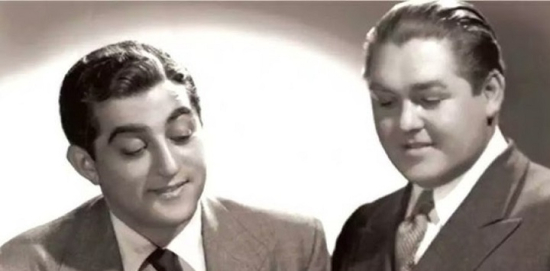
    Jussi Björling and Robert Merrill sing the great duet “Solenne in quest’ora” from Verdi’s LA FORZA DEL DESTINO.

    Listen here.

    These two voices were among the first I became familiar with in the early 1960s when I was discovering opera. It became my lifelong obsession.

  • Björling & Merrill: FORZA DEL DESTINO ~ Duet

    Merrill & bjorling

    Jussi Björling and Robert Merrill sing the great duet “Solenne in quest’ora” from Verdi’s LA FORZA DEL DESTINO.

    Listen here.

    These two voices were among the first I became familiar with in the early 1960s when I was discovering opera. It became my lifelong obsession.

  • Alisa Weilerstein ~ FRAGMENTS 2

    CH11513997

    Above, Alisa Weilerstein/FRAGMENTS 2 ~ performance photo by Fadi Kheir

    ~ Author: Shoshana Klein

    Tuesday January 21st, 2025 – This evening at Zankel Hall, Alisa Weilerstein’s’ Fragments project continued with its the second installation. You may remember the first one, last April.


    Like last time, there was no program given until the end – a practice I still find interesting, though slightly frustrating. I had a bit of a conclusion that the ideal listener either knows the Bach suites by heart, or doesn’t know them at all; someone like me (knowing them but certainly not well versed on the particular movements, etc) ends up a little stuck on which is which and where we are. 


    For the staging, the same light boxes that were set up for the first installment are set up spread around the stage rather than in a circle around the cellist like they were last time. She entered in full darkness – though during that moment, someone’s phone went off and said clearly “calling emergency services” and everyone laughed, which was a fun communal moment.


    This setting struck me as more theatrical than the last – it started with a bang and bright lights, and Weilerstein was wearing fishnets, a bright fuchsia short dress, and dramatic stage makeup with her hair curled and all over the place. It seemed to evoke a sort of dramatization and maybe a teenage emotionality.


    The way that she played the Bach suite movements were sweeping, very light even though much of the suite is in minor. Her playing of the fast passages is very elegant – bringing out the vocal and conversational qualities of these multi-line pieces written for one instrument.


    CH11513956


    Performance photo by Fadi Kheir


    For the first couple movements there were really smooth transitions and stark lighting changes. The new pieces were lit with green and the Bach was a warmer white/yellow. I wondered if it would continue like that the whole time with the lighting just indicating whether or not we were hearing a new piece, but as it went on the changes became less stark, and the movements had different types of lighting. Maybe adding to this, or reflected by it, particularly in the beginning of the set, the Bach had a more veiled angstyness while the newer pieces had more brash emotionality in the forefront, as if the newer compositions were unearthing the meanings of the Bach and saying them more plainly.


    One standout movement near the end had only pizzicati and required Weilerstein to sing along with her playing. It was simple sounding and also grounding, particularly because this person who is at the highest levels of cello playing was singing like a normal person. Not to say it was bad, it just humanized her in a way that brought reality back in a really sweet way.


    ~ Shoshana Klein

  • Dudamel Conducts Penderecki

    Krzysztof Penderecki jpg

    Above: composer Krzysztof Penderecki

    Gustavo Dudamel conducted a monumental performance of Krzysztof Penderecki’s SEVEN GATES OF JERUSALEM in 2008 with the Orquesta Sinfónica Simón Bolívar. A brief clip at the start shows the composer at a rehearsal.

    Following the Dudamel performance, Penderecki appears onstage, to tumultuous applause.

    Watch and listen here.

    I have loved this piece ever since I attended the US premiere in 1998:

    7 gates