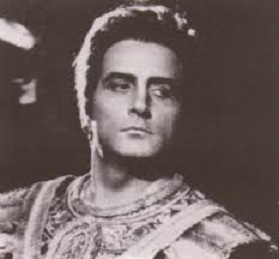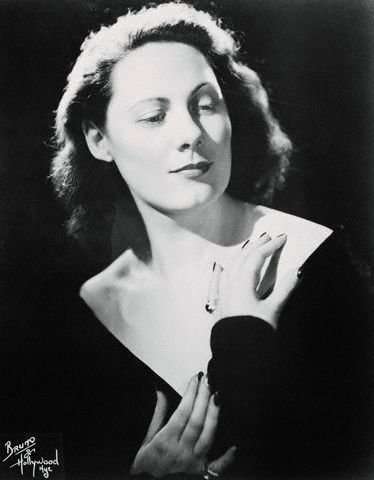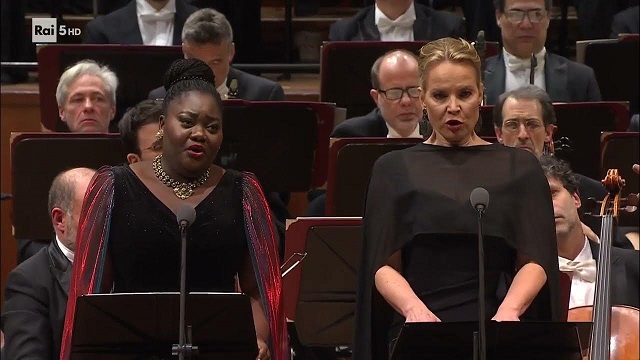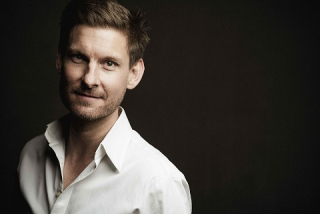
Mara Zampieri and Jose Carreras (above) in a scene from Act I of TOSCA, from a 1981 concert; Anton Guadagno conducts.
Listen here.
Mara Zampieri and Jose Carreras (above) in a scene from Act I of TOSCA, from a 1981 concert; Anton Guadagno conducts.
Listen here.
Above: tenor Dominic Armstrong (seated), conductor Leon Botstein, and soprano Felicia Moore onstage at Carnegie Hall; photo by Matt Dine
~ Author: Ben Weaver
Friday March 22nd, 2024 – Arnold Schoenberg’s gargantuan Gurre-Lieder, composed in 1900-03 (revised 1910-11), is unlike anything else in his catalog. With this lush and highly melodic work – for soloists, chorus and orchestra – he reached the ceiling of Romanticism and the only way out was to shatter it to smithereens. For Schoenberg, a mix of musical philosophy and observing the ravages of WWI signaled that music could not continue on the path laid out by his predecessors (Bach, Haydn, Mozart, Beethoven, Brahms, Wagner, etc. etc.) Schoenberg may have overreacted quite a bit, but, at a least with Gurre-Lieder, he left us with a grand finale of sorts to the excesses of 19th century music.
Gurre-Lieder’s libretto is adapted from Jens Peter Jacobsen’s dramatic poem Gurresange, written in 1868. It tells the story of King Waldemar and his love for the beautiful Tove, who is murdered by Waldemar’s jealous wife. Enraged, Waldemar curses God and is condemned to roam every night on wild hunts with his ghostly vassals. Waldemar is redeemed with arrival of Spring, and he and Tove are reunited as they become one with nature. Performances of this work are extremely rare, no doubt because Schoenberg calls for more than 150 musicians, an extravagance few organizations can afford, and none can afford frequently.
Part I opens with what Gabriel Adorno called “fairy land” music, a shimmering tapestry of harps, celesta, flutes, piccolo and some strings. Waldemar and Tove exchange declarations of love in extended monologues, set to ravishing Wagnerian and Straussian sounds.
Tenor Dominic Armstrong (above) took on the – let’s face it – impossible role of Waldemar. Schoenberg wrote the part for at least three different voices; not many singers have been able to possess them all. This is a Tristan/Parsifal/Tannhäuser part, with Tamino thrown in for good measure. I honestly don’t know who can really sing all this in a live performance. Dominic Armstrong is a lyrical tenor with a strong top, but sadly the voice disappears in the lower registers. And conductor Leon Botstein was not very kind, allowing the orchestra to cover Mr. Armstrong all evening. Armstrong’s strongest moments were in the lighter passages; his best singing came late in Part 3, in his final aria “Mit Toves Stimme flüstert der Wald”, when Schoenberg’s orchestration relaxed, allowing Waldemar to finally emerge.
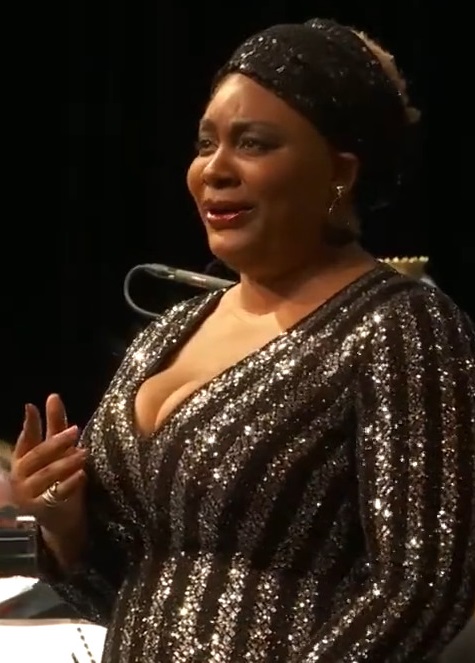
Soprano Felicia Moore (above) possesses a large, blooming voice, that managed to break through the orchestral cacophony, in spite of an insensitive conductor. Her Tove was exotic and warm.
Mezzo-soprano Krysty Swann (above, in a Matt Dine photo), as the Wood-Dove who describes the terrifying details of Tove’s murder, was exciting in her long monologue. The voice is large and steely, the vibrato a bit loose at the top, but Ms. Swann possessed an excellent sense of drama, managing to build to thrilling and hair-raising final moments of the Wood-Dove’s narrative.
Bass-baritone Alan Held (above, photo by Matt Dine) has been a favorite of mine for many years. Though it seemed like James Levine always kept Mr. Held back at the Metropolitan Opera, where he should have been singing Wotan among many other roles, I still vividly recall a searing Wozzeck Mr. Held sang at the Met in 2011. It was wonderful to hear him once again, his large voice easily filling Carnegie Hall as the Peasant who is terrified by Waldemar and his men’s nightly processions.
Tenor Brenton Ryan (photo above by Matt Dine) was a very memorable Klaus the Jester, starting his long monologue from the house floor, then jumping on to the stage. Mr. Ryan possesses a strong, characterful tenor that made me think he might have been a better choice to sing Waldemar.
And German bass-baritone Carsten Wittmoser was a magnificent Narrator, his crystal clear diction perfect for the sprechstimme part, which is usually given to older singers nearing retirement or even non-singer actors (Karl Maria Brandauer and Barbara Sukowa, for example.) So it was nice to hear a singer still in his prime take on this role.
The American Symphony Orchestra was founded by Leopold Stokowski – who conducted the US Premiere of Gurre-Lieder in 1932, so it has a direct connection to this work, and they played quite beautifully, and certainly loudly. Here I must fault Leon Botstein for not being more considerate of his singers. Even the Bard Festival Chorale found itself drowned out by the orchestra, occasionally becoming just a mass of garbled sounds coming from somewhere at the back of the stage.
Still, any live performance – flaws aside – of this supremely difficult work is was a special treat to be able to experience. How long before another performance is organized in New York City?
~ Ben Weaver
Performance photos by Matt Dine, courtesy of Carnegie Hall
Photo by Marcela Gómez
~ Author: Oberon
Wednesday February 28th, 2024 – Still on a high from last night’s CARMINA BURANA at Carnegie Hall, I went down to The Joyce on a rainy evening to see the Colombia-based dance company Sankofa Danzafro performing Behind the South: Dances for Manuel, which took me even higher.
The work references the Colombian writer Manuel Zapata Olivella, whose “Changó, el Gran Putas” – a mythological construction of South America’s African diaspora which spans more than five hundred years of history – took the author two decades to complete.
The Company’s Artistic Director, Rafael Palacios’ work celebrates the traditional music and dances of the muntu (the African people) as a key element of the Afro-Colombian community. Sankofa means “to return to” or “to go back and fetch…”: a finding of one’s roots.
I read all the background information regarding what I was about to see and hear, but it all vanished from my head when the house lights went down: for one hour I was simply mesmerized by music and movement.
Seated in an upstage corner were the two drummers who cast a spell over the hall with their playing: Juan José Luna Coha and Gregg Anderson Hudson Mitchell. The rhythmic vitality of their drumming was a primal force – like the heartbeat of the universe – creating an irresistible and urgent need to dance.
In a brief prologue, individual dancers rush fearfully about the stage, dodging bullets and sometimes hurling stones at their oppressors. Then the first of the tales unfolds: Rebel Blood. A woman in a white gown stands trembling in a pool of light. The mood is somber, and mystical voices are heard. A red-clad quartet of dancers emerge; they dance in pairs. Now a heavily pregnant woman enters, tethered to her mate by a silken cord. The man begins to shake uncontrollably; a pale spirit appears and carries him away.
Then comes the Song of Yemayá, a nurturing sea-goddess all in white who performs a flowing solo invoking protective energy. The red quartet return, and a vocal solo is heard, which evolves into a hypnotic rhythm. A procession now arrives, to the ringing of a bell: the pregnant woman and her mate return. The scene slowly fades.
A lone female, masked and ghostly, appears. Eerie vibraphone-like music is heard as spirits gather. Dancing with small, rapid steps, they move hypnotically about the stage in evolving patterns, almost like automatons. From the assembled community, fleeting solos stand out. The endless beat accelerates and things get wild before the initial woman is left alone.
A freshly agitated rhythm leaps up, the dancing full of fast steps, and a sense of exuberance rises. There are swift comings and goings as the pace quickens, becoming a runabout, and a frantic man shakes violently. The dancing slows, and in the end the dancers strike poses in place as the light fades.
The audience had clearly been enthralled throughout the piece; they now rose as one to scream heartily for the dancers. The two drummers came forward to a torrent of cheers. The stage was cleared, but insistent applause brought everyone back for another bow. Waves of love seemed to fill the hall, flowing to – and from – the stage.
I don’t feel I’ve done justice to the evening and the emotions the piece evoked. I must say, it’s nearly impossible to take notes at The Joyce; in the darkness, you end up writing lines on top of lines, and when you get home it is all undecipherable. But what I was feeling during this hour can’t really be expressed in words…you had to be there.
~ Oberon
Above: composer Carl Orff
~ Author: Oberon
Tuesday February 27th, 2024 – This evening at Carnegie Hall, the Orchestra of St Luke’s presented Carl Orff’s CARMINA BURANA. The performance was conducted by Tito Muñoz, with soloists Ying Fang (soprano) Nicholas Phan (tenor), and Norman Garrett (baritone), and the Westminster Symphonic Choir (James Jordan, Director) and the Young People’s Chorus of New York City (Francisco J. Núñez, Artistic Director).
What an exhilarating evening! The Carnegie stage was jam-packed with music-makers, and they brought the amazing score vividly to life. There is never a dull moment in CARMINA BURANA; every bar of music engages us. Maestro Muñoz had the massed forces under fingertip control, and by keeping his arms poised in the air between the work’s individual movements, he held applause at bay…until the end, when an ovation of tsunami proportions swept thru the venerable Hall, everyone on their feet and cheering with delight.
The choral singing was truly impressive, ever-alert to the shifting rhythms and the swirls of words. Their dynamic range is vast, down to near whispers at times, and then going full-tilt in the lusty Tavern Song. Likewise, Orff’s keenly judged orchestration was given in its full glory: rich, sweeping strings, clear and enticing winds (a special cheer for the flutes), and the percussionists, who are busy all evening with an array of instruments that includes chimes and castanets. The sounds of piano and celesta add magic to Orff”s imaginative scoring.
The work is divided into 25 relatively short sections, many of which are assigned to the chorus. There are three solo vocalists; the first to be heard was baritone Norman Garrett, a tall gentleman with an intriguing timbre. He was especially impressive in the Cour d’amours section, where the vocal line took him from falsetto to bass-like depths, and where a high-lying song displayed his lyrical powers. He looked very dapper in his tux.
By contrast, tenor Nicholas Phan wore an appropriately white nightclub suit in his role of a Roasted Swan. His treacherous aria, which lingers in a super-high tessitura, was cunningly managed, and his droll facial expressions conveyed the bird’s torment.
That ravishing soprano, Ying Fang, was the crowning glory of the evening. Clad in an unusual white frock trimmed in black, the soprano’s crystalline purity of timbre was magically projected into the great Hall. She lingered on uncannily sustained pianissimi that hung on the air like an alluring perfume. And on the sensual heights heights of the Dulcissime, Ying Fang’s voice shimmered with an intoxicating glow.
~ Oberon
A performance of TOSCA given at Nice in 1980 featuring Montserrat Caballe and Jose Carreras (above) as Floria Tosca and Mario Cavaradossi, and Juan Pons as Baron Scarpia. The conductor is Jésus Etcheverry.
Watch and listen here.
Above: Anthony McGill, photo by Todd Rosenberg
~ Author: Oberon
Sunday February 25th, 2024 – Music by two of France’s most beloved composers – Camille Saint-Saëns and Gabriel Fauré – was on offer this evening at Alice Tully Hall. Chamber Music Society of Lincoln Center once again assembled a stellar group of musicians, assuring a thoroughly enjoyable concert experience.
Gabriel Fauré’s Dolly Suite for Piano, Four-Hands, composed between 1894 and 1896, made for a charming start to the program. Pianists Anne-Maria McDermott and Gloria Chien gave a splendid performance of the work, which derives its name from an affectionate nickname for Helene Bardac, the young daughter of Fauré’s long-time mistress, Emma Bardac. Fauré composed these gem-like miniatures between 1893 and 1896, to mark Helene’s birthdays and other events in her young life.
The suite’s movements are:
Tonight, Ms. Chien was in charge of the lower octaves, and Ms. McDermott of the upper. They seemed to be truly enjoying playing this music, which veers from rambunctious to elegant. At the end, they embraced, and then basked in the audience’s warm applause.
It’s always a delight to hear Anthony McGill, Principal Clarinet of The New York Philharmonic, and this evening he regaled us with his sumptuous playing of Camille Saint-Saëns’ Sonata in E-flat major, Op. 167, dating from 1921…one of the composer’s last works. With Ms. Chien at the Steinway, the music simply glowed, from first note to last.
The opening Allegretto has a subdued start, but passion lurks beneath the surface. Mr. McGill was soon astounding us with his mastery of dynamics and his fluent coloratura. His pianissimi must be experienced to be believed: such control! Infinite beauty of tone is a McGill trademark, reaching our souls like a blessing from above. The movement has a poetic finish.
From a sprightly start, the Allegro animato finds the two players in perfect simpatico mode. Enchanting subtleties from both musicans continually cast a spell over the Hall. Ms. Chien opened the Lento with a deep, somber melody. She then commences a soft heartbeat motif, with Mr. McGill’s clarinet singing a forlorn melody. A wistful ‘ending’ is reached, but there’s a lovely piano postlude to follow.
Rapid keyboard figurations open the concluding Molto allegro, wherein the virtuosity of both players delights us: rapid scales and sparkling cascades of notes are crystal clear. Then M. Saint-Saëns makes a surprising mood-swing: there is a gorgeous fade-away, from which a lovely melody arises. Mr. McGill’s final pianissimo note, sustained to spine-tinlging effect, was simply uncanny.
I cannot recall ever having heard Fauré’s La Bonne Chanson performed live before. When this concert was first announced, Sasha Cooke was listed as the soloist; but in the event, it was the radiant young Chinese soprano Meigui Zhang (photo above) who sang the Fauré for us…exquisitely.
It’s been nearly a year since I first heard Ms. Zhang: in John Luther Adams’ Vespers of the Blessed Earth, on a memorable evening at Carnegie Hall, which you can read about here. For the Fauré songs tonight, she joined an ensemble of outstanding musicians: violinists Arnaud Sussmann and Paul Huang, violist Matthew Lipman, the NY Phil’s primo basso Timothy Cobb, and Ms. Chien at the piano.
The nine songs are settings of nine poems by Paul Verlaine, which the poet wrote as a wedding gift to his wife. (Ironically, Verlaine had also had an affair with Emma Bardac, mistress of Fauré.)
The songs explore many moods, by turns restless, idyllic, passionate, and pensive. The pretty, lyrical quality of Ms. Zhang’s voice is ideally suited to these songs. Particularly impressive were “J’allais par les chemins perfides” where the singer’s silken tone sounded especially lovely among the rich string mix; the urgent ecstasy of “Avant que tu ne t’en ailles“; the meltingly soft allure of her tone in “Donc, ce sera par un clair j:our d’été” with its beautifully sustained final note; and the sweet rapture of her “L’hiver a cessé“. Surely Ms. Zhang gained many new admirers this evening.
In these songs, the piano and strings provide a sonic tapestry into which the voice is woven to magical effect. Ms. Chien’s playing was a constant source of pleasure, and Arnaud Sussmann’s tone shimmered on high, seconded by Paul Huang. The deeper voices gave plushness to the ensemble: Matthew Lipman (viola) and David Requiro (cello) have much to do – they were particularly fine in “N’est-ce pas?” The composer might have given more to the bass, but Mr. Cobb made the most of each opportunity.
Following the interval, a glorious rendering of Camille Saint-Saëns’ 1875 Quartet in B-flat major brought together Ms. McDermott, and Mssrs. Huang, Lipman, and Requiro. Ms. McDermott commences the opening Allegretto, with the trio of strings joining in a unison passage. The blending of the four voices is most cordial, with the pianist’s seamless phrasing and the intriguing timbres of the three string players. I hadn’t heard Paul Huang for a while, and it was simply great to hear his distinctive sound again, as he sailed thru an ascending/decending solo motif. The Allegretto has a terrific ending.
Ms. McDermott emphatically attacks the opening bars of the Andante maestoso; the strings again join in unison, and the music has a vaguely Russian feel. There’s a slow piano theme, with the strings etching in comments along the way. Things then turn fast and furious, Ms. McDermott commanding the keyboard and the strings slashing away. Turbulence!
Mr. Lipman and Ms. McDemott launch the delightful Poco allegro, which charmed my companion and me with its Mendelssohnian flavor. There are major/minor shifts which lead to a Paul Huang cadenza, passionately played and with a ravishing trill. The music races lightly forward to a deliciously subtle finish.
The concluding Allegro starts briskly, the piano leading the way. The strings play in unison or pass phrases to one another. There’s an underlying restlessness that calms to a series of soft pizzicati. A slow build-up of tension gives way to a luxuriant sense of peace before a rising passage brings this splendid piece to its end. The musicians enjoyed a standing ovation; with our spirits lifted, we headed out into the freezing winter night.
~ Oberon
Jan Derksen (above) and Ángeles Gulín have the leading roles in a 1968 radio broadcast from Amsterdam of Verdi’s I DUE FOSCARI, conducted by Fulvio Vernizzi.
Ms. Gulín is Lucrezia Contarini and Mr. Derksen sings Francesco Foscari. Luigi Lega (Jacopo), Ugo Trama (Loredano), Cor Niessen (Barbarigo), and Adriana Hali (Pisana) complete the cast.
Listen here.