Author: Philip Gardner

  • Graham Gala @ The Joyce ~ 2023

    Ying xin melissa sherwood

    Above: Ying Xin of the Martha Graham Dance Company; photo by Melissa Sherwood

    Author: Oberon

    Thursday April 20th, 2023 – The Martha Graham Dance Company are at The Joyce for a couple of weeks, and tonight was their gala evening. The program offered Graham’s All-City Panorama and Embattled Garden book-ending three excerpts from Canticle for Innocent Comedians (choreographed by Sonya Tayeh with the individual sections by Jenn Freeman, Martha Graham, and Micaela Taylor).

    All-City Panorama is a re-take on Martha Graham’s 1935 work, Panorama, which premiered at a summer retreat in Bennington, Vermont. The original Panorama was 45 minutes long, set to a score by Norman Lloyd, and was performed by student dancers, It served as a rallying call to for social change. Panorama was lost until 1992, when an early film was discovered; from this, the dancework was reconstructed by Yuriko, who passed away in 2022 at the age of 102.

    Panorama rosalie banner

    Above: from All-City Panorama, photo by Rosalie Banner

    Tonight’s performance boasted a large ensemble of teen-aged dancers, all clad in red (Martha Graham had designed the original costumes). Heralded by drums, they take the stage with a youthful energy that is exhilarating. Forming and re-forming in various sub-groups, they move in compelling design patterns – from runabouts to noble processions – employing classic Graham steps and gestures.  

    A central quintet was impressively danced, and at one point, everyone musters into a moving, stage-filling circle: a celebration of community. Following a finale filled with traveling leaps, the stage is emptied. The dancers took their bows to a vociferous ovation from the packed hall.

    Janet Eilber then appeared onstage, hailing the young dancers as the future of Graham; later in the evening, the past was also honored as veteran dancers among the audience were cheered. Overall, the evening felt like a celebration of the proud continuum of the Martha Graham Dance Company, now in their 97th season. It all left me wondering if I will live to see the 100th season.

    I was not impressed with Canticle for Innocent Comedians when I first saw it a year ago at City Center; but last week, I had a chance to see a studio rehearsal which made me alter my opinion. The choreography is demanding and often quite beautiful. I enjoyed it much more with the dancers in practice clothes; the costumes, while visually striking, seemed to detract from rather than enhance the movement, and they sometimes affect the dancers’ line. Tonight, the music, by pianist Jason Moran, also seemed more captivating than I remembered.

    Performed this evening, a suite of excerpts from the work opened with the breath-takingly lyrical duet Moon, choreographed by Martha Graham herself – apparently the only portion of her 1952 the work to have survived more or less intact. Tonight, it was hypnotically danced by So Young An and Jacob Larsen with a gentle sensuality and a feeling of tenderness and trust. 

    Stars, choreographed by Michaela Taylor, was brilliantly danced by two of Company’s charismatic Italian stars, Marzia Memoli and Alessio Crognale. Their partnering is effortless, and their personalities meld persuasively to illuminate the dance.

    The beauteous Ying Xin then appeared for the solo Death/Rebirth, choreographed by Jenn Freeman. This solo is a profound depiction of loneliness, and Ying Xin’s suppleness of movement – and her expressive face – made for a captivating dance experience: paradoxically draining emotionally and uplifting spiritually. 

    Minutes later, Ying Xin was back onstage, portraying Eve in Graham’s iconic Embattled Garden

    At the same rehearsal where Innocent Comedians gave me a second look, Graham’s Embattled Garden had been danced, complete with sets and costumes. The work is always stunning to see, but up close it was simply thrilling. The cast of four must not only be dancers, but also acrobats, actors, and possessed of vibrant personalities.

    Tonight, in the theatrical setting, a slightly different cast made a most powerful impression. The Noguchi sets are masterpieces in their own right, and the Carlos Surinach score seemed fresh and vivid. Ying Xin’s Eve is the epitome of feminine grace, and her partner Lloyd Knight’s Adam is magnificent both as a presence and as a mover.
    Garden hibbard nash

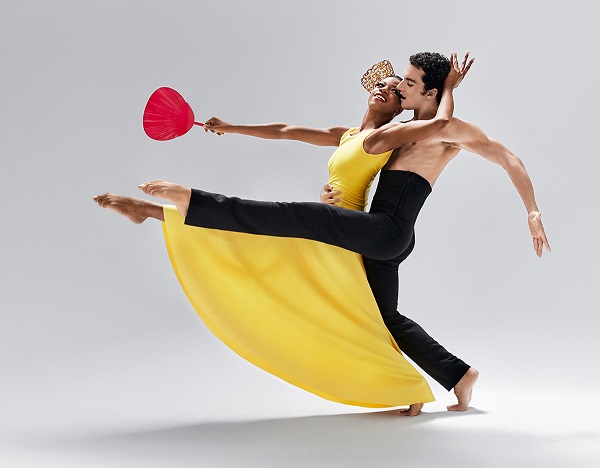
    Above, trouble in paradise: Leslie Andrea Williams and Lorenzo Pagano in a Hibbard Nash image

    Observing Adam and Eve from his perch in a fanciful Noguchi tree is the Stranger, danced by Lorenzo Pagano; lounging in the shade, fanning herself, is Lilith, danced by Leslie Andrea Williams. These intruders in Eden are hellbent on destroying the happiness of the young couple…just because they can. Aside from the astonishing flair and virtuosity of their dancing, Leslie and Lorenzo communicate volumes with their facial expressions and especially with their ever-observant, knowing eyes. Brilliant!

    ~ Oberon
  • Composer Portraits: Nicole Mitchell

    Nicole-mitchell

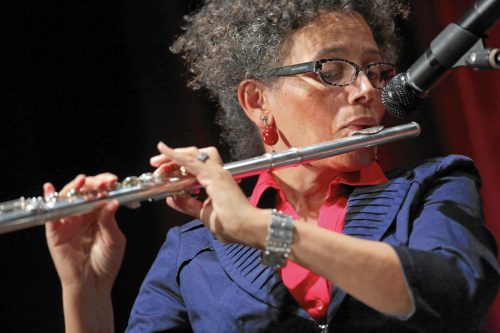
    Above: Nicole Mitchell

    Author: Oberon

    Thursday March 30th, 2023 – Another adventurous evening in the Miller Theatre’s ongoing Composer Portrait Series as we were introduced to the multi-talented Nicole Mitchell: composer, flautist, bandleader, educator, and the first woman president of Chicago’s Association for the Advancement of Creative Musicians (AACM).

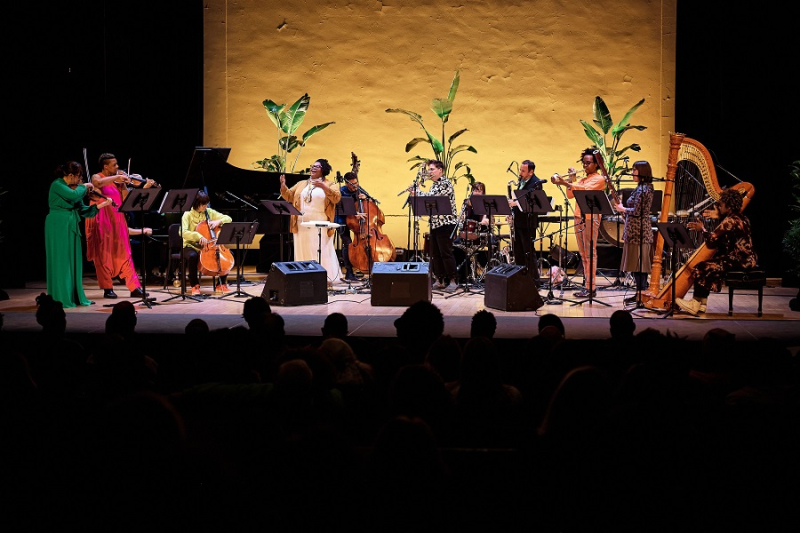
    Ms. Mitchell brought her flute along with her this evening, joining members of the International Contemporary Ensemble, vocalist Lisa E. Harris, and violinist Mazz Swift in works she has composed from 2015 thru 2023.

    On the Miller Theatre stage, a magic garden had been created with towering plants and clusters of candles; as the program progressed, the back panel was illuminated in varying hues. The musicians were distinctively dressed, creating the feel of a casual family gathering where every member had an invaluable place in the musical scheme.

    The evening opened with Whispering Flame, co-composed by Nicole Mitchell and Lisa E. Harris in 2017. From a busily insectuous opening instrumental passage, Ms. Harris’s rich, warm tones engaged us in a slow-rising vocal line. Ms. Mitchell’s flute playing was pristine, and she also presided over the electronics. Percussionist Clara Warnaar struck a summoning gong, and the music took on a windswept feeling, with trumpeter Jonathan Finlayson producing sputtering effects, and duetting violinists Mazz Swift and Gabriela Diaz adding a touch of lyricism. This kozmic work made for a perfect introduction to the program.

    SVfhZhko

    Above, playing Procession Time: Cory Smythe, Katinka Kleijn, Isabel Lepanto Gleicher, and Joshua Rubin; photo by Rob Davidson

    Bringing new sounds into the evening’s musical sphere, a quartet of artists played with such a wide range of colours that they created an impression of hearing a larger ensemble for Procession Time (2017). In the work’s first section, “Ritual Conception”, deep violet tones from Katinka Kleijn’s cello were matched by Joshua Rubin’s velvety bass clarinet. The music has a hesitancy about it, with Cory Smythe at the piano joining Isabel Lepanto Gleicher’s purring flute. Ms. Gleicher then takes off on a melodic flight, interrupted by the bass clarinet sounding rather ominous. Flute and standard clarinet harmonize to calming effect.

    The second section of Procession Time, “Carnival at the Cliff”, features quirky piano and cello motifs, and more harmonizing from flute and clarinet. A heavy rhythm develops, with squealing and screeching from the flute and clarinet.

    Transitions Beyond (2021) is a quintet for Ms. Harris (voice), Mr. Rubin (clarinet), and Mlles. Gleicher (flute), Diaz (violin), and Kleijn (cello). Although the program listed five movements, I could only detect four (perhaps I missed a transition along the way); but, at any rate, the work is a finely-woven sound. It starts with wordless vocalizing from Ms. Harris from which a text emerges over the sighs of a drooping cello: “I don’t want to leave you…” A violin solo turns into a dialogue for violin and cello, and soon their sounds begin to ooze, whereupon the winds take over. Ms. Harris sings a vocalise of uncanny sounds and pitches.

    The bass clarinet burbles and stutters, the violin take on a wispy feel, the singer continues to summon an array of colours. Cello and clarinet mingle, the winds sounding whimsical and the singer’s lines turning edgier. Now there is a flow of lyricism from the instruments, and a shimmering quality hovers over the singer’s low-range phrases. There is lots of beauty here, doled out so that each participating artists shines.

    The program’s first half concluded with the big hit of the evening: Building Stuff (2015, rev. 2023). This irresistible music had the whole place jumping, and provided wonderful opportunities for each of the nine players involved to shine. To a jaunty rhythm, Mr. Rubin’s clarinet sings out, followed by Ashley Jackson’s captivating harping and a sparkling xylophone motif from Clara Warnaar.

    A fantastic sway develops, steered by double-bass phenom Brandon Lopez. Mazz Swift reels off a vivid, jazzy violin solo, pianist Cory Smythe and Ms. Warnaar’s drumming combine in high style, and Ms. Mitchell’s flute adds a bright lustre. There are intriguing textures, with Sara Schoenbeck’s vibrant bassoon playing grabbing our attention, and Ms. Kleijn’s cello ever aglow with resonance. Mr. Smythe reaches into the piano to pluck some steely notes, and Ms. Jackson’s harp sounds sweet and sure. As Mr. Lopez’s fascinating rhythm steered the music to its finish, the crowd erupted in a burst of applause and cheering.  

    A6AKo05Y

    Above, the ensemble playing Inescapable Spiral; photo by Rob Davidson

    Following a charming  interview of Ms. Mitchell by The Miller’s Melissa Smey (and beautifully signed by two young people at the edge of the stage), the evening concluded with Inescapable Spiral (2017, rev. 2023) which brought together all the artists save for the composer, who listened from the hall. This long work seemed rather tame and aimless at times, especially after the fabulousness of Building Stuff, but it did let us continue to savour the individual playing of everyone involved.

    ~ Oberon

  • Jennifer Muller Has Passed Away

    Jennifer m by Matt Murphy
     
    It is very sad to read of the death of Jennifer Muller, a wonderfully musical and inventive choreographer. She was always very kind to me, opening her rehearsals to me and treating me almost like a member of her Company. I loved everyone who danced for her over the years that I knew her, and I grew very fond of her cozy rehearsal space. Above photo: Matt Murphy
     
    Some of my favorite memories of Jennifer’s work:
     
    Muller
     
    Above: from  MISERERE NOBIS
     
    Click each title to view:


  • WALKURE ~ Bayerische Staatsoper 1977

    Behrens (2) jpg

    A 1977 performance from the Bayerische Staatsoper of Wager’s DIE WALKURE features the Sieglinde of Hildegard Behrens (above); I saw Behrens in the role twice at The Met in 1983, and she was thrilling.

    Listen here.

    Conductor: Wolfgang Sawallisch

    Siegmund – James King
    Sieglinde – Hildegard Behrens
    Hunding – Kurt Böhme
    Brünhilde – Gwyneth Jones
    Wotan – Theo Adam
    Fricka – Brigitte Fassbaender
    Gerhilde – Leonore Kirschstein
    Ortlinde – Antonie Fahberg
    Waltraute – Charlotte Berthold
    Schwertleite – Ortrun Wenkel
    Helmwige – Gertrud Freedmann
    Siegrune – Helena Jungwirth
    Grimgerde – Liliana Netschewa
    Roßweiße – Gudrun Wewezow

  • Arensky & Brahms @ Chamber Music Society

    Bella2

    Above: violinist Bella Hristova, photographed by Lisa-Marie Mazzucco

    Author: Oberon

    Tuesday March 28th, 2023 – Works by Anton Arensky and Johannes Brahms were on the bill at Chamber Music Society of Lincoln Center this evening as violinist Bella Hristova, cellist Dmitri Atapine, and pianists Wu Qian and Wu Han teamed up for some magical music-making.

    The concert commenced with Arensky’s Six Children’s Pieces for Piano, Four Hands, Op. 34, composed in 1894. These charming miniatures found our two pianists side by side at the Steinway, with Wu Han presiding over the upper octaves and Wu Qian the lower.

    To give the pieces their English titles, we start with Fairy Tale which begins in the minor key, has a folkish feeling, and then becomes quite dramatic. Wu Han plays a series of decorative trills as the music ranges from hesitant to animated. Then, Wu Qian plays the familiar two-note birdcall that signals the delightful Cuckoo bird is nearby. This is a sprightly little piece with a subtle finish. The mood changes for Tears, which has the feel of a lament, with a deep bass line supporting a hymn-like melody. The ending is very quiet.

    Rippling motifs underscore the lovely Waltz, which gets quite bouncy. A passing reverie turns expansive before fading away, as if the dance was continuing in another room. Cradle Song appropriately has a slow, rocking feeling; the melody is that of a gentle lullaby. The concluding Fugue on a Russian Theme is tuneful and jovial. The music turns grand, and the two pianists have a grand time playing it.

    Dmitri-atapine

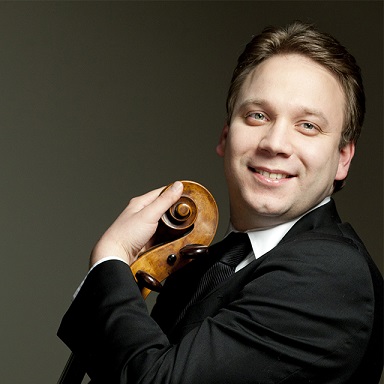
    Listening to Bella Hristova and Dmitri Atapine (above), joined by Wu Qian, play the Arensky Trio No. 1 in D -minor for Piano, Violin, and Cello, Op. 32, makes one wonder why we don’t hear more of this composer’s gorgeous music. He wrote copiously for solo piano, and numerous chamber works as well. And why cannot we hear more of his large orchestral works – which include two symphonies – or his choral pieces?  He also wrote three operas, which must be wonderful to experience.

    At any rate, we must be thankful for any opportunity to hear the music of this pupil of Tchaikovsky, especially when it as a luminously played as this evening. The introductory theme of the opening Allegro moderato, first played by Ms. Hristova and then taken up by Mr. Atapine, is hauntingly beautiful. These virtuosos bring such richness of timbre to everything they play, and this trio – a veritable font of melody – affords them so many opportunities.

    It is restless, passionate music, interrupted by a Springlike interlude in which Wu Qian spins lovely swirling passages from the Steinway. Now a sense of drama takes hold; the opening theme recurs, played – if it’s possible to imagine – even more thrillingly. There is a coda full of lyrical grace before the movement ends quietly.

    The ensuing Scherzo opens with an odd, stuttering quality. There are crisp plucking and jaunty melodies to be savoured, whilst at the keyboard Wu Qian offers cascades of notes decorated with lively trills. Now a swaying feeling takes over, and the music gets grand. After a brief hesitation, the stuttering resumes and the Scherzo comes to its whimsical finish.

    The evocative Elegia is the heart of the trio: Mr. Atapine opens with a pensive theme, then the string voices entwine as Wi Qian introduces poetic phrases from the keyboard. The music seems to evoke the memory of a lost love as the gently rocking strings sound over the quiet rapture evoked by the pianist. Ms. Hristova in her high range, the pianist pulsing quietly, and Mr. Atapine plucking ever so gently give the music an ethereal quality. Ms. Hristova takes up an autumnal melody as Mr. Atapine’s deep resonance sounds and the music fades away on a sustained chord.

    A reverential silence filled the hall, and then the agitated drama of the final Allegro non troppo sprang up. Things cool off, melodic phrases are exchanged, but then restlessness builds and the music becomes impassioned. From a sudden silence, Wu Qian’s shimmering notes are heard as the strings sing softly. The music ascends, and becomes reflective with the poignant violin and the soulful cello sounding. Then, out of the blue, a bustling rush to the finish line springs up. 

    The music of Johannes Brahms took the limelight after the interval: our two pianists returned for selections from the composer’s Hungarian Dances for Piano, Four Hands; Wu Qian was now playing the upper range and Wu Han the lower. These delightful pieces were written between 1868 and 1880, and they are chock full of rhythmic and melodic variety, spiced with a dose of paprika. The two women seemed to be having a blast playing them, much to the audience’s delight.

    Bringing the evening to its close, Wu Han, Ms. Hristova, and Mr. Atapine illuminated the Brahms Trio in C-major Op. 87, with sumptuous playing.

    In the opening Allegro, a unison theme for violin and cello develops int something big ad thrilling. When cal finally settles in, a sense of yearning is felt. The textures created by the three players are rich indeed, each displaying alluring tone that meshes into a persuasive whole. Epic grandeur develops as we relish Wu Han’s superbly polished playing, which takes the movement to a royal finish.

    Unison strings again herald the Andante con moto: a theme with five variations. The music takes on a gypsy air, reflecting Brahms’ interest in Hungarian music, which began in his youth. Here the blend achieved by our three artists was nothing short of remarkable, continually drawing me in to the music, which reaches a touching, quiet ending.

    In the brisk Scherzo, I sensed a Mendelssohnian enchantment. Lush melodies sprang up, and there’s a songful outpouring before a feeling of Puck lurking about returned at the music’s sudden stop.

    From its opening agitato, the concluding Allegro giocoso brings an abundance of delicious melodic and rhythmical treats, and the Mendelssohn mood continued to be felt. The musicians were warmly cheered as they took their bows, and I simply must mention Ms. Hristova’s bejeweled shoes, which added an extra sparkle to an already brilliant evening.

    ~ Oberon

  • 25 Years in Gotham

    Perry street

    Above: 118 Perry Street, my first NYC home; the building has been painted since we lived there

    March 28th, 2023 – Today marks the 25th anniversary of my move to New York City; after spending 22 years in Hartford, working at a thankless job with a bunch of wonderful people, I was ready to achieve my long-held goal of being a New Yorker before my 50th birthday.

    Me and wei-1

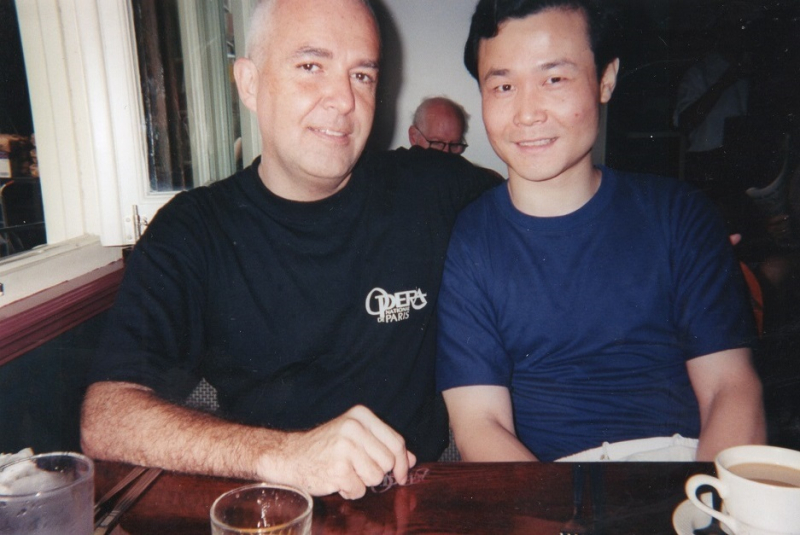
    Within two weeks of arriving in The City, I met Wei (above)…and I started a job in the opera room at Tower Records. My friends Paul and Tom had rented me their studio on Perry Street, and Wei and I were very cozy there for five years – a time period that included the 9/11 terrorist attack on the World Trade Center. I’ll never forget that morning, and rushing down to the street to see smoke pouring out of the Tower.

    15823701_10209672727348991_7172093874094922565_n

    My friend Richard (above) came down often during those years. and continued to do so until his untimely death in 2016.

    In 2003, Paul and Tom wanted their studio back, so Wei and I moved up to inwood. After a few weeks of feeling disoriented, I came to love it up here. Now, as the third act of my life/opera draws to a close, I keep wondering what the fourth act has in store for me. My friend Dmitry says, “The fourth act is the ballet!”

  • Dallas Symphony @ Carnegie Hall

    Luisi

    Above: Maestro Fabio Luisi

    Author: Shoshana Klein

    Sunday March 26th, 2023 – I have to admit to not knowing much about the Dallas Symphony Orchestra before tonight. I’ve seen Fabio Luisi guest conduct before but not work with his home orchestra. As it turns out, they put on a great concert – they played with energy, focus, and dynamic range, and Luisi does a great job of keeping things interesting and restrained to keep the music interesting later on. Despite, or maybe because of this, somehow the concert still had more people dropping things in the audience than any other concert I’ve ever been to.

    Negron jpg


    What keeps me awake by Angélica Negrón (above, photo by Quique Cabanillas) started the concert – a short 7-minute piece, but a very nice introduction to the concert. Negrón created a distinctive but not completely unfamiliar sound world – though this might have something to do with the fact that I listen to her band, Balún – which seriously, you should check out if you haven’t heard them. Negrón is the Composer in residence at the DSO and I’m looking forward to hearing more pieces that come out of that collaboration.


    The piece evokes uncertainty and wandering like her program note explains – navigating moving from Puerto Rico to New York City as a Latina composer trying to fit into spaces that historically excluded people who look like her.

    G o jpeg


    Rachmaninoff’s second piano concerto with Garrick Ohlsson (above) was very enjoyable. I’m usually in the balcony, and being on the orchestra level so close to the stage, I could actually feel the sounds through my feet when the brass let loose. The orchestra was super sensitive under Luisi, the piano sections drawing us all in and the louder sections contrasting well. Ohlsson played the 3rd movement with some extra snappiness, which was just enough to keep my full attention for a piece many of us have heard… somewhat frequently. Near the middle/end of the third movement, I think the piece loses steam a bit compositionally, but it almost makes the end more exciting – right around the time you start to be ready for it to be over, it gets into it again and heads for the hyper-romantic finish.


    Ohlsson did an encore that he announced from the stage, though it wasn’t really necessary – Chopin’s op 9 no 2, probably the most well-known of the nocturnes. Near the end, he had a little fun with it, adding some whimsy in places.


    The Tchaikovsky, (which started at almost 10pm, the joys of an 8:30 start time) was really well paced, restrained just enough more than usual to be noticeable. Some tempi choices in the second movement caught my ear, the bassoon solo section – while sounding great – was a little slow to me, and the horn solo also sounded good but a little fast. However, overall I chose to trust the plan as the whole piece came together really well. The wind soloists were all fantastic, and more soloistic than their counterparts in the first half of the concert.


    It’s played so much, but this is one of those pieces to me that if you put it away for long enough, it regains most of its charm. It turns out I hadn’t heard it in long enough that it felt fresh and new, at least with this exciting performance.


    ~ Shoshana Klein

  • Bach’s Matthäus-Passion @ The NY Philharmonic

    Bach

    Author: Ben Weaver

    Saturday March 25th, 2023 – J.S. Bach’s Matthäus-Passion, composed around 1724-27 (and revised through 1742), is arguably Bach’s greatest composition. Personally, I’d place it in the top ten greatest works of Western music. The NY Philharmonic performs it infrequently; the last time was in 2008 under the baton of Kurt Masur. Running at roughly 2:45 hours, the Matthäus-Passion is a work filled with passion and drama…more drama than most church music. Anyone mocking Verdi’s Requiem as being more opera than mass perhaps should take a closer look Bach’s greatest work. Verdi was following in Bach’s mighty footsteps. I was very glad to see it on the program this year, finally! I quite literally got chills as the work started and the chorus (Musica Sacra) sang the opening words: “Kommt, ihr Töchter, helft mir klagen.” Alas, the thrills did not last; I was sadly disappointed with tonight’s performance.

    Tenor Nicholas Phan sang the very difficult part of the Evangelist, who narrates the story of Jesus’ arrest, the debate over what his fate should be, his execution, and its immediate aftermath (the Passion ends before the resurrection.) Much of the drama of the work flows through the Evangelist’s words. Mr. Phan managed the difficult music very admirably, but the part can be a trap dramatically: there are many proclamations like “And Jesus said unto him.” How does one make each one sound fresh? I don’t have a clear answer. I suppose if it was easy, anyone would be able to do it. 

    Bass-baritone Davóne Tines’ Jesus (Mr. Tines was the only person on stage wearing a costume: a white, sleeveless robe) possesses a large voice; but it’s a voice with a guttural quality, which seldom opens or blooms.

    Mezzo-soprano Tamara Mumford, a favorite at the Metropolitan Opera across the Plaza, sang nicely. “Buß und Reu” in Part I was vocally steady and clear. But in Part II, Maestro Jaap van Zweden robbed Ms. Mumford and concertmaster Frank Huang of an opportunity to give their all in “Erbarme dich”, perhaps  the Passion’s most famous aria; certainly its most emotional and devastating piece. Written for solo voice, solo violin, and orchestra, this breathtaking music has the ability to stop time. Alas, Maestro van Zweden took it at a preposterous Allegro tempo; he absolutely wrecked it by turning it into a cabaletta. If your tempo is faster than John Eliot Gardiner’s, Nikolaus Harnoncourt’s, Trevor Pinnock’s, and Gustav Leonhard’s – you may consider looking at the score again.

    Amanda forsythe

    Soprano Amanda Forsythe (above), making her Philharmonic subscription concert debut with these performances, was sublime. Her ability to float pianissimi high notes was indeed spine-tingling. The aria “Aus Liebe will mein Heiland sterben,” which also includes a flute solo by Robert Langevin, was the highlight of the evening. 

    The Philharmonic’s Principal Associate Concertmaster, Sheryl Staples, had a chance to shine in “Gebt mir meinen Jesum wieder,” with a difficult solo. Unfortunately, bass Philippe Sly, making his Philharmonic debut with these performances, had pitch difficulties which offset Ms. Staples fine playing. Tenor Paul Appleby was superb all evening, the high tessitura of the aria “Geduld” presenting no difficulties for him.

    The Choral group Musica Sacra was in excellent form all evening, from the Chorales to dramatic exchanges representing specific characters. The Brooklyn Youth Chorus sang the opening and closing choruses of Part I, but did not return for Part II. Can’t say if that was intentional or if something kept them from returning.

    I do hope the Matthäus-Passion returns to the Philharmonic again soon – under a more caring conductor.

    ~ Ben Weaver

  • Bach’s Matthäus-Passion @ The NY Philharmonic

    Bach

    Author: Ben Weaver

    Saturday March 25th, 2023 – J.S. Bach’s Matthäus-Passion, composed around 1724-27 (and revised through 1742), is arguably Bach’s greatest composition. Personally, I’d place it in the top ten greatest works of Western music. The NY Philharmonic performs it infrequently; the last time was in 2008 under the baton of Kurt Masur. Running at roughly 2:45 hours, the Matthäus-Passion is a work filled with passion and drama…more drama than most church music. Anyone mocking Verdi’s Requiem as being more opera than mass perhaps should take a closer look Bach’s greatest work. Verdi was following in Bach’s mighty footsteps. I was very glad to see it on the program this year, finally! I quite literally got chills as the work started and the chorus (Musica Sacra) sang the opening words: “Kommt, ihr Töchter, helft mir klagen.” Alas, the thrills did not last; I was sadly disappointed with tonight’s performance.

    Tenor Nicholas Phan sang the very difficult part of the Evangelist, who narrates the story of Jesus’ arrest, the debate over what his fate should be, his execution, and its immediate aftermath (the Passion ends before the resurrection.) Much of the drama of the work flows through the Evangelist’s words. Mr. Phan managed the difficult music very admirably, but the part can be a trap dramatically: there are many proclamations like “And Jesus said unto him.” How does one make each one sound fresh? I don’t have a clear answer. I suppose if it was easy, anyone would be able to do it. 

    Bass-baritone Davóne Tines’ Jesus (Mr. Tines was the only person on stage wearing a costume: a white, sleeveless robe) possesses a large voice; but it’s a voice with a guttural quality, which seldom opens or blooms.

    Mezzo-soprano Tamara Mumford, a favorite at the Metropolitan Opera across the Plaza, sang nicely. “Buß und Reu” in Part I was vocally steady and clear. But in Part II, Maestro Jaap van Zweden robbed Ms. Mumford and concertmaster Frank Huang of an opportunity to give their all in “Erbarme dich”, perhaps  the Passion’s most famous aria; certainly its most emotional and devastating piece. Written for solo voice, solo violin, and orchestra, this breathtaking music has the ability to stop time. Alas, Maestro van Zweden took it at a preposterous Allegro tempo; he absolutely wrecked it by turning it into a cabaletta. If your tempo is faster than John Eliot Gardiner’s, Nikolaus Harnoncourt’s, Trevor Pinnock’s, and Gustav Leonhard’s – you may consider looking at the score again.

    Amanda forsythe

    Soprano Amanda Forsythe (above), making her Philharmonic subscription concert debut with these performances, was sublime. Her ability to float pianissimi high notes was indeed spine-tingling. The aria “Aus Liebe will mein Heiland sterben,” which also includes a flute solo by Robert Langevin, was the highlight of the evening. 

    The Philharmonic’s Principal Associate Concertmaster, Sheryl Staples, had a chance to shine in “Gebt mir meinen Jesum wieder,” with a difficult solo. Unfortunately, bass Philippe Sly, making his Philharmonic debut with these performances, had pitch difficulties which offset Ms. Staples fine playing. Tenor Paul Appleby was superb all evening, the high tessitura of the aria “Geduld” presenting no difficulties for him.

    The Choral group Musica Sacra was in excellent form all evening, from the Chorales to dramatic exchanges representing specific characters. The Brooklyn Youth Chorus sang the opening and closing choruses of Part I, but did not return for Part II. Can’t say if that was intentional or if something kept them from returning.

    I do hope the Matthäus-Passion returns to the Philharmonic again soon – under a more caring conductor.

    ~ Ben Weaver

  • Ensemble Intercontemporain @ Zankel Hall

    Ec
     
    Above: the players of Ensemble Interconterporain
     
    Author: Shoshana W. Klein
     
    Saturday March 25th, 2023 – If you’re a contemporary music performer or aficionado, chances are you’ve come across the Ensemble Intercontemporain – they are one of the quintessential contemporary music ensembles and they have a ton of recordings and videos on YouTube. The ensemble was created by Pierre Boulez in 1976, and I’d say that makes it one of the oldest of its kind, but in a lot of ways it’s actually still one of the only of its kind. The members are full-time, and while they’re based in Paris, the group’s performances are mostly on tour all over. Despite groups like Alarm Will Sound, the Boston Modern Orchestra Project, and others, the US certainly doesn’t have an analogous ensemble – all those that come to mind are different instrumentation, different focus, and certainly not full-time for 31 members. Of course, that’s probably partially due to funding structure differences – Ensemble Intercontemporain is funded by the French government as well as by touring. The ensemble defines contemporary as 20th and 21st century pieces – though surely not all 20th century work, remembering that Rachmaninoff and Respighi were composing far into the 20th century that this group certainly wouldn’t consider in their wheelhouse. 
     
    The concert started with Arnold Schoenberg’s 5 Pieces arranged for this size ensemble. The short, extremely lyrical, and fully engaging movements were a good start to a concert in which the other two pieces were 45 minutes each. The ensemble works incredibly well together – I felt that particularly the woodwinds had a huge range of timbres and dynamics. 
     
    Next was Matthias Pintscher’s sonic eclipse, a kind of double concerto. The premise is very interesting, in which the first and second movements are each “celestial bodies” and the third is called “occultation” and describes the eclipse. The first movement has a trumpet soloist (Clément Saunier), the second a horn soloist (Jean-Christophe Vervoitte), and both in the third. While I’m not sure I heard the intended sonic eclipse, I was able to appreciate a lot of the sonic textures – the timbral flexibility of all of the players combined with the writing meant that I often could barely tell where a sound was coming from – they were able to match each others’ sounds so well. At one point the string tremolo was matching the trumpet soloist flutter tongue in a way that I would not have thought possible beforehand.
     
    Boulez
     
    Above: Pierre Boulez
     
    The last piece – Boulez’s Dérive 2 – had such a sustained energy throughout the 45 minutes that it made me think again about how many ensembles and how many players in the world can play this music, not to mention exceptionally. It’s not played live often, understandably.
     
    This program was very much the ensemble’s traditional repertoire – significant pieces by their founder, current music director (Pintscher, also conducting), and Schoenberg. There’s definitely something to be said about a contemporary ensemble that has such a canon of its own – is it a little bit of a contradiction? Or a difference in defining “contemporary”? It might be worth noting that while they have plenty of newer members – much of the ensemble seemed on the younger side – the group of around 20 people performing seemed to have three women, and of the full 31 members listed on the website, I saw five. 
     
    Despite the difficulty of the whole concert, the ensemble consistently seemed to be enjoying themselves, as did the audience – the almost full house called Pintscher back on stage something like 5 times with a long standing ovation.
     
    ~ Shoshana W. Klein