
The Norwegian-born mezzo-soprano Lorri Lail sings Mahler’s Kindertotenlieder with the Berlin Radio Symphony conducted by Rolf Kleinert.
Listen here.
In memory of my brother, Jeffrey Morse Gardner, who passed away on September 26th, 2023.
The Norwegian-born mezzo-soprano Lorri Lail sings Mahler’s Kindertotenlieder with the Berlin Radio Symphony conducted by Rolf Kleinert.
Listen here.
In memory of my brother, Jeffrey Morse Gardner, who passed away on September 26th, 2023.
Author: Oberon
Sunday September 24th, 2023 – This evening at Westbeth, dancers Miki Orihara and Ghislaine van den Heuvel joined a fantastic ensemble of musicians in a program entitled ONOKORO – creations/beginnings. The production, Tokyo to New York, is under the artistic direction of Thomas Piercy; the performance took place at the Martha Graham Studios.
Onokoro comes from the ancient Kojiki, Japan’s oldest mythology; it was the name of the first island formed by the gods Izanagi and Izanami when they were creating Japan. The evening’s program took us on a musical and spiritual journey from “Ryoanji” (the first sounds) to “Netori, Netori” (the emergence of organized sound and music), and onward thru to “Onokoro” (which combines the Eastern and Western styles of music and movement).
The Graham space at Westbeth was the perfect setting for this production. As the house lights went out and silence fell over the space, the studio’s large windows created a feeling of l’heure bleue, that fleeting time when day yields to night. In the darkness, the musicians took their places to perform John Cage’s 1985 work “Ryoanji”. The only source of light in the room was the tablets from which the musicians read their scores. The piece opens with a kneeling percussionist, Marina Iwao, striking a bell; this summons is repeated insistently throughout the piece. Thomas Piercy plays the hichikiri, a small double-reed Japanese instrument which seems like a cross between flute and oboe. Mr. Piercy is joined by two other hichikiri players: Lish Lindsey and James Joseph Jordan. The sound of their instruments veers from sighs and whispers to squawking and whining. The audience seemed intrigued by the music.
Mr Piercy now took up his clarinet for Bin Li‘s clarinet concerto “Netori, Netori”. A seated Gagaku ensemble – Ms. Lindsey and Mr. Jordan joined by Harrison Hsu (sho) and Masayo Ishigure (koto) – create fascinating, otherworldly musical colours which are plucked or piped. As Mr. Piercy begin to play, dancer Maki Yamamae appears, dressed as a young warrior and carrying a ceremonial spear. The space is illuminated in golden light as the the slow ritual dance evolves in a series of poses. Mr. Piercy illuminates the music with soft trills and warblings, and the sound of escaping air; his dynamic control is uncanny. There are silent pauses in the music, and eventually the ensemble rejoins. Following the dancer’s exit, there is a quirky coda for the clarinet.
Two works having their world premieres at these concerts came next. The first, Gilbert Galindo‘s “Primordial” for clarinet, cello, and piano, opened with a somber cello passage, introducing us to an extraordinary cellist: Daniel Hass. Mr. Piercy again took up his clarinet for this work, and Ms. Iwao was at the keyboard. Galindo’s pensive music is hauntingly beautiful, bringing us a magical mixing of timbres. Mr. Hass produced shivering tremolos while Ms. Iwao found poetic depths in the piano’s lower octaves, and Mr. Piercy’s lambent tone and dynamic variety made for an engrossing experience.
After the briefest of pauses, the players proceeded to the second premiere, Miho Sasaki’s “黎明 – reimei – Dawn”. Here Mr. Piercy traded his clarinet for the ohichiriki. This music is intense, with threads of melody woven in amidst jarring harmonies. From this emerges high, delicate figurations from Ms. Iwao’s keyboard, while Mssrs. Piercy and Hass create a very distinctive tonal blend. The music, veering from disturbing to reassuring along the way, was very impressively served by these three musicians. And both the Galindo and the Sasaki works seemed to me ideal candidates for choreography.
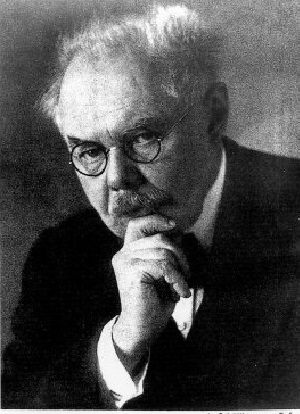
Above: composer Richard Wetz (1875 – 1935)
Listen to Richard Wetz’s’ REQUIEM here. Read about this forgotten composer here.
The soloists are Marietta Zumbült, soprano, and Mario Hoff, baritone, with the Dombergchor Erfurt, the Philharmonischer Chor Weimar, and the Thüringisches Kammerorchester Weimar.
Conductor: George Alexander Albrecht

Above: composer John Zorn; Sae Hashimoto, percussion; Jay Campbell, cello; Michael Nicolas, cello; Ches Smith, percussion
~ Author: Shoshana Klein
Thursday September 21st, 2023 – This was my first official concert of the 23/24 season and it was a good way to start off the year!
Composer John Zorn has a series of concerts marking his 70th, spanning the city and the season. He started over the summer, with concerts at Roulette, and now has a series at the Miller Theater. I heard at this concert about some other ambitious projects he’s done to mark other decades of his life, and given that, this series seems like it might be on the tamer side of things.
Zorn is a staple of the NYC music scene – I’ve already seen him around a few times, having only lived here for year. He’s usually in some variation of a black hoodie and camo pants, no matter the context.
This concert, called “Music for Strings”, began with a trumpet duet that Zorn came out to introduce with his usual casual demeanor. He referenced Stravinsky as an influence in his short introduction of the piece, which was definitely noticeable in the high-ranged, rhythmically complicated duet.
I’ll admit in general I don’t have a great handle on Zorn’s music – he has such a wide range, spanning jazz, classical, and of course his “game music”. It’s hard to get a sense of his personal style, other than sort of energetic and fast-paced, with quick and frequent changes in style and mood.
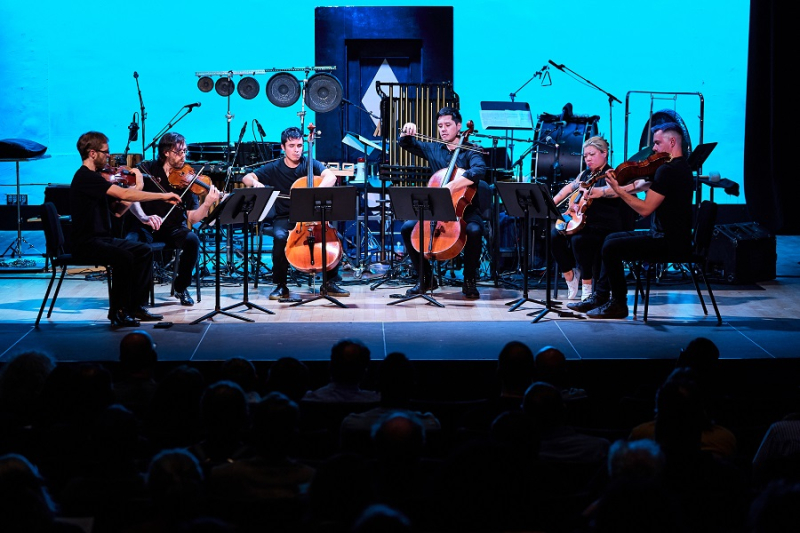
Above: Christopher Otto, violin; David Fulmer, violin; Jay Campbell, cello; Michael Nicolas, cello; Yura Lee, viola; John Pickford Richards, viola. Photo by Rob Davidson
The other three pieces on the program were written during lockdown. The first – for string quartet plus extra cello – was called Sigil Magik: A Curious and Detailed Exposition of Sigils, Signs, and Hieroglyphs Peculiar to the Occult Orders, Hermetic Brotherhoods, and Dark Mystery Schools of the Late Middle Ages. The name reminds me of a Terry Pratchett book, and in a similar way it was engaging and whimsical (and not very long).
The Gas Heart, a mini opera based on the play by Tristan Tzara, was the centerpiece of the show, and at least the one I found most enjoyable. Zorn said in his introduction to it that he was drawn to Tzara and the dadaists as a teenager, and that it was full of “quiet sounds that will probably make your ears bleed”. The piece had some of the energy of his game pieces: sudden and frequent switches between wildly different moods, particularly in the first act. Each performer had speaking roles and a microphone.
There was never a dull moment, as the piece included interesting sounds such as percussionists slurping water in bowls by their microphones, screaming (sometimes words, sometimes not), the cellists bowing above their fingering hands, an on-stage prop door that was slammed at the beginning and the end of the piece, a real saw, and at least one pair of tap dancing shoes.
I wish I had some familiarity with the play to have some context, but even without, it was a spectacle.
Prolegomena to Any Future Metaphysics That Will Be Able to Present Itself as a Science was the last piece on this program. Zorn – who I still can’t quite read to know exactly how serious he is (my guess is, not very) – said: “…occasionally you create something you never thought you were capable of creating…” (this part I think was sincere) and then he went on to say that it might be the greatest string sextet ever written.
I think someone with a better ear for form may have gotten more out of this piece, but it certainly had interesting moments and started to make me feel like I was getting an understanding for Zorn’s style. A standout for me was when he brought back the technique for all the players of playing the fingerboard above the fingering hand, this time for a haunting early music chorale sound.
All in all, an interesting evening.
~ Shoshana Klein
Performance photos by Rob Davidson, courtesy of The Miller Theatre at Columbia University.
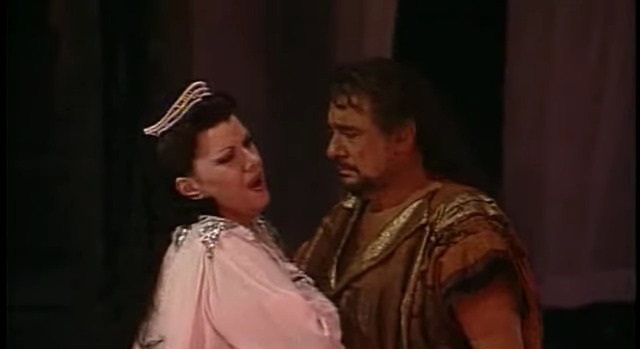
From the Palacio de Bellas Artes in Mexico City comes a 1998 performance of Camille Saint-Saëns’ SAMSON ET DALILA starring Barbara Dever and Placido Domingo. Genaro Sulvaràn is the High Priest, and Guido Guida conducts.
Watch and listen here.
Between 1992 and 2014, Barbara Dever sang nearly 100 performances with the Metropolitan Opera; I saw her excellent Amneris and Ulrica there. Genaro Sulvaràn sang the role of Count de Luna at he Met in 1999 and made a vivid impression.

It is very sad to read of the death of the American tenor Stephen Gould. Earlier in the summer, he had been diagnosed with bile duct cancer, and his demise was swift.
Born in 1962 in Virginia, Mr. Gould graduated from Olivet Nazarene University with a Bachelor of Arts in 1984.
He first made a name for himself in music theatre, singing some 3,000 performances in Andrew Lloyd Webber’s musical, PHANTOM OF THE OPERA. Turning to opera, he developed into a formidable heldentenor.
Among his signature Wagnerian roles were Siegfried, Tristan, Tannhäuser, and Parsifal; he also took on the arduous roles of Florestan, the Emperor in FRAU OHNE SCHATTEN, Bacchus, and Otello.
Mr. Gould performed at the major opera houses of the world, including the the Wiener Staatsoper, the Bayreuth Festival, Bayerische Staatsoper, Teatro Massimo di Palermo, Berlin State Opera, and the Teatro dell’Opera di Roma.
I first heard Stephen Gould on a radio broadcast of Wagner’s RING Cycle from the 2006 Bayreuth Festival. He was truly impressive, and his was the outstanding performance in the Cycle, conducted by Christian Thielemann.
Finally, in November 2019, I had the chance to experience Mr. Gould’s singing live, when the National Symphony Orchestra offered a concert performance of Act II of TRISTAN UND ISOLDE under the baton of Gianandrea Noseda at Devid Geffen Hall. This was my reaction:
“Veteran heldentenor Stephen Gould, now 57 years old and with years of singing opera’s most demanding tenor parts behind him, displayed a voice of prodigious power and tonal steadiness. He knows Tristan’s music so well, and he lives it fully. While his clarion singing rang amply thru the hall, he also has the tenderness of expression for “O sink hernieder, nacht der liebe…” And as the act moves towards its devastating ending, Mr. Gould’s magnificent singing of the moving passage “Wohin nun Tristan scheidet,willst du, Isold’, ihm folgen?” (“Where Tristan now shall go, will you, Isolde, follow?”) carried us to that exalted place where a great Wagnerian singer can take us.”
My friends who were at that performance with me were equally thrilled by Mr. Gould’s performance, and in the ensuing years his name would come up when we spoke of great performances we had witnessed. It speaks volumes when a singer can make such a memorable impression in a concert setting of single act of an opera.
Listen to Stephen Gould in the final minutes of Act II of TRISTAN UND ISOLDE here.
~ Ruhe jetzt, geliebter Held.

Dame Gwyneth Jones (above) sings the title-role in a performance of Richard Strauss’s ELEKTRA given at Orange in 1991.
Watch and listen here.
Elektra: Gwyneth Jones; Chrysothemis: Elisabeth Connell; Klytemnestra: Leonie Rysanek; Orestes: Simon Estes; Aegisth: James King
Conductor: Marek Janowski
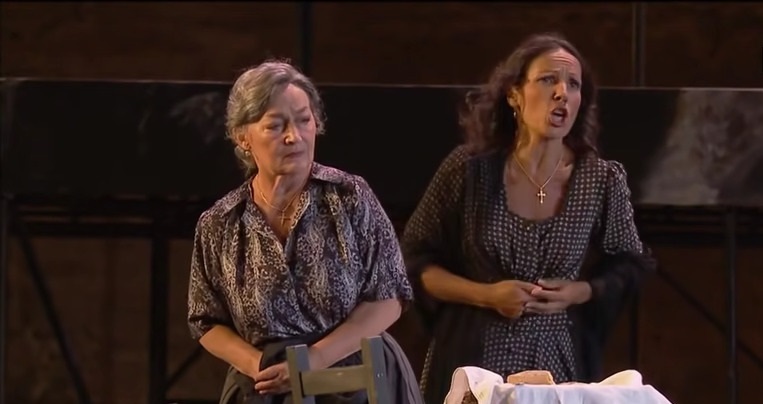
Above: the great Polish mezzo Stefania Toczyska as Mamma Lucia and as Santuzza
A performance of Mascagni’s CAVALLERIA RUSTICANA given at Orange in 2009.
Watch and listen here.

A performance from France 3 of Verdi’s LA TRAVIATA given in the Spring of 2019, conducted by Daniele Rustioni with Ermonela Jaho (above), Francesco Meli, and Placido Domingo in the leading roles.
Watch and listen here.
 Oberon's Glade