Author: Philip Gardner

  • Sinopoli: PARSIFAL @ Bayreuth ~ 1998

    Sotin elming

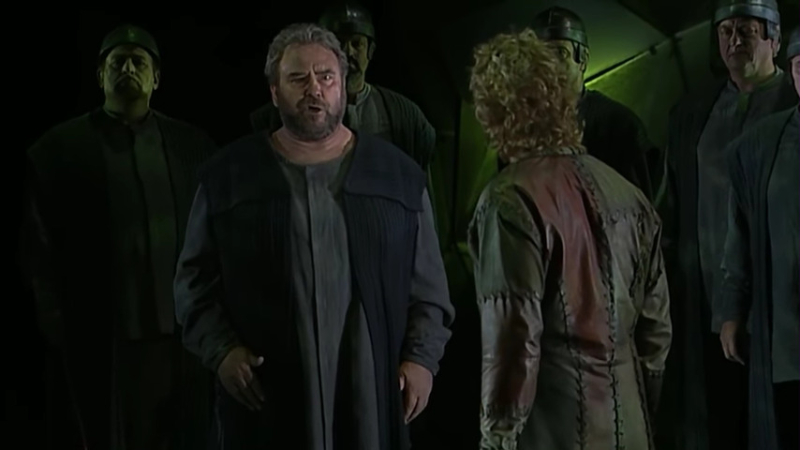
    Above: Hans Sotin as Gurnemanz, Poul Elming as Parsifal

    Wagner’s PARSIFAL from the 1998 Bayreuth Festival, conducted by Giuseppe Sinopoli.

    Watch and listen here.

    Cast:

    Amfortas – Falk Struckmann
    Titurel – Matthias Hölle
    Gurnemanz – Hans Sotin
    Parsifal – Poul Elming
    Klingsor – Ekkehard Wlaschiha
    Kundry – Linda Watson
    Grail Knights: Richard Brunner, Sándor Sólyom-Nagy
    Squires: Sarah Fryer, Jane Turner, Helmut Pampuch, Peter Maus
    Alto solo: Andrea Bönig 

    Flower Maidens: Claudia Barainsky, Joyce Guyer, Simone Schröder, Katerina Beranova, Dorothee Jansen, Laura Nykänen

  • MAGIC FLUTE @ The Met

    Joelle Harvey

    Above: soprano Joélle Harvey, this evening’s Pamina

    Monday December 26th, 2022 – The Met’s pared-down, English-language MAGIC FLUTE always offers a chance to hear interesting singers, from veterans to debutantes. Tonight’s cast featured a longtime favorite, Alan Held, as the Speaker, and the Polish soprano Aleksandra Olczyk as the Queen of the Night in her Met debut season.

    Under Duncan Ward’s baton, the opera flew by. A packed house gave only meager applause to the arias (Ms. Olczyk’s “wrath of hell” aria being the exception). But at the curtain calls, it was Joélle Harvey who received the greatest barrage of cheers…and rightly so, for she sang exquisitely.

    Ben Bliss was an excellent Tamino, finely shaping and enunciating his Portrait Aria (which is cruelly shortened in this production) and truly impressive at “O endless night…”, the opening phrase of Tamino’s great scene with The Speaker. For me, this is the pivotal passage of the opera, and Mr. Held’s responses to Mr. Bliss’s questions had gravity and meaning. Excellent, gentlemen!

    The Three Ladies (Jessica Faselt, Megan Marino, and Carolyn Sproule) sounded overly-vibrant at first, but soon smoothed things out and did some fine singing. I especially liked Ms. Sproule’s timbre: it is the lowest voice that gives the Ladies’ trios their moving parts.  The Three Spirits were rather weak at first, but they later perked up. I love their advice to the suicidal Papageno: “You have a life, so live it while you can!”

    Joshua Hopkins was again a very enjoyable Papageno, sure of voice and clear of diction. Soloman Howard sang Sarastro’s two great arias with nobility and rich tone, and – at the opposite end of the vocal spectrum – Aleksandra Olczyk tossed off the Queen of the NIght’s pyrotechnics successfully: the voice brightens at the top, making the high-Fs easy targets for her.  A bit of pitchiness did not deter from her success.

    Rodell Rosel repeated his crafty Monastatos, and Lindsey Ohse’s spirited Papagena showed her lustiness in the spoken dialogue: I think she will be wearing the pants in that marriage.

    Ms. Harvey walked away with top honors this evening; Pamina’s aria had a tonal shimmer that fascinated me, especially in the floated piani notes, which gave me goosebumps. The soprano’s luminous sound at “Be truthful…be truthful...” was matched soon after with her radiant “Tamino mine…”

    ~ Oberon

  • Voici des Roses

    1

    “Here are some roses,
    Of this enshrouded night.
    On this fragrant bed,
    Oh, my Faust, beloved…rest!
    In a voluptuous sleep
    You will feel
    More than a scarlet kiss.
    While flowers on your bed
    Open their petals,
    Your ear will hear
    Divine words.
    Listen, listen!
    The spirits of the Earth and the air
    Begin for you
    An exquisite concert of dreams.”

    Arthur Endrèze – La Damnation de Faust ~ Voici des roses

    ~ Photo: Kokyat

  • Christmas Eve 2022 @ Carnegie Hall

    R rengel

    Above: violinist Rubén Rengel

    Saturday December 24th, 2022 – Spending Christmas Eve at Carnegie Hall with my longtime friend Rob Scott, we enjoyed the New York String Orchestra‘s annual holiday concert which brought us music by Elgar, Mozart, Bach, and Tchaikovsky. Jaime Laredo was on the podium, and the Venezuelan violinist Rubén Rengel was the soloist in a Bach violin concerto. The venerable Hall was packed to the rafters with music-lovers who ventured out on an extremely frigid, windy night to hear great music in the most perfect setting. 

    The New York String Orchestra is a young orchestra: as the players in this pre-professional ensemble took the Carnegie Hall stage, we were struck by their youthful energy and by their sense of dignity. Moments later, we were thrilled by the sheer richness and beauty of the sound they produced.

    Edward Elgar’s Introduction and Allegro, Op. 47, opened the concert. Composed in 1905 for performance in an all-Elgar concert by the newly-formed London Symphony Orchestra, the score calls for a string quartet and string orchestra. The NYSO’s concertmaster, Steven Song, led the quartet which further featured Minji Lee (Principal violinist), Raphael Masters (Principal violist), and Camden Michael Archambeau (Principal cellist).

    From note one of the Elgar, the players filled the Hall with music of abundant warmth, played with passion and poise. Among the quartet, violist Raphael Masters’ playing of a solo passage early on exemplified the high level of musicianship and tonal polish these young people have already achieved. The Elgar flowed on, with the agitated Allegro sections alternating with stretches of big lyricism that had the feeling of a classic film score. A fugue highlighted the sonic allure of each of the orchestra’s sections, and  – all evening, actually – the basses were extremely pleasing to hear.

    Mozart’s Divertimento in D-Major, K. 136, was luxuriantly played; the opening Allegro, with its familiar theme, was taken at a perfect tempo by Maestro Laredo. The Andante was noble and gracious, highlighted by silken sustained tones from Mr. Song’s violin. The steady pulse of the concluding Presto was finely sustained, whilst the music winks at us with sly touches of wit.

    Mr. Rengel now joined the orchestra for J. S. Bach’s Violin Concerto in A-Minor, BWV 1041. We had heard – and greatly enjoyed  – Mr. Rengel’s playing earlier this season with Ensemble Connect at Weill Hall. Tall and slender, the handsome Venezuelan caught the dancing spirit of the concerto’s lilting Allegro. In the Andante, his sweet tone and technical finesse produced enticing subtleties, his control of dynamics drawing us in to the music. The concluding Allegro assai again had a dance-like feeling, and Mr. Rengel’s fluency in rapid passages was a delight to the ear. The violinist, who had held the Hall in a palpable state of silence during this performance, was warmly cheered by the audience at the end, his colleagues onstage joining in the applause.

    Jaime laredo

    Above: Maestro Jaime Laredo

    Very high on my list of favorite musical works is Tchaikovsky’s Serenade for Strings. Like so many other people, I fell in love with this moving and melodious work through performances of Balanchine’s ballet Serenade at New York City Ballet. Tonight, hearing it in concert form, with the movements in their original order (Mr. B had placed the fourth movement before the third) was an immersive experience for me. The music was played with such heartfelt tenderness by these young people, the celli and basses constantly sending waves of poignant nostalgia thru me as memories – both sad and lovely – of past loves filled my mind.

    The love of music has, from a very early age, meant so much to me…most especially thru the dark years of my teens. Music is a constant lover: always there for me with its timeless, saving grace.  

    ~ Oberon

  • O Holy Night

    O holy night

    Norman Treigle and Audrey Schuh sing “O Holy Night“. Listen here.

  • Britten’s CEREMONY OF CAROLS

    Xmas

    Perfect music for the Yuletide: Benjamin Britten’s CEREMONY OF CAROLS performed by The Singers, Matthew Culloton, conductor. Soloists are Min Kim, Harp; Jessie Braaten, soprano; Susanna Mennicke; soprano, Diane Koschak; sorpano, Britta Fitzer, alto; and Jessica Bandelin, alto.

    Watch and listen here.

  • Britten’s CEREMONY OF CAROLS

    Xmas

    Perfect music for the Yuletide: Benjamin Britten’s CEREMONY OF CAROLS performed by The Singers, Matthew Culloton, conductor. Soloists are Min Kim, Harp; Jessie Braaten, soprano; Susanna Mennicke; soprano, Diane Koschak; sorpano, Britta Fitzer, alto; and Jessica Bandelin, alto.

    Watch and listen here.

  • CMS Brandenburgs ~ 2022

    Bach

    Tuesday December 20th, 2022 – Chamber Music Society of Lincoln Center‘s annual presentation of Bach’s Brandenburg Concertos is always a highlight of the New York concert season, and this year these immortal works maintained their ‘masterpiece’ status as the Society rounded up a spectacularly talented team of players. As is the CMS custom, the concertos are presented in a different order each year, and the program is given three times in order to accommodate all the music lovers who are craving a holiday alternative to the Messiah and the Nutcracker.

    This evening, a packed house enthusiastically responded to music-making of the highest level. As a special treat, the gentlemen of the Escher Quartet joined the lineup; I love these guys, both as musicians and as personalities. 

    The program opened with the 5th Brandenburg, which belongs to the harpsichordist. Shai Wosner played the long cadenza with striking clarity and elegance. Violinist Daniel Phillips and cellist Sihao He then joined Mr. Wosner for a gorgeous  rendering of the Affetuoso, Clad in a royal purple gown, flautist Sooyun Kim dazzled with her luminous tone and deft technique. The complimentary string trio of violinist Aaron Boyd, violist Paul Neubauer, and bassist Lizzie Burns were excellent. Ms. Burns and Mr, Wosner went on to be pillars of musical perfection as the evening flowed onward.

    Next up was the 2nd Brandenburg, with trumpet virtuoso Brandon Ridenour sailing superbly thru the music. Mssrs. He and Wosner were joined by violinist Brendan Speltz, flautist Demarre McGill, and oboist James Austin Smith in weaving a lovely tapestry of sound in the Andante. Adam Barnett-Hart, Aaron Boyd, and Pierre Lapointe formed an admirable string trio, and it is always wonderful to hear Peter Kolkay offering his mellow bassoon tone to the music. In the concluding Presto, Mr. Ridenour and Mr. Smith vied with one another as they traded phrases, much to our delight.

    In the 4th concerto (in G-major), violinist Adam Barnett-Hart was very much in his element, alternating sustained tones of gentle lustre and with passages of high-speed coloratura. Duetting flautists Demarre McGill and Sooyun Kim dazzled the ear with the swift surety of their playing in the outer movements, and tugged at the heartstrings with the poignant harmonies of the central Andante. Ms. Burns and cellist Brook Speltz brought just the right weightiness of sound to counter-balance the high voices of the flutes and violin. In the final Presto, Mr. Barnett-Hart displayed incredible virtuosity.

    Following the interval, the 1st concerto, brought forth two horn players, Michelle Reed Baker and Julia Pilant, festively gowned (respectively) in red and green. They sounded as fine as the looked, and their duetting harmonies drew plushy responses from a trio of oboists: Stephen Taylor, James Austin Smith, and Randall Ellis. Mr. Kolkay’s dulcet bassoon playing has a prominent role here. The horns are silent during the poignant Adagio, where Aaron Boyd and the oboe trio spun pleasing harmonies over velvety unison phrases from Mihai Marica’s cello and Ms. Burns’ bass. The high horns swing into the jaunty Allegro, after which a wave of applause greeted the players. But there’s still a fourth movement – a mix of minuet and polonaise – in which separate choirs of winds and strings alternated, keeping the musical textures fresh til the end.

    The 6th concerto features pulsing cello and bass figurations, and duetting violas (Mssrs. Neubauer and Phillips). Mr. Neubauer and cellist Sihao He (graciously accompanied by Ms. Burns’ bass) drew us in to the moving tenderness of the Adagio, Mr. He concluding with a brief cadenza. Then without pause, the sneaky start of the closing Allegro begins to sweep us along. Mr. He dazzled us with his swift, fluent playing, whilst the two violists had a field day with the fast-paced music. This Allegro induced fervent applause from the crowd.

    The evening’s finale, the 3rd concerto, is a particular favorite of mine; it calls for three violins (Mssrs, Boyd, Brendan Speltz, and Barnett-Hart), three violas (Mssrs. Lapointe, Phillips, and Neubauer) and three cellos (Mssrs. Marica, He, and Brook Speltz), whilst the dedicated Wosner/Burns duo kept everything merry and bright. This concerto is unusual in that its “phantom” Adagio movement consists only of a brief passage from Mr. Wosner’s keyboard. Bach immediately sends the players back into a swirling Allegro. The evening’s performance drew to an end, the audience rising to hail the players with great – and much-deserved – enthusiasm. A second bow was called for, and then we headed out into the chilly night air, our spirits fortified by glorious music of Bach.

    ~ Oberon
  • Stéphane Degout ~ Chansons Madécasses

    Snapshot degout

    Maurice Ravel’s Chansons Madécasses performed by baritone Stéphane Degout with Michaël Guido (piano), Matteo Cesari (flute), and Alexis Descharmes (cello). The concert took place at the Amphithéâtre Bastille, Paris, in May of 2015.

    Watch and listen here.

  • Uta-Maria Flake ~ Träume

    Wesendonck

    German soprano Uta-Maria Flake (1951-1995) sings “Träume” from Richard Wagner’s Wesendonck-Lieder; her interpretation is rather unusual, but I like it.

    Listen here.

    “Ms. Flake studied at the Hamburg University of Music and, as a scholarship holder of the Hamburg State Opera, at Indiana University in Bloomington (USA). Further training by Tito Gobbi in Florence and by Mario del Monaco in Lancenigo. As early as 1971 she took part in a television recording of Offenbach’s ORPHEUS IN THE UNDERWORLD from the Hamburg Opera. In 1973 she won first prize in the national singing competition, and in 1974 she was a prizewinner at a concours in Montepulciano. She began her actual stage career in 1975 at the Stadttheater in Ulm, where she made her debut as Leonora in Verdi’s FORZA DEL DESTINO. From 1976-80 she was a member of the Dortmund Opera House. Here in 1979 she sang Eve in the German premiere of the opera PARADISE LOST by Penderecki; this was followed by guest appearances in this role at the Munich State Opera, at the Warsaw Opera and (in concert version) at the Salzburg Festival. From 1980-83 she was engaged at the Staatsoper Stuttgart, where she sang her great roles: Beethoven’s Leonore and Weber’s Agathe, Wagner’s Elsa and Eva, and Offenbach’s Giulietta.

    She made successful guest performances at the State Theater in Hanover, at the Deutsche Oper am Rhein Düsseldorf-Duisburg, at the State Opera (as Lisa in PIQUE DAME) and at the Deutsche Oper Berlin (as Leonore), at the Covent Garden Opera London (as Elsa and as Freia), at the Teatro San Carlos Lisbon (Freia, Sieglinde, Gutrune and 3rd Norn), at the Cologne Opera House (Tchaikovsky’s Lisa), and at the Teatro Verdi in Trieste and at the Stadttheater in Basel as Sieglinde in WALKURE. Ms. Flake was also a concert soloist and lieder recitalist.”