Author: Philip Gardner

  • Schultz/Rouvali @ The NY Philharmonic

    Composer

    Above: composer Žibouklė Martinaitytė, photo by Romas Jurgaitis

    Author: Ben Weaver

    Saturday February 19th, 2022 – As we all anxiously await the reopening of David Geffen Hall (née Philharmonic Hall, then re-christened Avery Fisher Hall) at Lincoln Center in Autumn 2022 (two years ahead of schedule!), the orchestra returned to the Rose Theater at Jazz at Lincoln Center for a concert featuring Richard Strauss, Tchaikovsky and a US Premiere of a recent work by Žibouklė Martinaitytė.

    Born in St. Petersburg (then Leningrad), USSR, but raised in Lithuania and now based in NYC, Ms. Martinaitytė’s gripping 2019 work Saudade received its US Premiere in these NY Philharmonic performances. The word “saudade” is Portuguese and has no direct English equivalent, but it comes close with “longing,” (or as Madonna described it when covering Césaria Evora’s great ballad “Saudade” during her Madame X Tour: “yearning.”) To be honest, I’m not entirely certain what Ms. Martinaitytė is longing for in her Saudade, which is rather dark and ominous. But that’s not important when the music is this hypnotic. Much of the composition is played at a steady, slow pace, with strings providing the canvas on which the rest of the orchestra makes its contributions. There is something of Arvo Pärt here, though more varied in orchestration. Martinaitytė’s orchestra is huge, with numerous brass and percussion instruments (including, three trombones, tubular bells, and vibraphone), but unlike the lazy “throw in the kitchen sink ” noise of a composer like Christopher Rouse (who Albert Gilbert subjected us to for several seasons), Ms. Martinaitytė’s use of every instrument on stage is always economical and perfectly woven into the tapestry of sound, not just smashing a gong to cover up inadequate musical transitions – something numerous contemporary composers do with abandon. As she slowly builds Sodade to its climaxes and retreats, the work most reminded me of the freezing winds of Sibelius and crashing waves of John Luther Adams. Although unlike John Luther Adams (not to be confused with John Adams), Ms. Martinaitytė believes in brevity. She tells the whole story in about 15 minutes of Saudade. This is a beautiful and gripping piece. Maestro Santtu-Matias Rouvali, currently artistic director of the Philharmonia Orchestra in London, shaped it superbly, and the orchestra seemed to enjoy its challenges. They applauded Ms. Martinaitytė warmly when she came up on stage for a bow: the crowd seemed truly impressed.

    The work Saudade has been recorded by the Lithuanian State Symphony Orchestra conducted by Giedrė Šlekytė, and is available on the Ondine label. It is highly recommended.

    Richard Strauss’ Brentano-Lieder, Op. 68, were composed in 1918 following a lengthy break from lieder composition, and on the heels of completing ROSENKAVALIER, both versions of ARIADNE AUF NAXOS, and DIE FRAU OHNE SCHATTEN. This is relevant because you can hear all three of these operas in these Brentano songs, and that is perhaps the reason they are infrequently performed as a set: the style of composition is so different from song to song that it’s difficult to find as singer who can cover the full spectrum of Straussian styles in less than 25 minutes. Over the years, some of these songs have been performed at the Philharmonic, by Beverly Sills, Kathleen Battle, Barbara Bonney, and Deborah Voigt, but they did not sing the same songs.
    Golda

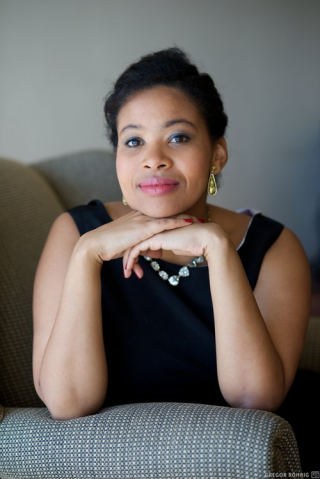
    Above: Golda Schultz, photo by Gregor Röhrig

    Fortunately the orchestra found an interpreter who managed to not only survive the challenge, but do so with flying colors. Young South African soprano Golda Schultz, who now resides in Bavaria, made a stunning Philharmonic debut with these performances. She has a silky, beautiful voice, even throughout the range, from a secure bottom (which she wisely does not force) to a ringing and full top. “Säus’le, liebe Myrtle!” and “Amor” could be outtakes from Zerbinetta, the more thoughtful in the former and coquettish in the latter, and Ms. Schutlz managed the runs and playful coloratura with aplomb. The lyrical yearning of “An die Nacht” could be Sophie’s wedding night jitters, and wildly passionate “Als mir din Lied erklang” a desperate outburst of the Composer. Ms. Schultz already sings Sophie and I think she’d make a marvelous Composer too. (Originated by Lotte Lehmann, it’s not really supposed to be sung by mezzo-sopranos.) And finally DIE FRAU OHNE SCHATTEN comes blaring in with an Empress-inspired “Ich wolf ein Sträußlein binden” – lyrical and passionate, with some light coloratura, Ms. Schultz never pushed her voice, but showed a simple pleasure of passion and signing. The final song of the cycle, “Lied Der Frauen,” is something the Dyer’s Wife could have sung. Perhaps here Ms. Schultz was reaching the limits of her current vocal comfort, but she did not become desperate and Maestro Rouvali did not allow the orchestra (massive, echt-Strauss sound) to cover her. If the Dyer’s Wife – a vocally brutal role – would be beyond Ms. Schultz’ natural capabilities, I think the Empress is a role she should seriously consider taking on. Ms. Schultz is an exciting young singer and was greeted appreciably by the audience. (…which did applaud after each song…but what can you do?)

    Rouvali

    Santtu-Matias Rouvali (above, photo by Chris Lee) concluded the concert with Tchaikovsky’s familiar Symphony No. 5. It is a long favorite of the public, even though after the premiere Tchaikovsky – in his typical manner – declared it his worst composition and that the public only pretended to like it. Perhaps Maestro Rouvali took the slow parts a bit too slow, they began dragging from the opening pages of the score. But anything above Adagio took on a playful pep and interesting rhythms. The Valse was perhaps the most successful of the movements, a warm and well judged pacing, lovingly shaped by the orchestra. The finale, too, was thrilling. This is music the orchestra has played many times and they seem to relish it once again.

    Since NY Philharmonic music director Jaap van Zweden is leaving the Philharmonic, people are speculating that every conductor who steps on the podium is auditioning for the post. This is certainly true of Maestro Rouvali. New York could certainly do much worse. I’d argue it has.  Worth noting currently Rouvali is principal conductor of the Philharmonia Orchestra, chief conductor of the Gothenburg Symphony, and chief conductor and artistic director of the Tampere Philharmonic Orchestra.

    Another interesting note on the state of the current Covid-19 pandemic and wearing of masks. One thing that has historically been difficult not to notice is how noisy NYC audiences frequently are. Many nights – and not only in the cold season – it sounds like a consumption ward with someone hacking up a lung every moment of a concert. This was not the case at this concert. One thing the CDC has noted is that, no doubt due to wearing of masks, very few people have gotten sick with the common cold. I don’t think I heard a single cough at this concert. I think perhaps we should make the wearing of masks mandatory at all times going forward.
    ~ Ben Weaver

  • Romantic Perspectives @ Chamber Music Society

    Wu Han

    Above: pianist Wu Han

    Sunday January 39th, 2022 – This evening’s program at Chamber Music Society of Lincoln Center, entitled Romantic Perspectives, was truly a soul-warming experience, following a week of cold weather and a gusty snowstorm the previous day.

    The program got off to an exciting start with a performance of the Scherzo from Johannes Brahms’s “F-A-E” Sonata for Violin and Piano, dating from 1853. With Wu Han at the piano, violinist Chad Hoopes brought real flair to his playing. From the buzzy opening, the two musicians were in perfect sync. This Scherzo has a lyrical interlude, wherein the players’ dynamics meshed ideally; then, back to a lively allegro. What an exhilarating way to start a concert!

    Next came a spectacular performance of Gustav Mahler’s sole work in the chamber music genre: the Quartet in A-minor for Piano, Violin, Viola, and Cello, composed in 1876. Violinist Danbi Um, elegant in a ruffled ultramarine tulle gown, led her colleagues onstage. Before taking her place at the Steinway, Wu Han stepped forward to introduce us to two young musicians making their CMS debuts this evening: violist Timothy Ridout, and cellist Sihao He

    No pianist can establish a musical mood quite like like Wu Han does; with the deep, brooding opening measures of the Mahler, she immediately drew us in. The fabulous sound Sihao He summons from his cello was soon blending with Mr. Ridout’s handsome viola tone and the silken magic of Ms. Um’s violin. As the single movement progressed, the four musicians took us deeper and deeper into the music, their playing resplendently full-bodied and thrillingly intense. Passions ebb and flow, and then a darkish calm settles over us. Ms. Um’s exquisite playing, and the extraordinarily poetic phrasing of Mssrs. Ridout and He, were all underscored by Wu Han’s captivating dynamic mastery. It seemed impossible to think that only four players could produce such an ‘orchestral’ sound; their performance moved me deeply.

    Ridout

    Above: violist Timothy Ridout

    Composed in 1861, Antonín Dvořák‘s Quintet in A-minor for Two Violins, Two Violas, and Cello, Op.1, brought together the evening’s full string contingent: violinists Danbi Um and Chad Hoopes, violists Paul Neubauer and Timothy Ridout, and cellist Sihao He.

    Written when Dvořák was twenty years old, this quintet was the first of his works to be ascribed an opus number. In the opening Adagio — Allegro ma non troppo, the unison slow introduction gives way to a dancing, animated feeling. The tone qualities of the five musicians were perfectly integrated, with Mr. Hoopes excelling in the numerous melodic flights for violin, nimbly seconded by Ms. Um; and Sihao He amplified the beautiful impression he had made in the Mahler. This movement has an unusual ending.

    The ensuing Lento brings forth cantabile melodies; the main theme is taken up by Mr. Ridout’s viola (Dvořák’s own instrument) playing over a rhythmical accompaniment provided by the other players. The middle section of the movement provides a fresh theme, after which we hear a reprise of the introductory melody. The composer gives both violists ample opportunity here, and the contrasting timbres of Mssrs. Neubauer and Ridout were savourable indeed. The violins play in unison, then Mr. Hoopes again moved me with a high-lying passage. A swaying mood develops, and a rising violin motif leads us to the movement’s finish

    The quartet’s Finale – Allegro con brio involves three primary themes. The marvelous sound of Sihao He’s cello was continually alluring to the ear, and Mr. Ridout again shone in a songful passage. The superb blend these five artists achieved carried us on to the work’s ending, hailed by the crowd with warm applause.

    It is interesting to note that Dvořák seemingly never heard his opus 1; its first public performance came seventeen years after his death, and it was not published until 1943.

    Sihao he

    Above: cellist Sihao He

    Having recently enjoyed Maxim Vengerov’s stunning performance of César Franck‘s Violin Concerto at Carnegie Hall, I was definitely in the mood for more of Franck’s music. This evening’s CMS program ended with the composer’s Quintet in F-minor for Piano, Two Violins, Viola, and Cello, dating from 1879.

    With a descending phrase from Danbi Um, the passionate slow introduction to the first movement is underway. Wu Han’s gorgeous entry has a hesitant feeling, as if the composer is not quite sure where he wants to take us; a rather fitful acceleration finally achieves Allegro status. Now all five players begin to pass the melodies from one to another. Mr. Neubauer’s dusky viola, Wu Han’s magical piano, the lovely sense of longing from Danbi Um’s violin, the poignant sound of Sihao He’s cello…all combined as the music turns huge. In this movement, a melody of chromatic half-steps is heard, creating a musical tension which  our players today clearly relished.

    The second movement, marked Lento, con molto sentimento, begins with a haunting theme from Wu Han’s keyboard, and sublime lyricism from Danbi Um. The chromaticism which awoke in the opening movement becomes more pervasive now, with Ms. Um and Mr. He trading phrases. Wu Han’s playing is heavenly, and the cellist is simply stunning. The music builds in grandeur and then dissipates, becoming celestial. Mr. Neubauer’s lovely viola passage, ethereal sounds from the piano, and Danbi Um’s haunting violin draw the movement to a tender finish.

    Chad Hoopes opens the final movement with a bustling motif, joined by Ms. Um in an agitato mode. The strings play the work’s main melody in unison, with a vibrant crescendo. A brief, sweet song from Danbi Um leads to a big build-up of sound and emotion as the quintet sails onward to an epic finale.

    A full-house standing ovation greeted the players, who were called back for a second bow, much to everyone’s delight.

    ~ Oberon

  • Maureen Forrester ~ Kindertotenlieder

    Forrester

    The great Canadian contralto Maureen Forrester sings Gustav Mahler’s Kindertotenlieder, which she recorded with the Boston Symphony Orchestra under Charles Munch’s baton in 1958.

    Listen here.

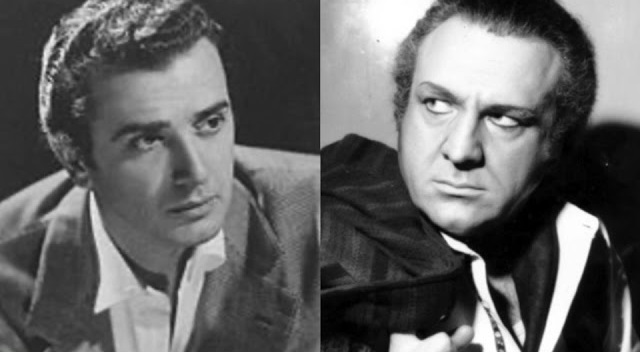
  • Corelli/Guelfi ~ FORZA DEL DESTINO – scenes

    Forza

    Franco Corelli and Giangiacomo Guelfi in scenes from Verdi’s LA FORZA DEL DESTINO from an RAI broadcast in 1956. Arturo Basile conducts.

    Listen here

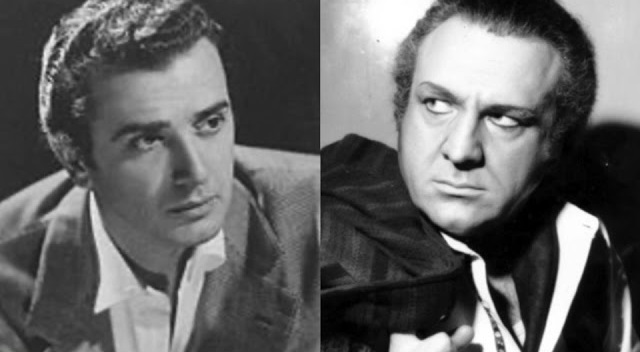
  • Corelli/Guelfi ~ FORZA DEL DESTINO – scenes

    Forza

    Franco Corelli and Giangiacomo Guelfi in scenes from Verdi’s LA FORZA DEL DESTINO from an RAI broadcast in 1956. Arturo Basile conducts.

    Listen here

  • LA BOHEME @ Macerata ~ 1977

    Boheme

    An audio-only recording of a performance of BOHEME given at Macerata in 1977 with Raina Kabaivanska (Mimi), José Carreras (Rodolfo), Elvida Ferracuti (Musetta). Rolando Panerai (Marcello), and Carlo Cava (Colline). Ferruccio Scaglia conducts.

    Listen here.

    The sound of planes passing over is an occasional distraction.

  • Narrative and Curse

    Traubel as Isolde

    Helen Traubel sings – magnificently – Isolde’s Narrative and Curse from the first act of Wagner’s TRISTAN UND ISOLDE.

    Helen Traubel – Isolde’s Narrative and Curse – Rodzinski cond

    “With the gleaming sword,
    I stood over him,
    Ready to avenge Morold’s death.

    He looked up – not at the sword,
    not at my hand –
    he looked into my eyes.
    His anguish
    touched my heart.
    The sword…I let it fall!

    His wound I healed so that he could travel homeward…and no longer trouble me with his gaze.”

  • @ My Met Score Desk ~ BOHEME Matinee

    Agresta castronovo

    Above: Maria Agresta and Charles Castronovo in LA BOHEME; a MetOpera photo

    Saturday January 22md, 2022 matinee – This performance had its ups and downs, The conducting of Carlo Rizzi was hit-or-miss; he sometimes allowed the orchestra to swamp the singers. But I did like his speedy take on the first several minutes of the Cafe Momus scene.

    Charles Castronovo repeated his very persuasive Rodolfo from the November run. His singing is emotional without straying from the notes, and he has both power and subtlety in perfect measure. His Mimi this afternoon, Maria Agresta, sounded sadly out-of-sorts, her vibrato prominent, and her highest notes not entirely comfortable. Offsetting these reservations was her congenial phrasing and some lovely piano effects.

    Lucas_meachem

    Lucas Meachem (above) was a magnificent Marcello, making every phrase count. The voice is large and warm, and he handily dominated the ensemble ‘reprise’ of the “Musetta Waltz” theme in Act II. His duet with Ms. Agresta in Act III was impressively sung. Gabriella Reyes screeched and shrilled Musetta’s lines at first, but settled in for a nice rendering of the Waltz; I feel that she might be better cast as Mimi.

    Alexander Birch Elliott was a fine Schaunard, despite having to cope with lacklustre conducting from Mr. Rizzi. I liked Peter Kellner’s Colline very much, too, but the thought of enduring a second Gelb intermission caused me to head home without hearing his “Vecchia zimara“.

    The House was substantially full, and there was surprise applause after the Bohemians dismissed Benoit in Act I. Lots of noisy chatter from the ceiling lighting bay during Act I was distracting, and the interminable first intermission simply killed whatever dramatic impetus the opera had going.

    Metropolitan Opera House
    Janaury 22nd, 2022 matinee

    LA BOHÈME
    Giacomo Puccini

    Mimì....................Maria Agresta
    Rodolfo.................Charles Castronovo
    Musetta.................Gabriella Reyes
    Marcello................Lucas Meachem
    Schaunard...............Alexander Birch Elliot
    Colline.................Peter Kellner
    Benoit..................Donald Maxwell
    Alcindoro...............Donald Maxwell
    Parpignol...............Gregory Warren
    Sergeant................Jonathan Scott
    Officer.................Ned Hanlon

    Conductor...............Carlo Rizzi

    ~ Oberon

  • Vengerov/Trpčeski @ Carnegie Hall

    CH11152281_Medium_res_comp

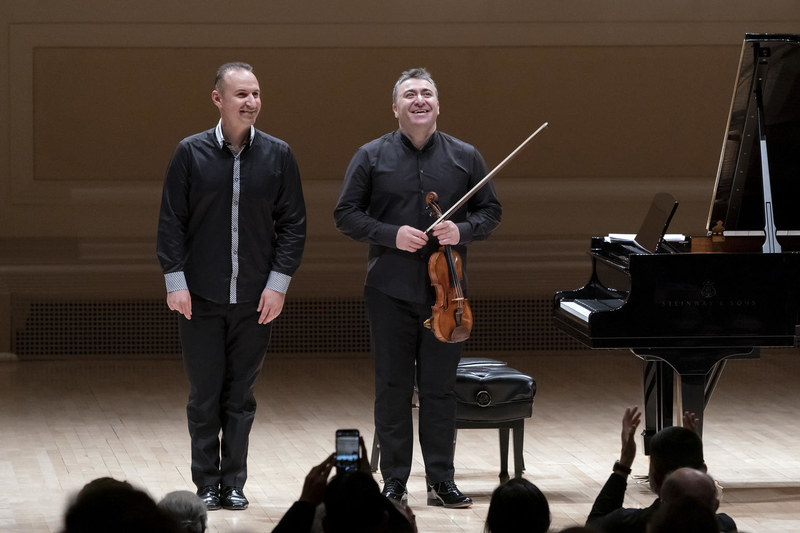
    Above: violinist Maxim Vengerov and pianist Simon Trpčeski onstage at Carnegie Hall; photo by Jennifer Taylor, courtesy of Carnegie Hall

    Thursday January 20th, 2022 – My first concert at the Stern Auditorium at Carnegie Hall since March of 2020. I was very happy to bring my friend DK to see one of his favorite artists, Maxim Vengerov, in recital. The Macedonian pianist Simon Trpčeski was at the Steinway for a wonderful program.

    The audience gave the musicians a hearty welcome as they walked out onto the stage. People are simply aching to hear great music played live again after the the long months of uncertainty. And so the opening Mozart seemed like a transfusion of peace and hope, though still tinged with darkness.

    CH11152497_Medium_res_comp

    Above: Maxim Vengerov, photo by Jennifer Taylor

    Mozart’s Violin Sonata in E-Minor, K. 304 was composed in 1778; this is the only one of Mozart’s violin sonatas written in a minor key; its underlying wistfulness might be connected to the fact that the composer’s mother had passed away while he was working on it.

    Departing from the norm, this sonata is in only two movements. The Allegro takes its character from the poignant opening theme, played in unison by violin and piano. The piano brings forth a second, more animated theme, though the mood remains restrained. A lovely dovetailing of dynamics marked the Vengerov/Trpčeski partnership’s playing, the violinist’s repeated insistent notes met by the pianist’s wonderful subtleties. 

    Mozart marks the second movement Tempo di Minuetto, but it has a forlorn quality not usually heard in a minuet. Solo piano introduces the grave yet graceful opening melody, and soon the two instruments take turns with it, their voices entwining. A major-key interlude gives us an unexpected ray of light, with sublimely soft playing from Mr. Trpčeski. The minor mode resumes, the melody flowing on to a rather sudden stop.

    CH11152391_Medium_res_comp

    Photo by Jennifer Taylor

    In direct contrast to the Mozart, Mssrs. Vengerov and Trpčeski next offered the Prokofiev Violin Sonata No.1. Prokofiev is one of my A-list composers, and this sonata encapsulates everything I love about his works: the rough-edged drama, the heartfelt lyricism, the chiaroscuro dynamics, and the subtle wit of his music always fascinates me.

    Following the four-movement structure (slow-fast-slow-fast) of the Baroque church sonatas, Prokofiev opens this sonata with a somber passage from the piano. The violin joins, edgy and buzzy, and then the two instruments blend in a unison lament. The piano’s dolorous notes draw the violin into a yearning, dramatic passage. Then the violin skitters softly on high as the pianist intones soft chords; it sounds “like the wind in a graveyard” as Prokofiev told David Oistrakh, who played the sonata’s premiere performance.

    The second movement, Allegro brusco, begins vigorously, lapses into a songful state, then turns fast and furious. Things subside briefly, but accents soon propel the piano forward again as the violin makes agitated remarks. Calming to lyricism, the music then gets grand – with a soaring melody leading to a wild finish.

    In the third movement, Andante, the Vengerov/Trpčeski transported us with their spectacular playing. An opening passage of piano filigree is taken up by the violin. A gorgeous violin melody is heard, whilst the piano sustains a magical atmosphere. This ethereal music puts us in a blissful state, with Mr. Vengerov finishing his reverie with a miraculously sustained pianissimo trill. Heavenly!

    Brilliant playing from both artists drove the sonata’s concluding Allegrissimo forward in spectacular fashion. A melodious interlude lets us again savour the warmth and serenity of Prokofian lyricism, and then some biting staccati dazzle us yet again. Another whiff of the “wind in a graveyard” motif leads on to work’s quiet closing. 

    CH11152496_Medium_res_comp

    Photo by Jennifer Taylor

    Following the interval, César Franck’s ever-popular Violin Sonata was given a thrilling performance by the Vengerov/Trpčeski duo. This sonata was inspired by the marriage of the great violinist Eugène Ysaÿe to Louise Bourdeau in 1886.  Franck’s initial idea for the sonata was to commence with a a slow and reflective opening movement, but Ysaÿe persuaded him that it worked best at a quicker tempo, so Franck marked it Allegretto, ben moderato. This movement juxtaposes rather than develops two themes, the first given almost exclusively to the violin, the second to the piano. These themes, particularly the violin’s, will return in the following movements. From note one, I fell under the spell of this music, which seemed so fresh and vivid as performed tonight. Mr. Trpčeski’s playing was positively rhapsodic, whilst Mr. Vengerov poured so much passion into the thrilling melodies the composer has given him.  

    The agitated, dramatic second movement casts its own spell, with the players again displaying their intriguing dynamic range and their peerless legato. The music is at once propulsive and poetic. Then comes the pensive Recitativo-Fantasia, wherein Mr. Vengerov’s rapturous playing in the high range is heard over the piano’s gently rolling misterioso figurations.

    The familiar and beloved themes reappear in the sonata’s final movement, which builds to a glorious finish. The inevitable reaction of the audience to the playing of Mssrs. Vengerov and Trpčeski was a fervent ovation, richly deserved. 

    Ravel’s Tzigane was a late addition to the program. Familiar to me mainly from the ballet that George Balanchine created for his muse, Suzanne Farrell, to this music, it’s a Vengerov specialty: he played it here at his February 2020 concert, just days before the pandemic shut everything down. 

    In July 1922, Maurice Ravel met the young Hungarian violinist, Jelly d’Aranyi, who was the grand-niece of famed 19th-century violinist Joseph Joachim. The composer was intrigued when he heard the violinist playing gypsy melodies at a party. Inspired, he fashioned a gypsy rhapsody, working on it over a period of two years. Ravel completed it just a few days before the premiere: on April 26, 1924, in London, Mlle. d’Aranyi and pianist Henri Gil-Marchex gave the premiere of Tzigane.

    Tzigane is a legendary showpiece, and tonight the amazing dexterity of the violinist (later joined by the pianist) kept the audience on the proverbial edge of their seats. After a giant “pre-cadenza”, the music starts to dance, by turns high and shimmering, then wildly earthy.

    CH11152444_Medium_res_comp

    At the concert’s end, Trpčeski and Vengerov were greeted with a lively ovation. They returned for three encores: two delicious Fritz Kreisler treats, and then Gabriel Fauré’s sublime Après un rêve, which was sublimely played. Bravo, gentlemen!  Bravissimo!!

    All photos by Jennifer Taylor, courtesy of Carnegie Hall.

    ~ Oberon