
The Stockholm Singers, conducted by Bo Aurehl, perform Alessandro Scarlatti’s Exultate Deo at the Strängnäs Cathedral. The concert took place in June 2018.
Watch and listen here.
The Stockholm Singers, conducted by Bo Aurehl, perform Alessandro Scarlatti’s Exultate Deo at the Strängnäs Cathedral. The concert took place in June 2018.
Watch and listen here.

Saturday November 20th, 2021 matinee – In 2016, Anita Hartig was a radiantly-sung Liu in TURANDOT at The Met. When her Violetta was announced in the 2018-2019 season, I was eager to hear her again, only to find that – at least at the performance I attended – she was having serious pitch problems. So this year, despite wanting to hear Charles Castronovo and Artur Ruciński in BOHEME, I hesitated to go because Ms. Hartig was the Mimi. Then I heard a clip from the prima of Mimi’s Act I narrative and the soprano sounded fabulous. So, there I was today, in a packed house, experiencing the Franco Zeffirelli BOHEME for the umpteenth time.
The afternoon started on a sour note: while waiting for the curtain to rise, the two women sitting next to me removed their masks, started eating crackers, called people on their phones, and even called each other! Seriously! I wasn’t about to let them ruin the performance for me, so I abandoned my seat with a view and went back to my more usual score desk.
I liked Eun Sun Kim’s conducting a lot. Her tempi felt just right, and she seemed to breathe with the singers, allowing them leeway with sustaining notes when they wished. The orchestra were in fine fettle, and I especially loved the harp passages at the opening of Act III.
BOHEME is a love story, and today’s lovers were excellently paired. Ms. Hartig’s “Mi chiamano Mimi” was gorgeously sung and phrased, and she turned on the power for the ecstatic cresting phrase of the love duet, and again for the climax of the ensemble following Musetta’s Waltz. Ms. Hartig’s sustained high-C at the end of Act I was handsomely harmonized by Charles Castronovo, today’s Rodolfo. The tenor’s Act I aria was particularly appealing in his way with the words; his top notes do not ‘bloom’ but they have ample power. In Act III, his anguish in telling Marcello the real reason he must break with Mimi was passionately expressed. Ms. Hartig’s “Addio senza rancor” was very moving, and she gave us an exquisite pianissimo on the final “…rancor!” A few moments later, having decided to stay with Mimi until the Spring, Mr. Castronovo ravished the ear with his own lovely pianissimo on “…alla stagion dei fior!“
Artur Ruciński’s Marcello was sung with power and warmth; he led the ensemble ‘reprise’ of Musetta’s Waltz in a commanding way, and was wonderful in his Act III duet with Mimi, and then in his conversation with Rodolfo. Fererica Lombardi was a bright-toned Musetta, making the most of her Waltz. Alexander Birch Elliott was an excellent Schaunard, and I very much liked Nicholas Brownlee’s voice as Colline – so much so that I regretted leaving before his Coat Aria (the thought of sitting thru another endless Gelb-Intermission sent me packing after Act III). The Scottish baritone Donald Maxwell, long a favorite at the Royal Opera, Covent Garden, doubled in the roles of Benoit and Alcindoro.
The Zeffirelli BOHEME has come in for some bashing of late. Some people feel it’s time for a change. But – like the Zeffirelli TURANDOT – it’s been a veritable cash cow for the Met, selling out (or selling “big”) no matter who is singing. Today’s nearly full house seemed attentive and appreciative. And of course they applauded the rise of the curtain on the Café Momus scene. Oh dear, people actually enjoying themselves at the opera! We can’t have that, now, can we?
Metropolitan Opera House
November 20th, 2021 matinee
LA BOHÈME
Giacomo Puccini
Mimì....................Anita Hartig
Rodolfo.................Charles Castronovo
Musetta.................Federica Lombardi
Marcello................Artur Rucinski
Schaunard...............Alexander Birch Elliot
Colline.................Nicholas Brownlee
Benoit..................Donald Maxwell
Alcindoro...............Donald Maxwell
Parpignol...............Marco Antonio Jordão
Sergeant................Tyler Simpson
Officer.................Ross Benoliel
Conductor...............Eun Sun Kim
~ Oberon

Above: conductor Dima Slobodeniouk, photo by Marco Borggreve
Thursday November 18th, 2021 – It was wonderful to re-connect with The New York Philharmonic this evening when they offered a program of music by Shostakovich and Tchaikovsky at Alice Tully Hall. As the hall slowly filled to capacity, I loved seeing so many of my favorite musicians again, taking their places onstage after the long months of isolation. Sheryl Staples was the concert-master tonight, and a sense of anticipation seemed to fill the Hall.
I was not sure how these big works would fare in the rather intimate space of Tully Hall, where we’re accustomed to hearing chamber music. But in fact, the sonic effect of the large ensemble was wonderful to experience: rich and deep; and when solo moments came along for the principals, the clarity was vivid. The risers for the winds and percussion were abandoned in this space. Most of the string players remained masked throughout the evening.
As the date of the concert drew near, an announcement was made that the scheduled conductor, Semyon Bychkov, would be replaced by Dima Slobodeniouk, who is making his Philharmonic debut with these performances.
Shostakovich wrote his first violin concerto 1947-48, but the composer hid it away until 1955, when it had its premiere performance by with the Leningrad Philharmonic, with David Oistrakh as soloist. It is to Oistrakh that Shostakovich dedicated the concerto.
It had not been safe for Shostakovich to bring forth this piece until Josef Stalin had been dead for two years. The 1946 Zhdanov Doctrine had warned that the post-war divide between US imperialism and the democratic Soviet Union had produced a conflict in Soviet culture: a conflict between good and best. Shostakovich knew that “best” meant: ‘…adhering to cultural standards specified by the government.’ And he also knew that this concerto would not have been deemed “acceptable”. He had already been previously condemned by Stalin, and he knew enough not to tempt fate.

Violinist Karen Gomyo (above) opened the evening, playing the Shostakovich 1st violin concerto in her debut NY Philharmonic performances. And what a triumph she had in this exceptionally demanding piece! Ms. Gomyo is a native of Tokyo; she studied at the Juilliard School with Dorothy DeLay. She looked gorgeous tonight in her midnight-blue frock, upon which tiny silver sequins sparkled like diamonds.
The concerto’s opening movement is entitled Nocturne. The deep strings underscore a low, doleful melody for the solo violin; as the music moves into a higher range, a sense of longing takes over. The winds, and then the violins, accompany the soloist’s ascent. Harp notes sound, the basses growl, and the winds create darkish textures, with a particularly rich solo passage for bass clarinet. Now the soloist rises to a shimmering, sustained high note.
The second movement, Scherzo, bounces out in agitato mode, the soloist deftly handling her tricky passages over the sound of plucking strings. Rhythms are brisk and uneven, taken at high speed, and the xylophone, horns, and clarinet add to the colorful palette of sound. The music breaks into a dance as the scherzo runs on to a big finish.
The third movement, Andante, is a passacaglia; after a deep, dramatic start, the music becomes dirge-like, with the basses and low winds maintaining an almost ominous feeling. The solo violin sings a poignant lament; the horn has a solo passage, plushy played, and then the plodding basses are joined by their celli brothers. The violin embarks on a gigantic cadenza, which ranges from the depths to the heights and calls for exceptional technical mastery; Ms. Gomyo’s staggering virtuosity kept the audience spellbound during this incredible solo.
The finale, a Burlesque marked allegro con brio, is introduced by the drums, with the xylophone again kicking in. How sweet to hear Anthony McGill’s clarinet singing forth! Ms. Gomyo makes a brilliant entrance. Orchestra and soloist have frequent interactions, with the Passacaglia theme popping up out of nowhere, now animated in a presto setting. The finale dances along its bravura way to a dazzling conclusion.
Ms. Gomyo was as riveting to watch as to hear: throughout her performance, her intensity and deep commitment could be read on her face. The audience responded to her thrilling performance with a vociferous standing ovation, the Philharmonic players joining in enthusiastically: a wonderful, celebratory atmosphere in the Hall.
After the interval, Tchaikovsky’s first symphony, known as “Winter Dreams” was sumptuously played by the orchestra, conducted with passion and great attention to detail by Maestro Slobodeniouk.
While I have always thought of Tchaikovsky as one of my favorite composers, for me the first symphony is not one of his finest works. I’d only heard it played live once before, by this same orchestra; at that time I found it pleasant enough. But maybe that is all it is: pleasant.
The first movement really felt over-long this evening; basically it seemed to be heading nowhere. Likewise, the fourth movement takes forever to get going, with various detours and a slow revving of the engines before the Allegro maestoso finally bursts forth The highlights of this performance were the passages that Tchaikovsky assigned to the principals: Robert Langevin (flute), Liang Wang (oboe), Anthony McGill (clarinet), and Judith LeClair (bassoon). Liang Wang’s solo in the second movement, which becomes entwined with the sound of the Langevin flute, was a little slice of heaven. Section by section, too, the orchestra simply sounded great: the viola and cello themes in the Adagio really glowed, and the richness of the cellos and basses in the final movement was truly savourable.
Yet, despite superb playing, tonight the Tchaikovsky 1st joined the Beethoven Pastoral on my list of symphonies to avoid in future. I think Tchaikovsky did Winter better in THE NUTCRACKER.
~ Oberon

Stephen Powell at the piano; photo by Shannon Finney
Acis Productions have released a new recording from baritone Stephen Powell, Why Do The Nations, which brings us 27 songs in ten languages, with the singer accompanying himself at the piano. When I first read of it, I wasn’t quite sure how I would feel about it. It’s a lot of ground to cover, for one thing. And then: is Mr. Powell as fine a pianist as he is a singer?
An initial playing of the disc dispelled any misgivings I might have had. The songs weave a multi-hued sonic tapestry of languages and styles. And – as it turns out – Mr. Powell’s an excellent pianist. I wept, I laughed…I derived great pleasure from this collection. So many of the songs – and Stephen’s singing of them – reached me on a very personal level.
Stephen Powell talks with Brad Cresswell about how Why Do The Nations came to be here.
The disc offers a mix of the very familiar with several songs I’ve never heard, and a couple of composers I’d never heard of.
Four of Germany’s lords of lieder – Schubert, Brahms, Wolf, and Strauss – are represented. Of their songs on this disc, only Schubert’s “Die Forelle” was familiar to me; Mr. Powell sings it so well, and his pianistic skills are impressive, too. Hugo Wolf’s “Auch Kleine Dinge“, about a delight in small things, is sung with an appealing subtlety. A truly beautiful Strauss song that I’d never heard, “Ich Trage Meine Minne”, speaks of the sustaining power of love; after a somewhat darker second verse, the song returns to light and joy with the memorable line: “I carry my love in silent bliss”. From Johannes Brahms, Mr. Powell brings us “Meine Liebe ist grün”, which celebrates the Springtime of love, wherein the poet is intoxicated by the scent of lilacs…something to which I can easily relate.
From France, we have songs by Maurice Ravel, Gabriel Fauré, and Émile Paladilhe, the last-named being only a name to me. His song, “Petits Enfants“, receives its world premiere recording on Mr. Powell’s disc. The poem, about the beauty of young children, is by Alphonse Daudet. The song has a delicate piano accompaniment, and Mr. Powell’s sweet upper notes sustain the atmosphere. Maurice Ravel’s boisterous drinking song, “Chanson à boire” comes from the well-beloved song cycle Don Quichotte à Dulcinée. It’s full of laughter, and ends with the piano on its own. Mr. Powell gives a fresh feeling to Fauré‘s familiar “Mandoline“, sung with a light touch, and with the piano part deftly handled.
Three of America’s greatest 20th century composers are heard from: Samuel Barber, Charles Ives, and Aaron Copland. Barber’s I Hear An Army, composed in 1937, has an aggressively dynamic accompaniment over which the words of James Joyce compare the end of an intimate relationship to the galloping hooves of an attacking troop of cavalrymen.
In 1952, Aaron Copland adapted Zion’s Walls, originally a folk song that became popular at camp meetings in Georgia; Copland eventually used the song in his opera THE TENDER LAND. On first hearing Mr. Powell’s rendering of Zion’s Walls, I simply wrote: “This Is Great!”
Charles Ives wrote Majority in 1921; Mr. Powell chose it as the final song on the disc. It’s a sort of toiling dirge, but with a reassuring ending.
The two kings of Italian opera turn up in canzoni mode: Giuseppe Verdi and Giacomo Puccini are allotted two songs each. Verdi”s La Seduzione (a seduced-and-abandoned tale) and the touching Il Poveretto (“The Poor Man”) have an operatic feeling to them. The latter tells of a poor veteran who, having served his country, is now reduced to begging. The song was written in 1847, but the problem still exists today. An ironic waltz springs up, only to halt as Mr. Powell movingly voices the line, “My country has forgotten me!”
The disc’s other Verdi song, La Seduzione, starts with a slow waltz and becomes more animated, with the telling line: “Nine moons moaned the betrayed…” The singer’s voice becomes tearful as he tells of the disgraced woman’s lonely, anonymous death.
It’s to Puccini that Stephen Powell turns for his opening song: Morire? (“To die?”). The text is by Giuseppe Adami, the composer’s librettist for LA RONDINE, IL TABARRO, and TURANDOT. It’s a poem that reflects on the meaning of death; one curious feature of this song is that the piano drops out for most of the final verse. The voice goes on high at the end.
Puccini’s Terra e mare did what a song often does for me: it put me in mind of a beloved literary passage, in this case from JRR Tolkien’s Lord of the Rings:
“Legolas Greenleaf long under tree, In joy thou hast lived, Beware of the Sea! If thou hearest the cry of the gull on the shore, Thy heart shall then rest in the forest no more.”
In this Puccini song, a man falls asleep, lulled by the sound of the wind in the poplar trees, which he dreamily mistakes for the sound of the sea. It’s a restless song, and both the piano and the voice capture the sensations of the lyrics perfectly.
Russian jewels by Peter Ilyich Tchaikovsky and Sergei Rachmaninoff bring forth some of Mr. Powell’s most engaging singing. Tchaikovsky’s “Nights of frenzy, sleepless nights”, a lament for a lost love of long ago, is particularly fine. In Rachmaninoff’s familiar “Spring Waters“, the singer conveys an almost operatic sense of vocal authority. The same composer’s “The Soldier’s Wife” is one of the collection’s saddest songs: the lament of a woman who married the man she loved, only to have him be taken from her by army recruiters. The song, with its deep sorrow, covers a wide vocal range and ends with a vocalise.
Benjamin Britten and Michael Head represent the United Kingdom. Two contrasting Britten songs are heard: the wryly humorous The Brisk Young Widow (which benefits greatly from Mr. Powell’s very clear diction), and the more pensive Every Night and Every Morn, with words by William Blake. In this song, the accompaniment seems somehow unsettling. There’s a rise in drama as the song nears its end…and then a questioning air at the finish. Composer Michael Head is new to me; his song Money, O!, written in 1928, covers a big vocal range, going deep. It sings of some of the advantages of being poor.
Meu Amor Me Disse Adeus (“My love told me goodbye forever“) by the Brazilian composer Cláudio Santoro hit me right where it hurts as the tenth anniversary of a bitter parting looms before for me. Like so many songs in this collection, this one is intensely personal, and Mr. Powell’s affecting singing of it makes it even more so.
The songs from the Asian lands are of special interest to me, in part because my spouse is Chinese, and in part because I’ve never heard them before. All three – one each from China, Japan, and Korea – could easily come from the pen of a Western composer, though the tell-tale harmonies say otherwise. I imagine Western singers might be happy to explore more song literature from these lands, but mastering the languages is not easy.
Listening to Mr. Powell sing Rentarō Taki‘s dreamlike Kōjō no Tsuki (“Moonlight Over the Ruined Castle”) – one of the most evocative songs on the disc – made me wish that my late friend, the contralto Makiko Narumi, was still here to sing me some Japanese songs.
The Korean composer Dong Jin Kim gives us a remarkably beautiful song, Gagopa (“I Want to Go Back“), full of longing for the days of childhood. The poet recalls the place of his birth, which he left long ago: “I want to recapture those days that had no tears.”
I asked my husband, Gotham’s premier Chinese tutor and translator, to listen to Mr. Powell’s recording of Zhao Yuanren’s “How Can I Not Think of Her“, wherein everything in nature reminds the poet of his lost love. I asked Wei to rate the singer’s diction. After a line or two, he said: “Good…very good…very clear!”. Then he asked to hear the song again, and he began to sing along.
From Spain, songs by Fernando Obradors, Manuel de Falla, and Xavier Montsalvage have a particular appeal in Mr. Powell’s interpretations. Fernando Obradors’ ¿Corazón porqué pasáis…? a brief delight of a song about affairs of the heart. The accompaniment is particularly pleasing, while a central passage of wordless vocalizing seems to say: “Don’t take this song too seriously.”
Manuel de Falla’s ironic El paño moruno (“The Moorish Cloth” ) is the shortest song in the collection. To very familiar melody, the story tells of a tiny stain on a piece of fine cloth that diminishes its value.
As with every song recital disc, there’s bound to be a favorite track. From Stephen Powell, we get the most hauntingly beautiful rendering of Xavier Montsalvage’s dusky lullaby “Cancion de cuna para dormir a un negrito” from Tres Canciones Negras that I have ever heard.
~ Oberon

Above: bass-baritone John Lundgren
Wagner’s DIE WALKURE from the 2016 Bayreuth Festival, conducted by Marek Janowski with the following cast:
Siegmund – Christopher Ventris
Hunding – Georg Zeppenfeld
Wotan – John Lundgren
Sieglinde – Heidi Melton
Brünnhilde – Catherine Foster
Fricka – Sarah Connolly
Gerhilde – Caroline Wenborne
Ortlinde – Dara Hobbs
Waltraute – Stephanie Houtzeel
Schwertleite – Nadine Weissmann
Helmwige – Christiane Kohl
Siegrune – Mareike Morr
Grimgerde – Wiebke Lehmkuhl
Rossweisse – Alexandra Petersamer
Watch and listen here.

Above: from NARCISSUS; photo by Andrew Jordan
Saturday October 30th, 2021 matinee – At New York Live Arts this afternoon with Roberto Villanueva for a performance of Christopher Williams’ NARCISSUS. It was a purely delightful hour, wherein the music, choreography, lighting, costumes, and the beautiful cast of dancers all combined to create a dreamworld at once quirky, erotic, and poignant.
NARCISSUS is set to Nikolai Tcherepnin’s score “Narcisse et Echo” which was composed in 1911 for Michel Fokine’s ballet of the same title, produced by Serge de Diaghilev for the Ballets Russes. In Mr. Williams re-imagining of the ballet, he takes a fresh look at the timeless tale of Nacissus, a young man very much taken with his own beauty. The enticing production features costume and set designs by Andrew Jordan and lighting by Joe Levasseur.
In a brief prologue, in which bouche fermée voices are heard, a group of Boeotians are silhouetted against the breaking dawn. We then meet the Oreads: a brotherhood of mountain nymphs with Spock-like ears. Dancers Casey Hess, Jack Blackmon, Alexander Olivieri, Michael Parmelee, and Logan Pedon cavort, their heavenly, nearly nude bodies adorned with fantastical red penises. For all the intimacy of their partnering, they paradoxically seem chaste. The music underscores the ecstatic feeling of these youthful males, savoring their delight in nature and in each others company. Throughout this provocative scene – and indeed, throughout the entire ballet – the choreography in superbly musical.
The music shifts with the arrival of Echo, who has both a penis and female breasts; Mac Twining plays the part handsomely. Echo is a lonely creature, and is rejected by the Oreads who hiss at him like animals. Now the Boeotians return: hetero and same sex couples of varying ages are danced by Janet Charleston, Alan Good, Ching-I Chang, Shayla-Vie Jenkins, Justin Lynch, and Jake Montanaro. They are joined by a trio of Bacchantes (Christiana Axelsen, Breckyn Drescher, and Caitlin Scranton), dressed in flame-coloured gowns, their faces painted white, their dark hair almost Medusa-like. Their dance is a highlight of the ballet. Now the music becomes tumultuous, the dancing joyous.
The Oreads re-appear, and we are only too happy to see them again; and finally we meet Narcissus himself – in the magnetic person of New York City Ballet principal dancer Taylor Stanley. Clad in a short blue tunic, his solo depicts the character’s self-love.
For Narcissus has fallen in love with his own reflection: a reflection danced by Cemiyon Barber in a yellow tunic. Their duet of mutual admiration is danced in-sync; meanwhile, their shadows follow them on the wall.
Echo returns; smitten with Narcissus, his dance is a visual lament. As the music veers from powerful to eerie, he sustains a balance as if teetering on the verge. Mr. Twining excelled here. Now Narcissus and his double return; the music gets big as they fill the space with swirling leaps and mirror-image passages. They embrace, sink to the ground, their bodies communing whilst the forlorn Echo watches them in despair. Narcisssus expires; reaching under his dead idol’s tunic, Echo brings forth a yellow narcissus as darkness falls.
The dancers were enthusiastically applauded; though I thought solo bows for Mssrs. Stanley, Barber, and Twining were in order, they were not forthcoming. The choreographer was warmly greeted by dancers and audience alike.
One of the many reasons I wanted to see this production was the presence in the cast of my friend Justin Lynch. Justin has danced for Amanda Selwyn, Lydia Johnson, and Nai-Ni Chen, and in 2014 he appeared in the Metropolitan Opera’s controversial production of DEATH OF KLINGHOFFER. In 2010, he participated in Kokyat’s photoshoot at the Secret Theater. Justn’s such a handsome fellow: it was great to see him again.
~ Oberon
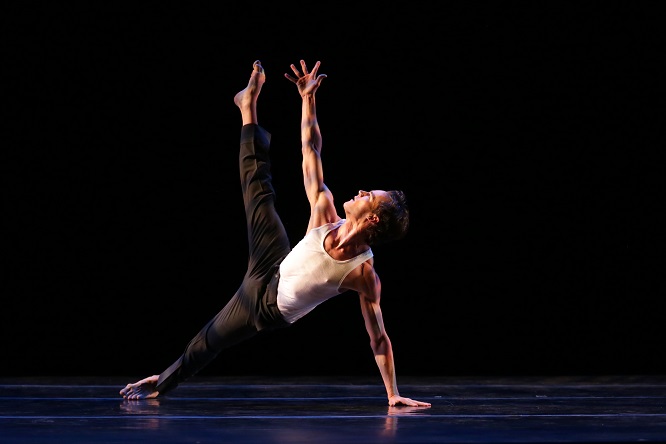
Above: Jacob Larsen of the Martha Graham Dance Company in Sir Robert Cohan’s solo Jacob; photo by Melissa Sherwood
Wednesday October 27th, 2021 – The Martha Graham Dance Company is presenting two programs at The Joyce in these final days of October, 2021. I happened to see Program B before seeing Program A.
During the long months of the pandemic, I found myself seriously missing the Graham dancers. Whenever I was down in The Village, I would walk by the Company’s home at 55 Bethune Street on the off-chance of seeing some of them, even though I knew full well that some of them had left the City. I did run into Lorenzo Pagano once, and that truly made my day. Otherwise, my only encounter with any of these fascinating people during the shutdown was via the Company’s webcasts of Immediate Tragedy in June 2020 and the three-part GrahamFest95 in May 2021.
This evening, my ‘reunion’ with the Graham Company was simply spectacular. It’s a company of stars, and they all shone tonight to dazzling effect.
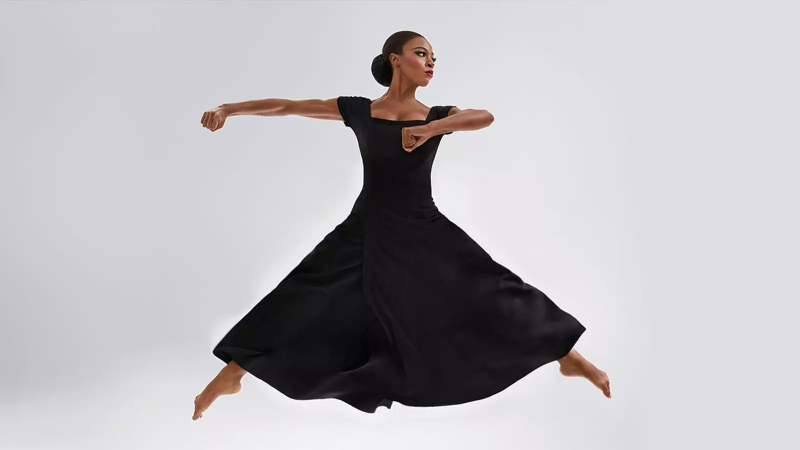
Above: Leslie Andrea Williams in Steps in the Street; photo © Hibbard Nash Photography
The excellent program opened with the powerful Steps in the Street, the second movement of Martha Graham’s epic all-female anti-Facist dancework Chronicle. Set to a vibrant, martial score by Wallingford Riegger, Chronicle premiered at the Guild Theater here in New York City in December of 1936. In her introductory remarks, the Graham Company’s artistic director Janet Eilber called the work “…a dance of determination and resilience.”
Led by the ever-luminous Leslie Andrea Williams, the women back rather hesitantly onto the stage one by one in silence. As the music commences, the choreography becomes complex (both in steps and gestures); it’s extremely demanding, calling for deep dedication and boundless energy. The Graham women were simply magnificent; their individual beauty and power radiated at every moment. These are women I have admired so much in recent years: So Young An, Laurel Dally Smith, Natasha M. Diamond Walker, Marzia Memoli, Anne O’Donnell, Anne Souder, and Xin Ying…watching them flash across the stage in intricate combinations – or simply walking with tremendous dignity and strength – was an exhilarating experience. New to the Company are Devin Loh and Kate Reyes. At the center of it all, the arresting presence of Ms. Williams glowed like a beacon of feminine strength and grace.

Above: Jacob Larsen, photo by Melissa Sherwood
Sir Robert Cohan‘s solo Jacob takes its name from dancer Jacob Larsen; Sir Robert, who passed away in January of this year at the age of 95, created the work on the dancer remotely during the period of pandemic isolation. Set to Nils Frahm’s Hammers, the dance opens with pulsating music as the dancer, clad in dark trousers and a wife-beater tee-shirt, does a run-about the finely-lit space, pausing from time to time in a pose with arms outstretched.
Mr. Larsen’s dancing filled the space with the choreographer’s finely-cratfted movement, his face handsome and expressive. Thrice he collapsed to his knees and then magically executed back-somersaults. Combining energy and artistry expertly, the danseur gave a compelling performance. During the solo’s final moments, danced in silence in the fading light, one could sense the audience’s pent up admiration building; and when the lights came up, Jacob was greeted with a great wave of applause and bravos, so richly deserved. “A star is born!”, I scrawled in my program.

Above: Natasha M. Diamond-Walker and Lloyd Mayor in Untitled (Souvenir); photo by Melissa Sherwood
I was very pleased to see Pam Tanowitz’s Untitled (Souvenir) again. I saw it twice during its premiere performance run in 2019 and had different (but all positive) feelings about it at each viewing. Caroline Shaw’s score was again a key element to my enjoyment of the piece: with elements of Americana, British Baroque, and an echo of hymn “The Lord Is Our Great Shepherd” all brilliantly woven together by the composer. The Graham dancers all looked fabulous in their costumes by Ryan Lobo and Ramon Martin of TOME.
This time around, Untitled (Souvenir) summoned up for me images of an English garden party sometime in the early days of the 20th century, when Art Deco was all the rage in Europe. Anne O’Donnell and Marzia Memoli are onstage for the work’s silent opening; Marzia unfolds into a beautiful arabesque and then the dancing starts: witty, but very much tongue-in-cheek. Other dancers now arrive: Lloyd Mayor, striking in lounging pajamas; the tall beauty Natasha Diamond-Walker; Lloyd Knight hopping on; the distinctive (and glamorously gowned) Xin Ying; Jacob Larsen (looking fresh after his brilliant solo performance); and Laurel Dalley Smith, who I always love to watch.
Everyone strikes poses, frequently ignoring the other guests. I was particularly taken with Natasha Diamond-Walker’s ‘character’: her spotlit, silent solo displayed the many mood shifts of a woman at once alluring and insecure. At one point, she even hid behind a piece of scenery…which is something I would do at a party.
There are duets, fleeting suggestions of romance, a trio of men in the cross-currents of mutual interests. In all, the work is a delight. And again, I must praise Caroline Shaw’s wonderful score, with cunningly accented motifs and a lambent cello solo. Iconic Graham moves and gestures pop up, getting a fresh take in Ms. Tanowitz’s choreography.

Above: Marzia Memoli and Lloyd Kinght in Treading; photo by Melissa Sherwood
Following the interval, Elisa Monte’s duet work, Treading, was stunningly danced by Lloyd Knight and Marzia Memoli. These two gorgeous creatures gave their all in a steamy, intimate pairing which demands great strength and control…and perfect timing. In their sleek body tights, Marzia and Lloyd generated a hothouse atmosphere, holding the audience in rapt attentiveness as their bodies folded and snaked thru the slow partnering motifs.
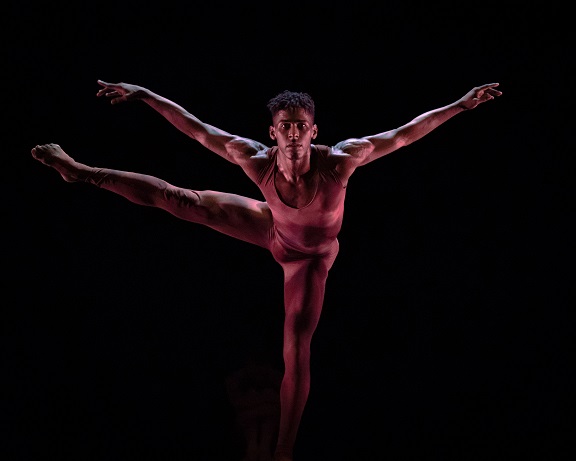
Lloyd (above, in a Brian Pollock photo) was mesmerizing to behold right from his opening solo…

…and Marzia created incredible shapes (Melissa Sherwood’s photo above), and her lush back-bend was a stunning moment. For me, Marzia’s was another ‘star is born’ performance tonight, and the audience seemed in full agreement.
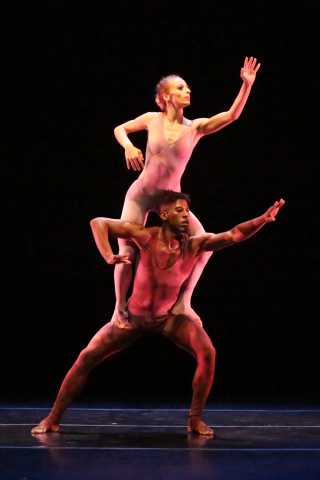
Above: Marzia and Lloyd in Treading; photo by Melissa Sherwood
Treading drew a huge response from the audience, and Ms. Monte joined the dancers onstage for a bow. Roses and champagne to Marzia and Lloyd for their breathtaking performance!

Above: Anne O’Donnell and Lloyd Mayor in Diversion of Angels; photo by Luis Luque
Diversion of Angels had its premiere at Connecticut College in August of 1948. This ballet is set to a wonderful romantic score by Norman Dello Joio; in it, three couples dance duets reflecting on different aspects of love. A Couple in Red embodies passionate love; a Couple in White, mature love; and a Couple in Yellow, the joys of young, flirtatious love.
Diversion is one of the Graham ballets that places extraordinary demands on all the dancers in the cast. So Young An, Devin Loh, Kate Reyes, and Anne Souder formed a lovely ensemble, their dancing filled with commitment, beauty, and energy. At one point, they are seated on the floor, gazing ardently into the eyes of their cavaliers: a very romantic moment in this ultra-romantic ballet. A newcomer to Graham, Richard Villaverde, made his mark with his handsome presence and deft dancing.
The three couples were splendid, each in their own way. Leslie Andrea Williams, a vision in White, danced like a goddess, and her partner, Alessio Crognale, was equally impressive. Together, they expressed the couple’s deep sense of quiet ecstasy, secure in their mutual love.
Anne O’Donnell looks fetching in Red, and she had the perfect partner in Lloyd Mayor. Their dancing, both individually and in duet passages, was vibrant and wonderfully true to the music. At one point, while Lloyd was elsewhere, Anne seems to be tempting Alessio; that’s the thing about passionate lovers: their passion can get directed in a different direction at the drop of a hat.
Laurel Dalley Smith was like a ray of sunshine in Yellow; Jacob Larsen completed his stellar evening as Laurel’s cavalier. Their choreography includes some daredevil catches and lifts: Laurel flew like a golden bird into Jacob’s arms and was swiftly swept aloft. Brilliant! I just loved watching them, and I must say that Laurel’s performance had the same ‘star-is-born’ feeling as Jacob’s and Marzia’s…the third in a single evening.
And what an evening it was…it stands as one of the great dance performances I have witnessed in the last quarter-century. Although tinged with regret for two ‘missing persons’ – who I hope are both well along on the road to recovery – the evening was made memorable by the unstinting generosity and mind-boggling talent of these unique and extraordinary dancers.
~ Oberon

Above: Stefka Evstatieva as Leonora and John Cheek as Padre Guardiano
The Canadian Opera Company’s 1987 production of Verdi’s LA FORZA DEL DESTINO with Stefka Evstatieva, Judith Forst, Yuri Marusin, Allan Monk, Peter Strummer, and John Cheek, conducted by Maurizio Arena.
Watch and listen here.

Scenes from a 1982 San Francisco Opera performance of TURANDOT with Linda Kelm (above), Nicola Martinucci, Barbara Daniels, and Kevin Langan, conducted by Myung-Whun Chung.
Listen here.
CAST:
A mandarin: Gregory Stapp; Liù: Barbara Daniels; Calaf: Nicola Martinucci; Timur: Kevin Langan; Ping: Thomas Woodman; Pang: David Gordon; Pong: Jonathan Green; Emperor Altoum: Eddie Albert; Turandot: Linda Kelm
I love finding any recordings by Johanna Meier. Despite the missing part of the first Strauss song, her vocalism is so pleasing in this 1982 recording from a concert by the Milwaukee Symphony conducted by Lukas Foss.
Listen here.
One of my all-time favorite sopranos, I saw Ms. Meier frequently at The Met and New York City Opera. She made a memorable impression in so many roles: as Puccini’s Musetta and Tosca, as Strauss’s Countess Madeleine, Marschallin, Ariadne, Kaiserin, Chrysothemis (both at The Met and at Tanglewood), as Rosalinda, Marguerite in FAUST, as Mozart’s Donna Anna, and Countess Almaviva, and as Wagner’s Elisabeth, WALKURE Brunnhilde, and – most especially – as Sieglinde.

 Oberon's Glade