Category: Ballet

  • …And All That Djazz @ NCB

    14199168_10154473099603571_6069759855082671756_n

    Friday September 16th, 2016A sold-out house this evening as Miro Magloire’s New Chamber Ballet presented their season-opening program. At a time when I am covering far less dance than in the past, Miro’s work – his choreography, his musical choices, and the dancers and musicians who bring the ballets to life – continues to draw me to his performances and rehearsals. Tonight’s program was one of the finest I have experienced at New Chamber Ballet: wonderfully diverse in the music presented, expertly danced by a quintet of distinctive ballerinas, and played by a violinist and pianist who seem to thrive on the stylistic range and technical challenges of the music Miro selects.

    Variety is the spice of life, and it is also – from a musical point of view – an essential element in putting together an evening of dance. Miro will sometimes provoke New Chamber Ballet‘s faithful followers with the thorniness of a score he has decided on; inevitably, his rightness of judgment wins out. These contemporary pieces are counter-balanced by more ‘accessible’ music – tonight, Tartini and Ravel – thus turning the evening into a audio roller coaster. We are along for the ride, which can be quite exhilarating, and the NCB musicians make it all so rewarding. 

    Opening the evening was a trio, Silk, which premiered in 2006. Doori Na’s playing of the Sonata VII for solo violin by Giuseppe Tartini was stunningly virtuosic. The violinist had a long evening ahead of him, playing in all four works; in the Tartini, he poised himself at a very high level of technique and artistry, and then incredibly soared upward from there. The Ravel that ended the evening was – to use a 60s phrase – mind-blowing.

    In Silk, the three dancers – Elizabeth Brown,Traci Finch, and Cassidy Hall – appear in Candice Thompson’s ice-blue, skirted leotards. They commence with slow ‘plastique’ port de bras and poses that might have been inspired by a Grecian urn. A sense of calm pervades their unison trio. There’s a silence as things are re-set for a charming, light-filled allegro.

    Striking poses in unison, the girls commence an andante which features a simply gorgeous Tartini melody, superbly intoned by Doori. Cassidy Hall has a long solo, danced beautifully, while Traci and Elizabeth stand back-to-back, swaying gently, and curling their hands in a subtly expressive motif. 

    Elizabeth and Cassidy sit in a stylized pose as Traci dances an impressive solo with lots of intricate pointe work and a sense of urgency. In a striking passage, Traci balances on both pointes as her upper body sways and angles itself off-kilter. Doori hones his tone down to a thread before it goes deep: this music is so demanding!

    Elizabeth Brown, a dancer of unique qualities, has solo passages laced into a spacious trio; as the pace of the music slows and then revs up again, Elizabeth executes lyrical turns and unusual, quirky footwork. The three girls dance in unison, with fast moves to slow music. Silk goes on to a sprightly conclusion.
    Thumbnail_IMG_0872_edited_sm

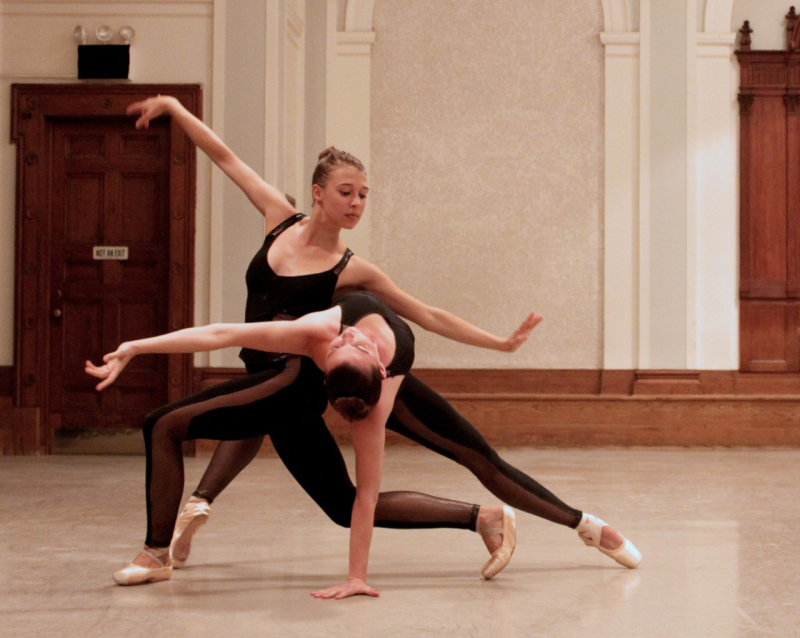
    Above: Cassidy Hall and Sarah Atkins in Upon My Wings; photo by Amber Neff

    In the first of the evening’s two premieres, Upon My Wings, Doori Na again made a vivid impression in the music of Reiko Fueting: tanz.tanz was composed for solo violin as an homage to Bach’s famous Chaconne. This ballet, originally entitled Tanz Tanz, was commissioned by the Columbia Ballet Collaborative, where it premiered in 2014.  For his own company, Miro has distilled the dancing to a duet for Sarah Atkins and Cassidy Hall.

    Skittering sounds from Doori’s violin find the two dancers balancing against one another’s bodies. They kneel and sway. The choreography features the intimate and physically taxing same-sex partnering that Miro has been exploring of late: for example, Sarah being rotated by Cassidy in an off-center balance.

    The violin stutters and buzzes, and Doori shows his mastery with some ultra-soft playing, so subtle and shining. The girls echo one another in turns as the music goes Bachian; the ballet ends in silence.

    Yellow-Rose-Red-Blue, the evening’s second premiere, marks Miro’s third collaboration with composer Michel Galante; the work is made possible by a grant from the O’Donnell-Green Music and Dance Foundation. 

    Thumbnail_IMG_0970_edited_sm

    Above: Amber Neff, Cassidy Hall, and Traci Finch in Yellow-Rose-Red-Blue; photo courtesy of New Chamber Ballet

    The ballet’s title derives from the colours of Sarah Thea’s stylish and usual costumes: mock-turtle-neck designs with long, gossamer slit-skirts. These elegant frocks add to the airy feeling of the space-filling choreography. Pianist Melody Fader joins Doori Na to play Galante’s very demanding score.

    As Amber Neff and Cassidy Hall engage in more of Miro’s intense partnering, the music is almost immediately fiendish: deep piano and growling violin. Things turn waltzy, and the girls pair off and circle the stage in a movement motif that is half-waltz and half-galop. The music continues to engage us: somehow, Doori is able to produce a deep, gritty sound as if he was drawing his bow across sandpaper. The dancers gather in a circle, raising their arms in a reverential gesture.

    Amber and Cassidy, standing back-to-back, wrap one another en attitude, and bend apart. The four dancers form a chorus line; the music grows agitated, and the girls rush off into a space-filling chase-about. Their paths cross; poses are struck while the others dance on. They re-form the celebratory circle, reaching for heaven. In an allegro rush, the dancers conjure up a galloping pace, drawing from a repeated note on Melody’s keyboard. 

    Yellow-Rose-Red-Blue: it’s complicated, both musically and choreographically. It will take further viewings to delve into its riches, and I feel certain we’ll be seeing it again soon. Tonight’s premiere certainly was provocative, and I look forward to this ballet’s future evolution. 

    Concluding the evening was Djazz. Set to Maurice Ravel’s sonata #2 for violin and piano, the ballet was commissioned by Leslie and Richard Curtis. Here designer Sarah Thea had the three dancers – Sarah Atkins, Traci Finch, and Amber Neff – in dark-coloured leotards to which long fringes have been attached. This gave the girls a “flapper” look which meshed well with Ravel’s jazz-tinted score; when doing fast turns, the fringe flared out, giving an added air of animation.

    Sarah Atkins leads off the dancing, soon joined by Traci Finch and Amber Neff; their contrasting personalities are engaging. Miro’s choreography here again calls for tricky partnering, as well as jazz-inspired swaying and sauntering. At the end of the first movement, the dancers wilt; at the end of the second, they sleep. In the finale, the dancing becomes very animated, with high-kicking extensions on display and brisk steps woven into the pulsating music.

    In the Ravel, the musical achievement of Doori Na and Melody Fader was extraordinary; I can honestly say I’ve never heard this piece played better. It’s such incredible music: rhythmically captivating, veering from assertive to misterioso, and rich in irony. Doori and Melody were rightly cheered by the full house as the evening drew to its close.

    Dancers: Sarah Atkins, Elizabeth Brown, Traci Finch, Cassidy Hall, and Amber Neff
    Musicians: Melody Fader, piano & Doori Na, violin

  • Claudia Schreier’s SOLITAIRE @ Vail

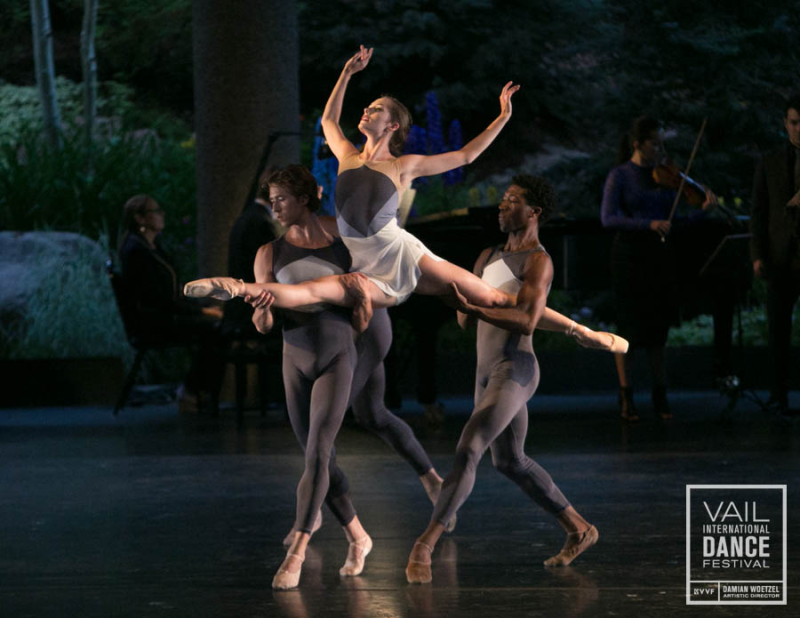
    Unity Phelan, Zachary Catazaro and the Catalyst Quartet in Claudia Schreier's Solitaire. Photo by Erin Baiano (3)

    Above: New York City Ballet’s Unity Phelan and Zachary Catazaro in the pas de deux from Claudia Schreier’s SOLITAIRE; photo by Erin Baiano for the Vail International Dance Festival

    SOLITAIRE, the newest ballet from choreographer Claudia Schreier, premiered at the Vail International Dance Festival on August 8th, 2016. The ballet was danced by Unity Phelan, Zachary Catazaro, Joseph Gordon (all of New York City Ballet) and Da’Von Doane (of Dance Theater of Harlem). The music, by Dmitri Shostakovich and Alfred Schnittke, was performed live by New York City Ballet‘s pianist deluxe Cameron Grant, and the Catalyst Quartet.

    I’m so pleased to share this video recording by Nel Shelby Productions of this new ballet’s world premiere performance: LINK

    Erin Baiano photographed the premiere of SOLITAIRE, and here are some of her wonderful images:

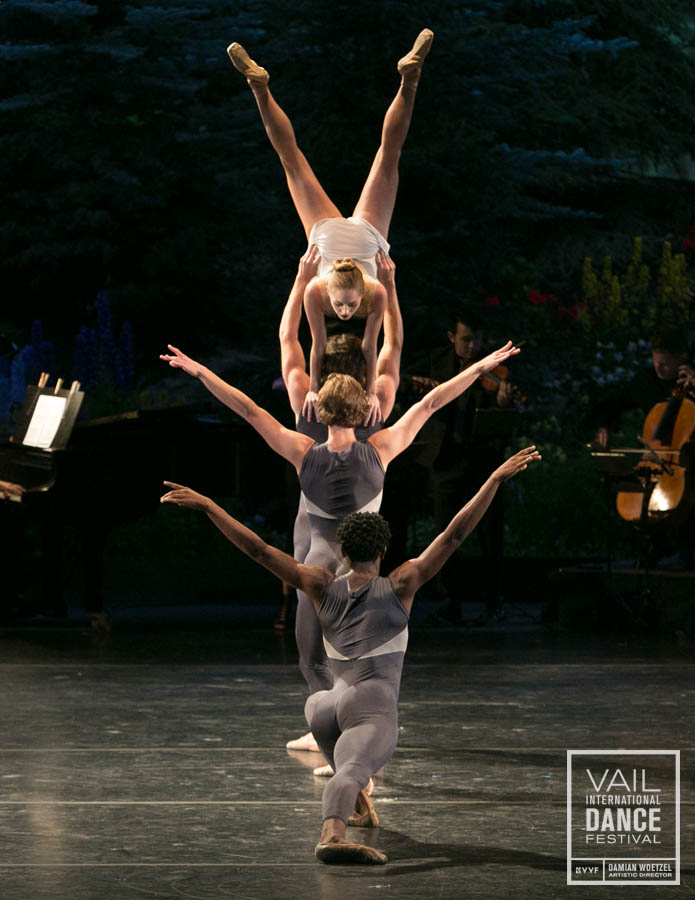
    Unity Phelan, Joseph Gordon, Da'Von Doane, pianist Cameron Grant and the Catalyst Quartet in Claudia Schreier's Solitaire. Photo by Erin Baiano

    Above: Unity Phelan, with Joseph Gordon and Da’Von Doane

    Unity Phelan, Zachary Catazaro, Joseph Gordon and Da'Von Doane in Claudia Schreier's Solitaire. Photo by Erin Baiano

    Above: a pose from SOLITAIRE‘s first section

    Unity Phelan, Zachary Catazaro and the Catalyst Quartet. Photo by Erin Baiano

    Above: Unity Phelan and Zachary Catazaro in the pas de deux

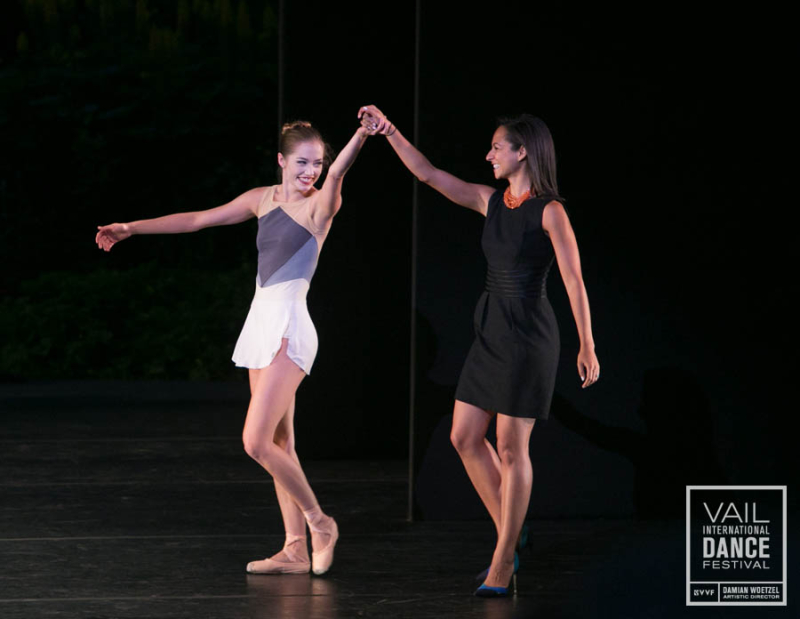
    Unity Phelan and Claudia Schreier bowing at the Vail International Dance Festival

    Above: ballerina Unity Phelan and choreographer Claudia Schreier take a bow following the premiere of SOLITAIRE, which drew a standing ovation from the Vail audience.

    All production photos by Erin Baiano.

  • L.A. Dance Project @ The Joyce

    Helix2a

    Above: Stephanie Amurao and Aaron Carr of L.A. Dance Project in Justin Peck’s HELIX; photo by Rose Eichenbaum

    Wednesday July 27th, 2016 – First off, I must heap praise on the dancers of L.A. Dance Project: throughout this long, uneven program at The Joyce, their energy, commitment, sexiness, and spirit kept us engaged, even when the choreography lapsed. Some of these dancers are familiar to me: Stephanie Amurao (she danced briefly with TAKE Dance), Morgan Lugo (he danced in Luca Veggetti’s BACCHAE for Morphoses in 2011); and Aaron Carr (formerly of Keigwin & Co); then there’s Anthony Bryant, a lovely guy I’ve known via Facebook and who I have now met as both a dancer and friend.

    The Joyce was packed – so nice to run into Denise Vale of the Martha Graham Dance Company! – as works by Sidi Labri Cherkaoui, Martha Graham, Justin Peck, and The Project’s director Benjamin Millepied were offered up.

    Mr. Cherkaoui – whose ORBO NOVO for Cedar Lake Contemporary Ballet in 2009, and SUTRA, seen at the White Lights Festival in 2010, linger in the memory – gives us HARBOR ME, a darkish piece set to music by Park Woojae. This work may be danced by three men or three women: tonight, it was the female trio: Stephanie Amurao, Julia Eichten, and Lilja Rúriksdóttir. The music features poignant cello passages; each of the three women has a solo, then trios develop in which they form languid structures. The music pulses up, with a mid-Eastern feel. The women dance a trio in a pool of light, conversing in gestures. The ballet starts to feel overly drawn-out: the alternation of solos and trios becomes repetitive, and there’s a bit too much floorwork. In the end, it’s the compelling dancing that saves it. 

    After the first interval, MARTHA GRAHAM DUETS proved a welcome change of pace. The three pas de deux were culled from a 1957 Graham documentary, A Dancer’s World, and are performed to piano music by Cameron McCosh from the film’s soundtrack. White Duet is now familiar to Graham devotees in its incarnation as part of Diversion of Angels; Star Duet and Moon Duet have not been seen since the 1960s.

    Developing the Graham style takes years for a dancer, and so one could not expect tonight’s sextet of dancers to look like the members of the current Graham company – people who are deeply invested in the Graham technique. Instead, a beautiful fusion has been achieved, and it’s simply wonderful to be seeing these duets performed with such lustre: Rachelle Rafailedes and Nathan Makolandra looked divine in the stylized White Duet, here danced in Janie Taylor’s sleek costumes, recalling the Balanchine black-and-whites.

    The delights of Star Duet were served up by Stephanie Amurao and Anthony Bryant. There are kick-lifts and arabesque balances, and then things get playful: Stephanie stands on Anthony’s thighs as he revolves in a gentle plié. In Moon Duet, Morgan Lugo looks like a young god. He and Julia Eichten gorgeously conveyed a sense of wonderment and quiet ecstasy as their duet unfolds.

    Justin Peck’s HELIX was far and away the most impressive of the program’s three new works. In her costume designs for this ballet, Janie Taylor puts the dancers in grey but playfully adds powder-blue socks. Esa-Pekka Salonen’s score is eminently dance-worthy and Justin’s choreography evolves naturally from the music. But for the lack of toe shoes, this piece is brilliantly balletic…with a contemporary twinge.

    At curtain-rise, three couples stand back-to-back. Then movement bursts forth: tricky footwork and complex partnering mark the three duets that Justin has created, and the dancers dive right in, vibrant and assured. When the music gets big, the dancers go still and then strike poses. A series of exuberant solos follows. Urgent comings and goings engage the eye, and then: everyone collapses. The crowd went wild, showering the dancers with applause. Kudos to all: Laura Bachman, Anthony Bryant, Nathan Makolandra, Robbie Moore, Rachelle Rafailedes, and Lilja Rúriksdóttir.

    Following a second intermission, Benjamin Millepied’s ON THE OTHER SIDE brought the full Company on in a colour-filled dancework set to piano music by Philip Glass. The ballet was premiered about a month ago at Sadler’s Wells, and perhaps it was scheduled for its Joyce performances without sufficient thought as to how it would fit in the program. Basically, it’s fatally over-extended.  

    ON THE OTHER SIDE starts more than promisingly – and it’s danced superbly from start to finish – but it simply goes on and on. Each segment, and the music that supports it, is more than pleasing to watch and hear, but after a while one could sense the audience’s impatience and desire for an ending. The dancers labored valiantly and never for a moment let the choreographer down; eventually my companion and I were feeling numb. 

    When the curtain finally fell, the dancers were warmly applauded but the rabble-rousing ovation they so deserved was dampened by the fatigue that had set in watching this last ballet. With judicious cutting, ON THE OTHER SIDE could still be a viable work; as it stands now, it’s as exhausting to watch as some of Twyla Tharp’s over-extended creations.

  • Young Dancers from Syria

    12865119_1468299850.7734

    UPDATE: The fund-raising was successful!

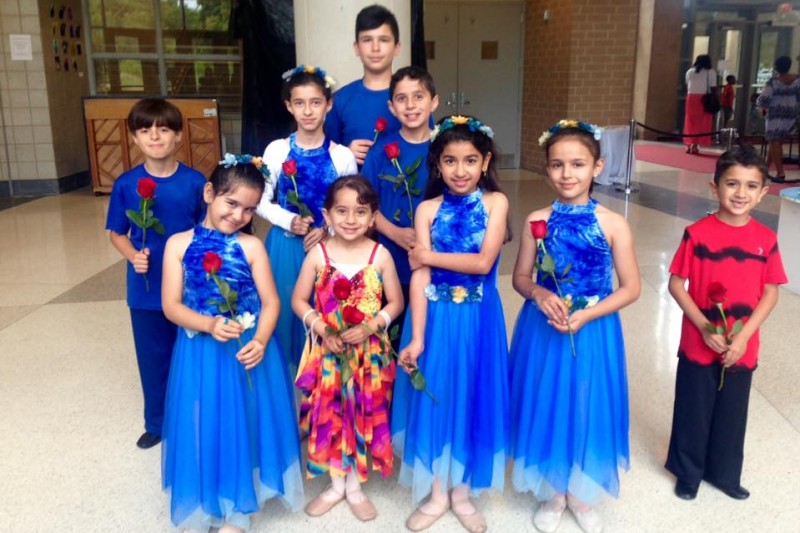
    My dancer/friend Joanna Priwieziencew has created a GoFundMe campaign to help nine youngsters who have been re-settled in Chicago from their native Syria. Over the past couple months, these lovely kids have had dance workshops generously donated by Shawn Lent and other volunteers at Performing Arts Limited; now Joanna’s mission is to enroll them for regular classes in the coming school year.

    Choreographer Brian Carey Chung shared these words in greeting these students: “Good luck, young ones! All of life is within the dance. If you practice, pay attention, and take to heart the music inside you, all of life’s lessons (how to be courageous, generous, disciplined, creative, graceful, a leader who also knows how to follow, etc.) can be learned.”

    12865119_1469399417.4922_updates

    UPDATE: The goal was reached…and the kids are happy. Thanks everyone!

  • Gallant’s RETROGRADE UNIVERSE @ Danspace

    G

    Above: Loretta Thomas and the ensemble, photo by Melanie Futorian

    Thursday June 23rd, 2016 – The high-vaulted space of St Mark’s Church can become oppressively warm on a Summer evening, but it was worth this minor discomfort tonight as the engaging dancers of Catherine Gallant/DANCE and Dances by Isadora, under the artistic direction of Ms. Gallant, presented a program offering a wide-ranging musical experience, choreography both new and venerated, and dancing that unfailingly found the heart of each piece presented. The performance affirmed both the power and the poetry of the feminine spirit, seen tonight in its many aspects.

    L1730727

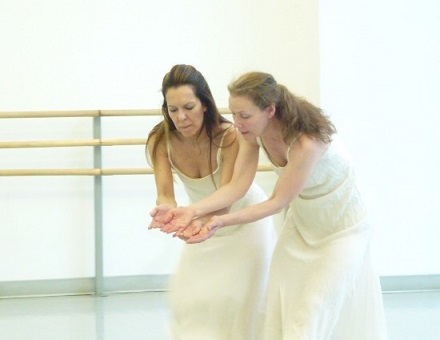
    Above: Janete Gondim and Eleanor Bunker rehearsing Catherine Gallant’s The Secret

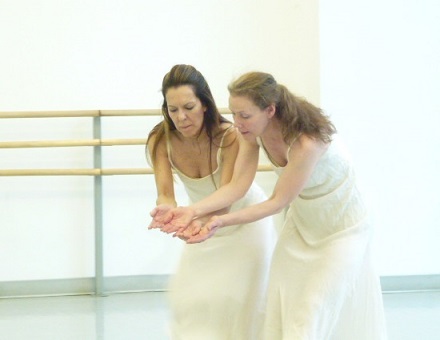
    The evening could not have a had a more propitious start than Ms. Gallant’s The Secret; like white-clad angels, the two dancers – Janete Gondim and Eleanor Bunker – continually conveyed the sense of wonder which permeates this dancework like a delicious fragrance.

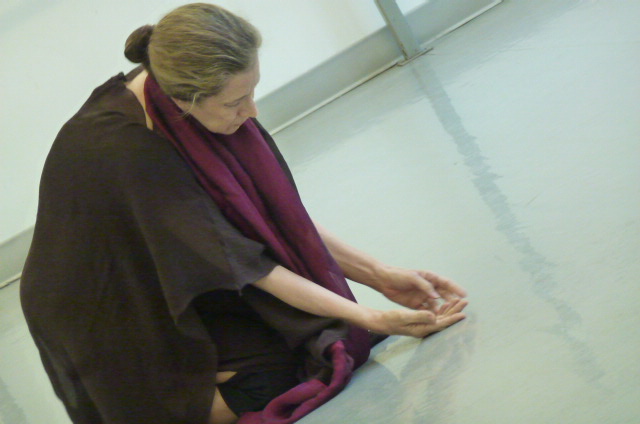
    With Ygor Shetsov at the piano, playing the Scriabin Poeme in F-sharp major, the two dancers moved about the space with a sort of quiet urgency, pausing to marvel at the treasure they had found, and which they were holding in the palms of their hands. The choreography flows gorgeously on the music: simple moves which take on a poetic resonance in the personalities of the two women; Janete and Eleanor were captivating to watch, and The Secret joins a short list of danceworks I’ve encountered in the past 20 years that ideally meld music, mood, and movement, leaving a lasting impression.

    C

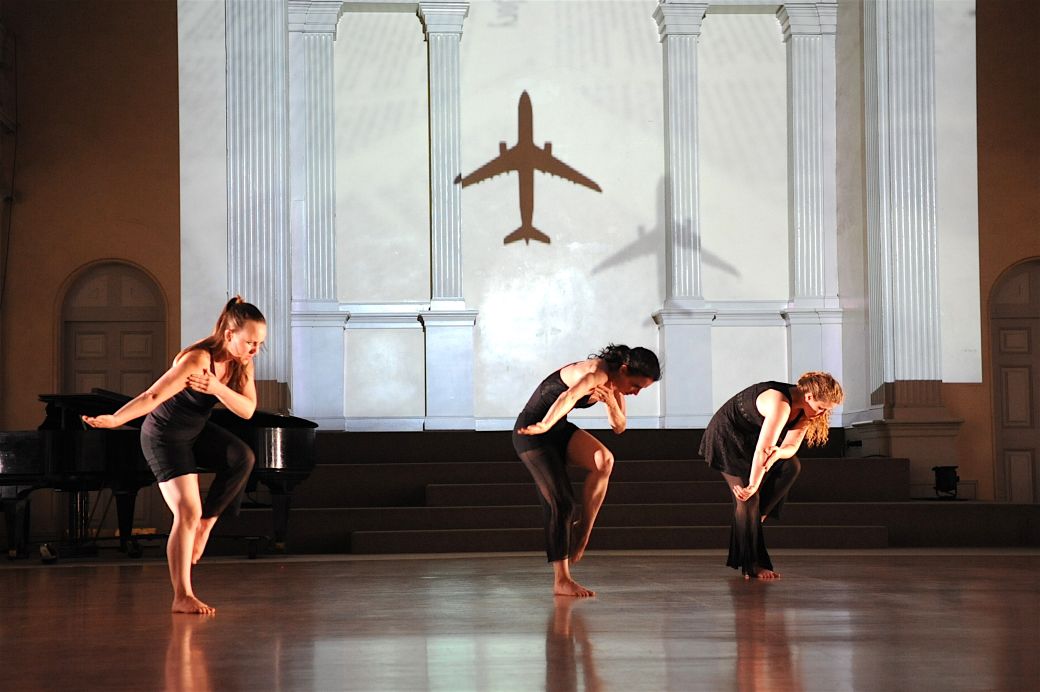
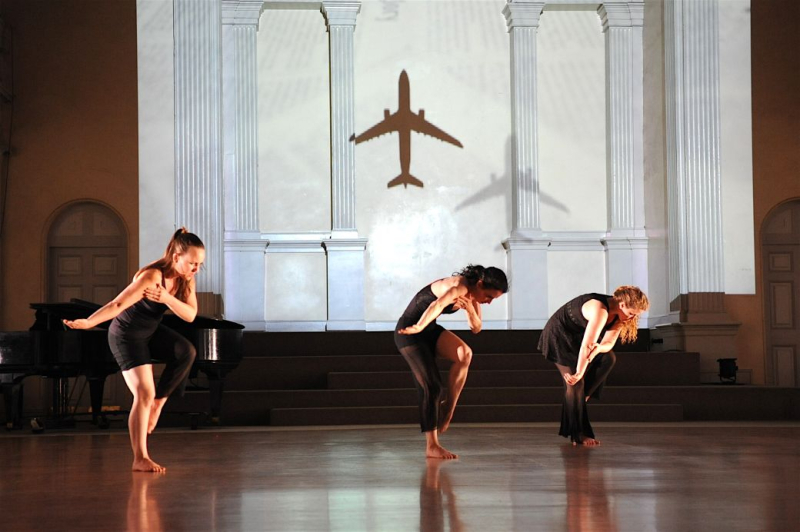
    The premiere of Ms. Gallant’s Retrograde Universe (above, in Melanie Furotian’s photo) offered a fine contrast to The Secret. Alternating passages of silence with music of Steve Reich, this piece found excellent interpreters in Michelle Cohen, Megan Minturn, Erica Lessner, and Charlotte Henrickson. The girls periodically flung themselves to the floor, or burst into paroxysms of anxious movement, whilst at other moments they simply stand stock still, striking sculptural poses. Whimsical projections of newsprint and of an airplane whose pilot had clearly lost his sense of direction added a touch of mystery to the work, which seemed at times to be going on a bit too long, but which was kept on track by the energies of the four dancers.

    Finally, a Gallant work created in 2009, features a score by Rome prize-winning composer Lisa Bielawa. Using texts from Franz Kafka, the composer creates music of haunting sonic textures as performed by violinist/vocalist Christina Courtin. Loretta Thomas danced this solo tonight, swathed in a long black veil. Her body ‘spoke’ the music, expressing an almost desperate loneliness. Ms. Courtin, in addition to being an emotive violinist, has a voice – plaintive and clear – which makes a poignant effect. At the end, Ms. Thomas, an artist to her fingertips, walked slowly upstage as the lights faded.

    Pogoplug.com d

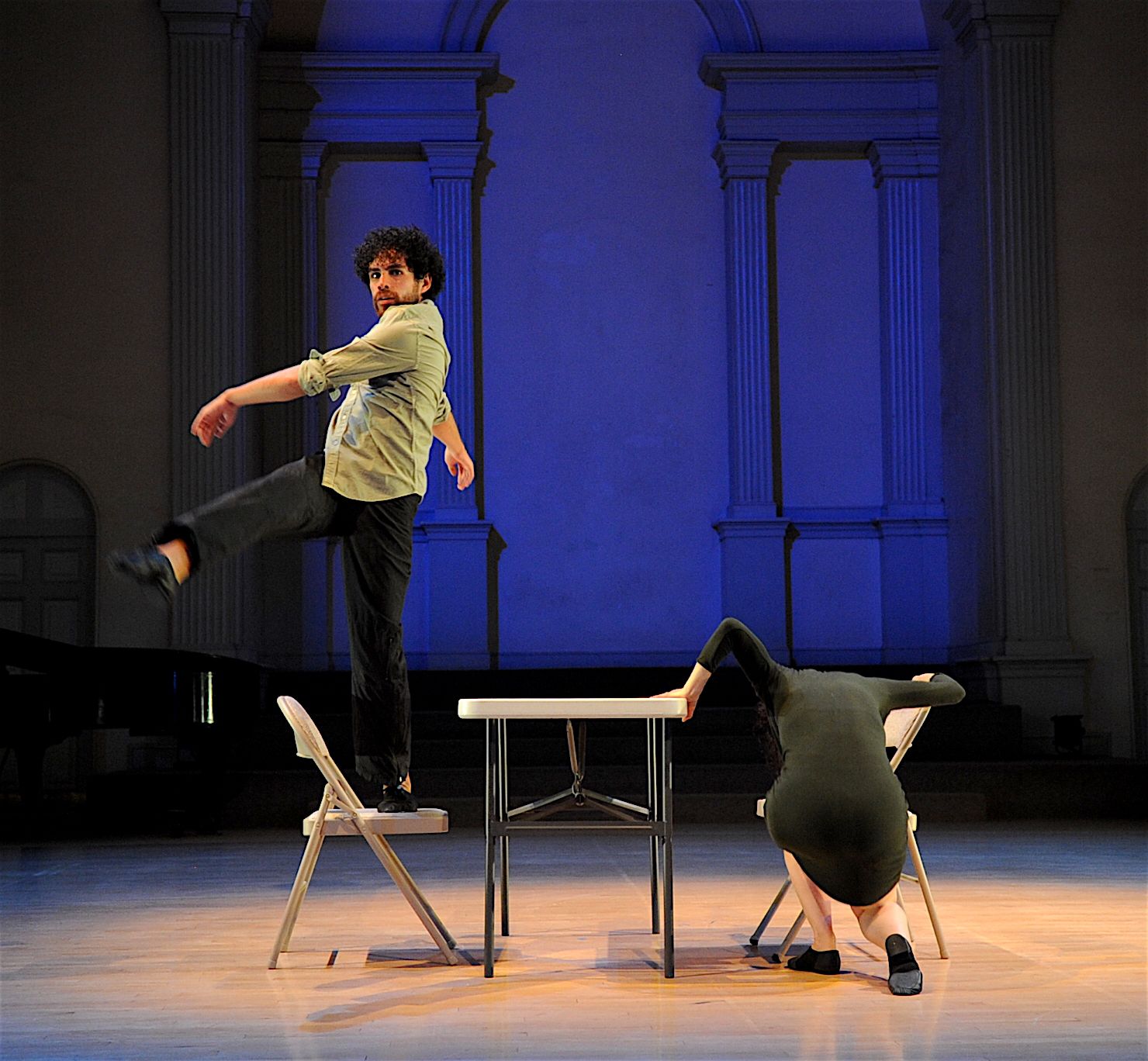
    Above: Alvaro Gonzalez and Michelle Cohen in Meeting #12; photo by Melanie Futorian

    A domestic drama, Meeting #12, opens with the dancers Michelle Cohen and Alvaro Gonzalez seated at a table. Much of this work is danced in silence, with interjections from Schubert’s E-flat major trio occasionally cropping up. The couple are enmeshed in a quarrel which becomes tempestuous, and the table and chairs eventually become part of the choreography. The beauteous Ms. Cohen and the scruffily handsome Mr. Gonzalez are ideally cast, and they make every moment of the work count. In the end, they find that actually conversing with one another may be the best solution. Projections of puffy clouds against a bright blue sky provide a visual counterpoint to the cramped kitchen in which the lovers have been arguing.

    The second half of the program was given over to works of Isadora Duncan.    

    Pogoplug.com e

    Above: from Valse Brillante, photo by Melanie Futorian

    Loretta Thomas has staged Isadora’s Valse Brillante (created c. 1910) for the Company, and it was danced this evening with lively grace by Jessie King, Amelia Sanders, Ella Lang, and Chanda Cragnotti. At the piano, Yegor Shetsov reveled in the ebb and flow of the Chopin Grande Valse Brillante.

    Three solos – each set to a Scriabin étudewere engrossing in their contrasting moods, and in the committed interpretations of the dancers.

    In Crossing, Scriabin-turbulence buffeted the hesitant anxiousness of Catherine Gallant, who danced with great physical devotion, mirroring the stormy music. The pain of loss and the thought of “nevermore” were movingly evoked by Loretta Thomas in her sorrowful performance of Mother, one of the Duncan works recalling the tragic death of Isadora’s two young children. Personifying feminine strength and the courage of resistance, Kristen Foote, a guest artist from the Limón Dance Company, gave a performance of radiant authority in Revolutionary. Mr. Shetsov played the three Scriabin études which accompany these solos with virtuosity and dramatic nuance.

    Catherine Gallant and Loretta Thomas have been working on the reconstruction of two movements of an untitled work – set to movements of the Beethoven 7th symphony – which Isadora performed as a solo between 1904 and 1909 on US and European tours.    

    L1730931

    Ms. Gallant (clad in white in the above rehearsal photo) danced the leading role tonight in her re-imagining of the symphony’s Allegretto, and Loretta Thomas has choreographed the Presto. Watching the Gallant dancers in this evening’s performance, we are reminded of the unique position held by Isadora Duncan in the history of dance, and of the continuing necessity of seeing her dances lovingly revived and maintained, so that new generations can both honor and enjoy her work, both for its historical value and its continuing resonance in modern times.

    Here are some Melanie Futorian images from the two Beethoven movements, the Presto of which closed tonight’s performance on a joyous note.

    Pogoplug.com b

    A

    Loretta Thomas (in white) and the ensemble

    Pogoplug.com h

    Pogoplug.com j

    Pogoplug.comf

  • Gallant’s RETROGRADE UNIVERSE @ Danspace

    G

    Above: Loretta Thomas and the ensemble, photo by Melanie Futorian

    Thursday June 23rd, 2016 – The high-vaulted space of St Mark’s Church can become oppressively warm on a Summer evening, but it was worth this minor discomfort tonight as the engaging dancers of Catherine Gallant/DANCE and Dances by Isadora, under the artistic direction of Ms. Gallant, presented a program offering a wide-ranging musical experience, choreography both new and venerated, and dancing that unfailingly found the heart of each piece presented. The performance affirmed both the power and the poetry of the feminine spirit, seen tonight in its many aspects.

    L1730727

    Above: Janete Gondim and Eleanor Bunker rehearsing Catherine Gallant’s The Secret

    The evening could not have a had a more propitious start than Ms. Gallant’s The Secret; like white-clad angels, the two dancers – Janete Gondim and Eleanor Bunker – continually conveyed the sense of wonder which permeates this dancework like a delicious fragrance.

    With Ygor Shetsov at the piano, playing the Scriabin Poeme in F-sharp major, the two dancers moved about the space with a sort of quiet urgency, pausing to marvel at the treasure they had found, and which they were holding in the palms of their hands. The choreography flows gorgeously on the music: simple moves which take on a poetic resonance in the personalities of the two women; Janete and Eleanor were captivating to watch, and The Secret joins a short list of danceworks I’ve encountered in the past 20 years that ideally meld music, mood, and movement, leaving a lasting impression.

    C

    The premiere of Ms. Gallant’s Retrograde Universe (above, in Melanie Furotian’s photo) offered a fine contrast to The Secret. Alternating passages of silence with music of Steve Reich, this piece found excellent interpreters in Michelle Cohen, Megan Minturn, Erica Lessner, and Charlotte Henrickson. The girls periodically flung themselves to the floor, or burst into paroxysms of anxious movement, whilst at other moments they simply stand stock still, striking sculptural poses. Whimsical projections of newsprint and of an airplane whose pilot had clearly lost his sense of direction added a touch of mystery to the work, which seemed at times to be going on a bit too long, but which was kept on track by the energies of the four dancers.

    Finally, a Gallant work created in 2009, features a score by Rome prize-winning composer Lisa Bielawa. Using texts from Franz Kafka, the composer creates music of haunting sonic textures as performed by violinist/vocalist Christina Courtin. Loretta Thomas danced this solo tonight, swathed in a long black veil. Her body ‘spoke’ the music, expressing an almost desperate loneliness. Ms. Courtin, in addition to being an emotive violinist, has a voice – plaintive and clear – which makes a poignant effect. At the end, Ms. Thomas, an artist to her fingertips, walked slowly upstage as the lights faded.

    Pogoplug.com d

    Above: Alvaro Gonzalez and Michelle Cohen in Meeting #12; photo by Melanie Futorian

    A domestic drama, Meeting #12, opens with the dancers Michelle Cohen and Alvaro Gonzalez seated at a table. Much of this work is danced in silence, with interjections from Schubert’s E-flat major trio occasionally cropping up. The couple are enmeshed in a quarrel which becomes tempestuous, and the table and chairs eventually become part of the choreography. The beauteous Ms. Cohen and the scruffily handsome Mr. Gonzalez are ideally cast, and they make every moment of the work count. In the end, they find that actually conversing with one another may be the best solution. Projections of puffy clouds against a bright blue sky provide a visual counterpoint to the cramped kitchen in which the lovers have been arguing.

    The second half of the program was given over to works of Isadora Duncan.    

    Pogoplug.com e

    Above: from Valse Brillante, photo by Melanie Futorian

    Loretta Thomas has staged Isadora’s Valse Brillante (created c. 1910) for the Company, and it was danced this evening with lively grace by Jessie King, Amelia Sanders, Ella Lang, and Chanda Cragnotti. At the piano, Yegor Shetsov reveled in the ebb and flow of the Chopin Grande Valse Brillante.

    Three solos – each set to a Scriabin étudewere engrossing in their contrasting moods, and in the committed interpretations of the dancers.

    In Crossing, Scriabin-turbulence buffeted the hesitant anxiousness of Catherine Gallant, who danced with great physical devotion, mirroring the stormy music. The pain of loss and the thought of “nevermore” were movingly evoked by Loretta Thomas in her sorrowful performance of Mother, one of the Duncan works recalling the tragic death of Isadora’s two young children. Personifying feminine strength and the courage of resistance, Kristen Foote, a guest artist from the Limón Dance Company, gave a performance of radiant authority in Revolutionary. Mr. Shetsov played the three Scriabin études which accompany these solos with virtuosity and dramatic nuance.

    Catherine Gallant and Loretta Thomas have been working on the reconstruction of two movements of an untitled work – set to movements of the Beethoven 7th symphony – which Isadora performed as a solo between 1904 and 1909 on US and European tours.    

    L1730931

    Ms. Gallant (clad in white in the above rehearsal photo) danced the leading role tonight in her re-imagining of the symphony’s Allegretto, and Loretta Thomas has choreographed the Presto. Watching the Gallant dancers in this evening’s performance, we are reminded of the unique position held by Isadora Duncan in the history of dance, and of the continuing necessity of seeing her dances lovingly revived and maintained, so that new generations can both honor and enjoy her work, both for its historical value and its continuing resonance in modern times.

    Here are some Melanie Futorian images from the two Beethoven movements, the Presto of which closed tonight’s performance on a joyous note.

    Pogoplug.com b

    A

    Loretta Thomas (in white) and the ensemble

    Pogoplug.com h

    Pogoplug.com j

    Pogoplug.comf

  • RIOULT @ The Joyce ~ June 2016

    Nyseason_885x518

    Wednesday June 22nd, 2016 – RIOULT at The Joyce, offering a very pleasing evening of dance from Pascal Rioult’s excellent troupe, with exceptional dancing from both established Company members and relative newcomers. The program was well-varied musically, and the evening was enhanced throughout by fine lighting and canny use of visual effects.

    Tchaikovsky’s Orchestral Suite #2 in C-major is the setting for Dream Suite which opened the program; this coloristic ballet – with gorgeously distinctive lighting by Jim French – is a visual treat. The inimitable Charis Haines is the Dreamer, and her dreams veer from lyrical to witty to mystical.

    Against a backdrop which shifts from pumpkin-coloured to vivid red, ten dancers move thru Charis’s dreamworld in quirky combinations, sometimes stopping to strike amusingly ironic poses. Masked characters appear: a bull, and ancient reptilian birds. Undercurrents of sexual fantasy are woven in and, as is often the case in dreams, things seem disjointed at times.

    The choreography overall is disarmingly simple – when the dancers simply form a circle, the effect is stunning – and Charis Haines excels in her solo passages. Colour – radiant and saturated – is everything. The striking image of a woman stretched out in a flat plank and borne aloft by her partner across the upstage space seems to signal a magical end to the ballet, but there’s another movement to come; that image, though, remains fixed in the memory.

    Selected Preludes and Fugues from Bach’s Well-Tempered Clavier (seemingly the Glenn Gould recordings, as there is much extraneous vocalism along the way) are the basis of Polymorphous, a stylized dancework which opened before a gridwork backdrop against neutral colours, with costumes of the same visual texture. Four dancers – Brian Flynn, Charis Haines, Jere Hunt, and Sara Elizabeth Seger – move in sync, almost like automatons. In two duets that follow, the first is accompanied by a ghostly negative-image film of the dancers projected above while during the second, multiple shadow images appear as echoes of the choreography.

    Duets, Sacred and Profane opened the evening’s second half; here we meet pairs of the RIOULT dancers in more personalized settings. In the first duet, from Kansas City Orfeo (1996), Sabatino A Verlezza as Orfeo attempts to revive his dead wife, Euridice (Catherine Cooch), to the appropriate music from the Gluck opera; this put me very much in mind of David Grenke’s powerful duet, Vespers.

    One of the Company’s newest members, Corinna Nicholson, made a really lovely impression dancing a duet from The Great Mass (2009) with Sara Elizabeth Seger. The girls wear gossamer ‘Baroque’ dresses, and they bring an air of courtliness to this charming piece.

    Two of RIOULT‘s most vivid dancers, Jere Hunt and Michael Spencer Phillips, were magnificent in a pas de deux from Te Deum (1995). To the music of Arvo Pärt, Michael – in a dark suit and white shirt – partners Jere, clad in black briefs, in an intimate duet. Though devoid of erotic overtones, the dance is both sensual and spiritual. Various imagined scenarios might be applied – two lovers, two brothers, a father and son, a guardian angel and his charge. Jere Hunt’s muscular physique speaks powerfully in its own right; a vein of poetic vulnerability which runs thru his work as a dancer gives his performances a deeply personal resonance. Michael’s handsomeness and the strength of his movement are captivating to behold: this is a dancer who can express both courage and tenderness. Together, the two men thrilled the audience.

    Something special needed to follow this male duet, and we found it the charismatic pairing of Charis Haines and Holt Walborn in a sublime Bach duet from Views of the Fleeting World (2008). Their expressiveness and their sense of the mutual devotion of this couple created a beautiful atmosphere.

    For a remarkable finale, Pascal Rioult’s unique setting of Ravel’s Bolero sparked an eruption of cheers from the mesmerized crowd at its end. Against a backdrop by Harry Feiner – a fanciful rendering of architecture à lespagnole – eight dancers perform endless repetitions of gestural motifs while periodically moving from one formation to another. Woven into these geometric configurations are illuminated solos which are luxuriantly slow and sometimes self-caressive. The dancers – Mlles. Cooch, Haines, Nicholson, and Seger with Mssrs. Flynn, Hunt, Phillips, and Verlezza – went thru their hypnotic paces with machine-like precision, whilst basking in the more voluptuous solo moments. Brilliant!

  • A Quartet of Female Choreographers

    13407164_3092102065116_6567679795283993630_n

    Wednesday June 15th, 2016 – Works by four prominent contemporary female choreographers were on offer this evening at New York Live Arts. In a well-contrasted program, distinctive dancing and excellent lighting made each piece glow in its own unique way.

    One couldn’t ask for a more engrossing start to an evening of dance than that offered by Molissa Fenley and Company: a duet entitled THE THIRD COAST (Premiere), and MALI, a solo danced by Ms. Fenley. Evocative music by Ryuichi Sakamoto (duet) and Laetitia Sonami (solo), and splendid lighting by David Moodey, were attractive assets to these two works.

    In a violet world, dancers Christiana Axelsen and Rebecca Chaleff dance a stylized duet in-sync. Their moves and gestures imply a secret language. Dawn-light glows as the two continue to mirror one another. In a second, more animated section – to piano music – the lighting goes sea-green. The two dancers bring a compelling grace to the angular movement.

    This mysterious duet leads directly into the solo danced by Ms. Fenley: a captivating experience in every regard as the fusion of the soundscape – clattering, crunching, sloshing – the lighting, and the dancer’s mesmerizing movement held the theatre under a spell. Ms. Fenley’s arms and hands were so expressive, and her sense of commitment gave the work a gorgeous resonance.

    Elisa Monte’s DEXTRA DEI was originally set as men’s quartet: the choreographer’s 1989 response to the devastation of the AIDS epidemic. Ms. Monte has now expanded the work, adding four women to the cast.

    It is a work that is both somber and sexy, full of chiaroscuro effects created by the David Moodey lighting. To atmospheric music by Tibor Szemzo, four men roll onto the stage and form patterns of moving sculpture. The delectable Clymene Baugher rolls on from the opposite corner where she encounters Thomas Varvaro. Their intimate, floor-oriented duet ends in surrender and repose.

    Lithe and supremely feminine, Maria Ambrose appears and is manipulated aloft by the three remaining men; the music is ominous, with deep vocals and bird cries. JoVanna Parks and Shay Bland enter, jungle drums sound softly, reverberating in the rain forest mist. The men withdraw, the woman dance a quartet with fleeting solo passages: an exotic tribal rite of a restless sisterhood.

    The men reappear, repeating the movement motifs that initiated the ballet. Over a sustained note, partnerships form: stylized lifts and turns abound as pulsing music underscores the communal rituals. The work, perhaps just a trifle too long, showed off Monte’s dancers to perfection.

    Margo Sappington’s ENTWINED depicts the melding of bodies and spirits. At once sensual and magical, this on-pointe ballet is set to Erik Satie’s Gnossiennes. I was familiar with this work from having seen Jennie Somogyi and Charles Askegard perform the signature duet from it with Ballet Next in 2011.

    This evening I was particularly delighted to find Lily Di Piazza dancing in the ballet’s opening pas de trois; I remember Lily’s dancing from her SAB days. Ms. Sappington and I had a lovely chat before tonight’s show, and she told me she had originally made this role on Lily. 

    As mists roll by, Lily, Marjorie Fiering, and  Marlon Taylor-Wiles danced with effortless beauty, accenting the classicism of the vocabulary. Marlon’s impressive physique and his powerful charisma were a counterpoise to the elegant feminine allure of the two girls.

    Silken Kelly appears for a solo, danced in pools of light; the lyrical choreography was sublimely articulated by this radiant dancer. The exquisite Chrystyn Mariah Fentroy then joined Mr. Taylor-Wiles for the tender, languid pas de deux; performing with an intimacy which we are permitted to savor, the two dancers fused into a single spirit. The duet’s ensuing, more animated passage gave the dancers space-filling combinations and complex partnering elements.

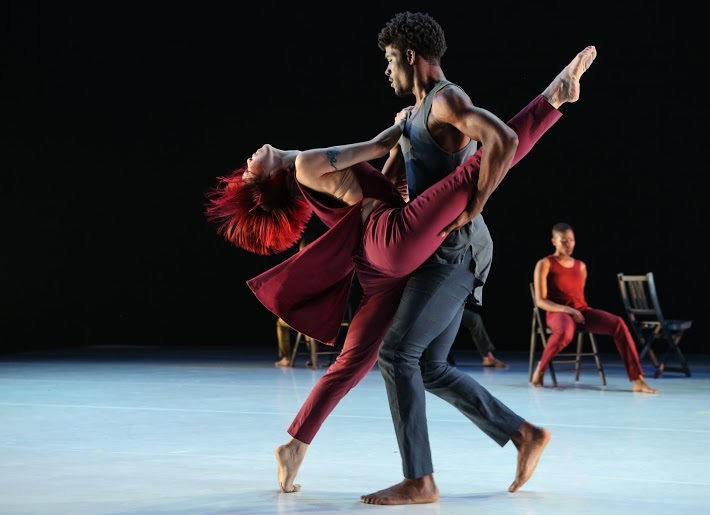
    Earlier this week, I caught a studio run-thru of Jennifer Muller‘s newest creation, WORKING TITLE.  Consisting of four duets – into which interjections by other dancers sometimes occur – the dancing is accompanied live by Yut Chia and Shayne Lebron Acevedo, of Yut and the Hot Four. Ms. Muller told me that she heard Yut playing in the subway station, approached him, and asked if he’d be up for a collaboration. The result is WORKING TITLE, a dancework about relationships that mixes passionate music and dynamic dance. A row of chairs is the setting for the characters, who come and go throughout the ballet, sometimes observing those who are dancing, sometimes isolated, withdrawn, deep in thought.

    In the opening vignette, Alexandre Balmain pursues Michelle Tara Lynch, setting up a duet of passionate turmoil, superbly performed by this alluring pair of dancers. Ms. Lynch’s hair becomes an active participant in the dance as she sought to steer clear of the young Frenchman’s advances. Alexandre’s line, and his lavish extension, continually lure the eye. Elijah Laurant, Ms. Muller’s newest dancer, turns this duet into a trio: his place in the romantic triangle is a bit ambiguous: we can’t tell if he’s just a troublemaker or if there’s some attraction between him and Alexandre…or him and Michelle. This added dramatic aspect keeps things lively.

    Gen Hashimoto then tries to interest Shiho Tanaka. Who could say “no” to Gen? But Shiho does. Their duet becomes tempestuous: Shiho’s solo marks her desire to be left alone, while Gen covers the space with his trademark sexy, bad-boy bravura. As Shiho continues to resist, the music pounds out a big beat.

    Sonja Chung, Elise King, and Seiko Fujita takes seats to observe the denouement of Gen’s attempted seduction: he and Shiho carry on – to no avail – as the music turns bluesy. 

    Index

    Sonja Chung (above, in a Julie Lemberger photo), a phenomenal dancer and presence, meets her match in height and allure in Elise King. As the two tall women veer between attraction and avoidance, emotions well up and feelings are hurt. Seiko Fujita tries to intervene – again, we don’t know her motive – but Sonja and Elise leave things unsorted.

    Index2

    Suddenly, Elijah Laurant sweeps Seiko Fujita off her feet (Julie Lemberger photo above) as they go wild in a high-energy duet, ripe with power and passion. 

    All the dancers then take seats, to ponder their solitary desires. Gen has another vivid solo, as does Sonja, and then a bit more brilliance from Seiko. All seek resolution. Sonja and Elise move off together; Gen finally persuades Shiho of his sincerity. We can’t be quite sure of the Michelle-Alexandre-Elijah situation. Seiko walks forward alone as the lights dim.

  • At Catherine Gallant’s Rehearsal

    L1730590

    Saturday June 11th, 2016 – I stopped in at the Ailey Studios this afternoon where Catherine Gallant and her very attractive troupe of dancers were in rehearsal, preparing for their upcoming performances at Danspace (St. Mark’s Church, 131 East 10th Street. New York, NY). Performance dates are June 23rd – June 25th, 2016, and you can purchase tickets here.

    Retrograde Universe is the title of this world-premiere production presented by Catherine Gallant/DANCE and Dances by Isadora, led by Artistic Director and Choreographer Catherine Gallant. Retrograde Universe includes four pieces by Gallant and three Isadora Duncan works. From Isadora, we will have an historical re-animation of Duncan’s Beethoven No. 7, which has not been performed since 1979; Three Scriabin Etudes, danced by Kristen Foote of the Limón Company on opening night; and Valse Brillante. Gallant’s Retrograde UniverseFinally, The Secret and Meeting #12 will show the contemporary aspects of the Company. The performance will feature musicians Christina Courtin and Yegor Shevtsov, and a visual creation from Nadia Lesy.

    In observing these lovely women today – going about their work with such dedication and such beauty of movement and expression – one feels a direct connection both with the well-spring of modern dance and with the indomitable feminine spirit. Gallant’s company is a collective of generational diversity and highly individual personalities molded into a community by their shared devotion to dance. 

    Today’s rehearsal included detailed work on some of the pieces to be shown at Danspace as well as a run-thru of the program. The woman swiftly changed costumes between works, while speaking quietly to one another and sharing a feminine bond: the atmosphere serious, but also light of heart and spirit.

    Here are some images that I was able to capture in the studio; much of the dancing was simply too fast-paced for me to capture, but I think the distinctive personalities of this bountiful band of women show thru.

    L1730455

    L1730489

    L1730541

    Ella Lang

    L1730657

    Francesca Todesco in Isadora Duncan’s Mother

    L1730671

    L1730687

    Janete Gondim and Eleanor Bunker in Catherine Gallant’s The Secret

    L1730697

    Janete and Eleanor in The Secret

    L1730706

    Eleanor Bunker

    L1730721

    Janete and Eleanor in The Secret. I was particularly moved by this dancework, and look forward to writing more about it after seeing it in performance.

    L1730737

    Michelle Cohen in Retrograde Universe

    L1730746

    The ensemble in Retrograde Universe

    L1730753

    Michelle Cohen

    L1730775

    Loretta Thomas

    L1730766

    Loretta Thomas

    L1730801

    Catherine Gallant

    L1730825

    Loretta Thomas

    L1730834

    Loretta Thomas

    L1730886

    Michele Cohen, Janete Gondim, and Margherita Tisato

    L1730889

    Catherine Gallant

    L1730913

    L1730925

    L1730931

    L1730946

    Michelle Cohen

    L1730952

    Catherine Gallant, Michelle Cohen

    L1730956

  • NY Phil: THE PLANETS + Williams’ Tuba Concerto

    PJ-BW140_FIXBAG_DV_20140723162140

    Above: Alan Baer of The New York Philharmonic in a Chris Lee photo

    Saturday May 28th, 2016 – Aside from Mars, I am not really a fan of the famous Gustav Holst work The Planets (composed in 1914-1916). I remember many years ago tuning in to a radio broadcast of the piece and finding my interest diminishing steadily once the spaceship left Mars for Venus; I never made it back to Earth.

    Tonight, a chance to hear The Planets in concert at Geffen Hall provided an opportunity to test my earlier reaction. Under the baton of David Robertson, The New York Philharmonic‘s performance of this sprawling epic was nothing short of marvelous. But the music itself just doesn’t reach me, beyond a surface appeal – and despite the composer’s obvious skill in orchestration. And so – yet again – upon departing Mars, I felt lost in space. 

    The remaining six movements do have their very appealing passages, of course, but also their longueurs. The only time I truly connected with any of the music was when the theme of the hymn ‘I Vow To Thee My Country strikes up as Jupiter looms in the sonic heaven. The stay on Uranus seemed endless: not much going on there. I simply couldn’t wait for this trip thru the solar system to end. Maestro Robertson had the huge forces doing his bidding to fine effect, and making a splendid sound; featured violin solos from Sheryl Staples were saving graces on this journey to nowhere. 
    But enough grumbling, lest I be mistaken for Bernie Sanders; the first half of the program was indeed thoroughly enjoyable.  

    Edward Elgar’s Introduction and Allegro (composed in 1905) opened the evening; it’s a beautiful piece and would make a great ballet score (maybe it’s been done?). The composer gives a prominent role to a string quartet, setting them before the full string contingent of the orchestra. As this quartet consisted of Sheryl Staples, Lisa Kim, Cynthia Phelps, and Carter Brey, the playing was remarkable – I especially was entranced by a solo from the viola of Ms. Phelps. When the Philharmonic strings played en masse, the richness of sound was truly savorable.
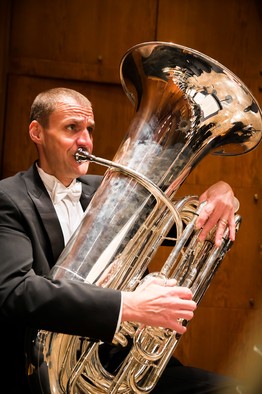
    The tall and slender Alan Baer then appeared with his silver tuba for John Williams’ Tuba Concerto. This rather brief work (just over 15 minutes in length) was very pleasing from start to finish, for Mr. Baer’s sound has a warm glow and a toothsome dark-chocolate richness in the lower range.

    The opening passages made me think of a sea shanty: good-natured, a bit brusque, with fog-horn low notes along the way. Later the tuba converses with the French horn, and in the concerto’s second movement, the tuba sounds deep phrases over a horn chorale before embarking on a polished cadenza.

    The violins strike up. The oboe has a theme that is passed to the flute, and then the flute and tuba talk to one another. After another – briefer – tuba cadenza, fanfares sound and there is a cabaletta of sorts, with trumpets giving propulsion and the tuba singing some skittish coloratura. Harp and timpani have a part to play: another inventive mix on the composer’s part. Swift-rising scales for the tuba herald a jovial conclusion.

    Philharmonic audiences love it when artists from the orchestra step forward in featured roles; there was lovely enthusiasm for the string quartet after the Elgar, and Mr. Baer received hearty cheers from the crowd, as well as the admiring applause of his colleagues.