Category: Ballet

  • Joshua Bell’s Mendelssohn @ The NY Phil

    Josh-bell-violin

    Wednesday December 30th, 2015 – Joshua Bell (above) played Mendelssohn’s violin concerto with The New York Philharmonic tonight on a program that was otherwise an all-Sibelius affair, in celebration of the Finnish composer’s 150th birthday.

    Sibelius’s The Swan of Tuonela, which opened the evening, was originally to have been included in an opera the composer was working on. It later became one of the Four Legendsthe best-known of the four and often played as a stand-alone work.  Tuonela, the realm of the dead in Finnish mythology, is surrounded by a dark-water moat on which the swan of Tuonela floats majestically, singing.

    This is music of somber gorgeousness. Sibelius structures the work on a cushioning of strings; Carter Brey’s mournful cello theme sets the tone. An evocative English horn passage (played, I believe, by Robert Botti – though we didn’t catch sight of him) leads to a brief brightening of mood. But the swan glides back into the gloom and her voice fades away to a mysterious heartbeat. At the composer’s wish, The Swan of Tuonela was performed at his own funeral.

    Alan Gilbert spoke to us before commencing the Sibelius Symphony No. 4. He seemed to veer from personal enthusiasm for the piece to apologizing for its depressing qualities. The symphony was written while the composer was dealing with problems stemming from alcoholism. This probably accounts for the work’s disjointed qualities.

    Forward-looking harmonically, the 4th does not sound like most of the other music that has given Sibelius lasting popularity over the years. Carter Brey again had a leading theme – played with striking lyricism – in the first movement. Later, as the ensuing movements unfold, the oboe, clarinet, and flute will all have their moments to shine forth. Maestro Gilbert referred to the second movement as a Scherzo, but if it’s a joke it stems from a very dark sense of humour; oddly, it includes a brief gavotte motif for flute duo…charming, but it goes un-developed. The big, deep theme of the Adagio comes closest to what we could think of as Sibelian. The agitated opening of the final Allegro – which includes the unexpected introduction of the glockenspiel – does not resolve in a positive way.

    Overall, the Sibelius 4th seemed an odd inclusion on a holiday-season program. Interestingly, it had not been played by the Philharmonic for nearly 30 years. Tonight’s audience reacted with a mixture of admiration for the playing and uncertainty as to whether they really liked the piece or not.

    Following the interval, Joshua Bell appeared for the Mendelssohn violin concerto. This was the composer’s last completed orchestral work: within three years of its premiere in 1845, he had died at the age of 38 following a series of strokes.

    Mendelssohn’s violin concerto is innovative in that its three movements are played without pause, preventing mood-breaking applause. Eschewing gratuitous technical flourishes, the composer instead goes in for heartfelt melody. There are brilliant and demanding passages to be sure, but they are more conscientiously woven into the musical fabric than tacked on to display the violinist’s deftness. 

    The concerto in fact seemed like a conversation between soloist and orchestra and, in the course of playing it, Mr. Bell often turned towards the musicians to keep the dialogue flowing in both directions. It goes without saying that the orchestra played superbly, and that Maestro Gilbert was in his particular element here – especially in the Adagio, where he and Mr. Bell communed in an almost balletic pas de deux.

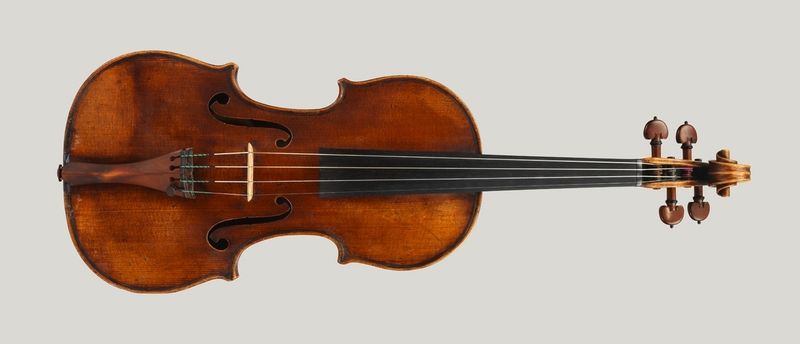
    Throughout, in fact, the black-clad violinist wove, bent, and swayed in a dance that had just a trace of the satanic about it as he drew the music from his 1713 Stradivarius. Right from the start – in that lovely and rather restless opening theme – Mr. Bell assured us we were in the presence of a musician of matchless technique, inspired artistry, and deep commitment. His capacity for subtle nuance was spine-tingling, and the satiny lustre of his sustained playing in the Adagio was – in a word – magical.

    Among the many felicities in this performance, I particularly liked Maestro Gilbert’s up-sweep of tempo as the first movement neared its conclusion, and some dashing attacks from Mr. Bell in the finale. It was a performance to treasure, and the audience could not suppress their enthusiasm: the applause erupted a split second before the final note could fade away. Mr. Bell was called out three times, and could easily have served up an encore or two: I liked instead that he let the concerto stand as his year-end gift to us. Bravo! 

    Returning to Sibelius to end the evening, Maestro Gilbert and the Philharmonic gave us a soul-stirring rendering of the composer’s Finlandia: a sure-fire crowd-pleaser, performed with resonant grandeur.

  • At Year’s End

    6a00d8341c4e3853ef00e54f201b938834-800wi

    Above: Me and my friend Richard outside the Perry Street condo, shortly after I moved to New York City in 1998.

    Odd-numbered years are often unpleasant ones for me. Just after Thanksgiving, one of my oldest friends – Richard – was found dead in his apartment in Southington, CT. The news did not shock me, since he had been in declining health for months, and he had seemed unwilling to pursue medical treatment.

    Our friendship stretched back to 1976 when we were both working at the old Covenant Insurance Company in Hartford CT. We shared many adventures over the years, and we had a few fallings-out, though never anything that lasted more than a day or two.

    Up until the time of his death, we spoke twice a week by phone (he had never shown an interest in owning a computer) and when he failed to call me on the Saturday after Thanksgiving I knew something was wrong. I tried to call him but his voicemail was full. Then Suzanne contacted me with the news of his death.

    The fact that he’s no longer with us and that we’ll never again meet in New Haven for lunch or spend a day together here in the City has sunk in slowly. I continue to miss his slightly raspy voice on the phone, and the other day when the phone rang (it seldom does) I momentarily thought: “Ah…Richard’s calling… finally…” and then I remembered.

    During 2015, three people I am very close to lost people dear to them, all in sudden and unexpected circumstances. To Dmitry, Brix, and Ta-Wei go my sympathies…life will never be quite the same for us now, even though the deep initial sorrow will fade over the years to come.

    ~~~~~~~~~~~~~~~~~~~~~~~~~~~~~~~~~~~~~~~~~~~~~~~~~~~~~~~~~~~~~~~~~~~~~~~~~~~~~~~~~~~~~~~~~~~~~~~

    2015 also saw a major change in my blog which – as a retired person – occupies a great deal of my time. During their Winter season, I finally gave up on New York City Ballet. They had become increasingly random with their press tickets and since my calendar is so full and events planned weeks in advance, it became very frustrating to be told on a Monday that they couldn’t accommodate you that week, after you’d set aside the date just for them. 

    I withdrew from their press list and have only been back once since: for Jennie Somogyi’s farewell. I miss the dancers and the Balanchine rep terribly, but it became clear to me that the powers that be didn’t care if I came and wrote about their Company or not.  

    My plan now is to go to NYCB from time to time; I don’t mind in the least buying tickets though by the time casting is announced, affordable seats in parts of the house where I like to sit are usually unavailable.

    Of course, New York City Ballet was one of the main attractions for me in making the move to New York City. That I will now see them rarely is sad in a way, yet – like the Countess Olenska in THE AGE OF INNOCENCE – I must go where I’m invited. 

    Curiously, losing NYCB started to make me think about my blog’s dance coverage in general. I realized my interest had been flagging, in part because I simply saw too much dance and in a way a lot of it was starting to look (and sound) the same. Meanwhile I was finding The New York Philharmonic, Chamber Music Society of Lincoln Center, Young Concert Artists, and the American Symphony Orchestra were all offering truly exciting concerts, and were wonderfully welcoming and very appreciative of having their performances written about.

    Since these major classical music organizations – along with The Met (yes, I still go…often…but that’s a whole ‘nother story) – announce their programming months in advance, it makes it easy to fill up my calendar for the entire season…but leaves far less time for dance. 

    So…voilà…my dance blog has become a classical music blog. Dance will certainly not be written off entirely though: a handful of Companies whose work I have enjoyed over the last several seasons will continue to have their rehearsals and performances covered here.

    There is so much more I could say about this transition, but in fact I am simply following the natural flow of things and am finding myself deriving enormous pleasure and meaning in the eternal realm of great music.

    I cannot wait to flip my calendar to 2016, and I wish everyone a year full of music, hope, and love.   

  • At Year’s End

    6a00d8341c4e3853ef00e54f201b938834-800wi

    Above: Me and my friend Richard outside the Perry Street condo, shortly after I moved to New York City in 1998.

    Odd-numbered years are often unpleasant ones for me. Just after Thanksgiving, one of my oldest friends – Richard – was found dead in his apartment in Southington, CT. The news did not shock me, since he had been in declining health for months, and he had seemed unwilling to pursue medical treatment.

    Our friendship stretched back to 1976 when we were both working at the old Covenant Insurance Company in Hartford CT. We shared many adventures over the years, and we had a few fallings-out, though never anything that lasted more than a day or two.

    Up until the time of his death, we spoke twice a week by phone (he had never shown an interest in owning a computer) and when he failed to call me on the Saturday after Thanksgiving I knew something was wrong. I tried to call him but his voicemail was full. Then Suzanne contacted me with the news of his death.

    The fact that he’s no longer with us and that we’ll never again meet in New Haven for lunch or spend a day together here in the City has sunk in slowly. I continue to miss his slightly raspy voice on the phone, and the other day when the phone rang (it seldom does) I momentarily thought: “Ah…Richard’s calling… finally…” and then I remembered.

    During 2015, three people I am very close to lost people dear to them, all in sudden and unexpected circumstances. To Dmitry, Brix, and Ta-Wei go my sympathies…life will never be quite the same for us now, even though the deep initial sorrow will fade over the years to come.

    ~~~~~~~~~~~~~~~~~~~~~~~~~~~~~~~~~~~~~~~~~~~~~~~~~~~~~~~~~~~~~~~~~~~~~~~~~~~~~~~~~~~~~~~~~~~~~~~

    2015 also saw a major change in my blog which – as a retired person – occupies a great deal of my time. During their Winter season, I finally gave up on New York City Ballet. They had become increasingly random with their press tickets and since my calendar is so full and events planned weeks in advance, it became very frustrating to be told on a Monday that they couldn’t accommodate you that week, after you’d set aside the date just for them. 

    I withdrew from their press list and have only been back once since: for Jennie Somogyi’s farewell. I miss the dancers and the Balanchine rep terribly, but it became clear to me that the powers that be didn’t care if I came and wrote about their Company or not.  

    My plan now is to go to NYCB from time to time; I don’t mind in the least buying tickets though by the time casting is announced, affordable seats in parts of the house where I like to sit are usually unavailable.

    Of course, New York City Ballet was one of the main attractions for me in making the move to New York City. That I will now see them rarely is sad in a way, yet – like the Countess Olenska in THE AGE OF INNOCENCE – I must go where I’m invited. 

    Curiously, losing NYCB started to make me think about my blog’s dance coverage in general. I realized my interest had been flagging, in part because I simply saw too much dance and in a way a lot of it was starting to look (and sound) the same. Meanwhile I was finding The New York Philharmonic, Chamber Music Society of Lincoln Center, Young Concert Artists, and the American Symphony Orchestra were all offering truly exciting concerts, and were wonderfully welcoming and very appreciative of having their performances written about.

    Since these major classical music organizations – along with The Met (yes, I still go…often…but that’s a whole ‘nother story) – announce their programming months in advance, it makes it easy to fill up my calendar for the entire season…but leaves far less time for dance. 

    So…voilà…my dance blog has become a classical music blog. Dance will certainly not be written off entirely though: a handful of Companies whose work I have enjoyed over the last several seasons will continue to have their rehearsals and performances covered here.

    There is so much more I could say about this transition, but in fact I am simply following the natural flow of things and am finding myself deriving enormous pleasure and meaning in the eternal realm of great music.

    I cannot wait to flip my calendar to 2016, and I wish everyone a year full of music, hope, and love.   

  • Chausson & Debussy

    9b0488c8

    Above: Ernest Chausson turning pages for Claude Debussy, at Luzancy in 1893

    The composers Ernest Chausson and Claude Debussy were great friends, and their admiration for one another’s music continued even after Chausson took Debussy to task for his debauched lifestyle.

    In the Summer of 1893, Chausson has rented a house in Luzancy and invited Debussy to come for a long stay. Knowing of Debussy’s keen interest on the music of Modest Moussorgsky, Chausson had sent off for a score of the Russian composer’s BORIS GODUNOV and Debussy spent many hours at the piano, playing thru the opera, with Chausson seated to his left, turning the pages. 

    Chausson’s catalog of compositions is relatively brief, for his life was cut short by a bicycling accident in 1899. he was killed instantly, at the age of 44.

    Chausson left us one great symphony, one opera (LE ROI ARTHUS), the gorgeous Poème de l’amour et de la Mer; the haunting Poème for violin and orchestra (used by Anthony Tudor for his ballet JARDIN AUX LILAS); chamber works, and songs.

    Here is one of Chausson’s best-known works:

    Chausson~Chanson perpetuelle – Sandra Porter – BBC 1996


  • Chausson & Debussy

    9b0488c8

    Above: Ernest Chausson turning pages for Claude Debussy, at Luzancy in 1893

    The composers Ernest Chausson and Claude Debussy were great friends, and their admiration for one another’s music continued even after Chausson took Debussy to task for his debauched lifestyle.

    In the Summer of 1893, Chausson has rented a house in Luzancy and invited Debussy to come for a long stay. Knowing of Debussy’s keen interest on the music of Modest Moussorgsky, Chausson had sent off for a score of the Russian composer’s BORIS GODUNOV and Debussy spent many hours at the piano, playing thru the opera, with Chausson seated to his left, turning the pages. 

    Chausson’s catalog of compositions is relatively brief, for his life was cut short by a bicycling accident in 1899. he was killed instantly, at the age of 44.

    Chausson left us one great symphony, one opera (LE ROI ARTHUS), the gorgeous Poème de l’amour et de la Mer; the haunting Poème for violin and orchestra (used by Anthony Tudor for his ballet JARDIN AUX LILAS); chamber works, and songs.

    Here is one of Chausson’s best-known works:

    Chausson~Chanson perpetuelle – Sandra Porter – BBC 1996


  • Rachmaninoff Finale @ The NY Phil

    Trifonov

    Above: pianist Daniil Trifonov

    Tuesday November 24th, 2015 – The third and final programme of The New York Philharmonic‘s Rachmaninoff Festival brought us Daniil Trifonov’s triumphant performance of the composer’s 3rd piano concerto as well as the ever-popular Symphonic Dances.

    Mr. Trifonov had the audience in the palm of his hand from the moment he walked onstage. He gave a magnificent performance, with terrific support from the orchestra. The 3rd piano concerto is everything the 1st isn’t: both in terms of structure and as a display of the soloist’s technique and artistry, the 3rd readily eclipses the composer’s earlier effort.

    Mr. Trifonov’s fluent – indeed astonishing – command of the keyboard held the audience under a spell. Particularly marvelous was the cadenza (the longer of the two provided by the composer) where the young pianist spun out the music to scintillating effect. With cunning inventiveness, Rachmaninoff has the flute suddenly speak up in the midst of the piano’s long paragraph: this wind theme passes on to the oboe, clarinet, and horn before the focus returns to the piano, which ends on a lovely fade-out.

    The composer paints on a big orchestral canvas in this concerto: a deep ‘Russian’ theme in the first movement impresses, and later there’s a big dance theme. The Philharmonic’s horns were ablaze tonight, the cellos plush, and the various wind voices piped up expressively.

    As the concerto raced to its conclusion, Mr. Trifonov carried the audience along on his dazzling ride. A full-house standing ovation ensued as the young master bowed graciously both to the house and his fellow musicians. I didn’t recognize his encore – and neither did my pianist/friend Ta-Wei – but it was deliciously played.

    Morlot

    Above: conductor Ludovic Morlot

    The piano had hidden Maestro Morlot during the concerto, but after the interval we had sight of him as he led the orchestra in a colourful performance of Symphonic Dances. New York City Ballet-lovers will be familiar with this score from Peter Martins’ 1994 setting of it. It’s a grand piece, with slashing rhythms in the first movement and a wonderful waltz in the second. Rachmaninoff uses the alto saxophone – a sound I always love to hear – to evocative effect, though I could not find a credit for the soloist in the Playbill. The harp also makes some rhapsodic interjections. Overall the orchestra, with Sheryl Staples as concertmaster, sounded superb and they seemed to truly enjoy playing this piece.

    After their rapt attentiveness during the concerto, the audience seemed to lose a bit of focus during the second half of the program. One couple down the row from us feasted on chocolates and Pellegrino whilst texting literally throughout the Symphonic Dances, and the woman on Ta-Wei’s right decided to conduct her own version of the score.

    At the end of the concert I asked Ta-Wei if he thought Rachmaninoff was a great composer or just a very good one. He replied: “Well, he knew what he was doing.” True, amply true.

  • An Evening @ New Chamber Ballet

    11229387_10153700794988571_1643682530134201836_o

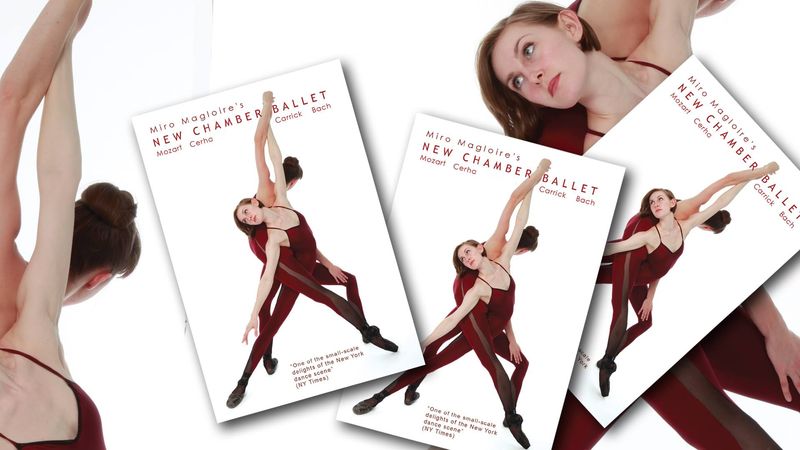
    Friday November 20th, 2015 – Miro Magloire’s New Chamber Ballet presenting works by Miro and resident choreographer Constantine Baecher in a nicely-mixed programme of new and olde music – expertly played – and danced by Miro’s uniquely talented band of ballerinas. In the intimate setting of the City Center Studios, there’s a sense of immediacy – both of the music and the dancing – that no other dance company in Gotham can quite match.

    In his most recent works, Miro’s choreography has been daring in its exploration of female partnering. Tonight’s concert opened with the premiere of a full version of Gravity, excerpted earlier this season and which I’d seen in a formative rehearsal.

    First off, a salute to violinist Doori Na for his impressive rendering of “Six Pieces for Violin” by Friedrich Cerha. The venerable Austrian composer, soon to celebrate his 90th birthday, is currently in the news locally as The Met is offering a new production of Alban Berg’s LULU which Mr. Cerha completed upon Berg’s death.

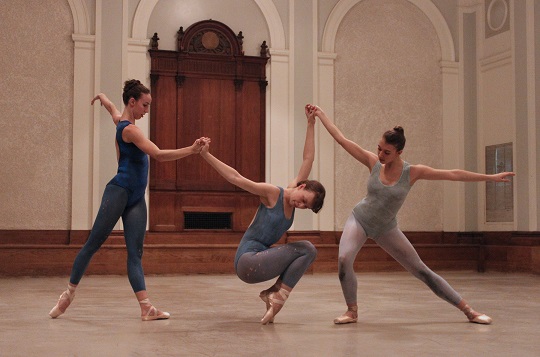
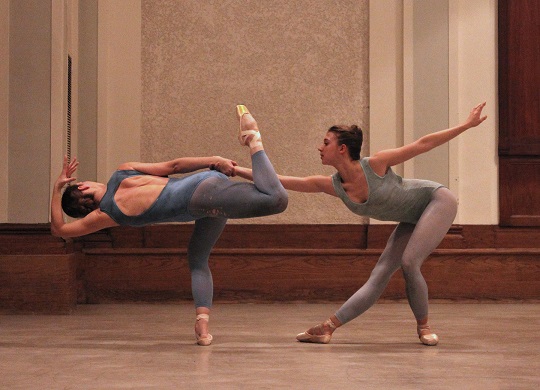
    Gravity was danced tonight by Elisabeth Brown, Traci Finch, and NCB’s newest member Cassidy Hall. The dancers alternate between posing and partnering: a duet for Elizabeth and Traci is observed by Cassidy, who then inserts herself into the dance. Elizabeth’s solo comes as the music falls silent; she then dances with Cassidy in a duet where Elizabeth, at full stretch, is nearly parallel to the floor in displaying a superb line.

    IMG_8922-edited-sm

    The dancers then polish off the ballet with a trio (Traci, Elizabeth and Cassidy, above). 

    More images from Gravity, photographed by Amber Neff:

    IMG_8883-edited-sm

    Cassidy Hall and Traci Finch

    IMG_8906-edited-sm

    Elizabeth Brown and Cassidy Hall

    Someone once wrote of Aristotle Onassis: “He was not the first man to want both his wife and his mistress.”  That very notion was the starting point of The Other Woman, Miro’s ‘classic triangle’ ballet set to a classic score: Bach’s B-minor violin sonata. 

    An en travesti Sarah Atkins, wearing a jaunty fedora, faces the age-old dilemma of the married man as he vacillates between his wife and his lover. Elizabeth Brown and Holly Curran offer contrasting attractions of face, form, and personality; in this very theatrical piece, their dancing is urgent and nuanced. The rival women confront one another while Sarah dances a space-filling solo. In the end it seems no real decision has been reached, and it feels like more chapters are yet to come before this story ends.

    Doori Na and pianist Taka Kigawa played the Bach so attractively, and moments later Taka returned play Beat Furrer’s ‘Voicelessness. The snow has no voice’ for Miro’s second premiere of the evening: Voicelessness. Taka’s playing was marvelous right from the murmuring start of the piece; he was able to sustain a pianissimo misterioso atmosphere throughout with great control. This was punctuated with the occasional emphatic high staccato.

    IMG_8328-edited-sm

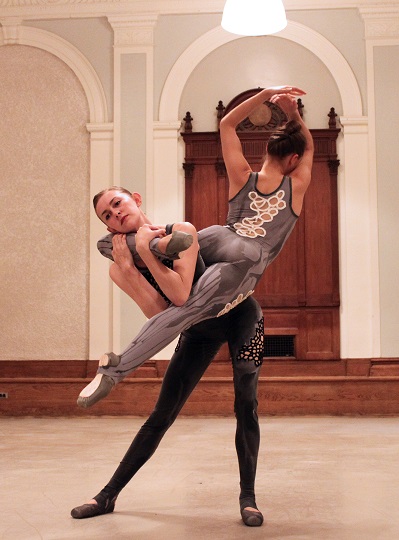
    In this duet the two dancers – Amber Neff and Cassidy Hall, (above) – perform extremely demanding and intensely intimate feats of partnering. The two girls, abetted by Taka Kigawa’s keyboard, sustained the tension of the work most impressively.

    IMG_8354-edited-sm

    Above: Amber Neff and Cassidy Hall in Voicelessness

     
    More images from Voicelessness; these photos are by Sarah Thea who also designed the costumes for four of the five works seen tonight:
     
    IMG_8170-edited-sm
     
    Amber Neff, Cassidy Hall
     
    IMG_8201-edited-sm

    Amber Neff and Cassidy Hall
     
    Following the interval, Richard Carrick’s score ‘In flow’ for solo violin provided another showcase for Doori Na as Miro’s Friction unfolded. The ballet opens in silence before Doori’s violin sounds hesitantly; the angular, sinuous music includes an alarming forte ‘scrunch’ at one point. Dancers Holly Curran and Amber Neff moved thru the intricate partnering motifs with total assurance and dealt with the technical demands Miro makes on them with cool confidence.
     
    The evening closed with Constantine Baecher’s lively and very original ballet, Mozart Trio, set to excerpts from the composer’s piano sonatas played with genial clarity by Taka Kigawa.
     
    In this ballet about beginnings and endings, the dancers speak: they speak not only of where they are and what they are doing at the moment, but also – more cosmically – of where they are in their lives.
     
    Traci Finch narrates solos by Elizabeth Brown and Sarah Atkins in turn, describing their dancing and giving us bytes of biography. In the second movement, Sarah’s solo takes an autobiographical approach (“I’m in the middle!” she calls out – of her dance, of her career, of her life?). The third movement is an abstracted trio for all three dancers, full of energy and wit, until they reach the self-declared “end of the end!”
     
    New Chamber Ballet‘s next performances are set for February 26th and 27th, 2016. More details will be forthcoming as the dates draw nigh.

  • Jennifer Muller’s Stages of Creation

    L1640936

    Striking a pose: the new Warhol piece by Jennifer Muller at a studio preview

    Tuesday November 17th, 2015 – Choreographer Jennifer Muller has been commissioned to create a new dancework for Introdans, the Netherlands-based contemporary dance company. The piece will premiere in February, 2016 on a program entitled Absolutely Amerika. This evening, at her studio on West 24th Street, Ms. Muller presented a sampling of this latest work, along with excerpts from some of the more recent additions to her Company’s repertoire.

    The room was packed with Muller friends and fans, and her lively and distinctive troupe of dancers seemed to ignore the fact that this was a studio showing, instead dancing at performance level. The dance-space is limited but the choreography is spacious and often fast-paced; yet the dancers moved with abandon, often coming within centimeters of the viewers – or of the ceiling, during the many lifts that the Muller repertory calls for.

    L1640814

    Two excerpts from FLOWERS were offered before dancer Michael Tomlinson (above, warming up) demonstrated a signature motif from the new work, which is inspired by quotes from the late Andy Warhol and is danced to a collage of music associated with the Warhol era.

    L1640965

    Above: the opening of MISERERE NOBIS

    I was particularly glad of another opportunity to see some passages from Jennifer’s 2014 masterpiece, MISERERE NOBIS, a compelling piece that has lingered in my mind since first encountering it. Originally danced by an all-female cast, Jennifer has now incorporated the Company’s men into this ritualistic work which is danced to Samuel Barber’s Adagio for Strings, which was inspired by Allegri’s immortal Miserere. The choreographer’s addition of men to the cast changed the flavor of the work slightly but didn’t diminish its power and beauty in the least.

    The evening closed with excerpts from ALCHEMY, an exciting multi-media piece which Ms. Muller premiered at New York Live Arts earlier this year. 

    The dancers were moving too fast most of the time for my camera to catch them, however here are a few images I was able to capture:

    L1640837

    Brittney Bembry, Michelle Tara Lynch

    L1640900

    Brittney Bembry

    L1640950

    Shiho Tanaka

    L1640970

    From MISERERE NOBIS

    L1640977
    Seiko Fujita

    L1640985

    Alexandre Balmain, Elise King

    L1650025

    Sonja Chung

    L1640989

    MISERERE NOBIS

    L1640915

    Jennifer Muller, ever the perfect hostess

    Jennifer Muller/The Works will be at New York Live Arts June 13th – 18th, 2016.

  • Jennifer Muller’s Stages of Creation

    L1640936

    Striking a pose: the new Warhol piece by Jennifer Muller at a studio preview

    Tuesday November 17th, 2015 – Choreographer Jennifer Muller has been commissioned to create a new dancework for Introdans, the Netherlands-based contemporary dance company. The piece will premiere in February, 2016 on a program entitled Absolutely Amerika. This evening, at her studio on West 24th Street, Ms. Muller presented a sampling of this latest work, along with excerpts from some of the more recent additions to her Company’s repertoire.

    The room was packed with Muller friends and fans, and her lively and distinctive troupe of dancers seemed to ignore the fact that this was a studio showing, instead dancing at performance level. The dance-space is limited but the choreography is spacious and often fast-paced; yet the dancers moved with abandon, often coming within centimeters of the viewers – or of the ceiling, during the many lifts that the Muller repertory calls for.

    L1640814

    Two excerpts from FLOWERS were offered before dancer Michael Tomlinson (above, warming up) demonstrated a signature motif from the new work, which is inspired by quotes from the late Andy Warhol and is danced to a collage of music associated with the Warhol era.

    L1640965

    Above: the opening of MISERERE NOBIS

    I was particularly glad of another opportunity to see some passages from Jennifer’s 2014 masterpiece, MISERERE NOBIS, a compelling piece that has lingered in my mind since first encountering it. Originally danced by an all-female cast, Jennifer has now incorporated the Company’s men into this ritualistic work which is danced to Samuel Barber’s Adagio for Strings, which was inspired by Allegri’s immortal Miserere. The choreographer’s addition of men to the cast changed the flavor of the work slightly but didn’t diminish its power and beauty in the least.

    The evening closed with excerpts from ALCHEMY, an exciting multi-media piece which Ms. Muller premiered at New York Live Arts earlier this year. 

    The dancers were moving too fast most of the time for my camera to catch them, however here are a few images I was able to capture:

    L1640837

    Brittney Bembry, Michelle Tara Lynch

    L1640900

    Brittney Bembry

    L1640950

    Shiho Tanaka

    L1640970

    From MISERERE NOBIS

    L1640977
    Seiko Fujita

    L1640985

    Alexandre Balmain, Elise King

    L1650025

    Sonja Chung

    L1640989

    MISERERE NOBIS

    L1640915

    Jennifer Muller, ever the perfect hostess

    Jennifer Muller/The Works will be at New York Live Arts June 13th – 18th, 2016.

  • Golden Age of the Violin @ CMS

    Violin

    Following the senseless horror of the terrorist attacks in Paris this past Friday, we turn yet again to music as a source of consolation. These words from Leonard Bernstein have echoed thru my mind over this weekend since the appalling news from France reached us: “This will be our reply to violence: to make music more intensely, more beautifully, more devotedly than ever before.”

    Sunday November 15, 2015 – A trio of superb young violinists were featured at this evening’s concert given by at Chamber Music Society of Lincoln Center at Alice Tully Hall. Paul Neubauer and David Finckel – masters of the viola and cello respectively – joined their young colleagues in celebrating the expressive violin style epitomized by the legendary Fritz Kreisler.

    Kreisler was in fact the first violinist I ever heard; my parents had some of his recordings and by the age or eight or nine I was already preferring these – and Horowitz, Flagstad, and Toscanini – to my mom’s favorites: Lawrence Welk and the McGuire Sisters.

    The first music we heard this evening was also oldest music on the programme: a sonata for two violins by Jean-Marie Leclair. Leclair may be the only violinist/composer in history to have had a highly successful career as a ballet dancer prior to turning to composing full-time around 1723. Today’s sonata dates from 1730 and was played with lively charm by Danbi Um and Sean Lee. Passing the melodies back and forth, the duo were well-matched, nuance for nuance. The tender sadness of the sonata’s Andante graziosa maintained a forward momentum, and then our two violinists sailed confidently thru the swirls of notes than make up the concluding Presto.

    Mr. Lee returned to the stage immediately with Benjamin Beilman and Paul Neubauer for Anton Dvorak’s C-major terzetto, composed in 1887. It opens with a tranquil theme, becomes more animated, then gently shifts between moods. After a passage of hesitations, as if unsure where to go next, the composer gives us a warm lullabye-like melody with a genial ending. A feeling of propulsive dance – and a touch of Mendelssohnian sparkle – fills the Scherzo; a central song with the flavour of a country waltz is most attractive, followed by a da capo which sweeps forward in alternating currents of lyrical breadth and teasing delicacy. In the final movement, Mr. Neubauer’s viola had a shivering motif, followed by an impassioned theme from Mr. Beilman; then there’s a brisk rush to the finish. 

    David Finckel’s name in my Playbill is now triple-underlined and festooned with exclamations marks for his marvelous playing in the Alexander Borodin 1881 D-major quartet. The cello sets the pace for the opening Allegro moderato and is given some heartfelt melodies in the later movements; these were relished by Mr. Finckel whose tone has an intimate, romantic glow.

    A Spring-like feeling pervades the opening of the Scherzo: Allegro, and then a familiar tune is heard: my mother would have recognized it as the melody of the 1950s pop song Baubles, Bangles & Beads(from the musical KISMET) which was recorded – seemingly – by everyone, including Marlene Dietrich and Frank Sinatra. For all the tune’s appeal, it still sounds best in its original Borodin setting. The second movement then rushes ahead, only to withdraw to a pizzicato fadeout at the end.

    Borodin sets the third movement as a Nocturne and Mr. Finckel sets the mood to perfection. Danbi Um, in the first violin chair, then takes up a sweet, high theme. Mssrs. Lee and Neubauer make the middle voices sing, the latter in a lovely melodic exchange with Mr. Finckel’s cello (“Gorgeous blends!” I scrawled in my Playbill.) Ms. Um takes up a shining theme, passing it to Mr. Finckel who descends with it into the cello’s depths. This Nocturne, with all four players deeply immersed in the music, made a particularly satisfying impression. In the concluding movement, the quartet summarized the work in recurrent themes, playing with such conviction that the audience were swept along and responded with especially warm applause, summoning the musicians out for a second bow. 

    After the interval, Ben Beilman stood alone on the stage and delivered a stunning performance of Eugene Ysaÿe’s E-minor sonata (1924). The work is a virtuosic test piece for which Mr. Beilman gets top marks. This young artist displays thorough technical assurance as well as a masterful control of dynamics. He took the strenuous demands Ysaÿe places on the player in stride, and an appealing aspect of modesty in his delivery endeared him to the crowd. This is a serious musician with something to say to us. The applause that enveloped Mr. Beilman at the end of his dazzling performance was amply deserved, bringing him out for a double curtain call. 

    No one could blame Fritz Kreisler for featuring the violin in his A-minor quartet: it was, after all, his instrument. Mr. Beilman, fresh from the demands of the Ysaÿe, was at his most lyrically persuasive here, regaling us with the melodic treats Kreisler has laid out for him. Danbi Um seconded Ben’s beautiful playing with many graceful turns of phrase, while Mssrs. Neubauer and Finckel brought Olde World warmth and expressiveness to their playing.

    Though rife with melodic felicities, including a waltz tune “mit schlag” and a gorgeously-sustained Ben Beilman high fade-away at the conclusion of the Romanze, the Kreisler quartet is one of those perfectly pleasant works that falls short of being truly memorable. But I can’t imagine it being better-played than it was this evening.

    In her welcoming remarks tonight, Chamber Music Society co-artistic director Wu Han had spoken of the distress we have all been feeling after the horrible events in Paris. She said that from Friday night til Sunday morning she had been so consumed with sadness that she couldn’t play the piano, but that at last she sat down to practice and found solace at the keyboard. She promised us that the evening’s programme would be uplifting, and she was right. 

    The Repertory:

     The Participating Artists: