Category: Ballet

  • Roschman Dance + SAAKASU

    11270215_10155584728285554_6005642330318231725_o

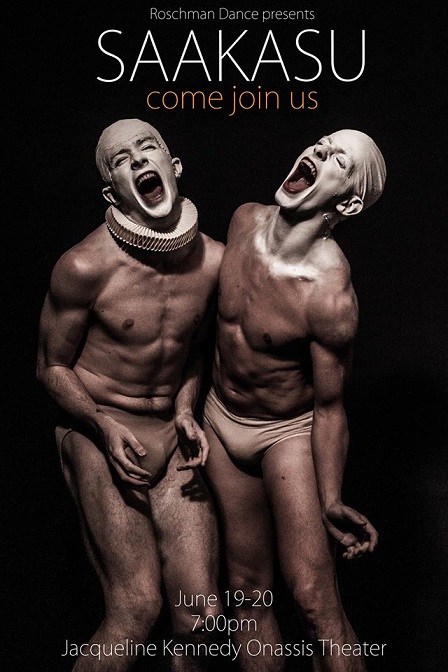
    Friday June 19th, 2015 – I’d never been to the Jacqueline Kennedy Onassis Theatre before. It’s a very nice venue for dance, with a proscenium stage and amphitheater seating, and tonight Roschman Dance (new to me) presented two works there, along with “Saakasu“, choreographed by Omar Roman de Jesus. 

    Roschman Dance’s 2012 work, “Learning To Fold“, opened the evening. Danced to music by Ethel, this piece showed the Roschman dancers to advantage with choreography that looks fresh and spacious. The six white-and-blue clad dancers shared a natural affinity for the sheer joy of movement. Aside from brief moments of reflection, the work is mostly a swirl of activity as the dancers come and go, connecting with one another in fleeting partnerships before sweeping onward. A stylized unison passage to the plucking of strings and a trio for the three women stood out, but for the most part “Learning To Fold” kept up its forward impetus: celebratory dance, performed with sincerity.

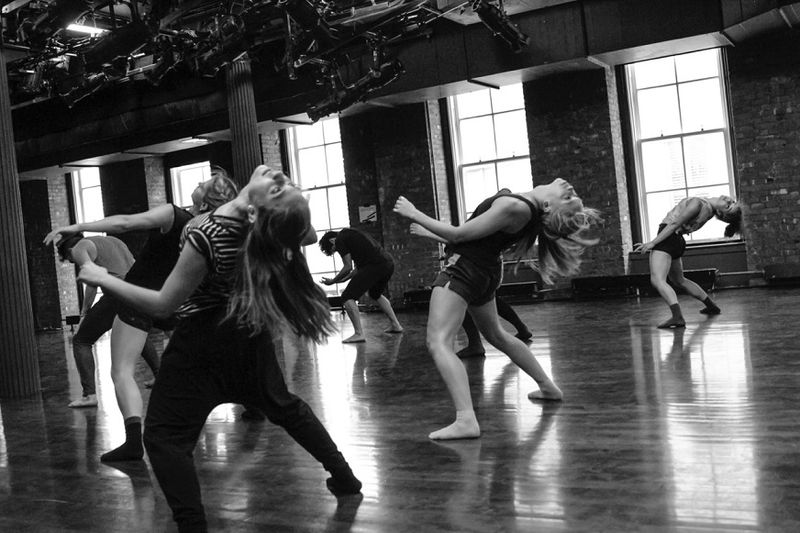
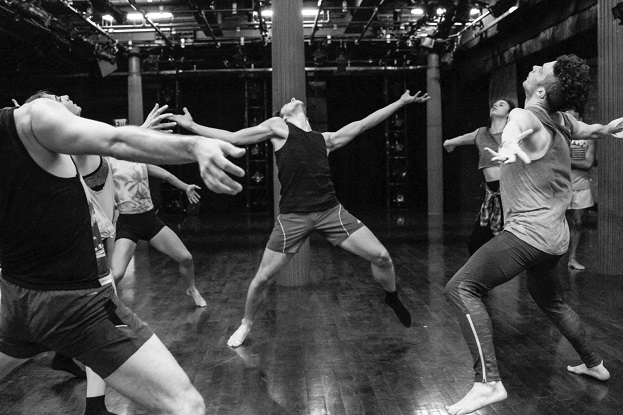
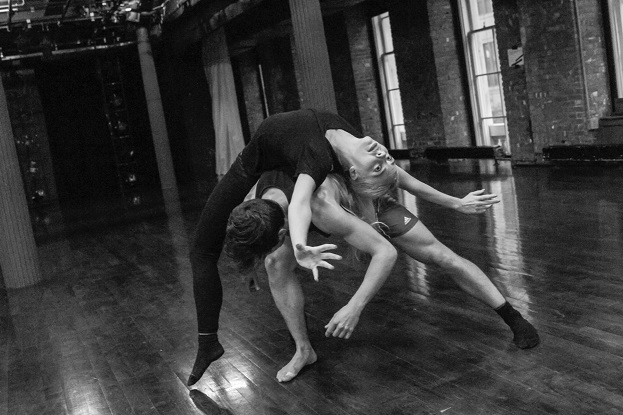
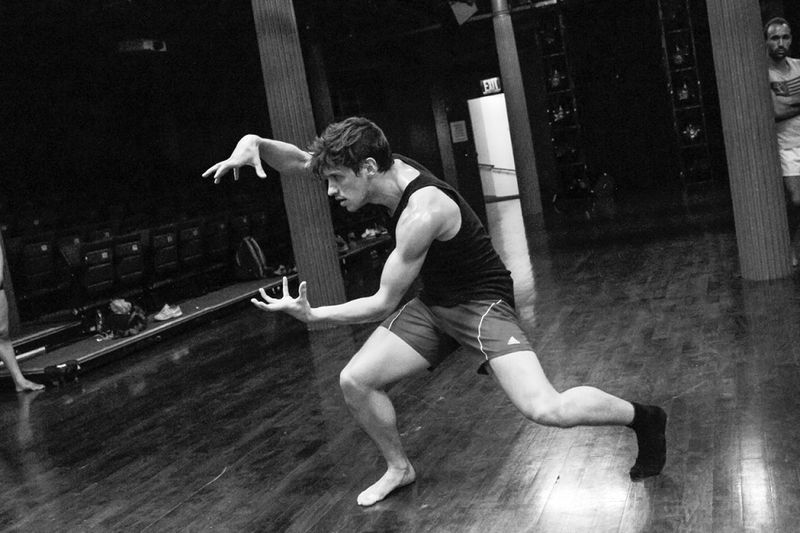
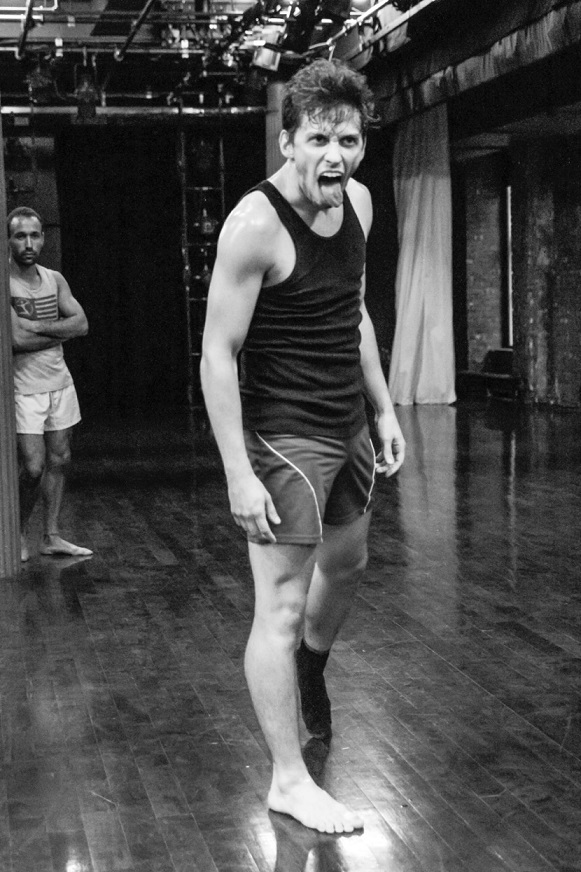
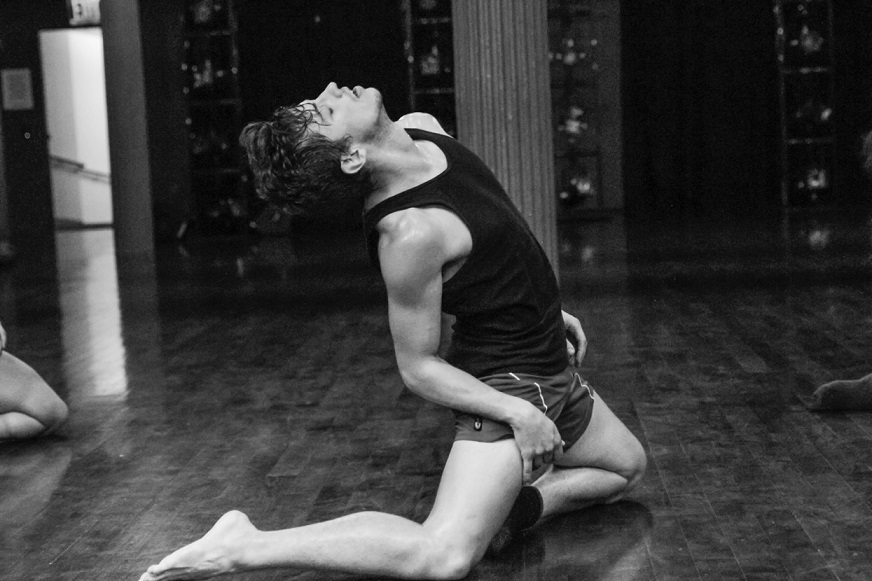
    Omar Roman De Jesus, who performs with Parsons Dance, offered  “Saakasu” (‘Circus’ in Japanese); earlier in the week photographer Travis Magee and I had dropped in at Omar’s rehearsal where his Parsons colleagues Ian Spring, Geena Pacareu Rijnsburger, and Eoghan Dillon along with a lively ensemble of young dancers were putting finishing touches on “Saakasu“.

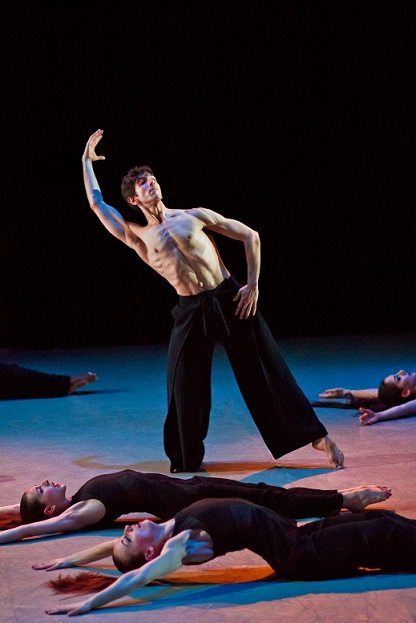
    Seen onstage, with its sexy costuming and dramatic lighting, “Saakasu” makes a vivid impression. It opens with Ian Spring alone onstage. In his seasons with Parsons Dance, Ian has developed from an energetic boy-next-door into a charismatic dancer of the first order: one of New York’s finest. Wearing only a dance belt, a ruffled collar, and powdered hair, Ian takes on the timeless persona of the traveling player: visions of old Japanese theatre, the commedia dell’arte, and the tragic Pagliaccio smearing on his white greasepaint are evoked. 

    The music of a kozmic hurdy-gurdy sets the mood; Ian, in a pool of light, emits a profound scream: his inner animal wants to emerge. Eoghan Dillon and two girls have a stylized trio; more screams, and the full ensemble take the stage with the wary eageress of animals who have escaped their cages. Ian and Zoey Anderson have a sensuous duet to a piano theme, and then the tribe return, stomping their feet and slapping their thighs in a primitive ritual. 

    Ian crosses the stage singing a famous circus song. The music goes big and industrial; he and Geena have a duet. Meanwhile Eoghan has been crawling among the savage dancers and he finally finds a means of escape, though he simply ends up running in place since nightmares rarely allow for escape. 

    The dancers rush about in a circle, leaping. Things slow to near stillness. Debussy’s immortal “Clair de lune” is heard as Ian dances a compelling solo with very subtle images of Nijinsky’s faune woven in. This reverie ends as the ensemble re-enter, stamping their feet. They shimmy, shake, and exalt around Ian, lifting their arms to summon some pagan god. They hit the floor as the music goes pensive, only to rise again and collectively stomp upstage as silence and darkness fall.

    I wasn’t familiar with Omar Roman de Jesus’s choreographic background, but with “Saakasu” he’s really onto something: vivid in its theatricality and demanding of the dancers in terms of both technique and expression, it’s a piece to be seen again. The audience reacted with shouts of enthusiasm. 

    Contrast is a valuable asset in a mixed program of dance and so, after the interval, Sean Roschman’s “Crooked Creek” (a world premiere) was a fine counterpoise to the large-scale and darkly sexy de Jesus work. Set to an ‘Americana’ score, Roschman Dance‘s latest work seems on the surface a simple presentation of young people at a dance in a rural community, maybe in the inter-war years of the 20th century. Yet there is an underlying sense of dread, as if something is not quite right.

    Three couples waltz to an innocent, hummed tune, and then the fiddle summons up a square dance. A woman is abandoned by her partner; she lingers to watch another couple’s duet. Agitated passages follow: a trio of women and an in-sync duet for two girls; always there is a sense of being observed.

    Cascades of fiddling urge the dancers onward: various pairings and shifting solo moments, stillness offset by activity. A buzzing musical motif, and one of the girls collapses as if infected; her sad solo evolves to a trio for the women, and then to a pas de quatre for two couples. The tempo picks up for a duet, then the sound of the cello sets up a solo for one of the women. The dancers rush about as if possessed before collapsing, and the lights go out. But in an postlude, one woman sits up, unsure of what has happened. Her questioning gaze is held as a final darkness falls.

    Seeing a new Company, it’s perhaps unfair to single out a particular dancer: but in the two Roschman works I was especially impressed by Christian Deluna-Zuno, a Mexican guy with a high-flying extension and a handsome stage presence.

  • Rehearsal: Omar Roman de Jesus’s SAAKASU

    IMG_9372

    Above: “Saakasu” rehearsal, photo by Travis Magee

    Sunday June 13th, 2014 – Omar Roman de Jesus, who dances with Parsons Dance, presents “Saakasu” at the Jacqueline Kennedy Onassis Theater, 120 West 46th Street, on June 19th and 20th, 2015, at 7:00 PM. The program is under the auspices of Roschman Dance who will be premiering a new piece, “Crooked Creek”, and a revival of their 2012 work, “Learning To Fold”. Tickets here.

    This evening, Omar invited photographer Travis Magee and me to a rehearsal of “Saakasu“, which  translates to “circus” in Japanese; Omar’s dancework presents “a nightmarish vision of animalistic transformation”.

    Ian Spring (above) of Parsons Dance has a pivotal role in “Saakasu”; his Parsons colleagues Geena Pacareu Rijnsburger and Eoghan Dillon are also in the work, along with an ensemble of dynamic young dancers.

    Travis’s photos from the rehearsal:

    IMG_0655

    Ian Spring (center) and the ensemble

    IMG_0662

    IMG_0463

    Above: Eoghan Dillon

    IMG_0262

    Above: a duet for Zoey Anderson and Ian Spring…

    …and more of Ian Spring:

    IMG_0548

    IMG_0625

    IMG_0702

    All photos by Travis Magee


  • Monte/Buglisi/Muller @ NYLA 2015

    ImageProxy.mvc

    Tuesday June 16th, 2015 – A triumvirate of distinguished female choreographers presenting their work at New York Live Arts: Jennifer Muller, Elisa Monte, and Jacqulyn Buglisi drew together to offer an impressive evening of dance, and each had the benefit of the excellence of her dancers.

    Sacred Landscapes – Episode 1 (Buglisi/World Premiere) This dreamlike dancework is set to an evocative score by Paola Prestini, performed live by cellist Jeffrey Zeigler and vocalist Helga Davis. As the lights come up, the dancers – clad in diaphanous garments – stride towards us in slow motion as fog billows about them. A sombre theme from the cello sets the mood. Among the many danced highlights, solos by Ari Mayzick and the ever-ravishing Carrie Ellmore-Tallitsch stood out. There are demanding partnering motifs, including some wafting high lifts.

    Ms. Davis’s voice is first heard in whispered parlando; she will later sustain some other-worldly high notes. The cellist meanwhile veers from dreamy to profound. The dancing is ritualistic and the dancers evoke an atmosphere that is both spiritual and the sensuous. Ms. Ellmore-Tallitsch gave an enthralling performance: her simple act of crossing the stage near the end of the piece took on a depth of resonance thanks to this dancer’s particular mystique. Lovely to re-encounter Lauren Jaeger (such expressive hands) and Darion Smith – all the dancing, in fact, took on a fine lustre.

    Hurricane Deck (Monte) begins with a quirky announcement: “A blow to the head…I’ve never been unconscious before!” and from there Elisa Monte’s eight dancers zip about the space against a sky-blue background, the choreography witty and active. Clymene Baugher, Maria Ambrose, Mindy Lai and JoVonna Parks swirl about in swift, playful combinations while the bare-chested boys – Malik Kitchen, Justin Lynch, Alrick Thomas and Thomas Varvaro – pursue and partner them: the movement is fun and eclectic.

    David Lang’s score is a lively setting for all this activity, with odd rhythms, stuttering brass, and a sense of whirring at one point as the dancers switch partners.  The backdrop has gone black as the dancers stand in a row, each stepping forward in an agitated danced narrative. They hit the floor only to bob up again. “Say it!…end it!” says the unseen narrator, and as the dancers embrace, silence falls and we hear their breathing. The piece seems to be over. 

    But instead, clanging sounds rouse them; the music turns rather ominous as they perform a sort of darkish coda to heavy brass. The atmosphere takes on a cloying tinge and the work moves slowly to an un-premeditative end. The dancers sustained this longish final section strongly, though I think the work might have benefited by stopping earlier, with the words “End it.” 

    Alchemy (Jennifer Muller/World Premiere): I had an opportunity to see this work in rehearsal a week before the performance. At that time, Jennifer mentioned there would be ‘projections’ but the production was in fact quite elaborate, with a scrim having been installed during intermission. Across the backdrop and scrim, thought-bytes appear in swift succession: “…a deluge of information…” and “…accumulating none-essentials…” are but two timely references. Later, catch-phrases from pop culture and Yahoo!-style headlines flash across the screens, making me chuckle. Eventually, single words come flying at us. The four-elements inspiration for Alchemy brings us a firestorm; projections of the scorched Earth finally give way to the blessed, cleansing effects of rain. Kudos to Mark Bolotin, who devised the video design.

    All these visual effects might have tended to dwarf dancers of lesser power than Jennifer’s; but the Muller troupe – and Jennifer’s choreography – assured that the dancing held forth and remained central to the production. We first find Caroline Kehoe alone onstage, a feminine presence of alluring line; Seiko Fujita appears, striking a sustained arabesque. They are joined by Shiho Tanaka, Michelle Tara Lynch, and Sonja Chung: even thru the scrim, their personalities read clearly.

    Gen Hashimoto, Michael Tomlinson, and Malik Warlick appear in stylized, slow-motion phrases; Benjamin Freedman will later complete the impressive male quartet. The dance becomes more active; the dancers rush about as if searching for something. Lightning flashes; threatened by Nature, Caroline and Malik dance an entwined, restless pas de deux.

    Having been cast down upon the blasted terrain, Gen struggles back to the land of the living; as Seiko also revives, they dance a tender, earth-bound duet. Sonja and Michael are beautifully matched in their duet. A feeling of desolation creeps in. In the dim light, Shiho’s poetic hands evoke the rain…which finally falls, bringing a glimmer of hope and renewal.  

    Sand (Buglisi) is performed to a luscious Philip Glass score which continually put me in mind of Debussy’s L”aprèsmidi d’un faune. Beautifully lit (by Clifton Taylor), this exotic pas de six calls for both lyrical movement and powerful elements of partnering. The three couples – So Young An with Juan Rodriguez, Stephanie van Dooren-Eshkenazi with Ari Mayzick, and Anne O’Donnell with Darion Smith – met all the demands of the piece whilst creating a sultry atmosphere, induced by the swaying sensuousness of the Glass score.

  • Philharmonic Finale: JOAN OF ARC

    Joanpiffard

    Above: Joan of Arc, a late-19th century painting by Harold H. Piffard

    Saturday June 13th, 2015 – Jeanne dArc au bûcher (Joan of Arc at the Stake), an oratorio by Arthur Honegger, was the final offering of the New York Philharmonic’s 2014-2015 season. Leave it to Alan Gilbert to end an exciting season with a big bang: Honegger’s epic work unfolded in a staged version which captured both the gravitas and the insouciant sarcasm of the score.

    Jeanne dArc au bûcher was originally commissioned by Ida Rubinstein, who had enflamed Paris when she appeared with Diaghilev’s Ballets Russes in the title role of Cléopâtre in 1909, and Zobéide in Scheherazade in 1910. Rubinstein premiered Jeanne d’Arc with her own Company at Basel in 1938; she bade farewell to the stage in the same work in 1939.

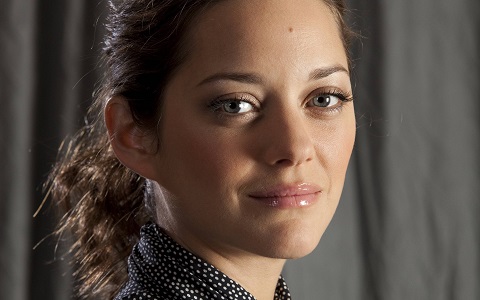
    The New York Philharmonic last performed the oratorio in 1994 with Marthe Keller in the title role. For the current performances, the superb French actress Marion Cotillard has taken on the role of Jeanne which she has previously performed at Orléans and Barcelona, and most recently on a tour of Monaco, Toulouse and Paris in the present production by Côme de Bellescize.

    Arthur Honegger’s setting of Claudel’s text centers on Joan of Arc’s last moments of life at the stake, where she sees the events of her life pass before her eyes before succumbing to a terrifyingly painful death. Her confessor, Brother Dominique, reads to her from the book of her life, starting with her trial and conviction for heresy and witchcraft in 1431 and goes back even further, beyond Charles VII’s coronation, to her awakening to the voices of the saints – Catherine and Margaret – in her country garden as a young maiden. Honegger’s theatrical setting calls for three speaking actors – as Joan, Brother Dominique, and a Narrator, respectively – as well as singing soloists and adult and children’s choruses.

    The often quirky score includes parts for saxophone, piano, and the electronic ondes martenot, and the musical influences range from plain chant and Baroque to folksong and jazz. The Philharmonic musicians were at their customary high level of play, and Maestro Gilbert’s detailed handling of the score made the best possible case for this unusual work.

    A runway wraps around the partially sunken orchestra, with the children’s chorus and various players coming into close range of the audience. Behind the orchestra, the adult chorus on risers loom up on either side of the grim stake, which rests on a small platform where Brother Dominique attempts to ease the horror of Joan’s impending torturous death by reminding her of her past good deeds and the notion of heavenly reward.

    The mood of the piece veers sharpy from piety to farce, with the presiding dignitaries at Joan’s sham trial portrayed as a pig and a donkey. The evening’s most memorable moments came at the end, as deep red light representing the consuming flames filled not only the stage but much of the auditorium. As everything faded to black, every chorister and musicians held up a small faerie light, leaving us with a vision of the eternal stars.

    Marion-Cotillard

    Above: Marion Cotillard; her portrayal of Joan was a tour de force, her wonderful voice encompassing both the irony and the terror of her speeches. From girlish sing-song to her witty responses to her captors thru to the earthy, guttural expressions of her fear of death, and at last her final ecstasy, Cotillard gave a masterful performance, as touching to watch as to hear. 

    Her fellow actors – Eric Génovèse as Brother Dominique and Christian Gonon (as narrator, and in multiple smaller roles ) – were ideally cast both in terms of their voicing of the lines and their characterizations. Among the various supporting roles, two singers stood out: soprano Erin Morley, radiant-toned in the high-lying phrases of the Virgin, and tenor Thomas Blondelle who sang fearlessly and with clear projection in the taxing tessitura of Porcus, the pig-magistrate, and in other smaller roles. Everyone, in fact, sounded well in this sometimes tricky music, and both choruses – the adults and the children – made a very fine effect.

  • In Performance: GRAHAM 2

    11015477_10153139682186131_3644922198939538584_n

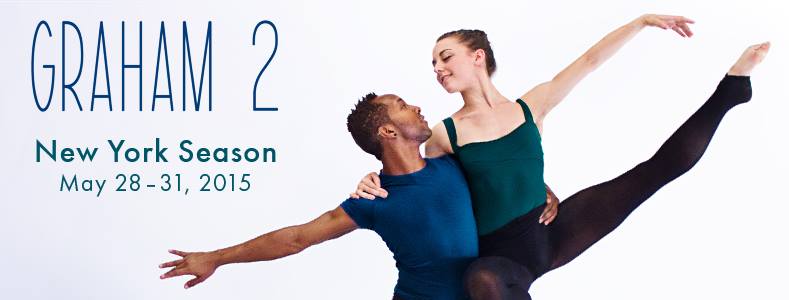
    Friday May 29th, 2015 – The young dancers of Graham 2 in performance at the Martha Graham Dance Company’s home space at Westbeth on Bethune Street in the West Village. It was rather stuffy in the theatre, and there were distractions of latecomers wandering in during the dancing. But it was a very impressive performance overall, and several of the participating dancers seemed poised to emerge as successful Graham artists in the seasons ahead.

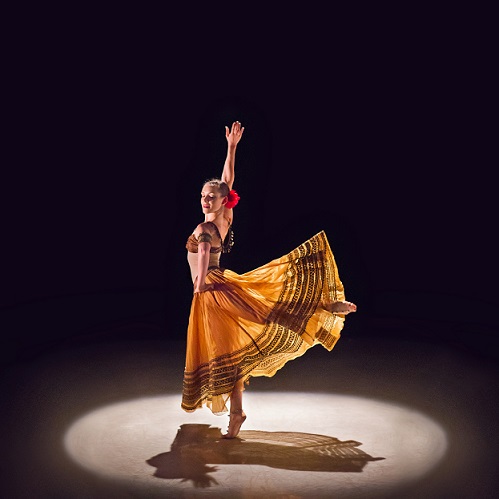
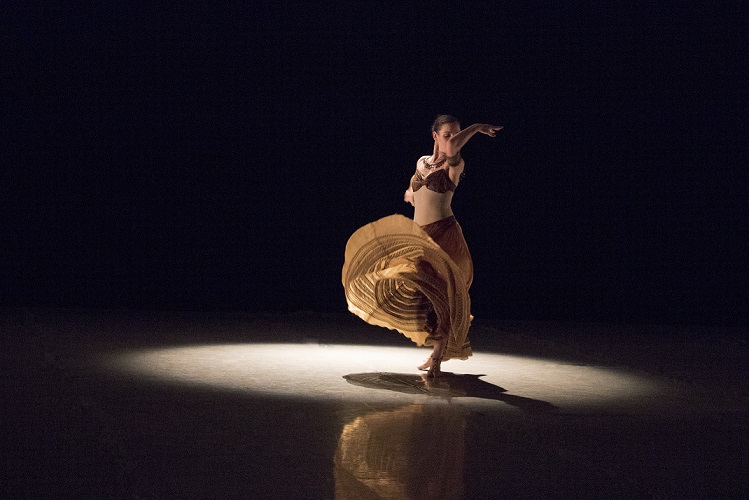
    Beginning in a circle of light, Dani Stringer performed the elegant solo à l’espagnole, SERENATA MORISCA. In a billowy skirt, wearing ankle bells and with a peony in her hair, Dani seemed eminently at home in this liltingly lovely dance, to atmospheric music by Mario Tarenghi. Premiered in 1916 (!) the solo looks absolutely fresh and au courante today. Two photos of Dani dancing the Serenata were offered to me – each captures her so well that I decided to include both:

    001 - _MG_1804

    Above, photo by Brigid Pierce

    002 - G215_SM1

    Above, photo by Antonia K Miranda

    HERETIC dates from 1929 and is one of Graham’s most powerful works. It alludes to the outcasts that are found in every culture, race, and religious affiliation. I’ve now seen it a few times and it’s a resonant work, with a stop-and-start score arranged by Charles de Sivy from an old Breton chanson

    002 - G215_H2

    Above: from HERETIC, with Jessica Sgambelluri and the Graham 2 ensemble; photo by Antonia K Miranda

    Jessica Sgambelluri gave a powerful performance as the scorned woman, constantly subjugated by the implacable sisterhood who move almost mechanically into positions of closing ranks around the hapless victim. At times they seem to be praying for the woman’s redemption, but they remain sternly rejecting, even threatening.

    001 - G215_H1

    Above: Ms. Sgambelluri and the ensemble in HERETIC; photo by Antonia K Miranda

    001 - G215_L1

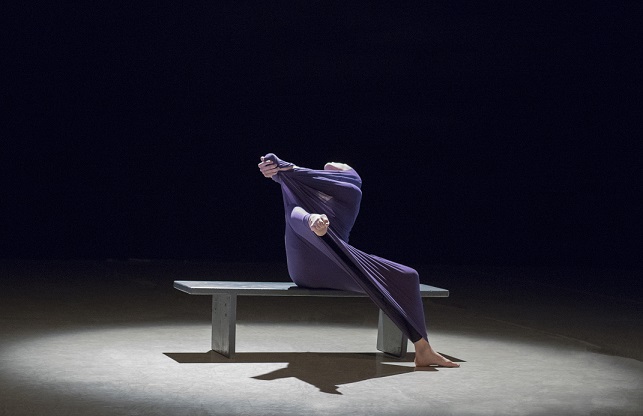
    Anja Zwetti (above, in Antonia K Miranda’s photo) took on the iconic Graham solo LAMENTATION and made a strong impression as she performed this ‘dance of sorrows’ seated on a bench and wrapped in a shroud of purple jersey. The Kodaly piano score gives the dancer her movement cues, and the lighting provides a shadow-dance that gives the work an added ghostliness. Ms. Zwetti held the audience in a state of keen focus throughout the solo. I had the feeling that several in the crowd were seeing LAMENTATION for the first time, and were deeply moved by the experience.

    002 - G215_L2

    Above: Anja Zwetti in LAMENTATION, photo by Antonia K Miranda.

    A selection from NIGHT CHANT followed, re-staged by the inimitable Virginie Mécène. This late Graham work (1988) is set to an exotic score by R Carlos Nikai and features a large ensemble of both male and female dancers who move in signature Graham motifs; it is an homage to the culture of the Native Americans, depicting the rituals of their community.

    001 - _MG_0258

    The women (above, photo by Brigid Pierce) appear variously in large or small movement units while the men, sexy in sleek tights, are given dynamic leaps and cartwheels. NIGHT CHANT features a central pas de deux couple: tonight we had the charismatic Dani Stinger and Alex Clayton giving a fluent performance. 

    003 - G2150178

    Above: the ensemble in TURNING POINT, photo by Antonia K Miranda

    In its world premiere performances, TURNING POINT by Blanca Li was a striking addition to the Graham 2 repertory. Thirteen dancers, clad in black trousers, first appear standing in place; they remain on their marks as individual solos, disconnected duets, and mini ensembles spring up almost randomly. They fall and rise in various combinations, and then there’s a walkabout before they re-group. They disappear and re-enter in a diagonal, with more floor time and passages of gestural language. Suddenly the dancers rush about the space; a female duet ensues, and then a female trio takes up a counter-dance. Silence falls, and the full ensemble appear in a cluster swaying gently as the light fades.

    Tao Guttierez’s wonderful score shows us a contemporary composer unafraid of melodic appeal; the dancers did a great job with this piece, which afforded many individual opportunities. I hope to have a chance to see TURNING POINT again.

    001_MG_0497

    Above: Jessica Sgambelluri in TURNING POINT; photo by Brigid Pierce.

    002_MG_0599

    Above: Stylianos Kefalas in TURNING POINT; photo by Brigid Pierce

    Following the interval, more Graham classics to be savoured, beginning with the 1936 all-female ensemble work STEPS IN THE STREET, the central section of Graham’s visionary anti-war trilogy CHRONICLE.

    002_MG_1790

    Dani Stinger (above, photo by Brigid Pierce) led the ensemble with an impressive sense of mission…

    001_MG_1757

    …while the ensemble (above, Brigid Pierce photo) moved compellingly thru the stylized demands the choreography places on them. My hope for these young dancers – both the women and the men – is that they will be instilled not only with Graham’s dance technique but also with her work ethic and philosophy of life.

    Anne Souder appeared next in the signature green-black-white-yellow dress that says: SATYRIC FESTIVAL SONG. This is Graham at her most witty, and Ms. Souder did an excellent job of it, with her quirky leaps, wiggles, and sudden posed stops; her hair also became part of her performance. I unfortunately don’t have a photo of Anne Souder in this solo but moments later she was back onstage for DIVERSION OF ANGELS and here she shone ever-brighter.

    001_MG_1248

    Above: Anne Souder in DIVERSION OF ANGELS; photo by Brigid Pierce

    In the concluding DIVERSION OF ANGELS (1948, to a Norman Dello Joio score), Ms. Souder displayed a soaring extension and rock-steady balances, along with a stage-hungry aspect that gave each moment of her performance an inspiring glow. The dancing by everyone, in fact, was really impressive. The men gave their passages a high-energy verve – will they make the leap to the top Graham echelon? Let’s hope so, because the courage and conviction are there: in addition to Alex Clayton, we had Alessio Crognale, Antonio Cangiano, and Stylianos Kefalas all doing handsome work. Sharing the spotlight with Ms. Souder in the ballet’s principal female roles were Anja Zwetti (lyrical in White) and Vera Paganin (lively in Yellow). Sarita Apel and Linda Bombelli joined Jessica Sgambelluri and Dani Stinger for some fine dancing in the supporting female quartet.

    Lovely to see Graham luminaries Natasha Diamond-Walker and Lorenzo Pagano among the crowd, and my special thanks to Janet Stapleton for arranging things and for sending me the production photos with perfect timing.

  • RESTLESS CREATURE @ The Joyce

    936786_622820757745337_656057846_n

    Above: the Restless Creature, Wendy Whelan, with her four choreographers; clockwise from top left: Kyle Abraham, Brian Brooks, Josh Beamish, and Alejandro Cerrudo; photo courtesy of Ms. Whelan 

    Tuesday May 26th, 2015 – Wendy Whelan’s RESTLESS CREATURE arrived at The Joyce this evening after an unforeseen delay: it was postponed from last season as Wendy was recuperating from surgery. In this production, the incomparable ballerina dances duets choreographed by four men – Joshua Beamish, Brian Brooks, Kyle Abraham, and Alejandro Cerrudo – and in each duet, she is partnered by the choreographer. 

    In July 2014, Wendy invited my friend Joe and I to the studio where she and Josh Beamish were rehearsing Josh’s duet in preparation for the London premiere of RESTLESS CREATURE. Tonight, Joe and I had seats in the front row, the better to savour every moment of this imaginative evening of dance.

    Musicians are seated on either side of the hall at audience level: pianist Rachel Kudo to our left and the Bryant Park Quartet to our right. It is a beautiful Max Richter cello solo played by the Quartet’s Tomoko Fujita that opens the evening; as the house lights fade, the tall and charismatic Alejandro Cerrudo starts his 2013 duet EGO ET TU with a sustained solo, the music having passed to the piano. Wendy Whelan, clad in white, makes a modest entry from upstage and dances a pensive solo with a vulnerable aspect. As the music reverts to the strings, Wendy and Alejandro are alternately drawn together and pulled apart. The music, which includes works by Philip Glass and Gavin Bryars in addition to the Richter, provides a gorgeous setting for the silken movement of the two dancers, and – as throughout the evening – Joe Levasseur’s lighting designs are a visual enrichment.

    A brief interlude from the Bryant players gives Wendy time for a costume-change, and then we move directly to Joshua Beamish 2015 duet CONDITIONAL SENTENCES with Ms. Kudo at the keyboard for J. S. Bach’s Partita No. 2 in C minor. Both dancers wear red shirts and grey trousers (I rather missed the long red skirt in which Wendy originally danced this piece) and the duet has the air of stylized courtship. Charmingly elusive, they cover the space deftly, ‘speaking’ to us, or to one another, in a wry gestural language. They seem very much like birds of a feather.

    Kyle Abraham’s darkly atmospheric duet THE SERPENT AND THE SMOKE begins in gloom with Kyle’s slow solo suddenly erupting in a spastic outburst. Mysterious music – by Hauschka and Hildur Gudnadóttir – creates an ominous expectancy; then, suddenly, there’s intense light. Warily, Wendy approaches Kyle and, to a lamenting theme, tenderness is cautiously explored in movement that is gorgeously stylized. Then silence falls and the dancing becomes more active. A lighting change makes a striking impact, along with a shift of pulse. The dancers pose on the floor as if in a mind-meld, and then, as the scene brightens, they rush about the stage in an enigmatic pursuit as Wendy’s hair comes undone.

    Music of Philip Glass ideally serves the Brian Brooks duet FIRST FALL which closes the programme. Reappearing in a daffodil-yellow frock, her hair flowing, Wendy dances a solo in silence. As the Bryant Park Quartet strike up, there’s a fine sense of urgency to the turbulent duet for the two dancers. Being up close gave us an intimate experience as – in the the duet’s most stunning passage – Wendy walks along the lip of the stage leaning on Brian’s bent back. A dancer’s trust in her partner is explored in a series of ‘blind’ fall-backs onto Brian’s hunched body. As the music fades, the dancers walk upstage, Wendy leaning dependently against Brian into a slow collapse.

    RESTLESS CREATURE might have been sub-titled “I Could Have Danced All Night” because that’s exactly what Wendy did. It was a tremendous pleasure to watch her take on the variety of movement motifs that the four choreographers asked of her, and to find her so thoroughly invested in dance which speaks a very different dialect from that which she trained and grew up in. As she moves on now to other projects, she remains the fascinating embodiment of everything dance is and can be.

  • Stella Abrera as Giselle @ ABT

    Abrera

    Above: Stella Abrera

    Saturday May 23rd, 2015 – Stella Abrera danced her first Giselle with American Ballet Theatre at The Met this evening; she had previously danced the role with the Company on tour. Ms. Abrera was originally to have debuted as the iconic Wili at The Met in 2008 but an injury intervened. Now at last we have the beauteous ballerina’s Giselle onstage here in New York, and what a lovely and moving interpretation it is. The audience, which included some 200 former members of ABT there to honor the Company’s 75th anniversary, gave Ms. Abrera and her partner, Vladimir Shklyarov, a delirious standing ovation.  

    ABT‘s GISELLE is a classic. Having seen it many times, there are of course aspects of it that I wish could be altered; but for a production which must frame any number of Giselles and Albrechts in a given season, it serves the ballet very well. The second act in particular is redolent of the perfume of the many phenomenal ballerinas who have graced this stage in this immortal role.

    While the Abrera debut was the evening’s centerpiece, there were many other impressive aspects to the performance. Leann Underwood was a vision in ruby-red as Bathilde, and Misty Copeland and Craig Salstein were on peak form for the Peasant Pas de Deux – I’ve never seen Craig dance better. Nancy Raffa’s mime as Berthe was clear and moving. Thomas Forster was a tall, intense Hilarion with a slightly creepy aspect, though his sincere love for Giselle was never in doubt. 

    Veronika Part’s plush dancing and Romanov-princess demeanor made her a stellar Myrthe; leaping along the diagonal in a swirl of white tulle, the imperious ballerina seemed gorgeously unassailable. Christine Shevchenko and Stephanie Williams danced beautifully as Moyna and Zulma, and the ABT Wilis, in Part’s thrall, won waves of applause for their precise, grace-filled dancing.

    Earlier this month I saw Stella Abrera in LES SYLPHIDES. She struck me as ideal in the Romantic style of this Fokine ballet; that performance seems now to have been a prelude to her Giselle. An immensely popular ABT ballerina, Abrera had the audience with her from the moment she opened the door to her cottage; as Giselle, she rushed out into the late-Summer morning full of joy and buoyed by her secret love, unaware that this was to be her last day on Earth.

    This Giselle had every reason to trust her Loys, for in Vladimir Shklyarov’s portrayal of the young nobleman there was a boyish sincerity and heart-on-sleeve openness that any girl would delight in. Shklyarov’s Albrecht had not thought far enough ahead as to the possible outcome of his village romance; he was genuinely in love and there was no trace of deceit behind his affection. Thus the naive pair saw no impediment to their romance; who knows? Albrecht might even have renounced his inheritance and they lived on together, happily ever after. Hilarion, in discovering the truth, ruins that scenario. Thus it seemed that Shklyarov’s Albrecht came to Giselle’s grave not as a repentant cad but as a bereft lover whose incautious behavior has destroyed his beloved.

    Abrera and Shklyarov both have beautiful, natural smiles, and they could not suppress the happiness of their mutual devotion throughout the early scenes of Act I. Their dancing together was light and airy, and Abrera’s solo was the lyric highlight of the first act. Yet whatever happens in Act I, and however moving Giselle’s mad scene might be – and Abrera’s was truly touching – it’s in Act II that the two dancers face the great test of both technical surety and poetic resonance. This evening Abrera and Shklyarov simply soared.

    Abrera’s Giselle gave all her purity and gentle strength to sustain her beloved throughout his ordeal. There was no way Myrthe could win against this Giselle’s steadfastness. In a spectacular pair of overhead lifts, Shklyarov swept Abrera heavenward with breathtaking steadiness. In his solos, the danseur‘s leaps and beats drew murmurs of admiration from the many dancers seated around us, and later his endless entrechats had the visual impact of a Joan Sutherland trill. Abrera, pallid and ethereal, danced sublimely. The final parting of the lovers was deeply affecting; cherishing the single flower Abrera had given him, Shkylarov seemed about to depart but in the end, drawn back by the memory of his lost Giselle, he collapsed amid the lilies on her grave.

    Standing ovations can seem de rigueur these days, but not this one: the moment the curtains parted on Abrera and Shkylarov standing alone on the vast stage, the audience rose as one and a great swelling of cheers filled the House. Not only do we have a superb ‘new’ Giselle to cherish – Abrera stands with the finest I have seen in the role – but also a deeply satisfying partnership that we can hope to enjoy frequently in coming seasons.

  • Chamber Music Society’s Season Finale

    Banner1

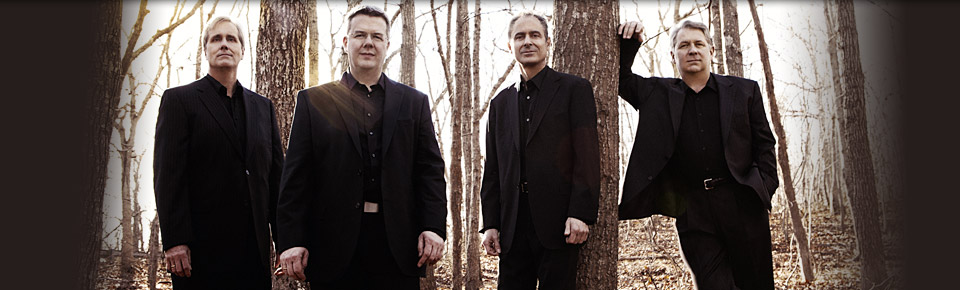
    Above: The Emerson String Quartet (Lawrence Dutton, Paul Watkins, Eugene Drucker, Philip Setzer) in a Lisa Mazzucco photo

    Tuesday May 19th, 2015 – Marking the end of their wonderful 2014-2015 season, Chamber Music Society of Lincoln Center presented the Emerson String Quartet, joined by violist Paul Neubauer and cellist Colin Carr, in a programme featuring the New York City premiere of a Lowell Liebermann work plus classics from Mozart and Tchaikovsky.

    It seems like only yesterday that I opened the CMS 2014-2015 season brochure and found myself anticipating every single one of the concerts listed; how quickly the months have flown by! But a few weeks ago, the Society announced their first Summer Season, and so now we will not have to wait until Autumn to be back at Tully Hall, hearing the great music and incredible artists who make the Society such a valuable part of our lives. 

    Tonight Alice Tully Hall was packed for this, the second performance of this programme. The Emerson String Quartet, surely one of the greatest chamber ensembles of all time, showed their mastery in works of contrasting styles; their marvelously integrated sound has a richness all its own: there are times you’d swear you’re listening to larger orchestra.

    Lowell Liebermann’s String Quartet No. 5 is one of the finest new works I have heard in recent years; not only is it superbly crafted, but it also draws a deep emotional response – something you can’t honestly say about a lot of newer music. Mr. Liebermann, who was seated directly behind us, wrote this brief note for the Playbill: “…I have no doubt that my mindset composing the piece and its resultant overriding elegiac tone was at least partly influenced by any number of depressing/terrifying events of the kind with which we are bombarded daily, in what seems more and more like a world gone mad.”  That sentence encapsulates to perfection my own feelings as I turn to the news each day and think “Can these things really be happening? Can people really have become so vain, shallow, and heartless? Has humanity lost its soul?” And so we turn to great music, both for consolation and also – sometimes – to weep with us. And that’s exactly what this quartet does.

    The music wells up from a deep cello phrase to eerie murmurings and a mournful viola theme. There’s a muted lullabye and a lamenting theme passed from viola to violin 2. Poignant textures draw us deeper and deeper into the music, and then it starts to scurry. A dance for viola is taken up by the violin; agitation builds. A full-scale canon develops, then more swirling dance music. A buzz, a violin duo, and then calm is restored with a yearning theme. A simply gorgeous violin solo is passed to violin 2 and then to the viola, which sings of anguish. A plucked passage from violin and viola takes us to a violin solo of pristine sadness before the music starts to echo its beginnings, fading in a ghostly glimmer. A profound silence filled the hall as the musicians finished: this evocative and thought-provoking piece had clearly made a deep impression. The composer was called to the stage, as bravos resounded. Both the music and the playing of it left me spell-bound.

    I kind of wished there’d been an intermission at that point, the better to remain in reverie; but Mozart’s Quintet in E-flat major K 614 brought the esteemed violist Paul Neubauer to the stage with the Emerson for music that was an antidote to the Liebermann and, almost against my will, I was drawn out of my pensive state into a sunnier place.

    Though written in Mozart’s last year, this Quintet is optimistic in tone and quite jolly in its dance motifs. Its elegant andante, prancing minuet, and jaunty finale were all played with spirit and grace, with much lovely ‘communicating’ between the players.

    For the evening’s concluding performance of Tchaikovsky’s Souvenir de Florence, Philip Setzer took the 1st violin stand with Mr. Neubauer and cellist Colin Carr adding their rich voices to the Emerson’s choir. The sound of this ensemble was really phenomenal, of symphonic resonance.

    The Souvenir is a pleasure from first note to last, but just as Tchaikovsky’s adagios in Swan Lake and Sleeping Beauty strike us most deeply in the heart, it’s the second movement of Souvenir that speaks directly to the receptive spirit. It reminded me so much of the composer’s Serenade for Strings which Balanchine transformed into his remarkable and eternal ballet masterpiece Serenade. Tonight’s performance of this Adagio cantabile was so richly played and so moving: music as consolation.     

    The Repertory:

    The Participating Artists:

  • Chamber Music Society’s Season Finale

    Banner1

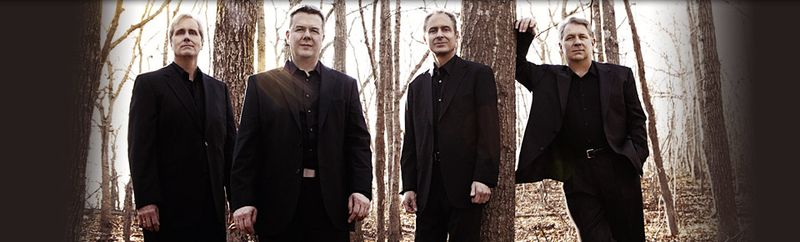
    Above: The Emerson String Quartet (Lawrence Dutton, Paul Watkins, Eugene Drucker, Philip Setzer) in a Lisa Mazzucco photo

    Tuesday May 19th, 2015 – Marking the end of their wonderful 2014-2015 season, Chamber Music Society of Lincoln Center presented the Emerson String Quartet, joined by violist Paul Neubauer and cellist Colin Carr, in a programme featuring the New York City premiere of a Lowell Liebermann work plus classics from Mozart and Tchaikovsky.

    It seems like only yesterday that I opened the CMS 2014-2015 season brochure and found myself anticipating every single one of the concerts listed; how quickly the months have flown by! But a few weeks ago, the Society announced their first Summer Season, and so now we will not have to wait until Autumn to be back at Tully Hall, hearing the great music and incredible artists who make the Society such a valuable part of our lives. 

    Tonight Alice Tully Hall was packed for this, the second performance of this programme. The Emerson String Quartet, surely one of the greatest chamber ensembles of all time, showed their mastery in works of contrasting styles; their marvelously integrated sound has a richness all its own: there are times you’d swear you’re listening to larger orchestra.

    Lowell Liebermann’s String Quartet No. 5 is one of the finest new works I have heard in recent years; not only is it superbly crafted, but it also draws a deep emotional response – something you can’t honestly say about a lot of newer music. Mr. Liebermann, who was seated directly behind us, wrote this brief note for the Playbill: “…I have no doubt that my mindset composing the piece and its resultant overriding elegiac tone was at least partly influenced by any number of depressing/terrifying events of the kind with which we are bombarded daily, in what seems more and more like a world gone mad.”  That sentence encapsulates to perfection my own feelings as I turn to the news each day and think “Can these things really be happening? Can people really have become so vain, shallow, and heartless? Has humanity lost its soul?” And so we turn to great music, both for consolation and also – sometimes – to weep with us. And that’s exactly what this quartet does.

    The music wells up from a deep cello phrase to eerie murmurings and a mournful viola theme. There’s a muted lullabye and a lamenting theme passed from viola to violin 2. Poignant textures draw us deeper and deeper into the music, and then it starts to scurry. A dance for viola is taken up by the violin; agitation builds. A full-scale canon develops, then more swirling dance music. A buzz, a violin duo, and then calm is restored with a yearning theme. A simply gorgeous violin solo is passed to violin 2 and then to the viola, which sings of anguish. A plucked passage from violin and viola takes us to a violin solo of pristine sadness before the music starts to echo its beginnings, fading in a ghostly glimmer. A profound silence filled the hall as the musicians finished: this evocative and thought-provoking piece had clearly made a deep impression. The composer was called to the stage, as bravos resounded. Both the music and the playing of it left me spell-bound.

    I kind of wished there’d been an intermission at that point, the better to remain in reverie; but Mozart’s Quintet in E-flat major K 614 brought the esteemed violist Paul Neubauer to the stage with the Emerson for music that was an antidote to the Liebermann and, almost against my will, I was drawn out of my pensive state into a sunnier place.

    Though written in Mozart’s last year, this Quintet is optimistic in tone and quite jolly in its dance motifs. Its elegant andante, prancing minuet, and jaunty finale were all played with spirit and grace, with much lovely ‘communicating’ between the players.

    For the evening’s concluding performance of Tchaikovsky’s Souvenir de Florence, Philip Setzer took the 1st violin stand with Mr. Neubauer and cellist Colin Carr adding their rich voices to the Emerson’s choir. The sound of this ensemble was really phenomenal, of symphonic resonance.

    The Souvenir is a pleasure from first note to last, but just as Tchaikovsky’s adagios in Swan Lake and Sleeping Beauty strike us most deeply in the heart, it’s the second movement of Souvenir that speaks directly to the receptive spirit. It reminded me so much of the composer’s Serenade for Strings which Balanchine transformed into his remarkable and eternal ballet masterpiece Serenade. Tonight’s performance of this Adagio cantabile was so richly played and so moving: music as consolation.     

    The Repertory:

    The Participating Artists:

  • At Home With Wagner VIII

    1310368-Richard_Wagner

    In 1968, Lorin Maazel conducted the RING Cycle at Bayreuth and from that cycle, the WALKURE looked especially tempting to me: not only are the ever-thrilling pairing of Leonie Rysanek and James King cast as the Wälsungs and such stalwart Wagnerians as Berit Lindholm, Theo Adam and Josef Greindl featured, but a rare performance as Fricka by Janis Martin – a singer in whom I’ve recently taken a renewed interest and who in December 2014 passed away – drew me to purchase this set. It’s an exciting performance in many ways, and Ms. Martin’s Fricka is one of the best-sung I have heard.

    Leonie Rysanek and James King sang Sieglinde and Siegmund together often, including on the commercial release of the entire Cycle conducted by Karl Böhm; the two singers know these roles inside-out but somehow they always manage to make the music seem fresh and genuinely exciting. Rysanek, always a powerhouse singer at The Met, scales down her voice here to suit the more intimate space of the Bayreuth Festspielhaus. She creates many poetic effects but when the emotional temperature of the drama rises, Rysanek – as ever – turns up the voltage. In Act I she produces her trademark hair-curling top notes and the famous scream (at Wieland Wagner’s bidding) as the sword is pulled from the tree. 

    James King is in superb voice; he sings with tireless generosity – his Sword Monolog one of the finest I’ve heard, with his astonishing cries of “Walse! Walse!” sustained with epic fervor – and he’s always vivid in the expressing the passions of the final pages of Act I. That pillar of Wagnerian basso singing, Josef Greindl, is as ever a strong and fearsome Hunding. The three singers, with vital support from Masetro Maazel (his tempos tending towards speed rather than breadth) make for a truly stimulating rendering of this act.

    As Wotan, Theo Adam’s powerful voice greets his favorite daughter; Berit Lindholm is bright and true in Brunnhilde’s battle cry, and then Janis Martin as Fricka arrives to throw a monkey-wrench into her husband’s plans. Ms. Martin, at this point in her career about to transition from mezzo to soprano (in the 1970s she was to be my first in-house Sieglinde, Kundry and Marie in WOZZECK); thus the highest notes of Fricka’s music hold no terrors for her. Her singing is clean, wide-ranging, and impressive. As she and Mr. Adam debate the matters at hand, Lorin Maazel’s orchestra underscores both sides of the argument. Ms. Martin exits, secure in her triumph.
    T adam

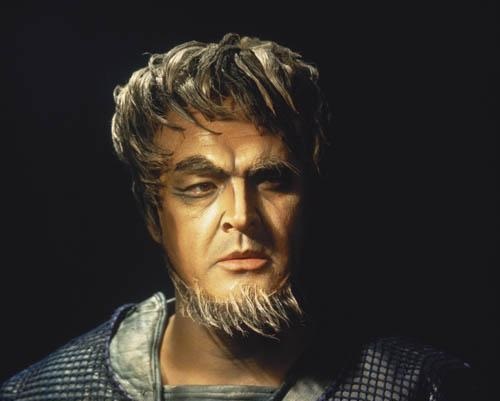
    Theo Adam (above) was my very first Wotan at The Met in RHEINGOLD in 1969, and I saw him some 20 years later, still very impressive in WALKURE. His sound per se is not highly individualized – it’s basically darkish and grainy – but he always manages to use it to optimum effect. His long monolog, with keen support from Maazel and increasingly urgent responses from Lindholm, is appropriately central to the drama of the performance.

    Rushing on, pursued by Hunding’s hounds, Rysanek and King make much of their scene together. For Ryssanek, moments of lyric tenderness veer off to outbursts of hysteria; King is heroically comforting. Rysanek emits a demented, curdled scream at the sound of Hunding’s approaching horns, and as she swoons, King sings “Schwester! Geliebte” as tenderly as I have ever heard it done. 

    In the great Todesverkundigung scene (the Annuncation of Death, where Brunnhilde appears as in a vision and warns Siegmund of his impending death in battle), Maazel brings weightiness without impeding the forward flow. A doom-ladened feeling of tension and barely controlled urgency underscores the exchange between soprano and tenor, with Ms. Lindholm expressing increasing desperation as she feels herself losing control of the situation. Maazel brilliantly emphasizes Brunnhilde’s shift of allegiance: a feeling of high drama as she rushes off. 

    The poignant cello ‘lullabye’ as Siegmund blesses Sieginde’s slumber is taken up by the orchestra with a rich sense of yearning, til Hunding’s horns intrude to terrifying effect. Awakening in a daze before grasping the situation, Rysanek’s mad scene reaches fever pitch. Adam thunders forth Wotan’s intercession, Rysanek screams as Siegmund is slain. After Wotan has dispatched Hunding with great contempt, Adam and Maazel rise to a thunderous finish as Wotan storms away to catch the traitorous Brunnhilde.

    Synek_Portrait1a

    Above: Liane Synek

    An excellent Helmwige from Liane Synek (sample her singing here, as Brunnhilde in a passage from a WALKURE performance in Montevideo 1959): she stands out from some rowdy singing by her sister-Valkyries. 

    Sieglinde’s desperate plea to be slain turns to joy as Brunnhilde informs her that she is with child, giving wing to Leonie Rysanek’s cresting ‘O hehrstes Wunder!’, the crowning moment of one of the soprano’s greatest roles.

    The scene is then set for the final father-daughter encounter; both Lindholm and Adam have moments of unsteadiness and the sound-quality is sometimes marred by overload. But both singers are truly engaged in what they are singing, with Theo Adam particularly marvelous in the long Act III passage starting at “So tatest du, was so gern zu tun ich begehrt…” (“So you did what I wanted so much to do…”) Once Brunnhilde has fallen into slumber, the bass-baritone and Maestro Maazel give an emotionally vibrant performance of Wotan’s farewell.

    ~~~~~~~~~~~~~~~~~~~~~~~~~~~~~~~~~~~~~~~~~~~~~~~~~~~~~~~~~~~~~~~~~~~~~~~~~~~~~~~~~~~~~~~~~~~

    Lilowa

    Above: mezzo-soprano Margarita Lilowa

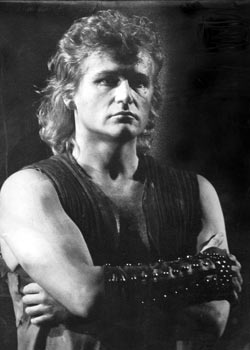
    A RHEINGOLD from Vienna 1976 piqued my curiosity – mainly to experience the conducting of Horst Stein whose superb 1975 Bayreuth GOTTERDAMMERNG I wrote about here. I was also wanting to hear Margarita Lilowa’s Erda, having recently really enjoyed her singing as Mary in a recording of FLIEGENDE HOLLANDER, and Peter Hofmann in what is said to be his Vienna debut performance, as Loge.

    The recording is clearly not from a broadcast but rather was recorded in-house; the sound varies – some overload in spots, some distancing of the voice, a couple of dropouts – and in quieter passages the breathing of the person making the recording can be heard: an unsettling effect. Also during the Alberich/Mime scene there’s some annoying mike noise. But overall, with steadfast concentration, the performance has many rewards. And chief among them is Maestro Stein’s expert shaping of the score.

    The Rhinemaidens are Lotte Rysanek (Leonie’s sister, who sometimes sounds a bit like her famous sibling), Rohangiz Yachmi, and Axelle Gall. Their more attractive moments come in solo lines rather than in a vocal blend. Zoltán Kelemen, the Alberich of the era, is superb here. He paints a full vocal portrait of the dwarf, from his early semi-playful pursuit of the Rhinemaidens thru the rape of the Gold, on to the vanity of his bullying Lord of Nibelheim, his shattering fall into Loge’s trap, and the vividly expressed narrative leading up to the Curse.

    Grace Hoffmann and Theo Adam are experienced Wagnerians who inhabit their roles thoroughly. The mezzo’s voice is no longer at its freshest (she was in the twenty-fifth year of her career here) but she is authoritative in characterization. Adam, strong and true of voice, makes a fine impression throughout, especially in his final hailing of Valhalla.

    Hannelore Bode’s voice seems too weighty and unwieldy for Freia, but the giants who pursue her are impressive indeed: Karl Ridderbusch and Bengt Rundgren are so completely at home as Fasolt and Fafner, and their dark, ample voices fill the music richly. Hale and hearty one moment, and wonderfully subtle the next, both bassos make all their music vivid. A lyric Froh (Josef Hopferweiser) and an ample-toned Donner (Reid Bunger – his “Heda! Hedo” has a nicely sustained quality) are well-cast.      

    Peter-Hofmann-calendar-250x350px

    Above: tenor Peter Hofmann

    Peter Hofmann’s Loge has a baritonal quality, and he blusters a bit but soon settles in to give a sturdy if not very imaginative performance of the Lord of Fire. The Nibelheim scene finds Adam, Hofmann, and Kelemen all at their keenest in sense of dramatic nuance, and Heinz Zednik is a capital Mime, well-voiced and inflecting the text with eerie colours.

    Ms. Lilowa’s Erda, sounding from a distance at first, comes into focus after her first line or two and has a round-toned, steady voice, making the most of her brief but important scene.

    Horst Stein’s overall vision of the score seems nearly ideal to me, and there are a number of particularly satisfying passages: his underscoring of the big lyric themes in Loge’s narrative, the detailing of the orchestral parts at Loge’s mention of Freia’s apples, the descent to Nibelheim. And once in Alberich’s domain, Stein shows keen mastery of nuance, both in colorfully supporting the dialogue and in a truly ominous “dragon” theme for Alberich’s transformation. Throughout the performance, it’s Stein who keeps us keenly focused on this marvelous score.

    ~~~~~~~~~~~~~~~~~~~~~~~~~~~~~~~~~~~~~~~~~~~~~~~~~~~~~~~~~~~~~~~~~~~~~~~~~~~~~~~~~~~~~~~~~~~
    Mcintyre

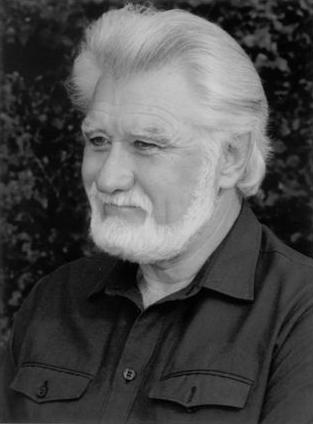
    Above: Sir Donald McIntyre

    Another RHEINGOLD – a recording of a performance I actually attended – is from a Met broadcast of February 15th, 1975. It’s interesting to compare my reactions to the recording with what I had written in my opera diary on the day of the performance, some forty years earlier.

    The 1974-75 season was a rich one for me; I was living (though not enrolled) at Sarah Lawrence College with TJ. We’d had our summer on Cape Cod together and, as we prepared to part company and resume our separate lives, we found we’d become so attached to one another that, only a few days after I’d returned to the tiny town and he’d moved into the college dorm, we threw caution to the wind and I went down and got a temp job at IBM in Westchester County and slept with him in his twin bed (he had drawn, luckily, one of the few ‘private’ room on the entire campus). We went down to Manhattan for the opera and the ballet three or four times a week.

    The Met were doing the RING Cycle that season, with Sixten Ehrling conducting. The virtues (or not) of his readings of the scores were hotly debated by the fans; he was sometimes booed when entering the pit, and sometimes cheered when he took his bows at the end of each opera. I thought at the time his conducting was “maybe lacking in grandeur, but well-paced and considerate of the singers.” Listening to it now, his RHEINGOLD seems perfectly fine, with many very satisfying passages…despite some fluffs from the horns here and there.
    Ehrling-Sixten-05

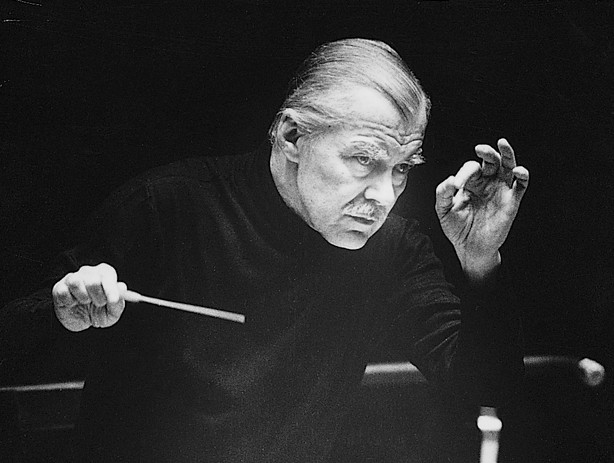
    Above: Sixten Ehrling

    (Note: in 1998, when I started working at Tower Records, I met Maestro Ehrling and his charming wife, a former ballerina. The first day I met him, he was in a cantankerous mood because all the clerks were busy and he was in a rush. I stepped up, greeted him with a little bow, and immediately began to talk to him about his RING Cycle. He became a regular customer and regaled me with all sorts of wonderful stories about the singers he had worked with. He also liked to correct my pronunciation; when I referred to Wotan’s daughter as “Broon-HILL-da” he yelled: “BROON-hil-d…” I ended up really enjoying our little friendship, and missed him when he became too ill to come to the store…though he’d often send his wife to us, with strict instructions as to what to buy for him. He passed away in 2005.)  

    Christine Weidinger, Marcia Baldwin, and – especially – Batyah Godfrey are good Rhinemaidens; they raise the performance level starting with the first appearance of the ‘gold’ motif. Marius Rintzler seems at first to be a bass-oriented Alberich (though later his topmost notes are wonderfully secure) and he becomes actually scary as his plan to steal the treasure takes over his mind. Abetted by Ehrling, the scene of the rape of the gold is dramatically vivid.

    Ehrling scores again in his super-reading of the descent to Nibeheim. Rintzler as Alberich, in his own domain, lords it fabulously over his brother and his slaves. Later, betrayed, Rintzler’s performance rings true in its desperation and his powerful declaiming of the curse.

    The opera’s second scene shows Ehrling at his best, with a nice sense of propulsion and excellent support of his singers. This matinee marked the Met debut of Donald McIntyre as Wotan; he would become known and beloved worldwide a few years later when the Chereau RING was filmed for international telecast at the Bayreuth Festival. On this afternoon in 1975, he makes a superb impression: he begins a bit sleepily (Fricka has just awakened him) but once he claps eyes on the finished Valhalla, his godliness rises to full stature. His singing throughout is generously sustained; by turns imperious and subtle, he makes an ever-commanding dramatic impression. McIntyre’s final scene, hailing the new home of the gods and dismissing the Rhinemaidens who plead from below for the return of the ring, is really exciting.

    Mignon Dunn, always a great favorite of mine, is an immediately distinctive Fricka. The role is rather brief, but Mignon makes the most of every opportunity, and her gift for vocal seduction manifests itself near the end, as she lures Wotan’s thoughts away from the mysterious Erda and turns them instead towards Valhalla (where she hopes to keep him on a tighter tether…but, it doesn’t work.)

    Glade Peterson, as Loge, seems rather declamatory at first. His ample voice serves him well in the monolog, despite some moments of errant pitch. He lacks a bit of the subtlety that can make Loge’s music so entrancing. As the hapless Mime, Ragnar Ulfung is both note-conscious and characterful; he makes a string impression though once or twice he too wanders off-pitch.

    The giants are simply great: John Macurdy’s Fafner is darkly effective – he has less to sing than his brother Fasolt, but he will eventually get the upper hand…violently. Bengt Rundgren as the more tender-hearted of the two is truly authoritative, with page after page of finely inflected basso singing.

    Mary Ellen Pracht, a Met stalwart, does well as Freia, and William Dooley is a splendid Donner…his dramatic, full-voiced cries of “Heda, Hedo!” are in fact a high point if the opera, and are punctuated by a fantastical thunder-blast. Tenor Kolbjørn Høiseth is rather a fuller-toned Froh than we sometimes hear; there’s something rather ‘slow’ about his delivery. (A few days later, he sang a single Loge at The Met, and then a single Siegmund.)

    In the house, the amplifying of Erda’s Warning ruined the moment musically, but this does not affect the broadcast which is picked up directly from the stage mikes. And so Lili Chookasian makes an absolutely stunning effect with her rich, deep tones. Where are such voices as hers today? After “Alles was ist, endet!” and “Meide den Ring!”, one feels chills running up and down the spine. Magnificent!