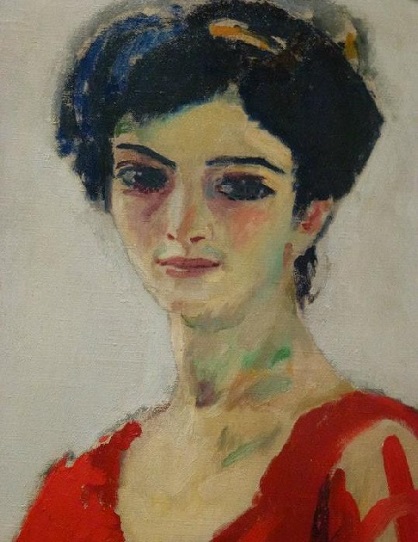
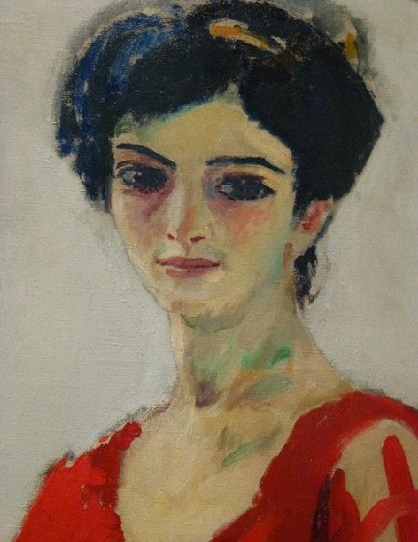
Maria
Kees van Dongen (1877-1968)

Above: the Berlin Holocaust Memorial
On Thursday April 30th, 2015, the 70th anniversary of the death of Adolf Hitler will be marked. On that date in 1945, with the Red Army only blocks from his bunker underneath the Reich Chancellery, Hitler and his wife Eva Braun committed suicide.
On 16 January 1945, Hitler had moved into the Führerbunker, a secure underground haven of residential and office space from whence he continued to rule Germany for three more months. He was joined by his senior staff, Martin Bormann, and later by Eva Braun. At some point Joseph Goebbels with his wife Magda and their six children also took up residence in the upper Vorbunker. Two or three dozen support, medical, and administrative staff were also living there. These included Hitler’s secretaries (among them Traudl Junge), a nurse named Erna Flegel, and telephonist Rochus Misch. Hitler’s dog Blondi was also one of the occupants of the underground bunker; Hitler could sometimes be seen strolling around the chancellery garden with Blondi.
This recent article in The Guardian tells of the lingering effects of Hitler’s reign of horror on the city of Berlin. Reading the story of course prompted me to watch, yet again, Oliver Hirschbiegel’s 2004 film ‘Der Untergang‘ (Downfall).
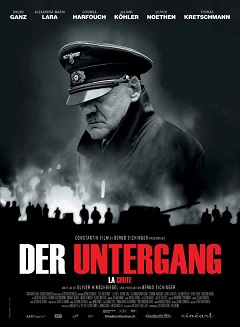
In this powerful film, which I cannot recommend highly enough, the Swiss actor Bruno Ganz creates a portrait of Hitler in the final days of his life that has a harrowing feeling of reality. The dictator’s slow grasp of the fact that his Reich is doomed is detailed in scenes in which the character veers from cool efficiency and calculation to epic temper tantrums as he berates his generals and clings desperately to the belief that Germany can still prevail. Once that illusion has been shattered by incoming reports that the bunker is surrounded, Hitler becomes a ghost of himself. He marries Eva, has cyanide capsules tested on his beloved dog Blondi, and finally withdraws with his wife to the private room where they end their lives, having bid farewell to his faithful staff.
In the film’s most chilling scene, Magda Goebbels (another uncannily ‘real’ characterization, from actress Corinna Harfouch) systematically murders her six children; she then sits down to a game of solitaire before going up to the Chancellery garden where her husband shoots her before taking his own life. This scene so powerfully depicts the sway Hitler held over his followers, creating a vast cult in which he was viewed as nothing less than a god. Following his death, many of the faithful shot themselves rather than face a world where Hitler was no longer.
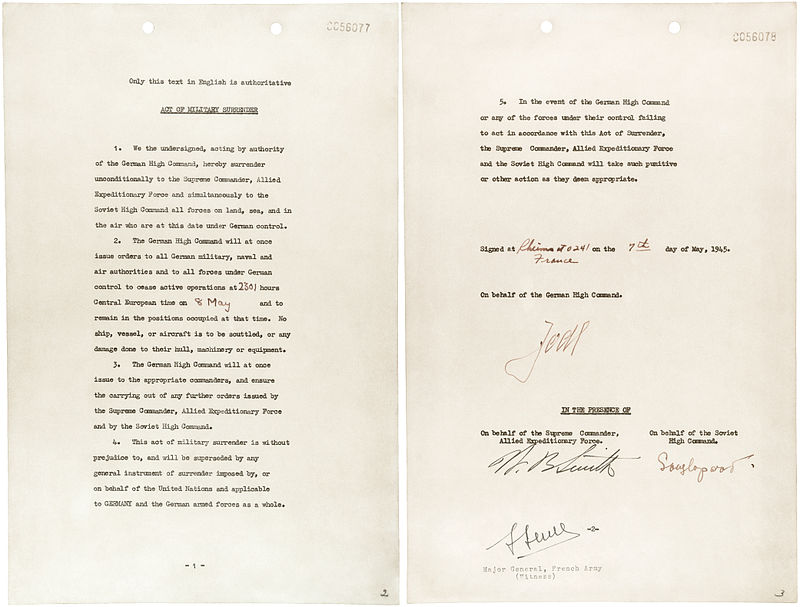
Above: the instrument of surrender, which ended the war in Europe.
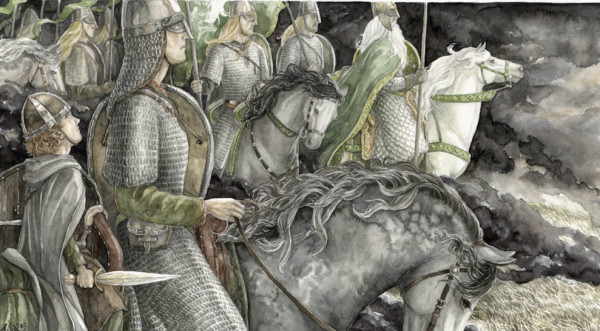
“Where now the horse and the rider? Where is the horn that was blowing?
Where is the helm and the hauberk, and the bright hair flowing?
Where is the hand on the harpstring, and the red fire glowing?
Where is the spring and the harvest and the tall corn growing?
They have passed like rain on the mountain, like a wind in the meadow;
The days have gone down in the West behind the hills into shadow.
Who shall gather the smoke of the dead wood burning,
Or behold the flowing years from the Sea returning?”
~ THE TWO TOWERS/JRR Tolkien
|
Winter Heavens |
|
| George Meredith (1888) | |
| “Sharp is the night, but stars with frost alive Leap off the rim of earth across the dome. It is a night to make the heavens our home More than the nest whereto apace we strive. Lengths down our road each fir-tree seems a hive, In swarms outrushing from the golden comb. They waken waves of thoughts that burst to foam: The living throb in me, the dead revive. Yon mantle clothes us: there, past mortal breath, Life glistens on the river of the death. It folds us, flesh and dust; and have we knelt, Or never knelt, or eyed as kine the springs Of radiance, the radiance enrings: And this is the soul’s haven to have felt.” |

Rudolf Schock sings “In fernem land” from Wagner’s LOHENGRIN, conducted by Horst Stein.

I’ve fallen in love with Vincent Persichetti’s WINTER CANTATA which I discovered quite by chance when I plucked a CD of the composer’s choral works off the shelf at the library a couple weeks ago.
Composed in 1964, the work was inspired by a collection of haiku (‘A Net of Fireflies‘) which Persichetti’s daughter had given him as a gift. To the intriguingly spare accompaniment of flute and marimba, the chorus of women’s voices weave a magical tapestry of wintry images. Intricate harmonies and tapering sustained notes are particularly pleasing vocal elements; the flute and marimba evoke cool air and gently swirling flakes of snow. There are eleven brief movements, and an Epilogue which draws its text from one line of each of the previous eleven poems.
The CD, featuring the Mendelssohn Club of Philadelphia conducted by Tamara Brooks, may be found here.

Above: Japan’s Yoshihito Nishioka
Friday August 22nd, 2014 – Really nice day at the US Open Qualifying Tournament. Clouds kept the heat index at a comfortable level, and there was a breeze stirring. Around 3:00 PM, a ceiling of dark clouds settled over the Tennis Center, and just as Yoshihito Nishioka finished signing autographs after his win, the rains came down. I had really wanted to see the end of Hiroki Moriya’s match and to see Tatsuma Ito, a player I realy like and whose first two matches I missed this time around. But the rains were heavy enough to send the crowds scurrying, and it was obviously more than just a passing shower. I knew that even if play resumed within an hour, it would take an additional hour or more to dry the courts. So I left, though I didn’t really want to.

I started my day watching Japan’s Taro Daniel (above) in a hard-fought match against the experienced Canadian player Peter Polansky. Polansky took the first set convincingly, and Taro was showing visible frustration and fatigue in the second set when I had to walk away so as not to miss any of Steve Darcis’ match on Court 17. I was a bit surprised to find – after the truncated Darcis match – that Taro was still playing: he had apparently pulled himself together and taken the second set, and he was just a couple of games away from winning the third. He played really well, and the crowd was loving him. After the final point, he sank to his knees in disbelief. He had to sign a ton of autographs.

Above: Taro Daniel after his win

Over at Court 17 (above), I was totally psyched for the Darcis match. I found a nice seat very high up with no one in my immediate vicinity and a breeze to keep me cool. Tennis heaven! Steve played a stupendous first set. His opponent Emilio Gomez of Ecuador simply couldn’t get anything going against the Darcis Machine. Gomez managed to take one game in the first set but otherwise it was all-Darcis, all the time; Steve won the first set in 23 minutes, concluding with a superb passing shot.
Steve won the first game of the second set and then Emilio walked over to the chair umpire and asked for the trainer. After a long wait the trainer showed up, taped Emilio’s ankle, and play resumed. But as soon as Steve finished the second game, Emilio limped off the court and retired. So Steve’s victory, however assured, was a bit bittersweet. Nevertheless, it’s good he’s into the main draw and I hope he has a success.

Above: Steve Darcis of Belgium
After watching the end of the Taro Daniel/Peter Polansky I went over to Courts 4/5/6 where four Japanese players were to be playing their matches in succession. Yuichi Sugita was over-powered by Germany’s Matthias Bachinger today. Yuichi didn’t show the same energy as he had in his previous match. He had the trainer out during the second set for his ankle; though hobbled, he was still able to play out the match. Hiroki Moriya, following his thrilling match on Wednesday, seemed subdued today as he met the powerful Swiss Marco Chiudinelli. Marco thoroughly dominated the first set, but Hiroki came out swinging for the second set and fought hard to take it in a tie-breaker. However, he could not sustain the momentum and in the end Chiudinelli was the winner.

Yoshihito Nishioka (above) held the Japanese banner high with a stunning win over Turkey’s hard-hitting Marsel Ilham. Like Sugita and Moriya, Nishioka is small of stature. But he was able to answer Marsel’s blistering strokes with well-placed, authoritative hitting. Nishioka only had one patch of trouble: a long service game where he kept being stalled at deuce. But once past that it was smooth sailing for the Japanese boy. The lopsided score (6-3, 6-1) does not really reflect the threat posed by Marsel Ilhan. But the crowd was over-joyed to celebrate Nishioka’s win, and he was engulfed by fans at the end.

Above: Yoshihito Nishioka signing autographs after winning his match
The rain prevented me from seeing Tatsuma Ito; I’m following his match now on the website.
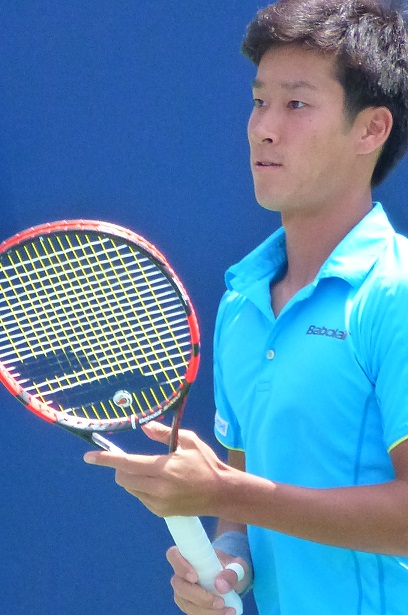
Above: Yuichi Sugita of Japan
Wednesday August 20th, 2014 – Today was a really good day at the US Open Qualifying Tournament. What constitutes a “really good day” at a tennis tournament? A day when the players you like…win!
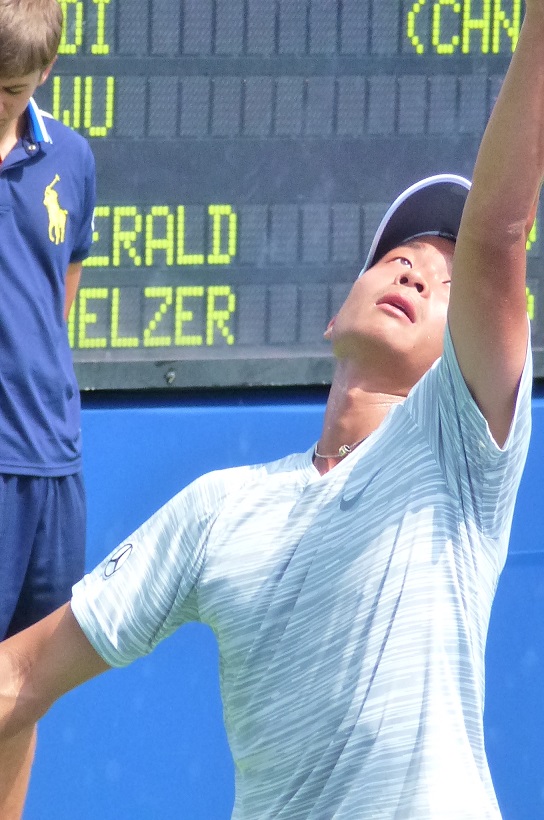
Today started excellently with China’s Di Wu (above) scoring an impressive victory over Gerald Melzer of Austria. Di Wu dominated the match with his steady play, slowly wearing down his opponent. Patience and surety of technique kept the Chinese boy on the path to victory. The 6-2 6-2 score says it all.

Above: Di Wu signing autographs after his match
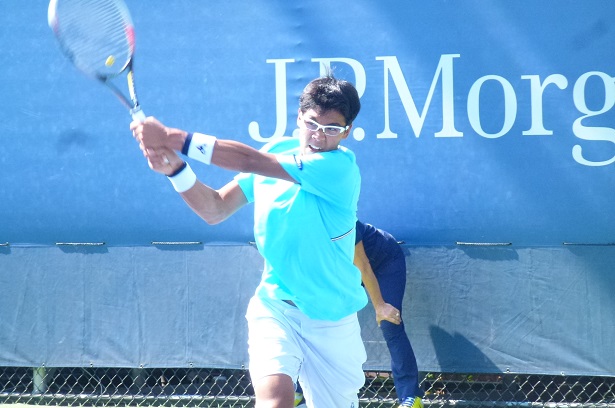
A new face from Korea, Hyeon Chung (above), convincingly beat Argentina’s Augustin Velotti. Hyeon Chung, rather gangly and loose-limbed – and sporting some funky sunglasses – kept his opponent under control and was enthusiastically supported by a large contingent from New York’s Korean community.
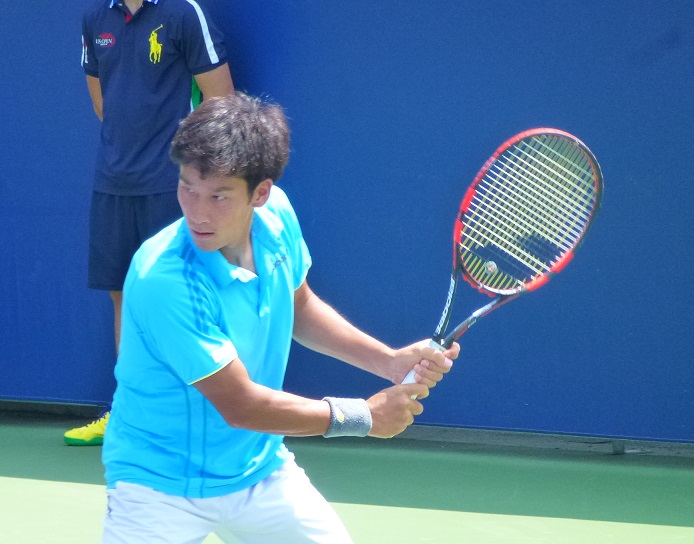
Yuichi Sugita (above) played an exciting match against Germany’s Tim Puetz. Yuichi had opportunities to close out the first set sooner than he did, but his patience paid off. In the second set. Tim Puetz put up a strong battle, with some rowdy vocal support from the German fans, but Yuichi never lost his cool and he prevailed in the end, playing some beautiful tennis along the way. Rather reticent throughout the match, Yuichi let out a celebratory whoop when he scored match point.
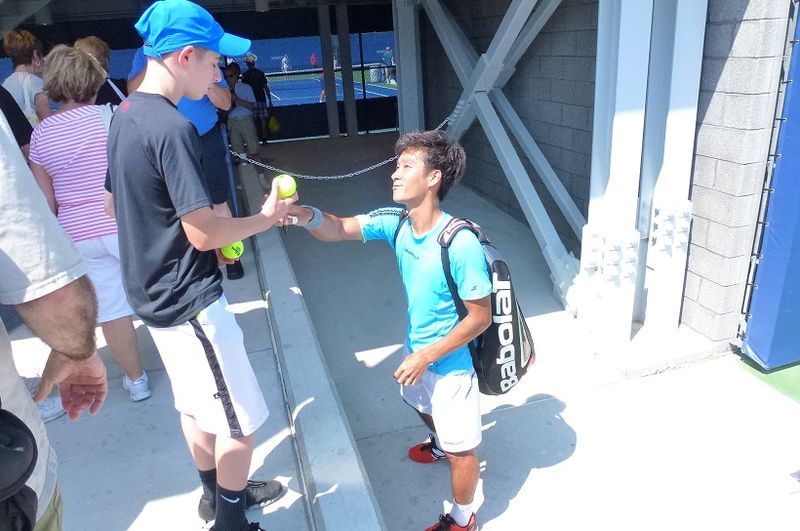
Above: Yuichi after the match

Yuki Bhambri (above), the tall player from India, took an early break from the Lithuanian Laurynas Grigelis. But Grigelis broke back and the match progressed with some very exciting rallies and fantastical shots from both players. They seemed well-matched in the first set – it seemed it could go either way – but then Yuki took the edge. He sustained his high level of play throughout the second set, giving Grigelis few chances to make any headway. A strong victory for the Indian.

Above: Yuki Bhambri
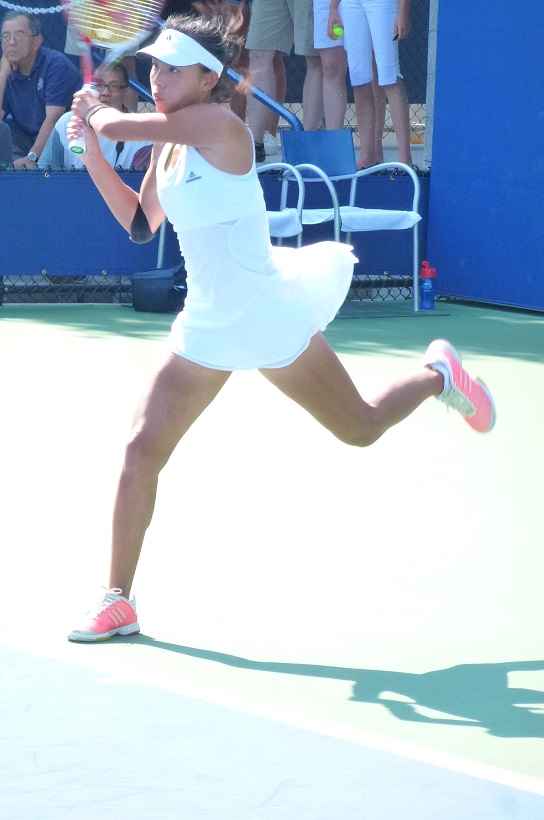
I don’t get to watch many women’s matches at the Open; there are so many male players I try to follow, plus – to be honest – women’s tennis at the qualifying level is not always exciting. Today I did watch China’s Qiang Wang (above) fighting hard to sustain a win over Russia’s Evgenia Rodina in a three-set match buoyed by good audience particpation.
I hadn’t been over to the corner courts (4, 5, and 6) on Tuesday and I was surprised today to see the renovations that have taken place since last Summer. The three courts are streamlined, with new scoreboards, seats that don’t over-heat as the sun beats down on them, and added “mezzanine” seating at each end of the court.
One funny thing happened: the girl at the food stand misunderstood me, thinking I wanted a beer. She asked for ID! I said, “I need ID to buy a diet Coke?”


 Oberon's Glade