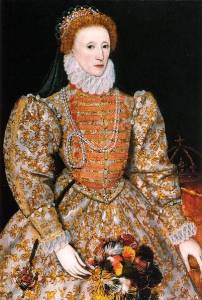
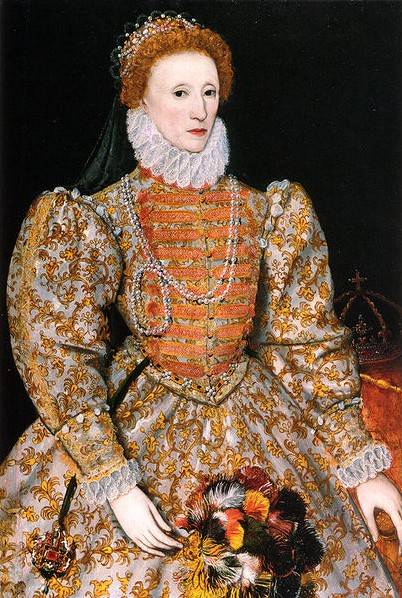
Over the centuries there have been many unsolved-mystery tales about royal offspring, legitimate or otherwise. Bastard babies of monarchs quietly strangled, starved or sold off; a royal infant who dies in the cradle and is secretly replaced by a serving girl’s babe to preserve the succession; twins separated at birth for whatever reason only to meet up again when one is prince and the other pauper. But no such story that I’ve ever read matches Chris Hunt’s fantastical novel of Tudor times: THE BISLEY BOY, which I have just read again after first encountering it a dozen years ago on a shelf at the Different Light bookstore.
The notion that Elizabeth I of England was actually a man goes back centuries; it stemmed from a time when the child Elizabeth was suffering from one of her many bouts of serious illness. Sent to a royal residence in the tiny town of Bisley to recover in the healthy air, she worsened and died…or so the story goes. A village boy of similar build and colouring was smuggled in to take the place of the dead princess, sparing her caretakers the wrath of Henry VIII.
But was it not too convenient that such a lad could be found and the substitution so cleverly made? Novelist Hunt solves this ‘problem’ by making his Bisley Boy a bastard son of Henry VIII’s bastard son Henry Fitzroy. Fitzroy was married at the age of fourteen to Lady Mary Howard and while historically it was believed their union was never consumated, novelist Hunt imagines that the teen-aged Fitzroy fathered a son off Lady Mary. Fitzroy died at the age of 17 in 1536. His baby son, born in the very Bisley residence where Elizabeth came to convalesce, was raised in the house by loyal servants of Fitzroy until his death. Then the boy, at age 2 and known as John Neville, was taken in by a kindly Bisley family. Thus in the small village there was a boy who could believably take the place of Princess Elizabeth: a boy who – like the princess – sprang from a Tudor/Howard union.
John Neville is drawn to the house where he was born but his adoptive father refuses to answer any questions about the place, which now stands empty, and he forbids the boy to go near the royal cottage. But a few years later, sneaking back to his boyhood home, John finds a slender, elfin young girl playing in the walled garden – a girl who looks so much like him it’s uncanny. It is the Princess Elizabeth. Katherine Champernowne (later to be famously known by her married name, Kat Ashley) is nursing Elizabeth back to health. Kat and the princess spot the boy and he becomes a playmate for Elizabeth. His adoptive father can say nothing to discourage the set-up since a royal wish is his command.
One day for a joke, Elizabeth and John change clothes. John, dressed in Elizabeth’s gown, fools even the discerning Kat who is astounded by how much John looks like her young charge.
When the princess suddenly takes ill again, withers and dies, the horrified Kat begs John to take the place of the Tudor princess and save the nurse from severe punishment. The boy, tired of Bisley and knowing himself to be a grandson of Henry VIII in his own right, agrees. It’s planned only as a temporary ruse, but in fact there is no going back.
Thus the long charade begins: ‘Elizabeth’ passes muster when meeting her father and siblings as they’d seen her but rarely and of course she’d changed a bit since the last encounter. ‘Elizabeth’ survives the death of her half-brother Edward and the difficult years when Bloody Mary Tudor rules England in a reign of Catholic terror. Becoming queen, ‘Elizabeth’ continues the ruse til her death decades later, with only a very few trusted intimates knowing her secret.
The story, though far-fetched, meshes well with several things we know about Elizabeth: her eternal virginity, her refusal to marry, her hatred of physicians, even her eventual hair loss which was disguised by elaborate wigs and headdresses. Over the years (in the novel) faithful serving girls smuggled phials of rabbit’s blood into the royal bedchamber, spilling droplets onto the sheets to confirm the queen’s periods.
But what of her rumoured intimacies with Thomas Seymour and later with Robert, Earl of Leicester? In both cases, John Neville/Elizabeth – a beautifully androgynous gay boy with lustful appetites – so intrigues the men while keeping them at arm’s length that when ‘she’ capitulates and reveals her true sex, they each admit to having had boys before (“What else can a man do while at sea?” asks Admiral Tom) and they are thrilled to have one now who also happens to be the most powerful person in the realm. Other dalliances come and go, the queen’s aroused state in certain situations disguised by her stiff petticoats and voluminous skirts.
Near the end of John/Elizabeth’s life, the impetuous Robert Devereux, Earl of Essex, bursts into her bathing chamber and discovers Elizabeth’s secret. Already in trouble for suspected treasonous activities against the crown, Essex is condemned to die although if he’d not found her out, Elizabeth, now an old woman in a man’s withering body, would most likely have spared him. On the scaffold, he did not betray her secret – he didn’t reveal the truth – and he died nobly.
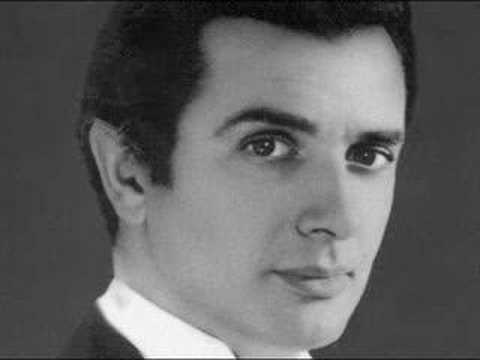
What a film this would make! I even have someone in mind for the title-role.
In conjunction with THE BISLEY BOY I also read Beverley Murphy’s BASTARD PRINCE, a factual account of the life of Henry Fitzroy. There seems to be a surprisingly vast amount of documentation about him and the incidents of his short life, culled from sources at the time when he was considered very likely to inherit the English throne. Despite his birth status, it was thought by many that a bastard king was preferable to a legitimately-born queen. The arrival of Prince Edward changed the succession quite decisively, and Henry Fitzroy did not live long enough to pose any threat to Bloody Mary’s ascent to the throne following the early death of her half-brother Edward.











 Oberon's Glade