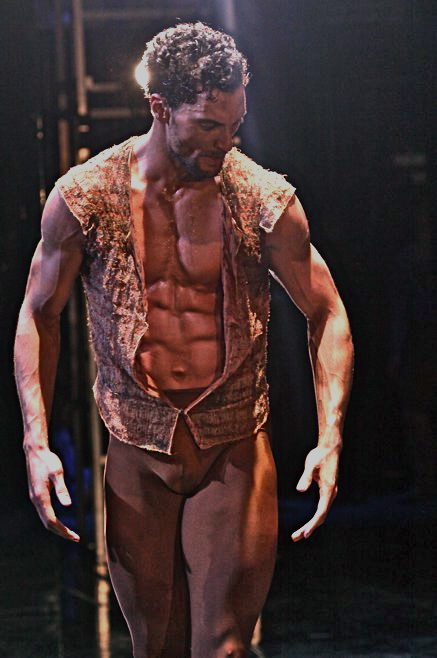
Category: Dance

  • New Music @ Rose Studio

    ~Author: Scoresby

    Thursday April 26 2018 – At the Chamber Music Society of Lincoln Center’s last New Music concert of the season, the Schumann Quartet and pianist Gloria Chien gave a wide-ranging performance. The first piece on the program was the last movement of Swiss composer Helena Winkelman‘s Quadriga Quartet for Strings titled “Sleipnir the eight-legged” based on the eponymous horse in Norse mythology. While only the last movement of the quartet, Ms. Winkleman is open to it being played alone. It is a rollicking piece that includes references to Bartok, jazz, metal, and Swiss folk music all in a contemporary idiom.

    The Schumann Quartet played through the virtuosic material with enthusiasm, indulging in all the fun timbres Ms. Winkleman imbeds in the score and still able to bring out the lyricism that punctuates the more cacophonous moments. In fact, violist Liisa Randalu and cellist Mark Schumann seemed to blend incredibly well as duo – matching each other to create a delicious backdrop for first violinist Erik Schumann and second violinist Ken Schumann’s lyrical melodies. Through the work, the rhythmic pulse sounds like a frenetic horse stomping through – it is a shame we only got to hear one movement of this quartet. I look forward to hearing more of Ms. Winkleman’s music soon.

    Screen Shot 2018-05-01 at 5.25.18 PM

    Above: Schumann Quartet; Photo Credit: Kaupo Kikkas

    The second work on the program was Timo Andres’s five continuous movement work Quintet for Piano, Two Violins, Viola, and Cello. The aptly named first movement Cannons and Fables, sounds like an upbeat riff on minimalist Schumann. The most interesting was the second movement, which is based on large dusty tremolos in all of the instruments. The quartet’s tight and structured sound contrasted the more rustic sounding piano part. While interesting to listen to – this doesn’t seem to Mr. Andres’s most interesting work.

    Henze’s brief “Sonatina for Violin and Piano” seemed highly structured and a completely different sound world than the earlier Andres. Second violinist Ken Schumann and Ms. Chien presented the work based off of themes from one of his operas. The Allegretto has an active piano work full of counterpoint and dissonance, with what seem to be quotes from Messiaen’s Quartet for the End of Time. Mr. K Schumann captured the almost romantic nostalgia in the second movement, his mute letting him produce a supple ghostly sound and his phrasing emphasizing the lyrical quality of the music. Ms. Chien in the last movement embraced the drama in the piano part and gave heft to the huge chords that end the piece below Mr. K Schumann’s highpitched violin.  

    After the rigidly structured world of Henze, the program moved into two selections from “Piano Etudes” by Augusta Read Thomas. The first (etude 3), titled Cathedral Waterfall – Homage to Messiaen, is a spacious work that uses the extreme reaches of the piano and heavy use of pedal to evoke a large cathedral. Ms. Chien let the piano boom in these chords, making the small space seem like an echo chamber. She managed to let the color of each chord be clear without blending into the next – thus producing a chiming sound. This effect sounded at once like Feldman’s sparse tone mixed with the large spaciousness that Crumb’s Makrosomos evoke. The second work (etude 2) called “Fire Waltz – Homage to Bartók” is a thrillingly fun Ligeti-esque work. Ms. Chien seemed to stick to its incisive rhythm and sound like a machine that kept getting interrupted. It was a fun reading that seemed to relish in Ms. Thomas’s jazzy composition style.
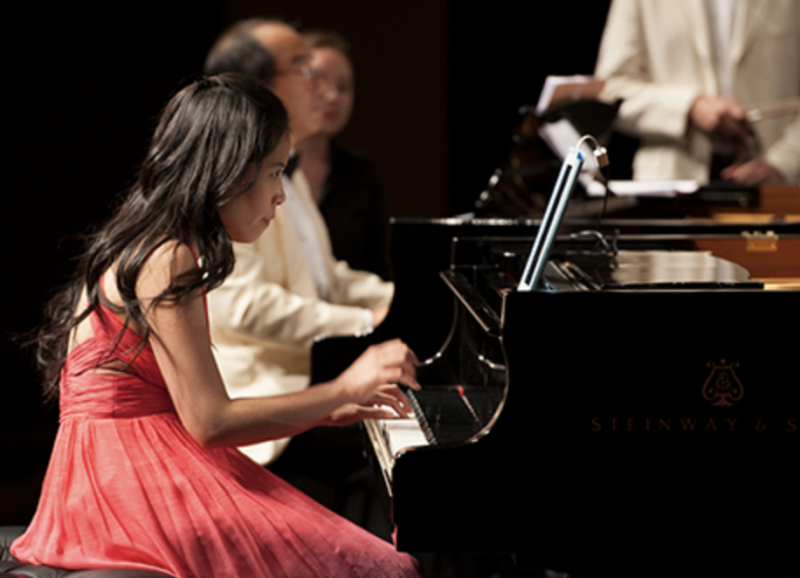
    Screen Shot 2018-05-01 at 5.22.19 PM

    Pianist: Gloria Chien

    The most well-known piece on the program was Arvo Pärt’s Fratres. Mr. Pärt originally composed the work in 1977 and has rearranged it over 15 times for different instrument combinations. While all share a structural chord sequence and something percussive, each one has a slightly different sound. In her speech beforehand, Ms. Randalu shared that Mr. Pärt thought of his music as existing not for a particular timbre or instrument, but in absolute forms – structural music. All four members of the quartet gave a dedicated performance. 

    Mr. K Schumann held the same note for all 10 minutes of the performance, letting everyone blend around and atop his drone. This version of Fratres is more spiritual and less earthy than other versions of the piece. They took the chords slowly, the instruments started in the high harmonics and over the course of the piece moved to the lowest notes through the chord sequence – Mr. M Schumann’s warm cello pizzicato breaking up the sequence. The lack of contrast in this version of the work, makes it much more sparse – perhaps intentional to evoke a choir. While certainly a beautiful work and given a detailed rendering here, it seemed like an odd way to end such an exciting program – perhaps it would have been better served an opener? Nonetheless, it capped another great performance in the CMS New Music Series.

  • Classical Evolution @ Chamber Music Society

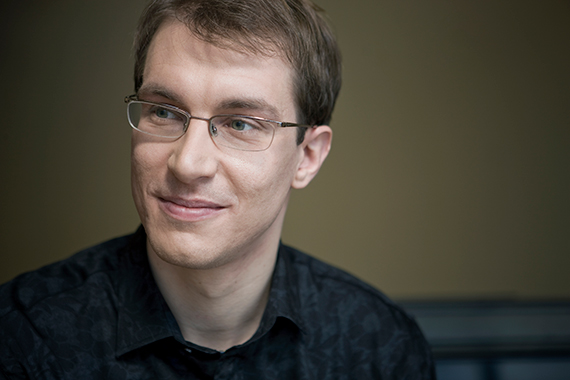
    2aaf32_c2a51dd8031d4d7cab51a39159e29b1e~mv2_d_4048_3215_s_4_2

    Above: Tommaso Lonquich, photographed by Anna Grudinina

    ~ Author: Oberon

    Friday April 27th, 2018 – Chamber Music Society of Lincoln Center brought together clarinet phenomenon Tommaso Lonquich, the outstanding pianist Gilles Vonsattel, and a quartet of sterling string players for an evening of music-making that was by turns stimulating and soothing. Audience distractions were annoying, but the music prevailed.  

    According to one of his students at the time, Mozart wrote his Trio in E-flat major for Clarinet, Viola, and Piano, K. 498, “…on 10 sheets (19 pages)…” in Vienna, dating it August 5, 1786. It’s not clear how the nickname “Kegelstatt” came to be applied to this trio; the word refers to ‘a place where skittles are played’ – skittles in those days referring not to the colorful candies but rather to a nine-pins bowling game which Mozart sometimes enjoyed. At any rate, the name stuck, and thus has the trio come down to us today.

    Home music-making being all the rage in Vienna at the time, the trio was first played at a ‘house concert’ in the von Jacquin family’s residence: Anton Stadler played clarinet, Mozart the viola, and Franziska von Jacquin – a pupil of Mozart’s to whom the piece is dedicated – the piano. The clarinet at that time was only just coming into its own, so an alternate version of the trio with the clarinet part transcribed for violin was also published.

    This evening, clarinetist Tommaso Lonquich joined violist Yura Lee and pianist Gilles Vonsattel for an first-rate performance of this delightful trio. Mr. Lonquich, whose playing made a truly memorable impression when I first heard him in 2015, displayed all the same fascinating qualities of his artistry tonight: prodigious breath-control, a wonderful sense of melodic flow, and a magical finesse of the dynamic range. He and his two colleagues here were very nicely matched, for Mr. Vonsattel’s playing readily displays both verve and nuance – his tapered phrases so elegant – whilst Ms. Lee, ever a joy to encounter, aligned her tonal quality to the clarinetist’s, making their harmonizing especially attractive.

    The Menuetto was particularly enjoyable tonight; after a big start, the music simmers down and the three musicians seemed to vie with one another to see who could play the softest. Then the viola sets up an animated figuration, keeping things lively. Detail-oriented playing from all three – and their keen awareness of one another – put a smile on my face.

    In the concluding Rondeaux: Allegretto, a rolling song sets forth; clarinet and piano sing to one another. Mr. Vonsattel’s summons up sparkling sounds from the Steinway before turning more lyrical. Ms. Lee introduces a viola theme which is passed about and harmonized. Throughout, the dynamic arc keeps the ear on the alert: some glowing pianissimo motifs from the keyboard captured my imagination.

    Mr. Lonquich then took the lead in Carl Maria von Weber’s Quintet in B-flat major, Op. 34 (1811-15), with a stylish string quartet: Erin Keefe, Ida Kavafian, Yura Lee, and Nicholas Cannellakis. Like Adolphe Adam’s score for GISELLE, von Weber’s music is very operatic: one continually imagines a baritone launching a cavatina, or a soprano doling out elaborate roulades in some kind of auf Deutsch mad scene. It is perhaps this operatic connection that makes Weber’s music so appealing to me.

    After a hesitant opening of string chords, the clarinet enters very softly and takes an impressive crescendo on a single note. From here, Mr. Lonquich embarked on his astonishing performance, his tone dulcet in every register, his swift coloratura and dizzyingly accurate scales full of life and light. Cellist Nick Canellakis takes up a theme of ‘vocal’ quality; later, his gorgeous tone will be a steadying element as Mr. Lonquich continues to revel in mad bravura.

    Mr. Canellakis’s somber-sounding cello opens the Fantasia: Adagio ma non troppo, with Mr. Lonquich taking up a poignant melody; there’s heartfelt beauty in his thoughtful measuring out of the tone. Meanwhile, Mr. Canellakis continues to savour each cello passage. Clarinet scales and long, soft phrases develop, and then things come to a halt. The strings play a lament; the clarinet’s re-entry will bring us more delicate scales and whispered pianissimi before the elegant melody is resumed.

    The lively Menuetto features delightful warbling effects from Mr. Lonquich’s clarinet, along with madcap zips up to his high range; in contrast, some ultra-soft playing a bit later hung gorgeously on the air. Erin Keefe’s violin introduces a cordial interlude, followed by the clarinet resuming his fanciful warbling.

    As the concluding Rondo: Allegro giocoso commenced with the rhythm of a gentle galop, I scrawled “A treat!” across my Playbill. Mr. Lonquich sounded forth brightly, the clarinet melody drawing us forward to his spectacular scale-forays to the top before reeling off fantastic passages of fiorature in a marvelous bravura display.

    As the players sailed on their merry way thru this vastly enjoyable music, one sensed a build-up of excitement in the hall: Mr. Lonquich’s virtuosity dazzled, and the crowd’s reaction was a vociferous standing ovation, with the players called out twice as a feeling of sheer joy filled the hall.

    Main

    Following the interval, Mr.Vonsattel (above) returned to the Steinway for a perfectly polished rendering of the Brahms Quintet in F minor for Piano, Two Violins, Viola, and Cello, Op. 34 (1862), with Ms. Kavafian now in the first chair.

    At first we are lulled by a melodious start, but suddenly: drama – a big theme takes over. The string voices come alive: silky violin, mellow viola, rich cello. Mr. Vonsattel, Ms. Kavafian, and Mr. Canellakis play in unison; the piano gets rapturous before a lull, whereupon a hush sets.  Softly Mr. Vonsattel lures in a thread of sound from the violin and a warmer depth from the cello. The music builds to a mysterious dance, with glimmering piano. Intoxicated by the music and the detailed playing, I recalled a state we sometimes achieved back in the Flower-Power era: of being blissed out.

    The gentle start of the Adagio, hampered by thoughtless audience activity, nevertheless made its mark. Lovely harmonies rose, Ms. Lee and Mr. Canellakis mellifluous, with Mlles. Kavafian and Keefe duetting sweetly. The movement concludes with a tender fade-away.

    The Scherzo begins with a low cello pulse, and suddenly a big theme explodes that is both mysterious and passionate. A marziale motif takes over, a paean – to music? to life? – which subsides into a calm interlude. When things re-bound, Mr. Vonsattel at the keyboard turns sprightly as a rise in propulsion takes us to an emphatic end.

    Mr. Canellakis – shall we say here what a simply terrific cellist he is? – commences the concluding movement in a surprisingly sorrowful mood, and Mr. Vonsattel at the piano sounds richly. Now the dancing Rondo commences, veering from impetuous quietness to nervy turbulence. Themes are rewoven, and we are being borne along towards the finish when, at the worst possible moment – and with only a minute of music left to go – someone noisily began unwrapping a snack.

    ~ Oberon

  • Pontus Lidberg’s UNE AUTRE PASSION

    Une_autre_passion_c_gregory_batardon_12

    Photo by Gregory Batardon

    ~ Author: Oberon

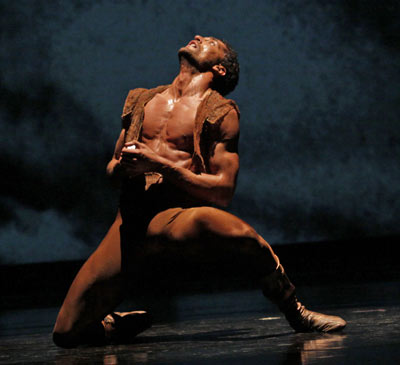
    Tuesday April 24th, 2018 – Ballet du Grand Théâtre de Genève have brought Swedish choreographer Pontus Lidberg’s abstract take on Johann Sebastian Bach’s Saint Matthew Passion – UNE AUTRE PASSION – to The Joyce.

    Pontus’s trademark flowing – and fluent – choreography is beautifully executed by the Geneva dancers, and – needless to say – the music is sublime. The audience seemed literally enthralled by the production, in which some stunning underwater film segments add a striking visual dimension.

    Pontus turns to the classic 1959 Karl Richter recording of the Saint Matthew Passion, featuring the legendary Dietrich Fisher-Dieskau and the no less marvelous Hertha Töpper; the choreographer excludes the recitatives, assembling a soundscape of choruses and arias. He does not attempt a narrative of the story of Christ’s final hours, but rather an abstract essay in movement on the theme of the Passion, full of desire, uncertainty, and consolation.

    At curtain-rise, six tall white panels form a wall at the back of the dancing area. Overhead, shadowy clouds hover and moonlight pierces the gloom. The dancers emerge, all in white: their skirts, trousers, shirts, and tank-tops are not gender-specific. They dance en ensemble.

    The moveable panels become part of the choreography as the dancers slide them about the space; illusions are conveyed when one dancer vanishes behind a moving panel to be replaced by another as the panel slips away. The wall re-forms and the dancers crash into it.

    Now the film begins: white mannequins stand under the water as a nude man swims lyrically among them…could the swimmer be the choreographer himself? From time to time, the film continues throughout the ballet. The mannequins get dis-assembled, and later the ‘lamb of god’ appears to float by in the guise of a stuffed creature.

    The panels are transformed into slides, the dancers sliding down while colleagues dance a stylized ritual; solo passages, and a male ensemble, continue the endless fluidity of movement. A luminous passage shows the dancers in silhouette, like a living frieze. This gives way to a walking motif as groups of dancers cross the space – urgently – in regimented order.

    At the heart of UNE AUTRE PASSION is a pas de deux performed to the great aria ‘Erbarme dich, sung by Ms. Töpper. The couple (I’m sorry to say I am not sure of the dancers’ names) move hypnotically; the woman has a solo and then they are reunited, only to part again. Then the man dances alone, seeking among the moving panels until he finds her again. 

    Now one by one the dancers remove their outer garments. The movement is stylized, filled with gestures of supplication. From solo and duet phrases, the dancers slowly assemble, lying in a row upon the floor along the side of the space. The panels are then formed into a wall, enclosing the bodies. A single man now seeks entry into this repository of souls; a second man prevents him, and their duet becomes yet another memorable passage in this deeply moving ballet. 

    The dancers re-assemble in a swaying motion; a male solo follows as the music becomes a hymn. The voice of Dietrich Fisher-Dieskau fills the space as we wait breathlessly to see how this Passion will conclude. The wall now stands along stage left, and the dancers approach it – at first walking, then running, then rushing. They pound on the surface, pray before it, collide with it, collapse at its feet: but the wall remains impenetrable.

    “We are living through a very hard time, our gift is to be alive,” said Pontus Lidberg in an interview during the creation of UNE AUTRE PASSION. In this ballet, Bach’s immortal music and the poetry of the dance that it has evoked feel like an affirmation of life: a refuge of beauty in a darkening world.

    The ballet ends with a naked man standing before the paneled wall. Has he been shut out of heaven, or does his vulnerable presence mark the dawn of a new day, freed of the hypocrisy, hatred, and oppression that have undermined the great religions?

    ~ Oberon

  • Pontus Lidberg’s UNE AUTRE PASSION

    Une_autre_passion_c_gregory_batardon_12

    Photo by Gregory Batardon

    ~ Author: Oberon

    Tuesday April 24th, 2018 – Ballet du Grand Théâtre de Genève have brought Swedish choreographer Pontus Lidberg’s abstract take on Johann Sebastian Bach’s Saint Matthew Passion – UNE AUTRE PASSION – to The Joyce.

    Pontus’s trademark flowing – and fluent – choreography is beautifully executed by the Geneva dancers, and – needless to say – the music is sublime. The audience seemed literally enthralled by the production, in which some stunning underwater film segments add a striking visual dimension.

    Pontus turns to the classic 1959 Karl Richter recording of the Saint Matthew Passion, featuring the legendary Dietrich Fisher-Dieskau and the no less marvelous Hertha Töpper; the choreographer excludes the recitatives, assembling a soundscape of choruses and arias. He does not attempt a narrative of the story of Christ’s final hours, but rather an abstract essay in movement on the theme of the Passion, full of desire, uncertainty, and consolation.

    At curtain-rise, six tall white panels form a wall at the back of the dancing area. Overhead, shadowy clouds hover and moonlight pierces the gloom. The dancers emerge, all in white: their skirts, trousers, shirts, and tank-tops are not gender-specific. They dance en ensemble.

    The moveable panels become part of the choreography as the dancers slide them about the space; illusions are conveyed when one dancer vanishes behind a moving panel to be replaced by another as the panel slips away. The wall re-forms and the dancers crash into it.

    Now the film begins: white mannequins stand under the water as a nude man swims lyrically among them…could the swimmer be the choreographer himself? From time to time, the film continues throughout the ballet. The mannequins get dis-assembled, and later the ‘lamb of god’ appears to float by in the guise of a stuffed creature.

    The panels are transformed into slides, the dancers sliding down while colleagues dance a stylized ritual; solo passages, and a male ensemble, continue the endless fluidity of movement. A luminous passage shows the dancers in silhouette, like a living frieze. This gives way to a walking motif as groups of dancers cross the space – urgently – in regimented order.

    At the heart of UNE AUTRE PASSION is a pas de deux performed to the great aria ‘Erbarme dich, sung by Ms. Töpper. The couple (I’m sorry to say I am not sure of the dancers’ names) move hypnotically; the woman has a solo and then they are reunited, only to part again. Then the man dances alone, seeking among the moving panels until he finds her again. 

    Now one by one the dancers remove their outer garments. The movement is stylized, filled with gestures of supplication. From solo and duet phrases, the dancers slowly assemble, lying in a row upon the floor along the side of the space. The panels are then formed into a wall, enclosing the bodies. A single man now seeks entry into this repository of souls; a second man prevents him, and their duet becomes yet another memorable passage in this deeply moving ballet. 

    The dancers re-assemble in a swaying motion; a male solo follows as the music becomes a hymn. The voice of Dietrich Fisher-Dieskau fills the space as we wait breathlessly to see how this Passion will conclude. The wall now stands along stage left, and the dancers approach it – at first walking, then running, then rushing. They pound on the surface, pray before it, collide with it, collapse at its feet: but the wall remains impenetrable.

    “We are living through a very hard time, our gift is to be alive,” said Pontus Lidberg in an interview during the creation of UNE AUTRE PASSION. In this ballet, Bach’s immortal music and the poetry of the dance that it has evoked feel like an affirmation of life: a refuge of beauty in a darkening world.

    The ballet ends with a naked man standing before the paneled wall. Has he been shut out of heaven, or does his vulnerable presence mark the dawn of a new day, freed of the hypocrisy, hatred, and oppression that have undermined the great religions?

    ~ Oberon

  • More From The Lubovitch 50th @ The Joyce

    Othello Migdoll

    Above: The Joffrey Ballet’s Fabrice Calmels in Lar Lubovitch’s Othello; photo by Herbert Migdoll

    ~ Author: Oberon

    Saturday April 21st matinee – Continuing the celebration of the 50th anniversary of the Lar Lubovitch Dance Company at The Joyce, four dancers from The Joffrey flew in to perform excerpts from Lar’s 1997 full-length ballet, Othello, while Lubovitch Company members offered three distinctively different works by the choreographer. It was a first-rate afternoon of dance all round.

    Little Rhapsodies (dating from 2007) is a gem of a dancework: to the delightful Symphonic Études, Opus 13, of Robert Schumann, three men – Jonathan Emanuell Alsberry, Reed Luplau, and Benjamin Holliday Wardell – trade solos and dance in unison.

    At curtain rise, the dancers are seen in silhouette. They dance together, in a folkish vein. Then the solos begin: Mr. Wardell is a gorgeous and expressive mover; the ever-brilliant Mr. Alsberry is winningly whimsical and blithely balletic; and Mr. Luplau with a lightness of touch, breezy turns, and copious charisma. Music and movement are happily meshed in a pas de trois, followed by more solos: Mr. Wardell something of a revelation; Mr. Luplau amazingly swift, sure, and supple; Mr. Alsberry effortlessly combining the dynamic and the lyrical. The trio dance on to a fun finish.

    Dance companies worldwide should snap up Little Rhapsodies: a perfect ballet to show off the male virtuosos on your roster.

    Othello: A dance in three acts is Lar Lubovitch’s 1997 full-length ballet, choreographed to a score by Elliot Goldenthal. In excerpts from Act III, guest artists Fabrice Calmels, Victoria Jaiani, Temur Suluashvili, and Rory Hohenstein of the Joffrey Ballet danced the final pages of the tragedy with a compelling sense of theatre.

    In a claustrophobic black chamber, Mr. Calmels’ downcast, glowering Moor sits on his black throne. The supplicant Cassio (Mr. Hohenstein, his hands bound) and the conniving Iago (Mr. Suluashvili) get under his skin whilst the incredibly lovely and vulnerable Ms. Jaiani as Desdemona seems unaware of her impending doom. The chilly music says it all. 

    Ms. Jaiani has a solo, her en pointe dancing a vision of grace. Mr. Calmels, his towering stature taking over the stage, displays the anguish of his mixed emotions. In a love/hate duet, he caresses his wife one moment and seems repulsed by her the next.

    Photo by Cheryl Mann

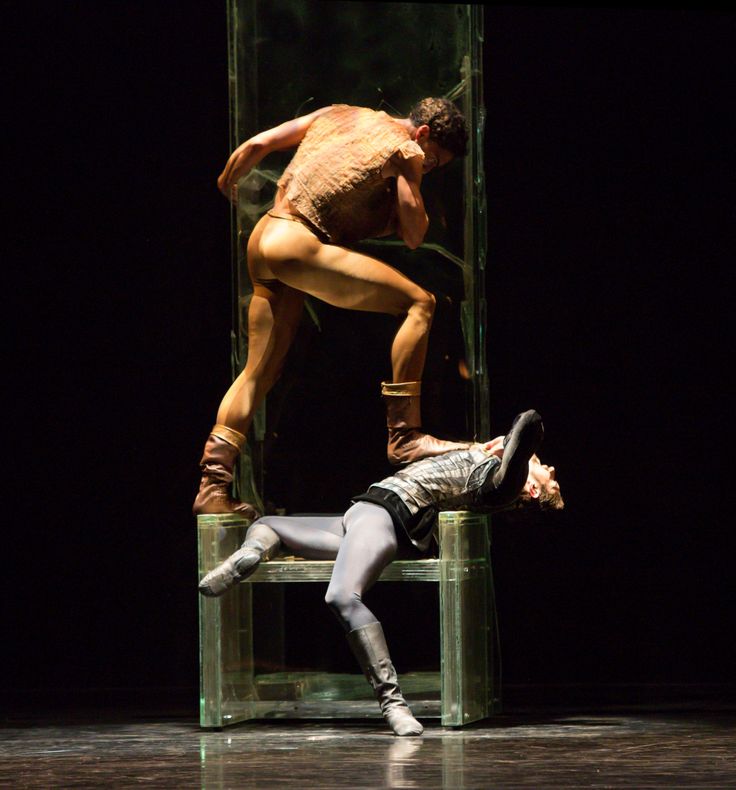
    Mr. Suluashvili’s handsome, conniving Iago now continues his machinations to about bring about Othello downfall: in their dramatic scene, Mr. Calmels leaps onto the arms of his throne as Suluashvili’s Iago cowers beneath the Moor’s wrath (above, in a Cheryl Mann photo). Then the fatal handkerchief is produced. In this scene, composer Elliot Goldenthal makes marvelous use of the saxophone.

    Eerie music accompanies Ms. Jaiani’s return as Desdemona. Then the composer conjures up an ominously cinematic setting for the final combat between husband and wife. Othello quickly prevails, and – true to Shakespeare’s immortal words – ‘I kissed thee ere I killed thee’ passionately kisses Desdemona as he strangles her with the handkerchief.

    As the four Joffrey dancers received resounding applause, I was recalling my only previous encounter with the Jaiani/Calmels partnership: they danced in Edwaard Liang’s Woven Dreams at Fall for Dance in 2011. They were splendid then, and splendid today.

    Something About Night, Lar’s newest creation, was premiered earlier in the week. I liked the piece a lot at its first performance but, as so often happens, a second viewing today made an even stronger impression. The gently ecstatic duet for Nicole Corea and Tobin Del Cuore really cast a spell today, and Brett Perry’s solo was nothing less than sublime. Belinda McGuire and Barton Cowperthwaite had less to do than I might have wished, but Barton still had Men’s Stories ahead of him, wherein his performance brought down the house. 

    Men's Stories  Photo by Nan Melville 7002Mens-659_preview

    Men’s Stories: A Concerto in Ruin (above, in a Nan Melville photo) closed the performance on a mighty note. The cast was the same as that of the opening night, and they all outdid themselves. Stunningly-danced solos by Reed Luplau, Jonathan Emanuell Alsberry, Anthony Bocconi, and Barton Cowperthwaite – and an epic performance from Benjamin Holliday Wardell – kept the level of excitement sky-high, whilst Colin Fuller, Matthew McLaughlin, Brett Perry, and Lukasz Zięba all looked great and danced their hearts out.

    The poignant, darkling, magically masculine world of Men’s Stories kept the audience in a rapt state of involvement, its musical mélange endlessly evocative. As waves of applause swept thru the house, the dancers took several bows before Mr. Lubovitch joined them onstage to a barrage of cheers. Happy 50th, Lar!!

    Friends and fans gathered on the lower level after the show; I loved seeing Gabrielle Lamb again, having a long chat with Nicole Corea, meeting Fabrice Calmels, and congratulating JJ, Barton, Reed, and Brett. When Mr. Lubovitch quietly walked thru the backstage door, the crowd burst into spontaneous applause. 

    ~ Oberon

  • Richard Goode @ Alice Tully

    ~Author: Scoresby

    Tuesday April 17 2018 – Oddly, I have never had the chance to hear the pianist Richard Goode before. While a seminal figure in the American piano scene, I always seemed to not be able to make his performances. Thus, I was grateful to hear him live first on Lincoln Center’s Great Performers Series in program that ran in chronological order (spare the encore) over 300 years of music history.

    The program opened with the Second and Third Pavians and Galliardes from Byrd’s My Ladye Nevells Booke of Virginal Music. While stunning music due to Mr. Goode’s pinpoint articulation – I couldn’t help but feel a layer was missing from the music by hearing it on the piano. The many trills and ornaments sound far heavier on a piano. Nonetheless Mr. Goode highlighted the harmonic progressions and layered the voicing so the audience could always hear the melody through those ornaments. In the Second Pavian, Mr. Goode let the large groupings of arpeggios having a flowing sound – he crafted melodic line to be joyous and full of energy. In the Galliarde to the Second Pavian, Mr. Goode loosened some and let the music have a more spontaneous feel, but still captured the dance form.

    The second work on the program was Bach English Suite No.6 in D minor, BWV 811. In the opening Prelude, Mr. Goode seemed to have an improvisatory feel to the music – a lot less structured than the Byrd earlier. As the prelude turned into a fugal section, Mr. Goode seemed to eschew the carefree style for rigid structured and lucidity. It was a wonderful transition that let him highlight the quiet beauty in the inner voices and left hand of this denser section. As the prelude escalated in intensity, he took advantage of the piano’s wide dynamic range to let it boom like an organ. Mr. Goode took a brisker pace for the later movements. This worked particularly well in the charming Gavotte I and II. With the speed of the trills and folk-like allure, the Bach seemed to echo the Byrd from earlier. This seemed quite intentional every part of the program seemed to be strung together with a few different ideas. In the speedy Gigue that ends the suite, Mr. Goode seemed to at once capture the rhythm and get into a more dancelike idiom. His left hand’s clarity is rare in a pianist and he used it to build the intensity in each of the scales, adding drama to this finale. Despite having a light touch to the keys, Mr. Goode seemed to be able to build a large sound without sacrificing clarity.

    Screen Shot 2018-04-23 at 4.44.32 PM

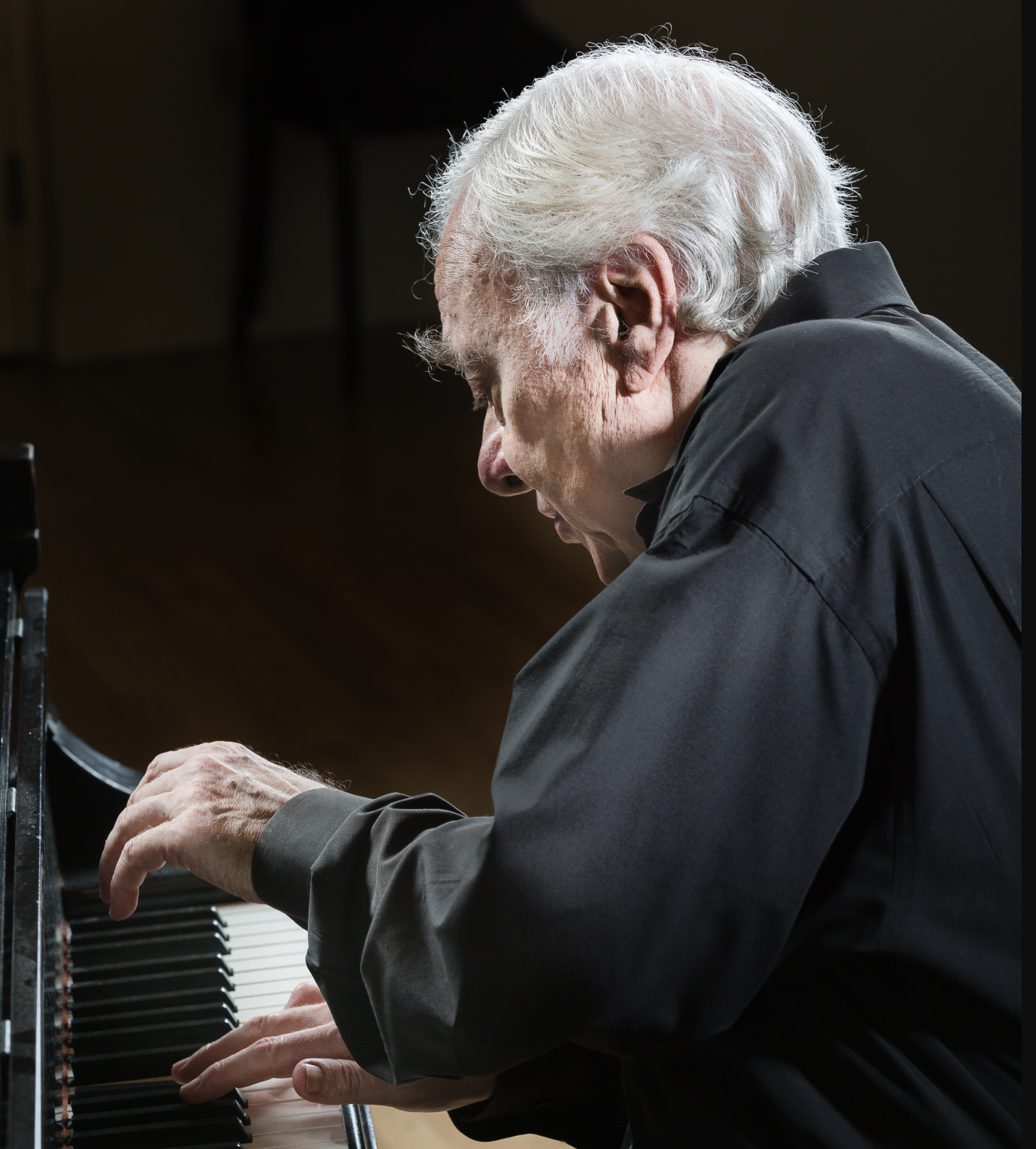
    Above: Pianist Richard Goode; photo credit: Steve Riskind

    The highlight of the program was hearing Mr. Goode’s interpretation of Beethoven Sonata No. 28 in A major, Op. 101. Mr. Goode was the first American pianist to record all 32 of Beethoven’s sonatas; his expertise in the music showed this evening. Mr. Goode’s style of playing seems to revolve around painting the exacting structure of the music, so in the Beethoven he eschewed some of the more sentimental elements of the work to do this. While I personally find it sometimes a bit cold, it is interesting to hear a fresh and insightful interpretation.  In the lyrical opening, Mr. Goode seemed to take a straightforward approach that pushed the music along. At first he kept his playing quiet and measured, but he seemed to emphasize the expansions into different registers and bell-like chords that appear littered through the work. While some pianists use these chords as a simple break, Mr. Goode made sure that each time they appeared they were a harmonic feature that drove the piece. Similarly as the first movement unfolded, he let the left hand’s drone sing clearly.

    The second movement is famous for its odd Schumann-esque march. Mr. Goode let the driving rhythmic structures take precedent, echoing the bell-like motif from the first movement. He also made sure all the jazzy riffs had spunk to them, which echoed the Debussy to come. The most fun part of the night was during the giant fugue that ends the work. Mr. Goode managed to make the exciting fugue have pristine clarity, only to be quiet in to the romantic opening of the piece. The humorous coda at the end of the work seemed to have a few audiences members smiling as he finished.

    The final work on the program (after intermission) were the Debussy Préludes, Book 2. Mr. Goode’s interpretation, while beautifully played, felt a little too monotone for my taste. Nonetheless, in the third image La puerta del vino, he managed to capture both the Spanish rhythms and bursts of different colors. The Ondine suited his style of playing well, letting each of the arpeggios ripple through with exacting phrasing. He capture the eccentricity of Hommage à S. Pickwick Esq. P.P.M.P.C., getting an earthier, Rachmaninoff- sort of sound. The tinkling of the folksy dance and humor during the contrasting section of the work harkened back to the Barqoue works earlier. It is clear that Mr. Goode manages to unify his programs by highlighting the common strands between works.

    The audience seems to love Mr. Goode, giving him a hearty ovation following the exciting Feux d’artifice. After all the applause Mr. Goode played an extended encore: Chopin Barcarolle in F-sharp major, Op. 60. While the perfect closing piece for the program (according to Mr. Goode’s remarks the Barcarolle was a favorite of Debussy’s) and a pleasurable indulgence it felt a little long-winded to add on to the end of the performance. Nonetheless, Mr. Goode’s playing was just as thoughtful and free as earlier, closing the recital on a high-note.

  • Petrenko|Bayerisches Staatsorchester @ Carnegie Hall

    CH1375937

    Above: Kirill Petrenko on the Carnegie Hall podium; photo by Chris Lee

    ~ Author: Ben Weaver

    Wednesday March 28th, 2018 – Kirill Petrenko is finishing his term as the Generalmusikdirector of the Bavarian State Opera and in the 2019-20 season will take over as the chief conductor of the world’s most prestigious orchestra, Berlin Philharmonic. It is with the Bavarian State Opera forces (in the concert hall dubbed Bayerisches Staatsorchester) that Petrenko is making his Carnegie Hall debut this season. His only previous NYC appearances were at the Metropolitan Opera where he led a very memorable revival of Ariadne auf Naxos in 2005 and Khovanschina in 2012. For this Carnegie debut concert, Petrenko programmed two oft-forgotten works by two very famous composers: Johannes Brahms’ Double Concerto and Pyotr Tchaikovsky’s Manfred Symphony.

    Brahms composed the Concerto for Violin, Cello and Orchestra, Op. 102, in 1887. It was his last orchestral composition and it was greeted coolly even by ardent supporters like Eduard Hanslick. Soon Brahms himself was dismissing it as “folly” in letters to Clara Schumann. Neglected for many years, it certainly deserves to be heard more often; it surrenders nothing to his famed violin concerto in inspiration, melody and excitement. The writing may not seem as virtuosic as the violin concerto perhaps because Brahms composed a truly double concerto. The two instruments don’t have the kind of virtuosic writing that concertos often do. The music is more of a dialogue for violin and cello – and orchestra, too. It takes a great deal of camaraderie between the two soloists and conductor to bring the pieces together. Maybe it’s the lack of true star turns for the soloists that keeps some musicians away. But when played as superbly as it was by Julia Fischer and Daniel Müller-Schott, with Maestro Petrenko on the podium, the results are breathtaking.

    CH1375954

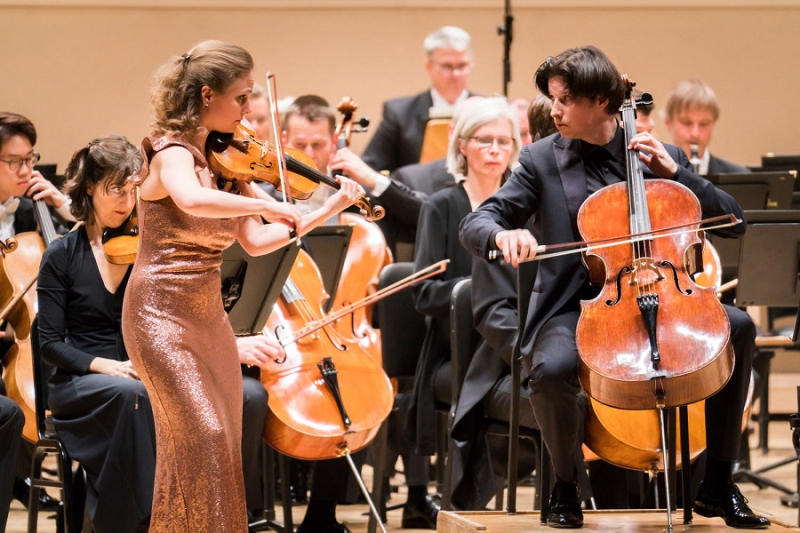
    Above: Julia Fischer and Daniel Müller-Schott playing the Brahms Double Concerto, with Maestro Petrenko; a Chris Lee photo

    The work begins with a dramatic and brief orchestral opening and immediately the cello launches into an extended solo. One of the few passages of this kind in the work, Müller-Schott immediately established himself as an artist. Rich and velvety notes poured from the instrument. Julia Fischer, a former child prodigy who has grown into a true artist of the violin, soon joined in for one of the concerto’s many extended conversations between the two instruments. Ms. Fischer’s sound is delicate and sweet, the notes rolling effortlessly from her bow. Fischer and Müller-Schott have collaborated many times over the years. Their discography together includes a lot of chamber music, as well as the Brahms concerto. Their musical partnership came across beautifully in the performance, whether playing in unison or handing off music back and forth, it’s the sort of relationship that takes time to develop. The hushed, pastoral-ish second movement was wondrous and the Bohemian inspired dances of the Finale were perfect. Maestro Petrenko and the superb Bayerisches Staatsorchester forces were excellent partners.

    Ms. Fischer and Mr. Müller-Schott gave an encore: an extended virtuoso piece: Passacaglia by Johann Halvorsen. It was really great!

    CH1375936

    Above: Julia Fischer and Daniel Müller-Schott, photo by Chris Lee

    Tchaikovsky’s largest orchestral work, the Manfred Symphony was composed in 1885, between his more famous 4th and 5th Symphonies. Inspired by Byron’s poem (Schumann composed a famous overture based on it as well), Tchaikovsky – already master of the large orchestral forces – outdid himself with sheer size of forces needed, including a harmonium (typically replaced by an organ in performances and recordings.) Initially Tchaikovsky considered it to be his finest composition, but after a mixed reception from critics and the public, in what was a common refrain of his life, turned on it and declared it awful; even considered destroying everything but the first movement. Fortunately his instinct to burn it did not come to pass because it is certainly one of his greatest works. And I often think it may be his greatest symphony.

    What I find astonishing about the Manfred Symphony is the sheer amount of invention – melodic and orchestration. In some ways it reminds me of Verdi’s Falstaff. Some complain that Verdi’s last opera is lacking in melody, but it might actually contain more melodies than all of his other works combined. They simply fly by and disappear so quickly that one can fail to notice. That’s my view of Tchaikovsky’s Manfred. The melodies and brilliant orchestration can be so sudden, so novel and so brief that it’s all gone and moved on to something else entirely before you realize what you just heard. It is truly a work that demands repeated hearings.

    The dark first movement depicts Manfred’s anguished wanderings in the Alps; “His life shattered…”, as the program note (by Mily Balakirev) describes. With halting phrases, Tchaikovsky depicts a peaceful pastoral one moment, Manfred’s pain the next. The explosive climax – one of Tchaikovsky’s most beautiful melodies – is hair-raising. I often hear it as a perfect musical accompaniment to the moment in Wuthering Heights where Heathcliff is found dead in Catherine’s room, thunder and lightning blaring outside. The two middle movements are, by contrast, blasts of light. The light fairy music of the Scherzo (in the program a fairy of the Alps appears to Manfred splashing in a waterfall) would have pleased Mendelssohn, I think. The slow third movement presents a portrait of a peaceful nature, something Beethoven would have recognized perhaps. And in the final movement, again a darkness descends. The music swirls and growls as Manfred visits the caves of Arimanes. And the anguished love theme from the first movement returns to signal Manfred’s death – greeted with an organ playing a hymn.

    The forces of the Bayerisches Staatsorchester played the work superbly. Kirill Petrenko led an all-around thrilling performance, goading the players to play bigger and louder (I was reminded of the famous story of Richard Strauss rehearsing Elektra and yelling to the players: “Louder, louder! I can still hear Madam Schumann-Heink!”) But effortlessly bringing volume and emotion down to a whisper when needed as well. Though Manfred has long been neglected (many complete recorded cycles of Tchaikovsky’s symphonies do not include it), over the past few years it has been heard in NYC several times. New York Philharmonic played it with Semyon Bychkov (one of Petrenko’s mentors) and Vienna Philharmonic played it at Carnegie with Valery Gergiev. Perhaps Maestro Bychkov’s performance was bigger. The NY Philharmonic’s heavier sound might account for the bigger bombast. Bayerisches Staatsorchester has a leaner, more pointed sound overall. It provided greater transparency in the more heavily orchestrated parts (and there are many.) Personal tastes will vary on the preferred sound. But no doubt Kirill Petrenko led a superb night of music-making. His future with the Berlin Philharmonic is very exciting.

    CH1375935

    Above: Kirill Petrenko and the musicians of the Bayerisches Staatsorchester acknowledge the applause at the close of this evening’s concert; photo by Chris Lee

    ~ Ben Weaver

  • YCA Presents Flautist Anthony Trionfo

    Anthonyhiresmattdine3

    Above: Anthony Trionfo, photographed by Matt Dine

    ~Author: Oberon

    Wednesday March 28th, 2018 – Young Concert Artists presenting flautist Anthony Trionfo at Merkin Hall. Mr. Trionfo is a musician of prodigious talent and scintillating personality; along with the excellent pianist Albert Cano Smit and a quartet of string players, he offered a wide-ranging, adventurous program combining the familiar, the rare, and the new.

    Gabriel Fauré‘s Fantasy in E minor, Op. 79, opened the evening. Mr. Trionfo’s shining tone and his feel for the sensuous undercurrents of the opening Andantino gave way, in the Allegro, to florid passages of crystalline coloratura. Mr. Cano Smit was the ideal partner here, his playing impeccably tailored, his seriousness of intent and commitment most welcome in such a young artist. 

    Returning alone to the stage, Mr. Trionfo gave a superbly confident performance of J.S. Bach’s Partita in A minor, BWV 1013. In this suite of dances, the flautist showed great subtlety and a multi-hued timbre that kept the music ever-alive. The Courante had a feel of birdsong, the Sarabande a forlorn air of touching simplicity. In the concluding Bourrée anglaise, the playing was light-filled and lovely.

    The New York premiere of drip/spin by Katherine Balch, the 2017 YCA Composer-in-Residence, was prefaced by Mr. Trionfo’s remarks about the ‘dew-drop necklace’ – silk threads and mucus droplets – with which the glow-worm attracts and entraps its prey. The perpetual motion of the piano part seems to envision the spinning toils of the glow-worm, whilst the sighs and blips from the flute depict the unsuspecting victim. Some of the piano keys have been ‘prepared’, adding a ghostly quality. The flute lingers on high, until an energy drain occurs. Then the piano begins a rolling motif; in its death throes, the preyed-upon flute goes wild, with harsh accents that finally sputter out.

    Al21165

    For the Chant de Linos by André Jolivet, a string quartet comprised of Mélanie Genin (harp), Aleksey Semenenko (violin), Ida Kavafian (viola) and Sang-Eun Lee (cello) joined Mr. Trionfo onstage. André Jolivet (1905-1974) composed this work on commission from the Paris Conservatoire in 1944 as a compulsory test piece for competitors in the Solo de Concours; the prize was won that year by Jean-Pierre Rampal. The work is a threnody (or lament to the dead) inspired by the story of Linos, son of Apollo. Linos taught Orpheus to play the lyre, and he was later killed by Heracles for criticizing him too much. André Jolivet was a composer inspired by the legends from antiquity; he wrote many chamber music works, eleven concertos, as well as orchestral and vocal music.

    The rich yet transparent textures of the strings are quite contemporary in sound yet they evoke a distant, mythic past. A dreamy passage for flute and harp draws us in; the music can veer from lyrical to explosive in the twinkling of an eye. A subtle flute solo leads to a darkish dance played by all. Things get a bit woozy before turning to lament; following a cadenza, the music dances onward with the flute trilling and piping. What a great idea to program this ensemble piece tonight: a wonderful opportunity to hear this music, and so beautifully played.  

    Albert cano smit

    Above: pianist Albert Cano Smit

    A fascinating performance of Lowell Liebermann’s Sonata for flute and piano, Op. 23, followed the interval. The opening Lento con rubato soon wraps us in the strange beauty of its misterioso atmosphere. Delicate sounds from the piano’s upper register are followed by a big outburst which subsides into ghostliness. Single notes struck by the pianist underscore a sinuous flute motif; then the flute sound turns big and piercing. Rippling piano figurations summon the flautist back to song, a gentle flow becoming a percolation. The haunting melody returns in all is mystery, and Mr. Trionfo’s flute makes a final ascent to a remarkably sustained note that tapers away.

    In the ensuing Presto energico, there is much bouncy, lively coloratura from the flute which Mr. Trionfo conveyed brilliantly, with lots of body English; meanwhile the piano writing is animated…almost wild. The music sails forward, with virtuosic playing from Mr. Cano Smit whilst Mr. Trionfo spins high flourishes with his flute. This work drew a very warm audience response, with the composer taking a bow to waves of enthusiasm.

    Ian Clark’s Zoom Tube again gave Mr. Trionfo the opportunity to demonstrate some of the various sound effects his flute could produce…like the Balch, but more extroverted and pop-oriented. He sometimes seemed to be producing two different sounds at the same time, ‘speaking’ or blowing air, playfully jazzing things up, even emitting a whooping scream at one point.

    Mr. Trionfo’s arrangement of the traditional Carnival of Venice provided an immensely enjoyable showcase for his virtuosity. After a captivating trill, the flautist embarked on a series of variations on the familiar tune: the blues, bel canto, jazz, a Latin lilt, ‘Casta diva‘, and on and on. Mr. Cano Smit was the perfect accomplice in this imaginative tour de force as the two players kept the audience thoroughly engaged with their technical dazzle and well-contrasted personalities.

    As an encore, Mr. Trionfo offered Debussy’s Syrinx, ending on a sustained, gossamer pianissimo.

    ~ Oberon

  • CMS Winter Festival 2018 – #3

    Shanghai-Quartet-Header

    Above: the Shanghai Quartet

    ~ Author: Oberon

    Tuesday March 27th, 2018 – The last concert of Chamber Music Society of Lincoln Center‘s Winter festival, entitled Chamber Music Vienna.

    Ignaz Schuppenzigh (1776-1830) is credited with pioneering the ‘chamber music series’. Schuppenzigh was a violinist and a friend of Beethoven who presented over a hundred chamber music concerts in Vienna between 1823 and 1828. Works of Haydn, Mozart, and Beethoven were prominently featured in the programming, and it is precisely those three composers whose music we heard this evening.

    But tonight’s concert had a deeper significance, for it duplicated exactly the program Schuppenzigh offered in Vienna on March 26th, 1827 – the very day that Beethoven passed away. In fact, it has been determined that the moving Largo con espressione from Beethoven’s Trio in G major, Op. 1, No, 2, was being played the exact time of the great man’s passing. 

    The Shanghai Quartet opened this evening’s concert with Haydn’s Quartet in G major for Strings, Hob. III:81, Op. 77, No. 1 (1799). The Shanghai have their own distinctive sound, cool and concise, suited well to both their Haydn and Mozart offerings on this program.

    The opening movement of the G major quartet, marked Allegro moderato, has a feeling of perpetual motion, somewhere between a march and a dance. There are ingratiating modulations and the writing is quite florid. By contrast, the Adagio, with its unison opening, has an almost operatic feeling. Courtly, and with gracious harmonies, the first violin sings forth and then engages in a duet with the deepening cello. Rising modulations – with the cello ever-prominent – bring a da capo which, with varying harmonics, reaches an emotional level I don’t often feel in Haydn’s music. The Shanghai made much of this movement’s sheer beauty.

    The Minuet has the genuine air of a scherzo; it’s fun, with swirls of notes carrying the violin on high. The swift, unison start of the Finale: Presto brings some very nimble playing from the Shanghai’s 1st violinist, Weigang Li; the music becomes genuinely exhilarating.

    Next came Mozart: his Quartet in D-major for Strings, K. 575, is one of the “Prussian” quartets (dating from 1789) and as such features the cello as a nod to the cello-playing king, Friedrick Wilhelm II. In the opening Allegretto, it is the cello that presents the second theme; here, and throughout the piece, the Shanghai’s Nicholas Tzavaras shone.

    While the Andante clearly showcases the cello, Mozart doesn’t shirk on opportunities for the violist – Honggang Li – or the violins, Weigang Li and Yi-Wen Jiang. Mr. Tzavaras is really in his element with the melodies, and at one point a matched phrase is passed from voice to voice. Quite inventive.

    Following the light, jesting feeling of the Menuetto (Allegretto), the concluding Allegretto‘s theme takes the cello to its high register. A decorative canon pops up before we reach the finale. 

    785535479-ludwig-van-beethoven-central-cemetery-tomb-vienna-austria

    Above: Beethoven’s tomb in Vienna’s Central Cemetary

    The evening ended with Beethoven’s Trio in G major for Piano, Violin, and Cello, Op. 1, No. 2. Pianist Gilbert Kalish, violinist Arnaud Sussmann, and cellist Paul Watkins took the stage for a first-rate performance of this work from a still-young composer.

    Following a slow introduction, in which the lovely blend of the strings and the stylish Steinway work of Mr. Kalish heralded delights to come, the first movement goes Allegro in quite a lively, sometimes folkish manner. The writing has its witty aspects, but the two women in front of us decided they’d never heard anything so hilarious, and they struck up a running conversation, laced with chuckles. Shushing was to no avail.

    Arnaud Sussmann’s absolutely gorgeous tone made a glowing impact in the Largo con espressione, inter-weaving with the bounteous beauty of Mr. Watkins’s cello to irresistible effect as refined romance bloomed from the keyboard. This Largo is considered to be Beethoven’s first great slow movement.

    Following the Scherzo, which bounces from major to minor and back, light-weight agitation marks the Finale: Presto. One violin motif seems like a pre-echo from Rossini’s GUILLAUME TELL overture. With its rhythmic vitality and breezy, devil-may-care lilt, the Presto comes to a vivacious end.

    ~ Oberon

  • CMS Winter Festival 2018 – #3

    Shanghai-Quartet-Header

    Above: the Shanghai Quartet

    ~ Author: Oberon

    Tuesday March 27th, 2018 – The last concert of Chamber Music Society of Lincoln Center‘s Winter festival, entitled Chamber Music Vienna.

    Ignaz Schuppenzigh (1776-1830) is credited with pioneering the ‘chamber music series’. Schuppenzigh was a violinist and a friend of Beethoven who presented over a hundred chamber music concerts in Vienna between 1823 and 1828. Works of Haydn, Mozart, and Beethoven were prominently featured in the programming, and it is precisely those three composers whose music we heard this evening.

    But tonight’s concert had a deeper significance, for it duplicated exactly the program Schuppenzigh offered in Vienna on March 26th, 1827 – the very day that Beethoven passed away. In fact, it has been determined that the moving Largo con espressione from Beethoven’s Trio in G major, Op. 1, No, 2, was being played the exact time of the great man’s passing. 

    The Shanghai Quartet opened this evening’s concert with Haydn’s Quartet in G major for Strings, Hob. III:81, Op. 77, No. 1 (1799). The Shanghai have their own distinctive sound, cool and concise, suited well to both their Haydn and Mozart offerings on this program.

    The opening movement of the G major quartet, marked Allegro moderato, has a feeling of perpetual motion, somewhere between a march and a dance. There are ingratiating modulations and the writing is quite florid. By contrast, the Adagio, with its unison opening, has an almost operatic feeling. Courtly, and with gracious harmonies, the first violin sings forth and then engages in a duet with the deepening cello. Rising modulations – with the cello ever-prominent – bring a da capo which, with varying harmonics, reaches an emotional level I don’t often feel in Haydn’s music. The Shanghai made much of this movement’s sheer beauty.

    The Minuet has the genuine air of a scherzo; it’s fun, with swirls of notes carrying the violin on high. The swift, unison start of the Finale: Presto brings some very nimble playing from the Shanghai’s 1st violinist, Weigang Li; the music becomes genuinely exhilarating.

    Next came Mozart: his Quartet in D-major for Strings, K. 575, is one of the “Prussian” quartets (dating from 1789) and as such features the cello as a nod to the cello-playing king, Friedrick Wilhelm II. In the opening Allegretto, it is the cello that presents the second theme; here, and throughout the piece, the Shanghai’s Nicholas Tzavaras shone.

    While the Andante clearly showcases the cello, Mozart doesn’t shirk on opportunities for the violist – Honggang Li – or the violins, Weigang Li and Yi-Wen Jiang. Mr. Tzavaras is really in his element with the melodies, and at one point a matched phrase is passed from voice to voice. Quite inventive.

    Following the light, jesting feeling of the Menuetto (Allegretto), the concluding Allegretto‘s theme takes the cello to its high register. A decorative canon pops up before we reach the finale. 

    785535479-ludwig-van-beethoven-central-cemetery-tomb-vienna-austria

    Above: Beethoven’s tomb in Vienna’s Central Cemetary

    The evening ended with Beethoven’s Trio in G major for Piano, Violin, and Cello, Op. 1, No. 2. Pianist Gilbert Kalish, violinist Arnaud Sussmann, and cellist Paul Watkins took the stage for a first-rate performance of this work from a still-young composer.

    Following a slow introduction, in which the lovely blend of the strings and the stylish Steinway work of Mr. Kalish heralded delights to come, the first movement goes Allegro in quite a lively, sometimes folkish manner. The writing has its witty aspects, but the two women in front of us decided they’d never heard anything so hilarious, and they struck up a running conversation, laced with chuckles. Shushing was to no avail.

    Arnaud Sussmann’s absolutely gorgeous tone made a glowing impact in the Largo con espressione, inter-weaving with the bounteous beauty of Mr. Watkins’s cello to irresistible effect as refined romance bloomed from the keyboard. This Largo is considered to be Beethoven’s first great slow movement.

    Following the Scherzo, which bounces from major to minor and back, light-weight agitation marks the Finale: Presto. One violin motif seems like a pre-echo from Rossini’s GUILLAUME TELL overture. With its rhythmic vitality and breezy, devil-may-care lilt, the Presto comes to a vivacious end.

    ~ Oberon