Category: Dance

  • CMS Winter Festival 2018 – #3

    Shanghai-Quartet-Header

    Above: the Shanghai Quartet

    ~ Author: Oberon

    Tuesday March 27th, 2018 – The last concert of Chamber Music Society of Lincoln Center‘s Winter festival, entitled Chamber Music Vienna.

    Ignaz Schuppenzigh (1776-1830) is credited with pioneering the ‘chamber music series’. Schuppenzigh was a violinist and a friend of Beethoven who presented over a hundred chamber music concerts in Vienna between 1823 and 1828. Works of Haydn, Mozart, and Beethoven were prominently featured in the programming, and it is precisely those three composers whose music we heard this evening.

    But tonight’s concert had a deeper significance, for it duplicated exactly the program Schuppenzigh offered in Vienna on March 26th, 1827 – the very day that Beethoven passed away. In fact, it has been determined that the moving Largo con espressione from Beethoven’s Trio in G major, Op. 1, No, 2, was being played the exact time of the great man’s passing. 

    The Shanghai Quartet opened this evening’s concert with Haydn’s Quartet in G major for Strings, Hob. III:81, Op. 77, No. 1 (1799). The Shanghai have their own distinctive sound, cool and concise, suited well to both their Haydn and Mozart offerings on this program.

    The opening movement of the G major quartet, marked Allegro moderato, has a feeling of perpetual motion, somewhere between a march and a dance. There are ingratiating modulations and the writing is quite florid. By contrast, the Adagio, with its unison opening, has an almost operatic feeling. Courtly, and with gracious harmonies, the first violin sings forth and then engages in a duet with the deepening cello. Rising modulations – with the cello ever-prominent – bring a da capo which, with varying harmonics, reaches an emotional level I don’t often feel in Haydn’s music. The Shanghai made much of this movement’s sheer beauty.

    The Minuet has the genuine air of a scherzo; it’s fun, with swirls of notes carrying the violin on high. The swift, unison start of the Finale: Presto brings some very nimble playing from the Shanghai’s 1st violinist, Weigang Li; the music becomes genuinely exhilarating.

    Next came Mozart: his Quartet in D-major for Strings, K. 575, is one of the “Prussian” quartets (dating from 1789) and as such features the cello as a nod to the cello-playing king, Friedrick Wilhelm II. In the opening Allegretto, it is the cello that presents the second theme; here, and throughout the piece, the Shanghai’s Nicholas Tzavaras shone.

    While the Andante clearly showcases the cello, Mozart doesn’t shirk on opportunities for the violist – Honggang Li – or the violins, Weigang Li and Yi-Wen Jiang. Mr. Tzavaras is really in his element with the melodies, and at one point a matched phrase is passed from voice to voice. Quite inventive.

    Following the light, jesting feeling of the Menuetto (Allegretto), the concluding Allegretto‘s theme takes the cello to its high register. A decorative canon pops up before we reach the finale. 

    785535479-ludwig-van-beethoven-central-cemetery-tomb-vienna-austria

    Above: Beethoven’s tomb in Vienna’s Central Cemetary

    The evening ended with Beethoven’s Trio in G major for Piano, Violin, and Cello, Op. 1, No. 2. Pianist Gilbert Kalish, violinist Arnaud Sussmann, and cellist Paul Watkins took the stage for a first-rate performance of this work from a still-young composer.

    Following a slow introduction, in which the lovely blend of the strings and the stylish Steinway work of Mr. Kalish heralded delights to come, the first movement goes Allegro in quite a lively, sometimes folkish manner. The writing has its witty aspects, but the two women in front of us decided they’d never heard anything so hilarious, and they struck up a running conversation, laced with chuckles. Shushing was to no avail.

    Arnaud Sussmann’s absolutely gorgeous tone made a glowing impact in the Largo con espressione, inter-weaving with the bounteous beauty of Mr. Watkins’s cello to irresistible effect as refined romance bloomed from the keyboard. This Largo is considered to be Beethoven’s first great slow movement.

    Following the Scherzo, which bounces from major to minor and back, light-weight agitation marks the Finale: Presto. One violin motif seems like a pre-echo from Rossini’s GUILLAUME TELL overture. With its rhythmic vitality and breezy, devil-may-care lilt, the Presto comes to a vivacious end.

    ~ Oberon

  • CMS Winter Festival 2018 – #3

    Shanghai-Quartet-Header

    Above: the Shanghai Quartet

    ~ Author: Oberon

    Tuesday March 27th, 2018 – The last concert of Chamber Music Society of Lincoln Center‘s Winter festival, entitled Chamber Music Vienna.

    Ignaz Schuppenzigh (1776-1830) is credited with pioneering the ‘chamber music series’. Schuppenzigh was a violinist and a friend of Beethoven who presented over a hundred chamber music concerts in Vienna between 1823 and 1828. Works of Haydn, Mozart, and Beethoven were prominently featured in the programming, and it is precisely those three composers whose music we heard this evening.

    But tonight’s concert had a deeper significance, for it duplicated exactly the program Schuppenzigh offered in Vienna on March 26th, 1827 – the very day that Beethoven passed away. In fact, it has been determined that the moving Largo con espressione from Beethoven’s Trio in G major, Op. 1, No, 2, was being played the exact time of the great man’s passing. 

    The Shanghai Quartet opened this evening’s concert with Haydn’s Quartet in G major for Strings, Hob. III:81, Op. 77, No. 1 (1799). The Shanghai have their own distinctive sound, cool and concise, suited well to both their Haydn and Mozart offerings on this program.

    The opening movement of the G major quartet, marked Allegro moderato, has a feeling of perpetual motion, somewhere between a march and a dance. There are ingratiating modulations and the writing is quite florid. By contrast, the Adagio, with its unison opening, has an almost operatic feeling. Courtly, and with gracious harmonies, the first violin sings forth and then engages in a duet with the deepening cello. Rising modulations – with the cello ever-prominent – bring a da capo which, with varying harmonics, reaches an emotional level I don’t often feel in Haydn’s music. The Shanghai made much of this movement’s sheer beauty.

    The Minuet has the genuine air of a scherzo; it’s fun, with swirls of notes carrying the violin on high. The swift, unison start of the Finale: Presto brings some very nimble playing from the Shanghai’s 1st violinist, Weigang Li; the music becomes genuinely exhilarating.

    Next came Mozart: his Quartet in D-major for Strings, K. 575, is one of the “Prussian” quartets (dating from 1789) and as such features the cello as a nod to the cello-playing king, Friedrick Wilhelm II. In the opening Allegretto, it is the cello that presents the second theme; here, and throughout the piece, the Shanghai’s Nicholas Tzavaras shone.

    While the Andante clearly showcases the cello, Mozart doesn’t shirk on opportunities for the violist – Honggang Li – or the violins, Weigang Li and Yi-Wen Jiang. Mr. Tzavaras is really in his element with the melodies, and at one point a matched phrase is passed from voice to voice. Quite inventive.

    Following the light, jesting feeling of the Menuetto (Allegretto), the concluding Allegretto‘s theme takes the cello to its high register. A decorative canon pops up before we reach the finale. 

    785535479-ludwig-van-beethoven-central-cemetery-tomb-vienna-austria

    Above: Beethoven’s tomb in Vienna’s Central Cemetary

    The evening ended with Beethoven’s Trio in G major for Piano, Violin, and Cello, Op. 1, No. 2. Pianist Gilbert Kalish, violinist Arnaud Sussmann, and cellist Paul Watkins took the stage for a first-rate performance of this work from a still-young composer.

    Following a slow introduction, in which the lovely blend of the strings and the stylish Steinway work of Mr. Kalish heralded delights to come, the first movement goes Allegro in quite a lively, sometimes folkish manner. The writing has its witty aspects, but the two women in front of us decided they’d never heard anything so hilarious, and they struck up a running conversation, laced with chuckles. Shushing was to no avail.

    Arnaud Sussmann’s absolutely gorgeous tone made a glowing impact in the Largo con espressione, inter-weaving with the bounteous beauty of Mr. Watkins’s cello to irresistible effect as refined romance bloomed from the keyboard. This Largo is considered to be Beethoven’s first great slow movement.

    Following the Scherzo, which bounces from major to minor and back, light-weight agitation marks the Finale: Presto. One violin motif seems like a pre-echo from Rossini’s GUILLAUME TELL overture. With its rhythmic vitality and breezy, devil-may-care lilt, the Presto comes to a vivacious end.

    ~ Oberon

  • Lisa Batiashvili|ORPHEUS @ Carnegie Hall

    P1010052_preview

    Above: violinist Lisa Batiashvili, rehearsing for this evening’s concert with ORPHEUS; photo by Matt Dine

    ~ Author: Oberon

    Saturday March 24th, 2018 – My friend Dmitry and I are big fans of Lisa Batiashvili, so we were excited by this opportunity to hear her play the Prokofiev second concerto with ORPHEUS at Carnegie Hall. The program successfully blended works by Schubert and Prokofiev, and the comely violinist basked in a rock-star ovation after her dazzling performance.

    In 1823, Franz Schubert composed incidental music for Helmina von Chézy’s play, Rosamunde. The play was a failure, but Schubert’s music has come down to us across nearly two centuries. ORPHEUS opened their concert tonight with the play’s Entr’acte No. 1, commencing with a big, resonant sound that gave the illusion of a full symphony orchestra. The music has an air of theatrical drama, and there’s some lovely writing for clarinet. 

    Paul Chihara’s persuasive arrangement of Prokofiev’s Schubert Waltzes Suite, created specially for ORPHEUS, was highly enjoyable, and attractively played. Solo passages for oboe, flute, clarinet, and trumpet stood out. Mr. Chihara was present, and took a bow from the audience.

    P1010100_preview

    Above: ORPHEUS onstage at Carnegie Hall, a Matt Dine photo

    The two existing movements of Franz Schubert’s Symphony No. 8 in B Minor, D. 759 (Unfinished) were given plush treatment by the ORPHEUS forces, and again the clarinet, oboe, and flute soloists seized on their opportunities to delight us with melodious gems. The ensemble sound overall was vividly textured, with notable sonic warmth from the cellos, and the frequent repeats of the familiar theme of the Allegro moderato were so cordially played. A cellphone interrupted the Andante – twice! – spoiling the atmosphere; and no sooner had that distraction faded, than some poor bloke had a terrible coughing fit. It took all my powers of concentration to endure.

    After the interval, Ms. Batiashvili strolled onto the Carnegie Hall stage along with the ORPHEUS musicians – eschewing a star’s entrance – and proceeded to enthrall us with her commanding and emotionally vivid performance of the second Prokofiev violin concerto, Op. 63.

    P3240077_preview

    Above: Lisa Batasthvili playing the Prokofiev 2nd this evening; photo by Matt Dine.

    From her opening solo passage, Ms. Batiashvili’s playing seemed wonderfully at home, both in the embracing acoustic of the venerable hall and in the decidedly à la Russe qualities of the music. Her luminous tone in the sustained melodic passages and the clarity and deftness of her coloratura flourishes were captivating. A spidery motif over plucked accompaniment was subtly delivered, and – after a lamenting theme from the cellos and a march-like intrusion – she produced lively swirls of notes over a descending orchestral figure. As the violinist returned to the sweet, poignant melody heard earlier, we were on a Batiashvili high when the mood was broken by a moaning baby somewhere in the upper tiers. At moments like this, I seriously think about giving up concert-going.

    But Ms. Batiashvili drew us back into her world with her simply gorgeous playing in the Andante assai; the theme has a nostalgic glow and it sings over a plucked accompaniment. Sailing higher and higher, with spine-tingling glamour of tone, the violinist provided for us a transfusion of tranquility in a world going mad. The ensemble then take up the melodic passage as the violin plays pizzicati.

    The final movement, Allegro, ben marcato, brings us elements of the wit that Prokofiev can so magically integrate into his music: yet another reason he’s one of my top favorite composers. The castanets here always make me smile. Throughout this dance-like movement, it was as much fun watching the pretty violinist as listening to her. As this concerto reaches its lively finish, I always wish it had been longer.

    Ms. Batiashvili, looking lovely as ever in her wine-coloured gown, won an enraptured ovation from the crowd. She treated us to a delightful encore: the March from Prokofiev’s LOVE OR THREE ORANGES.

    P3240344_preview

    Above, mutual admiration: Lisa Batiashvili and the players of ORPHEUS. Photo by Matt Dine.

    ~ Oberon

  • Mitsuko Uchida @ Carnegie Hall

    4929_6093_Uchida-Mitsuko_Decca_Marco

    Above: Mitsuko Uchida, photographed by Marco Borggreve

    ~ Author: Oberon

    Monday February 26th, 2018 – Mitsuko Uchida in an all-Schubert recital at Carnegie Hall. I had only heard Ms. Uchida performing live once before, on Bastille Day, 1989, at Tanglewood; that evening, she played the Ravel G-major concerto, with Seiji Ozawa conducting. In 2009, some twenty years after that Tanglewood encounter, Mitsuko Uchida was named Dame Commander of the British Empire by Queen Elizabeth II.

    This evening, Dame Mitsuko walked onto the Carnegie Hall stage to an affectionate round of applause. Clad in a black trouser outfit with a golden sash and gold shoes, she bowed formally to the crowd, put on her eyeglasses, and sat down at the Steinway. For the next two hours, the pianist filled the hall – and our hearts – with her renderings of three Schubert sonatas. Her playing was by turns dramatic and poetic, and there was a wonderful feeling that her interpretations were very much at home in the venerable space: we were literally enveloped in the music.

    Mitsuko Uchida is a true artist. She isn’t here to dazzle us with theatrics or with her own personality, but to bring us great music in all its clarity and richness.

    The ongoing discussion in the realm of classical music as to whether Schubert’s piano sonatas belong in the same echelon as Beethoven’s was continued in tonight’s Playbill and in remarks overheard in intermission  conversations around us. My feeling, based on limited experiences to date, is that Beethoven’s sonatas more often reach a spiritual depth which Schubert’s – for all their beauty and fine structuring – never quite attain.

    The evening opened with the C-minor sonata, D. 958. Ms. Uchida immediately commanded the hall with the sonata’s crisp, dramatic start. As she moved forward, I initially felt she was giving too much pedal; but this notion was soon dispelled. Flurries of scales were exhilarating, and dancing themes ideally paced. The movement ends quietly.

    The Adagio brings us the first of many melodies heard throughout the evening that remind us of Schubert’s stature as a lieder composer. From its melancholy, soft start, one can imagine a voice taking up the melody; Ms. Uchida’s songful playing underscored this vocal connection throughout the concert. Some unfortunate coughing infringed on the quietest moments, but the pianist held steady and the atmosphere was preserved.

    Following a Menuetto – its unusually somber air perked up by the Allegro marking – the sonata’s dancelike final movement feels almost like a tarantella. A marvelous lightness moves forward into alternating currents of passion and playfulness. Ms. Uchida’s tossing off of several flourishing scales was particularly pleasing. 

    The A-Major sonata, D. 664, published posthumously in 1829, has variously been dated between 1819-1825. Referred to as “the little A-major” it was the shortest of the three sonatas on offer tonight, and it’s a real gem.

    This sonata’s opening Allegro moderato commences with another ‘song without words’. The pianist moves from high shimmers to dusky depths of turbulence and back again. A hesitant, sighing start to the Andante soon develops gently into minor-key passages. Ms. Uchida’s playing has a rapt, dreamlike quality and a lovely sense of mystery here; this evolves to a heavenly finish. The final Allegro commences with rippling motifs; emphatic downward scales lend drama, while waltz-like themes entice us. Throughout, the pianist’s feeling for nuance continually intrigued.
     
    Following the interval, we had the longest of the program’s three sonatas: the G-Major, D. 894 (often referred to as the Fantasie-Sonata‘), which was composed in the Autumn of 1826.

    The ultra-soft opening of this sonata found Ms. Uchida at her most compelling. As the Molto moderato e cantabile unfolds, there are high, decorative passages interspersed with big, rumbling downhill scales and waltzy motifs. Again the pianist’s scrupulous attention to detail and her control of dynamics kept the hall mesmerized. In the Andante, Ms. Uchida savoured the calm of the opening measures. Then grand passions spring up, alternating with lyrical flows from minor to major. The soft ending of this Andante was magical.

     
    Heraldry sets off the Menuetto, Allegro moderato, which later lures us with a waltz. Ms. Uchida’s caressing of the notes as the music softens was sublime. The Allegretto, full of repeats, again reminded us of how marvelous this music sounded in the hall.
     
    Greeted with an exceptionally warm standing ovation, Ms. Uchida delighted us with a miniature encore – one of Arnold Schoenberg’s “Six Little Piano Pieces” Op. 19 – which took a about a minute to play. This witty gesture was a perfect ending to a great evening of music-making.  

    ~ Oberon

  • Cantanti Project: Caccini’s EURIDICE

    Caccini
    ~ Author: Oberon

    Friday February 23rd, 2018 – Taking us back to the very beginnings of opera – back to where it all began – the Cantanti Project bring us a rare opportunity to experience Giulio Caccini’s EURIDICE. Last Autumn, when I first read of these performances, I knew I would want to be there.

    In 1600, Jacopo Peri had written an opera to Ottavio Rinuccini’s libretto based on the story of Orfeo and Euridice; but Peri’s opera has not yet been published when Giulio Caccini took up the same libretto, and his setting of it was performed at the Pitti Palace, Florence, on December 5, 1602. Thus Caccini’s EURIDICE is often referred to as ‘the first opera’.

    Joyce Yin, soprano and Artistic Director of the Cantanti Project, kindly arranged for me to watch a rehearsal of EURIDICE a week prior to the performances. This was a great introduction to the opera, and provided me with an opportunity to get a handle on who’s who in the cast.

    The performance took place in the ‘white box’ studio of the Alchemical Studios on West 14th Street. This long and rather narrow space was well-utilized, with seating along the walls on either side, the musicians of Dorian Baroque tucked into one corner, and the singers making the most of the central playing area.

    Director Bea Goodwin’s savvy – and often touching – stage direction told the story clearly, with elements of dance woven in and all the characters vividly drawn. Stylized gestural language was beautifully rendered, especially in the scene where Orfeo pleads with Pluto to restore Euridice to life. Alexandria Hoffman’s simple and elegant Grecian-tunic costuming – all white – and the lighting design by Michael Celentano and Emma Clarkson enhanced the performance at every turn. The audience – wonderfully silent and attentive – were clearly taken with the entire presentation.

    Let me first praise the excellent quartet of musicians whose contribution to the performance’s success was vital. Dylan Sauerwald – conducting from the harpsichord – was joined by Paul Holmes Morton (theorbo), John Mark Rozendaal (viola da gamba), and Christa Patton (harp). Their instruments are beautiful, and beautifully played, giving a timeless feeling to the music. Caccini’s EURIDICE may be four centuries old, but tonight is seemed fresh and new.

    Aside from Orfeo and Euridice, the cast all do double-duty; each singer has an assigned name-role whilst doubling as nymphs and shepherds. Where to begin with the singers? At the beginning: as La Tragedia, Fiona Gillespie Jackson’s sweet, clear soprano drew us in to the story and the musical style with her lovely rendering of the Prologue. Her words – and the assignment of this music to a melodious soprano rather than a darker contralto – foretell a happy ending, despite intervening trials and sorrows.

    Joyce Yin’s lyrical and well-projected soprano, and the youthful joy of her portrayal, were just right for Euridice. At times called upon to dance, Ms. Yin took that in stride as well. Her radiant happiness a being reunited with Orfeo was lovely to behold. As Orfeo, the tall and slender Aumna Iqbal combined authoritative acting with a distinctive voice; she was thoroughly at home in the recitativo style, shading her words and colouring the tone with impressive command. As a relaxed bridegroom-to-be, Orfeo at first carouses with friends and makes a ribald reference to his wedding night. Then, Ms. Iqbal consummately caught the character’s descent from light-heartedness to despair when news of his Euridice’s demise arrives.

    As Dafne, the bearer of those sad tidings, soprano Elyse Kakacek excelled. Her vocalism combined clarity of tone with depth of feeling, and her facial expressions told of the grief her message cost her. An intrinsic sense of hesitancy in her presentation made clear her reluctance to tell the tale of Euridice’s fate. Later, though, as his friends urged Orfeo to seek his beloved in Hades, Mr. Kakacek circled the space in authentic dance moves, exhorting everyone to optimism and the hope of a happy resolution. 

    As Venere, goddess of Love, Brittany Fowler’s striking presence and commanding singing made her the perfect advocate for Orfeo at Pluto’s court. Tall and austere, Tom Corbeil as Pluto seemed thoroughly implacable at first, his singing powerful and his stature intimidating. Lydia Dahling, as Prosperina, surprisingly takes Orfeo’s side in the debate, her singing warm of tone yet urgent. Michael Celentano and Marques Hollie, with contrasting tenor voices, are Charon and Radamanto in this key scene, wherein Ms. Iqbal was superb. These are the opera’s most powerful moments, with Orfeo supplicating himself before Pluto to beg for Euridice’s return. The characters’ varying gestures of supplication, implacability, and intercession were done with authority: engrossing staging, very well-played.

    Mr. Hollie’s power and wide-range were utilized when – as Amyntas – he sought to reassure his friends that Orfeo had indeed been successful in his bid to regain his beloved and that the couple would soon appear among them again. Mr. Celentano’s lyrical sound was pleasing to hear in his interjections as the story moved to its resolution.  

    Two singers who particularly intrigued me were Laura Mitchell (Arcetro) and Sarah Lin Yoder (Nymph). Ms. Mitchell’s attractive singing was made the more ingratiating thru her lovely use of piano and her nuanced delivery of the words. Ms. Yoder, a unique beauty, displayed a voice of natural power and expressiveness.  

    Aside from the scene in the Underworld, another vignette in the opera which made a particularly strong impression on me occurred as the assembled nymphs and shepherds knelt in a circle to mourn Euridice’s death. Handsomely lit, this passage calls for finely-harmonized ensemble singing interspersed with solo lines. The blend of voices was really enchanting, both here and at the opera’s happy end. 

    ~ Oberon
  • Cantanti Project: Caccini’s EURIDICE

    Caccini
    ~ Author: Oberon

    Friday February 23rd, 2018 – Taking us back to the very beginnings of opera – back to where it all began – the Cantanti Project bring us a rare opportunity to experience Giulio Caccini’s EURIDICE. Last Autumn, when I first read of these performances, I knew I would want to be there.

    In 1600, Jacopo Peri had written an opera to Ottavio Rinuccini’s libretto based on the story of Orfeo and Euridice; but Peri’s opera has not yet been published when Giulio Caccini took up the same libretto, and his setting of it was performed at the Pitti Palace, Florence, on December 5, 1602. Thus Caccini’s EURIDICE is often referred to as ‘the first opera’.

    Joyce Yin, soprano and Artistic Director of the Cantanti Project, kindly arranged for me to watch a rehearsal of EURIDICE a week prior to the performances. This was a great introduction to the opera, and provided me with an opportunity to get a handle on who’s who in the cast.

    The performance took place in the ‘white box’ studio of the Alchemical Studios on West 14th Street. This long and rather narrow space was well-utilized, with seating along the walls on either side, the musicians of Dorian Baroque tucked into one corner, and the singers making the most of the central playing area.

    Director Bea Goodwin’s savvy – and often touching – stage direction told the story clearly, with elements of dance woven in and all the characters vividly drawn. Stylized gestural language was beautifully rendered, especially in the scene where Orfeo pleads with Pluto to restore Euridice to life. Alexandria Hoffman’s simple and elegant Grecian-tunic costuming – all white – and the lighting design by Michael Celentano and Emma Clarkson enhanced the performance at every turn. The audience – wonderfully silent and attentive – were clearly taken with the entire presentation.

    Let me first praise the excellent quartet of musicians whose contribution to the performance’s success was vital. Dylan Sauerwald – conducting from the harpsichord – was joined by Paul Holmes Morton (theorbo), John Mark Rozendaal (viola da gamba), and Christa Patton (harp). Their instruments are beautiful, and beautifully played, giving a timeless feeling to the music. Caccini’s EURIDICE may be four centuries old, but tonight is seemed fresh and new.

    Aside from Orfeo and Euridice, the cast all do double-duty; each singer has an assigned name-role whilst doubling as nymphs and shepherds. Where to begin with the singers? At the beginning: as La Tragedia, Fiona Gillespie Jackson’s sweet, clear soprano drew us in to the story and the musical style with her lovely rendering of the Prologue. Her words – and the assignment of this music to a melodious soprano rather than a darker contralto – foretell a happy ending, despite intervening trials and sorrows.

    Joyce Yin’s lyrical and well-projected soprano, and the youthful joy of her portrayal, were just right for Euridice. At times called upon to dance, Ms. Yin took that in stride as well. Her radiant happiness a being reunited with Orfeo was lovely to behold. As Orfeo, the tall and slender Aumna Iqbal combined authoritative acting with a distinctive voice; she was thoroughly at home in the recitativo style, shading her words and colouring the tone with impressive command. As a relaxed bridegroom-to-be, Orfeo at first carouses with friends and makes a ribald reference to his wedding night. Then, Ms. Iqbal consummately caught the character’s descent from light-heartedness to despair when news of his Euridice’s demise arrives.

    As Dafne, the bearer of those sad tidings, soprano Elyse Kakacek excelled. Her vocalism combined clarity of tone with depth of feeling, and her facial expressions told of the grief her message cost her. An intrinsic sense of hesitancy in her presentation made clear her reluctance to tell the tale of Euridice’s fate. Later, though, as his friends urged Orfeo to seek his beloved in Hades, Mr. Kakacek circled the space in authentic dance moves, exhorting everyone to optimism and the hope of a happy resolution. 

    As Venere, goddess of Love, Brittany Fowler’s striking presence and commanding singing made her the perfect advocate for Orfeo at Pluto’s court. Tall and austere, Tom Corbeil as Pluto seemed thoroughly implacable at first, his singing powerful and his stature intimidating. Lydia Dahling, as Prosperina, surprisingly takes Orfeo’s side in the debate, her singing warm of tone yet urgent. Michael Celentano and Marques Hollie, with contrasting tenor voices, are Charon and Radamanto in this key scene, wherein Ms. Iqbal was superb. These are the opera’s most powerful moments, with Orfeo supplicating himself before Pluto to beg for Euridice’s return. The characters’ varying gestures of supplication, implacability, and intercession were done with authority: engrossing staging, very well-played.

    Mr. Hollie’s power and wide-range were utilized when – as Amyntas – he sought to reassure his friends that Orfeo had indeed been successful in his bid to regain his beloved and that the couple would soon appear among them again. Mr. Celentano’s lyrical sound was pleasing to hear in his interjections as the story moved to its resolution.  

    Two singers who particularly intrigued me were Laura Mitchell (Arcetro) and Sarah Lin Yoder (Nymph). Ms. Mitchell’s attractive singing was made the more ingratiating thru her lovely use of piano and her nuanced delivery of the words. Ms. Yoder, a unique beauty, displayed a voice of natural power and expressiveness.  

    Aside from the scene in the Underworld, another vignette in the opera which made a particularly strong impression on me occurred as the assembled nymphs and shepherds knelt in a circle to mourn Euridice’s death. Handsomely lit, this passage calls for finely-harmonized ensemble singing interspersed with solo lines. The blend of voices was really enchanting, both here and at the opera’s happy end. 

    ~ Oberon

  • Rehearsal: Miro Magloire’s New Saariaho Ballet

    L1910653

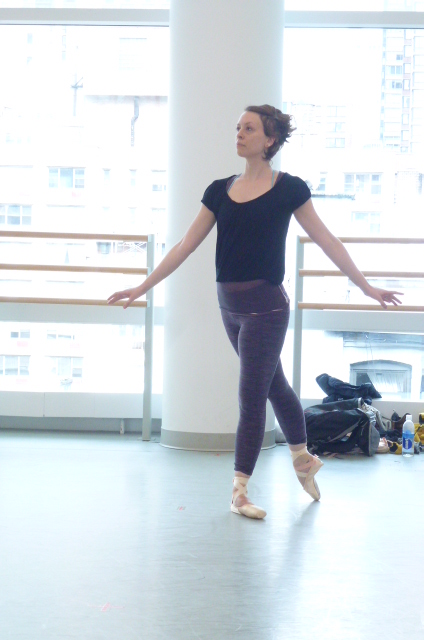
    Above: dancers and singers unite in Miro Magloire’s new ballet, “I AM

    ~ Author: Oberon

    Monday February 12th, 2018 – Since I am unable to attend this weekend’s New Chamber Ballet performances, the Company’s director, Miro Magloire, invited me to a studio rehearsal this morning of his newest creation: “I Am” set to music by Kaija Saariaho and Karin Rehnqvist.

    When I arrived this morning, the Saariaho portion of “I Am” was being rehearsed, with dancers Kristine Butler, Traci Finch, and Amber Neff; members of the vocal ensemble Ekmeles (Charlotte Mundy, Mary Mackenzie, and Elisa Sutherland) not only sing but participate in the choreography, and NCB’s violinist Doori Na and pianist Melody Fader were on hand to play the magical music of Ms. Saariaho.

    Here are some images from today’s rehearsal of “I Am“:

    L1910572

    Mary Mackenzie, Kristine Butler

    L1910586

    Amber Neff, Charlotte Mundy  

    L1910611

    Amber & Charlotte

    L1910645

    Elisa Sutherland, Traci Finch

    L1910649

    Elisa, Charlotte, Mary, and Kristine

    L1910655

    Traci, Amber, and Elisa

    L1910658

    Elisa and Charlotte face-off

    L1910709

    Elisa Sutherland

    L1910724

    Elisa encircled

    L1910771

    Mary & Kristine

    L1910780

    Kristine Butler

    L1910817

    Traci Finch, Amber Neff

    L1910834

    Traci & Amber

    L1910901

    Charlotte Mundy

    The second part of “I Am” is set to music by Karin Rehnqvist: “Davids Nimm“, a vocal trio based on Swedish shepherdess’s calls.

    Between the two parts of “I Am“, the Company will show a new ballet danced to selections from Johann Sebastian Bach’s Well-Tempered Clavier. This was being rehearsed today, with Melody Fader at the piano and dancers Sarah Atkins, Elizabeth Brown, Kristine Butler, and Amber Neff:

    L1910934

    L1910945

    Elizabeth Brown

    L1910949

    Sarah Atkins, Elizabeth Brown

    L1910986

    Amber Neff, Kristine Butler

    L1910993

    Amber Neff, Elizabeth Brown

    L1920001

    Kristine Butler, Sarah Atkins

    L1920017

    Kristine Butler with Elizabeth, Amber, and Sarah

    The performances will be February 16th and 17th, 2018 at the City Center Studios. For tickets, go here.

    ~ Oberon

  • American Symphony Orchestra Presents ‘Hollow Victory’

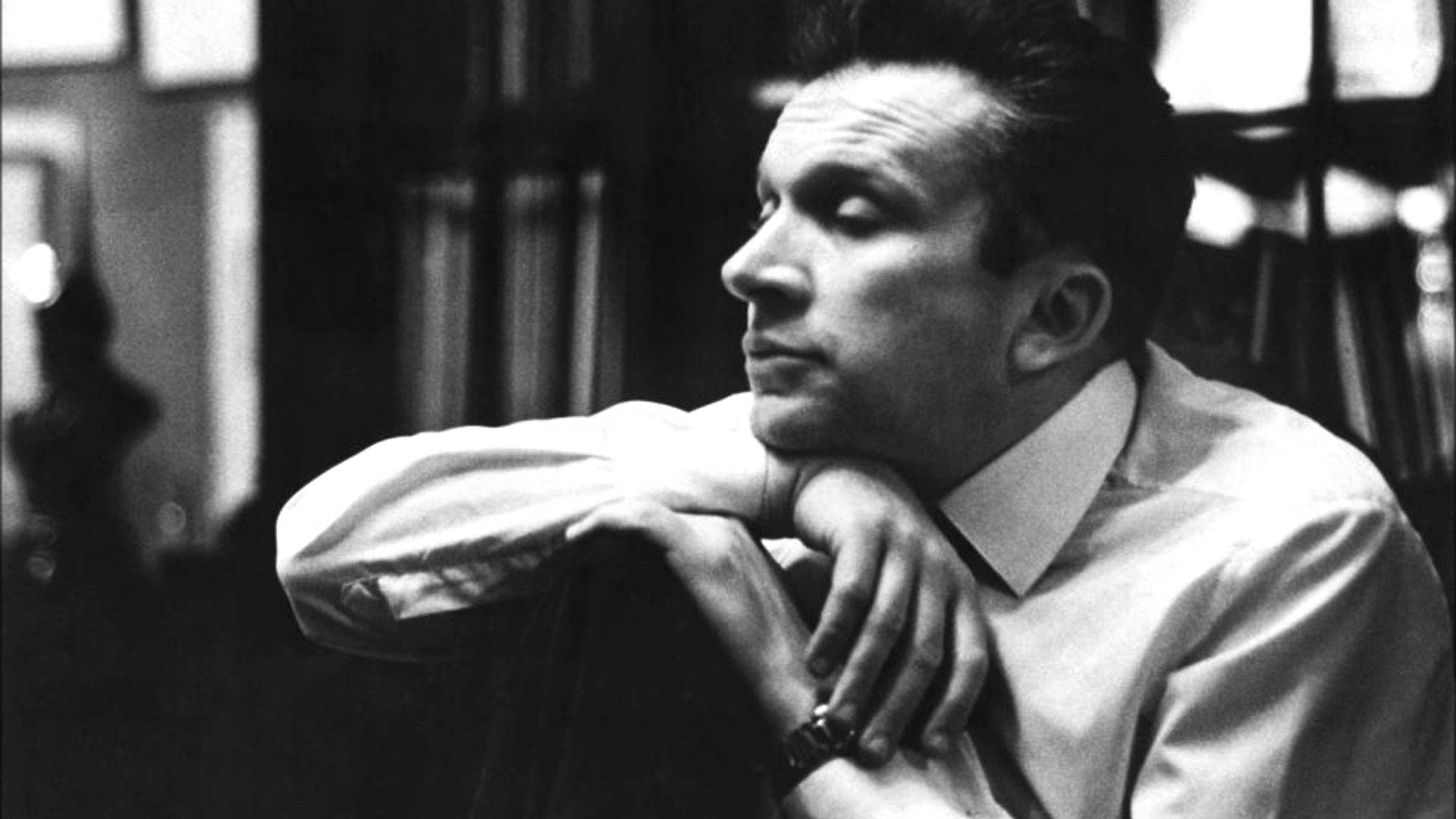
    Weinberg

    Above: composer Mieczysław Weinberg

    ~ Author: Ben Weaver 

    Sunday February 29th, 2018 – Leon Botstein and his American Symphony Orchestra always present interesting programming of rarely-performed works. On January 28th, the theme was “Jews in Soviet Russia after the World War” and was perhaps one of their finest concerts. Presented were three works by two composers: first half was dedicated to Mieczysław Weinberg and second half to Vieniamin Fleishman. Both men were close friends with Dmitri Shostakovich, whose influence can be heard in their works.

    Mieczysław Weinberg is perhaps the better-known of the two. Born in 1919 in Warsaw, Poland into an artistic family (his father was a conductor and composer of the Yiddish theater and his Ukrainian-born mother was an actress.) During the war his parents and younger sister were interned in the Lodz ghetto and died in the Trawnicki concentration camp. After the war, in the Soviet Union where he settled, Weinberg was arrested by the KGB in 1953. Shostakovich’s personal appeal to Lavrenti Beria – and Stalin’s death soon thereafter – saved Weinberg’s life. Weinberg’s vast musical output includes 22 symphonies, 17 string quartets, 9 violin sonatas, 7 operas, 40 film and animation scores (including for the Palm d’Or-winning film “The Cranes are Flying.”)

    Leon Botstein began the concert with Weinberg’s “Rhapsody on Moldavian Themes,” composed in 1949. An ancient state – forced to be one of the Soviet Union’s republics between 1940 and 1991 – Moldavia’s culture is closely related to Romania’s and it’s folk melodies sometimes will bring to mind folk melodies Brahms and Dvořák used in their famous collection of dances. Weinberg’s Rhapsody begins with a drive from the low strings and then an oboe introduces the first mournful theme. The Rhapsody moves easily between the mournful and infectious dance tunes, alternating soaring full string section and solos for individual instruments. There is a definite Klezmer dance tune near the end, which brings the work to an exciting close.

    Weinberg’s substantial Symphony No. 5, composed in 1962, without a doubt takes inspiration from Shostakovich’s Symphony No. 4, which though it was premiered in 1961 was composed 25 years earlier, and Weinberg and Shostakovich used to play a two piano arrangement of it for friends long before the premiere. The work opens with a slow “siren,” two repeated notes, from the violins. This motif returns over and over throughout the symphony like a wail of doom, sometimes picked up by other instruments. There are sudden interruptions from the timpani, bringing to mind Mahler’s 6th Symphony. There are beautiful and beautifully-played solos for various instruments, most notably the flute (Yevgeny Faniuk is listed as principal flautist) and horn (Zohar Schondorf)). The Symphony ends with a hushed march, growling trombones and a mysterious celesta.

    Veniamin Fleischman was born in 1913 and entered the Leningrad Conservatory in 1939. His teacher, Shostakovich, called Fleishman his favorite student. While a student, on Shostakovich’s suggestion, Fleishman began composing the opera “Rothschild’s Violin,” from a short story by Chekhov. (Fleishman wrote his own libretto.) When the Nazis invaded the USSR in the summer of 1941 Fleishman enlisted in the Red Army and was killed on September 14 near Leningrad. Shostakovich went to great lengths to retrieve Fleishman’s manuscript of the opera. He completed and orchestrated the work in 1943-44, and later went to great lengths to have it performed, though without much success. Its sympathetic portrayal of Jewish people no doubt did not fit comfortably with the Soviet regime. There was one concert performance in Moscow in 1960 and a staged performance did not take place until 1968. Shostakovich wrote in his memoirs: “It’s a marvelous opera – sensitive and sad. There are no cheap effects in it; it is wise and very Chekhovian. I’m sorry that theatres pass over Fleishman’s opera. It’s certainly not the fault of the music, as far as I can see.” 

    The main character, a Christian coffin maker Yakov Ivanov, undergoes a spiritual crises and something of an awakening. After Yakov’s wife Marfa informs him that she is dying, they both reminisce about their dead child, and Yakov realizes he will have to build his own wife’s coffin. “Life is all loss, only death is gain,” he says. Though Yakov quarrels with Rothschild, the young flautist in the local Jewish orchestra, at the end he leaves Rothschild his most prized possession: the violin, which Rothschild begins to play as the opera ends.

    Rothschild’s Violin” is a magnificent opera. Fleishman, editing Chekov’s story, brilliantly removed all secondary characters and stories, keeping only the story of the coffin-maker. We know nothing even about the young Jew to whom Yakov leaves his violin; nor about Yakov’s wife Marfa, who is dying. This is a story of one man, there are no loungers or pauses in the narrative. It moves quickly through monologues and dialogues, only pausing for Yakov’s final apotheosis where he comes to understand his life and losses. Though the characters, especially Marfa, feel sorry for themselves, there is no sentimentality or cheap dramatic effects. The simplicity of it is what gives the work so much power.

    220px-Mikhail_Svetlov_bass.jpg_300_(2)

    The quartet of singers assembled for the opera was perfect. Bass Mikhail Svetlov (above) was a deeply moving and beautifully sung Yakov. The only native Russian speaker in the cast, he projected the text and all its nuances in a way few can. His is a big, rich voice, with an easy top.

    Index

    Mezzo-soprano Jennifer Roderer (above) was a plum-voiced Marfa; managing to be both a nagging self-pitying wife and a woman who, perhaps on her deathbed, has obviously suffered so much. What kept flying through my head as she was singing is that Ms. Roderer’s large, beautiful and booming mezzo would make a fantastic Fricka; it is a role she sings and we can only hope she is able to sing it at the Metropolitan Opera (which is supposed to bring back its Ring cycle soon.)

    M heller

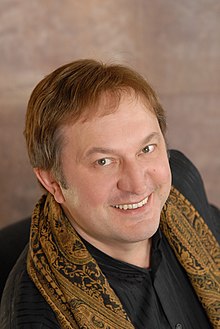
    Tenor Marc Heller (above), singing the role of the leader of the Jewish orchestra, would make a pretty good Siegfried. The huge, ringing voice flew easily over the orchestra and Maestro Botstein’s rather unforgiving volume.

    AaronBlake200

    Lyric tenor Aaron Blake (above) was a lovely and nervous young Rothschild. There is actually very little for Rothschild to sing, so Mr. Blake made up for it with pantomime acting, particularly at the end after Yakov has gifted him his fiddle (kindly loaned for the proceedings by a violinist on stage), and an extended orchestral postlude (including lovely solo violin playing by concertmaster Gabrielle Fink) summarizes not only Yakov’s sacrifice, but Rothschild’s future. Intentionally or not, there was something quite poetic and moving in the fact that a member of the orchestra gave up her violin and was not able to play the extended orchestral passage in the end, mirroring Yakov’s own losses.

    It is also worth nothing that the final orchestral passage goes from being lightly scored and transparent to having a very close resemblance to the searing final moments of Shostakovich’s 5th Symphony.

    Rothschild’s Violin” is a great opera; it deserves to be staged.

    ~ Ben Weaver

  • Brahms & Dvořák @ Chamber Music Society

    BrahmsDvorak400px

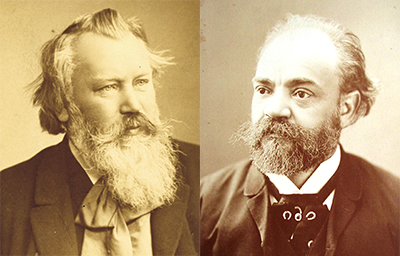
    Above: Johannes Brahms and Antonín Dvořák

    ~ Author: Oberon

    Tuesday January 30, 2018 – This evening’s highly enjoyable program offered by Chamber Music Society of Lincoln Center brought us works by Johannes Brahms and Antonín Dvořák: music for piano 4-hands by each composer, with a piano trio from Brahms and a piano quintet from Dvořák. Six excellent musicians were on hand to delight an audience who had chosen great music over the SOTU. 

    Pianists Wu Han and Michael Brown shared the Steinway for the opening work: selections from Dvořák’s Slavonic Dances. Wu Han – clad is brilliant red – presided over the lower octaves and Mr. Brown the higher. The chosen Dances, two from opus 46 and two from opus 72, formed a perfect set.

    With the joyous opening of opus 46, #1, the cares and concerns of daily life were swept away; this Presto in C-major moves from exuberance to subtlety and back again. The players clearly enjoyed sharing the keyboard: in his program note, Mr. Brown compared playing 4-hands with playing doubles in tennis. And he further remarked that “…sharing one pedal is as strange as someone else brushing your teeth!” This duo got on like a house afire, vying in technical brilliance and relishing the more thoughtful passages. Opus 46, #2 has a darker, E-minor start, but then turns sprightly; Dvořák alternately accelerates and then pumps the brakes throughout this Allegretto scherzando.

    The dances of opus 72 are in general less extroverted and rambunctious than those of the 46. The pianists kept to E-minor with #2 which has a lyrical sadness and an emotional pull at first but later becomes sparkly and charming. They rounded off this opening Dvořák set with opus 72, #1, Molto vivace in B-major. This commences with a rocking rhythm and shows fresh vitality before it quietens with some lovely upper-range shimmers only to re-ignite as it hastens to its finish.

    For the Piano Trio in C-minor, Op. 101 of Johannes Brahms, Mr. Brown was joined by violinist Paul Huang and cellist Dmitri Atapine. This trio was composed in 1886 while the composer was summering at Hofstetten, Switzerland, and it was premiered in December of that year, with the composer at the piano, Jeno Hubay playing violin, and David Popper as cellist.

    The opening Allegro energico begins passionately, and the strings play often in unison. Following an animated passage, there comes a deep melody; the movement ends almost abruptly. 

    The trio’s second movement starts very quietly, almost hesitantly, the strings are muted and given over to almost sneaky plucking as the piano holds forth. Then violin and cello have a dialogue. The pizzicati recur, and the sotto voce atmosphere of the music is sustained.

    The Andante develops yet another conversation: this time between the duetting strings and the piano. All three musicians showed lovely dynamic gradations throughout. Mr. Brown’s dreamy and evocative playing drew sighing motifs from the violin and cello. A sudden burst of passion ends the Andante

    The rhythmic vitality of the concluding Allegro molto undergoes a mood change in an interlude where Mr. Huang’s polished tone could be savoured. Melodious exchanges lead on to a fervent finish. The three players’ sense of fraternity was evinced as they bowed to the audience’s sincere applause.

    Following the interval, our two pianists played three of Brahms’ Hungarian Dances. Wu Han and Mr. Brown had switched places on the piano bench, giving Mr. Brown the deeper registers whilst Wu Han shone in the soprano range.

    The Poco sostenuto in F-minor commences with a brooding quality, but then speeds up. A witty, almost ‘toy piano’ feeling charms in the central section before a return to the starting point. The music dances on to a fun finale. The Allegretto in A-major has a droll start and some playful hesitations: the two pianists seemed like co-conspirators here. Mr. Brown relished the low melody of the Allegro molto in G-minor whilst Wu Han’s sweetly struck higher notes felt like raindrops. The music then grows lively, with a gypsy lilt.

    A sterling performance of Dvořák’s Piano Quintet in A-major, Op. 81 (dating from 1887) made for the evening’s perfect finale, with violinists Chad Hoopes and Paul Huang, violist Matthew Lipman, and cellist Dmitri Atapine joining Wu Han.  

    Mr. Atapine sets the opening Allegro ma non tanto in motion with a nobly-played cello theme; there follows a warm tutti passage where we’re assured of a beautifully blended performance. Wu Han’s gorgeous playing (throughout) underscores the silken high range of Mr. Hoopes’ violin; then Mr. Lipman takes up a viola theme which is passed to Mr. Hoopes. Pulsing strings lead to an expansive passage; the Hoopes violin sings deliciously. We can revel in the intertwined voices for a few moments before the movement dashes to an ending.  

    The second movement, Andante con moto, was a source of true magic tonight, with Wu Han again displaying her gifts for creating atmosphere. Mr. Lipman has the melody; a tempo increase brings us duetting violins. Then comes an engrossing passage: Mr. Atapine’s cello sings deep as the violinists pluck; then Mssrs. Hoopes and Atapine sound a gentle, rolling motif in support of Wu Han’s luminous playing. Mr. Lipman takes up the main theme with rich lyricism. A sudden animation is calmed by the limpid piano, and then the ‘engrossing passage’ is repeated, with unbelievable subtlety.

    Chad Hoopes sends the Scherzo off with a light touch; Wu Han’s dazzling playing has me under a spell. The viola and cello engage us, Mr. Atapine’s attentiveness and sense of joy in his playing is inspiring to behold. Following a luminous interlude, the cellist propels the Scherzo to a lively finish.

    The Finale: Allegro starts with a petite into, and then embarks on a flowing dance. I absolutely loved watching Wu Han here, ever-alert and eyeing her colleagues with affection, she was clearly having a marvelous time of it. The mood shifts unexpectedly as Mr. Hoopes plays what seems like a hymn…or a prayer. Then the music goes on its lilting way to a jubilant close. 

    ~ Oberon

  • American Symphony Orchestra Presents ‘Hollow Victory’

    Weinberg

    Above: composer Mieczysław Weinberg

    ~ Author: Ben Weaver 

    Sunday February 29th, 2018 – Leon Botstein and his American Symphony Orchestra always present interesting programming of rarely-performed works. On January 28th, the theme was “Jews in Soviet Russia after the World War” and was perhaps one of their finest concerts. Presented were three works by two composers: first half was dedicated to Mieczysław Weinberg and second half to Vieniamin Fleishman. Both men were close friends with Dmitri Shostakovich, whose influence can be heard in their works.

    Mieczysław Weinberg is perhaps the better-known of the two. Born in 1919 in Warsaw, Poland into an artistic family (his father was a conductor and composer of the Yiddish theater and his Ukrainian-born mother was an actress.) During the war his parents and younger sister were interned in the Lodz ghetto and died in the Trawnicki concentration camp. After the war, in the Soviet Union where he settled, Weinberg was arrested by the KGB in 1953. Shostakovich’s personal appeal to Lavrenti Beria – and Stalin’s death soon thereafter – saved Weinberg’s life. Weinberg’s vast musical output includes 22 symphonies, 17 string quartets, 9 violin sonatas, 7 operas, 40 film and animation scores (including for the Palm d’Or-winning film “The Cranes are Flying.”)

    Leon Botstein began the concert with Weinberg’s “Rhapsody on Moldavian Themes,” composed in 1949. An ancient state – forced to be one of the Soviet Union’s republics between 1940 and 1991 – Moldavia’s culture is closely related to Romania’s and it’s folk melodies sometimes will bring to mind folk melodies Brahms and Dvořák used in their famous collection of dances. Weinberg’s Rhapsody begins with a drive from the low strings and then an oboe introduces the first mournful theme. The Rhapsody moves easily between the mournful and infectious dance tunes, alternating soaring full string section and solos for individual instruments. There is a definite Klezmer dance tune near the end, which brings the work to an exciting close.

    Weinberg’s substantial Symphony No. 5, composed in 1962, without a doubt takes inspiration from Shostakovich’s Symphony No. 4, which though it was premiered in 1961 was composed 25 years earlier, and Weinberg and Shostakovich used to play a two piano arrangement of it for friends long before the premiere. The work opens with a slow “siren,” two repeated notes, from the violins. This motif returns over and over throughout the symphony like a wail of doom, sometimes picked up by other instruments. There are sudden interruptions from the timpani, bringing to mind Mahler’s 6th Symphony. There are beautiful and beautifully-played solos for various instruments, most notably the flute (Yevgeny Faniuk is listed as principal flautist) and horn (Zohar Schondorf)). The Symphony ends with a hushed march, growling trombones and a mysterious celesta.

    Veniamin Fleischman was born in 1913 and entered the Leningrad Conservatory in 1939. His teacher, Shostakovich, called Fleishman his favorite student. While a student, on Shostakovich’s suggestion, Fleishman began composing the opera “Rothschild’s Violin,” from a short story by Chekhov. (Fleishman wrote his own libretto.) When the Nazis invaded the USSR in the summer of 1941 Fleishman enlisted in the Red Army and was killed on September 14 near Leningrad. Shostakovich went to great lengths to retrieve Fleishman’s manuscript of the opera. He completed and orchestrated the work in 1943-44, and later went to great lengths to have it performed, though without much success. Its sympathetic portrayal of Jewish people no doubt did not fit comfortably with the Soviet regime. There was one concert performance in Moscow in 1960 and a staged performance did not take place until 1968. Shostakovich wrote in his memoirs: “It’s a marvelous opera – sensitive and sad. There are no cheap effects in it; it is wise and very Chekhovian. I’m sorry that theatres pass over Fleishman’s opera. It’s certainly not the fault of the music, as far as I can see.” 

    The main character, a Christian coffin maker Yakov Ivanov, undergoes a spiritual crises and something of an awakening. After Yakov’s wife Marfa informs him that she is dying, they both reminisce about their dead child, and Yakov realizes he will have to build his own wife’s coffin. “Life is all loss, only death is gain,” he says. Though Yakov quarrels with Rothschild, the young flautist in the local Jewish orchestra, at the end he leaves Rothschild his most prized possession: the violin, which Rothschild begins to play as the opera ends.

    Rothschild’s Violin” is a magnificent opera. Fleishman, editing Chekov’s story, brilliantly removed all secondary characters and stories, keeping only the story of the coffin-maker. We know nothing even about the young Jew to whom Yakov leaves his violin; nor about Yakov’s wife Marfa, who is dying. This is a story of one man, there are no loungers or pauses in the narrative. It moves quickly through monologues and dialogues, only pausing for Yakov’s final apotheosis where he comes to understand his life and losses. Though the characters, especially Marfa, feel sorry for themselves, there is no sentimentality or cheap dramatic effects. The simplicity of it is what gives the work so much power.

    220px-Mikhail_Svetlov_bass.jpg_300_(2)

    The quartet of singers assembled for the opera was perfect. Bass Mikhail Svetlov (above) was a deeply moving and beautifully sung Yakov. The only native Russian speaker in the cast, he projected the text and all its nuances in a way few can. His is a big, rich voice, with an easy top.

    Index

    Mezzo-soprano Jennifer Roderer (above) was a plum-voiced Marfa; managing to be both a nagging self-pitying wife and a woman who, perhaps on her deathbed, has obviously suffered so much. What kept flying through my head as she was singing is that Ms. Roderer’s large, beautiful and booming mezzo would make a fantastic Fricka; it is a role she sings and we can only hope she is able to sing it at the Metropolitan Opera (which is supposed to bring back its Ring cycle soon.)

    M heller

    Tenor Marc Heller (above), singing the role of the leader of the Jewish orchestra, would make a pretty good Siegfried. The huge, ringing voice flew easily over the orchestra and Maestro Botstein’s rather unforgiving volume.

    AaronBlake200

    Lyric tenor Aaron Blake (above) was a lovely and nervous young Rothschild. There is actually very little for Rothschild to sing, so Mr. Blake made up for it with pantomime acting, particularly at the end after Yakov has gifted him his fiddle (kindly loaned for the proceedings by a violinist on stage), and an extended orchestral postlude (including lovely solo violin playing by concertmaster Gabrielle Fink) summarizes not only Yakov’s sacrifice, but Rothschild’s future. Intentionally or not, there was something quite poetic and moving in the fact that a member of the orchestra gave up her violin and was not able to play the extended orchestral passage in the end, mirroring Yakov’s own losses.
    It is also worth nothing that the final orchestral passage goes from being lightly scored and transparent to having a very close resemblance to the searing final moments of Shostakovich’s 5th Symphony.

    Rothschild’s Violin” is a great opera; it deserves to be staged.

    ~ Ben Weaver