Category: Dance

  • Brahms|Thorvaldsdottir|Salonen @ NY Phil

    A gilbert foto michael j lutch

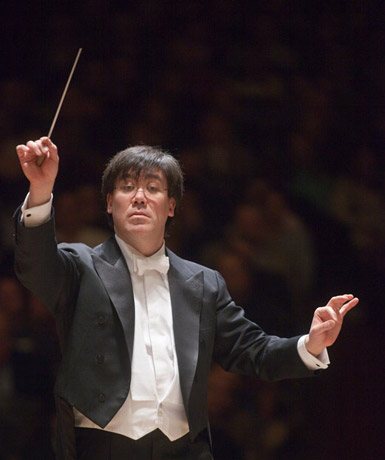
    Above: Alan Gilbert, in a Michael J Lutch photo

    Author: Scoresby

    Tuesday May 23rd 2017 – Now in the final weeks of his tenure as music director, Alan Gilbert led the New York Philharmonic at David Geffen Hall in the last of four concerts of a diverse program. Guest soloists included the respected violinist Leonidas Kavakos, soprano Anu Komsi, and soprano Piia Komsi (both sopranos in their NY Philharmonic Subscription debuts). It also happened to be a night devoted to the retiring members of the NY Philharmonic and such there was a ceremony right after intermission.
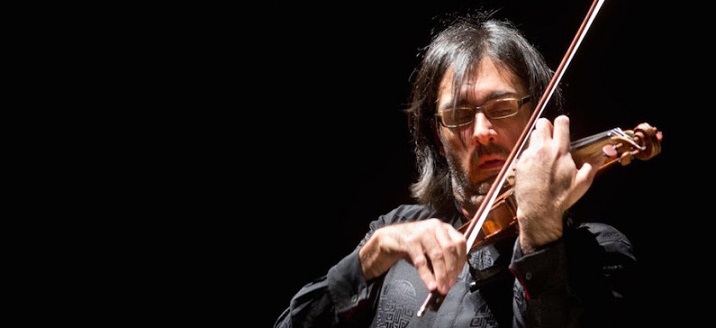
    Leonidas-kavakos

    The program started out with the classic Brahms’s Concerto in D major for Violin and Orchestra, Op. 77. I have heard Mr. Kavakos (above)  a few times before and have always enjoyed his performances. This Brahms was taken at a slow pace in the first movement. Mr. Kavakos seemed to use a style of playing with very light bow pressure and many staccato notes, which emphasized the more modernist elements of the work (particularly in the cadenza). While most players make this into a flashy piece, both the orchestra and Mr. Kavakos seemed to be tempered, bordering on torpid. They did bring transparency and structure, emphasizing each phrase.

    Opening with a sensual organ-like chorale, the second movement seemed more effective at this tempo. It allowed the orchestra to breathe through some of the more beautiful tutti sections and Mr. Kavakos time to care for each line. The finale was Mr. Kavakos at his best, finally managing to fully synchronize with the orchestra and lunging through difficult technical demands.

    After the intermission was the annual New York Philharmonic ceremony honoring both the retiring and retired musicians. This is a time-honored tradition in which retiring musicians give a speech – it is also a nice time for former musicians to come back to the orchestra.

    Dawn_hannay

    As the violist and Chairperson of the Musician’s Orchestra Committee Dawn Hannay (above) pointed out in her memorable speech, the musicians and history of an organization are vital in creating a particular sound. “Without the musicians, the conductor is just waiving their arms around.”

    Photo by Kristinn Ingvarsson

    Above: Anna Thorvaldsdottir; photo by Kristinn Ingvarsson

    The second piece on the program was the New York premiere of Aeriality by the young Icelandic composer Anna Thorvaldsdottir. While this was my first time hearing any of her work live, I have been relishing two recent discs of her music  for the past few years – one released by Deutsche Grammophon and the other recorded by International Contemporary Ensemble. It was a pleasure to hear this rich music live, which is a completely different experience than listening to an album. As with many of Ms. Thorvaldsdottir’s pieces, the sound is huge and immersive.

    In some ways, one might consider this piece as much an ambient soundscape as it is a structured musical piece. The percussion seems the only thing grounding about the music; it otherwise shifts through a variety of textures and colors – almost like moving through space. It is a evokes strong visuals of a primordial landscape in my mind. The clusters, density, and waves of sound all increase until a climactic moment when the music turns into light, feathery texturing. It really felt like the orchestra arrived somewhere it fell silent. The performers drew a big sound and played well. Mr. Gilbert led a slower account that accentuated the many textures, but also felt a little less structured.

    The program closed with the New York premiere of a work by the esteemed composer and conductor Esa-Pekka Salonen. The piece was an older one from his output entitled Wing on Wing, inspired by the completion of Frank Gehry’s Walt Disney Concert Hall. It includes two sopranos who move to different parts of the hall, percussionists who also play from different parts of the hall, the electronic sounds of a fish, and the voice of Frank Gehry himself.

    The sopranos Anna and Pii Komsi did an excellent job through difficult descending and ascending passages that evoked the sounds of a siren. While the orchestra played rivetingly throughout the work, the electronics sounded a little kitschy. The piece has classic Salonen sound of colorful open sounding chords with interesting textures from a variety of instruments. It evoked both Ligeti’s Atmosphères and Debussy’s Jeux, melded with Salonen’s creative rhythms.

    The moment that grabbed the most was the final purely orchestral section, in which the orchestra bursts into a frenetic dance anchored by the percussion. It was lovely to hear the New York Philharmonic present important contemporary composers and a nice reminder of the importance of the musicians in the orchestra.

    ~ Scoresby

  • Alexander Sitkovetsky/Wu Qian @ CMS

    2171-sitkovetsky

    Above: Wu Qian and Alexander Sitkovetsky

    Author: Scoresby

    Thursday May 11th, 2017 – I had the experience of going to Chamber Music Society of Lincoln Center’s wonderfully intimate Rose Studio for a duo performance – from a married couple no less: violinist Alexander Sitkovetsky  and pianist Wu Qian. I am always a fan of performances in the Rose Studio as you feel enveloped in the music – there is no bad seat in a hall this small. I have only ever heard solo piano performance and all string chamber music in here, so it was interesting to see how the space is different with a mixed ensemble.

    The program was well-balanced, with each half starting with one shorter piece followed by one full-length sonata. It commenced with Korchánski’s arrangement of Manuel De Falla’s Suite populaire espagñole for Violin and Piano. While I have heard the entirety of the piece once in performance, violinists tend to only play the jaunty last movement as an encore piece. It was a pleasure to hear it in full here.

    Mr. Sitkovetsky’s playing was clean and clear. He seemed to use extra bow pressure to make the lines come out very smoothly, adding a sweeping vibrato in the more romantic lines. Mr. Sitkovetsky was at his best during the pulsing dance sections. As a whole, their take was slower than I am used to, which allowed Ms. Qian to do an excellent job bringing out the impressionistic elements of the piano part. Particularly noteworthy was her silky tone in the second movement and percussive pulses in the fourth movement, both reminding me of de Falla’s Nights in the Gardens of Spain (which composed within a year of the Suite).

    he first half of the program ended with Schumann’s Sonata in D minor for Violin and Piano, Op. 121. While I hadn’t heard it live before this program, I have never had much of an affinity for this piece. I typically find it too busy-sounding, with the first movement quite repetitive. Nonetheless, the duo did a fine job with the piece making many of the lines more clear than they typically are. They took a structured approach, allowing one to hear a coherent flow of ideas through the piece (which is not always the case). Mr. Sitkovetsky managed to get a more muscly sound than earlier, most noticeable in the last movement. Ms. Qian handled the technical demands and quirky off-beats well.

    The second half of the program began with Alfred Schnittke’s Suite in the Old Style for Violin and Piano. Schnittke’s pieces typically have a conglomerate sound, mixing a modernist idiom with other styles. Here Schnittke composed the piece in a completely Baroque style (with the exception of one note). Mr. Sitkovetsky had a sweet and playful tone. He and Ms. Qian seemed in complete sync as they wove their way through the various movements. I loved the way they played the third movement, a minuet that sounds more like a lullaby. Here the dance pulse of the minuet was clear. They managed to conjure up a beautiful sense of yearning for another time: it was nostalgia in the best way possible.

    This led straight into the difficult fugue which they played with a bouncy, light tone, and sheer virtuosity. They managed to highlight all of the voicing well, with great coordination between them – the violin almost felt like an extension of the piano. In the final movement “Pantomime“, they took a slow, methodical approach that emphasized the humor. This made the dissonant climax after the child-like introduction hysterical – a few audience members let out quiet chuckles. The piece ends with an amusing incomplete scale into silence.

    The program concluded with Grieg’s Sonata No. 3 in C minor for Violin and Piano, Op. 45. This was once a favorite of the violin repertoire, but has decreased in popularity over the years. I’ve always been a fan and found this reading invigorating. The passionate and edgy melody of the first movement fit Mr. Sitkovetsky’s full sound well. Ms. Qian provided sparkling playing with Lisztian waterfall-like arpeggios mixed with dark coloring. The start of second movement is a sugary and sentimental, reminiscent of a Trenet song if the violin were a vocalist. It is a nice escapist melody. 

    In the final movement, Mr. Sitkovetsky and Ms. Qian brought out all of the folksy dance-like rhythms. It is always a good sign when everyone in the audience seems to be tapping their feet or bobbing their head. The back and forth between the instruments was lovely, as was watching their shadows move on the back of the hall. They brought Grieg’s colors to life, making every phrase ring. To hear such lush music in a small space was a treat.

    ~ Scoresby

  • EUGENE ONEGIN @ The Met

    Netrebko ONEGIN

    Above: Anna Netrebko as Tatiana

    Author: Ben Weaver

    Saturday April 22nd, 2017 matinee – Tchaikovsky’s operatic adaptation of Pushkin’s “Eugene Onegin” arrived this Spring at the Metropolitan Opera. Today, the season’s final performance of the opera was telecast via HD to cinemas around the world. It’s a practice that has been contributing to the hemorrhaging of live audience attendance for the house. The Met auditorium has countless empty seats more often than not, and many of those that are filled are actually papered and subsidized by donors. Today’s ONEGIN matinee was one of only two performances of the opera that actually sold out.

    Robin-Ticciati

    In the pit was the English conductor Robin Ticciati (above). He led a really magnificent reading the score, the Met Orchestra responding to Tchaikovsky’s superb orchestration with perfection. Ticciati was careful not to overwhelm the singers with sound (Tchaikovsky’s orchestral writing is often dense). There was a wonderful lightness to his interpretation, each musical strand rising magically out of the tapestry of sound. His energetic, forward moving pacing mostly worked well. Perhaps if Tatiana in her Letter Scene and Lensky in his Act II aria had been allowed to linger just a tad longer…but overall Tchaikovsky’s magical score danced and sighed superbly.

    The cast assembled for the revival of this 2013 production was first rate. At the heart of it was Anna Netrebko as Tatiana. When Netrebko first sang the role at the Met in 2013 I did not think she made a great impression. Primarily I objected to her bland reading of the text, disappointing for a native speaker. She has certainly been able to deepen her understanding of the role. This afternoon she was a living, breathing heroine. Her Letter Scene was by turns wistful and sad, excited and terrified. Fear as she awaits Onegin’s arrival, and shame at his rejection, were palpable. Haughtiness, in a crimson gown at the royal ball in Act III as she sees Onegin for the first time in many years, was delicious. And the final scene revealed verismo-ish declarations that she will not betray her husband. I suddenly remembered that Netrebko has sung Lady Macbeth and intends to sing Tosca too. These flashes of pure steel were thrilling. Vocally she was excellent. There are occasional tendencies (not new to her) to stray off pitch in her middle voice. But her top was strong and gleaming, and the aforementioned steel in the final scene brought to mind Galina Vishnevskaya. The young, impressionable Tatiana is a woman now, royalty even. She won’t let Onegin forget this.

    Mattei ONEGIN

    Peter Mattei as Onegin (above) was in stunning voice. Truly this is one of the most beautiful baritone sounds in the world. Soft and plush, but not lacking in volume. Mattei’s long-limbed figure undergoes a reverse transformation of Tatiana. Haughty and indifferent at first, he unravels as Tatiana grows in stature. While Mattei’s singing was beyond reproach, his Russian diction was quite poor. In Act 1 it was still recognizable as Russian. Alas, as the opera progressed I often wasn’t sure he was singing in Russian at all, or just making sounds intended to sound vaguely Slavic.

    Russian tenor Alexei Dolgov was a terrific Lensky. His singing is effortless. Perhaps his neurotic, bordering hysteric Lensky would not be to all tastes, but it was believable, and – again – the singing was terrific. His Act II aria was heart-wrenching; his Russian diction crystal clear. Elena Maximova, as Lensky’s fiancée Olga, did everything right dramatically and musically. Perhaps the voice is a bit too monochrome and lacks warmth, but during the Act II ball she wonderfully conveyed a flirty, young woman who only too late realizes that her behavior towards her fiancée will lead to tragedy.

    It is a great touch to have a young bass play Prince Gremin. Usually Gremin is seen as an old man, but a youthful Stefan Kocan, with the necessary low notes in full bloom, leaves no doubt why Tatiana would refuse to leave him for a now-pathetic Onegin. 

    It was wonderful to see and hear two veteran Russian mezzos as the matriarchs. Elena Zaremba as Madame Larina showed off a still gleaming, forceful mezzo, effortlessly dominating ensembles. The great Larissa Diadkova, long one of my favorite singers, was a superb Filippyevna. There is still much voice left and dramatically her fussy Nanny was by turns funny and deeply moving as she recalls her own youth. My first live Filippyevna was the legendary Irina Arkhipova making a much belated Met debut in 1997. It is the highest compliment I can pay Diadkova to say that she is in the Arkhipova stratosphere of artists. 

    There were wonderful supporting appearances by Tony Stevenson as Triquet (lovely singing of the birthday song; it’s a character that can be very grating, but Stevenson is a superb character singer/actor), Richard Bernstein as Zaretski, and David Crawford as a Captain. The chorus was in excellent form, under the leadership of Donald Palumbo. 

    The big problem with the Met’s ONEGIN, alas, is the mediocre-to-terrible production by Deborah Warner, sets by Tom Pye, costumes by Chloe Obolensky and lighting by Jean Kalman. Warner’s boring conception is old-fashioned in the worst sense of the word. I’m as fond of a “period appropriate” production as anyone, but Warner’s staging contributes nothing to the work. The previous, gorgeous production by Robert Carsen showed more depth with a simple white box and autumn leaves than Warner and team manage with stuffy period detail. The silly “when in doubt, just lay down on the stage” trope should be made illegal. All of Act I is set in the Larin country home living room. Why the family would bring their entire farming staff in there, and then allow people to throw wheat on the living room floor, is a mystery. The Duel scene is the most effective, a moody wintry landscape. But the columns in all of Act III are simply too large, sitting like titans, distracting from any and all action on the stage. 

    So it was the superb cast of singing actors, the orchestra, and thrilling conducting by Ticciati that made this ONEGIN a superb musical event.

    ~ Ben Weaver

  • Jonathan Biss|NY Philharmonic

    Jonathan_Biss_104_credit_Benjamin_Ealovega
    Above: pianist Jonathan Biss in a Benjamin Ealovega portrait

    Author: Scoresby

    Thursday April 20th, 2017 – The promising young conductor Courtney Lewis shared his New York Philharmonic subscription debut (he was the Assistant Conductor there from 2014 – 2016) with the pianist Jonathan Biss. The program was split between two orchestral works bookending two piano concerti. While individually the pieces were interesting, it was a little unclear how the program fit together. It was my first time hearing Mr. Lewis live and my first time hearing Mr. Biss in an orchestral performance – though I have enjoyed his solo performances in the past.

    The first selection on the program was Part Two Scene One of Berlioz’s Roméo et Juliette, Dramatic Symphony after Shakespeare’s Tragedy, Op. 17. The scene is broken down into a tone poem of sorts with the subtitles: Romeo Alone, Sadness, Distant Sounds of a Concert and a Ball, and Great Festivities in the Capulet’s Palace. While a Berlioz fan, I had never heard this particular work before. After last night’s performance I immediately went home and listened to the full piece online – it is some of Berlioz’s most original composing.

    1MlJi1ft

    Mr. Lewis (above) and the orchestra had superb dynamic control, starting from just a hush in the beginning that evoked a person meandering through a forest with the lighting shimmering and shifting under different trees. The music itself reminded me so much of the creeping chromaticism and lush sounds in Tristan and Isolde that I kept expecting to hear the famous Tristan Chord. Berlioz doesn’t go that far though, and instead the piece opens up into a great party scene.

    Mr. Lewis led this change in atmosphere marvelously – shifting from a tragic meditative walk into a brash, almost militaristic ball. This wasn’t light dance music in Mr. Lewis’s interpretation; instead, there were crashes and thumps with the percussion implying the coming tragedy. It was satisfying to see that the players seem to have genuine affection for him and it felt like they wanted him to succeed.

    Next on the program was the young composer Timo Andres’s The Blind Banister: Concerto for Piano and Chamber Orchestra with Jonathan Biss performing the piano part. The piece was composed as a companion piece to Beethoven Piano Concerto No. 2 in B-flat major, Op. 19 (on the program later), though as Mr. Andres admits in his notes there are few similarities other than a motif he takes from the cadenza of the Beethoven. Mr. Andres’s piece centers on downward/upward scalar motion and suspended seconds. It is tonal and has layers upon layers of atmosphere, with the piano a fabric holding it together. Mr. Lewis did a good job of highlighting different timbres in the score, while Mr. Biss gave the piece a dedicated performance. The woodblocks in the second movement were particularly fun to hear.

    The second half started with the underappreciated gem of the Beethoven Piano Concerti: No. 2 in B-flat major, Op. 19. I have always had affinity for this piece, being dainty and expressive at the same time. Mr. Biss was at his best in the first and last movements, playing with a touch as light as a feather. It was impressive hearing how he could change the color of a particular phrase with his changes in articulation, ranging from buttery legatos to harpsichord-like plucking.

    In the Adagio the orchestra shined – I thought the brass section sounded lovely with a warm sound. Mr. Biss played the dynamics of the adagio well, but didn’t have the same ease and gloss as he did in the first movement. The Rondo was played brusquely and with finesse; all of the structures were very tight. Mr. Biss did a good job of keeping the tune playful, making it sound like something someone could whistle. The orchestra gave an equally nimble performance.

    The final piece on this eclectic program was Elgar’s In the South (Alassio), Op. 50.  I’ve never had an affinity for Elgar before, but this unknown piece to me reminded me a lot of Strauss mixed with Italian folk tunes. Mr. Lewis played through the large swells of romanticism well. The quietest sections were the most memorable, with a charming duet between the harps and Associate Principal Viola Rebecca Young being a highlight of the evening. During the denser moments of the piece, some of the middle range instruments sounded muddy, but this is was due more to Elgar’s writing than Mr. Lewis’s conducting. Overall Mr. Lewis proved more than capable and demonstrated he is a flexible conductor well on his way to a major career. Mr. Biss lived up to his reputation as a fine Beethoven interpreter and a subtle artist. 

    ~ Scoresby
  • Violinist Simone Lamsma @ Weill Hall

    DSC7528_20
     
    Above: Simone Lamsma, photographed by Otto Van Toorn
     
    {Note: As I continue to cope with a severe lower back episode, please welcome guest-writer Scoresby, who will be covering some events in my absence and – hopefully – will continue to write for this blog in the future so that we may – between the two of us – cover even more concerts.}  
     
    Thursday March 30th, 2017 – The violinist Simone Lamsma performed a well-programmed Carnegie debut at Weill Hall with pianist Robert Kulek.

    While a well-known composer for his orchestral music, this was the first time I have heard a James Macmillan piece. It was a welcome introduction to his sound world. His Sonata for Violin and Piano, “Before the Tryst” is a 15-minute piece in one-movement that cycles through many different moods and colors. At its heart is a setting that Macmillan wrote in the early 1980’s of the Scottish poet William Soutar’s “The Tryst”. Previously, Macmillan used a melody from the setting in a shorter violin and piano work called “After the Tryst”.

    Before the Tryst” initiates with a whisper of violin harmonics and the percussive, almost inaudible, high reaches of the piano. Percussion and rhythm are vital to this piece – it almost feels like dance music. There are many trills (reminiscent of the opening of the Prokofiev sonata), slides, tone clusters, and other well used devices to paint a colorful canvas. While tonal, there are plenty of delicious dissonances.

    There are sections of lyric quiet punctuated with aggressively anxious lines. Fittingly, it reminded me of a young person anxiously falling into an all consuming love, feeling both drawn-in and cut off at the same time. It is certainly a worthwhile entry into the violin repertoire.

    Ms. Lamsma managed to dramatically capture all of the rhythms, particularly near the end. She played with a wonderfully scratchy, Stravinsky-esque tone. Mr. Kulek complemented this with a warm tone. The piece ends with a section of the violin hostilely interjecting long pauses until only the silence remains.

    Prokofiev Sonata No. 1 in F Minor, Op. 80 is one of my favorite pieces of music, so it is always a pleasure to hear a live performance. It is a later Prokofiev piece started in the backdrop of the Great Terror in 1938 and completed in 1946 – David Oistrakh and Samuel Feinberg performed the first and third movements at his funeral seven years later.

    Ms. Lamsma’s crafted a sarcastic edge and raspiness that served the piece well. In the first movement, she did an excellent job of keeping space and quiet within the piece – if played too quickly it can lose its brooding mood. One of the most successful parts of her recital was Ms. Lamsma’s virtuosic playing and fast tempo in the second movement. Mr. Kulek let loose in the fortissimos creating an urgent mood.

    In the third movement, Ms. Lamsma’s mute on the instrument along with her tone, almost made her sound like the ghostly playing of a 1940’s record. This movement is Prokofiev in one of his most impressionist idioms. As I was listening, I could almost imagine the static from an LP and sounds of rain patting a window on a dreary day. The last movement ended the sonata with fast, rhythmic pulses, which finally gave way to one last whispering statement of the first movement.

    Robert Kulek - 220a

    Above: Robert Kulek, photo by Brabander Fotografie

    After the intermission was Strauss’s Violin Sonata in E-flat Major, Op. 18. While I personally have never had an affinity for this piece, this reading did make me see how important the piece was to Strauss’s development for his later symphonic poems. The piece is written in three movements with a dense piano part that the violin soars over.

    Ms. Lamsma gave a muscular performance in all three movements, though managed to have still a spontaneous flair in the second movement. The violin playing had a warmer, fuller tone in the Strauss. At many points, particularly in the first and third movements, I felt as if this piece would work well as a concerto because the piano part has so much bundled in. Nonetheless, Mr. Kulek managed to give a transparent reading, with notably sensitive playing in the second movement.

    The romance of the Strauss balanced the heavier first half of the program well. Clearly this young artist has an eye for thoughtful programming. As an encore, the artists treated the audience to a bonbon in the form of Samuel Dushkin’s “Sicilienne” (after Romanze from Weber’s Violin Sonata, Op. 10, No. 1).

    ~ Scoresby

  • Reese Thompson’s KIDS PLAY

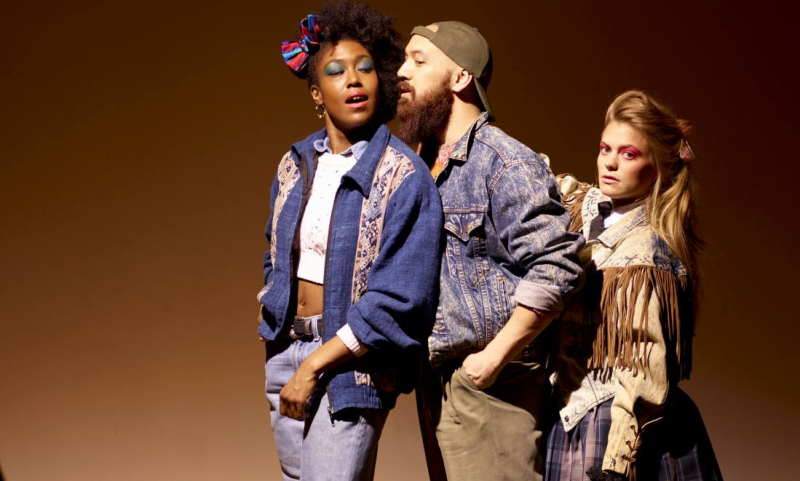
    Kids play - cast

    Above: the cast of Reese Thompson’s play KIDS PLAY –  Erin Margaret Pettigrew, Matthew Bovee, and Joy Donze; styling by Anthony Hagan, hair and make-up by Ta Ming Chen; photographed by Jan Klier

    Recently, I received an e-mail from Reese Thompson. Reese and I worked together back in the day at Tower Records, and while we seldom see one another, we have stayed in contact thru the passing years.

    I could see from the heading of his e-mail – “Important Life Announcement” – that this was not just a friendly, keeping-in-touch message. Fortunately, it contained very good news: Reese’s play, entitled KIDS PLAY, is to be presented at the Edinburgh Fringe Festival this Summer. Edinburgh Fringe is the largest and one of the most prestigious arts festivals in the world: last year the Festival spanned 25 days and featured 50,266 performances of 3,269 shows in 294 venues. I expect this year’s Festival will carry on in the same vein.

    Reese and I, and hundreds of thousands of people world-wide, have something in common: we were cruelly bullied as children. In his e-mail, Reese mentioned the specific times in his daily school routine when things were most treacherous: getting to and from school, lunch-hour, and the playground. Although I am many years older than Reese, I experienced the exact same pattern in my youth. Nothing has changed…in fact, I would say things have gotten worse.

    “For certain kids, the world reveals itself as a dangerous place early on.” Truer words have never been spoken. If you are ‘different’, you become – at a very young age – fair game for those who fit accepted norms, both at school and in the community.

    The burgeoning suicide rate among very young people should be setting off all kinds of alarms, but instead it seems to have become just another statistic: suicide is now the third leading cause of death among young people, resulting in about 4,400 deaths per year. According to Yale University’s Office of Public Affairs, victims of bullying are 2 to 9 times more likely to consider suicide than non-victims.

    For those young people who don’t fit in, and who lack parental support and understanding, life becomes a quest to find your people: we build our own family and support network over time, and inevitably this replaces blood ties as a source of refuge, understanding, and encouragement.

    Reese Thompson’s KIDS PLAY evolved over a three-year period from a 10-minute play dealing with shaming, internalized sexism, and bullying on the playground. Since then, by collaborating with different casts and directors, the present a full-length version has taken shape. It now encompasses such themes as  childhood friendships, attending Catholic school, and nerve-wracking decisions about coming out. Reese’s play is both auto-biographical and universal.

    But, lest you think KIDS PLAY is a dark downer of a theatrical experience, it doesn’t wallow in despair: in fact, there is singing…and dancing, as in this preliminary video featuring the cast members and choreographed by Benjamin Rowan.

    Of course, putting on a production at a festival across the pond costs money, and the KIDS PLAY folks have started a fun-raising effort: you can read more about the play (and the other half of its double bill, Joy Donze’s 13 AND NOT PREGNANT), and contribute to the expenses involved here.

  • Sciatica

    Radiating-pain-sciatic-nerve

    UPDATE – 3/18/17 – I’m now in my 7th day of being virtually home-bound. The pain is pretty much steady; painkillers have helped me get thru the week…and I have a chiropractor who makes house calls! I so miss getting out, taking walks, having lunches with friends, and attending concerts and dance performances. 

    Meanwhile, if anyone knows an acupuncturist who might make a house call up here in Inwood, e-mail me at [email protected]

    March 11, 2017 – After intermittent sciatic problems over the past three or four years, I’m in the midst of an especially painful episode that is causing me to miss events, which is extremely frustrating for me. Sciatic pain is random and meds which might work one day do nothing the next. I’m dealing with it as best I can, and hope to be back on a normal schedule soon.

  • Mendelssohn’s Sorrow @ Chamber Music Society

    20170226_MS

    Above: the Schumann Quartet

    Sunday February 26th, 2017 – Following last week’s Chamber Music Society of Lincoln Center‘s program centering on joy-filled music by Felix Mendelssohn, we were back at Alice Tully Hall to experience the great composer’s more melancholy moods. With music of Bach and Schumann also on offer, we became acquainted with Schumann String Quartet, and could admire once again three artists whose CMS performances to date have given particular pleasure: violinist Danbi Um, cellist Jakob Koranyi, and pianist Juho Pohjonen.

    Juho_Pohjonen009_0

    Mr. Pohjonen (above) opened the evening with Bach’s Chromatic Fantasy and Fugue in D minor for Keyboard, BWV 903. The Finnish pianist’s elegance of technique and his Olde World mystique always summon up for me visions of pianists from bygone days performing in the drawing rooms of Paris, Budapest, or Vienna. But for all those dreamworld allusions, Mr. Pohjonen’s playing has vibrant immediacy and is very much of our time.  

    Mr. Pohjonen, in a program note, describes the Chromatic Fantasy as “labyrinthine”, and that it most surely is; but it’s a wonderful work to get lost in, and as the pianist drew us along the music’s sometimes eccentric, almost improvisational pathways, we could only marvel at the gradations of both subtlety and passion in his playing.

    The Schumann Quartet intrigued us from the very opening notes of their rendering of Mendelssohn’s Fugue in E-flat major. From her first phrase, violist Liisa Randalu drew us in; the three Schumann brothers – Erik and Ken (violins), and Mark (cello) – take up the wistful melody in turn. The music becomes gently animated, with the four voices blending serenely. Poignant colours from the rising violin and the honeyed resonance of the cello frame Ms. Randalu’s expressive playing. These textures will become key elements in the Schumann Quartet’s performance of the composer’s Quartet in F-minor, which followed immediately.

    Mendelssohn’s last completed major work, the F-minor quartet was composed in 1847. On returning to Frankfurt from a tiring stay in London in early May, the composer soon learned that Fanny, his beloved sister, had died of a stroke. Mendelssohn struggled that summer with work on numerous projects, but was only able to complete this final quartet, dedicated to Fanny’s memory. On November 4th, he died following a series of strokes. He was 38 years old.

    The F-minor quartet opens with scurrying attacks and a sense of restless energy. The music softens to a nervous pulsing as the cello sings from lyrical depths, with the luminous violin overhead. The movement then accelerates to a striking finish. The “scherzo” ironically mixes passionate phrases with delicate commentary. Viola and cello rumble darkly in the brief trio passage, then the tempest stirs up again before a little coda vanishes into thin air.

    A simple song that Mendelssohn and Fanny had shared in happier times memorializes their bond in the touching Adagio, which commences with a descending cello passage. The recollections evoked by the song, which is a sweet melody in its own right, are now tinged with sadness. Superbly controlled tone  from Erik Schumann’s violin was most affecting; the pulsing cello then heralds a surge of despairing passion.

    The finale is restless, at times verging on dissonant. Passing notions of lyricism are swept away, and wild passages for the violin warn of an impending disaster. This is a composer on the brink.

    The Schumann Quartet’s very impressive playing of this disturbing yet strangely beautiful piece earned them a very warm acclamation from the Tully Hall crowd. It is pleasing to know that they will be back with us next season in this same lovely space to share other aspects of their artistry – music from The Roaring Twenties on March 4th, 2018, and a full Schumann Quartet evening on April 29th, 2018, when they’ll play works of Haydn, Bartok, Reimann, and Schumann. 

    Following the interval, Mr. Pohjonen offered Robert Schumann’s Arabesque in C major for Piano, Op. 18. This episodic piece has a narrative aspect, though none is stated or even implied. Mr. Pohjonen relished the melodious themes that rise up, veering from major to minor as the Arabesque flows forward. Subtle passages become treasurable in this pianist’s interpretation, and the poetic finish of the work was lovingly expressed.

    Juho Pohjonen returned with his colleagues Danbi Um and Jakob Koranyi for Schumann’s Trio No. 1 D minor for Piano, Violin, and Cello, Op. 63.

    Danbi-Um-Banner_2

    Above: Danbi Um, photo by Vanessa Briceño

    Koranyi_Jakob_pc_Anna-Lena_Ahlström_1_72

    Above: Jakob Koranyi, photo by Anna-Lena Ahlström

    Ms. Um, lithe and lovely in a fair burgundy-hued gown, displayed the sweetness of tone that makes listening to her so enjoyable; Messrs Koranyi and Pohjonen are masters of dynamic nuance, and thus the three together delivered page after page of radiant, colorful playing. 

    The D-minor trio’s opening movement calls for rippling arpeggios from the pianist, expertly set forth by Mr. Pohjonen. Ms. Um and Mr. Koranyi harmonize and converse in passages which switch from lyrical yearning to emphatic declamation. A pause, and a new theme emerges: delicate at first, then turning passionate. A sense of agitation prevails in this movement, despite ‘settled’ moments: the three musicians captured these shifts of mood so well, and they savored the rather unexpected ending. 

    Marked “Lebhaft, doch nicht zu rasch” (‘Lively, but not rushed’), the scherzo has the feel of a scuffing, skipping dance. Rising and falling scales glow in the calmer interlude; but the dance soon strikes up again…and comes to a sudden halt.

    The trio’s third movement embarks on a disconsolate violin passage, played with affecting expressiveness and lovely control by Ms. Um. When Mr. Koranyi’s cello joins in, this simple melody becomes increasingly touching. A gently urgent central section reverts to the slow, sad gorgeousness so evocatively sustained by our three musicians, the cello sounding from the depths.

    The tuneful finale seems almost joyous, but shadows can still hover. The playing is marvelously integrated, becoming tender – almost dreamy – with smoothly rippling piano and the violin on the ascent. The themes mingle, developing into a big song. This simmers down briefly before a final rush of energy propels us to the finish. 

    I had felt pretty certain the Um-Koranyi-Pohjonen collaboration would produce memorable results, and I was right. We must hear them together again – soon – and let’s start with my favorite chamber works: the Mendelssohn piano trios. The audience shared my enthusiasm for the three musicians, calling them back for a second bow this evening.

    • Bach Chromatic Fantasy and Fugue in D minor for Keyboard, BWV 903 (before 1723)
    • Mendelssohn Fugue in E-flat major for String Quartet, Op. 81, No. 4 (1827)
    • Mendelssohn Quartet in F minor for Strings, Op. 80 (1847)
    • Schumann Arabesque in C major for Piano, Op. 18 (1838-39)
    • Schumann Trio No. 1 D minor for Piano, Violin, and Cello, Op. 63 (1847)
  • Mendelssohn’s Sorrow @ Chamber Music Society

    20170226_MS

    Above: the Schumann Quartet

    Sunday February 26th, 2017 – Following last week’s Chamber Music Society of Lincoln Center‘s program centering on joy-filled music by Felix Mendelssohn, we were back at Alice Tully Hall to experience the great composer’s more melancholy moods. With music of Bach and Schumann also on offer, we became acquainted with Schumann String Quartet, and could admire once again three artists whose CMS performances to date have given particular pleasure: violinist Danbi Um, cellist Jakob Koranyi, and pianist Juho Pohjonen.

    Juho_Pohjonen009_0

    Mr. Pohjonen (above) opened the evening with Bach’s Chromatic Fantasy and Fugue in D minor for Keyboard, BWV 903. The Finnish pianist’s elegance of technique and his Olde World mystique always summon up for me visions of pianists from bygone days performing in the drawing rooms of Paris, Budapest, or Vienna. But for all those dreamworld allusions, Mr. Pohjonen’s playing has vibrant immediacy and is very much of our time.  

    Mr. Pohjonen, in a program note, describes the Chromatic Fantasy as “labyrinthine”, and that it most surely is; but it’s a wonderful work to get lost in, and as the pianist drew us along the music’s sometimes eccentric, almost improvisational pathways, we could only marvel at the gradations of both subtlety and passion in his playing.

    The Schumann Quartet intrigued us from the very opening notes of their rendering of Mendelssohn’s Fugue in E-flat major. From her first phrase, violist Liisa Randalu drew us in; the three Schumann brothers – Erik and Ken (violins), and Mark (cello) – take up the wistful melody in turn. The music becomes gently animated, with the four voices blending serenely. Poignant colours from the rising violin and the honeyed resonance of the cello frame Ms. Randalu’s expressive playing. These textures will become key elements in the Schumann Quartet’s performance of the composer’s Quartet in F-minor, which followed immediately.

    Mendelssohn’s last completed major work, the F-minor quartet was composed in 1847. On returning to Frankfurt from a tiring stay in London in early May, the composer soon learned that Fanny, his beloved sister, had died of a stroke. Mendelssohn struggled that summer with work on numerous projects, but was only able to complete this final quartet, dedicated to Fanny’s memory. On November 4th, he died following a series of strokes. He was 38 years old.

    The F-minor quartet opens with scurrying attacks and a sense of restless energy. The music softens to a nervous pulsing as the cello sings from lyrical depths, with the luminous violin overhead. The movement then accelerates to a striking finish. The “scherzo” ironically mixes passionate phrases with delicate commentary. Viola and cello rumble darkly in the brief trio passage, then the tempest stirs up again before a little coda vanishes into thin air.

    A simple song that Mendelssohn and Fanny had shared in happier times memorializes their bond in the touching Adagio, which commences with a descending cello passage. The recollections evoked by the song, which is a sweet melody in its own right, are now tinged with sadness. Superbly controlled tone  from Erik Schumann’s violin was most affecting; the pulsing cello then heralds a surge of despairing passion.

    The finale is restless, at times verging on dissonant. Passing notions of lyricism are swept away, and wild passages for the violin warn of an impending disaster. This is a composer on the brink.

    The Schumann Quartet’s very impressive playing of this disturbing yet strangely beautiful piece earned them a very warm acclamation from the Tully Hall crowd. It is pleasing to know that they will be back with us next season in this same lovely space to share other aspects of their artistry – music from The Roaring Twenties on March 4th, 2018, and a full Schumann Quartet evening on April 29th, 2018, when they’ll play works of Haydn, Bartok, Reimann, and Schumann. 

    Following the interval, Mr. Pohjonen offered Robert Schumann’s Arabesque in C major for Piano, Op. 18. This episodic piece has a narrative aspect, though none is stated or even implied. Mr. Pohjonen relished the melodious themes that rise up, veering from major to minor as the Arabesque flows forward. Subtle passages become treasurable in this pianist’s interpretation, and the poetic finish of the work was lovingly expressed.

    Juho Pohjonen returned with his colleagues Danbi Um and Jakob Koranyi for Schumann’s Trio No. 1 D minor for Piano, Violin, and Cello, Op. 63.

    Danbi-Um-Banner_2

    Above: Danbi Um, photo by Vanessa Briceño

    Koranyi_Jakob_pc_Anna-Lena_Ahlström_1_72

    Above: Jakob Koranyi, photo by Anna-Lena Ahlström

    Ms. Um, lithe and lovely in a fair burgundy-hued gown, displayed the sweetness of tone that makes listening to her so enjoyable; Messrs Koranyi and Pohjonen are masters of dynamic nuance, and thus the three together delivered page after page of radiant, colorful playing. 

    The D-minor trio’s opening movement calls for rippling arpeggios from the pianist, expertly set forth by Mr. Pohjonen. Ms. Um and Mr. Koranyi harmonize and converse in passages which switch from lyrical yearning to emphatic declamation. A pause, and a new theme emerges: delicate at first, then turning passionate. A sense of agitation prevails in this movement, despite ‘settled’ moments: the three musicians captured these shifts of mood so well, and they savored the rather unexpected ending. 

    Marked “Lebhaft, doch nicht zu rasch” (‘Lively, but not rushed’), the scherzo has the feel of a scuffing, skipping dance. Rising and falling scales glow in the calmer interlude; but the dance soon strikes up again…and comes to a sudden halt.

    The trio’s third movement embarks on a disconsolate violin passage, played with affecting expressiveness and lovely control by Ms. Um. When Mr. Koranyi’s cello joins in, this simple melody becomes increasingly touching. A gently urgent central section reverts to the slow, sad gorgeousness so evocatively sustained by our three musicians, the cello sounding from the depths.

    The tuneful finale seems almost joyous, but shadows can still hover. The playing is marvelously integrated, becoming tender – almost dreamy – with smoothly rippling piano and the violin on the ascent. The themes mingle, developing into a big song. This simmers down briefly before a final rush of energy propels us to the finish. 

    I had felt pretty certain the Um-Koranyi-Pohjonen collaboration would produce memorable results, and I was right. We must hear them together again – soon – and let’s start with my favorite chamber works: the Mendelssohn piano trios. The audience shared my enthusiasm for the three musicians, calling them back for a second bow this evening.

    • Bach Chromatic Fantasy and Fugue in D minor for Keyboard, BWV 903 (before 1723)
    • Mendelssohn Fugue in E-flat major for String Quartet, Op. 81, No. 4 (1827)
    • Mendelssohn Quartet in F minor for Strings, Op. 80 (1847)
    • Schumann Arabesque in C major for Piano, Op. 18 (1838-39)
    • Schumann Trio No. 1 D minor for Piano, Violin, and Cello, Op. 63 (1847)

  • Graham/Duato/Cherkaoui @ The Joyce

    Mosaic4

    Above: Xin Ying and Abdiel Jacobsen in Sidi Larbi Cherkaoui’s Mosaic; photo by Brigid Pierce

    Friday February 17th, 2017 – A richly rewarding evening of dance from The Martha Graham Dance Company, performing works by Graham, Nacho Duato, and Sidi Larbi Cherkaoui at The Joyce. A packed house seemed spellbound by the ballets, and went wild for the Graham dancers – and rightfully so: their power, commitment, bravery, and beauty make them seem super-human. 

    As a prelude to the evening, Peter Sparling’s gorgeous film SacredProfane was shown as audience members found their seats and settled in. You can sample Sparling’s imaginative work here.

    Mysteries 2

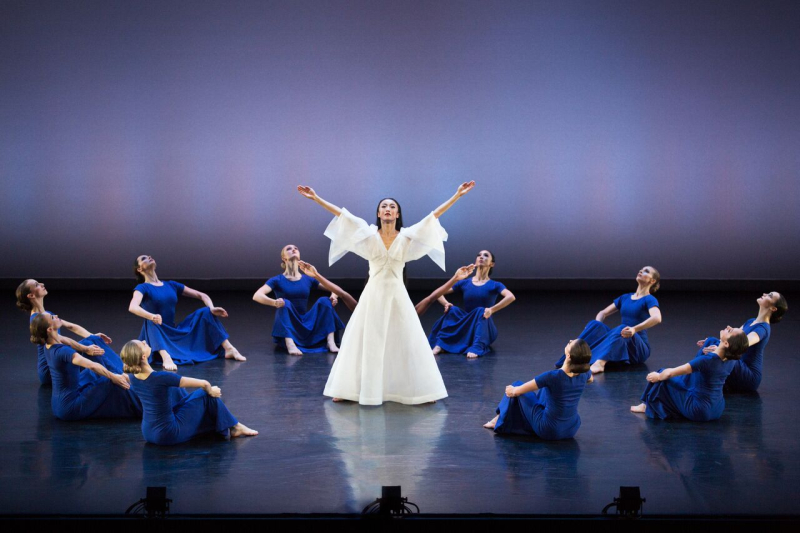
    Above: Pei-Ju Chien-Pott and the ensemble in Primitive Mysteries; photo by Brigid Pierce

    Primitive Mysteries is the Graham work I have most been wanting to see ever since I first read about it a few years ago, shortly after I had attended the rehearsal of Chronicle with photographer Brian Krontz which turned my curious interest in Graham into something of an obsession.

    Performed to music by Louis Horst for flute and piano, Primitive Mysteries is divided into three sections: “Hymn to the Virgin,” “Crucifixus,” and “Hosannah.” The work premiered on February 2, 1931, with Martha Graham in the central role. This ritualistic ballet draws inspiration from the veneration of the Virgin Mary that permeates Catholicism, but also from the rites of the Native Americans whose belief systems were obliterated by the arrival of undocumented immigrants on these hitherto unsullied shores.

    Mysteries 4

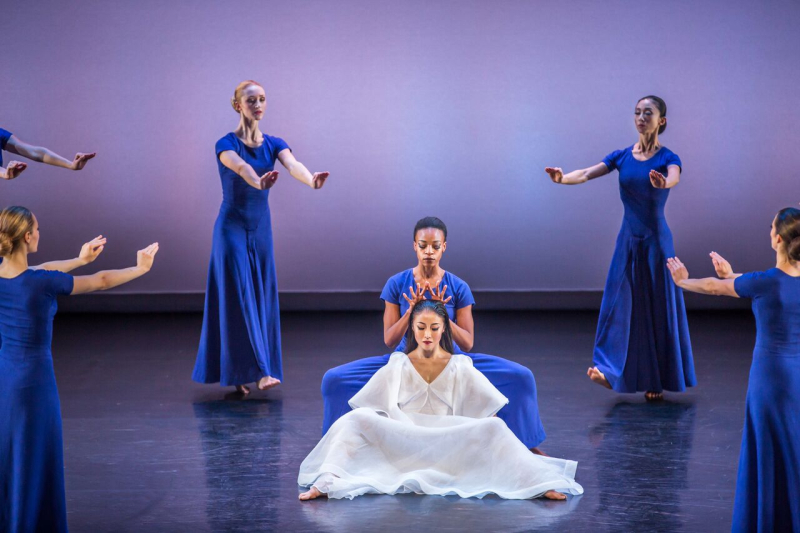
    Above: PeiJu Chien-Pott and the ensemble in Primitive Mysteries; photo by Brigid Pierce

    A corps of twelve blue-clad women frame the iconic Virgin, portrayed this evening by that fascinating Graham paragon, PeiJu Chien-Pott. Clad in pristine white, her hair flowing like black silk, Ms. Chien-Pott presides over her acolytes with benign yet unquestionable authority.

    The dancers enter in silence, with slow, unified strides: they will exit and re-enter in the same mode for each section of the ballet. Trademark Graham moves are to be seen, with high-stepping, contracted motifs, and regimented, stylized gestures unifying the sisterhood. In the second movement, Ms. Chien-Pott strikes a pose of crucifixion, arms outstretched, while the women circle her at increasing speed.

    Mysteries 3

    Above: PeiJu Chien-Pott and Leslie Andrea Williams (center) in a Brigid Pierce photo

    In the concluding “Hosannah”, Ms. Chien-Pott and Leslie Andrea Williams – a charismatic, ascending Graham dancer – strike ecstatic plastique poses, ending with Ms. Williams in a slow, backward collapse into Ms. Chein-Pott’s arms: a Pietà-like vision. Transfigured, the women slowly leave the stage as darkness falls.

    Primitive Mysteries evoked the first of the evening’s ovations, the dancers receiving vociferous screams of delight from the crowd as they took their bows.

    Rust 2

    Above: Lloyd Mayor at the top of the heap in Rust; a Brigid Pierce photo

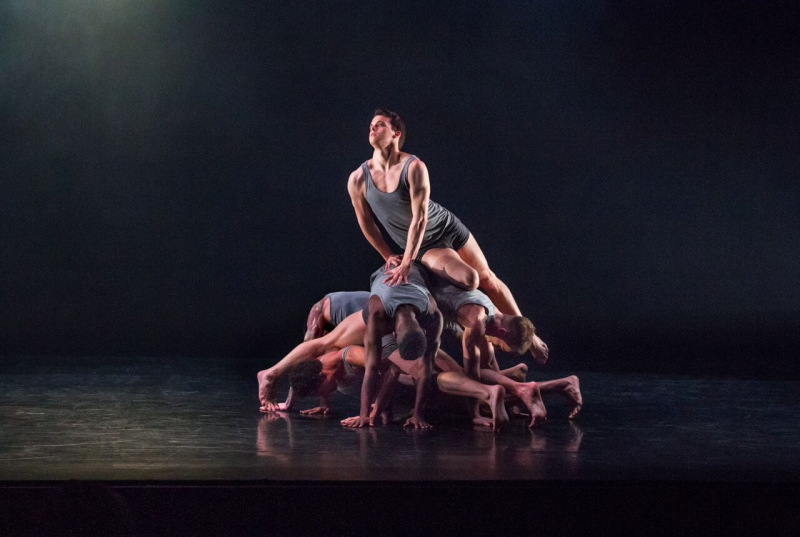
    After a brief pause, the curtain rose on Nacho Duato’s Rust, a powerful all-male work that served as an ideal counterpoise to the feminine spirit of the preceding Graham work. Lorenzo Pagano emerges from the shadows under the relentless beam of an interrogation spotlight; upstage, the hapless Ari Mayzick is kicked, tortured, and left for dead. Ben Schultz, Lloyd Mayor, and Abdiel Jacobsen complete the quintet as Mr. Duato puts them thru demanding physical passages and down-trodden floor work.

    Rust

    Above: from Rust; photo by Brigid Pierce

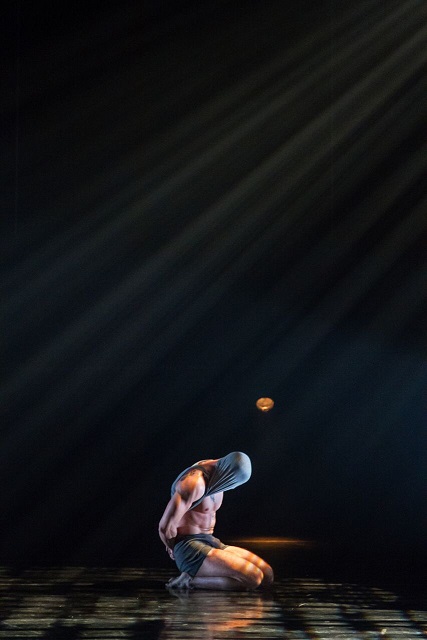
    Rust is danced to Arvo Pärt’s deep-chanting “De Profundis” (composed in 1980); voices emerge from the depths of despair, rising up to create an atmosphere of devotional reverence. The spirituality of the music and the brutality of the action remind us of the violence that permeates the history of the great religions. Rust ends with the men kneeling, hooded and with their hands tied behind their backs: all are prisoners, one way or another.

    Ben s rust

    Above: Ben Schultz in Rust; photo by Brigid Pierce

    We had had a preview of Sidi Larbi Cherkaoui’s Mosiac a few weeks ago at the Graham studios. Tonight this exotic, sensual but also shadowy ballet looked mysterious in Nick Hung’s lighting. Felix Bunton’s mid-Eastern score, spicy and alluring, is embellished by spoken commentary from the news networks.

    The dancers, costumed in soft, warm-hued garments, are seen in a cluster at curtain-rise. In a solo passage, Anne Souder’s personal beauty and physical flexibility made an alluring impression. Vocals that evoke deserts, minarets, and marketplaces set the dancers swirling; smoke drifts on the air as Lorenzo Pagano steps forward for a solo.

    Unspecified4d

    Above: Lorenzo Pagano in Mosaic; Brigid Pierce’s image from a studio showing 

    Mosaic

    Above: Xin Ying in Mosaic; photo by Brigid Pierce

    A threatening atmosphere arises; the incomprehensible talk all sounds like bad news. Stylized dancing under aqua lights brings forth the Company’s incredible Xin Ying: her feel for the sway of the music is intrinsic. A big beat and strobe lights give off contrasting impressions: are we in a nightclub or a prison yard? The dancers begin to shed their outer layers of clothing, and their vulnerability lends a new aspect to the story.

    Mosaic2

    A duet for Anne Souder and Lloyd Mayor (above, photo by Brigid Pierce) could be provocative, or manipulative. In the end, the dancers return to the clustered formation, but now they are trembling uncontrollably.

    Mosaic3

    Above: Xin Ying and Abdiel Jacobsen in Mosaic; a Brigid Pierce photo  

    To close the evening Diversion of Angels, Martha Graham’s glowing commentary on the aspects of love, was marvelously danced. To Norman Dello Joio’s lyrical, romance-tinged score, we meet three women who embody the ages of love: Charlotte Landreau (Young Love, in yellow), Xin Ying (Passionate Love, in red), and Konstantina Xintara (Deep and Lasting Love, in white); each has her beloved: Lloyd Mayor, Lorenzo Pagano, and Ben Schultz respectively. An ensemble of four women (So Young An, Marzia Memoli, Anne Souder, and Leslie Andrea Williams) and an additional man (Jacob Larsen – to complete the male quartet) fill out the stage picture with animated choreography, often heralding or echoing the principals.

    Konstantina-1

    Ms. Xintara (above) and Mr. Schultz exude calm: her elongated arabesques show romantic centeredness and confidence while his muscular physique provides a pillar of strength for his beloved. A particular gesture of Ben’s reminded me ever so much of Nijinsky’s Faune.  At times, this White Couple simply stand together, assured of their mutual affection as they watch the younger generations leap and swirl.

    Xin-ying

    Xin Ying (above), superbly beautiful in her red frock, repeatedly displays her own arabesque-motif, sustaining the pose with awesome control. Mr. Pagano is a more fleeting lover here, but when he and his love do meet up, their passion sizzles.

    Charlotte

    Charlotte Landreau (above) is a dancer to cherish. With her strong technique and engaging presence, Charlotte seems destined for many Graham roles. As the Woman in Yellow tonight, her breezy jetés – stretched long and wonderfully elevated – delighted my choreographer/friend Claudia Schreier and me. As Charlotte’s ardent young lover, Lloyd Mayor hovered over his sweetheart, looking at once smitten and protective. 

    Jacob Larsen, handsome of face and form, kept pace with the Company’s dynamic men; he looks likely to become a valuable asset in the Graham rep. 

    An excellent evening on every count, and the cheers and applause that greeted the generous Graham dancers as they took their bows were eminently deserved.

    Production photos in this article are by Brigid Pierce, sent to me at just the right moment by the Graham Company’s press agent, Janet Stapleton.