Category: Dance

  • Schubert’s WINTERREISE @ CMS

    Huber-Gerharer

    Above: Gerold Huber and Christian Gerhaher

    Tuesday February 24th, 2014 – Baritone Christian Gerhaher and pianist Gerold Huber performing Schubert’s immortal masterpiece, Winterreise, as part of Chamber Music Society of Lincoln Center‘s Winter Festival, Intimate Expressions. The performance comes to us in the midst of a particularly cold and somber Winter.

    Composed in 1827, when Franz Schubert was 30 years old and had less than two years remaining in his life, the twenty-four songs of Winterreise are set to poems of Wilhelm Müller. The poet, who had earlier provided the texts for the composer’s song cycle, Die schöne Müllerin, was a nearly-exact and equally short-lived contemporary of Schubert. They never met, and Müller died just as Schubert was beginning work on Winterreise.

    Winterreise is not a narrative song cycle, but rather a collection of vocal miniatures on themes of solitude and despair, set against a relentless and unforgiving wintry landscape. Though the subject matter is overall quite gloomy, there is some variety of tempo and rhythm among the songs. But in the final twelve of the Winterreise songs, we experience a feeling of darkness gathering about Schubert, and his sense of impending doom. The last Winterreise songs evoke feelings of great beauty overshadowed by death. The composer died in 1828.

    Tonight’s performance had all the makings of a superb musical experience – which, in fact, it was – yet the overall effect of the cycle was somewhat compromised. In her opening remarks, CMS co-artistic director Wu Han announced that the pianist Gerold Huber was suffering from a heavy cold. He had generously agreed to perform, but we were cautioned that he might be in need of taking a break midway thru the cycle. This was indeed the case; after about a half-hour, pianist and singer walked offstage and the audience took the opportunity to stretch, chat, and check their cellphones. This intrusion of reality broke the spell of the music. When the artists returned, it took a while for the hall to settle in again, and there were further minor disruptions in the second half of the performance, with a corresponding decline in focus.

    Mr. Gerhaher has a wonderful lyric instrument capable of both power and shaded nuance; and yet it was the pianist – Mr. Huber – who most thoroughly entranced me with the subtle delicacy of his playing in the cycle’s most intimate moments. Together the two gave as fine a rendering of Winterreise as one might hope under the circumstances. The great benefit for me was, it sent my estimation of this cycle, which I have never previously appreciated and have in fact avoided, soaring. Perhaps that is one of the gifts of growing older.

    I look forward to hearing Mr. Gerhaher on March 1st singing the Brahms GERMAN REQUIEM at Carnegie Hall. And I will hope to encounter Mr. Huber again at some point for he is an artist of intrinsic expressiveness.

  • Graham @ The Joyce 2015 – Part II

    30828_433083144185_6944679_n

    Above: Blakeley White-McGuire and Tadej Brdnik; these two phenomenal dancers were making their ‘farewell’ appearances as members of the Graham company tonight.

    Sunday February 22nd, 2015 – For me it was a bittersweet evening at the Martha Graham Dance Company‘s final performance of their 2015 Joyce season following the news earlier this week that tonight would mark the ‘farewell’ Graham performances of Blakeley White-McGuire and Tadej Brdnik, two of the great Graham interpreters of our time and two people I greatly love and admire both as dancers and personalities. 

    Tadej danced in the very first performance of a Graham work that I ever saw: Appalachian Spring at Jacob’s Pillow some 20 years ago. That afternoon his Bride was the inimitable Miki Orihara. Combining the physique of a champion athlete with an appealingly boyish face, Tadej’s boundless energy and commitment have made him a Graham icon; he also has a devilish sense of humor, and I’ve seen him at the end of a long rehearsal keeping his fellow-dancers merry with one-liners and dead-pan expressions. In these final performances as a Company member, he has again shown the power and presence that have made him an emblematic Graham dancer throughout his career.

    Of Blakeley White-McGuire, one can say she has indomitable technical prowess and a rare gift for communicating emotion. But beyond that there’s an undefinable element in her dancing which only a handful of dancers in my experience have possessed: a spiritual connection with the music and the movement that makes her performances not just important, but essential. Blakeley is twice-blessed by Terpsichore, and it is we – the audience – who reap the benefits of her beauty and generosity of spirit. 

    Like Wendy Whelan, who recently retired from New York City Ballet (and who was in the audience tonight!), both Blakeley and Tadej have indicated that they aren’t retiring, but simply turning a page in the chronicle of their dancing careers.

    Blakeley and Tadej walked into the Graham studios for the first time on the same day some two decades ago. Although in the original scheme of things they were not scheduled to dance Errand Into The Maze together this season, it seems they were destined by the gods to do so.

    _MG_7823

    Their performance was thrilling, commencing with Blakeley’s opening solo (photo above by Brigid Pierce) in which she danced with a palpitating mixture of fear and resolve, delineating the character’s destiny in a vivid marriage of technique and temperament. Tadej, as the monstrous Minotaur, stalks her like a vicious predator, his incredible thigh musculature giving him grounded strength of purpose. Their pas de deux, so fraught with struggle and sexuality, shows Graham’s gift for devising miracles of leverage, counter-balance, and entwining in her partnering motifs. Blakeley and Tadej’s joint triumph was vastly cheered by the packed house, and their Graham colleagues joined them onstage for the celebration. 

    For all the excitement generated by Blakeley and Tadej, the evening was an enriching one overall, commencing with two Graham works in which two of my beloved Muses appeared: Deep Song opened the program in a vivid performance by Carrie Ellmore-Tallitsch, and Miki Orihara gave a luminous rendering of an excerpt from Primitive Mysteries, presiding over a corps of young women in blue.

    _MG_7545

    Above: Carrie Ellmore-Tallitsch in Deep Song; photo by Brigid Pierce

    Deep Song is a solo work by Martha Graham, set to Music by Henry Cowell. It was premiered in 1937 as one of the choreographer’s responses to the horrors of war (the Spanish civil war in this case). In a black and white gown, Carrie Ellmore-Tallitsch is first seen seated on a white bench. The choreography develops with seeming inevitability as she struggles with her  inner torment, sinking to the ground. She later lifts the bench, seeming to use it as a shield or hiding place. Finally the bench takes on a coffin-like aspect as she lowers it over herself. Carrie, a dancer I have always held in highest esteem, danced as superbly as I expected. The audience seemed to agree: she won a prolonged ovation which made me want to smile and weep at the same time.

    6a00d8341c4e3853ef01a511cbecd5970c-800wi

    Miki Orihara (rehearsal image, above) appeared like a shimmering angel all in white to perform the ‘Hymn to the Blessed Virgin’ from Graham’s 1931 ballet Primitive Mysteries. This is the Graham work I am most curious about, and tonight’s tantalizing excerpt makes me curiouser and curiouser. Escorted by a group of attendants in deep blue gowns (members and apprentices of Graham II), Miki radiates feminine mystique with her poetic gestures, moving with an almost ghostly lightness of tread. To Louis Horst’s atmospheric melody for flute and piano, the women perform antique rituals in this finely-structured dancework. The ensemble’s signature poses and port de bras make a particularly strong effect as Miki walks forward between facing rows of acolytes who sink down or raise their arms to heaven as she passes by. Miki sustains a powerful pose in demi-plié as the women circle about her. All to soon, their cortège passes onward but the resonance of their dancing lingers. Miki, always so movingly inspired and inspiring, sets a lovely example for the young dancers surrounding her: not only of how to move, but how to be.

    In the Graham Company’s on-going project of asking now-generation choreographers to create short danceworks inspired by Martha’s legendary solo Lamentation, Michelle Dorrance and Liz Gerring have now devised new pieces – Lamentation Variations – for the Graham dancers. Bulareyaung Pargalava’s Variation, a classic by now, was also on offer tonight.

    007_ChristopherJones_013

    Above: the Graham men in Michelle Dorrance’s Lamentation Variation; left to right are Abdiel Jacobsen, Ben Schultz, Lloyd Knight, Lloyd Mayor, Tadej Brdnik. Photo by Christopher Jones.

    Ms. Dorrance, a tap-dancing paragon, did not ask the Graham dancers to tap. But the music she used relied on tap rhythmics with a jazzy over-lay. The men formed a kind of central knot, while a quintet of women were seen in walkabouts…which one or two of the men sometimes strayed into. Though abstract, an underlying aspect of sadness and solitude prevailed throughout this work.
    001_MG_2624

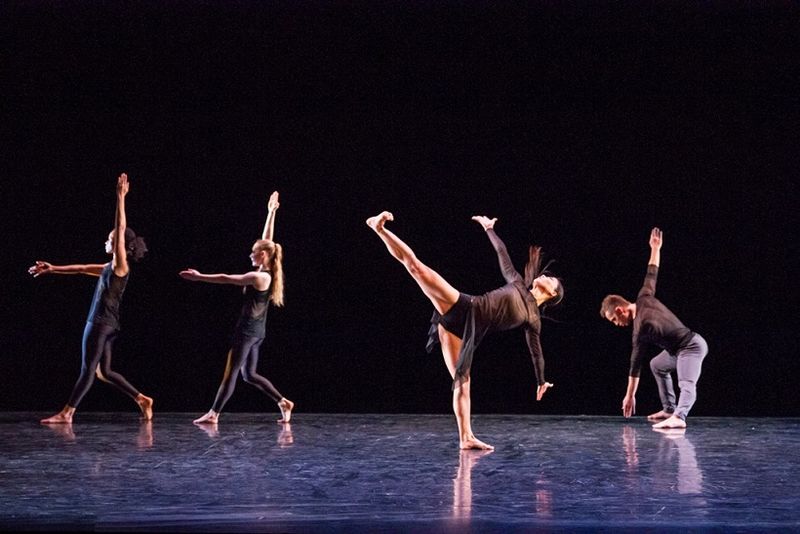
    Liz Gerring’s Lamentation Variation is a quartet – performed by Natasha M Diamond-Walker, Charlotte Landreau, Ying Xin, and the indefatigable Tadej Brdnik (photo, Brigid Pierce) – which is set to a score for electronics and piano. The movement is rather stylized, and choreographer and dancers make excellent use of the space.

    150212_M_Graham_B_Pagarlava_003

    Above: from Bulareyaung Pargalava’s Lamentation Vartiation; photo © 2015 Yi-Chun Wu.

    Pargalava’s Variation opens to the sound of Martha Graham’s voice speaking about the solo that inspired all these variations. Soon a haunting melody from Mahler’s ‘Songs of the Wayfarer’ is heard. In flesh-coloured tights, the delicate XiaoChuan Xie and her three demi-god partners – Ben Schultz, Lloyd Knight, and Lloyd Mayor – move with a sense of flowing lyricism through intricate partnerings in which Chuan alternately sinks down and is lifted on high. The dancers and the dance certainly wove a hypnotic spell tonight.
    002_MG_7971

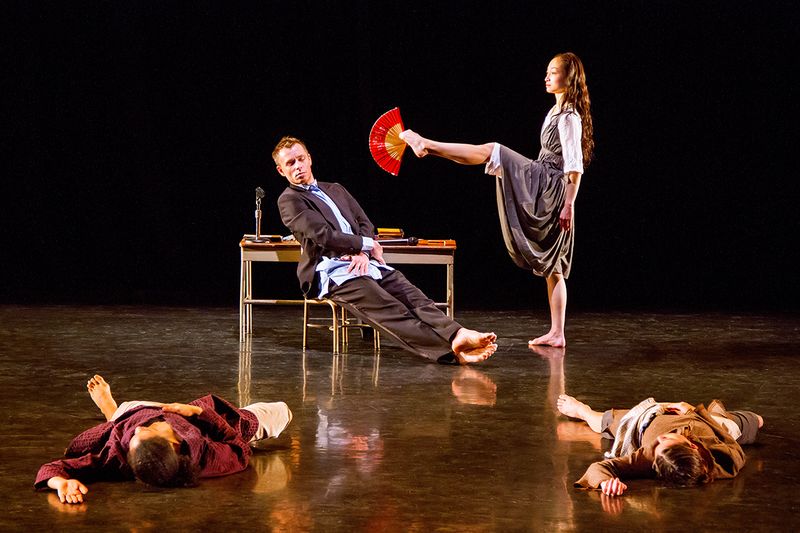
    Above: Tadej Brdnik and XiaoChuan Xie in Annie-B Parson’s The Snow Falls in the Winter; photo by Brigid Pierce.

    I saw Annie-B Parson’s The Snow Falls in the Winter a few seasons ago when OtherShore performed it. It’s simply not my cup of tea. For me one of the great joys of watching dance is: the dancers are silent. Once they begin to speak, a whole element of mystery falls away. Ms. Parson’s work is more like a play with a bit of dancing thrown in. The Graham dancers of course flung themselves into the piece with their customary zest, and Carrie Ellmore-Tallitsch and Natasha Diamond-Walker in particular proved themselves adept actresses. But while many in the audience applauded lustily and commented enthusiastically on this very ‘different’ work, I found it pretty tedious.

    006_MG_8799

    Above: from Andonis Foniadakis’ Echo, Lloyd Mayor, PeiJu Chien-Pott, and Lloyd Knight; photo by Brigid Pierce

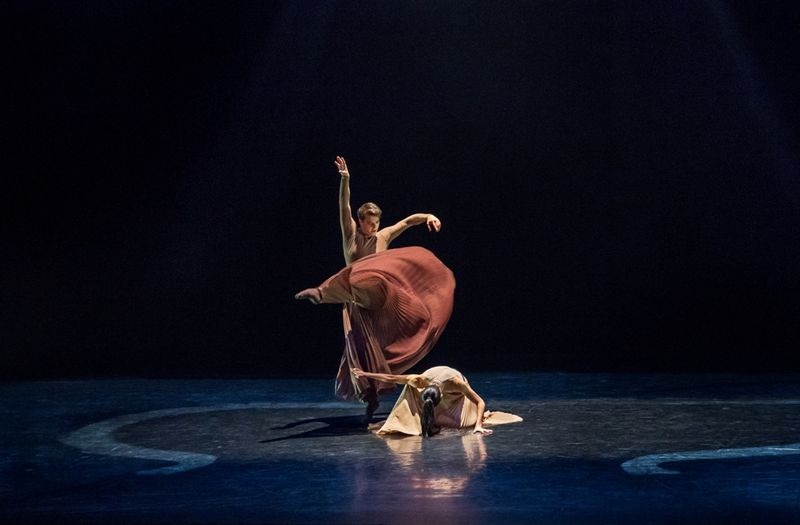
    The evening then soared to its conclusion with Andonis Foniadakis’ myth-inspired masterwork, Echo. It’s more a mood piece than a literal re-telling of the ancient tale of Narcissus and Echo, and as such it flows gorgeously upon Julien Tauride’s atmospheric score. The Graham Company’s beautiful pair of Lloyds – Mayor and Knight – create the illusion of Narcissus and his refection in deeply-enmeshed duets, their movement enhanced by their long sheer skirts (costumes by Anastasios Sofroniou) as caught in shadowy swirls by Clifton Taylor’s lighting design. PeiJu Chein-Pott is simply gorgeous as Echo, her dancing radiant and her creation of the character’s unspoken love and frustration literally becoming poetry in motion. In a supporting ensemble (as if such dancers can ever be thought of as merely ‘supporting’!) Tadej Brdnik, Ben Schultz, Abdiel Jacobsen, Natasha Diamond-Walker, XiaoChuan Xie, Charlotte Landreau, and Lauren Newman all wove into the marvelous mythic tapestry that Mr. Foniadakis has created.
    002_MG_8527

    Above: from Andonis Foniadakis’ Echo, Lloyd Mayor and PeiJu Chien-Pott; photo by Brigid Pierce

    So nice to see many dancer-friends among the crowd: Wendy Whelan, Mariya Dashkina Maddux, Jere Hunt, Justin Lynch, Jonathan Breton, and Alexandre Balmain; and of course my delightful companion of the evening, Roberto Villanueva. Special thanks to Janet Eilber, the dance world’s most gracious hostess, and to publicist Janet Stapleton for sending me the production photos with perfect timing. 
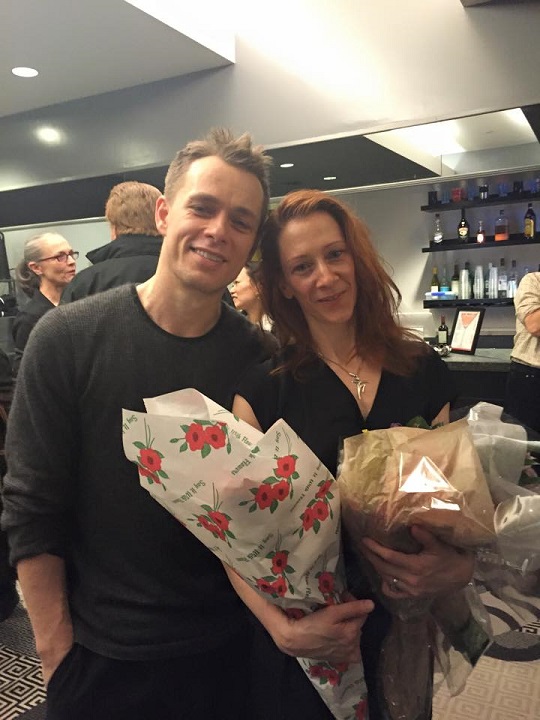
    11018652_10152754243055749_7393396627905223554_n

    Afterglow: Tadej Brdnik and Blakeley White-McGuire basking in the affectionate admiration of friends and fans after the performance. Photo courtesy of Karen Brounstein.

  • YCA Young Composers Concert @ Merkin Hall

    ComposersConcertslideSW_edited_output..fw_1

    Tuesday February 17th, 2015 – Young Concert Artists presenting an evening of chamber music by young composers at Merkin Hall. I invited my choreographer-friend Claudia Schreier to join me, as she is always in quest of music to set dances to.

    It was a cordial and wonderfully satisfying evening of music, the four composers showing an expansive range of styles and influences, and a fine mastery of writing for the chosen instruments. The level of playing was high and mighty, and how lovely to re-encounter Ursula Oppens, who throughout her career has been a champion of new music.

    3f573b6e43ae27169d0dd8cde6c2d7f6

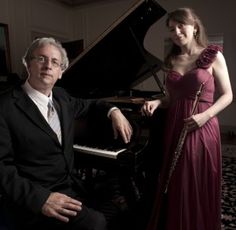
    Things got off to a shining start with BENJAMIN C.S. BOYLE‘s Sonata-Cantilena (NY premiere) performed by pianist Charles Abramovic and flautist Mimi Stillman (above). This four-movement work opens with a Debussyian shimmer; it wends its way thru melodious passages – sometimes doleful and sometimes evoking the warblings of exotic birds – with some sprightly, witty cascades of impetuous coloratura added to the mix. Ms. Stillman, in a fetching pale-violet frock, played beautifully and Mr. Abramovic was a congenially artful partner. 

    Ursula oppens pianist

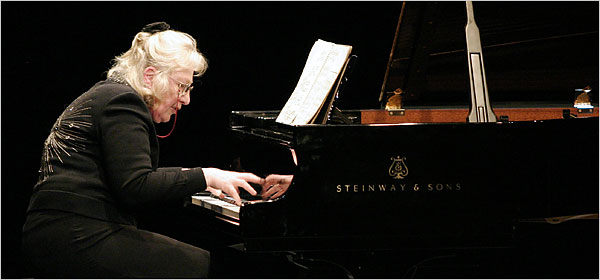
    Ms. Oppens (above) was then joined by violinist Paul Huang and clarinetist Narek Arutyunian for DAVID HERTZBERG‘s Orgie Céleste (Premiere), a fantastical evocation of heavenly delights. Complex and ear-tingling in its textures, much of the music has an ethereal quality as the piano and violin linger in their high registers; meanwhile the clarinet murmurs a two-note motif endlessly, like a subtly pulsing heartbeat. Mr. Huang showed extraordinary technical control as he met all the composer’s demands with alacrity, including some ironic glissandi. The intermingling of the three voices kept everything in a constant state of freshness, Ms. Oppens was wonderfully vivid in her silvery filigree and Mr. Arutyunian seizing melodic opportunities his mellow, expressive tone. The audience responded enthusiastically to both the music and the musicians.

    The only one of tonight’s composers previously familiar to me was KENJI BUNCH, who I had met several years ago while I was working at Tower Records. Since then I have heard quite a bit of his music, but I had not had the pleasure of hearing him play live. He’s a superb violist, with a marvelous mastery of the instrument, making it sing for him is two very contrasted works.

    Bunch (Kenji)--Monica Ohuchi(sm)

    Above: Kenji Bunch and pianist Monica Ohuchi

    In I Dream in Evergreen, Kenji revealed the viola’s depth of lyricism in a poignant reflection on the sundering aspects of death, when mortal friendships end and are transformed into memory. Ms. Ohuchi’s gently shimmering opening theme is soon joined by the viola intoning its poetic recollection of past affection and regret. Together the two musicians provided a reflective interlude, impeccably played.    

    Kenji’s Étude No. 4 (from a set of twelve études he composed for his wife, Ms. Ohuchi, under the title Monica’s Notebook) is a brief and brilliant piece. Lasting all of 90 seconds, it sends the pianist’s hands rippling up and down the keyboard in a delightful display of dexterity. Ms. Ohuchi nailed it, and she was rightly given sustained applause which wouldn’t quit til she returned for a solo bow (personally, I was hoping for an encore of the piece!)

    In Étouffée for solo viola, Kenji’s panoramic exploration of the viola’s possibilities was truly impressive and enjoyable; his playing is mesmerizing – there’s no other word for it. Inspired by a favorite dish from the Cajun culture, the work opens with a hazy, out-of-focus quality as if the viola was drunk on Southern Comfort. This evolves into a big country dance-tune, captivating in its combination of rhythmic drive and sexy rubato. Bravo, Kenji! His entire set was really impressive.

    OpusOne

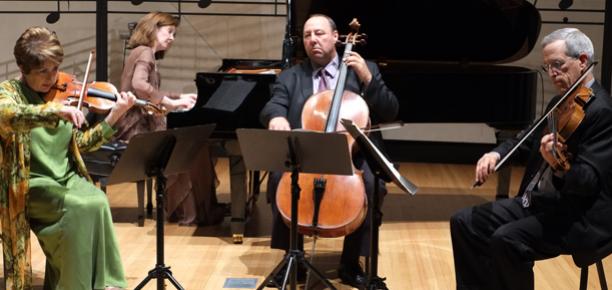
    Having musicians of the caliber of the Opus One quartet (above) play the New York premiere of your work must have given composer CHRIS ROGERSON a thrill. His Summer Night Music for Piano Quartet is full of musical marvels and how superbly it was played tonight by the Opus One artists: Ida Kavafian, violinist; Steven Tenenbom, violist; Peter Wiley, cellist; and Anne-Marie McDermott, pianist.

    In four movements, Summer Night Music opens with a sense of quietude at Twilight. First the cello, then viola, and then the violin introduce themselves in gentle motifs. Ms. McDermott reaches inside the body of the Steinway to pluck the piano’s strings as the cello murmurs plaintively and the violin plays high and pensive. In Fireflies, the piano spins forth with fluttering restlessness and sparkling little interjections. There’s a dense passage from all four players until, until – with a high fade-away from violin and piano – the memory of a Summer night slips away.

    The third movement, Evening Prayers, sounds like a gentle lullabye; the violin lingers on high and the viola and cello blend thru the music in simpatico phrases. The concluding Sleep Music commences with a gently vibrant quality, soft and high; a mellowness of cello and viola evoke deepening night. There is a broad melody for unison strings – and a passionate piano theme – before the music finally vanishes into thin air on Ms. Kavafian’s violin strings.

    10885560_575110625952729_3334037620464024949_n

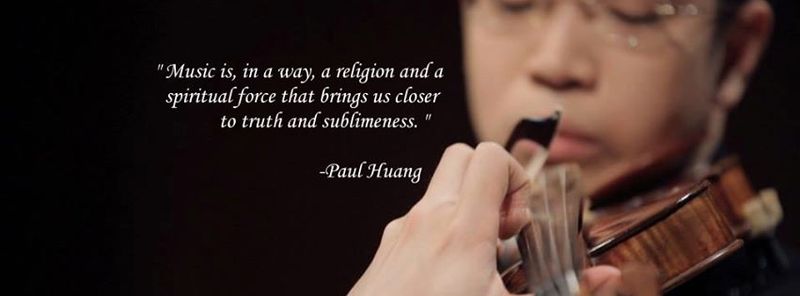
    In researching some of the participating artists, I came upon the above quote from the young violinist Paul Huang. He has expressed something here that I have always felt.

  • NY Philharmonic Ensembles: Concert @ Merkin Hall

    Penderecki

    Above: the composer Krzysztof Penderecki

    Sunday February 15th, 2015 matinee – This series of chamber music concerts by musicians from The New York Philharmonic looked so appealing when I saw the initial announcement. Due to my crowded calendar, this was my first opportunity to attend one of the concerts this season, and I’m most grateful to Lanore Carr of the Philharmonic for arranging it for me. Aside from the very interesting repertoire, the concert gave us an opportunity to ‘meet’ many of the Philharmonic’s artists in a more intimate setting. 

    Merkin Hall is a fine venue for chamber music – with a very clear acoustic – and the audience, who braved frigid temperatures to attend, were held in a sustained state of attentive delight by both the music and the playing.

    The outstanding contemporary Polish composer Krzysztof Penderecki’s String Trio was premiered in 1990 at Krakow. Today, cellist Nathan Vickery introduced the piece, citing the fact that Penderecki set out early in his career to write music that would antagonize his listeners, but that, over time, his approach mellowed.

    The String Trio is a vivid and very pleasing miniature – about 12 minutes long – and was played to perfection by Mr. Vickery with Quan Ge (violin) and Dawn Hannay (viola). After a slashing, jagged introductory phrase, the viola, then the cello, and then the violin make opening statements. The work takes on a conversational feel, as the instruments seem to murmur or chatter to one another with buzzing intimacy. The second movement is dance-like. All three players excelled in both tonal appeal and rhythmic surety. It was a bracing, lively performance, with intriguing touches of wit subtly expressed..

    Jean Sibelius’s String Quartet in D minor, Voces intimae, Op. 56 was the only familiar work on the programme. This is music rich in expressions of melancholy and tenderness – even the more animated passages have a rather forlorn undercurrent – and in introducing it, violist Irene Breslaw quoted Sibelius as saying it was “…music that brings a smile to your lips at the time of death.”

    The musicians – Anna Rabinova and Hyunju Lee (violins), Ms. Breslaw, and cellist Qiang Tu (superb depth of tone!) – vied with one another in poignancy of expression and beauty of line. Combined, their voices mingled in heartfelt harmonies, most especially in the quartet’s autumnal Adagio where their evocations of longing and regret spoke so deeply to me. In the scurrying finale, the players’ technical deftness was truly impressive.

    The chance to hear music by Vittorio Giannini was an important factor in wanting to attend this concert. This now-nearly-forgotten composer was so prolific, writing operas, symphonies, sacred works, chamber music, and songs. His sister, Dusolina Giannini, was an operatic soprano who sang two dozen performances at The Met from 1938-1941. Vittorio Giannini was well-regarded in his lifetime – he taught at Juilliard, The Manhattan School of Music, and the Curtis Institute, and he founded the North Carolina School of the Arts – and his music won favor with audiences. Yet he and his music seem to have lapsed into obscurity following his premature death in 1966 at age 63.

    Today we heard Vittorio Giannini’s Piano Quintet, and a gorgeous work it is! Melodically rich in the spirit of Puccini and Rachmaninoff, this quintet presents a rhapsodic blend of piano and strings in which theme follows theme in a steady flow of passionate lyricism. Giannini is so adept in his art that the music is able to speak directly to the heart without ever becoming cloying. Violinist Yulia Ziskel, commenting on the composer and his forgotten works, spoke of the ‘silver screen’ quality of certain passages of the quintet, and how right she was. But the music does more than just bathe the senses in a sea of opulent melodies, for the composer also shows a keen talent for rhythmic nuance. 

    Guest artist Keun A Lee – who I had heard previously playing for an Alek Shrader recital – was simply a luminous central force for the quintet. Her playing is elegant and generous, and she is also a delight to watch. Ms. Ziskel was joined by Shanshan Yao (violin), Rémi Pelletier (viola) and Mr. Vickery (cello). They played with warm resonance, most especially in the second movement where the cello takes the melodic lead (with the piano) which is then picked up by the viola. This adagio featured some of the evening’s most passionate playing. The third movement gets dance-y, developing a swaying effect at one point before swirling onwards to the fast and furious finale.

    Chamber music must be so rewarding to play; and imagine how delightful it must have been for these musicians to discover the Giannini anew. The caliber of playing was stellar, and this was a really engaging programme.

  • Gallery: Graham @ The Joyce 2015

    001_MG_6565

    Above: Blakeley White-McGuire in Martha Graham’s CHRONICLE; photo by Brigid Pierce

    Here are some images from the Martha Graham Dance Company‘s 2015 season at The Joyce. Read about the first of three programmes the Company are presenting here.

    Click on each production photo to enlarge:

    002_MG_6695 (1)

    Above: the women’s ensemble in CHRONICLE, photo by Brigid Pierce

    001_MG_4839 (1)

    Above: Abdiel Jacobsen as Adam and Carrie Ellmore-Tallitsch as Lilith in Graham’s EMBATTLED GARDEN; photo by Brigid Pierce

    003_MG_2240

    Above: Tadej Brdnik (at the right) in Nacho Duato’s RUST; photo by Brigid Pierce

    There are new additions to the Graham company’s on-going LAMENTATION VARIATIONS project this season: 

    006_Christopher.Jones_003 (2)

    Above: from Sonya Tayeh’s LAMENTATION VARIATION, an ensemble work; photo by Christopher Jones.

    002_MG_3010

    Above: from Kyle Abraham’s LAMENTATION VARIATION, as danced by XiaoChuan Xie and Ying Xin, photographed by Brigid Pierce 

    004_MG_3037

    005_MG_3075

    Kyle’s Variation is being performed by alternating casts of two women (Ying Xin and XiaoChuanXie, above, in two more Brigid Pierce images)…

    150107_MGDC_KyleAbraham_LamenatationSeries_LLoydKnight_LloydMayor_SunyPurchase_Christopher.Jones_001

    …and two men: Lloyd Knight and Lloyd Mayor, photographed by Christopher Jones. [Note: the Lloyds are wearing shirts in this photo; in performance they danced bare-chested.]

    Peter Arnell’s marvelous photo-montage of the Graham dancers, which is being shown at every performance during the current Joyce season, may now be viewed here, at VOGUE. A couple of stills, below, will give you an idea of what this ‘moving picture’ is like:

    Image001

    Image004

    Catch these fabulous dancers thru February 22nd at The Joyce. Details here.

  • New Chamber Ballet: Gallery

    Entangled ncb

    Images from New Chamber Ballet‘s February 2015 performances at City Center Studios have come my way. Read about the evening here. Above, from Miro Magloire’s ballet ENTANGLED; the dancers are Sarah Atkins and Traci Finch. The above photo and the following images from Miro’s ballet RAW are provided by courtesy of New Chamber Ballet:

    IMG_6772_edited

    From RAW: the dancers are Traci Finch and Amber Neff

    IMG_6804_edited

    RAW: Traci Finch, Amber Neff

    IMG_6819_edited

    RAW: Amber Neff, Traci Finch

    IMG_6836_edited

    RAW: Amber Neff, Traci Finch

    IMG_6983_edited

    From Miro Magloire’s RAW: Amber Neff, Traci Finch

    The costume designs for both RAW and ENTANGLED are by Sarah Thea. She provided the following photos from ENTANGLED, used with permission:

    DSC_0571_edited

    Traci Finch, Sarah Atkins

    DSC_0926_edited

    Traci Finch, Sarah Atkins

    10987575_821115211937_7307417082433706898_n

    Above: pianist Melody Fader; photo by Cherie B

    Live music is a key element at all New Chamber Ballet performances. Pianist Melody Fader has been Miro’s collaborator for several seasons and, along with violinist Doori Na, she makes the music an integral factor in the audience’s enjoyment of NCB evenings. Melody is currently in the midst of a Kickstarter campaign to develop funding for her chamber music project, something that’s dear to her heart. You can find out all about it – and help make it happen – here.

    New Chamber Ballet‘s next performances will be April 17th and 18th, 2015. Information about repertory and tickets will be forthcoming.

  • First Breath: Photography by Travis Magee

    Image1

    On January 31st, 2015, photographer Travis Magee opens a solo show entitled First Breath, at the Film Society of Lincoln Center’s Frieda and Roy Furman Gallery. The gallery is adjacent to the Walter Reade Theater, on the upper tier of the north side of the Lincoln Center campus.

    “Travis Magee’s photographs are like compelling choreography. There seems always to be an implied narrative, but it is up to the viewer to decipher and to decide for themselves what the hell is going on!” says acclaimed dancer and choreographer Sean Curran.
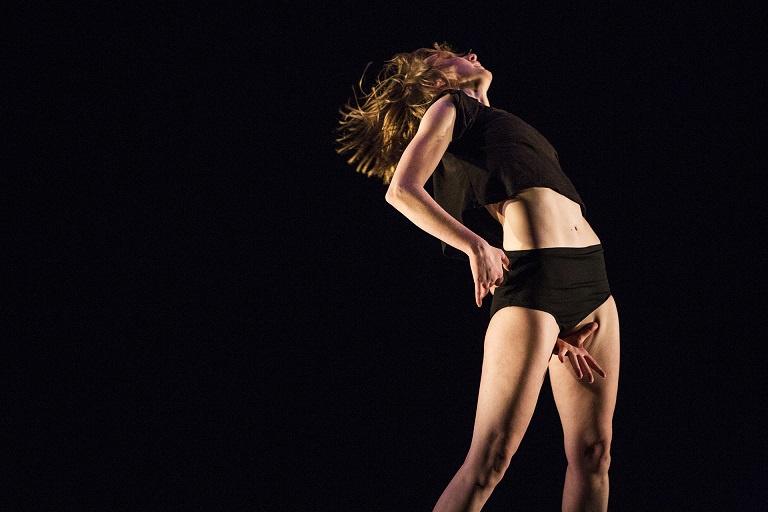
    I first met Travis thru his work as a dancer with Cherylyn Lavagnino Dance. He recently produced a vivid portfolio of images from a rehearsal of Parsons Dance for Oberon’s Grove, and I’m looking forward to working with him again in the near future.

    Check out Travis’s striking photographs at the Frieda and Roy Furman Gallery where the show – in conjunction with the Dance on Camera Festival – runs thru February 11th, 2015.

  • Gallery: Intermezzo Dance Company

    _G1A1695

    Above: Amber Neff, Abi Stafford (NYC Ballet principal), and Shoshana Rosenfield in Craig Salstein’s THE MYTH OF SISYPHUS; photo by Sarah Sterner

    On January 17th and 18th, 2015, Intermezzo Dance Company, founded and directed by ABT soloist Craig Salstein, offered a programme of works by five choreographers at Columbia University’s Miller Theatre. The theme of the evening, From Myth to Philosophy, was echoed in a gallery of artwork by four New York City-based artists in the theatre lobby.

    Since I was involved in the planning stages of the programme, I feel I cannot write a review per se, beyond saying that the five ballets were well-contrasted in style and music, and that there was some very fine dancing to be seen.

    Photographer Sarah Sterner has provided some images from the Myth to Philosophy programme, and I am sharing them here as a representation of the works performed and the dancers who took part:

    _G1A1565

    Mauro Villanueva in Craig Salstein’s THE MYTH OF SISYPHUS

    _G1A1640

    Amber Neff in Craig Salstein’s THE MYTH OF SISYPHUS

    _G1A1376

    ABT’s Nicole Graniero with the Intermezzo ensemble in Gemma Bond’s MYTHOLOGY

    _G1A1343

    Tanner Schwartz in Gemma Bond’s MYTHOLOGY

    _G1A1800

    Rina Barrantes, Alfredo Solivan, and Temple Kemezis in Cherylyn Lavagnino’s HERA’S WRATH

    _G1A1850

    Temple Kemezis and Rina Barrantes in Cherylyn Lavagnino’s HERA’S WRATH

    _G1A1953

    Kaitlyn Gilliland in Adam Hendrickson’s BLACK IS THE COLOUR OF MY TRUE LOVE’S HAIR 

    _G1A1147

    Kaitlyn Gilliland in Adam Hendrickson’s BLACK IS THE COLOUR OF MY TRUE LOVE’S HAIR

    _G1A2021

    Nicole Graniero (ABT) in Ja’ Malik’s JOURNEY TO PANDORA

    _G1A2102

    Oliver Swan-Jackson in Ja’ Malik’s JOURNEY TO PANDORA

    _G1A2300

    Rina Barrantes, Nancy Richer, and Giselle Alvarez in Ja’ Malik’s JOURNEY TO PANDORA 

    _G1A0781

    Nicole Graniero in Ja’ Malik’s JOURNEY TO PANDORA

    All photos by Sarah Sterner.

  • Tawny Chapman Residency @ CONTINUUM

    L1530798

    Above: Tawny Chapman with CONTINUUM‘s Donna Salgado, Vanessa Salgado, Courtney Sauls, Laura DiOrio, and Dorrie Garland 

    Wednesday January 21st, 2015 – Backhausdance, a California-based company, performed at Joyce SoHo (boy, do I miss that place!) in 2010. I liked their programme a lot, and so I was glad today to have a chance to meet Tawny Chapman from Backhausdance while she’s in NYC as artist-in-residence at Donna Salgado’s CONTINUUM Contemporary Ballet.

    “It’s not what you look at that matters, it’s what you see.” – Henry David Thoreau. That quote was a springboard to what Tawny and the CONTINUUM dancers were working on, constructing signature phrases that evolved into dance.

    L1530821

    Dorrie Garland and Courtney Sauls

    L1530747

    Vanessa Salgado

    L1530908

    Laura DiOrio

    L1530724

    Courtney Sauls

    L1530634

    The group

    Dorrie and Courtney worked together on a duet created to be danced in a very limited space. Some photos from this duet may be found in this Facebook album.

    Backhausdance will be performing at the Schimmel Center in New York City on February 27th and 28th, 2015. Details here. Very much worth seeing! 

  • NYCB: Opening Night|Winter Season 2015

    Balanchine-Stravinsky-1965

    Above: George Balanchine and Igor Stravinsky

    Update: Happy Birthday Mr. B ~ January 22nd!

    Tuesday January 20th, 2015 – An all-Balanchine evening to open the New York City Ballet‘s Winter 2015 season. In the days leading up to the performance there were several changes to the originally-announced casting, and it all turned out very well. Clothilde Otranto was on the podium to bring us the three contrasting scores, and the spirit of Balanchine hovered overall. 

    SERENADE received a performance aglow with lyricism; having recently heard the score played at Carnegie Hall, I was again thinking how Balanchine’s choreography is so intrinsically linked to the music: when you hear it played anywhere you immediately see the dance.

    Sterling Hyltin graced the enchanting melodies with her unique mixture of sophistication and impetousity; I wonder what perfume Mr. B would have chosen for her? There was a wonderful chemistry between Sterling and Robert Fairchild, especially in the passage where he pursues her around the stage: she draws him onward, elusive but always looking back to gently reassure him. This was just one of many such nuanced moments in their partnership tonight. As the ballet seems to take a darker turn, Sterling’s vulnerability came into play…so movingly. During the intermission, we sought superlatives to describe this ballerina’s performance: yet none seemed to suffice, really. So we simply basked in her beautiful glow.

    Erica Pereira could celebrate her birthday a day early with a new role: the Russian Girl, to which she initially brought an airy charm; as the ballet progressed, Erica found deeper hues of feminine resonance in her role. She was especially lovely in the opening of the third movement, dancing with the her four sisterly demi-solistes (Mlles. Adams, Dronova, Mann, and Sell) and later, her lustrous black hair flowing free, Erica rushed into Ask LaCour’s waiting arms with a sense of urgent grace.

    Teresa Reichlen, after swirling thru her elegant pirouettes earlier on, drew sighs of admiration for her sustained supported arabesque in the final movement, always a heart-filling moment. She danced radiantly, whetting the appetite for her upcoming debut in CHACONNE.

    Throughout the ballet, the corps ballerinas provided so many moments to savour, both as individuals and in the ensemble passages which Mr. B wove for them with such an imaginative sense of visual poetry. I wanted to throw roses onstage for all of them.

    AGON tonight was a triumph, with a powerful performance of the central pas de deux by Maria Kowroski and Amar Ramasar. At their charismatic finest, these two dancers displayed the amazing stretch, uncanny pliability, and dynamic counter-balances that Mr. B demands of them. Their bold physicality clearly captivated the crowd who wouldn’t stop applauding until Maria and Amar had bowed three times.

    Andrew Veyette’s wonderfully strong and supple dancing and his brazen high kick put a personal stamp on his solo. The masculine vigor of his presence held our focus whenever he was onstage. Likewise, Megan LeCrone made an excellent impression with her poised, steady balance and authoritative movement. Demi-solistes get to shine in AGON and tonight we had Lauren King, Ashley Laracey, Devin Alberda, and Daniel Applebaum all on peak, opening-night form. The quirky Stravinsky score continues to prick up our ears, no matter how many times we’ve heard it.

    That bountiful ballerina, Ashley Bouder, took command of the opening movement of SYMPHONY IN C. Dancing with her emblematic generosity, technical dazzle, and a touch of playful rubato, she not only illuminated the Allegro Vivo but continued to dance with outstanding clarity and musicality in the ballet’s demanding finale. Chase Finlay kept pace with her and was a handsome-as-ever cavalier. Particular pleasure was derived from watching the two ballerina demis in this opening movement: Claire Kretzschmar and Meagan Mann. They have a lot to do and they did it brillliantly.

    Sara Mearns, dancing with velvety sumptuousness and her own particular mystique, was partnered with gallant grace by Jared Angle. They made the Adagio – one of the wonders of Balanchine’s world – as breath-taking as it should be, with a slow, gorgeous melt into the final pose. Their artistry and lyrical poise made this duet a bulwark of beauty in a darkening world. 

    Further illumination came as Lauren Lovette and Gonzalo Garcia filled the space with swirling vibrancy in the Allegro Vivace. They are a marvelous match-up: a fetching ballerina and a prince of a cavalier. Let’s see them together again soon: so many possibilities.

    Brittany Pollack opened the finale with some sparkling combinations, soon joined by the fascinating Adrian Danchig-Waring, a man who mixes classicism and dynamic strength in perfect measure. The stage then filled with all my beloved NYCB dancers and the evening swept on to its imperial conclusion.

    A word of praise for all the demi-solistes in the Bizet; their role in this ballet is so much more than decorative. So thanks to all: Meagan and Claire (already noted for their excellence), Andrew Scordato, Joshua Thew, Jenelle Manzi, Sarah Villwock, Lars Nelson, Devin Alberda, Mary Elizabeth Sell, Gretchen Smith, Peter Walker, Daniel Applebaum, Alina Dronova, Ralph Ippolito, Troy Schumacher and Kristen Segin (who had also made her mark in SERENADE)…and indeed to everyone who made this a grand night for dancing.