Category: Music

  • Aldo Protti’s Prologo…and Credo

    5a98e51316e41

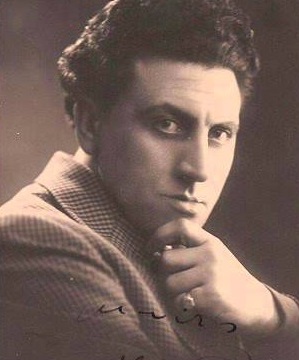
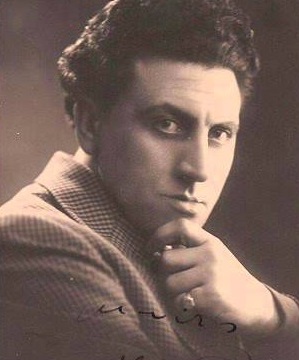
    The Italian baritone Aldo Protti (1920-1995) was a native of Cremona. He studied at Parma, and made his operatic debut in 1948, at the Teatro Pergolesi in Jesi, as Rossini’s Figaro. Within two years, he was at La Scala, singing Amonasro in AIDA. From that point forward, Protti sang in Italy’s leading theaters as well as making guest appearances in Vienna; he participated in several broadcasts for the RAI, and in 1957 sang at Lyric Opera of Chicago as Barnaba (GIOCONDA) and Marcello (BOHEME).

    Protti made important recordings for Decca, including a 1954 OTELLO with del Monaco and Tebaldi, Alberto Erede conducting. When Herbert von Karajan planned his stereo-remake of that Verdi opera for Decca in 1961, Ettore Bastianini was chosen to sing Iago. But Bastianini had failed to learn the part, so Karajan called upon Protti to repeat the role; the baritone surpassed his earlier recorded portrayal both vocally and in terms of characterization.

    In 1985, at the age of 65, Protti sang a single performance as Rigoletto at The Met. He then joined the Company on tour, singing the role in six cities (including in Boston, where his Gilda was Roberta Peters in her final performance with The Met). He sang Rigoletto twice more, in concert form, with The Met in the Parks.

    Rigoletto was Protti’s most frequent role, which he performed 425 times in all; Scarpia, Count di Luna, and and Iago each figured prominently in his repertoire, with 100 performances of each role in his résumé.

    Also Protti passed away at Cremona in 1995.

    Aldo Protti – Prologo ~ PAGLIACCI

    Aldo Protti – OTELLO ~ Credo – Karajan cond

    ~ Oberon

  • Aldo Protti’s Prologo…and Credo

    5a98e51316e41

    The Italian baritone Aldo Protti (1920-1995) was a native of Cremona. He studied at Parma, and made his operatic debut in 1948, at the Teatro Pergolesi in Jesi, as Rossini’s Figaro. Within two years, he was at La Scala, singing Amonasro in AIDA. From that point forward, Protti sang in Italy’s leading theaters as well as making guest appearances in Vienna; he participated in several broadcasts for the RAI, and in 1957 sang at Lyric Opera of Chicago as Barnaba (GIOCONDA) and Marcello (BOHEME).

    Protti made important recordings for Decca, including a 1954 OTELLO with del Monaco and Tebaldi, Alberto Erede conducting. When Herbert von Karajan planned his stereo-remake of that Verdi opera for Decca in 1961, Ettore Bastianini was chosen to sing Iago. But Bastianini had failed to learn the part, so Karajan called upon Protti to repeat the role; the baritone surpassed his earlier recorded portrayal both vocally and in terms of characterization.

    In 1985, at the age of 65, Protti sang a single performance as Rigoletto at The Met. He then joined the Company on tour, singing the role in six cities (including in Boston, where his Gilda was Roberta Peters in her final performance with The Met). He sang Rigoletto twice more, in concert form, with The Met in the Parks.

    Rigoletto was Protti’s most frequent role, which he performed 425 times in all; Scarpia, Count di Luna, and and Iago each figured prominently in his repertoire, with 100 performances of each role in his résumé.

    Also Protti passed away at Cremona in 1995.

    Aldo Protti – Prologo ~ PAGLIACCI

    Aldo Protti – OTELLO ~ Credo – Karajan cond

    ~ Oberon

  • CMS Summer Evenings 2023 ~ Concert 4

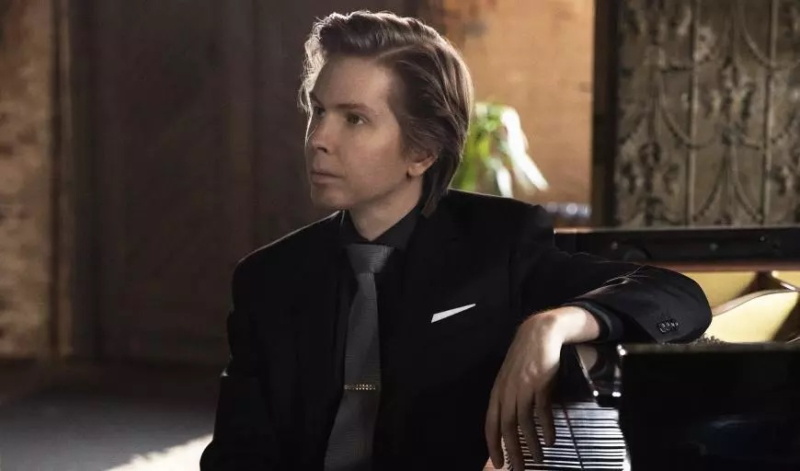
    Juho_Lisa-Marie Mazzucco jpg

    Above: pianist Juho Pohjonen, photo by Lisa-Marie Mazzucco

    Author: Oberon

    Tuesday July 18th, 2023 – The final concert in Chamber Music Society of Lincoln Center‘s 2023 Summer Evenings series presented a quintet of distinctive artists in music of Haydn, Mozart, and Fauré. The remarkable Finnish pianist Juhi Pohjonen was at the center of this engrossing program, playing in all three works with the combination of passion and subtlety that is his trademark.

    Haydn’s Trio in E-flat major for Violin, Cello and Piano, Hob. XV:29, dating from 1797, made for an elegant start to the evening. The opening Poco allegretto commences with a sustained note from the three artists: violinist Stella Chen, cellist Sihao He, and Mr. Pohjonen. The music then progresses in a ‘theme and variations’ setting, briefly entering the minor mode. The pianist’s rippling florid passages delighted the ear, whilst violin and cello duetted lyrically.

    The pianist opens the Andante with the most delicate of pianissimi, taking up a simple melody in which the three voices blend sweetly. The ebb and flow of passion and restraint leads to a mini-cadenza from the pianist before the Allemande finale kicks off with a burst of energy.  Mr. Pohjonen spins off immaculate fiorature laced with trills, whilst Sihao He offers rapid cello scalework. After pausing for a playful piano passage, the music dances on: winding down, only to re-boot to a zesty finish.

    Mozart’s Concerto No. 12 in A -major for Piano and String Quintet, K. 414, was written in 1782 for the composer himself to perform, with a small ensemble; the string quartet setting was created later. This piece offers a perfect showcase for Mr. Pohjonen’s artistry.

    The opening Allegro features genial strings: violist Beth Guterman Chu has joined violinists Stella Chen and Danbi Um, with Sihao He’s mellow sound enriching the harmonies. Mr. Pohjonen’s marvelous tone and sparkling agility are pure magic. Ms. Guterman Chu, with a gleam in her eye, is a wonderful addition to the ensemble, whilst Sihao He’s rich-toned descending motifs are truly appealing. At last comes a fabulous Pohjonen piano cadenza, so gracefully played.

    The Andante suffered from the intrusion of two dropped objects and a jangling cellphone, but the artists kept their focus, opening with a string quartet. Mr. Pohjonen’s nuanced playing was just sublime, and I must again praise Sihao He’s plush sound. A minor-key piano passage underlined by sighing strings achieves a marvelous blend, and Mr. Pohjonen’s cadenza was offered in a hushed pianissimo, with trills etched in.

    The final Rondeau: Allegretto is lively indeed, with nimble, utterly clear piano phrases and unison string passages, which eventually develop into a fugue. Full stop…and then the pianist’s virtuosity was in full   flourish, pausing only for some enticing delicate measures along the way. Bravo Juho!

    Following a rather longish the interval, Gabriel Fauré’s Quartet in C-minor for Piano, Violin, Viola, and Cello No. 1, Op. 15, was given a luminous performance by Mr. Pohjonen, Danbi Um, Beth Guterman Chu, and Sihao He.

    The opening Allegro molto moderato momentarily has an à la Russe feeling, later becoming quietly rapturous. A piano theme is soon taken up by Danbi Um’s silken violin, then passed on to Ms. Chen and Ms. Guterman Chu. The music becomes overwhelmingly beautiful and passionate, before turning more lyrical. Mr. Pohjonen’s sorcery is again evidenced in the movement’s sustained conclusion.

    Delicate plucking opens the Scherzo, with sprightly motifs from the Steinway: all is lightness and air. Rhythms compete, the music covering a broad dynamic range with shifts of energy. After a false finish, the piano gently resumes. The unison strings then part company, taking up slithering scales. The music dances on, full of fun.

    Sihao He introduces the Adagio with an achingly gorgeous theme; the strings unite, and the pianist is at his most pensive. Danbi Um’s violin sounds radiantly, whilst the violist and cellist, playing in unison, introduce darker hues. These lower voices join Danbi in poignant harmonies. The music is lush and passionate until a sudden mood swing comes from the piano, playing pianissimo.  The the opening cello solo returns, and a feeling of time standing still gave me the chills…so haunting. Then Mr. Pohjonen offers a final benediction.

    In the final Allegro molto, we can simply sit there and savour the vibrant playing that’s on offer. Juho is beyond splendid, and bits of melody are passed about among the string players. After a brief interlude, the music seems to be summoning energy for a big finish, but instead there’s a full stop. From the silence, Danbi Um’s exquisite sound emerges, opening a pathway to a grand and sweeping finish.

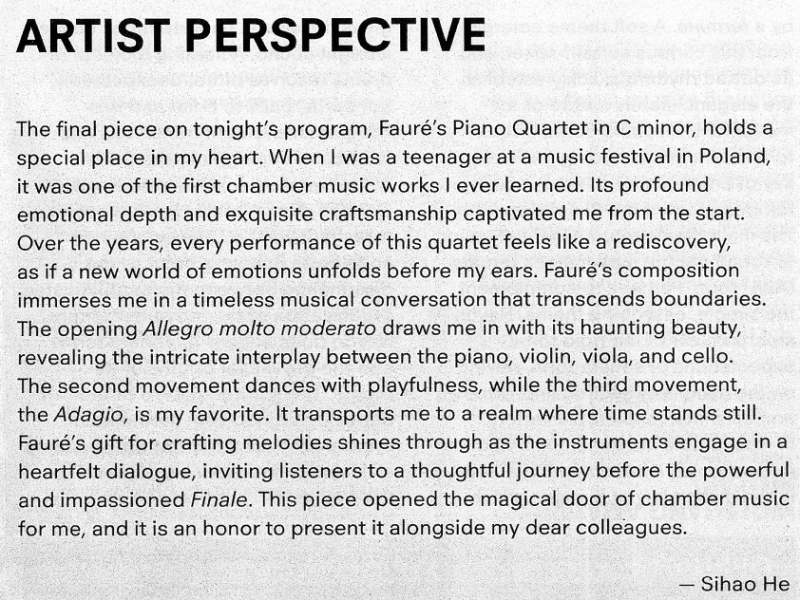
    Cellist Sihao He wrote of his experience learning the Fauré C-minor quartet as a teenager; I wanted to include his thoughts about the work here, as they align perfectly with my own:
    Faure-1 jpg

    ~ Oberon

  • Samuel Barber ~ Symphony #1

    Samue barber

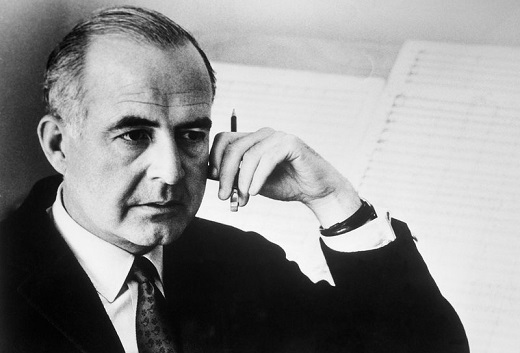
    Above: Samuel Barber (1910-1981)

    The Chicago Youth Symphony Orchestra, conducted by Allen Tinkham, in a 2018 performance of Samuel Barber’s Symphony #1, Opus 9.

    Watch and listen here.

  • Haitink Conducts DIE WALKURE ~ Act I

    Snapshot haitink

    Sir Bernard Haitink (above) conducts the first act of Wagner’s DIE WALKURE at a concert given by the Royal Concertgebouw Orchestra at Amsterdam on February 24th, 2008. The soloists are Eva-Maria Westbroek, Clifton Forbis, and Sir John Tomlinson.

    Watch and listen here.

  • Bach & Handel – Orchestra of St. Luke’s

    Screenshot 2023-06-19 at 06-50-56 Events (2)

    Above: Hugh Cutting

    ~ Author: Oberon

    Tuesday June 17th, 2023 – The Orchestra of St. Luke’s, conducted by Bernard Labadie, presenting countertenor Hugh Cutting in a program of music by Bach and Handel at Zankel Hall.

    The players of St. Luke’s, led by their gracious concertmaster, Krista Bennion Feeney, set the mood of the evening with a cordial performance of the Sinfonia from the Bach cantata “Wir müssen durch viel Trübsal” (“We must pass thru great sorrow”), BWV 146, featuring organist Avi Stein. This music drew us in with its melodic flow and rhythmic grace. A key element of the entire program was the rich double-bass playing of John Feeney: like the heartbeat of the universe.

    Mr. Cutting then took the stage; blonde and boyish, he reminds me a bit of cellist Jonathan Swensen. In Bach’s immortal “Vergnűgte Ruh” BWV 170, Mr. Cutting’s lovely clarity of tone, his mastery of dynamics, and his intriguing personality at once engaged us; it was easy to understand why, in 2021, he was the first countertenor to win the Kathleen Ferrier Award. The voice effortlessly fills the hall, and his gorgeous straight-tone notes, gradually infused with a touch of sensuous vibrato, were spine-tingling.

    The second half of the program was given over to Handel, commencing with the overture to Giulio Cesare, which was the very first music of Handel I ever heard in live performance…yes, the night of Beverly Sills’ triumphant Cleopatra at New York City Opera. Mr. Cutting then offered a sly and captivating rendering of Cesare’s ‘hunting’ aria, “Va tacito e nascosto” from Giulio Cesare, with Zohar Schondorf playing the demanding horn part. The two gentlemen seemed to revel in their duetting, bowing to one another at the aria’s finish.

    The charismatic Mr. Cutting then switched characters to offer Tolomeo’s angry aria, “L’empio, sleale, indegno!” from Giulio Cesare. With acting as vibrant as his singing, he has a wonderful gift for ornamentation, reveling in his technical prowess, much to the audience’s delight.

    A four-movement suite from Handel’s Ariodante featured some nimble playing from bassoonist Shelley Monroe Huang in the second and fourth movements. In the third, marked Allegro, Maestro Labadie set an exhilarating pace, and then accelerated to the finish line.

    Mr. Cutting brought vibrant dramatic accents to the opening recitative “Otton, qual portenso fulmine è questo?” from Agrippina; then, in the pensive aria “Voi che udite“, he was at his most affecting, his singing seconded to lovely effect by oboist Melanie Feld. In the da capo, Mr. Cutting’s voice was incredibly moving. Here again, Mr. Feeney’s double bass was so poignant.

    In “Furibondo spira il vento” from Handel’s Partenope, the singer tossed off Handel’s florid demands with stunning virtuosity: his scale passages swift and sure, his low notes lending dramatic vitality. This incredible showpiece caused the audience to erupt in cheers and applause at the end. Mr. Cutting was called back three times; the crowd so wanted an encore, but none was forthcoming.

    We must hear this voice again, and soon. There is so much music I want to hear him sing.

    ~ Oberon

  • Claire Chase ~ Density 2036 @ Zankel Hall

    Claire chase

    Above: Claire Chase

    Author: Shoshana Klein

    Thursday May 25th, 2023 – Claire Chase’s Density 2036 project is long and ambitious: a 24-year long project of new commissions, inspired by Varèse’s famous flute piece Density 21.5. Each year, she performs an entire new program of works. This year, she’s 10 years into the project, so the 10 days leading up to this concert have been a recap of all of these new pieces, culminating in Thursday’s world premiere of a 50-minute chamber piece by Anna Thorvaldsdottir named Ubique. For this evening’s piece, the ensemble was composed of Claire Chase, flutes; Katinka Kleijn and Seth Parker Woods, cellos; Cory Smythe, piano; and Levy Lorenzo, live sound. The concert started with a conversation between Ara Guzelimian and Thorvaldsdottir, who described a blank page at the beginning of a composition as freeing – that composing a piece “starts with a sensation – finding something that doesn’t exist yet”

    The introduction – which turned out to be a recurring theme – was a deep, low rumbling (not unlike the sound the subway makes in Zankel Hall, begging the question if that was an intentional move by the composer writing for the hall). There was striking low lighting around the ensemble, really creating a space that brought you into the beginning of the performance. The lighting changed throughout the piece in a way that was engaging and followed the different sections – adding some literal color changes to the musical color changes, very tastefully.


    The piece seemed to have many movements (though if so, they weren’t indicated in the program) – some quite short and full of quick gestures and handoffs, others more slow-moving. There were more sections and honestly more tonality than I was expecting from Thorvaldsdottir. There were a few parts where bass flute and the two cellos mixed in really interesting ways – Thorvaldsdottir is always one for unique texture and sound, and this piece was no exception.


    At about 40 minutes into the 50-minute piece, Chase finally picked up a C flute, as opposed to the Contrabass flute (named Bertha, as we were told in the pre-concert conversation) and the regular bass flute (whose name I do not know) that she’d been playing so far. The “regular” flute at this point in the piece was strangely light and really felt like a different world – a change from the usual where the lower flutes have the otherworldly feeling.


    I didn’t feel like I got a good sense of the structure of the piece, but I still enjoyed it, and the recurring rumbling theme gave it some sense of unity. I imagine it would be interesting to be keeping up with the entire project of new flute works and really get to know Chase’s playing – undoubtedly her style influences all of these new commissions, and her explicit goal is for the new pieces to “expand the boundaries of the instrument”. It’s also worth mentioning that as ambitious as it sounds that Claire Chase played a full length recital every night for 10 nights this month, the plan for the final concert of Density 2036 is for her to put on a 24-hour long concert with all of the new music commissioned throughout the project. 


    ~ Shoshana Klein

  • ORPHEUS: A Paul Robeson Celebration & “Egmont”

    Carnegie hall

    ~ Author: Oberon

    Saturday May 20, 2023 – ORPHEUS presenting the world premiere of Jasmine Barnes’ Songs of Paul, celebrating the 125th birthday of the great singer/activist Paul Robeson; this was followed by Beethoven’s Egmont in an arrangement by Andreas Tarkmann, with a new translation of the narrative by Philip Bohem. Soprano Karen Slack and baritone Will Liverman were the excellent soloists for the Barnes, and Ms. Slack also sang the soprano arias in the Beethoven, sharing the stage with the inimitable Christine Baranski, who was the Narrator. 

    Robeson

    Above: Paul Robeson

    Ms. Barnes’ new work was warmly received by the audience tonight; her arrangements are beautiful, and were finely played by the artists of ORPHEUS. Sometimes the music seemed too symphonic, detracting a bit from the voices; I grew up hearing these songs on my grandmother’s 78s, with Lawrence Brown playing piano, and the orchestral settings tonight at times felt too glossy. Be that as it may, the songs were superbly sung by Will Liverman (“Didn’t My Lord Deliver Daniel?”, “Deep River”, “Swing Low, Sweet Chariot”, and “Sometimes I Feel Like a Motherless Child”) and Karen Slack (“There’s A Man Going Round Taking Names” and “My Soul’s Been Anchored in the Lord“). The two singers joined together for a grand finale, starting with the profound “Go down, Moses” which gave way to the rousing “Joshua Fit the Battle of Jericho“. Both singers sounded marvelous in the great Hall; composer Jasmine Barnes joined them for a bow, to loud cheers from the crowd.

    Egmont jpg

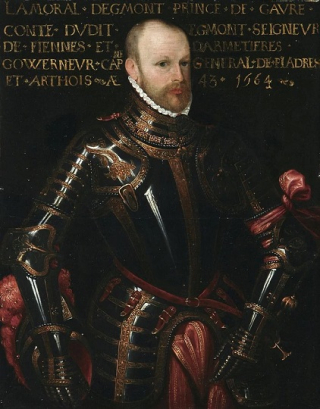
    The Beethoven did not seem the right companion piece to the Robeson fest this evening; though both Paul Robeson and Lamoral of Egmont were idealists and freedom fighters, that is their only real connection. There was a feeling of restlessness in the Hall as the Beethoven went on, and at least four different cellphones went off, which was distracting. At any rate, Egmont is not one of Beethoven’s masterpieces; the music mostly feels dutiful rather than inspired.

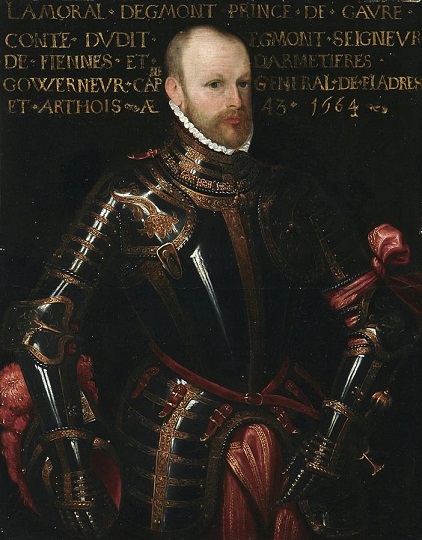
    The historical story of Lamoral of Egmont (above) began in Brussels, in the second half of the 16th century. The Low Countries, under the heavy yoke of Philip II and his Spanish Inquisition – reference Verdi’s DON CARLO – found their civil rights curtailed and the Protestant movement crushed. Egmont, although himself a loyal Catholic, went to Madrid to plead for clemency for the Protestants. He was received with honors by King Philip, but when Egmont returned to his homeland, the king sent the Duke of Alva to Brussels to squash all resistance to Spain’s will. Egmont was imprisoned and eventually executed for treason; his martyr’s death roused the Lowlanders to rebel and cast off their Spanish overlords.

    Beethoven took up the tale of Egmont in 1809, when he was commissioned to compose incidental music for the Vienna premiere of the Goethe play. Beethoven composed a set of musical numbers for Egmont, beginning with the dramatic overture, now a free-standing staple of the concert repertory. There are four entr’actes, two songs for Klärchen, and the final scenes of Egmont’s trial and death. It ends with Egmont’s exultant call to the people to overthrow their oppressors: “Defend your land! And to liberate your loved ones, give yourselves joyously, as I do now, for you!”

    Ms. Baranski, clad all in white, read the narrative, which veers from poetic to melodramatic, with her distinctive voice and innate sense of drama. Ms. Slack sang Klärchen’s two brief arias attractively. The orchestra – all evening – played splendidly, with several notable solo passages for the winds.

    ~ Oberon

  • ORPHEUS: A Paul Robeson Celebration & “Egmont”

    Carnegie hall

    ~ Author: Oberon

    Saturday May 20, 2023 – ORPHEUS presenting the world premiere of Jasmine Barnes’ Songs of Paul, celebrating the 125th birthday of the great singer/activist Paul Robeson; this was followed by Beethoven’s Egmont in an arrangement by Andreas Tarkmann, with a new translation of the narrative by Philip Bohem. Soprano Karen Slack and baritone Will Liverman were the excellent soloists for the Barnes, and Ms. Slack also sang the soprano arias in the Beethoven, sharing the stage with the inimitable Christine Baranski, who was the Narrator. 

    Robeson

    Above: Paul Robeson

    Ms. Barnes’ new work was warmly received by the audience tonight; her arrangements are beautiful, and were finely played by the artists of ORPHEUS. Sometimes the music seemed too symphonic, detracting a bit from the voices; I grew up hearing these songs on my grandmother’s 78s, with Lawrence Brown playing piano, and the orchestral settings tonight at times felt too glossy. Be that as it may, the songs were superbly sung by Will Liverman (“Didn’t My Lord Deliver Daniel?”, “Deep River”, “Swing Low, Sweet Chariot”, and “Sometimes I Feel Like a Motherless Child”) and Karen Slack (“There’s A Man Going Round Taking Names” and “My Soul’s Been Anchored in the Lord“). The two singers joined together for a grand finale, starting with the profound “Go down, Moses” which gave way to the rousing “Joshua Fit the Battle of Jericho“. Both singers sounded marvelous in the great Hall; composer Jasmine Barnes joined them for a bow, to loud cheers from the crowd.

    Egmont jpg

    The Beethoven did not seem the right companion piece to the Robeson fest this evening; though both Paul Robeson and Lamoral of Egmont were idealists and freedom fighters, that is their only real connection. There was a feeling of restlessness in the Hall as the Beethoven went on, and at least four different cellphones went off, which was distracting. At any rate, Egmont is not one of Beethoven’s masterpieces; the music mostly feels dutiful rather than inspired.

    The historical story of Lamoral of Egmont (above) began in Brussels, in the second half of the 16th century. The Low Countries, under the heavy yoke of Philip II and his Spanish Inquisition – reference Verdi’s DON CARLO – found their civil rights curtailed and the Protestant movement crushed. Egmont, although himself a loyal Catholic, went to Madrid to plead for clemency for the Protestants. He was received with honors by King Philip, but when Egmont returned to his homeland, the king sent the Duke of Alva to Brussels to squash all resistance to Spain’s will. Egmont was imprisoned and eventually executed for treason; his martyr’s death roused the Lowlanders to rebel and cast off their Spanish overlords.

    Beethoven took up the tale of Egmont in 1809, when he was commissioned to compose incidental music for the Vienna premiere of the Goethe play. Beethoven composed a set of musical numbers for Egmont, beginning with the dramatic overture, now a free-standing staple of the concert repertory. There are four entr’actes, two songs for Klärchen, and the final scenes of Egmont’s trial and death. It ends with Egmont’s exultant call to the people to overthrow their oppressors: “Defend your land! And to liberate your loved ones, give yourselves joyously, as I do now, for you!”

    Ms. Baranski, clad all in white, read the narrative, which veers from poetic to melodramatic, with her distinctive voice and innate sense of drama. Ms. Slack sang Klärchen’s two brief arias attractively. The orchestra – all evening – played splendidly, with several notable solo passages for the winds.

    ~ Oberon

  • Kathleen Battle ~ Oh! quand je dors

    Snapshot battle

    Kathleen Battle sings Franz Liszt’s ‘Oh! quand je dors‘ from a recital she gave at the Temple of Dendur, Metropolitan Museum of Art, in 1990. Warren Jones is at the piano.

    Watch and listen here.