Category: Music

  • Alto Rhapsody: Mildred Miller

    MillerNozze

    Above: Mezzo-soprano Mildred Miller as Cherubino in LE NOZZE DI FIGARO. Photo: Sedge LeBlanc.

    Every year ar Christmas approaches I find myself wanting to hear the Alto Rhapsody of Johannes Brahms. I am not quite sure what it is about this unusual and unique vocal/choral work that suggests Christmas to me because the text has nothing to do with Christ’s birth. But it is about a Winter journey, and about hope and spiritual refreshment; maybe those are thoughts that should come to mind this time of year.

    Brahms wrote this work – I suppose we could call it a cantata – in 1869 as a wedding gift for Julie Schumann, daughter of Robert and Clara Schumann. Brahms is thought to have been in love with Julie. It was first performed privately but in 1870 it was heard by the public for the first time in a concert at Jena where the soloist was Pauline Viardot. (Viardot looms large in my musical imagination; hers is the one voice from out of the past that I most dearly wish I could hear; and how I would love to have met her…her, and Lillian Nordica!).

    The Alto Rhapsody begins with a sort of narrative for solo voice in a minor key; it seems a bit bleak, well-suiting the poetic image of a lost soul wandering in the desolation of a lonely landscape. The mood lifts as the chorus joins in, hymnlike and now in major-key mode. The music is tranquil, luminous, joyful in a calm way. The solo voice intones the melody against the choral harmonies – gorgeous – and the piece ends with a sort of benediction that has the effect of an amen.

    The Alto Rhapsody is not often performed in concerts these days. For symphony orchestras it means hiring a chorus in addition to the soloist, and for choral societies it’s a little difficult to program as it is a bit too short to be half of the bill, and you need to think of something else for your guest soloist to sing during the evening. I’ve only experienced it once in a concert hall.

    Many great singers have recorded the Alto Rhapsody: Kathleen Ferrier, Marian Anderson, Dame Janet Baker, Christa Ludwig, Marilyn Horne. I have Ludwig’s lovely rendition, and up til a couple years ago I would often break out Sigrid Onegin’s recording. But that magisterial performance is somewhat dampened by the singer’s tendency to be ever-so-slighly off-pitch at times. This year I decided I wanted a different recording and so I went to Amazon to peruse the listings and very quickly settled on the SONY recording with mezzo-soprano Mildred Miller, conducted by Bruno Walter. I got it for a bargain price, paired with the same composer’s Deutches Requiem.

    When I had a bit of free time the other day, I slipped the disc in and found the recording to be just perfect in every regard. The sound is warm, full and plush, Maestro Walter is perfectly in his element, the chorus sounds heavenly and Mildred Miller is a complete delight. She doesn’t falsely weight her lower range; her timbre is feminine and not overly-maternal, and she avoids overdoing the angst of the opening passages. 

    Mildred Miller sang at The Met for 23 years, making more than 300 appearances. She made her debut as Cherubino in 1951 and went on to sing Suzuki, Nicklausse, Octavian, and the Composer in ARIADNE AUF NAXOS. By the time I encountered her in the 1960s she had settled into a repertoire of ‘major-secondary’ roles; I loved her as Annina in ROSENKAVALIER and the Second Lady in the Chagall ZAUBERFLOETE. She was my first ‘Lene in MEISTERSINGER in 1968, when she signed the cast page of my program:

    6a00d8341c4e3853ef014e88cbff12970d-800wi

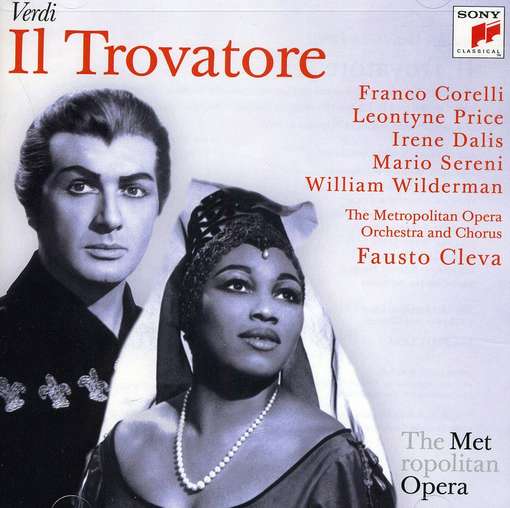
  • Met’s 1961 TROVATORE on SONY

    886979100626

    The Metropolitan Opera on SONY series recently issued the famous February 4, 1961 TROVATORE broadcast with Leontyne Price and Franco Corelli which followed by a week their wildly acclaimed joint Met debut in the Verdi opera. The 1960-61 Met broadcast season was happening without my knowledge, otherwise I would certainly have been glued to my radio. But I did not discover the Met broadcasts until the following season when the fabled Sutherland ‘debut’ LUCIA was the first time I tuned in. From then until just a couple of years ago, I hardly ever missed a broadcast.

    I heard Price and Corelli many times at The Met – Leontyne I actually heard at the Old Met as Fiordiligi in COSI FAN TUTTE (in English) and Franco sang in the first performance I saw at the New Met (as Calaf in TURANDOT). I loved them both in those golden years though I knew Franco could be sloppy at times and Leontyne, over the years, developed some annoying idiosyncrasies. I’d never heard the 1961 TROVATORE so I set aside time to concentrate on it; I must say, it is a very erratic performance.

    Fausto Cleva, a favorite conductor of Renata Tebaldi, takes much of TROVATORE at a breathless clip. For the most part the singers manage to keep up though there’s some scrambling here and there. Aside from Leontyne Price, who strives throughout for thoughtful musicality, the principal quartet of singers tend to sing TROVATORE in verismo style rather than treating it like a god-child of the bel canto era. I suppose there’s a temptation to snarl and bluster in the opera’s dramatic utterances and in a live performance there is no recourse other than to let the singers do what they will in declaiming the text. But it becomes a bit tiresome after a while.

    Corelli is the most lachrymose Manrico I ever heard; he gives the same impression on his commercial recording of the role for EMI, though that is more artfully sung. Of course there is a lot of very powerful and exciting vocalism in his interpretation, but this is somewhat compromised by his melodramatic excesses. Upon receiving news that Leonora is to take the veil, Corelli has a little mad scene which wanders right off the musical map. But despite some slight variability of pitch at times, the utterly distinctive Corelli timbre and his sheer generosity of voice make him a Manrico on the grand scale. Interestingly, Corelli only sang this opera at the Met eleven times, retiring it from his repertory at the House in 1964. A new production in 1969 was reportedly planned for Corelli but in the event Placido Domingo was the Manrico.

    Leontyne Price on the other hand kept Leonora in her repertoire for over twenty years; the great aria “D’amor sull’ali rosee” might be considered the soprano’s theme song and she sang it superbly at the gala that closed the Old Met in 1966. The warmth and shimmering beauty of her timbre provide the vocal high points of this 1961 broadcast where she manages to maintain the Verdian line while her colleagues wander into melodramatic over-accenting of certain passages. For my money, Price was not a soprano with a first-rate forte top; she was best in the floating upper phrases of a role. Corelli drowns her out on the final D-flat of Act I, and her high-C at the climax of the Act IV duet with di Luna doesn’t have any zing to it. But overall it’s wonderful to hear the soprano in all her freshness in this music. Over the ensuing years Price developed a vocal ‘style’ that could be off-putting: growling in the lower register and introducing some bluesy mannerisms that could spoil her performances for me. You don’t hear these on her commercial recordings so much, but in the House she could be very self-indulgent. Nevertheless her singing could still thrill, right to her farewell operatic performance.

    I always loved the sound of Mario Sereni’s voice, so warm and attractive. For me he was at his best in verismo: his Marcello, Carlo Gerard and Tonio (PAGLIACCI) were all very fine; he did leave behind some wonderful studio recordings too, notably his Germont with de los Angeles and his Enrico on the RCA/Moffo LUCIA. But in this TROVATORE he seems way off form. I wonder in fact if he was actually originally scheduled for this  broadcast since Robert Merrill had sung di Luna in the Price/Corelli debut performance and sang it again in the next performance following the broadcast. Whatever the case, Sereni seems unprepared. He sings the wrong entry line in the first scene of Act III and gets lost in the recitative on his entry in Act IV. Some handsome singing along the way is offset by serious pitch problems in the great aria “Il balen”. It’s sad that this particular broadcast should be chosen as a document of Sereni’s live Met performances; I know I can never listen to it again.

    Irene Dalis was a great favorite of mine. She was a powerful stage presence and a singer who could be both passionate and subtle. Her performance is exciting but I feel of all the singers she may have been most put-off by Cleva’s fast tempi. In the Act III, Scene 1 finale Irene is pushed to the limits by the conductor’s absurdly rapid pace and it seems to me that she simply stops singing during the final bars of music. Her final scene is very impressive, though, with the quiet calm of her “Ai nostri monti” and a sustained high B-flat in her last triumphant, vindictive phrase. Ten years after this broadcast, I saw Irene’s Azucena at the Met during a June Festival performance. Despite the intervening decade of singing some of opera’s most demanding roles, she was in fact far more thrilling and vocally secure than on this 1961 broadcast.

    It’s good to have a document of William Wilderman’s performance of Ferrando; his ample and darkishly dramatic singing gets the opera off to a strong start. Teresa Stratas sings the brief role of Inez and there is no mistaking her voice. She strives to make something lovely of her phrase bidding farewell to Leonora at the convent, but Price trumps her by coming in a shade early and stepping on the younger soprano’s tapering piano.

    For all its flaws, listening to this recording reminded me of how much I love this opera. Despite its improbable plot, the vast treasury of Verdi melody makes TROVATORE essential.

  • Gertrude Grob-Prandl

    Gertrude grob-prandl

    While I was working at Tower, I got into a discussion one day with my boss and a couple of the other ‘opera people’ who worked there. We were naming favorite singers and in one breath I mentioned Nilsson, Rysanek, Behrens and Dame Gwyneth Jones. “Oh, so you’re a size queen!”, Bryan laughed. Well, not really…since I also loved people like Reri Grist, Patricia Brooks, Lucia Popp and Kathleen Battle. But if you want to stereotype me, go right ahead: because I do love big voices.

    The four ‘loud ladies’ I mentioned above were among the largest voices I ever heard live. I guess Dame Gwyneth’s was the biggest of all though I’d also have to mention Angeles Gulin who, in a concert performance of LES HUGUENOTS at Carnegie Hall (1969) unleashed an enormous voice in Valentine’s music. But there was one voice, often described as the largest of all operatic voices in living memory, that for some reason I had never heard: that of the soprano Gertrude Grob-Prandl.

    Of course I’d heard people talking about her, and I read the article about her in Lanfranco Rasponi’s excellent book The Last Prima Donnas. But I’d never heard her sing a note until about a week ago when I was sampling different versions of Ortrud’s Invocation from LOHENGRIN on YouTube. Grob-Prandl’s rendition blew me away both in terms of the dimensions of the voice and the easy top.

    So I ordered a Myto recital disc by the soprano on which she sings music of Weber, Halevy, Meyerbeer, Wagner and Strauss and it’s all pretty glorious. Now I’m trying to locate her complete recording of TURANDOT. The voice does tend to go off-pitch slightly here and there, and a few notes take a split second to tonalize after she hits them – an endearing quality she shared with Leonie Rysanek.

    Grob-Prandl sings Isolde’s Narrative and Curse here.

  • Giorgio Tozzi Has Passed Away

    Tozzi_pic2
    I’m very sorry to learn of the death of Giorgio Tozzi, the basso whose voice was among the first that I became familiar with when I started listening to opera at a very early age.

    My parents had presented me with a prophetic birthday gift: a two-LP set of Verdi and Puccini arias culled from various RCA Victor recordings. Tozzi was the featured basso (the other singers were Milanov, Albanese, Peters, Bjoerling, Peerce, Merrill and Warren…what a collection of voices to cut one’s operatic teeth on!) and I literally wore out the tracks of his performances of arias from NABUCCO and SIMON BOCCANEGRA. Once my voice changed I would try to sing along with Tozzi in these arias, and also with his rendition of “Some Enchanted Evening” which my mother loved so.

    IMG_0002
    Giorgio Tozzi sang Don Giovanni in the very first performance I ever attended at the (Old) Met…

    IMG_0001
    …and he was my very first Hans Sachs (at the ‘new’ Met). I saw him so many times over the years: as Daland, as Philip II, as Fiesco, as Colline, Mozart’s Figaro, Ramfis and and as Count Rodolfo in LA SONNAMBULA. He sang more than 500 performances with the Metropolitan Opera (in-House and on tour) between 1955 and 1975. He created the role of the Old Doctor in Samuel Barber’s VANESSA and sings in the classic recording of that opera. Tozzi sang in the final trio from LA FORZA DEL DESTINO during the gala concert that marked the end-of-an-era closing of the Old Met in 1966.

    In 1978, a few years after he had left The Met, I saw Giorgio Tozzi onstage for the last time. He sang (an acted) grandly as Oroveso in Bellini’s NORMA in a performance at Hartford CT opposite the thrilling Cristina Deutekom as Norma.

    Giorgio Tozzi’s voice became widely known outside the world’s opera houses when he sang the music of Emil de Becque for the soundtrack of the film SOUTH PACIFIC (Rossano Brazzi portrayed de Becque on-screen). Tozzi later appeared in stage productions of the musical and on Broadway in MOST HAPPY FELLA.

    Giorgio Tozzi sings the Old Doctor’s aria from VANESSA here: “For every love there is a last farewell; for each remembered day an empty room.”