Category: Music

  • Images from NYC Ballet’s Balanchine Evening

    C36439-15_Duo_MFairJAng_1

    A series of Paul Kolnik’s photographs from last night’s Balanchine programme at New York City Ballet. Above: Jared Angle and Megan Fairchild in DUO CONCERTANT.

    C34660-9_Sym3_HyltinRama

    Amar Ramasar & Sterling Hyltin in SYMPHONY IN THREE MOVEMENTS.

    C36436-12_Episodes

    Janie Taylor & Sebastien Marcovici with the corps de ballet in EPISODES.

    C36429-16_4Temp

    Tyler Angle & Ashley Bouder in THE FOUR TEMPERAMENTS.

    My thanks to Mr. Kolnik and the NYCB press office for providing these photos

  • James Levine’s Return to The Met

    J LEVINE

    Tuesday September 24th, 2013 – James Levine’s return to the podium of the Metropolitan Opera House was the main reason I attended the season’s prima of Mozart’s COSI FAN TUTTE. The maestro last conducted at The Met on May 14, 2011 (WALKURE) and in months that followed numerous rumors circulated as to his health troubles and his posisble return to conducting. One usually reliable source indicated it was unlikely we’d ever see him in The Met pit again.

    But then the the outlook began to brighten: Levine was spotted riding his motorized wheelchair thru Central Park. And then came the best news: on May 19th, 2013, Levine led The Met Orchestra in a concert at Carnegie Hall. Tonight he was back in The House where I first heard him conduct at his debut (and exciting but uneven TOSCA in June 1971) and where I have experienced dozens of his performances over the ensuing decades.

    About a week prior to tonight’s performance, I heard that COSI was not selling well at the box office. When I relayed this information to a friend, she said: “Well, COSI is not a popular opera.” But I beg to differ: I think it’s always been well-attended in the past; but the current cast – aside from Matthew Polenzani – is not filled with particularly luminous names. In the past when singers like Steber, Stich-Randall, Leontyne Price, Dame Kiri, Carol Vaness, or Renee Fleming headed the cast, audiences were substantial and enthusiastic.

    Although this evening’s performance was a red-letter date in the recent history of The Met (thanks to Levine’s presence), as a performance of COSI FAN TUTTE it was not particularly memorable. In general, the men in the cast tended to outshine the women.

    An announcement was made as the houselights dimmed: Matthew Polenzani was suffering from a cold, but would sing anyway and asked our indulgence. There were only passing signs of indisposition in Matthew’s singing, and his technique and artistry carried him thru the great aria “Un’aura amorosa” with success: it was the vocal highlight of the evening. Rodion Pogossov was a characterful Guglielmo and Maurizio Muraro a fine Don Alfonso in the Italian buffo tradition.

    Susanna Phillips kicked off her big Met season (she is to be Rosalinda in the new FLEDERMAUS and Musetta in BOHEME in the coming months) singing the notoriously difficult role of Fiordiligi with a warm timbre and an even range, meeting the technical challenges of “Come scoglio” successfully. Without effort, she dominated the duets with her smaller-voiced sister, sung by Isabel Leonard. Danielle de Niese was Despina: her voice does not really fall pleasantly on the ear, but her vocal characterization was flavorful.

    The House – full in the upper tier but spottier lower down – gave Levine a big ovation when he materialized in the pit, though as Dmitry pointed out, if he’d been conducting for a ‘Wagner audience’, the reception would have been like a tsunami. Levine’s handling of the score and the playing of his musicians was everything one expected and desired. It’s wonderful to have him back, though curiously the two men next to me – who seemed like seasoned opera-goers – kept referring to him as “James Le-VEEN”.

    I would have liked to have heard Phillips and Polenzani in their Act II arias and their big duet, but faced with a Gelb-intermission and the less stimulating singing of the other cast members, we headed out, missing the chance to join in what I am sure was a big celebration for the Maestro at the end.

    Conductor: James Levine

    Fiordiligi: Susanna Phillips

    Dorabella: Isabel Leonard

    Despina: Danielle de Niese

    Ferrando: Matthew Polenzani

    Gugliemo: Rodion Pogossov

    Don Alfonso: Maurizio Muraro

  • A Memorable Concert From Tanglewood

    Vickers

    Above: tenor Jon Vickers

    It seems everything is on YouTube these days; I was especially glad to come upon this concert which I was fortunate enough to have attended. The performance of Act I of Wagner’s DIE WALKURE took place at Tanglewood in 1979; Jessye Norman was Sieglinde, Jon Vickers sang Siegmund and Gwynne Howell was Hunding. Seiji Ozawa conducted the Boston Symphony Orchestra. It seems to have been the only time that Norman and Vickers sang this music together.

    The concert has held its prominent place in my memory mainly because of Jon Vickers’ singing as Siegmund. While listening to the YouTube recording, I decided to dig out my opera diary write-up of the concert and see if the impressions I registered in the diary the morning after the concert held true upon listening to it again, almost 35 years later.

    Of course any broadcast in going to create a very different sonic impression from when you are sitting in the concert space, and that’s especially true in a vast setting such as Tanglewood.

    My diary entry reflects my admiration for Ozawa’s conducting and for Gwynne Howell’s singing as Hunding, and that holds true on listening to the recording. Jon Vickers is as sensational as I remember him being.

    At the time of the concert, my Sieglinde was Leonie Rysanek. I thought she was the only one and so I had compared the impact of Jessye Norman’s performance to Leonie’s and found it wanting. This was my first time experiencing Jessye live and depite so many admirable aspects in her singing, I did not think she was as thrilling in the role as Leonie was. Of course, they are totally different types of singers and listening to Jessye on the recording there is just so much to enjoy. At the time, I praised her lower register especially, and her dynamics and her persuasive way with the text; but I found her a bit too restrained and lady-like overall, and also noted that her top register did not really bloom (the top was Leonie’s glory at the time). And to me it seems on the recording a couple of Jessye’s highest notes are just a hair’s breadth below pitch.

    Norman went on to become a great favorite of mine, though I always thought she was really a mezzo-soprano. (By far the grandest singing I ever heard from her came in a concert performance of Act II of SAMSON ET DALILA at Carnegie Hall in 1983 where I thought to myself… ‘this is Jessye!’)

    Listening now to the Tanglewood recording makes me think more highly of Norman’s performance; of course over the ensuing years I have enjoyed many types of Sieglindes since those incredible Rysanek-evenings. My perspective has broadened and Norman’s interpretation seems pretty grand to me now.

    Vickers bowled me over at Tanglewood and he does so again on the recording. In his white sport coat  he reminded me of “…a wrestler dressed for the prom.” Siegmund’s music was “…offered with unstinting vocal generosity (as well as unbelievable subtlety!). Vickers, with that rough-beautiful timbre, gave his all. His command and artistry were dazzling. The great moments – the whole Sword monolog with its unearthly cries of ‘Wälse! Wälse!’;…his gorgeous ‘Winterstürme’; the enthralling build-up to pulling out the sword; his impassioned presentation of Notung to Sieglinde, and his stentorian final lines – were just the pinnacles of a truly magnificent performance.”

    “As Ozawa and the orchestra crashed thru the heart-stopping pages and drove the act to its glorious conclusion, the whole audience leapt up with a massive shout. The soloists and conductor were called out many times, to frantic ovations…”

    So nice to have this souvenir of a wonderful memory.

  • Mozart’s Last Aria

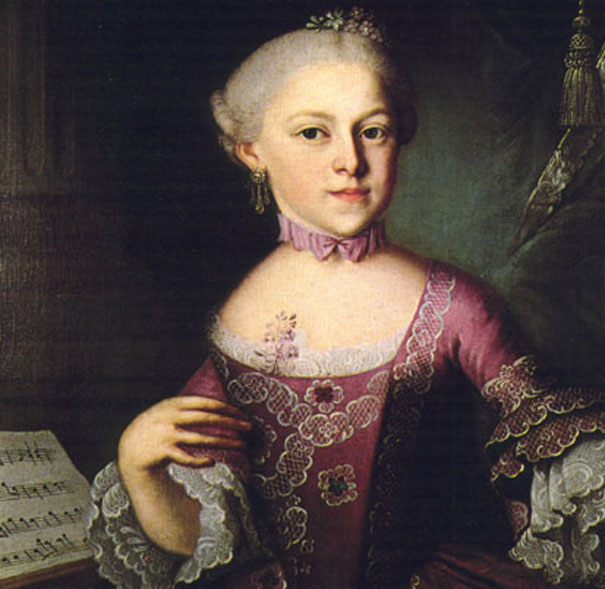
    Nannerl

    Above: Maria Anna (Nannerl) Mozart 

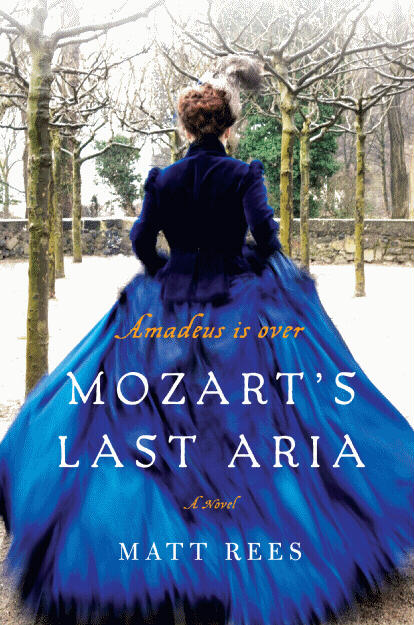
    After recently watching the film Mozart’s Sister, my curiosity was piqued about Mozart’s older sister Nannerl, herself a talented musician forever in the shadow of her genius-brother. Matt Rees’s novel MOZART’S LAST ARIA popped up on my radar, and I grabbed a copy from Amazon; admittedly the book’s attractive cover was an added incentive:

    Mozarts Last Aria.US

    Nannerl, four-and-a-half years older than Wolfgang, was considered a musician of equal talent to her brother. As their father carted them all over Europe, playing for royalty, Wolfgang began to eclipse his sister in notoriety.

    Both children began to compose, Wolfgang openly and Nannerl furtively. Wolfgang admired and encouraged his older sister’s work. At a
    concert, when Wolfgang announced that the piece he had just played was
    written by his sister, their father Leopold was furious. He ordered Nannerl never to
    compose music again because in the 18th century, women did not become
    composers.

    Thereafter, Leopold focused all his attentions on Wolfgang, leaving Nannerl at home, taking only her brother on tour, and forcing her to give piano lessons to wealthy students to finance Wolfgang’s travels. Nannerl became depressed, and in the years that followed the close relationship of brother and sister faded, especially once Wolfgang had married Constanze.

    In 1784, Nannerl had married the magistrate Johann Baptist Franz von Berchtold zu Sonnenburg; they lived in St. Gilgen and she did not see Wolfgang again. In the novel, which begins with Nannerl, having received a letter from Constanze informing her of Wolfgang’s death, leaving St. Gilgen for Vienna in an effort to learn the facts surrounding Wolfgang’s untimely demise.

    Of course, there have always been rumours that Mozart was poisoned – namely by the rival composer Antonio Salieri. There is no verifiable evidence of this, but the myth has persisted anyway.

    Constanze’s letter to Nannerl hints at foul play. This induces Nannerl’s trip to Vienna where she runs up against a wall of silence and deception. Attempting to ascertain who might have had cause to desire her brother’s death – the jealous husband of one of his amours?  a
    sinister creditor?  a rival composer? or those involved in the secret and banned acttvities of the Masons? – Nannerl finds her own life endangered.

    At a soiree where Nannerl dresses as her brother and plays one of his compositions for an elite assemblage, the culprit is unmasked. But many questions remain, and as Nannerl slowly sorts things out, a complex web of duplicity and political intrigue is revealed.

    In reality, Nannerl did not travel to Vienna following her brother’s death. But in using her as the axis of his novel, the author has crafted a finely-paced murder mystery into which real personages from the time – including Emanuel Schikaneder, librettist of Mozart’s “Masonic” opera THE MAGIC FLUTE – are introduced. The novel would seem well-suited to a cinematic treatment: a beautiful period piece with a host of brilliant character roles and a built-in soundtrack of some of the greatest music ever written.

  • Hampson/The Jupiter Quartet @ Alice Tully Hall

     Hugo Wolf

    Above: the composer Hugo Wolf

    Sunday April 28, 2013 – The Chamber Music Society of Lincoln Center presented a programme of works spanning three centuries; the Jupiter String Quartet and the celebrated baritone Thomas Hampson collaborated in a new work by Mark Adamo (NY Premiere), and the Quartet played Wolf, Schubert and Webern before rounding out the evening with Wolf songs sung by Mr. Hampson.

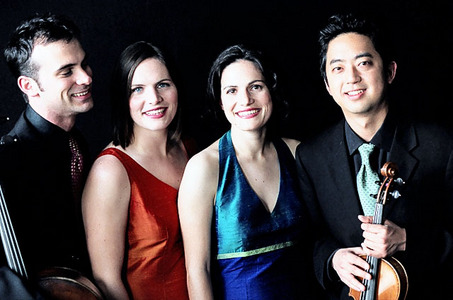
    Large_Jupiter quartet6

    The Jupiter String Quartet opened the programme with Franz Schubert’s quartet in E-flat major, written when the composer was 16 years old. The players immediately displayed the warm, Autumn-gold sound that they would sustain throughout the concert. The melodies of this youthful work of the composer were wafted into the hall with generous lyricism; in the adagio especially, violinist Nelson Lee’s persuasive turns of phrase had a bel canto polish.

    Anton Webern’s Langsamer Satz (‘Slow Movement’) was composed in 1905 but never publicly performed in the composer’s lifetime. Dating from the period before he embraced his twelve-tone destiny, this brief quartet was written when Webern was 22 and exploring a relationship with his cousin Wilhelmine, who he eventually married. The music is in full-blown Romantic style; its heart-on-sleeve emotional quality tinged with a trace of melancholy was lovingly captured by the Jupiter players. 

    Hampson_acosta_5

    Thomas Hampson, photo by Dario Acosta

    I’ve been following Thomas Hampson’s career since I first heard him at the annual Winners Concert of the Metropolitan Opera National Auditions in 1981. He seems to be the only singer from among that year’s winners to have developed and sustained a major international career. Among his many roles at The Met since then, several have ranked high among my memorable operatic experiences, most especially his Count Almaviva, Billy Budd (a spectacular performance all round, in 1992), Onegin, Posa, Werther, Wolfram in TANNHAUSER, and Amfortas in PARSIFAL. In recent seasons, he has explored the heavier Verdi roles; I was very impressed with his Iago just a couple of months ago.

    Today in Mark Adamo’s ARISTOTLE, Hampson’s voice seemed remarkably fresh and showed nary a trace of the passage of time. It was completely and marvelously satisfying vocalism from a singer who has passed the thirty-year mark of his career. Blessed from the start of his singing career with an immediately identifiable timbre, the baritone today sang with warmth, a broad dynamic palette, impressive sustaining of phrase and keen verbal clarity (no need for us to refer to the printed texts). This was singing of the first magnitude.

    Mark Adamo’s ARISTOTLE can already be ranked as a 21st century vocal masterpiece. Set to a poem by Billy Collins, the work is about the passage of time and the stages of life. It resonates on a personal level, especially for those of us moving into the later decades of our span. Mark Adamo’s writing and the playing of the Jupiter Quartet provided Mr. Hampson with a marvelous vehicle in which the singer’s artistry is fully presented. 

    The poet’s text is imaginative, funny, poignant; opening candidly with “This is the beginning…almost anything can happen…” each of the works three ‘movements’ describes the experiences – from epic to mundane – that colour our lives as time passes. “This is your first night with her, your first night without her” is a touching wrinkle in the first section. 

    “This is the middle…nothing is simple anymore…” sets forth this memorable line: “Disappointment unshoulders his knapsack here and pitches his ragged tent.” And finally at the last: “And this is the end, the car running out of road, the river losing its name in an ocean…” Singer and players joined to create a memorable musical experience, the baritone’s incredible sustaining of the work’s final lines truly magical. The composer, seemingly overwhelmed by emotion, was called up to the stage and joined the musicians in receiving a sustained applause.

    The second half of the evening was given over to works of Hugo Wolf, commencing with his brief and melodic Italian Serenade, played by the Quartet. Thomas Hampson then offered a set of the composer’s songs. With the exception of Anakreon’s Grab – which was the concluding work on today’s printed programme – I have never really been drawn to Wolf’s lieder, despite many attempts over time to make a connection. The first two songs today were rather jolly, and then the singer and musicians moved into deeper and darker territory, which proved very pleasing indeed. And yet it was still the calm beauty of Anacreon’s Grave that moved me the most. As an encore, Wolf’s “Der Rattenfänger”, based on the tale of the Pied Piper, was given a vivid theatrical treatment by singer and players. 

    The works on today’s programme:

    Schubert: Quartet in E-flat major for Strings, D. 87, Op. 125, No. 1 (1813)

    Webern: Langsamer Satz for String Quartet

    Adamo: Aristotle for Baritone and String Quartet (2012, CMS Co-Commission, New York Premiere)

    Wolf: Italian Serenade for String Quartet (1887)

    Wolf: Selected Lieder for Baritone and String Quartet

  • Oratorio Society: Britten’s WAR REQUIEM

    White_dove.23095031_std

    Monday April 22nd, 2013 – The Oratorio Society of New York presented a performance of Benjamin Britten’s WAR REQUIEM at Carnegie Hall this evening. 

    One of the greatest and most meaningful choral works ever created, the WAR REQUIEM was commissioned for the re-dedication of Coventry Cathedral in 1962; the church had been almost totally destroyed by German bombs in 1940. Britten, a life-long pacifist, drew on the poetry of Wilfred Owen
    – who had been killed in 1918 (one week before the Armistice ended the war) at the age of 25 while fighting in France
    – as well as the texts of the Latin mass for the dead in setting his
    masterpiece. Though deeply spiritual in atmosphere, Britten intended the
    WAR REQUIEM to be a secular work.

    The Oratorio Society, one of New York City’s oldest cultural treasures, traces its history back to 1873. Founded by Leopold Damrosch, the Society presented their first concert on December 3,
    1873. One year later, on Christmas night, the Society began what has become an unbroken
    tradition of annual performances of Handel’s Messiah. In 1891, the Oratorio Society participated in the opening concert of what is now Carnegie Hall.

    The chorus and musicians of the Society under Kent Tritle’s baton tonight unfurled the sonic tapestry of Britten’s creation in a performance which greatly satisfied both the ear and the soul. In the composer’s structuring of the REQUIEM, the large chorus and orchestra – supporting a soprano soloist – sing the Latin texts of the mass while a chamber orchestra (led by David Rosenmeyer) accompanies the tenor and baritone soloists whose words come from the poetry of Wilfred Owen. From high up in a side balcony, the voices of children from the choir of Saint John The Divine (directed by Malcolm Merriweather) provide an angelic sound, accompanied by a small organ.

    Britten’s score, richly textured, amazes in its rhythmic and instrumental variety. Marked by off-kilter harmonies and shifting tonalities, the music is grand and theatrical one moment and poignantly stark and personal the next. The juxtaposition of public mourning and private grief – and of the liturgical and poetic texts – give the REQUIEM its unique resonance.

    Of the three vocal soloists, soprano Emalie Savoy (currently a Met Young Artist) revealed a sizeable lyric instrument with a blooming high register and a capacity to dominate the massed choral and orchestral forces. Tenor John Matthew Myers sang with a plaintive, clear and warm timbre while baritone Jesse Blumberg gave a wonderfully expressive rendering of the texts, his voice hauntingly coloured in his long final solo.

    At the close of the piece, all the participants were warmly lauded by the audience.

    “My subject is War, and the pity of War.
    The Poetry is in the pity…
    All a poet can do today is warn.” ~ Wilfred Owen

    Now, nearly a century after the poet’s warning, mankind continues to use war as a means of settling religious and ideological differences. This evening’s concert fell on Earth Day, reminding us of the fragility of the planet on which we all live. Only by turning away from gods and politics – those great dividing forces – can we hope to find a path into a safe and meaningful future. Like the poet’s two soldiers from opposing armies who find themselves dying side by side in a ditch far from their homes as the REQUIEM draws to a close, we must learn to embrace our common humanity before it’s too late.

    The evening’s participating artists will were:

    Kent Tritle, conductor
    David Rosenmeyer, chamber orchestra conductor
    Emalie Savoy, soprano
    John Matthew Myers, tenor
    Jesse Blumberg, baritone
    Choristers of the Cathedral of St. John the Divine,
    Malcolm Merriweather, conductor
    Chorus and Orchestra of the Society 

  • Score Desk for DON CARLO

    L1070620

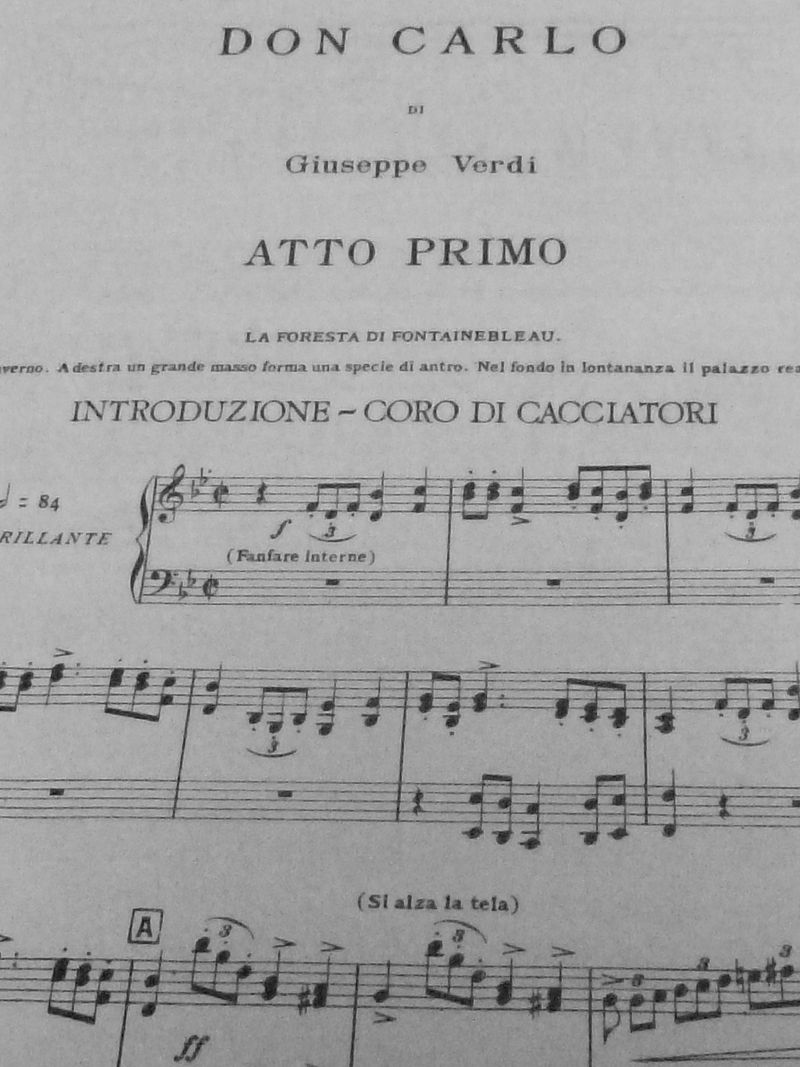
    Monday February 25th, 2013 – A powerful line-up of male principal singers drew me to this performance of Verdi’s DON CARLO at The Met. The women in the cast seemed less interesting by far; having seen the production before – and feeling no need to see it again – I took a score desk and settled in.

    DON CARLO was for years my favorite opera, but then the German repertory began to edge out the Italian in my heart and soul. Now ARIADNE AUF NAXOS, ELEKTRA and DIE WALKURE are in a sort of three-way tie for the top spot. But I still love DON CARLO and always go when it is performed. I’m not crazy about the Fontainebleau scene, and I never watch the Auto da Fe since the sight of people burning other people alive for the greater glory of some fiendish imagined god (or rather, to maintain the power of the men who created him and sustained the myth thru blood and force over the centuries) is revolting.

    Negative reviews of Loren Maazel’s conducting and of Barbara Frittoli’s singing as Elisabetta had me thinking in advance that this might be a partial CARLO for me. Added to the prospect of two Gelb-intermissions, and the fact that I was already feeling tired when I got there, it seemed that a very long evening was loooming ahead. But I found myself drawn in by the opera itself, and I always enjoy the experience of being in the House with the score in front of me. I stayed to the end and on the whole felt it was a very good evening, particularly thanks to the superb performances of Dmitry Hvorostovsky and Ferruccio Furlanetto as Posa and Philip II respectively.

    To be sure, some of Maestro Maazel’s pacing was slow. To me his conducting registered a measured sense of grandeur and dignity, and of events unfolding with a sort of epic inevitability. Often considered Verdi’s most purple opera – the colour of royalty evoked in sound – I felt Maazel’s concept worked well: there were lively passages along the way, and his Auto da Fe scene was amply majestic and well-structured. For the most part he kept his singers at the forefront; in a few places they needed all their reserves of breath to sustain the line thru the slow tempi. But, following the score, I thought the conductor had things well in hand.

    Maazel experienced some boos at his solo bow; I wonder if it was pre-meditated since it seemed to be coming from one area of the Family Circle. Recently while my friend Dmitry and I were having a pre-PARSIFAL supper, I could overhear a woman in the next booth telling her companion that she was planning to boo conductor Daniele Gatti. If she did, it got lost in the cheers. Maazel’s conducting was quirky but worked well to my ears; the only potentially boo-able performance was that of Ms. Frittoli but the audience tolerated her with polite applause.

    I find the Fontainebleau scene a needless introduction to the evening. Verdi sanctioned its elimination for performances in Italy following the premiere in Paris where five-act operas were de rigeur. Some people say, “Oh, it gives the opera context!” Undoubtedly. But we lived without it for years, savoring the gloriouly dark horn theme which opens the four-act version and immeditely sets us in the mood for this opera about royalty and religion. Tonight, with Ms. Frittoli sounding very wary, the scene seemed even more expendable than ever. It makes for such a long night, even under the best of circumstances.

    The soprano’s perilous performance serves as a reminder that a vocal career is short enough without quickening its demise by singing roles that are too heavy. Ms. Frittoli will be remembered in New York City for her exquisite singing as Desdemona in 1999; she was also a particularly fine Mimi, and as recently as 2005 she managed an impressive Fiordiligi by manipulating the dynamics to control the effects of a widening vibrato. But singing things like the Verdi REQUIEM and Donna Anna have taken their toll on her lyric instrument. Tonight the vibrato was painfully evident even at the piano level. She managed to avert disasters, though a high B-flat in the quartet was scary and she could not sustain the floated B-natural in the final duet, on “…il sospirato ben”, one of the role’s most affecting moments. Overall it was sad to experience this voice in its current state. The news that she’ll be singing Tosca later this year in Europe does not bode well.

    These performances of Elisabetta were originallly slated for Sondra Radvanovsky; when Sondra moved to BALLO instead, the Met turned to Ms. Frittoli. They should have cast about for a more appropriate alternative. When I think of the wonderful Elisabettas I have experienced – Caballe, Kabaivanska, Freni, and  Radvanovsky as well as Marina Mescheriakova’s flawless Met debut in the role – Ms. Frittoli’s pales into a haze.

    Anna Smirnova’s voice does not always fall pleasantly on the ear, being rather metallic. But she is a skilled singer who managed the filagree of the Veil Song very well and pulled out all the stops for an exciting “O don fatale” with brazenly sustained high notes. 

    Don Carlo is a bit heavy for Ramon Vargas but this very likeable tenor sang quite beautifully through most of the evening. His voice is clear and plaintive, his singing stylish and persuasive. Only near the end of the opera did a few signs of tiredness manifest themselves. His delicious singing of “Qual voce a me del ciel scende a parlar d’amore?” in the love duet was a high point of the evening.

    Eric Halvarson’s Inquisitor was powerully sung and stood up convincingy against the overwhelming Philip II of Ferruccio Furlanetto. The two bassos had a field day, trading thunderbolts in their great confrontation. Basso Miklos Sebestyen was a very impressive Friar (the Ghost of Charles V), drawing a round of applause fo his sustained low F-sharp in the St. Juste scene of Act I. Jennifer Holloway was a very fine Tebaldo but Lori Guilbeau, who has a pretty sound, seemed not to be well-coordinated with the pit as she sang her offstage lines as the Celestial Voice.

    The towering magnificence of Dmitry Hvorostovsky‘s Posa and Ferruccio Furlanetto‘s Philip II put the performance on a level with the greatest Verdi experiences of my opera-going years. Dima’s singing was velvety and suave, his breath-control mind-boggling, his singing affecting, elegant and passionate by turns. His high notes were finely managed and marvelously sustained.

    Mr. Furlanetto’s glorious singing is a throwback to the days when great Italian voices in every category rang thru the opera houses of the world.  Now nearing his fortieth year of delivering generous, glorious vocalism, the basso’s dark and brooding tones fill The Met with a special sonic thrill. His singing, so rich and deeply-felt, can thunder forth at one moment and then draw us in with hushed, anguished introspection the next. From first note to last, Furlanetto’s Philip II was simply stunning. His hauntingly tender musing on the phrase “No…she never loved me…her heart was never mine…” just before the epic climax of his great monolog moved me to tears.

    There were huge eruptions of applause and cheers after both the baritone and the basso finished their big arias; but applause nowadays tends to dwindle rather quickly and the days of show-stopping aria ovations are largely a thing of the past. 

    There were lots of empty seats which surprised me: with this starry assembly of male singers and the season’s biggest name from the conducting roster involved, I expected a fuller house.

    Dima2

    Dmitri Hvorostovsky

    Furlanetto

    Ferruccio Furlanetto

    Metropolitan Opera House
    February 25, 2013

    DON CARLO
    Giuseppe Verdi

    Don Carlo...............Ramón Vargas
    Elizabeth of Valois.....Barbara Frittoli
    Rodrigo.................Dmitri Hvorostovsky
    Princess Eboli..........Anna Smirnova
    Philip II...............Ferruccio Furlanetto
    Grand Inquisitor........Eric Halfvarson
    Priest Inquisitor.......Maxime de Toledo
    Celestial Voice.........Lori Guilbeau
    Friar...................Miklós Sebestyén
    Tebaldo................ Jennifer Holloway
    Count of Lerma..........Eduardo Valdes
    Countess of Aremberg....Anna Dyas
    Flemish Deputy..........Alexey Lavrov
    Flemish Deputy..........Paul Corona
    Flemish Deputy..........Eric Jordan
    Flemish Deputy..........Evan Hughes
    Flemish Deputy..........Joshua Benaim
    Flemish Deputy......... David Crawford

    Conductor...............Lorin Maazel

  • Verdi REQUIEM @ Carnegie Hall

    Angel

    Tuesday October 23, 2012 – I’d been looking forward to this performance for weeks; the Verdi MESSA DA REQUIEM is one of my favorite pieces of music, glorious from first note to last. I have experienced some thrilling live performances over the years, including three superb evenings at Tanglewood. Great conductors, great soloists and top-notch choral groups have placed their stamp on this grandiose and poignant score.  

    Tonight’s performance will not fall in the memorable category, although the playing of the Philadelphia  Orchestra was thrilling, and the singers of the Westminster Symphonic Choir gave their hearts and souls to the work’s resplendent choral passages.

    Opening the work with an achingly slow and very inspiring rendering of the score’s first pages, conductor Yannick Nézet-Séguin went on to a very impressive performance of the entire work. He moulded the great arcs of music with a fine sense of grandeur and he and his players shone in the more introspective moments. Only his rather pretentious holding of the applause by not lowering his baton after a reasonable pause at the end seemed off-kilter; it wasn’t that profound of a performance.

    The REQUIEM is sometimes referred to as a ‘sacred opera’; it is so very operatic by nature that, as with all operas, performances of it tend to stand or fall by its principal vocalists. Tonight we had an even split of a surprisingly excellent mezzo-soprano and a very fine basso, aligned with a soprano who seemed sometimes on the verge of distress and a tenor who labored valiantly to make his once-generous voice flesh out Verdi’s magnificent melodies.

    791

    Christine Rice (above), a singer totally new to me, gave a very pleasing performance in every respect, Her timbre has a soprano feel to it, but she used a comfortably plush and resonant chest voice to make the most of her every phrase. In an evening of often wayward vocalism, I found myself sighing with relief whenever Ms. Rice stood up to sing. Basso Mikhail Petrenko might not have the sheer vocal heft of some of the singers who have preceded him in this music, but his sound is steady and warm and his vocalism is expressive. The opening pages of the Lacrymosa, where Ms. Rice and Mr. Petrenko joined forces, was the evening’s purest sonic pleasure.

    Marina Poplavskaya’s opening phrase was painful to the ear; her voice sounded unsteady and ill-sorted. As the evening progressed, a feeling of lack of vocal support grew. Her voice often sounded pallid and tentative, and she used a piano approach to high notes to cover a spreading quality that emerged when she sang full-out. Shortness of breath was worrisome, as were vagaries of pitch here and there; her lower-middle register did not always speak. And some of the most thrilling moments of the REQUIEM, when the soprano voice should sail out over the massed choral and orchestral forces, went for naught tonight as Ms. Poplevskaya’s sound was erased by the sopranos of the chorus.

    Opera lovers can’t help but be aware of Rolando Villazon’s vocal struggles in recent seasons. This very likeable singer tried to sing with his usual generosity and passion, but the sound now is smallish and grey. The top does not bloom, but narrows instead. And he has a very strange method of attacking notes with a biting huskiness. Attempting to make the music interesting, he drew down the tone to a thread at times but it did not sound well-supported; and a patch of off-pitch singing in the Hostias was disconcerting.

    It was a sad night for the soprano and tenor though the audience, typically, did not seem to notice anything was amiss. I wonder how much more impressive the evening would have been if different vocalists had taken on these roles. It was a squandered opportunity, in my view.

    • The Philadelphia Orchestra
      Yannick Nézet-Séguin, Music Director
    • Marina Poplavskaya, Soprano
    • Christine Rice, Mezzo-Soprano
    • Rolando Villazón, Tenor
    • Mikhail Petrenko, Bass
    • Westminster Symphonic Choir
      Joe Miller, Conductor
  • TROVATORE from Rome/1967

    600full-giuseppe-verdi

    It’s taken me a while to locate, but I’ve now found on CD the 1967 performance of Verdi’s IL TROVATORE from Rome 1967 that I used to have on reel-to-reel and that always seemed to me to capture the essence of this melodious, melodramatic work. Conducted by Bruno Bartoletti, the performance features a quartet of principal artists (all Italian) who strike at the very heart of the opera, a score rooted in bel canto but also forward-looking in its way. Photo of the composer, above.

    Gabriella Tucci’s beautiful lirico-spinto voice made a great impression on my when i first heard her in Met broadcasts as Aida, Cio-Cio-San, Violetta and Desdemona back in the early 60s. These were my formative years as an opera-lover and Tucci’s voice spoke directly to my heart; there was a lovely vulnerable quality to her singing. I finally got to see her onstage, as Leonora in TROVATORE at the Old Met in 1965, and I heard her again in this role at a concert performance at the Newport Festival in 1967.  She is the Leonora of the 1967 Rome performance and re-affirms everything I loved about her in this music. She does experience one brief moment of pitch trouble during the high-lying arcs of the great fourth act aria, but everything else in her performance is sung quite beautifully. Her phrasing and use of the language seem to me to set her among the most persuasive of Verdi stylists.

    Piero Cappuccilli is the Conte di Luna, making his usual fine impression in terms of vocal attractiveness and breath-control. For me, it’s never been a really distinctive sound – I’m not sure I could pick out the Cappuccili voice in a ‘blind’ line-up of Italian baritones – but he had a huge career, much of it spent as Italy’s premier Verdi baritone.

    BergonziTrovatorea

    Carlo Bergonzi’s always been my favorite tenor; yes, I know that as time passed he tended to have trouble maintaining pitch in the upper range (he was originally a baritone) but for me his gorgeous timbre, dynamic mastery, fluid diction and stylish turnings of phrase make him The King. On this night in Rome, his opening serenade ‘Deserto sulla terra’ is ravishing to the ear and he crests up to the final phrase with such sustained and expressive vocalism that the audience erupts with cheers. Ever the scrupulous musician, Bergonzi delivers the trills in “Ah, si bel mio” with his customary polish, and his “Di quella pira” is made urgent not by shouting but by verbal emphasis. Such a wonderful document of him in this role.

    Fiorenza cossotto

    For all the excitement that Tucci, Cappuccilli and Bergonzi provide, it is Fiorenza Cossotto as Azucena who gives the evening’s most stunning performance. Cossotto’s voice, one of the grandest I ever heard live (as Eboli, Amneris, Santuzza, Azucena, and Dame Quickly) generates incredible excitement among the Rome audience. The protracted ovation after her Act II monologue reminded me of the night I saw her Amneris at The Met: although there were no curtain calls after the Judgement Scene, the audience gave Cossotto such a massive applause that the conductor was literally unable to commence the Tomb Scene for a good five minutes. Cossotto’s huge, round sound and her splendid emotional commitment (always musical – she never strayed from the notes for dramatic effect) are on peak form for the Rome Azucena, a thrilling sonic experience.

    Cossotto establishes her majestic vocal presence immediately in “Stride la vampa” but it is in her great monolog “Condotta ell’era in ceppi,” as Azucena describes her mother’s execution, where the mezzo soars into the musico-dramatic stratosphere with a searing performance that elicits an endless ovation from the crowd. This is Italian opera at its most thrilling, and few singers over time could match Cossotto in her prime for vocal and emotional generosity. She continues to dominate this Rome performance right to her final triumphant high B-flat. 

    The sound quality is pretty good for the period, and Bruno Bartoletti keeps things humming along in the pit and allows his singers to sustain cherished notes – sometimes in a competitive way – which makes for an extra thrill here and there. I so enjoyed listening to this performance again after many years.

  • Lydia Johnson Dance @ Peridance: Gallery

    Copy of 14

    A gallery of Kokyat’s images from the two works presented by Lydia Johnson Dance at Peridance on the afternoon of February 26th, 2012. Above: Lisa Iannacito McBride in the untitled Golijov.

    Copy of 4

    Laura DiOrio

    Copy of 9

    Jessica Sand

    Copy of 11

    Jessica Sand, Lisa Iannacito McBride, Kaitlin Accetta

    Copy of 12

    Laura DiOrio

    Copy of 16

    Ensemble

    Copy of 24

    Copy of 28

    From Lydia Johnson’s untitled Golijov.

    Copy of 62

    The second work on the program was FALLING OUT, set to the third symphony pf Philip Glass. Above, Kerry Shea.

    Copy of 7

    Ensemble

    Copy of 23

    Kerry Shea & Max van der Sterre

    Copy of 27

    Max and Kerry

    Copy of 61

    Kerry Shea

    Copy of 29

    Max van der Sterre & Kerry Shea in Lydia Johnson’s FALLING OUT.

    All photos by Kokyat.