Category: Music

  • Nelsons/BSO: Mozart/Adès/Sibelius @ Carnegie Hall

    CH11371830_Medium_res

    Above: Maestro Andris Nelsons; photo by Fadi Kheir

    Author: Ben Weaver

    Tuesday April 25th, 2023 – The Boston Symphony Orchestra, under the baton of their music director Andris Nelsons, returned to Carnegie Hall last week. The concert of April 25th, 2023 was a marvelous evening of music by Mozart, Adès, and Sibelius, featuring two outstanding soloist artists. 
    CH11371826_Medium_res

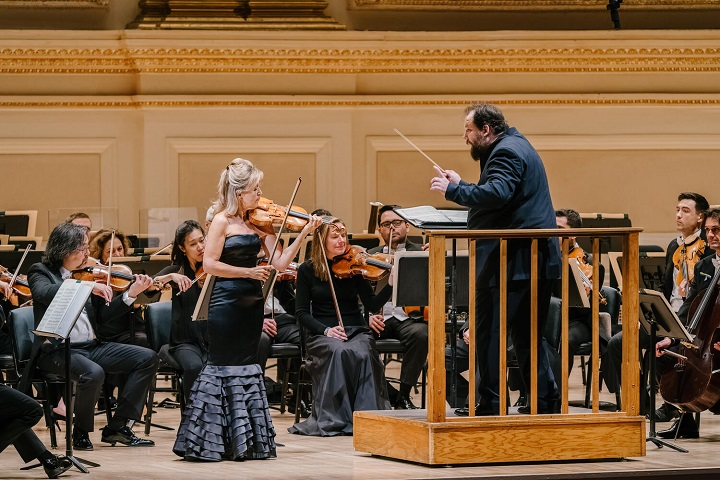
    The great Anne-Sophie Mutter (above, photo by Fadi Kheir) performed two works: Mozart’s Violin Concerto No. 1 in B-flat major, KV 207 and the New York premiere of Thomas Adès’ Air (Homage to Sibelius) for Violin and Orchestra.

    Mozart’s violin concertos have been part of Mutter’s repertoire for her entire career; it’s music she has played and internalized, and performances she has perfected, through the years. The magical performance on Tuesday night of the 1st Concerto, composed in 1773, was essentially perfect. Mutter’s golden, rich, steady tone never wavered; the soulfulness of her playing made the audience lean in. Mozart’s virtuosic writing gave Mutter no difficulties; she dispatched every run, double stop, and trill with absolute ease.

    The new composition by Adès, Air (Homage to Sibelius), is a very different work from Mozart. Composed for Ms. Mutter in 2022, it’s a single-movement, semi-minimalist work (running about 13 mins) that lets the soloist stay in the upper reaches of the instrument for almost its entire run time. While the soloist played a canon – Ms. Mutter’s perfect control and steadiness were wondrous to hear – the orchestra shifted the landscape through orchestration and rhythms. Maestro Nelsons shepherded the forces around Ms. Mutter beautifully, the BSO letting the music ebb and flow. While Mr. Adès explicitly says Air is an homage to Sibelius, I heard more Arvo Pärt and John Adams than Sibelius.
    CH11371825_Medium_res

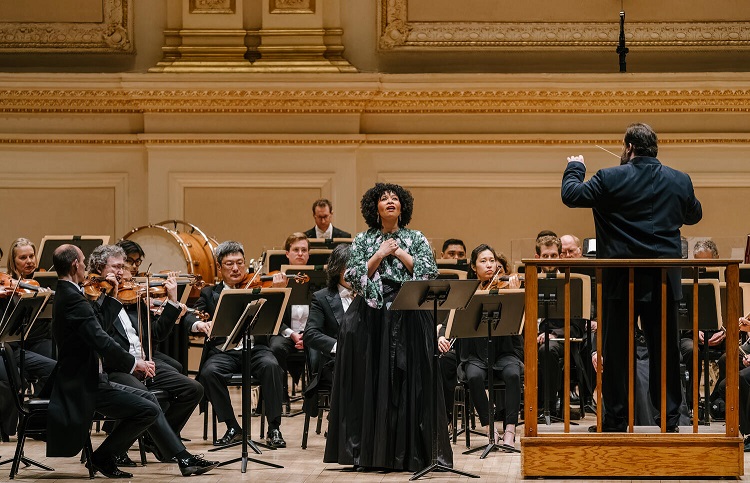
    Above: soprano Golda Schultz sings Sibelius; photo by Fad Kheir

    Two works by Sibelius book-ended the evening’s program. The vocal tone poem Luonnotar, Op. 70, is one of Sibelius’ most mystical and magical works. With text taken from the first “song” of the Finnish epic national poem Kalevala (a work that inspired several other major works from Sibelius), it tells the story of the (non-religious) Creation. The huge leaps and range of the vocal writing makes Luonnotar one of the most demanding works for a soprano, and South African soprano Golda Schultz was mesmerizing. Her rich voice is even throughout the range, even in the uppermost reaches it remains creamy and ravishing. Her breath control ensured she never ran out of air for Sibelius’ long and achingly beautiful melodies. Maestro Nelsons was sensitive to never let the orchestra drown out the singer. This is a work I wish would be performed more often.

    CH11371827_Medium_res

    Above: Maestro Nelsons and the BSO; photo by Fadi Kheir

    The concert ended with an expansive performance of Sibelius’ Symphony No. 5 in E-flat major, Op. 82. Sibelius’ sound-world is really like no other. I don’t think there is another composer who composed music of such surging coldness and brilliant light. You can feel the winds sweeping across the snow and the icy water glistening in the Sun. The episodic nature of Sibelius’ writing, in the hands of lesser conductors, can be difficult to stitch together. Maestro Nelsons managed it beautifully, and the Boston Symphony – which has a long history of playing Sibelius – responded to every nuance. The orchestra’s marvelous brass section deserves special recognition here because the very exposed writing for the horns in the first and third movements was played perfectly by the ensemble. The final movement, one of Sibelius’ most famous compositions, with the majestic tolling of the horns and sweeping melody from the strings, is one of those rare truly breathtaking glories of music. It’s interesting that this overwhelming section – supposedly inspired by a flock of swans he watched passing overhead – is only played in all its Romantic glory once. When it is repeated in the second half of the movement, it changes to a darker, almost sinister tone. And the work ends with 4 chords and 2 unisons – broken by pauses. A stark and startling conclusion.

    The Boston Symphony is second to none playing Sibelius; years ago Sir Colin Davis – one of the great exponents of the Finnish bard’s music – played and recorded his works with the BSO extensively. Andris Nelsons doesn’t miss a beat.

    Performance photos by Fadi Kheir, courtesy of Carnegie Hall

    ~ Ben Weaver
  • YCA Presents Violinist Lun Li ~ Debut Recital

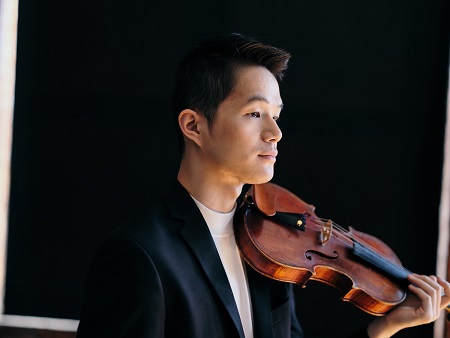
    Lun li

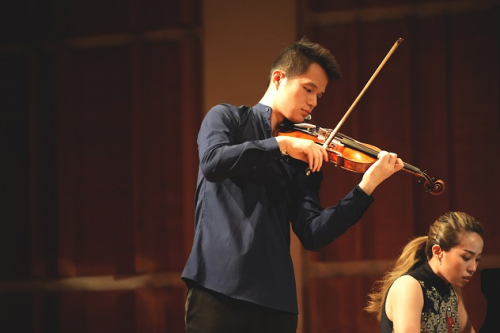
    Wednesday April 26th, 2023 – Young Concert Artists presenting the New York debut recital of violinist Lun Li (above) tonight at Merkin Hall. Pianist Janice Carissa shared the stage with the young violinist in a wide-ranging program which Lun Li described in a program note:

    My debut program explores the interplay between fantasy and reality through the works of Bartók, Messiaen, Schumann and others. I have chosen a set of repertoire that explores this blurred dimension, and more importantly, allows the listener to form sonic connections without needing extensive knowledge and context. I invite you to form your own personal narratives with this program.”

    In the program’s brief opening work, “Don Quixote” from 18 Miniatures by Giya Kancheli, both players showed themselves to be passionate and highly accomplished musicians. The music has a boisterous start, which develops into a strutting dance. Thereafter, extroverted phrases alternate with delicate, witty ones.

    Lun Li then spoke briefly, and asked that we withhold applause during the remainder of the program’s first half. He and Ms. Carissa then commenced on a marvelous performance of Francis Poulenc’s Violin Sonata.

    Poulenc originally wrote this sonata in 1942/1943, for the young French violinist Ginette Neveu, who perished in a plane crash in 1949 at the age of thirty. Thereafter, the composer revised the sonata, making several changes in the last movement. The work recalls the composer’s memories of the great Spanish poet Federico García Lorca (1899-1936); suspected of homosexuality, García Lorca was executed by the Fascists soon after the outbreak the of the civil war.

    The sonata’s opening Allegro con fuoco makes a frantic start before easing into a tango-like mood, which speeds up before halting for a long pause. A tender melody develops with great passion; alternating moods carry us to a fantastic finish.

    Poulenc headlined his second movement, an Intermezzo, with a quotation from García Lorca: “The guitar makes dreams weep,” alluding to the poet’s own guitar arrangements of Spanish songs. The music begins with a lulling piano motif accompanied by plucked violin notes. A subtle melody becomes rapturous, the piano lapses into a dreamlike state. Off-kilter harmonies sound before an upward violin glissando brings a quizzical end.

    The third movement’s title, Presto tragico, foreshadows the death of the poet: fast and urgent passages mesh with dancelike swirls of notes, climaxing with a violent chord. A searing violin theme jolts us, then the music subsides to a tragic, mournful conclusion.

    Honoring Lun Li’s request for “no applause” was difficult after such a thrilling performance, but the mood held and he commenced the high, soft agitato of Salvatore Sciarrino’s Per Mattia, a brief work that flowed seamlessly into the ensuing Schoenberg. 

    Janice carissa.

    Above: pianist Janice Carissa

    Arnold Schoenberg’s Phantasy, Op. 47, began life as a solo violin piece, to which the composer later added a separate piano accompaniment. Lun Li and Ms. Carissa here displayed the wonderful sense of teamwork that underlined their playing all evening. The pianist, whose gown was a work of art in and of itself, is wonderfully subtle, and she deftly handled the rhythmic shifts in which this music abounds. Together, the players veered from the ethereal to the drunken, dancing along thru stuttering, jagged passages which morphed, incredibly, into Fritz Kreisler’s Miniature Viennese March. This was a brilliant ending to the concert’s first half: jaunty, and impeccably played.

    Music of Olivier Messiaen, his Fantaisie, opened the evening’s second half; the composer is perhaps best remembered for his magnificent, poignant Quartet for the End of Time. The Fantaisie opens with Ms. Carissa delivering an emphatic statement from the piano. Dance-like passages are heard, and then Lun Li’s violin soars over gorgeous rippling figurations from the pianist. The music sails along, alternating rapid passages with thoughtful ones: mood swings that are relished by the players. From a high-velocity, tumultuous buildup, the music becomes cinematic. Animated/agitated music gives way to another high-flying, silken violin theme. The climax is reached, with the composer offering a swift, dazzling finish. 

    Robert Schumann’s quirky Bird as Prophet, arranged by Leopold Auer, comes next. Ascending violin phrases have a touch of irony, and then a lyrical song springs up, with a shimmering trill. The music features some wistful hesitations.

    4

    Lun Li and Ms. Carissa polished off the evening with a compelling performance of Béla Bartók‘s Violin Sonata No.2, Sz. 76. Lun Li aptly described this music as being “from a different planet”, and from its big, strange start it is indeed kozmic, weird, and wonderful. Passion and pensiveness send alternating currents thru the hall, sagging violin motifs develop into an epic expressiveness. As things simmered down, Lun Li remained unfazed by the ill-timed sound of a cellphone: he delivered a plucking ‘cadenza’ from which a dance emerged: cascades of notes from the violin over a pounding rhythm from the keyboard. Fabulous playing…they sounded like a whole orchestra! 

    Bartók offers a fantastical sonic variety in this piece in terms of tempi and dynamics: a piano solo of epic power gives way to a spidery violin motif. Lun Li becomes a veritable speed demon, playing fast and furious, and taking things to new heights. The music calms, and slows; the violin sighs, then starts plucking, and the music dances onward.

    2

    The audience hailed the musicians with a fervent ovation at the sonata’s end, and Lun Li graciously thanked us for having accompanied him on this musical journey. He then launched a performance of Schubert’s  Erlkönig that was an astounding demonstration not only of his virtuosity but of his unbounded passion and his heartfelt dedication to music.

    I look forward eagerly to hearing Lun Li again…and soon: on Friday May 5th, he will play the Prokofiev 2nd with the Riverside Symphony at Alice Tully Hall. Tickets and info here

    Performance photos courtesy of Young Concert Artists.

    ~ Oberon.

  • Ralph Vaughan Williams ~ A SEA SYMPHONY

    Vaughan-Williams

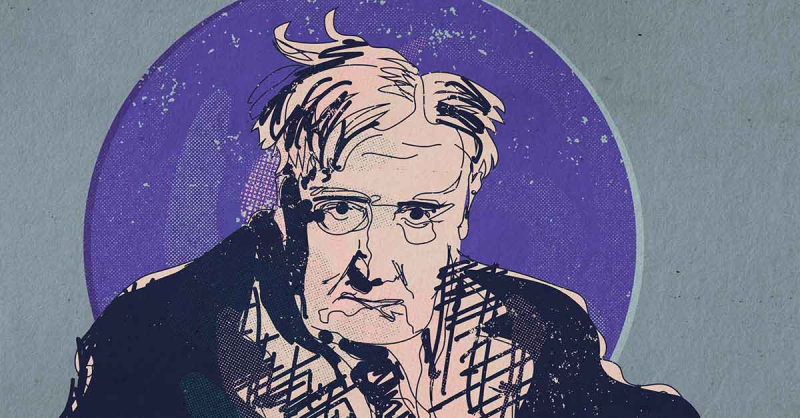
    Above: Ralph Vaughan Williams

    Author: Oberon

    Friday April 21st, 2023 – The Choral Society and Orchestra of Grace Church presenting a performance of Ralph Vaughan Williams’s A SEA SYMPHONY, conducted by John Maclay, with soloists Tami Petty (soprano) and Hadleigh Adams (baritone).

    Vaughan Williams selected for the first three movements of A SEA SYMPHONY three poems from Walt Whitman’s Leaves of Grass. The symphony’s first two movements are entitled “A Song for All Seas, All Men” and “On the Beach at Night Alone.” The third movement, called in the symphony “The Waves“, is Whitman’s poem in the same series entitled “After the Sea Ship.” For the fourth and longest movement, entitled The Explorers“, the composer chose lines from widely scattered excerpts of another lengthy sub-section of Leaves of Grass entitled “Passage to India.”

    In all four movements, the composer tightened up the poetry to best serve his musical vision of the boundless sea. From the first brass fanfare proclaiming the words “Behold the Sea!” to the mystical choral invocation of a  “…vast rondure, swimming in space“, words and music align to depict both the epic grandeur and the meditative power of the planet’s oceans.

    This evening was very frustrating for me, as I have waited years to hear this work performed live. The audience included many people who brought small children, and of course, two such youngsters were seated directly in front of us. After being reasonably well behaved during the first movement, they became fidgety and restless. The parents basically ignored their antics, especially during the long final movement. My companion and I were exasperated by the situation: yet another case of the  triumph of people who don’t care over people who do. 

    Musically, the evening got off to an uneven start. The balance between the orchestra, the huge chorus, and the soloists was off; the blend became mushy and most of the words were incomprehensible. The symphony’s great opening movement therefore went for nought. Things improved greatly during the second and most haunting movement, “On the Beach at Night Alone” and the ensuing scherzo, “The Waves“, was well done. In the over-long final movement, the composer seems to have been unable to decide how to end the piece: he would periodically venture into a cul de sac, delaying the inevitable.

    The evening’s soloists are both possessed of fine voices. Baritone Hadleigh Adams was sometimes overwhelmed by the orchestra in the opening movement, but that is the conductor’s fault. Mr. Adams came into his own with a wonderful rendering of “On the Beach at Night Alone” where his expressive singing and fine timbre could be deeply enjoyed. An eloquent passage for solo cello enhanced the singing, making this the highlight of the evening.

    Soprano Tami Petty has a clear, sweet voice that blooms as it ascends; in this regard, she reminded me of Helena Dix, the Australian soprano who sang Norma at The Met earlier this year. Ms. Petty sounded truly lovely in the big Hall, making me hope she’ll have a go at the Verdi REQUIEM here someday soon.

    Sea symphony

    Above, bowing during the massive standing ovation at the concert’s end, are Ms. Petty, Maestro Maclay, and Mr. Adams; photo by Brian Hatton.

    I don’t anticipate another opportunity to hear A SEA SYMPHONY here in New York City again in my lifetime, but I have the marvelous Grammy Award-winning Telarc CD of it with the Atlanta Symphony Orchestra and Chorus, conducted by Robert Spano, and wonderful soloists Christine Goerke and Brett Polegato that I can turn to.

    ~ Oberon

  • Composer Portraits: Nicole Mitchell

    Nicole-mitchell

    Above: Nicole Mitchell

    Author: Oberon

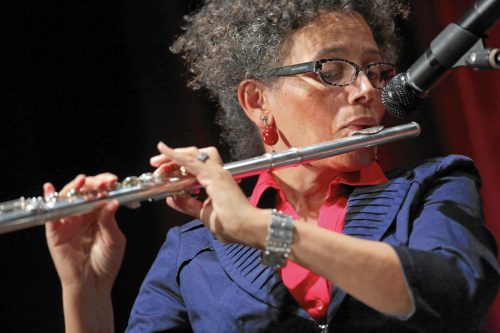
    Thursday March 30th, 2023 – Another adventurous evening in the Miller Theatre’s ongoing Composer Portrait Series as we were introduced to the multi-talented Nicole Mitchell: composer, flautist, bandleader, educator, and the first woman president of Chicago’s Association for the Advancement of Creative Musicians (AACM).

    Ms. Mitchell brought her flute along with her this evening, joining members of the International Contemporary Ensemble, vocalist Lisa E. Harris, and violinist Mazz Swift in works she has composed from 2015 thru 2023.

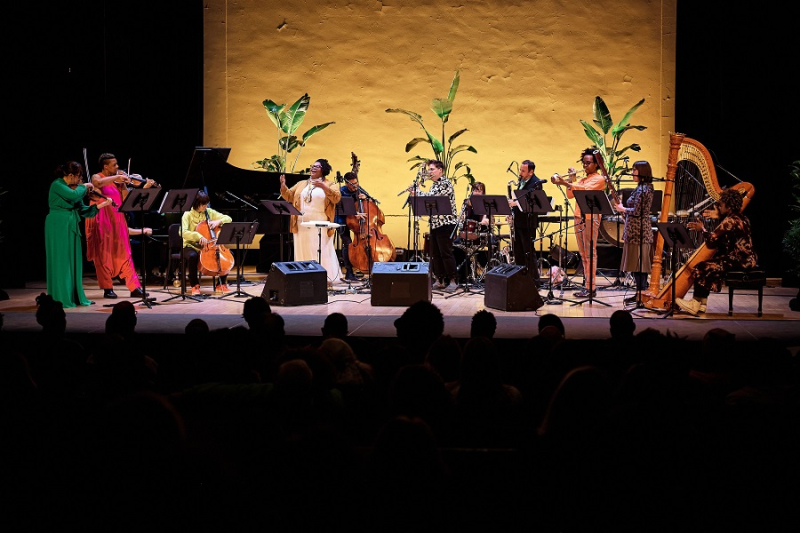
    On the Miller Theatre stage, a magic garden had been created with towering plants and clusters of candles; as the program progressed, the back panel was illuminated in varying hues. The musicians were distinctively dressed, creating the feel of a casual family gathering where every member had an invaluable place in the musical scheme.

    The evening opened with Whispering Flame, co-composed by Nicole Mitchell and Lisa E. Harris in 2017. From a busily insectuous opening instrumental passage, Ms. Harris’s rich, warm tones engaged us in a slow-rising vocal line. Ms. Mitchell’s flute playing was pristine, and she also presided over the electronics. Percussionist Clara Warnaar struck a summoning gong, and the music took on a windswept feeling, with trumpeter Jonathan Finlayson producing sputtering effects, and duetting violinists Mazz Swift and Gabriela Diaz adding a touch of lyricism. This kozmic work made for a perfect introduction to the program.

    SVfhZhko

    Above, playing Procession Time: Cory Smythe, Katinka Kleijn, Isabel Lepanto Gleicher, and Joshua Rubin; photo by Rob Davidson

    Bringing new sounds into the evening’s musical sphere, a quartet of artists played with such a wide range of colours that they created an impression of hearing a larger ensemble for Procession Time (2017). In the work’s first section, “Ritual Conception”, deep violet tones from Katinka Kleijn’s cello were matched by Joshua Rubin’s velvety bass clarinet. The music has a hesitancy about it, with Cory Smythe at the piano joining Isabel Lepanto Gleicher’s purring flute. Ms. Gleicher then takes off on a melodic flight, interrupted by the bass clarinet sounding rather ominous. Flute and standard clarinet harmonize to calming effect.

    The second section of Procession Time, “Carnival at the Cliff”, features quirky piano and cello motifs, and more harmonizing from flute and clarinet. A heavy rhythm develops, with squealing and screeching from the flute and clarinet.

    Transitions Beyond (2021) is a quintet for Ms. Harris (voice), Mr. Rubin (clarinet), and Mlles. Gleicher (flute), Diaz (violin), and Kleijn (cello). Although the program listed five movements, I could only detect four (perhaps I missed a transition along the way); but, at any rate, the work is a finely-woven sound. It starts with wordless vocalizing from Ms. Harris from which a text emerges over the sighs of a drooping cello: “I don’t want to leave you…” A violin solo turns into a dialogue for violin and cello, and soon their sounds begin to ooze, whereupon the winds take over. Ms. Harris sings a vocalise of uncanny sounds and pitches.

    The bass clarinet burbles and stutters, the violin take on a wispy feel, the singer continues to summon an array of colours. Cello and clarinet mingle, the winds sounding whimsical and the singer’s lines turning edgier. Now there is a flow of lyricism from the instruments, and a shimmering quality hovers over the singer’s low-range phrases. There is lots of beauty here, doled out so that each participating artists shines.

    The program’s first half concluded with the big hit of the evening: Building Stuff (2015, rev. 2023). This irresistible music had the whole place jumping, and provided wonderful opportunities for each of the nine players involved to shine. To a jaunty rhythm, Mr. Rubin’s clarinet sings out, followed by Ashley Jackson’s captivating harping and a sparkling xylophone motif from Clara Warnaar.

    A fantastic sway develops, steered by double-bass phenom Brandon Lopez. Mazz Swift reels off a vivid, jazzy violin solo, pianist Cory Smythe and Ms. Warnaar’s drumming combine in high style, and Ms. Mitchell’s flute adds a bright lustre. There are intriguing textures, with Sara Schoenbeck’s vibrant bassoon playing grabbing our attention, and Ms. Kleijn’s cello ever aglow with resonance. Mr. Smythe reaches into the piano to pluck some steely notes, and Ms. Jackson’s harp sounds sweet and sure. As Mr. Lopez’s fascinating rhythm steered the music to its finish, the crowd erupted in a burst of applause and cheering.  

    A6AKo05Y

    Above, the ensemble playing Inescapable Spiral; photo by Rob Davidson

    Following a charming  interview of Ms. Mitchell by The Miller’s Melissa Smey (and beautifully signed by two young people at the edge of the stage), the evening concluded with Inescapable Spiral (2017, rev. 2023) which brought together all the artists save for the composer, who listened from the hall. This long work seemed rather tame and aimless at times, especially after the fabulousness of Building Stuff, but it did let us continue to savour the individual playing of everyone involved.

    ~ Oberon

  • Dallas Symphony @ Carnegie Hall

    Luisi

    Above: Maestro Fabio Luisi

    Author: Shoshana Klein

    Sunday March 26th, 2023 – I have to admit to not knowing much about the Dallas Symphony Orchestra before tonight. I’ve seen Fabio Luisi guest conduct before but not work with his home orchestra. As it turns out, they put on a great concert – they played with energy, focus, and dynamic range, and Luisi does a great job of keeping things interesting and restrained to keep the music interesting later on. Despite, or maybe because of this, somehow the concert still had more people dropping things in the audience than any other concert I’ve ever been to.

    Negron jpg


    What keeps me awake by Angélica Negrón (above, photo by Quique Cabanillas) started the concert – a short 7-minute piece, but a very nice introduction to the concert. Negrón created a distinctive but not completely unfamiliar sound world – though this might have something to do with the fact that I listen to her band, Balún – which seriously, you should check out if you haven’t heard them. Negrón is the Composer in residence at the DSO and I’m looking forward to hearing more pieces that come out of that collaboration.


    The piece evokes uncertainty and wandering like her program note explains – navigating moving from Puerto Rico to New York City as a Latina composer trying to fit into spaces that historically excluded people who look like her.

    G o jpeg


    Rachmaninoff’s second piano concerto with Garrick Ohlsson (above) was very enjoyable. I’m usually in the balcony, and being on the orchestra level so close to the stage, I could actually feel the sounds through my feet when the brass let loose. The orchestra was super sensitive under Luisi, the piano sections drawing us all in and the louder sections contrasting well. Ohlsson played the 3rd movement with some extra snappiness, which was just enough to keep my full attention for a piece many of us have heard… somewhat frequently. Near the middle/end of the third movement, I think the piece loses steam a bit compositionally, but it almost makes the end more exciting – right around the time you start to be ready for it to be over, it gets into it again and heads for the hyper-romantic finish.


    Ohlsson did an encore that he announced from the stage, though it wasn’t really necessary – Chopin’s op 9 no 2, probably the most well-known of the nocturnes. Near the end, he had a little fun with it, adding some whimsy in places.


    The Tchaikovsky, (which started at almost 10pm, the joys of an 8:30 start time) was really well paced, restrained just enough more than usual to be noticeable. Some tempi choices in the second movement caught my ear, the bassoon solo section – while sounding great – was a little slow to me, and the horn solo also sounded good but a little fast. However, overall I chose to trust the plan as the whole piece came together really well. The wind soloists were all fantastic, and more soloistic than their counterparts in the first half of the concert.


    It’s played so much, but this is one of those pieces to me that if you put it away for long enough, it regains most of its charm. It turns out I hadn’t heard it in long enough that it felt fresh and new, at least with this exciting performance.


    ~ Shoshana Klein

  • Bach’s Matthäus-Passion @ The NY Philharmonic

    Bach

    Author: Ben Weaver

    Saturday March 25th, 2023 – J.S. Bach’s Matthäus-Passion, composed around 1724-27 (and revised through 1742), is arguably Bach’s greatest composition. Personally, I’d place it in the top ten greatest works of Western music. The NY Philharmonic performs it infrequently; the last time was in 2008 under the baton of Kurt Masur. Running at roughly 2:45 hours, the Matthäus-Passion is a work filled with passion and drama…more drama than most church music. Anyone mocking Verdi’s Requiem as being more opera than mass perhaps should take a closer look Bach’s greatest work. Verdi was following in Bach’s mighty footsteps. I was very glad to see it on the program this year, finally! I quite literally got chills as the work started and the chorus (Musica Sacra) sang the opening words: “Kommt, ihr Töchter, helft mir klagen.” Alas, the thrills did not last; I was sadly disappointed with tonight’s performance.

    Tenor Nicholas Phan sang the very difficult part of the Evangelist, who narrates the story of Jesus’ arrest, the debate over what his fate should be, his execution, and its immediate aftermath (the Passion ends before the resurrection.) Much of the drama of the work flows through the Evangelist’s words. Mr. Phan managed the difficult music very admirably, but the part can be a trap dramatically: there are many proclamations like “And Jesus said unto him.” How does one make each one sound fresh? I don’t have a clear answer. I suppose if it was easy, anyone would be able to do it. 

    Bass-baritone Davóne Tines’ Jesus (Mr. Tines was the only person on stage wearing a costume: a white, sleeveless robe) possesses a large voice; but it’s a voice with a guttural quality, which seldom opens or blooms.

    Mezzo-soprano Tamara Mumford, a favorite at the Metropolitan Opera across the Plaza, sang nicely. “Buß und Reu” in Part I was vocally steady and clear. But in Part II, Maestro Jaap van Zweden robbed Ms. Mumford and concertmaster Frank Huang of an opportunity to give their all in “Erbarme dich”, perhaps  the Passion’s most famous aria; certainly its most emotional and devastating piece. Written for solo voice, solo violin, and orchestra, this breathtaking music has the ability to stop time. Alas, Maestro van Zweden took it at a preposterous Allegro tempo; he absolutely wrecked it by turning it into a cabaletta. If your tempo is faster than John Eliot Gardiner’s, Nikolaus Harnoncourt’s, Trevor Pinnock’s, and Gustav Leonhard’s – you may consider looking at the score again.

    Amanda forsythe

    Soprano Amanda Forsythe (above), making her Philharmonic subscription concert debut with these performances, was sublime. Her ability to float pianissimi high notes was indeed spine-tingling. The aria “Aus Liebe will mein Heiland sterben,” which also includes a flute solo by Robert Langevin, was the highlight of the evening. 

    The Philharmonic’s Principal Associate Concertmaster, Sheryl Staples, had a chance to shine in “Gebt mir meinen Jesum wieder,” with a difficult solo. Unfortunately, bass Philippe Sly, making his Philharmonic debut with these performances, had pitch difficulties which offset Ms. Staples fine playing. Tenor Paul Appleby was superb all evening, the high tessitura of the aria “Geduld” presenting no difficulties for him.

    The Choral group Musica Sacra was in excellent form all evening, from the Chorales to dramatic exchanges representing specific characters. The Brooklyn Youth Chorus sang the opening and closing choruses of Part I, but did not return for Part II. Can’t say if that was intentional or if something kept them from returning.

    I do hope the Matthäus-Passion returns to the Philharmonic again soon – under a more caring conductor.

    ~ Ben Weaver

  • Bach’s Matthäus-Passion @ The NY Philharmonic

    Bach

    Author: Ben Weaver

    Saturday March 25th, 2023 – J.S. Bach’s Matthäus-Passion, composed around 1724-27 (and revised through 1742), is arguably Bach’s greatest composition. Personally, I’d place it in the top ten greatest works of Western music. The NY Philharmonic performs it infrequently; the last time was in 2008 under the baton of Kurt Masur. Running at roughly 2:45 hours, the Matthäus-Passion is a work filled with passion and drama…more drama than most church music. Anyone mocking Verdi’s Requiem as being more opera than mass perhaps should take a closer look Bach’s greatest work. Verdi was following in Bach’s mighty footsteps. I was very glad to see it on the program this year, finally! I quite literally got chills as the work started and the chorus (Musica Sacra) sang the opening words: “Kommt, ihr Töchter, helft mir klagen.” Alas, the thrills did not last; I was sadly disappointed with tonight’s performance.

    Tenor Nicholas Phan sang the very difficult part of the Evangelist, who narrates the story of Jesus’ arrest, the debate over what his fate should be, his execution, and its immediate aftermath (the Passion ends before the resurrection.) Much of the drama of the work flows through the Evangelist’s words. Mr. Phan managed the difficult music very admirably, but the part can be a trap dramatically: there are many proclamations like “And Jesus said unto him.” How does one make each one sound fresh? I don’t have a clear answer. I suppose if it was easy, anyone would be able to do it. 

    Bass-baritone Davóne Tines’ Jesus (Mr. Tines was the only person on stage wearing a costume: a white, sleeveless robe) possesses a large voice; but it’s a voice with a guttural quality, which seldom opens or blooms.

    Mezzo-soprano Tamara Mumford, a favorite at the Metropolitan Opera across the Plaza, sang nicely. “Buß und Reu” in Part I was vocally steady and clear. But in Part II, Maestro Jaap van Zweden robbed Ms. Mumford and concertmaster Frank Huang of an opportunity to give their all in “Erbarme dich”, perhaps  the Passion’s most famous aria; certainly its most emotional and devastating piece. Written for solo voice, solo violin, and orchestra, this breathtaking music has the ability to stop time. Alas, Maestro van Zweden took it at a preposterous Allegro tempo; he absolutely wrecked it by turning it into a cabaletta. If your tempo is faster than John Eliot Gardiner’s, Nikolaus Harnoncourt’s, Trevor Pinnock’s, and Gustav Leonhard’s – you may consider looking at the score again.

    Amanda forsythe

    Soprano Amanda Forsythe (above), making her Philharmonic subscription concert debut with these performances, was sublime. Her ability to float pianissimi high notes was indeed spine-tingling. The aria “Aus Liebe will mein Heiland sterben,” which also includes a flute solo by Robert Langevin, was the highlight of the evening. 

    The Philharmonic’s Principal Associate Concertmaster, Sheryl Staples, had a chance to shine in “Gebt mir meinen Jesum wieder,” with a difficult solo. Unfortunately, bass Philippe Sly, making his Philharmonic debut with these performances, had pitch difficulties which offset Ms. Staples fine playing. Tenor Paul Appleby was superb all evening, the high tessitura of the aria “Geduld” presenting no difficulties for him.

    The Choral group Musica Sacra was in excellent form all evening, from the Chorales to dramatic exchanges representing specific characters. The Brooklyn Youth Chorus sang the opening and closing choruses of Part I, but did not return for Part II. Can’t say if that was intentional or if something kept them from returning.

    I do hope the Matthäus-Passion returns to the Philharmonic again soon – under a more caring conductor.

    ~ Ben Weaver

  • Ensemble Intercontemporain @ Zankel Hall

    Ec
     
    Above: the players of Ensemble Interconterporain
     
    Author: Shoshana W. Klein
     
    Saturday March 25th, 2023 – If you’re a contemporary music performer or aficionado, chances are you’ve come across the Ensemble Intercontemporain – they are one of the quintessential contemporary music ensembles and they have a ton of recordings and videos on YouTube. The ensemble was created by Pierre Boulez in 1976, and I’d say that makes it one of the oldest of its kind, but in a lot of ways it’s actually still one of the only of its kind. The members are full-time, and while they’re based in Paris, the group’s performances are mostly on tour all over. Despite groups like Alarm Will Sound, the Boston Modern Orchestra Project, and others, the US certainly doesn’t have an analogous ensemble – all those that come to mind are different instrumentation, different focus, and certainly not full-time for 31 members. Of course, that’s probably partially due to funding structure differences – Ensemble Intercontemporain is funded by the French government as well as by touring. The ensemble defines contemporary as 20th and 21st century pieces – though surely not all 20th century work, remembering that Rachmaninoff and Respighi were composing far into the 20th century that this group certainly wouldn’t consider in their wheelhouse. 
     
    The concert started with Arnold Schoenberg’s 5 Pieces arranged for this size ensemble. The short, extremely lyrical, and fully engaging movements were a good start to a concert in which the other two pieces were 45 minutes each. The ensemble works incredibly well together – I felt that particularly the woodwinds had a huge range of timbres and dynamics. 
     
    Next was Matthias Pintscher’s sonic eclipse, a kind of double concerto. The premise is very interesting, in which the first and second movements are each “celestial bodies” and the third is called “occultation” and describes the eclipse. The first movement has a trumpet soloist (Clément Saunier), the second a horn soloist (Jean-Christophe Vervoitte), and both in the third. While I’m not sure I heard the intended sonic eclipse, I was able to appreciate a lot of the sonic textures – the timbral flexibility of all of the players combined with the writing meant that I often could barely tell where a sound was coming from – they were able to match each others’ sounds so well. At one point the string tremolo was matching the trumpet soloist flutter tongue in a way that I would not have thought possible beforehand.
     
    Boulez
     
    Above: Pierre Boulez
     
    The last piece – Boulez’s Dérive 2 – had such a sustained energy throughout the 45 minutes that it made me think again about how many ensembles and how many players in the world can play this music, not to mention exceptionally. It’s not played live often, understandably.
     
    This program was very much the ensemble’s traditional repertoire – significant pieces by their founder, current music director (Pintscher, also conducting), and Schoenberg. There’s definitely something to be said about a contemporary ensemble that has such a canon of its own – is it a little bit of a contradiction? Or a difference in defining “contemporary”? It might be worth noting that while they have plenty of newer members – much of the ensemble seemed on the younger side – the group of around 20 people performing seemed to have three women, and of the full 31 members listed on the website, I saw five. 
     
    Despite the difficulty of the whole concert, the ensemble consistently seemed to be enjoying themselves, as did the audience – the almost full house called Pintscher back on stage something like 5 times with a long standing ovation.
     
    ~ Shoshana W. Klein

  • ASO Presents Strauss’s DAPHNE

    Daphne

    Thursday March 23rd, 2023 – The American Symphony Orchestra performing Richard Strauss’s rarely-heard DAPHNE in concert form at Carnegie Hall, with Maestro Leon Botstein on the podium. The Bard Festival Chorale, under the direction of James Bagwell, had a big part to play in the proceedings.

    The one-act opera, written in 1936-1937, comes late in Strauss’s composing career, when ELEKTRA, SALOME, ROSENKAVALIER, DIE FRAU OHNE SCHATTEN and ARIADNE AUF NAXOS were already established in the world’s opera houses. 

    The story of DAPHNE in a nutshell: Shepherds anticipate the feast of Dionysus, with Daphne’s parents, Peneios and Gaea, presiding over the preparations. Daphne, in love with nature, shuns the ways of men. Her childhood playmate, the shepherd Leukippos, tries to embrace her lovingly, but she repels him and renounces the coming festivities. She refuses to don the clothing her mother has lovingly prepared for her, and runs away. Playfully, the women persuade Leukippos to wear the clothes instead. Apollo arrives, in a peasant’s disguise, and is immediately drawn to Daphne, who rebuffs him. The feast begins, and the disguised Leukippos offers Daphne a cup of wine, arousing the jealousy of Apollo. The heavens respond to the god’s anger with rumbles of thunder, which cause the sheep to run away; the shepherds chase after the flock, leaving Apollo, Daphne, and Leukippos alone. Leukippos reveals his true identity, and challenges Apollo to reveal his. Instead, Apollo shoots Leukippos dead with his bow. Apollo begs Daphne’s forgiveness, saying he will grant her wish to join the natural world and will then love her in the form of a laurel tree. Her transformation begins, and her disembodied voice is heard among the rustling leaves.

    About tonight: The evening got off to a rather stodgy start as a large phalanx of choristers slowly filled the stage space to sing An den Baum Daphne, an a cappella choral epilogue to the opera which Strauss composed in 1943. This seemed like a nice idea on paper, but the music overall is not terribly interesting,  consisting of numerous repeats of a five-note theme familiar to me from DIE FRAU OHNE SCHATTEN. It seemed to go on and on, and while there were many appealing individual voices among the chorus, they did not always blend well. There were some pitch issues along the way, and a feeling that the piece was a bit under-rehearsed.

    Then came an intermission, which completely killed the Straussian atmosphere that had been established, with people chatting blithely and wandering up and down the aisles. At last the opera itself commenced, but it took time for the crowd to re-settle.

    DAPHNE is a gorgeous opera: a veritable feast of melody…there is never a dull moment musically. The vocal writing is extremely demanding; a very fine cast had been assembled, but their work was often undermined by over-loud playing from the orchestra. At the climaxes, voices were being forced in order to stay afloat, This has been happening at The Met a lot this season too, where conductors seem to think loud = exciting. Yes, there is a superficial thrill to it, but in the end it doesn’t do anyone any good.

    That being the case, the singers could only be admired for holding steadfast and getting thru these taxing moments…especially when an orchestra is onstage behind you rather than in the pit.

    The opera got off to an excellent start with baritone Kenneth Overton’s handsome singing as the 1st Shepherd. The voice is fresh and warm, and he cuts a fine figure to boot. Later in the opera, a trio of choristers come forward to portray his fellow shepherds: Jack Cottrell, Paul Holmes, and Blake Austin Brooks.

    In the title-role, so ravishingly sung on the esteemed EMI recording by the great Mozartean Lucia Popp, Jana McIntyre displayed a clear, soaring lyrical sound that deftly encompassed the role’s wide range. It is a girlish timbre, perfect for expressing youthful vulnerability and impetuosity, but Ms. McIntyre also summoned considerable power when needed. In one especially lovely passage, her voice entwined with an obbligato from the ASO’s concertmaster, Cyrus Beroukhim. There were a few spots when the orchestra pressured the soprano, but she held her own and emerged unfazed. Daphne is a “big sing” and without a persuasive interpreter, the opera is not worth reviving. Ms. McIntyre not only sang beautifully, but she looked fetching in her pale lime-green frock, and she used her expressive hands with the grace of a ballerina to shape the music and send it out to us.

    As two maids, Marlen Nahhas and Ashley Dixon were much more than supporting players: both have luscious voices, sounding very much at home in the Carnegie Hall space. In solo phrases, they were each truly appealing to hear, and then they duetted to charming effect. Their scene was not mere filler, but a musical treat all on its own. 

    Strauss hated tenors: that is what people say when listening to an otherwise fine tenor struggle with the demands of Bacchus or the Emperor in FRAU OHNE SCHATTEN,  Tonight, both the leading tenors – rivals in the story – fared well, despite the assaults of the orchestra at certain inconvenient moments. Kyle Van Schoonhoven as Apollo (sometimes deemed Strauss’s cruelest tenor role) had the scope of the role, and the testing top notes were successfully attained. A more thoughtful conductor could have made the singer’s job easier but Mr. Van Schoonhoven was always impressive. And, in the more lyrical stretches, he displayed a very appealing timbre…and a sense of poetry. 

    As Daphne’s admiring swain, Leukippos, Aaron Blake made a striking impression. Slender of frame, and intense of presence, the tenor’s lyrical sound contains a vein of metal (aligned to crisp diction) that he can call upon to cut thru when needed. By turns playful and cocky, the character was portrayed to perfection, and the tenor unleashed a laser-beam  sustained note as fate closed in on him.

    Magnificent singing came from contralto Ronnita Miller (Gaea) and basso Stefan Egerstrom (Peneios), as Daphne’s parents. Ms. Miller, whose 1st Norn at The Met simply dazzled me a few seasons back, sings like a goddess with earthy chest tones of unusual richness. Stunning in her every note and word, the contralto looked like a fashion icon gowned all in black, and she shed her blessèd maternal light over the proceedings, even when sitting silently while others sang. Stefan Egerstrom, where have have you been al my life? What a powerful, resonant voice this man commands. He delivered his music with great authority: each note was rounded and true, and everything compellingly phrased. And yet, for all the strength of their voices, even Ms. Miller and Mr. Egerstrom were not immune to the effects of the encroaching orchestra.

    Daphne Matthew Dine 1

    Above, onstage at Carnegie Hall (from left): Stefan Egerstrom, Ronnita Miller, Aaron Blake, Kyle Van Schoonhoven, Jana McIntyre, Leon Botstein (back to camera), and Ashley Dixon. Photo by Matthew Dine.

    ~ Oberon

  • Accordion & Saxophone @ The Morgan Library

    Yca

    Above: Steven Banks and Hanzhi Wang

    Tuesday February 22nd 2023 – Young Concert Artists presenting a noontime concert at The Morgan Library featuring the unusual combination of accordion and saxophone. The players – Hanzhi Wang (accordion) and Steven Banks (saxophone) – have both previously appeared at The Morgan in solo recitals; they are brilliant, unique artists, and I was eager to hear them live again. But the afternoon did not turn out as planned.

    We settled into our seats, but after a few minutes we were shivering. We put our coats back on, but the damp chill was pervasive. Looking around, it seemed that everyone in the audience was bundled up, and I was recalling an evening many years ago when the young Frederica von Stade gave a recital in a frigid hall in Syracuse, NY, where the maintenance staff had inadvertently shut off the heat; luckily, someone located a small space heater which was set up onstage to keep the singer somewhat warm.

    This afternoon’s musicians took the stage, Mr. Banks towering over the petite Ms. Wang. They launched their program with an arrangement of Handel’s Recorder sonata in G-minor, HWV 360; it took a moment to adjust to the brighter sound of the saxophone in music we are accustomed to hearing played with the softer timbre of the recorder, but Mr. Banks immediately scaled back his dynamic palette, bringing delicious subtleties to the music. Meanwhile Ms. Wang, looking so lovely in her pleated white frock, transformed her accordion into a compact organ, playing with such cordial tone and bending the phrases with consummate skill. As he music veered from courtly to festive, the players were wonderfully in sync and so attentive to one another, making for a musical treat.

    Three miniatures by Krzysztof Penderecki – the great and sorely missed Polish master-composer – were so fascinating to hear. The first, Allegro, is weirdly spastic; it seems to reach its quirky end in a matter of seconds, with the players wryly relishing the innate humour of the piece. A dark and doleful Andante cantabile followed, the timbres of the two instruments blending to perfection. The concluding Allegro ma non troppo is a bouncy dance, polished off zestfully by Ms. Wang and Mr. Banks.

    Now Ms. Wang offered excerpts from Bach’s Goldberg Variations: the very familiar Aria, played with great depth of feeling, followed by four variations which called for all manner of fanciful fiorature, dispatched with effortless grace and polish by this remarkable virtuoso.

    Virtuosity continued in abundance as Ms. Wang gave us two works by Martin Lohse: Autumn Rain, with its dotty raindrops sparklingly defined, and the more somber Winter’s Tale, in which gentle snowflakes drift down on an overcast wintry afternoon. Ms. Wang’s incredible dexterity was simply mind-boggling to observe, her fingers flying nimbly over the keys as she spun out the music, much to our delight.

    But we were now chilled to the bone, and we silently agreed that we needed to leave and seek some warmth. We slipped up the stairs as the stage was being set for the next piece, and a few other audience members followed us out. I was sorry to miss Mr. Banks’s set, and the anticipated Astor Piazzolla finale.

    ~ Oberon