Category: Music

  • @ My Met Score Desk for PETER GRIMES

    Grimes

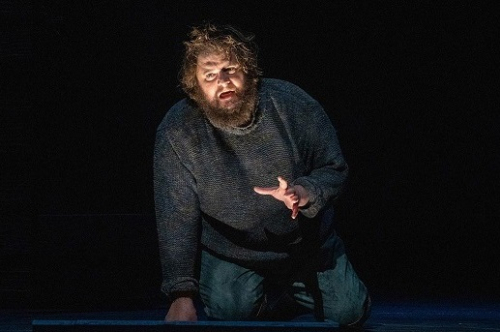
    Above: Allan Clayton as Peter Grimes; a Met Opera photo

    NOTE: This article was delayed due to problems with Typepad. Photos may be slow to load, and the musical excerpt may not play.

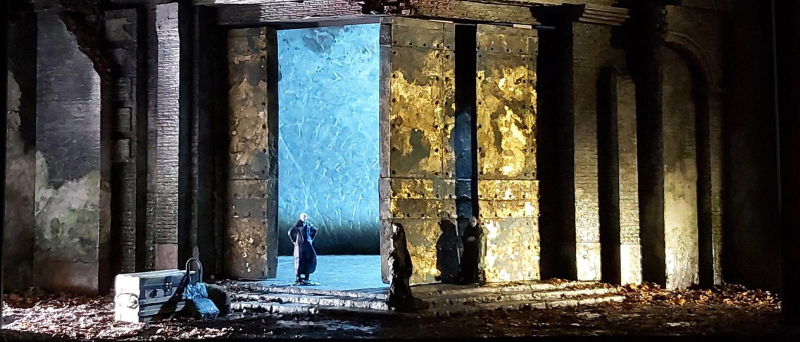
    Saturday October 28th, 2022 matinee – I didn’t like the Met’s current PETER GRIMES production, which premiered in 2008, when I saw it in the House, but later I watched it on DVD and found it thrilling. For this revival, I pondered getting a seat with a view, but then opted for practicality and took a score desk.

    I first saw GRIMES in 1983; it was a day I shall never forget. We’d been to SIMON BOCCANEGRA in the afternoon, and I was exhausted; sitting there waiting for GRIMES to begin, I thought “I’ll never make it to to end.” But moments after the curtain rose, Jon Vickers delivered his blazing first line, “I swear by almighty God…”, stepping on Swallow’s line in his impatience, and from that moment on, I was riveted. Vickers, his colleagues Elisabeth Söderström and Thomas Stewart, and a stellar lineup of singing actors (Jean Kraft, Lili Chookasian, Jerome Hines, Dale Duesing, Ezio Flagello, and Robert Nagy) gave me a thrilling first GRIMES, under the baton of the great Sir John Pritchard.

    In the ensuing years, I experienced two magnificent portrayals of Grimes at The Met: Philip Langridge and Anthony Dean Griffey each made an overwhelming impression. This afternoon, the British tenor Allan Clayton staked out his own claim to the role with a stunningly sung performance. I first heard the voice of Allan Clayton on the excellent Decca DVD entitled Britten’s Endgame.

    The Met Orchestra were on top form this afternoon, and the opera’s interludes – well-beloved as a concert ‘suite’ – were by turns painfully beautiful and searingly violent. The conductor, Nicholas Carter, was at his finest in these glorious passages. But he was less successful when solo voices were singing, sometimes giving too much volume and either covering the singers or leaving them to struggle for a heftier sound. The Met Chorus, with so much to do in this opera, were simply grand: “O tide that waits for no man…spare our coasts!

     
    Allan Clayton’s Grimes was more lyrical in sound than the other tenors I have heard live in the role, though he has good cutting power when he needs it. It was in the poetic passages of the music that the tenor made our hearts ache for this hapless, misunderstood man. From the start, his wonderfully clear diction made every word count. In the opening scene in the court, telling of the death of the first apprentice, Mr. Clayton drew us in.
     
    As the opera unfolds, the character’s hopes for a new life are raised, only to be dashed. Mr. Clayton’s extraordinarily expressive singing caught every nuance of these shifts in Grimes’s mental state. His poignant “Great Bear and Pleiades“, where he sings of the “…clouds of human grief…” along with “What harbour shelters peace?, and “In dreams I’ve built myself some kindlier home” were hauntingly sung, in contrast to the deranged scene in which he torments the apprentice and eventually sends the boy down the sea cliff to his doom.  My feeling is that Mr. Clayton’s Grimes may be the closest to Peter Pears’ in vocally capturing the personality of the doomed fisherman. Mr. Clayton’s performance deservedly won the audience’s vociferous approval.
     
    Soprano Laura Wilde made an unexpected Met debut this afternoon as Ellen Orford. Her voice, with a somewhat girlish timbre, was appealing in her Act II scene with the apprentice, John, and especially so in her third act Embroidery aria. In more dramatic passages, the conductor sometimes failed to do the right thing, leaving Ms. Wilde to push the tone. The soprano and Mr. Clayton were well-matched in general, She was warmly received by the audience.
     
    Balstrode fills an odd place in the opera: as one of the few true friends and defenders of Grimes, the character is key; but Britten does not give him all that much to sing. Adam Plachetka was fine in the role today.
     
    The librettist and composer create expert character studies amongst the townsfolk of The Borough, affording wonderful opportunities for today’s cast. Prime among these is Swallow, splendidly voiced this afternoon by the excellent Patrick Carfizzi.
     
    Two mezzo roles offered Denyce Graves and Michaela Martens many choice phrases as Auntie and Mrs. Sedley respectively. After a few warm-up notes, Ms. Graves sounded very well; “A joke’s a joke, and fun is fun!” she jibed sarcastically. Ms. Martens, with the meatier role of one of the opera’s most despicable characters (a busybody and gossip with a drug addiction,) got a round of laughs from the crowd with “I’ve never been in a pub in my life!” and pulled out some darkish chest tones at “Murder most foul it is!” and “Crime, which my hobby is...”
     
    Harold Wilson as Hobson kicked the opera off with his strong-voiced summons of Grimes to take the oath; later, Hobson tries to evade Ellen’s offer to accompany him to pick up Grimes’s next apprentice. Chad Shelton (Bob Boles) and Justin Austin (Ned Keene) each made their mark, and the always-effective Tony Stevenson excelled as the Reverend Horace Adams. As Auntie’s two nieces, Brandie Sutton and Maureen McKay sang prettily; they were joined by Mlles. Wilde and Graves in the opera’s pensive quartet, one of the score’s unique highlights.
     
    With this performance, PETER GRIMES seemed to edge out BILLY BUDD as my favorite Britten opera; however, that pendulum might swing back if I ever get to see BILLY BUDD again, just as the very top spot on my list of favorite operas has shifted between ARIADNE AUF NAXOS and ELEKTRA for years.
     
    PETER GRIMES is a cruel opera; the characters (well, except for Ellen) each have a mean streak, and zero tolerance for anyone who is ‘different’. Growing up in a similar small town, where everyone knows (and minds) everyone else’s business, I learned to keep mostly to myself, leaving the world behind to live in my own dream-space filled with opera, and with longings I didn’t understand. Like Peter, I had an understanding girlfriend who protected me in a way, and soothed my sadness.  My classmates were cruel, but things never turned brutal, as they do in The Borough: “Bring the branding iron and knife…what’s done now is done for life!” I sometimes wonder how I endured those long, worrisome days.

    Metropolitan Opera House
    October 28th, 2022 matinee

    PETER GRIMES
    Britten

    Peter Grimes............Allan Clayton
    Ellen Orford............Laura Wilde (debut)
    Captain Balstrode.......Adam Plachetka
    Mrs. Sedley.............Michaela Martens
    Auntie..................Denyce Graves
    Niece...................Brandie Sutton
    Niece...................Maureen McKay
    Hobson..................Harold Wilson
    Swallow.................Patrick Carfizzi
    Bob Boles...............Chad Shelton
    Rev. Horace Adams.......Tony Stevenson
    Ned Keene...............Justin Austin
    John....................Brandon Chosed

    Villagers: Helena Brown, Ross Benoliel, Scott Dispensa,
    Ned Hanlon, Jeremy Little, Patrick Miller, Steven Myles, Earle Patriarco,
    Jonathan Scott, Meredith Woodend, Yohan Yi

    Conductor...............Nicholas Carter

    Settling in at my desk well before curtain time. I opened the old, heavy score I had taken from the library, and found the incredible inscription shown below. It means that Benjamin Britten actually held this score in his hands.

    Britten autograph-1 jpg
    ~ Oberon

  • Danish String Quartet @ Chamber Music Society

    Danish qt

    Above: the Danish String Quartet, photographed by Caroline Bittencourt. From left: Rune Tonsgaard Sørensen (violin); Fredrik Schøyen Sjölin (cello); Frederik Øland (violin); Asbjørn Nørgaard (viola)

    NOTE: I again apologize for the “look” of this post. Due to a prolonged downtime at Typepad, the photo may not appear.

    Sunday October 30th, 2022 – How wonderful to hear the Danish String Quartet live again! Their iconic sound is really quite unlike that of any other string quartet, though how to describe what actually sets them apart is nearly impossible. You simply have to be there.

    This evening they brought us music of Mozart, Britten, and Schumann, all of it played with silken smoothness of tone and technique. One nice thing about the Danish: the two violinists switched seats in the course of the program, so that today we got to experience Rune Tonsgaard Sørensen taking the lead for the two Mozart works, and Frederik Øland in the Britten and Schumann.

    A large audience greeted the Danes with warm applause; the players sat down, and immediately set the evening sailing with Mozart’s Divertimento #15, K. 138. Expert timing marked their playing of the uplifting opening Allegro; world weariness was quickly banished as polished phrase after phrase drew us in. What sounds! The sustained line of the Andante allowed us to savour the textures of Mozart’s harmonies, which become quite delicate for a while. Mr. Tonsgaard Sørensen’s sublime phrasing, and the velvety warmth provided (all evening) by cellist Fredrik Schoyen Sjölin were most welcome. From its lively start, the concluding Presto swept us along, its charming and witty mid-section an added attraction. This short and sweet Divertimento was a perfect concert opener.

    How wonderful to hear Benjamin Britten’s Three Divertimenti the day after experiencing the composer’s masterwork PETER GRIMES at The Met. These brilliant miniatures make a nicely-contrasted concert set, and The Danes played them to perfection. The amusingly off-kilter March highlights the quartet’s outstanding violist Asbjørn Nørgaard. The music steps along, with a brief detour for some Mendelssohnian lightness, before gaining speed to a sudden finish. The second divertimento, Waltz,  features gently plucking rhythms, the violin and viola topping things off. We dance blithely along, faster and faster, to a cute conclusion. The agitato start of Burlesque soon has the players strumming, plucking, and tapping their instruments. The music accelerates to a brisk conclusion.

    Now for another Mozart treat: the Quartet in E-flat major, K. 428. The opening Allegro non troppo commences with the players in unison, Mr. Tonsgaard Sørensen leading the way. Such gracious music: the violist much (and marvelously) occupied, the cellist the beating heart, the violin’s upward runs providing a gentle lift to the spirit. It’s magical music, and magically played. The Andante con moto has a lovely start, with bending harmonies sweetly blended.  The intrinsic beauty of Mozart’s melodies creates a timeless feeling, with Mr. Tonsgaard Sørensen‘s silken tone giving us the blessing of calm. I wanted it to go on and on.

    But, instead, a Minuet must be danced: such elegance! A minor-key interlude provides contrast, and Mr.  Tonsgaard Sørensen‘s demonstrates perfect control before passing a theme off to Mr. Øland. We now arrive at the final Allegro vivace, bustling and blithe, with coy hesitations. The abounding charm of the music gives the feeling that all’s right with the world….an illusion, I know, but…illusions are, by their nature, sweet.

    Following the interval, Robert Schumann’s Quartet in A-major, Op.41, No, 3, made for a spectacular finish to the program. A feeling of sweet sadness permeates the opening movement, in which the intertwining voices mingle expressively. An agitato figuration for the cello draws a response from the other three voices. There is an underlying anxiousness at the start of the second movement which creates a restless feeling, and the cello takes the lead with a tender theme; the music – rich and dense – becomes a slow dance. Again, the blend the players achieve is simply miraculous.

    Now comes the crowing glory of the evening: the Adagio molto. Following a poignant start, the viola draws us in with a searching feeling. The violin and viola play a rising phrase that seems to draw us heavenward, whilst a captivating density of tone from the lower voices carries us deeper and deeper into the music; the sounds of the violins seem to hypnotize us. The end of the movement is so profoundly gorgeous that all else is forgotten. 

    But Schumann has an Allegro molto vivace up his sleeve to delight us: from an agitato start, scurrying motifs pop up. Then a trudging beat commences, dancing us on the the finish.

    Reveling in a full-house standing ovation, the Danish String Quartet offered an encore from Papa Haydn’s very first work for string quartet, giving us yet another sublime musical experience.

    ~ Oberon

  • Ensemble Connect Delights @ Weill Hall

    Screenshot 2022-10-25 at 07-45-30 Ensemble Connect

    Monday October 24th, 2022 – When I saw the announced program for this evening’s concert by Ensemble Connect at Weill Hall, I knew I had to be there: what an enticing line-up of composers…and, in the event,  it was all so dazzlingly played!

    The young musicians of Ensemble Connect are exceptionally talented; all the music tonight sounded fresh and vibrant. They are also appealing to watch. The works on this well-contrasted program spanned the years from 1717 to 1994, and it was a sonic feast from first note to last. 

    CH11266821

    Above, playing the Martinů: Yasmina Spiegelberg, Garrett Arney, Laura Andrade, and Cort Roberts; photo by Fadi Khier

    Bohuslav Jan Martinů’s rarely heard Quartet for Clarinet, Horn, Cello, and Side/Snare Drum, H. 139, dates from 1924. This rather quirky mix of instruments does – as hornist Cort Roberts pointed out in his introductory remarks – represent the four ‘families’ of the symphony orchestra: strings, winds, brass, and percussion. What delightful sounds we heard from Mr. Roberts and his colleagues: Yasmina Spiegelberg (clarinet), Laura Andrade (cello), and Garrett Arney (snare drum).

    The work is full of wit and irony, yet in the central Poco Andante comes a poignant lament that is extraordinarily moving. Snare drum and cello lead off the opening Allegro moderato, which becomes march-like as the clarinet and horn join in. A trudging feeling develops, with a horn solo which later shifts to the clarinet. The music seems about to fade away, but there’s a big bang ending.

    As the Andante commences, my companion and I were simply blown away by the depth and beauty of tone that cellist Laura Andrade produced. Ms. Andrade played in all four works this evening, and maintained her beautiful sound and sterling musicality at every moment. Ms. Spiegelberg joins the cellist with a rather mysterious air; Mr. Arney’s snare drum comments on the women’s duet, and then Mr. Roberts’ mellow horn sounded a somber theme. The cello solo returns to the touching opening passages, played with heart-rending beauty.

    At the jaunty start of the concluding Allegretto, the voices enter one by one: drum, cello, clarinet, horn. The music jogs along, with the horn ringing forth. After the instruments have exchanged lively, wry phrases, there is a little unison coda to round things off. Such a wonderful way to open the evening, and what a stroke of genius on Martinů’s part to center the work on that profound lament.

    The petite but hugely talented pianist Joanne Kang now joined the impressive Venezuelan violinist Rubén Rengel and Ms. Andrade for a simply glorious performance of Clara Schumann’s Piano Trio in G-Minor, Op. 17. Their playing was tremendously beautiful and moving, and they are as attractive to watch as to hear; their performance of this masterwork seem so vital and immediate, making it an outstanding musical experience of recent seasons

    Clara Schumann’s writing shows a mastery of counterpoint and a heartfelt gift for melody. It’s music alive with romantic ardor. The opening Allegro moderato begins in a melancholy mood, and soon develops a passionate flow of lyricism, with dramatic outbursts along the way adding a sense of urgency. Ms. Kang kept the momentum going with her perfect timing, whilst Mr. Rengel and Ms. Andrade displayed rich, abundant tone as one lustrous theme after another sprang up.  The Scherzo – “in the tempo of a minuet” – commences with an elegant passage for violin and piano; it is gentle, pensive music, and again Ms. Andrade’s plush sound warmed the soul.

    Ms. Kang lovingly played the Andante‘s waltz-like opening, soon joined by the hushed, poetic sound of Mr. Rengel’s violin; their blend carries them thru captivating harmonies. The music gets a bit wild, only to be calmed by more gorgeousness from the Andrade cello. Achingly beautiful playing from these young artists, with the cellist rounding everything of with a simple descending scale that brought tears to my eyes. 

    The trio’s final Allegretto brought forth more dazzling playing from the three musicians; Ms. Kang in particular shown here with sumptuous, large-scale playing and – later – passages of glistening arpeggios. Following a mini-fugue, the music gets grand, only to simmer down to a melody of longing, then moving onward to its epic finish. My companion and I were so thrilled by this rapturous performance.

    Eleanor+Alberga

    Following the interval, music by the Jamaican-born composer Eleanor Alberga (photo above): her String Quartet No. 2. As violist Halam Kim remarked before the playing started, the entire 18-minute single movement develops from a very brief descending phrase that opens the piece; this Mr. Rengel dashed off for us as an introductory demo: it lasts less than a second.

    From its active start, dance-like with dazzling dissonances, the piece moves on with complex harmonies and rhythmic shifts as well as witty touches, such as a repetitive figuration for the 2nd violin (Brian Hong) that made me smile. Mellowing to an andante section laced with enticing harmonies, we arrive at an intriguing passage where tremolo shivers from Mlles. Kim and Andrade underscore an eerily harmonized theme for Mssrs. Rengel and Hong. Ms. Andrade’s knockout cello playing continues to fascinate us, whilst plucked notes from Ms. Kim and Mr. Hong support a high-flying passage for Mr. Rengel’s violin.

    CH11266889

    Above, playing the Alberga quartet: Rubén Rengel, Brian Hong, Laura Andrade, and Halam Kim; photo by Fadi Kheir

    The music dances on, getting dense and with a big buildup until it turns heartfelt and lush; we seem to be headed to the finish line, but…no: a delightful return of the tremolo viola/cello combo with woozy violins pops up before the music’s energetic final measures. The piece was enthusiastically received; I was hoping Ms. Alberga might be among the audience so we could hail her for her colorful, marvelous score.

    There was a slight delay before the evening’s concluding piece as a technical glitch with the tablets took some straightening out. Ah, for the simple beauty of a paper score!

    CH11266818

    Above: the ensemble playing Bach; photo by Fadi Kheir

    It was with J. S. Bach’s Brandenburg Concerto No. 5 that the evening closed. The large ensemble featured all the players from earlier in the evening, plus bassoonist Nik Hooks – a player with rich, amiable tone and agile technique – and the proverbially “tall, dark, and handsome” Iranian/Pakistani/American flautist, Amir Farsi: limpid of tone, with a personable presence as he bends and sways to the music. Mr. Hooks and Ms. Andrade provided a very high-class continuo, with Ms. Kim and Mr. Hong the supporting strings. Mr. Rengel and Mr. Farsi played magnificently, and there was truly a sense of magic in the hall as the performance unfolded.

    CH11266826

    Above, Joanne Kang at the harpsichord for the Bach; photo by Fadi Kheir

    Of course, this is “the Brandenburg with the harpsichord”, and Mr. Kang gave us a fleet-fingered and fabulous rendition of the long cadenza. The audience, and her colleagues, could not resist breaking in with applause for her stunning playing, one of the highlights of the evening. Other treats in the Bach were the poignant blending of Mr. Rengel’s violin with Mr. Farsi’s flute in the Affetuoso, and the light and lively finale wherein Ms. Andrade and Mr. Hooks put the continuo in the spotlight.

    CH11266799

    Above, the principal players for the Bach: Rubén Rengel, Joanne Kang, and Amir Farsi; photo by Fadi Kheir

    Such a pleasing and deeply satisfying evening! For two hours, the woes of the world and the cares of daily life were forgotten. A thousand thanks to these dedicated musicians, and to the music that makes life worth living.

    All photos by Fadi Kheir, courtesy of Carnegie Hall.
  • Vengerov/Osetinskaya @ Carnegie Hall ~ 2022

    Maxim_vengerov-

    Above: Maxim Vengerov

    Thursday October 20, 2022 – In February 2020, just days before life-altering pandemic commenced, Maxim Vengerov and Polina Osetinskaya gave a memorable recital at Carnegie Hall. This evening, they were back on the Carnegie stage with another enticing program.

    But our evening did not quite go as planned. First, a 20-minute delay of the start of the concert caused the audience to become restless. Then, during the music, the women behind me chatted whilst a woman next to me fell asleep and snored lightly. Then, about 90 seconds before the end of the Kreutzer sonata, a woman stood up and struggled over the people in her row to get to the aisle. My friend Dima, who is Russian, always says ‘Russian audiences are the worst’; we decided to have a late supper rather than endure more distractions. It was kind of sad to leave, because Mr. Vengerov and Ms. Osetinskaya really were playing divinely.

    The artists finally took the stage, Mr. Vengerov rather oddly clad in what appeared to be a bulky blue sweater and matching trousers. Ms. Osetinskaya on the other had was a vision of elegance in a black frock which perfectly showed off her lithe figure. 

    J. S. Bach Violin Sonata No. 1 in B-Minor, BWV 1014, is different from many other works for violin and harpsichord from this era, because the right hand of the harpsichord is fully written out by Bach. Up to this point in time, it had been customary for only the left hand and the chords for the keyboard to be specified. But BWV 1014 changed the relationship of the instruments: the harpsichord would now be equal to the violin, not merely an accompaniment. The harpsichord thus became a second melodic voice, changing the art of the violin sonata forever.

    Of course, Ms. Osetinskaya was at the Steinway rather than a harpsichord; her playing of the Bach was simply exquisite,  though – in fact – she surpassed herself in the ensuing Beethoven. It is the piano that opens the Bach sonata with a really gorgeous passage, and then the violin enters on a long, soft-suspended tone. Throughout the sonata, the two artists’ dynamic modulations were perfectly in sync.

    The first Allegro is lively and charming, and the Andante – with its hushed, sustained start – has a fine, dignified feeling. The minor-key finale is fast and fun, with the two players keenly tuned into one another as the music hastens along.

    Polina-Osetinskaya

    The artists took only a momentary break – not leaving the stage – before commencing their luminous rendering of Beethoven’s immortal Violin Sonata No. 9 in A-Major, Op. 47, “Kreutzer“.

    The sonata begins with a slow introduction played by the solo violin. The piano then responds, Ms. Osetinskaya displaying a gracious subtlety. Mood swings now come into play: passages of animation alternate with more pensive phrases. The music gets almost angry before the composer reverts to the calm of the sonata’s opening.

    Ms. Osetinskaya launches the familiar theme of the Andante with a softly rippling motif. Now comes a delicious set of variations in which the ravishing sound of the piano sustains each mood and meshes with Mr. Vengerov’s sweetly turned phrases, his whisper-light top notes, and fabulous trills.

    From its sprightly start, the third movement, a tarantella based on another familiar theme, calls for great virtuosity from both players: “Tons of notes!!”, I scrawled on my Playbill. The sonata ends with a celebratory final rush. The audience gave the musicians a resounding ovation though, in fact, they deserved even more.

    Mr. Vengerov is scheduled to return to Carnegie Hall on Sunday May 21st, 2023, for a Concert in Honor of Andrei Sakharov. Gidon Kremer, Steve Isserlis, Evgeny Kissin, Lera Auerbach, and the Emerson String Quartet willm also take part.

    Now if we could just get Ms. Osetinskaya here for a concerto evening, or – better still – a solo recital…!

    We headed out, sorry to miss the arrangements of six songs from Dmitri Shostakovich’s marvelous song cycle, From Jewish Folk Poetry; these songs are so dear to me.

    ~ Oberon

  • @ The Met’s Opening Night ~ MEDEA

    Met medea

    Tuesday September 27th, 2022 – The Metropolitan Opera opened their 2022-2023 season this evening with the Met premiere of Cherubini’s MEDEA. Originally performed in French – the opera’s world premiere took place on March 13th, 1797, at the Théâtre Feydeau in Paris – MEDEA in its Italian version became one of Maria Callas’s greatest triumphs.

    This was my fourth time experiencing MEDEA in the theatre. In 1974, the New York City Opera staged the work for their premiere singing-actress, Maralin Niska, who was magnificent in the role. Incredibly, in 1982, the Company offered another new production of the work – somewhat more timeless in feeling – with Grace Bumbry very effective in the title-role. In 1987, the opera was given in Bridgeport, Connecticut, in a traditional setting; Gilda Cruz-Romo sang Medea. Gilda, a longtime favorite of mine, was not ideally suited to the role but she still had plenty of voice a her disposal; it was the last time I ever saw her onstage. 

    Met Opening Night tickets being prohibitively expensive, I took a score desk for this performance; I plan to go a second time to have a view of the sets and costumes. This evening was a huge personal triumph for Sondra Radvanovsky; singing to a sold out house – a real rarity at The Met in this day and age – she won a thunderous ovation of the kind singers like Tebaldi, Nilsson, Rysanek, and Dame Gwyneth Jones used to garner. Sondra deserved every decibel, for she threw herself into the difficult and demanding role with total commitment.

    The evening opened with the national anthem. I have always love singing it, but when we came to the words “…o’er the land of the free…” and was suddenly overcome with grief. We seem to be rushing headlong to our doom as a great democracy; I am hoping I won’t live long enough to experience the bitter end.

    MEDEA itself is maddeningly uneven: thrilling passages – mainly for the title-character – alternate with routine music; conductor Carlo Rizzi led a performance that was more dutiful than inspired. It was in the individual singers that the evening made its musical impact; chorus and orchestra played a vital role in keeping the opera afloat when the main characters were otherwise occupied.

    Matthew Polenzani’s Giasone is quite different from that of such earlier stalwarts in this music as Jon Vickers and James McCracken: more lyrical and thus more vulnerable. Polenzani sang beautifully, and his voice carried perfectly in the big hall. His expressive range veered from poetic (with his bride) to defiant (dealing with his ex-), to ultimate despair as he watched his entire world go up in flames. 

    Janai Brugger’s Glauce made much of what is a rather ungrateful role; Glauce has a very demanding aria early in the opera and thereafter is eclipsed both musically and dramatically by her rival, Medea. Ms. Brugger’s voice sails easily into the hall, and she combined full-toned lyricism with technical assurance.

    Michele Pertusi has had a long and distinguished career, and tonight, as Creon, he was most impressive. The voice is steady and sure, and it fills the house. It’s always wonderful to hear a native Italian making the most of the words. Pertusi’s Creon was outstanding, establishing real authority.

    I had previously experienced Ekaterina Gubanova as a powerful Cassandra in a concert performance of LES TROYENS, and as Brangaene in a concert version of Act II of TRISTAN UND ISOLDE where she sounded a bit taxed in her upper range. Tonight, as Medea’s faithful companion, Neris, Ms. Gubanova was superb. Her poignant aria, with its haunting bassoon accompaniment, was the musical centerpiece of the evening. The singer seemed to hold the house under a spell as she sang of her devotion to her mistress, winning warm applause at the aria’s end, and an enthusiastic round of bravas at her bows.

    Mille bravi! to Met principal bassoonist Evan Epifanio for his gorgeously mellow playing in Neris’s aria; he and Ms. Gubanova ideally complimented one another. 

    Witnessing the Radvanovsky triumph was vastly pleasing to me, as I have been a great admirer of the diva since her days as a Met Young Artist. In her many performances that I’ve experienced, she has always seemed to have a unique gift for making opera seem important. Sondra’s dynamic range is her greatest gift: the incredible focus and power of her highest notes can be followed moments later by a shimmeringly “alive” pianissimo. And she has an enthralling stage presence: a fearless actress, she seems to become the woman she is portraying. All this made her Medea a holy terror.

    Medea makes a sneaky entrance, and soon she is alone with her former lover/husband, to whom she pours out her emotions in the great aria “Dei tuoi figli la madre…“; here, the Radvanovsky voice ranges from extraordinary tenderness to blind fury. I might have wished for a more chesty expression at “Nemici senza cor!” (Sondra really opened the chest range in Act II!) but the soprano knew what she was about. Polenzani gave a powerful response, eliciting a blistering, sustained top note from the furious sorceress. They quarreled on, to brilliant effect.

    Act II commences without a break (thank god they didn’t bring up the houselights to quarter!) and Sondra, who had had a couple of throaty notes in Act I, was now blazing away on all cylinders, the voice fresh as can be, and the increasing use of chest voice adding to the thrills. Medea’s pleadings to Creon to be given one more day in Corinth cover a wide range of cajoling and deceit…Sondra and Mr. Pertusi were electrifying here. And when she won, Sondra celebrated her success: Medea now has time to work her destructive spells.

    Following Neris’s gorgeous aria, sounds of the wedding ceremony are heard, with the chorus invoking the gods to bless Glauce and Giasone. Medea counters this with diabolical mutterings of her own, cursing the crowd with a starkly chested “Rabia infernal!“. Then, suddenly, she sails up to a vibrant final phrase. I admit I was kind of hoping Sondra would “take the fifth” here, as Callas sometimes did, but that notion was lost in the barrage of applause.

    Act III is only about 30 minutes long, and is preceded by an over-long prelude. Sondra again stuns us with her powerful “Numi, venite a me!” and then gives us her finest, most magical singing of the evening with “Del fiero duol!” capped by en enormous high note. Polenzani, maddened by grief, assails her: “Our sons! What was their crime that they deserved to die?”…to which she answers, “They were your children!”

    I stood up from my desk to watch the finale: flames are licking at the walls of the temple; the corpses of the two boys are lying on the floor upstage. Medea delivers her final line to Giasone: Al sacro fiume io vo! Colà t’aspetta l’ombra mia!” (“I go to the sacred river…there, my shade will await you!”) and moves slowly to her dead sons. She settles herself between them, taking their bodies in her arms as the entire temple is engulfed in flames.

    There’s a video of tonight’s finale – and the curtain calls – that is a wonderful souvenir of the evening. However, having been recorded on a cellphone, it gives no idea of the sheer volume and depth of the sound of a full-house standing ovation at The Met. To Sondra, it must have felt like being hit by an avalanche of affection. Watch here.

    ~ Oberon

  • Gunther Schuller: Of Reminiscences And Reflections

    Gunther-schuller

    Above: composer Gunther Schuller

    Passing some of the time while sheltering in place by re-reading my twenty-volume opera diary, I came upon an entry dating from the Spring of 1997 detailing a concert by the Hartford Symphony. It seems that I was very taken that evening with a work by Gunther Schuller entitled Of Reminiscences And Reflections. I’d never heard this music again after that first encounter, but I got to wondering how I would feel about it now.

    Of course, I found the music on YouTube: you can listen to it here.

    Below is the program page from the Hartford performance:

    Htfd symph

    And this is what I wrote in my diary:

    “…the revelation here was Gunther Schuller’s Of Reminiscences and Reflections, conducted by the composer. I kept hearing Salome, especially near the end of the 20-minute work. The textures are rich and varied, giving an impression in certain passages of dark clouds drifting across a night-time sky, sometimes allowing stars to shine thru. The percussionists had a real workout. Overall, it was quite thrilling, and the orchestra played very well.”

    Listening to it now, some twenty+ years on, I was again impressed. The piece was composed in 1992 as a response to the death of Mr. Schuller’s wife; a feeling of the threat of engulfing tragedy suffuses much of the music.

    ~ Oberon

  • Opera’s Greatest Love Duet

    Nuit d'ivresse

    Béatrice Uria-Monzon and Roberto Alagna are seen in both rehearsal and performance of “Nuit d’ivresse“, the love duet from Hector Berlioz’ LES TROYENS from a concert given at Marseille in 2013. Lawrence Foster conducts.

    Watch and listen here.

  • Opera’s Greatest Love Duet

    Nuit d'ivresse

    Béatrice Uria-Monzon and Roberto Alagna are seen in both rehearsal and performance of “Nuit d’ivresse“, the love duet from Hector Berlioz’ LES TROYENS from a concert given at Marseille in 2013. Lawrence Foster conducts.

    Watch and listen here.

  • Britten’s LES ILLUMINATIONS ~ Roxana Constantinescu

    Snapshot illuminatins

    Roxana Constantinescu (above) sings Britten’s LES ILLUMINATIONS in a performance from the Kammermusikfest Lockenhaus, 2014. Pekka Kuusisto is the concert-master.

    Watch and listen here.

  • Britten’s LES ILLUMINATIONS ~ Roxana Constantinescu

    Snapshot illuminatins

    Roxana Constantinescu (above) sings Britten’s LES ILLUMINATIONS in a performance from the Kammermusikfest Lockenhaus, 2014. Pekka Kuusisto is the concert-master.

    Watch and listen here.