Category: Music

  • Remembering Makiko Narumi

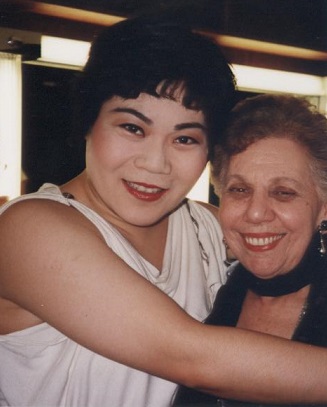
    With eve shapiro 2000

    Above: Makiko Narumi with director Eve Shapiro

    April 30th, 2022 – Twenty years ago on this date, my friend the Japanese contralto Makiko Narumi passed away at the age of 33. I first met Makiko soon after I moved to New York City in 1998; I had heard her singing Schumann’s Frauenliebe und -leben at a Juilliard liederabend and was simply blown away by the sound of her voice, and a few days later she came into the opera room at Tower Records where I was working; she was stunned when I addressed her by name.

    We struck up a friendship and over the next 3 years I heard her many times at Juilliard (both in opera and lieder), in the semi-final and final rounds of the Met Auditions, at a Licia Albanese Foundation gala, at private concerts, singing the Rückert Lieder with the Juilliard Orchestra, and – in 2000 – at Tanglewood as Dame Quickly in FALSTAFF, conducted by Seiji Ozawa. Her last public appearance was singing the Mahler 2nd at Carnegie Hall just a few weeks before she passed away…a very emotional evening for both of us.

    One of the happiest days of our friendship: the Tanglewood FALSTAFF:

    1175885WOOzbiA

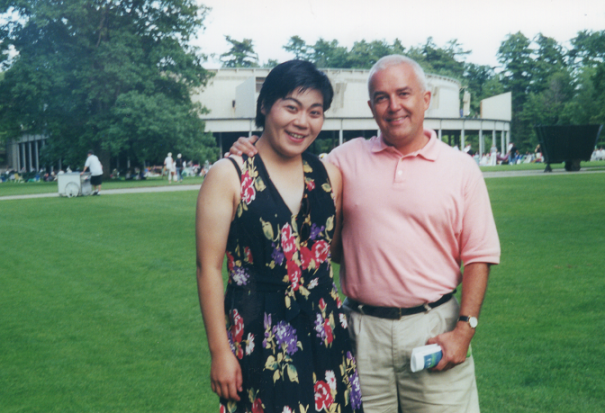
    Here we are on the lawn at Tanglewood after the performance in the Summer of 2000…

    118111jC9ldEDF

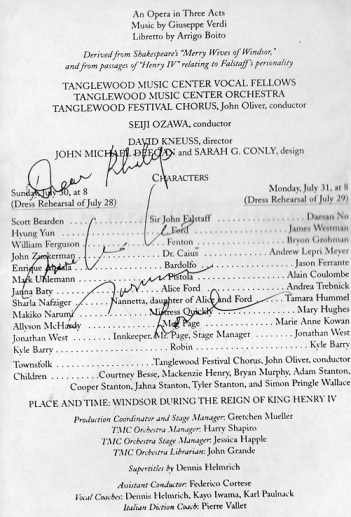
    …I even asked for her autograph!

    Makiko tanglewood falstaff

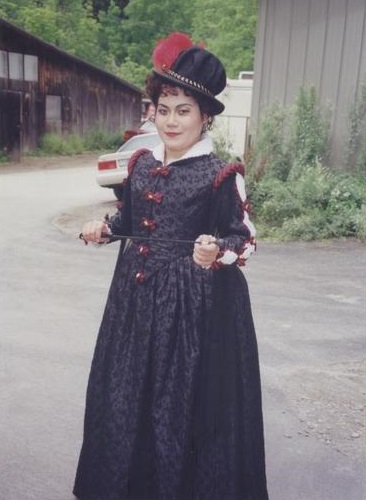
    Above: Makiko costumed as Dame Quickly…

    1185364kaB3O31

    …and here’s the entire cast of the Tanglewood FALSTAFF with Maestro Ozawa.

    I love to think of her now, bolstering the contralto section in the heavenly choir.

    Makiko’s memorial:

    Makiko's memorial 2002-1 jpg

    A message from Makiko’s parents:

    Message from makiko's parents-1jpg

  • Grace Park/Joseph Liccardo @ Merkin Hall

    Park-grace

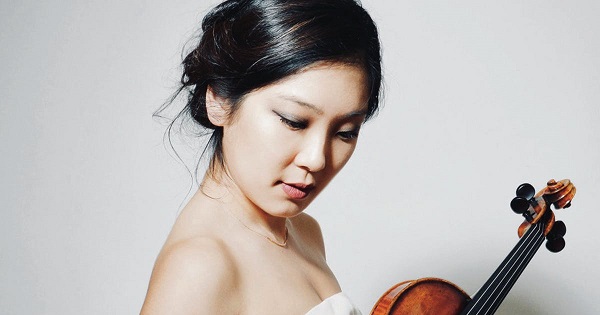
    Tuesday April 26th, 2022 matinee – Violinist Grace Park (above) with pianist Joseph Liccardo in a matinee recital at Merkin Hall. Ms. Park, a elegant beauty, looked chic in flowing white trousers and a fitted white halter-top; she strode onto the stage with the dapper Mr. Liccardo, and they opened their program brilliantly with the Scherzo from Johannes Brahms’ FAE Sonata; this movement was composed as part of a welcoming musical gift created to honor the great violinist Joseph Joachim’s arrival at Düsseldorf. The title FAE Sonata refers to Joachim’s motto: “Frei, aber einsam” (‘Free, but lonely’).

    The Brahms Scherzo made for a perfect introductory piece: it goes thru many changes of mood, from flashy, to sentimental, to passionate. Although there were moments when the piano seemed too loud, Ms. Park and Mr. Liccardo were perfectly in sync, and they brought us delicious subtleties along the way.

    With the blend of voice and piano now perfectly aligned, music of Clara Schumann came next. Written in 1853, these brief works were among the last pieces that Clara ever wrote. After Robert’s death in 1856, she composed almost nothing more herself, instead keeping Robert’s music alive through her touring, and the editing of his works.

    With the blend of voice and piano now perfectly aligned, these Clara Schumann gems glowed. The opening Andante molto had the feeling of an exquisite dream, with the players displaying beautiful phrasing and a keen sense for dynamic variety. A sadness arises with the second Romance, Allegretto Mit zatern vortage, though things turn lighter in time; throughout, the alternating currents of mood were deftly illuminated by the players. The final Romance, Leiderschuaftlich, is the most enchanting, with its flow of violin melody over rolling arpeggios from the keyboard. Ms. Park’s tone was at its sweetest here, with finely-etched trills and staccati, whilst Mr. Liccardo’s playing flourished.

    A change in program brought us Leoš Janáček’s Violin Sonata rather that the originally-announced Mozart KV 454. Composed in 1914, when the world was poised on the edge of war.

    From its passionate con moto start, the first movement is quite dramatic. The violin and piano seem to converse as they pass thru various musical moods: ironic, suspenseful, to a longing lyricism, and a calm finish, The ensuing Ballada brings forth shimmering figurations from the piano and a sustained, poetic theme from the violin. I loved watching Ms. Park’s expressions as the music seemed to draw forth her deepest feelings. Mr. Liccardo’s glistening passages met with Ms. Park’s ascending line for a radiant high ending.

    The following movement, a sort of scherzo – opens with the piano trilling and the violinist slashing the strings; a folk-like dancing song rises up. The sonata moves on, thru staccati and trills that give a restless feeling, to a searing passage from the violin. Near the end, the piano seems dreamy and the violin rather anxious.

    Composer Chris Rogerson introduced his Lullabye, No Bad Dreams, composed in 2009. Drawing upon his childhood fears of bedtime, he wrote a work that tells of a calming ritual his parents devised as they tucked him in for the night. The lullabye has Mr. Liccardo’s piano in the high range whilst Ms. Park’s line is sustained. Suddenly the music turns brisk – not ready for sleep yet – and develops an unusual grandness that speaks of passion and longing. Following a slow fade, there is a fitful agitation – which the composer indicates might be the result of having eaten too many sweets during the day. Sleep comes at last, with Ms. Park sustaining a long, high note. Musicians and composer were well-applauded for this musical memento of childhood; it certainly brought forth memories for me.

    Joseph_Liccardi_500

    Above: pianist Joseph Liccardo

    From J S Bach, we heard the Sonata for Violin and Harpsichord in E-major. This was most impressively played, commencing with a lovely, sustained Adagio, followed by the light and graceful Allegro, which features much animation from the piano. The heart of the sonata – and of the afternoon – came with the achingly beautiful Adagio ma non tanto; as played by Ms. Park and Mr. Liccardo, it felt like a bit of Heaven on Earth…something we so desperately need in these bleak times. In the concluding Allegro, our two musicians regaled us with their dazzling virtuosity, eliciting prolonged applause

    To conclude the program, we heard Schubert’s Rondo Brilliante in B-minor, which opens with contrasting passages that build to the emergence of the Rondo proper. This technically demanding piece was marvelously played by Ms. Park and Mr. Liccardo, but it also seemed endless; the same themes are repeated again and again, with several indications that the end was near only to have the music take another detour. After a while, I found my mind wandering. But eventually the Schubert came to an end, and the musicians were enthusiastically – and deservedly – cheered.

    ~ Oberon

  • Julia Faulkner ~ Vier Letzte Lieder

    Julia faulkner capriccio

    Above: Julia Faulkner as the Countess in Strauss’s CAPRICCIO

    Soprano Julia Faulkner sings Richard Strauss’s Vier Letzte Lieder with the orchestra of the Vienna State Opera conducted by Michael Halász; the performance took place in 1993. Listen here.

    Ms. Faulkner studied at the Eastman School of Music, and had a major career in both opera and concert. She had a long association with both the Bavarian State Opera and the Vienna State Opera, and she sang with such prestigious orchestras as the Concertgebouw, the Berlin Philharmonic, and the Cleveland Orchestra.

    Julia Faulkner was a Met Auditions winner in 1985, made her Met debut in 1994 as Arabella, and in 2001-2002 sang several performances as Marianne in ROSENKAVALIER and the Voice of the Falcon in FRAU OHNE SCHATTEN with the Company.

    She is currently Director of Vocal Studies at the Chicago Lyric Opera’s Ryan Opera Center. Her beautiful recording of Pergolesi’s STABAT MATER for Naxos is one of my favorites.

  • 50 Years Ago ~ End of The Bing Era @ The Met

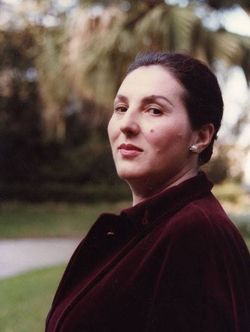
    Montserrat_Caballé

    Above: Montserrat Caballé

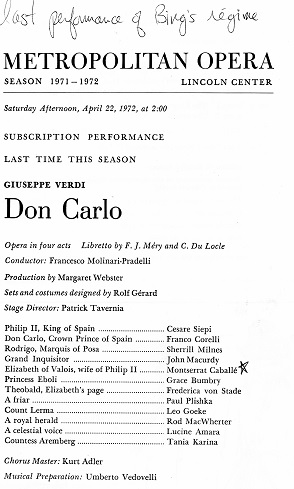
    On April 22nd, 1972, fifty years ago today, a matinee of Verdi’s DON CARLO was the final opera performance of Sir Rudolf Bing’s reign at The Metropolitan Opera. That evening, a gala concert featuring many great artists of the day paid tribute to the departing general manager.

    I attended the matinee, and I tried to get a ticket for the evening’s farewell concert, but none were to be had. Here’s what I wrote in my diary about the afternoon’s DON CARLO:

    “In spite of a few shortcomings, this was for the most part a superb and highly enjoyable performance; the opera itself is magnificent. Francesco Molinari-Pradelli’s conducting was dutiful, and not very inspired. I found myself wishing for a different maestro.

    All the singers were perfectly suited to their roles. Two fine tenors – Leo Goeke as Count Lerma and Rod MacWherter as the Herald – sounded wonderful in their brief musical moments. Lucine Amara and Frederica von Stade graciously took on small roles in honor of Mr. Bing: Ms. Amara repeated her 1950 Met debut role as the Celestial Voice to lovely effect, whilst Ms. von Stade stepped back from such roles as Nicklausse, Hansel, and Cherubino to make a sensational Theobald, the queen’s page. What a voice this mezzo has, and how boyish and alert her acting was! Paul Plishka was amply resonant as the mysterious Friar (aka Charles V).

    John Macurdy sang very well as the Grand Inquisitor, joining the great Cesare Siepi’s Philip II to make the confrontation of church and state a chilling scene. The Siepi voice remains impressive, giving us a wonderfully personal “Ella giammai m’amo“; his acting and bearing left nothing to be desired. Bravo!

    Grace Bumbry as Eboli gave one of the finest performances I have heard from her. A couple of snags in the Canzone del Velo were quickly forgotten as she swept thru the fiery Garden Scene trio and on to a striking “O don fatale” which elicited great applause. Bumbry looks sensational onstage, though her acting is sometimes mannered.

    Franco Corelli did not seem as vocally secure in the title-role as is the 1970 performances with Raina Kabaivanska, but still quite exciting. His singing was sustained and well-modulated, and of course he looks great onstage, though as an actor he sometimes went overboard. Still, Corelli always ignites the crowd.  Sherrill Milnes sounded better today than he did earlier in the season; his Posa is a masculine, commanding figure, and he makes you care about the character’s fate.

    Standing head and shoulders vocally above her colleagues, Montserrat Caballé was a sublime Elisabetta. Her regal bearing and innate sense of nobility made her physical stature irrelevant: she in unquestionably a queen in every sense of the word. She looked magnificent in the costumes, especially the rich red gown of the Auto da Fé scene. Ms. Caballé’s singing was thrilling from first note to last, and it is a pleasure to watch her sing: she expends no evident effort, whether producing an ensemble-topping forte or a shimmering pianissimo.  Her farewell to the Countess of Aremberg (both verses) was a poised moment of poetic beauty. All afternoon, the diva seemed to inspire her colleagues, especially in the Closet Scene quartet which was a highlight of the performance. And in the great aria “Tu che le vanita“, Ms. Caballé rose to spectacular heights, pouring out the queen’s despair rich-toned phrases, and weaving in uncanny pianissimi of spine-tingling delicacy. The aria won a huge ovation. And then La Caballé ended the evening by holding the opera’s final note FOREVER! Her Elisabetta ranks with the greatest operatic interpretations I have experienced to date. Bravississima!!!

    Don carlo-1 jpg

    Montserrat Caballé’s sensationally sustained final note at this performance is preserved on this recording of the opera’s ending from the broadcast: Cesare Siepi is Philip II, John Macurdy is the Grand Inquisitor, Placido Domingo is Don Carlo, and Paul Plishka’s is the Voice of Charles V.  Listen here.

    ~ Oberon

  • Sasha Cooke’s Cherubino @ The Met

    Sasha cherubino

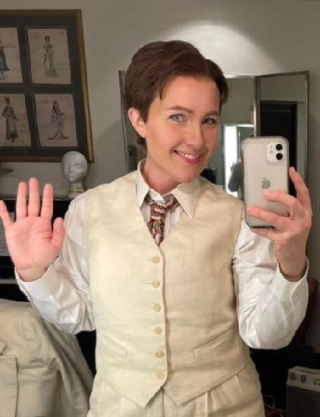
    Above: mezzo-soprano Sasha Cooke in a Cherubino selfie; borrowed from Sasha’s Facebook page

    Author: Oberon

    Thursday April 21st, 2022 – I very seldom go to evening performances at The Met these days; the long intermissions can leave me getting home after midnight, which makes me nervous. However, I could not possibly forego a chance to see Sasha Cooke’s Cherubino at The Met, and since this cast did not have a matinee I could attend, I went tonight with a plan to stay for two acts, thus hearing both of Sasha’s arias. Once there, the excellence of the entire cast made me wish I could stay to the end…to give Sasha a big “bravissima” during the bows.

    The Met’s current NOZZE DI FIGARO production, needless to say, is updated, having a sort of Downton Abbey feel. The set, of metallic latticework, seemed ugly at first, but I soon got used to it as it revolved from room to room. Richard Eyre’s staging is excellent, each character being finely delineated. I “learned” this opera in the late 1960s when I attended several performances of the New York City Opera’s English-language production, and the words kept coming back to me this evening: opera in English works well for comedies. Of course, tonight it was Italian that was being sung.

    Pfeffer-nimrod-david-resized

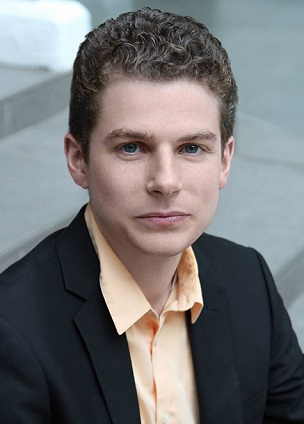
    The Israeli conductor Nimrod David Pfeffer (above) made his Met podium debut tonight; a member of the Company’s music staff since 2014, Maestro Pfeffer was given this last NOZZE of the current run, and he did a very fine job. The brisk overture set the tone of the evening, and he kept the energy level high whist still allowing the singers some leeway here and there to spin out their lines, or add a bit of embellishment. A couple of times, things got out-of-sync; but this was swiftly remedied. Of special note this evening were the expert continuo players: Howard Watkins (fortepiano) and Julia Bruskin (cello)…bravi!!

    Every person in the cast was outstanding; from both a vocal and a theatrical point of view, this NOZZE stood with the finest performances of this masterpiece that l have attended.
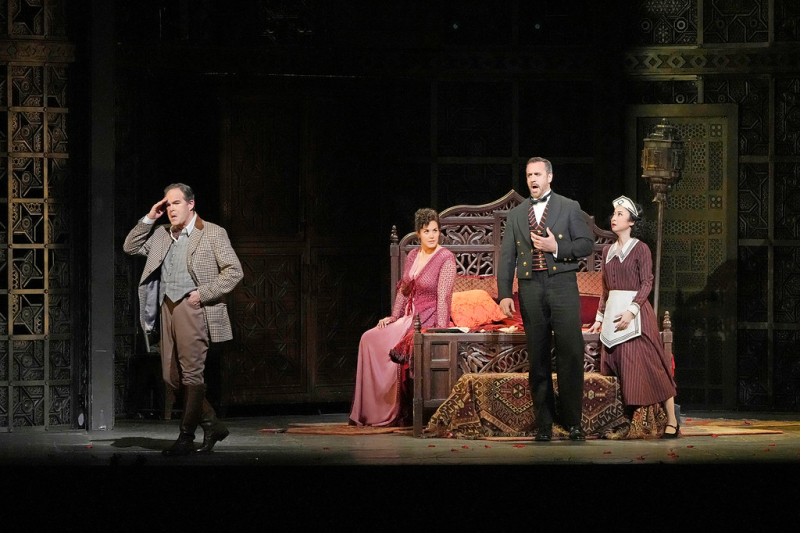
    Nozze 2

    Above, in a Ken Howard/Met Opera photo: Gerald Finley, Federica Lombardi, Christian van Horn, and Ying Fang

    Let’s start with the title-role: Christian van Horn’s Figaro was at the same entrancing level as his Mefistofele here in 2018. With his house-filling voice and tall, slender frame, this singer compels you to attend to his every note, word, and gesture; yet somehow he also always manages to be part of the ensemble, so attentive to everything that happens around him. His “Se vuol ballare” and “Non piu andrai” were splendidly sung. 

    Mr. van Horn and the lovely Ying Fang as Susanna made a cozy couple; they were very comfortable with each other physically, and their by-play in the opening scene was quite intimate. It seemed obvious that, while their marriage vows were as yet unspoken, this would not be a “brautnacht” in the true sense of the word. Ms. Fang’s singing was simply delicious; her voice so sweet and clear in the big House. As an actress, she proved deft and subtle, with expert timing and witty facial expressions. One can hear already a Contessa in her future, but for now let us savour her delectable Susanna.

    Lombardi finley

    Above, the Almavivas: Ferderica Lombardi and Gerald Finley; a photo borrowed from Mr. Finley’s Twitter page

    Gerald Finley’s Count was yet another feather in the cap of this wonderful Canadian bass-baritone, who I last saw as a magnificently-sung Athanaël in THAIS in 2017. He gave a perfect portrayal of the predatory Count, constantly thwarted by Figaro & Friends. I was surprised to discover that Mr. Finley is in his 60s now: he sounds and moves like a much younger man. The voice is in fine estate, including an interpolated top note as his dismissed his wife’s story about Cherubino’s presence in her boudoir: “I don’t believe you!”

    I heard the Italian soprano Federica Lombardi earlier this season as Musetta in BOHEME and thought she was good but unexceptional. Reading her Playbill bio tonight, I found that it’s loaded with Mozart roles; and then, hearing her “Porgi amor“, I could easily understand how her Mozart is valued. The voice is clear, with a kind of quiet allure; she sometimes employs straight-tone to lovely effect, and her dynamics gave me tingles of delight. In the ensemble where her husband tries to win her forgiveness, Ms. Lombardi’s voice flew up to two crystalline high-Cs. A tall, slender woman, the soprano looks striking onstage, and she conveyed the Contessa’s nobility and the long-suffering abuse she’s endured in he marriage. But also: she let us know that Rosina is still a young woman, and understandably tempted by the over-sexed Cherubino. Ms. Lombardi is a valuable addition to The Met roster

    Nozze

    Above, two girls and a boy in a bedroom: Ying Fang, Federica Lombardi, and Sasha Cooke; a Met Opera photo

    I first heard Sasha Cooke when she was a Met Young Artist; she was in the same ‘class’ as my lovely Lisette Oropesa, and they both had their ‘stepping out’ in solo parts in HANSEL & GRETEL: Sasha as the Sandman, and Lisette as the Dew Fairy. I heard Sasha at various Young Artist presentations, and was much taken with both her voice and her distinctive personal beauty. Since then, she has become a world-class recitalist whilst continuing to take on choice operatic roles. This season, after being absent since 2008, Sasha returned to the Met as Edwige in Handel’s RODELINDA and as Cherubino.

    The first thing I noticed about about Sasha tonight – aside from what a handsome boy she makes – was that the voice has grown larger and warmer over time, without losing its unique qualities. In the playful “Non so più cosa son“, she handled the Maestro’s swift tempo with complete assurance, and then made a very touching impression as the page turns more pensive at “E se non ho chi mi oda...” before polishing it off with a joyous …”parlo d’amor con me!”  In the page’s trademark aria, “Voi che sapete“, Sasha’s warm tone and perfect diction set her comfortably in the high echelon with my delightful Cherubinos of the past: Biancamaria Casoni, Evelyn Lear, Rosalind Elias, Kay Creed, Helene Schneiderman, Frederica von Stade, Susanne Mentzer, and Susan Graham.

    Sasha’s Cherubino was a lively youth, crawling under the bed to hide from the Count, enjoying her transformation into a girl, and finally clambering up a tall armoire to leap out of the window.  In sum, she simply lived the part…and it was very sweet to read that Ms. von Stade had sent Sasha her bejeweled ‘Cherubino’ shoe buckles to honor Sasha’s return to The Met. Now, we just need to keep her here!

    Four top-flight singing actors graced the cast with their presence: Elizabeth Bishop (whose Berlioz Dido and Gluck Iphigenie I had the good fortune to see) was a voicey Marcellina, with astute comic timing, whilst Maurizio Muraro, a basso buffo the great tradition of Salvatore Baccaloni and Fernando Corena, gave a powerful rendering of Bartolo’s “vendetta” aria. Paul Corona’s strong-toned Antonio was another plus, trying hard not to be duped by Figaro’s made-up story of who it was who jumped from the window. 

     As Don Basilio, Giuseppe Filianoti revealed his still-beautiful voice aligned to the touching colours he found in the words – something that comes naturally to a native Italian.

    ~ Oberon
  • Ghena Dimitrova: Berlioz ~ La Mort de Cléopatre

    Ghena d

    The great Bulgarian soprano Ghena Dimitrova sings Hector Berlioz’s La Mort de Cléopatre at a concert given in Valencia, Spain, in 1995.

    Listen here.

  • Rival Princesses

    Ghena anna

    Ghena Dimitrova is Amneris and Anna Tomowa-Sintow is Aida in their Act II scene from Verdi’s AIDA from a 1998 concert given at Sofia.

    Watch and listen here.

  • Kariné Poghosyan ~ Serenata Andaluza

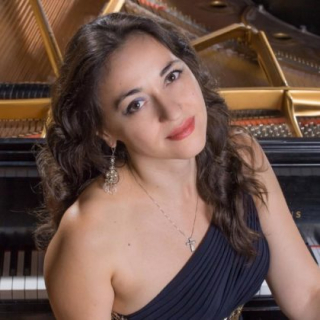
    Karine-Poghosyan

    Pianist Kariné Poghosyan performs Manuel de Falla’s Serenata Andaluza in a recital given at Yerevan, Armenia, in July 2010.

    Watch and listen here.

  • Truls Mørk ~ Bloch’s Schelomo: Rhapsodie Hébraïque

    Mork

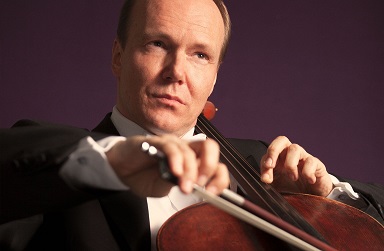
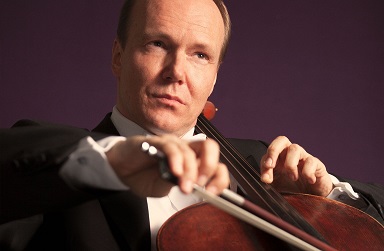
    One of my favorite artists, the Norwegian cellist Truls Mørk, joins the Stavanger Symphony Orchestra in a performance of Ernest Bloch’s Schelomo: Rhapsodie Hébraïque at a concert given in August 2019. Markus Stenz is the conductor.

    Watch and listen here.

  • Truls Mørk ~ Bloch’s Schelomo: Rhapsodie Hébraïque

    Mork

    One of my favorite artists, the Norwegian cellist Truls Mørk, joins the Stavanger Symphony Orchestra in a performance of Ernest Bloch’s Schelomo: Rhapsodie Hébraïque at a concert given in August 2019. Markus Stenz is the conductor.

    Watch and listen here.