
The Scottish mezzo-soprano Beth Taylor enjoyed a great success at her Carnegie Hall debut, singing Cornelia in Handel’s GIULIO CESARE with The English Concert.
The Scottish mezzo-soprano Beth Taylor enjoyed a great success at her Carnegie Hall debut, singing Cornelia in Handel’s GIULIO CESARE with The English Concert.

The great Canadian contralto Maureen Forrester sings Gustav Mahler’s Kindertotenlieder, which she recorded with the Boston Symphony Orchestra under Charles Munch’s baton in 1958.
Listen here.
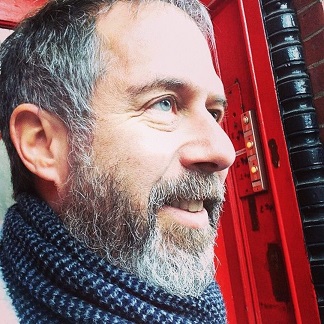
Above: composer Steven Swartz
~ Author: Lili Tobias
Thursday April 24th, 2025 – It was unexpectedly difficult to get to the location of the New Music for Percussion, Piano, and Strings concert, performed at NYU. After waiting in the lobby for half an hour and being ushered towards the elevators with no other directions, the other audience members and I finally arrived at Room 620 shortly before the music began. Composer Steven Swartz, who had an exciting premiere on the program, described the feat as “breaching the walls of the castle.” But fortunately, all the music on last night’s program was entirely worth the struggle of getting there!
The program began with two pieces for piano trio, each made up of a handful of very short movements. These were Miu Sato’s Threads of Belonging and Takashi Yoshimatsu’s Atom Hearts Club Suite No. 1. Despite the brevity of the music, both composers packed an incredibly diverse array of sounds into each piece, from lush, pianistic arpeggios that filled out the space around the violin and cello’s melodies to energetic syncopated rhythms in odd meters. The three performers, Angel Guanga (violin), Noelia Carrasco (cello), and Malka Bobrove (piano) are all currently undergraduate students at NYU, but their sound as an ensemble was nothing short of professional, playing with an incredible level of confidence and precision.
I was also impressed with pianist Miles Avery’s performance of …couple égyptienne en route vers l’inconnu… by György Kurtàg. The music featured pointillistic collections of notes, connected together through the overtones left behind by the sustain pedal. Avery played every single note with such intention that each sound that emanated from the piano seemed to have an entirely different character from the last.
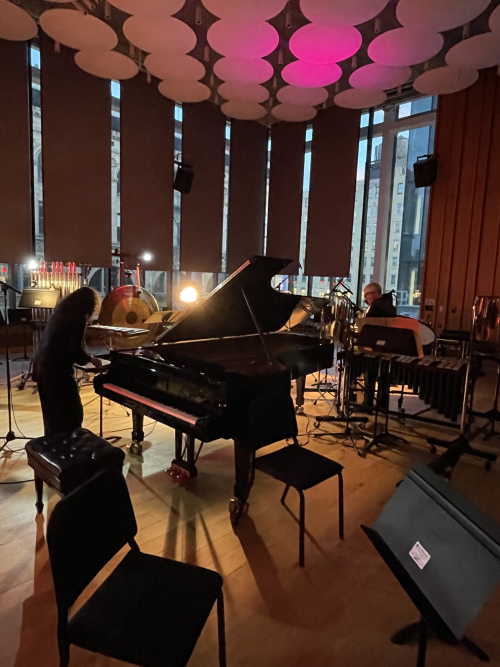
Above: pianist Marilyn Nonken and percussionist Jonathan Haas do a soundcheck before the world premiere of Steven Swartz’s When the horizon has a mind of its own.
I was absolutely mesmerized by the fragments of sound that emerged just to trail off again, reminding me of light refracted through glass. Swartz’s inspiration for this piece came from a light source as well—he observed the intricacies and ever-changing motion of the sunset and aimed to capture the elusiveness of those moments in this piece. I certainly felt that ephemeral nature: The music felt aimless in an entirely good way, the sort of aimlessness you might have when you’re walking through nature on a summer afternoon without being in a hurry to get anywhere in particular. I also felt an all-encompassing sense of serenity in the moments of silence between the notes, especially in the silences after the deep rumble of the bass drum or passages in the very lowest register of the piano. This piece of music is certainly one of those pieces that I want to listen to over and over again!
The program ended with two pieces by Jacob Druckman, Reflections on the Nature of Water (Shiqi Zhong, marimba) and Animus II (Bowen Zheng, mezzo-soprano, Natalie North, percussion, Zhaoxuan Song, percussion). Animus II was certainly the most eclectic music of the night: The colorful lighting, unintelligible singing, and bubbly electronic noises turned the room into an extraterrestrial landscape. As I was heading out, I caught a glimpse of one of the percussion scores, which was one of those half traditional notation, half graphic scores that bridges the gap between a useful tool and visual art. I also spoke with percussionist Natalie North, who told me that they had been working on this piece for the whole semester and had never performed from a score like that before. It certainly looked like they knew what they were doing though!
Swartz mentioned in the program notes the playful nature of a sunset, and his music was equally playful. In fact, all the pieces on this program were exceptionally playful, each in their own unique ways, which made for such a joyful evening. I hope that When the horizon has a mind of its own has the opportunity to be performed many more times going forward!
~ Lili Tobias

In 1957, Maria Callas sang a concert with the Dallas Symphony under the baton of Nicola Rescigno. Someone snuck a tape recorder into one of the rehearsals for this concert, and the resulting “Callas/Rehearsal in Dallas 1957” made the rounds of reel-to-reel tape-traders back in the 1960s.
David Abramovitz, my very first opera-friend, gave me a copy of the rehearsal tape and I enjoyed it, despite being somewhat frustrated with the stops-and-starts as Callas and Rescigno worked out the interpretive details. I was especially impressed by the different takes on passages from the entrance scena – sometimes referred to as the Letter Scene – of Lady Macbeth from Verdi’s MACBETH.
It occurred to me to patch these phrases together and create a complete run-thru of the recitative and aria. Years later, when I was getting rid of my reel-to-reel collection, it was one of the few things I saved. The voice of Maestro Rescigno can sometimes be heard, and there’s some static at first, and a bit of tape drag. But once she’s into the aria proper, it gets better.
Maria Callas – MACBETH aria – rehearsal composite – Dallas 1957

Latonia Moore and Jesus Garcia sing the St. Sulpice duet from Massenet’s MANON in a concert given by the Vermont Youth Symphony in 2013.
Watch and listen here.

Dmitry Hvorostovsky sings Rachmaninov’s In The Silence of the Secret Night from a 1990 recital. This was not long after he had won the 1989 Cardiff Singer of the World Competition.

~ Author: Lane Raffaldini Rubin
Saturday March 29th, 2025 – Not one but two composers were present at David Geffen Hall tonight to receive enthusiastic ovations for their music performed by Leonard Slatkin and the New York Philharmonic. It was, in a sense, a family affair. The composer John Corigliano has been a friend of Slatkin’s and the Philharmonic for half a century, while the other composer, Cindy McTee, is Slatkin’s wife. While the third composer of the evening—Dmitri Shostakovich—was not on hand, this evening’s concert was a testament to the vitality of music of the present era.
Cindy McTee’s 2010 piece Double Play is a two-movement fantasia on Charles Ives’s 1908 composition The Unanswered Question. More than just an exercise in Ivesian orchestral writing, the piece is a sonic lava lamp of shifting ambiguities and cinematic episodes. A low drone in the double basses unifies the fragmentary material in the woodwinds while hushed string chords oscillate between gorgeous dissonance and consonance.
The second movement, entitled “Tempus Fugit”, begins with the ingenious tick-tocking of an ensemble of mallets, sounding like a cupboardful of disagreeing clocks and metronomes. The Ivesian writing of the first movement returns under this misaligned timekeeping, establishing an fascinating non-relationship between the disparate concepts of the two movements.
This juxtaposition is muddied in the second movement by the inclusion of passages of chase-scene-style music and Gershwin-like big-band flourishes (although played brilliantly crisply by the Philharmonic brass). McTee’s piece was intricately orchestrated and finely crafted but went on a bit longer than it needed to and wouldn’t have suffered from cuts in the second movement.

Above: Cindy McTee and Leonard Slatkin take a bow; photo by Chris Lee.
For John Corigliano’s 2020 piece Triathlon the soloist Timothy McAllister brought three saxophones to the stage. In writing the piece, Corigliano asked himself “what would happen if I wrote a concerto for saxophonist and orchestra, not saxophone and orchestra.” McAllister, the preeminent classical saxophonist for whom the concerto was written, is, after all, a skilled player of the soprano, alto, and baritone saxophones. Corigliano exploits the unique qualities of all three in Triathlon.
The first movement, “Leaps” for soprano saxophone, bursts right out of the gate with slinking high and low figures, bustling orchestral sounds, and swaggering bravura material for the soloist. McAllister’s playing is assured and confident while maintaining a chamber music sensibility, which suits well the elaborate dialogues that Corigliano writes between the soloist and various voices in the woodwinds and brass. One notable section of this movement appears to quote Ravel’s children’s opera L’enfant et les sortilèges with ravishingly mysterious textures in the woodwinds, providing a fluttering backdrop for lyrical solos in the soprano saxophone.
The second movement, entitled “Lines”, hews close to its name by eschewing rhythmic figuration in favor of “linear” melodic material. This movement for alto saxophone occupies a hybrid sound-world somewhere between the hazy atmosphere of Coltrane and the broad horizons of Copland’s A Lincoln Portrait.
Things get wilder in the third movement, which begins with a baritone saxophone cadenza of key clicks, slap tonguing, and other extended techniques up and down the range of the instrument. “Licks”, the title of this movement, has multiple meanings as the soloist seems to riff and improvise and produce very physical sounds from the tongue itself. The entire movement is a rollicking pseudo-improvisatory accompanied recitative. In a fun plot twist at the very end of the piece, McAllister picks up the soprano sax for one last picaresque lick.

Above: Timothy McAllster and Maestro Slatkin playing the Corigliano; photo by Chris Lee
In the second half of the program, Slatkin led the Philharmonic in Shostakovich’s Symphony No. 5 of 1937. It’s a piece that is, as Slatkin writes, “a bit more familiar for both musicians and audience”. Indeed, it was an admirable if conventional performance, with thrilling—booming—climaxes, flawless details across the woodwinds, and propulsive treatment of dramatic transitions.

Throughout the concert, Slatkin (above, photo by Chris Lee) frequently put down his baton to conduct with his hands, only to pick the baton back up within the same movement. Slatkin holds the baton from the end of its long handle, rather than gripping it, which means that he relies on his left hand to communicate finer-grain detail to the players. His conducting was at its best when he put down the baton (as in the first movement of McTee’s piece and the sublime Largo of Shostakovich), allowing him to be expressively geometric—an impressively effective semaphore for the musicians. During the Shostakovich Largo, which he conducted from memory, I wondered where his baton had gone, since there was no music stand on the podium for him to rest it on. When the movement was over, he reached behind the folder on the first desk of the violas to retrieve his baton from where he had stashed it. Meant to be invisible, it was just one of the many clever details that added up to this superbly crafted concert.
~ Lane Raffaldini Rubin
Performance photos by Chris Lee, courtesy of the New York Philharmonic

~ Author: Oberon
Tuesday March 25th, 2025 – Young Concert Artists presenting bass-baritone Joseph Parrish (photo above) in recital at Merkin Hall, with Francesco Barfoed at the piano.
I first heard Mr. Parrish in a performance of Pauline Viardot’s CENDRILLON given by City Lyric Opera in 2021; I was immediately impressed by his singing, acting, and charismatic personality. In 2023, he sang superbly at the Gerda Lissner Winners Concert, having won first prize in the song/lieder division. And in 2024, Mr. Parrish made a most convincing (and beautifully sung) Salieri in Rimsky-Korsakov’s opera MOZART AND SALIERI, performed by Parlando.
Tonight, Mr. Parrish showed that his is a voice that can bring people together. His stage presence is relaxed and cordial, with glimmers of humor along the way; it is a voice with an extensive range and a mastery of dynamics that allows him to veer impressively between hall-filling power and the most gentle of pianissimos. He can turn a phrase like a magician, whilst all the time his body language and expressive face draw listeners to him like a magnet. This is charisma personified.
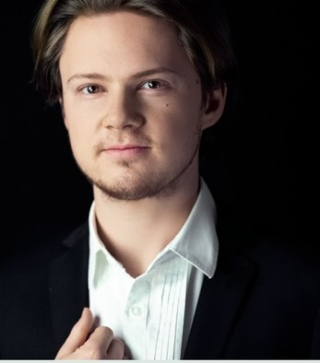
For the first half of the program, Mr. Parrish shared the stage with a stellar pianist: Francesco Barfoed (photo above). Francesco is a musician of extraordinary talent, his playing so perfectly aligned with the singer’s vision of the music.
Mr. Parrish opened the evening with Harry Burleigh’s “Elysium”, and in this single song he set a very high standard for himself: a standard which he would often surpass as the concert progressed. “Elysium” displayed the voice’s sheer power, as well as its sense of control…the last note was simply awesome. More Burleigh next – “You ask me if I love you” – in which the singer details the sensations he experiences when with his beloved…as if to say: “Do you really need to ask? “
Classics from two masters of lieder followed: Mahler’s romantic Liebst du um Schönheit with its poetic words, so lovingly rendered, and Schubert’s immortal Ständchen, in which the pianist plays a major role; the music covers a big vocal range and part of the allure is in the detailing of subtle nuances. The song reached a majestic pinnacle but then ends quietly. Then back to Burleigh for “Her Eyes Twin Pools“; Mr. Barfoed’s playing here is essential to the song’s meaning, whilst the singer’s face, expressive hands, and slender form create a visual poem all their own.
Charles Brown’s ‘The Barrier‘ at first seems to sing of an admirer’s shyness in hesitating to approach the object of his desire, but there is another reason for his reluctance, revealed in the song’s final line. Whilst listening to the song, I was thinking: “How lovely…how poetic…” and then the last words sent a chill thru me.
“Along The Dusty Road” by Hal Johnson seems like a folksong at first; a touch of the blues takes us to a spiritual place; Mr. Parrish sang so many beautiful notes in this song until reaching a whispered final tone that hung on the air.
Charles Brown’s “Song Without Words” is just that. The singer begins with humming, then switches to what the French call “bouche fermée“ which has a slightly different feel from plain old humming. The singer opens his mouth but no words emerge, just sound. Who knew vocalizing could be so expressive?
The New York Premiere of Psalm by YCA Composer-in-Residence Alistair Coleman draws on the old German hymn “How a Rose E’er Blooming“. The words “No one…” are repeated endlessly, as Mr. Parrish displays his vast dynamic range. The words change to “We were…we are…” and the music grows more passionate. The piano then introduces the carol itself, creating an air of fragrant softness. Hypnotically, “…the thorn…” now becomes the song’s lyric.
After the interval, Mssrs. Parrish and Barfoed returned with a Margaret Bonds piece, “You Can Tell The World“, a song with a theatrical feel – so alive – and giving the pianist a chance to shine brightly; it reaches a fantastical finish. Three beloved classics came next. First, “Deep River” in which Joseph made such a poignant impression, displaying the strength, range, and awesome breath control at his command. In “A City Called Heaven“, I had that uncanny feeling that he was singing just to me. At last, the triumphant “Ride On, King Jesus” in which his singing moved me so deeply with his range, power, and vitality.
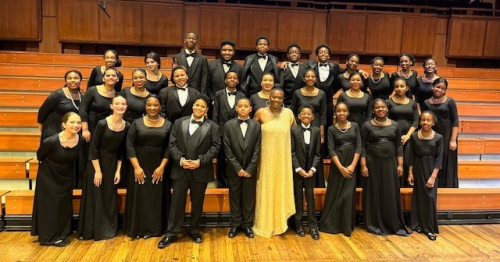
Now the young singers of the Washington Performing Arts Children of the Gospel Choir (above) took the stage, greeted by a vociferous ovation. Dressed in black gowns and tuxedos, they are just plain gorgeous to behold. And then they sang! Under the elegant and inspiring conducting of the group’s artistic director Michele Fowlin, and accompanied by the delightful pianist Anthony “Tony” Walker, they dazzled Merkin Hall with their young voices, weaving perfect harmonies, gesturing poetically, and swaying to Mr. Walker’s marvelous rhythms. Judging by the perfection their singing achieved, I would guess Ms. Fowlin can be a demanding taskmaster, but also that she has a heart of gold. She seemed to glow with pride for her young prodigies.
Their Praise Medley encompassed Greg Roberts’ Prelude to Worship, Rodnie Bryant’s We Offer Praise, and Richard Smallwood’s Anthem of Praise. The audience went crazy for these astounding kids, and Ms. Fowlin and Mr. Walker caused screams of joy to erupt as they took their bows. One boy in the choir reminded me so much of mi amor de loin, Brix, in far away Cebu; after one song, the boy fell to his knee and opened his arms as if to embrace the world.
Mr. Parrish offered three more songs – Bobby McFerrin’s Don’t Worry Be Happy, the profound Let Us Break Bread Together, and Richard Smallwood’s Total Praise (Joseph at the piano himself…!); the last two songs were arrangements by Ms. Fowlin. By then, I’d pocketed my pen and was letting the magic carry me. So much joy filled the hall as the evening came to an end.
~ Oberon
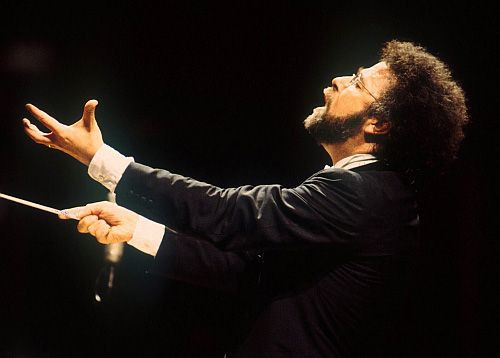
The late, lamented Giuseppe Sinopoli (above) conducted this concert performance of Strauss’s ELEKTRA with the Staatskapell Dresden at Tokyo’s Suntory Hall in 1995.
Watch and listen: https://www.youtube.com/watch?v=zBhGicuJMIM
Klytemnestra: Felicity Palmer; Elektra: Sabine Hass; Chrysothemis: Inga Nielsen; Aegisthus: Wilfried Gahmlich; Orestes: Alfred Muff.
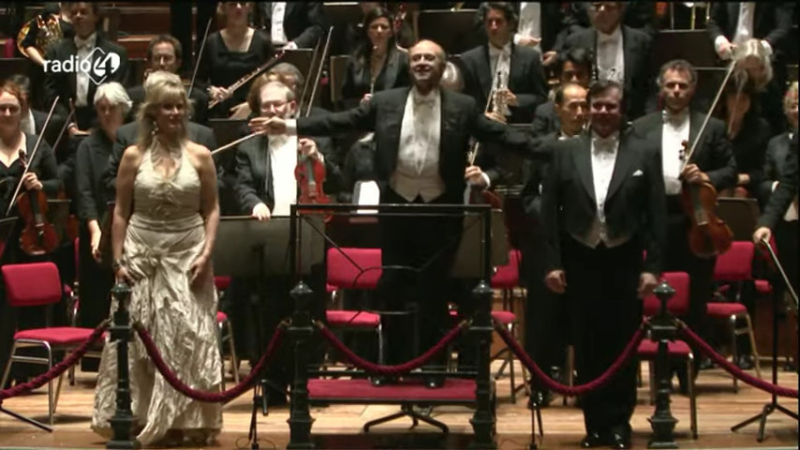
Camilla Nylund and Robert Dean Smith are Elsa and Lohengrin in a concert performance of the opening scene of Act III of LOHENGRIN given by the Royal Concertgebouw in 2010. Iván Fischer conducts.
Watch and listen here.
 Oberon's Glade