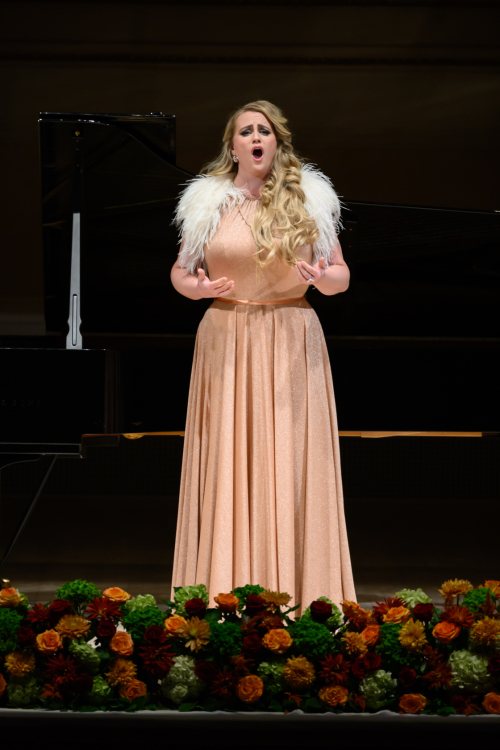
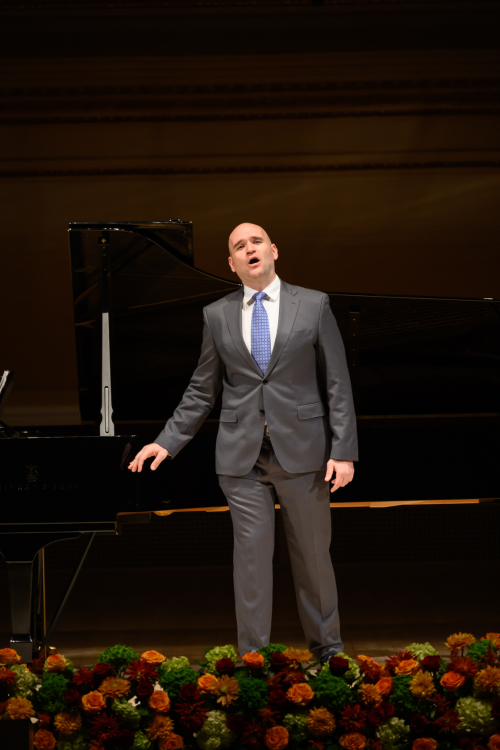
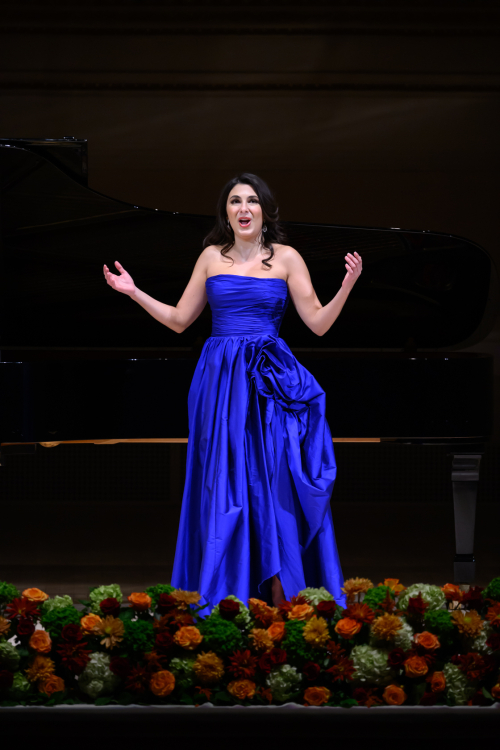
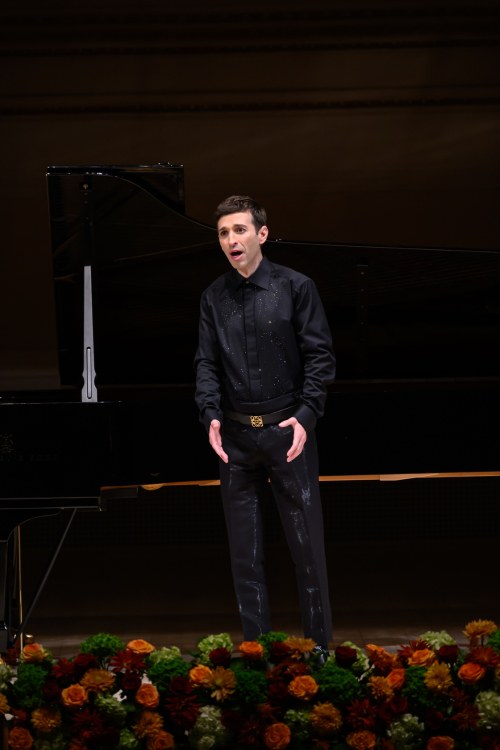
Category: Music

  • Orchestra of St. Luke’s ~ Bernstein’s ‘Kaddish’

    Samuel-pisar

    Above: Samuel Pisar

    ~ Author: Oberon

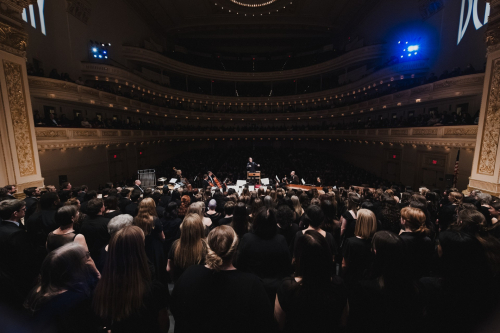
    Wednesday January 29th, 2025 – Carnegie Hall marked the 80th anniversary of the liberation of Auschwitz with a performance of Leonard Bernstein’s Symphony No. 3, “Kaddish.” A setting of ‘A Dialogue with God’ by the late Samuel Pisar – who had himself been a survivor of Auschwitz – was spoken tonight by Pisar’s wife, Judith Pisar, and their daughter Leah Pisar, with James Conlon leading the Orchestra of St. Luke’s. The Bard Festival Chorus, directed by James Bagwell, and the Brooklyn Youth Chorus, led by Dianne Berkun Menaker, made the choral passages an integral part of the evening’s performance.

    The reviews were quite harsh when the Boston Symphony Orchestra, conducted by Charles Munch, premiered this symphony on January 10, 1964; it is dedicated to the memory of President John F. Kennedy, who had been assassinated on November 22, 1963.

    Tonight was my first time hearing this work. In preparation, I read some articles and reviews of the piece; these seemed mostly to center on the narrative rather than on the musical setting. My idea was to focus on the music and let the narration flow, but that proved impossible: such is the power of Mr. Pisar’s writing.

    Former Secretary of State Antony Blinken, stepson of Samuel Pisar, made an eloquent introductory speech in which he drew a connection between the substance of Bernstein’s Kaddish and the current situation here in the USA. This of course was surely weighing on the minds of most everyone in the audience.

    Judith and Leah Pisar had taken their places next to the podium, and Maestro Conlon entered to a warm greeting. Most of my experiences with Mr. Conlon’s conducting have been at the Metropolitan Opera, where he debuted in 1976  and went on to preside over nearly 300 performances, the latest having been Shostakovich’s LADY MACBETH OF MTSENSK, more than ten years ago. I’d love to see him on the Met podium again.

    Low humming from the chorus opens the Kaddish, and then Judith Pisar, a petite woman, began to speak. Her voice is deep and profound as she talks of the Age of Anxiety, which seems to be having its second dawning. Leah Pisar’s speaking voice has a sense of passion and urgency which contrasted with Mme. Pisar’s more solemn tones.

    A high violin tone is sustained by concertmaster Krista Bennion Feeney until the xylophone sounds an alarm. A melancholy theme of unison celli turns anxious as the basses join. Following a resounding crash, the music gets wild and fast, with the crack of a horsewhip. The chorus’s rhythmic clapping gets a bit jazzy; their song is accented by the xylophone, and it moves to a big finish.

    Over quiet percussion and choral humming, Judith Pisar speaks long…and movingly; the essence of the work now becomes evident: where was god when these horrible things were happening to his people? What wrongs had they committed to merit such torment and anguish? Was god angry or simply indifferent?

    As questions are raised – “How did the Holocaust, the genocides, and the ethnic cleansings become acceptable?” – and as the spoken words become more haunting and horrifying, the actual music tends to feel less engrossing.

    But then, soprano Diana Newman’s high, sweet voice floats over an accompanying harp: clear and reassuring. The female choristers join, and the music turns grand, only to fade with the xylophone sounding. Ms. Newman resumes, supported by high, spun-out sounds of the violins. Angelic voices hum, whilst scurrying music underscores Leah Pisar’s speaking of “incendiary demagogues”.  

    The music turns delicate; Mme. Pisar speaks until a crescendo obliterates her voice; her daughter speaks of “chaos on Earth”. Aching celli and basses play deep and rich; the music swells with both choruses joining. Stabbing accents turn into an oddly merry passage for clarinet, flute, and bassoon. The Youth Chorus sings; the spoken description of “the warm embrace of democracy” seems ironic now.

    A postlude of strings and brass becomes a lament, with muted trumpet and oboe. The music hesitates; Leah Pisar speaks again, with Ms. Feeney’s violin as solo accompaniment. Now Mme. Pisar issues a plea for peace as horn and trumpet sound. There is a fast and jazzy chorus, which Ms. Newman joins. The finale feels a bit extended, but then a dramatic pause leads to a final Amen.

    Throughout the work, the eternal question hovers overall: why does god allow these things to happen? And why did he abandon the faithful in their hour of direst need? Another such test seems to loom before us now. Perhaps there are no gods, and we’re simply going to have to make it on our own.

    ~ Oberon
  • Roomful of Teeth/Tambuco Percussion Ensemble

    CH11514760

    Above: performance photo by Jennifer Taylor

    ~ Author: Lili Tobias

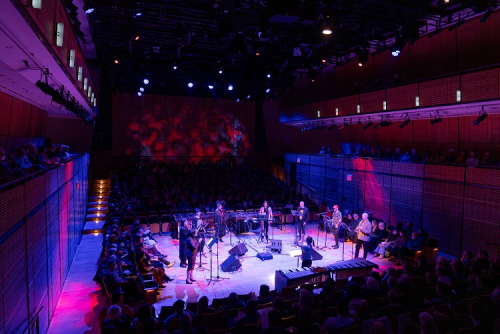
    Saturday January 25th, 2025 – Tonight, I had the joy of hearing Roomful of Teeth and Tambuco Percussion Ensemble perform at Carnegie Hall’s Zankel Hall. Between the two ensembles, I got to hear music by six different composers, from familiar favorites of mine like Caroline Shaw, to names that were completely new to me (but who I will certainly listen to again)

    Both Caroline Shaw’s and William Brittelle’s pieces were exceptionally chaotic—which is completely on brand for Roomful of Teeth! The eight singers performed a vast variety of vocal techniques and styles, including but not limited to guttural croaking sounds, throat singing, really really high notes, muttering repeated syllables, low glissandos, and speaking normally. Shaw’s piece, The Isle, in which she set text from Shakespeare’s The Tempest, also contrasted the chaos at times with more homophonous singing—hearty choral triads and flowing solo melodies—which provided a good balance so we could still hear the words.

    The text of Brittelle’s piece, Psychedelics, was very different. He explains in the program notes that the surreal collection of words in this music are “meant to form a swarm of images, not a literal, linear narrative.” And they certainly did just this! As I listened, I caught snippets of the words, such as “I watch for dogs,” and these fragments created a very joyful experience in their meaninglessness. Throughout this piece, I never knew what to expect in the best possible way!


    The bridge between the vocal portion of the concert and the percussive potion was the composer Gabriela Ortiz. Ortiz is Carnegie Hall’s composer in residence this year, and both Roomful of Teeth and Tambuco Percussion Ensemble performed a piece of hers in this concert.


    In Canta la Piedra-Tetluikan (of which this would have been a world premiere performance if not for the group of elementary school kids who got to sit in on a rehearsal), Ortiz set the words of poet Mardonio Carballo. And these words were in Nahuatl! Nahuatl is a language (sometimes considered a group of languages) spoken in Central Mexico, and I was very excited to hear it in a musical context. Ortiz’s setting of Carballo’s poem was joyously animated. The mesmerizing repetitions—“atl, atl, atl” (water, water, water), “tlitl, tlitl, tlitl” (fire, fire, fire), and more—and energetic (and very difficult!) rhythms grounded the music in the natural world. 


    I had been especially looking forward to hearing the voiceless alveolar lateral affricate (tɬ), since that sound is common in many variants of Nahuatl (and doesn’t appear whatsoever in English), but if the singers were singing it, the distinctly fricative sound didn’t come across prominently. Perhaps they were singing in a variety of this language that doesn’t include this consonant though, and no matter what, it was very exciting to hear music in Nahuatl!


    CH11514773


    Photo by Jennifer Taylor


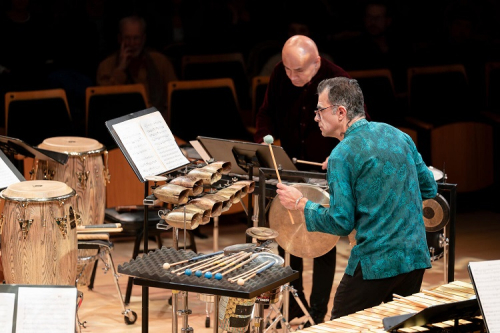
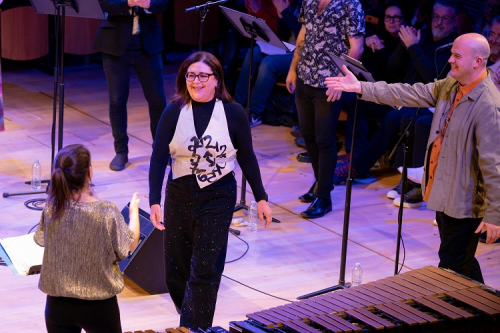
    After intermission, Tambuco Percussion Ensemble performed the movement “Liquid City,” from Ortiz’s 2014 piece, Liquid Borders. The four members of the ensemble played facing each other in a circle (the perfect set-up for the central stage!) and the blooms of sound radiated outwards into the hall. The diverse timbres of the instruments certainly reflected the diverse borders of urban and rural Mexico which Ortiz aimed to reflect in this music, the sounds mixing and shifting into unique and beautiful shapes.


    CH11514777


    Photo by Jennifer Taylor


    The other three pieces on the program were very different in that they were far more homogenous in terms of the instrumental inventory: Jorge Camiruaga’s Cuarteto en chico for four drums, Leopoldo Novoa’s Sábe cómo e’? for four guacharacas (and briefly one marímbula), and Steve Reich’s Mallet Quartet for two vibraphones and two marimbas. While these pieces were certainly reigned in the chaos compared to the first half of the program, they also proved that you could still create a wide variety of sounds and musical textures even among more similar instruments. 


    CH11514766


    Above: Gabriela Ortiz, photo by Jennifer Taylor


    It was especially fun to see how many of the composers on the program were in the concert hall enjoying the music alongside me and the rest of the audience! I enjoyed this concert so much, and I have a feeling they did too.

    ~ Lili Tobias

  • Three Masterpieces @ Chamber Music Society

    Cms

    ~ Author: Oberon

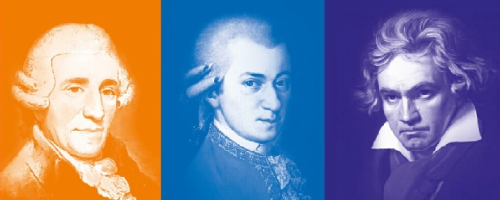
    Sunday February 26th, 2025 – A packed house at Alice Tully Hall for this evening’s concert of works by Haydn, Mozart, and Beethoven presented by Chamber Music Society of Lincoln Center. For me, it was a revelatory experience since I was hearing – for the first time – the Viano Quartet. Founded in 2015, the group soared to prominence after winning first prize at the 2019 Banff International String Quartet Competition.

    Viano jpg 2

    Above, the artists of the Viano Quartet: Tate Zawadiuk, Aiden Kane, Lucy Wang, and Hao Zhou. They opened this evening’s program with Haydn’s Quartet in F-major. Op. 77, No. 2, which dates from 1799. This was the last quartet the composer wrote.

    The opening Allegro moderato has a gracious start; this is music that’s full of charm. It speeds up, with delightful swift passages alternating with more lyrical ones. Each voice of the Viano Quartet has its say, and each is distinctive; but the magic is in the way they are blended. An excursion into minor mode brings new emotional responses before resuming the opening mood; the movement finds a brisk finish.

    The Menuetto, placed second, has a swift, witty start. Mood swings between major and minor are gorgeously negotiated by the players, whilst ironic pauses and cunning rhythmic figurations are added delights. An interlude, filled with sweet harmonies, leads on – with more clever hesitations – to a sudden finish: all so deftly played..

    The Andante opens with violinist Hao Zhou and cellist Tate Zawadiuk engaged in a courtly duo; they are such wonderfully attentive and expressive artists, as pleasing to watch as to hear. The other voices join, with Mr. Zhou and Ms. Wang offering harmonized violin passages. The playing from all is detailed, but never fussy. Hao Zhou plays a decorative theme over a melodious blend from Mlles. Wang and Kane (the quartet’s excellent violist) and Mr. Zawadiuk; the latter then takes up the melody, sounding supremely lovely. Zhou then plays an exquisite ‘accompanied’ cadenza, bringing the Andante to a serene finish.

    An emphatic chord kicks off the scampering Vivace assai; Zhou’s virtuosity here is so impressive, inspiring vivid animation from his colleagues. A whimsical section – like a rhythmic game – leads on to the uninhibited finale of what was destined to be Haydn’s last completed quartet. Simply terrific music-making from the Viano players, who were called back for a second bow; in the 25-minute span of the Haydn, they had soared into my upper echelon of favorite quartets.

    Maintaining their high standards, the Viano Quartet then offered magnificent Mozart: the Quintet in E-flat major, K. 614, was the Master’s final chamber work, composed in April 1791, the year of his death.

    Joining the quartet, one of the Society’s best-loved artists, Arnaud Sussmann, brought his viola into the scheme of things; for the program’s concluding Beethoven, he would return in his more customary role as violinist.

    Mozart commences his quintet with an Allegro di molto, launched by the two violas; Mr. Sussmann and Ms. Kane immediately formed a most congenial duo, communicating artfully, and harmonizing to perfection. As this indescribably delicious movement continued, Hao Zhou displayed his silken tone and impeccable technique to striking effect.

    The Andante has a prim and proper start; a theme with four variations ensues. Mr. Zawadiuk’s cello playing is particularly fine here, his tone the basis for alluring harmonies; Ms. Kane’s  likewise has a special glow. The music’s enticing little pauses tempt the imagination.

    The Menuetto breezes along, with repetitive descending phrases lending a playful air. A waltz-like passage ensues, with Mssrs. Sussmann and Zawadiuk setting the pace and communicating amiably.

    Mozart’s finale feels like an hommage to Haydn. It has a sprightly start, and offers some perfect opportunities to savour Hao Zhou’s sweet and subtle tone. With playful pauses along the way, this Allegro leaves us pondering – as so often – what wonders Mozart might have wrought had he lived as long as Haydn did.

    Following the interval, Mr. Sussmann joined cellist Paul Watkins and pianist Gilles Vonsattel for a perfect rendering of Beethoven next-to-last trio: his Opus 70, No, 2. The piece has a poignant start, with cello, violin, and piano introduced in turn. The timbres of the Sussmann violin and the Watkins cello compliment one another ideally in a duetting flow and in phrases passed back and forth. Meanwhile, from the Steinway, Mr. Vonsattel’s shimmering sounds provide a luminous contrast to the blendings of the strings. The movement has a curious finish.

    With the second movement, an Allegretto, Beethoven seems to honor both Mozart and Haydn; it opens with a rather sentimental melody; then animated string passages waft over a tinkling piano accompaniment. Amusing as this was, it went on a bit longer than my interest span could sustain; yet the playing was pristine.

    Another Allegretto opens with Mr. Sussmann in a violin melody played over lulling piano motifs; the Watkins cello joins the blend as sheer beauty prevails. The music gets quite quiet.

    The finale gets off to a fun start with all three musicians on top form, Mr. Vonsattel especially impressive in the music Beethoven has given him; for here, after the strings have been slightly dominant in the first three movements, the piano part offers us stunning passages in which to savour the virtuosity and grandeur of the Vonsattel artistry.

    As sometimes happens to me, even in the music of the greatest masters, a sense of detours and culs-de-sacs began to creep in. An ending seems to loom, only to recede as the music soldiers on.

    But it was all so wonderfully played, as – in fact – was the entire program.

    ~ Oberon
  • Michal Partyka ~ Vision fugitive

    Partyka jpg

    Polish baritone Michal Partyka (above) sings “Vision fugitive” from Massenet’s HERODIADE at a 2012 concert given by the Orchestre de L’Opera National de Paris, conducted by Guillaume Tourniare.

    Watch and listen here.

  • Christmas Eve 2024 @ Carnegie Hall

    Mozart

    ~ Author: Oberon

    Tuesday December 24, 2024 – I spent Chrstmas Eve with a dear, long-time friend at Carnegie Hall, where the The New York String Orchestra were offering their customary Christmas Eve concert. The all-Mozart program brought us an overture, a concerto, and a symphony – all by the Master, and all beautifully played by the young musicians of this large and unique orchestra.

    Maestro Jaime Laredo opened the evening with the overture to The Impresario, a comic singspiel which Mozart composed in 1786. This overture is short…I might even say too short!

    Morales

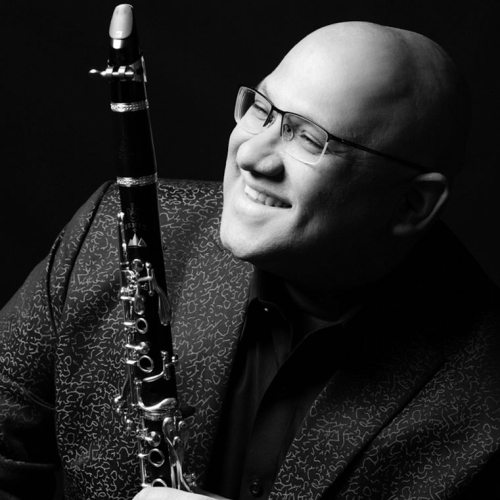
    Ricardo Morales (above) then took the stage as soloist in Mozart’s heavenly Clarinet Concerto. I’ve never forgotten hearing music from this celebrated piece for the first time: in the film Out of Africa, Baroness Blixen (Meryl Streep) and Denys Finch Hatton (Robert Redford) are on safari; Finch Hatton has brought along a gramophone, and he puts on an old 78 rpm of the concerto, which attracts a pair of curious monkeys who – after listening raptly for a few moments – attack the gramophone.

    The first movement, Allegro, has a pulsing, melodious start. Dulcet clarinet roulades immediately introduce us to Mr. Morales’ mastery of dynamics, and his gift for incredible subtlety in his playing. His silky-smooth sound is captivating, and his agility astounds, with  fabulously clear scale-work and a charming passage where he deftly bounces from low to high notes. A mini-cadenza leads to the movement’s finale, where the Morales clarinet warbles like a magical bird over the orchestra’s plush playing.

    The Adagio – the heart of the concerto, and perhaps of Mozart’s entire oeuvre – introduces the clarinet’s simple but heartfelt melody, soon taken up by the orchestra. A fresh, wide-ranging theme evolves, in which Mr. Morales’ control and breath support are mind-boggling to experience. Following a brief cadenza, the main theme returns, hauntingly lovely; a heavenly trill from the clarinet draws the movement to a close.

    The concerto’s final Rondo has a sprightly start; Mr. Morales commences a flow of fantastical fiorature. The orchestra has an exotic, minor-mode passage, and then the clarinet’s wide range – from gleaming highs to velvety low notes – is explored in colorful playing. A magical performance, full of wonders. Bravissimo, Mr. Morales! 

    Symphony No. 36, “Linz”, closed the evening. Mozart was en route to Vienna when he stopped at Linz to visit an old friend, Count Thun-Hohenstein. On learning that a concert was scheduled just 5 days after his arrival at Linz, Mozart worked feverishly to compose a new work for the occasion: the result was a symphony in C-major, which soon earned the nickname the “Linz” Symphony.

    The first movement has a regal start. In the ensuing melody, bassoon and oboe stand out. A wistful mood sets in for a bit, then more joyous music sounds…with an odd rhythmic echo of Handel’s Hallelujah chorus. The music flows on, by turns thoughtful and grand.

    The ensuing Poco adagio begins elegantly. The music darkens, but only slightly, with the timpani evoking a sound of distant thunder. Somber moments alternate with courtly ones. The third movement – Menuetto – feels stately and grand at first, then becomes a conventional minuet, with some outstanding playing by bassoonist Laressa Winters.

    Mozart’s chose a Presto rather than a Rondo for the symphony’s finale, wherein swift and gracious themes alternate with lyrical lulls.

    Heading to the train home, I asked my companion if he felt that Mozart sometimes went on and on in his symphonies – something one rarely feels in his operas. He replied: “I was just thinking the same thing!” 

    ~ Oberon
  • An Eric Whitacre Holiday @ Carnegie Hall

    Cms-1 jpg

    ~ Author: Lili Tobias

    Tuesday November 26th, 2024 – I don’t celebrate Christmas, but I do love the traditions of music written for the holiday, especially when that music is choral! So this past Tuesday, I attended An Eric Whitacre Holiday at Carnegie Hall. This annual concert is a celebration of Whitacre’s Christmas music, his Christmas-adjacent music, and some other Christmas music by different composers (including Melissa Dunphy who was in the audience!).

    Whitacre himself conducted the Distinguished Concerts Singers International (DCSI), part of Distinguished Concerts International New York (DCINY), which produces concerts around New York that bring together singers from around the globe. This concert featured two different 250-member choirs, accompanied by pianist Kelly Yu-Chieh Lin and the Distinguished Concerts Orchestra. These musicians had only been rehearsing all together for the past two days, but they performed so well together that the short time wasn’t at all apparent. I was impressed with the clarity of the singers’ diction, as well as their ability to reach incredibly low volumes despite how many of them there were. I always enjoy the sound of a really large choir too, since the diverse array of different voices actually enhances the blend of sound.


    Whitacre is best known for the enchanting harmonies he uses in his music, in particular his tone clusters. The majority of the program for this concert was indeed very harmony-focused and, overall, very slow moving. While this aspect of Whitacre’s music is certainly beautiful, I find that his music really shines when it’s faster and more rhythmic. There were a few moments of quick music that I absolutely loved, including in the “An Unexpected Turn” scene from his opera The Gift of the Magi. In particular, Whitacre is really good at utilizing odd time signatures to drive the music forward while still maintaining the flow. These moments were a refreshing change, and I bet the singers had so much fun singing them too!


    Thumbnail_image0-48


    As I briefly mentioned earlier, this concert also included Whitacre’s Christmas opera, The Gift of the Magi. This was actually the world premiere of the orchestrated version, orchestrated by Evan L. Snyder and Whitacre. I was impressed with how the staging was done, given that most of the stage was taken up by 250 singers and a small orchestra. The action took place in the areas on either side of the orchestra, so the characters could travel across the stage for the different scenes. The singers also used the conductor’s podium to sit on or lay down props such as gift boxes. I felt that the production was just right for the venue, and the singing was wonderful too!


    This concert had an extremely warm and welcoming atmosphere. It was a family affair all around, as the audience was largely made up of the choir members’ relatives coming to support them. And not only that, but Whitacre’s wife, soprano Laurence Servaes, starred as Della in the opera, and his son (for whom he had written Goodnight Moon) was in the audience. While I won’t be celebrating Christmas this year, I certainly celebrated an Eric Whitacre holiday on Tuesday night!


    The performance photos are by Dan Wright.


    ~ Lili Tobias

  • Concertgebouw: Schoenberg & Mahler

    Untitled

    Performance photo by Chris Lee

    ~ Author: Ben Weaver

    Saturday November 23rd, 2024 – The Royal Concertgebouw Orchestra gave two sold-out concerts at Carnegie Hall last week under the baton of its chief conductor designate Klaus Mäkelä. The second concert on Saturday, November 23rd featured beloved works by Arnold Schoenberg and Gustav Mahler.

    Between the two concerts, this evening’s playing of Schoenberg’s Verklärte Nacht, Op. 4 was the strongest performance of the orchestral works the Concertgebouw presented this week. Originally composed for string sextet in 1899, Schoenberg made an arrangement for a string orchestra and it’s become one of his most beloved and most frequently performed works. The string section of the Concertgebouw was on absolute peak form with its lush yet concentrated sound. Schoenberg’s score is by turns dark, ominous, romantic, and shimmering, and the orchestra reflected each emotion and turn with beautiful clarity. Maestro Mäkelä conducted it without a score, so it appears to be a work that is close to his heart. Maybe that’s why he managed to keep the tension throughout the entire composition. 

    When it comes to playing Mahler, I think the Concertgebouw’s only rival is the New York Philharmonic. These symphonies are close to their hearts and they perform them frequently. The Symphony No. 1 in D major received its Dutch premiere in 1903 under Mahler himself. This evening’s performance under the orchestra’s young incoming chief conductor was somewhat mixed.

    The first movement was something of a mess that echoed the very unfortunate performance of Rachmaninoff’s Symphony No. 2 the previous evening: while Maestro Mäkelä can build to a climax, he was unable to connect any of the climaxes together, the tension and structure of the music disintegrating every few minutes. So it was here, unfortunately. Low voltage would be one way to describe it, a flicker of color quickly draining into something dull and gray.

    Fortunately things improved as the performance continued, and Mäkelä managed to keep the symphony moving. The second movement is filled with sections of chamber music, interrupted by full orchestral blasts. There was some wonderful playing from individual sections of the Concertgebouw, the winds in particular covering themselves in glory.

    The Funeral March was the best part of the performance. The double bass solo (principal Dominic Seldis) was appropriately weary and somber. The mocking tune that interrupts it was nicely paced and delightfully almost jazzy. The Finale was largely well handled, but lacked enough frenzy to be truly satisfying until the very last moments.

    With Maestro Mäkelä taking over two of the world’s top orchestras – the Concertgebouw and the Chicago Symphony Orchestra – these performances left me concerned if he is the right person for these jobs at this time. But time will soon tell if the confidence he has inspired in others pays off.

    ~ Ben Weaver

  • Concertgebouw: Schoenberg & Mahler

    Untitled

    Performance photo by Chris Lee

    ~ Author: Ben Weaver

    Saturday November 23rd, 2024 – The Royal Concertgebouw Orchestra gave two sold-out concerts at Carnegie Hall last week under the baton of its chief conductor designate Klaus Mäkelä. The second concert on Saturday, November 23rd featured beloved works by Arnold Schoenberg and Gustav Mahler.

    Between the two concerts, this evening’s playing of Schoenberg’s Verklärte Nacht, Op. 4 was the strongest performance of the orchestral works the Concertgebouw presented this week. Originally composed for string sextet in 1899, Schoenberg made an arrangement for a string orchestra and it’s become one of his most beloved and most frequently performed works. The string section of the Concertgebouw was on absolute peak form with its lush yet concentrated sound. Schoenberg’s score is by turns dark, ominous, romantic, and shimmering, and the orchestra reflected each emotion and turn with beautiful clarity. Maestro Mäkelä conducted it without a score, so it appears to be a work that is close to his heart. Maybe that’s why he managed to keep the tension throughout the entire composition. 

    When it comes to playing Mahler, I think the Concertgebouw’s only rival is the New York Philharmonic. These symphonies are close to their hearts and they perform them frequently. The Symphony No. 1 in D major received its Dutch premiere in 1903 under Mahler himself. This evening’s performance under the orchestra’s young incoming chief conductor was somewhat mixed.

    The first movement was something of a mess that echoed the very unfortunate performance of Rachmaninoff’s Symphony No. 2 the previous evening: while Maestro Mäkelä can build to a climax, he was unable to connect any of the climaxes together, the tension and structure of the music disintegrating every few minutes. So it was here, unfortunately. Low voltage would be one way to describe it, a flicker of color quickly draining into something dull and gray.

    Fortunately things improved as the performance continued, and Mäkelä managed to keep the symphony moving. The second movement is filled with sections of chamber music, interrupted by full orchestral blasts. There was some wonderful playing from individual sections of the Concertgebouw, the winds in particular covering themselves in glory.

    The Funeral March was the best part of the performance. The double bass solo (principal Dominic Seldis) was appropriately weary and somber. The mocking tune that interrupts it was nicely paced and delightfully almost jazzy. The Finale was largely well handled, but lacked enough frenzy to be truly satisfying until the very last moments.

    With Maestro Mäkelä taking over two of the world’s top orchestras – the Concertgebouw and the Chicago Symphony Orchestra – these performances left me concerned if he is the right person for these jobs at this time. But time will soon tell if the confidence he has inspired in others pays off.

    ~ Ben Weaver

  • American Composers Orchestra @ Zankel Hall

    PXL_20241031_001633210

    Above: Curtis Stewart & Kebra-Seyoun Charles

    ~ Author: Shoshana Klein

    Wednesday October 30th, 2024 – I’ve had a thing about the concept of borders since the US border patrol incinerated my innocent house plants at the US Canada border in 2022. The name of this concert by the American Composer’s Orchestra was “The New Virtuoso: Borders” and at the beginning, Curtis Stewart framed the concert in a way that sounded really great. He talked about using virtuosity in new ways, rethinking the way the instruments work, and considering the use of borders. This included the concept of good borders (like healthy boundaries) versus harmful borders – like those used to start wars, and those that mark our identities without causing harm. I really wondered if the music would live up to this deep description. 

    The program:

    Michael Abels: Borders 

    Kebra-Seyoun Charles: New Work (ACO Commission, developed via EarShot CoLABoratory/World Premiere)

    Curtis Stewart, Embrace (ACO Commission)

    Paul Novak, Forest Migrations (ACO Commission/World Premiere)

    Victoria Polevá, The Bell

    The first piece was by Michael Abels, who has written the music to a bunch of blockbuster movies. The description of the piece and the inspirations for it that was printed in the program was beautiful – the idea was that in the first movement, the guitar is within the borders of the bar lines and in the second movement it’s not. The second movement also depicts a child running – sometimes in joy and sometimes in fear. It was a little hard to hear all of that in the music but in the second movement the guitar was definitely leading more and there were complicated rhythmic sections where the guitar and orchestra were definitely in different meters, which was a cool effect.


    The Paul Novak piece “Forest Migrations” was about trees and ecological borders – he used the orchestra of the metaphor for forest and forest migration caused by climate change. He described how the movement of the piece would be slow – each player playing one at a time, and also mentioned that musicians owe a debt to the trees that their instruments are made of, which I thought was really interesting. I really liked the concept but I was not convinced that the effect was going to be unique. In reality, it was really well done but not what I expected from the description – there was a lot more movement and melody than I was expecting. I like the way the concept of borders were explored and discussed in this new way, but once again, I was not sure I heard it in the music the way it was described. 


    Before the start of Kebra-Seyoun Charles‘ piece, Curtis Stewart asked if they wanted to say anything else about it and they said “have fun.” The piece was all about blending musical styles – so mostly genre borders were those being addressed. There was harpsichord in the orchestration, which was really cool juxtaposed against some of the other musical styles that were played, and in the first movement the piece kept falling into a sort of Bach sound. The idea of the first movement was walking down the street in New York and catching snippets of lots of different things and I think it achieved that relatively well. The whole piece was very virtuosic and seemed really technically difficult for the bass soloist (though it was the composer, so they did a great job and obviously knew what they were getting into!). The second movement started very schmaltzy and almost sounded like a quote from something. Charles seemed to be having fun and they actually got the orchestra to sound kind of raucous in a way that you don’t hear often in a concert hall, which was refreshing.


    The Victoria Poleva piece had dark and interesting sound worlds – it definitely explored the concept of a bell and the concept of war, though in reality a lot of the peace was actually really uplifting and bright. Another thing that was bright was the soloists dress which was right yellow and sparkly! This piece felt a lot more cinematic than Michael Abel’s piece, ironically. One movement was almost entirely an ascending major scale with various harmony changes. There were some really cool whistling wind whistling sounds going along with string string sounds that were like ghost noises. It was kind of interesting that this Ukrainian composer who mentioned Ukraine and mentioned the war didn’t really mention borders, though maybe it’s just implicit enough that it wasn’t necessary.


    PXL_20241031_014727965


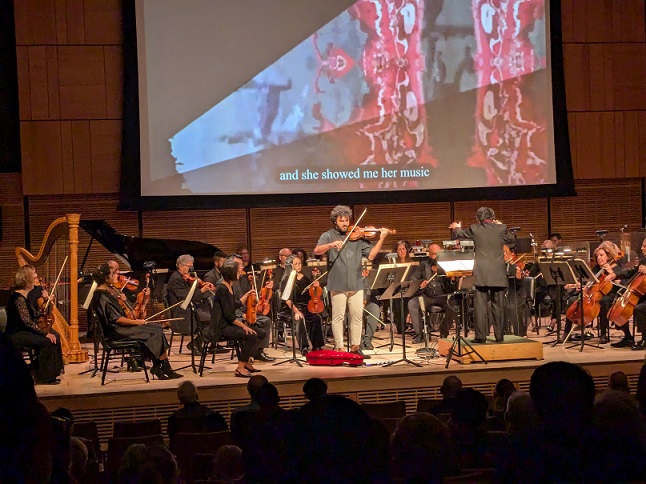
    The last piece was by Curtis Stewart (above), who is also the artistic director of the ACO. This was probably the most involved piece of the program. There was a video and there was audio recording and there was audience participation! I’m always impressed when a composer tries to incorporate audience participation. In this context it worked pretty well, we basically sang chords in a progression. I wasn’t that much of a fan of the video but having the audio was nice. It was a compilation of his mother’s voice talking about music, interspersed with the composers from the concert and school kids from the ACO’s young composer program answering the same questions that she had. One of those questions that he mentioned before he started stuck with me was “how does music carry you through the changes in your life.” The piece was less full of electronics than I was expecting given his setup, but I did really like the music.


    Conductor Mei-Ann Chen, who I’ve heard great things about, seemed like a dynamic, clear, and energetic leader who would be fun to play under. Overall, I suppose the theme of the concert for me was something along the lines of “great thoughts and concepts that don’t always come through in the music” but in some ways that’s par for the course in new music, and honestly I still prefer it to a lack of contextualization or tying things together – I love a concert that ties ideas together and brings up relevant issues. Many things were tried and many of them were successful.

    ~ Shoshana Klein

  • The Tucker Gala @ Carnegie Hall ~ 2024

    Richard-Tucker

    Above: Rlchard Tucker

    ~ Author: Oberon

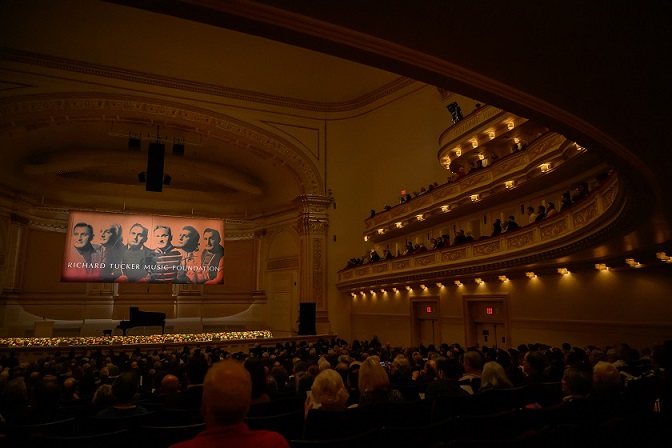
    Sunday October 27th, 2024 – The 49th annual Richard Tucker Music Foundation gala took place this evening at Carnegie Hall. It was an excellent program – including one aria that is rarely performed – with much impressive vocalism. The evening descended into silliness during the encores, but the audience overwhelmingly approved of la commedia, leaving me feeling like an old stick in the mud.

    You always run into people you know at the Tucker Gala. I was especially happy tonight to run into my friend – and fellow Patricia Brooks fan – from back in the day: Matthew Epstein.

    003-RICHARD_TUCKER_GALA_2024-0025

    Photo by Dario Acosta

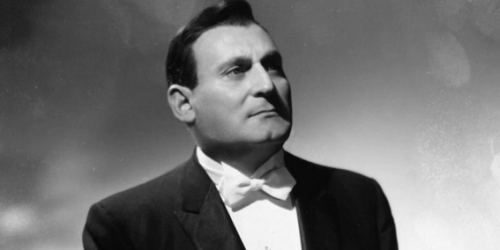
    Following tradition, the first voice we heard was that of Richard Tucker singing the “Addio alla madre” from CAVALLERIA RUSTICANA. The power and passion of his voice are immortal.

    014-RICHARD_TUCKER_GALA_2024-0214

    Above: Nadine Sierra, photo by Dario Acosta

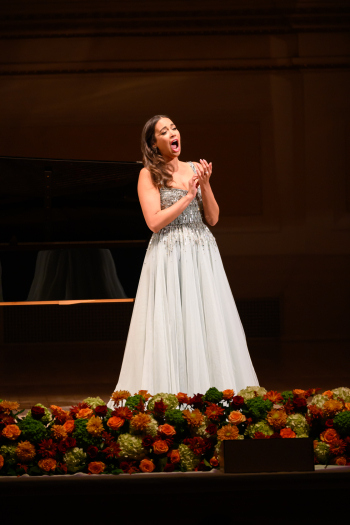
    After Barry Tucker’s welcoming speech, the program commenced with Mimi’s narrative “Mi chiamano Mimi” from LA BOHEME; this brought Nadine Sierra and pianist Bryan Wagorn together in a rendition that was a bit slower than we might be accustomed to, but which gave us more time to savour Nadine’s luxuriant phrasing and lovely tone. She made the slow rise to B-natural before commencing “…ma quando vien o sgelo…” which makes such a magical effect. Listening to her this evening made me think that Nadine could now venture into roles like Mimi, Liu, and Amelia Grimaldi, and even Desdemona and the TROVATORE Leonora.

    028-RICHARD_TUCKER_GALA_2024-0340

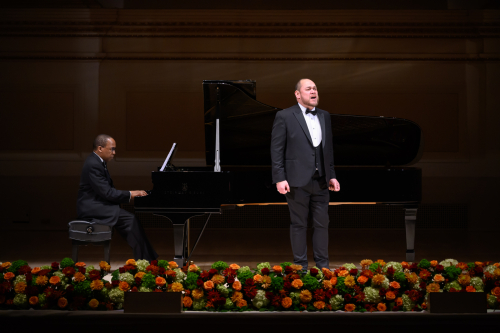
    Quinn Kelsey (above, photo by Dario Acosta) then took the stage, accompanied by Howard Watkins, for a truly magnificent “Eri tu” from BALLO IN MASCHERA. This was opera at its grandest, the singer filling the Hall with a flood of golden tone, achingly heartfelt in the character’s distress and his sense of defeat and resignation. This is a baritone voice to rank with the greatest of my experience: Warren, Merrill, MacNeil, Milnes, and the unforgettable Dmitri Hvorostovsky.

    047-RICHARD_TUCKER_GALA_2024-0506

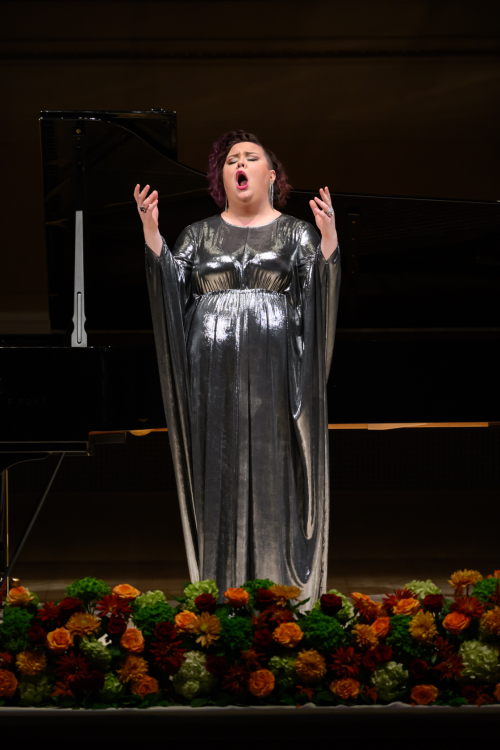
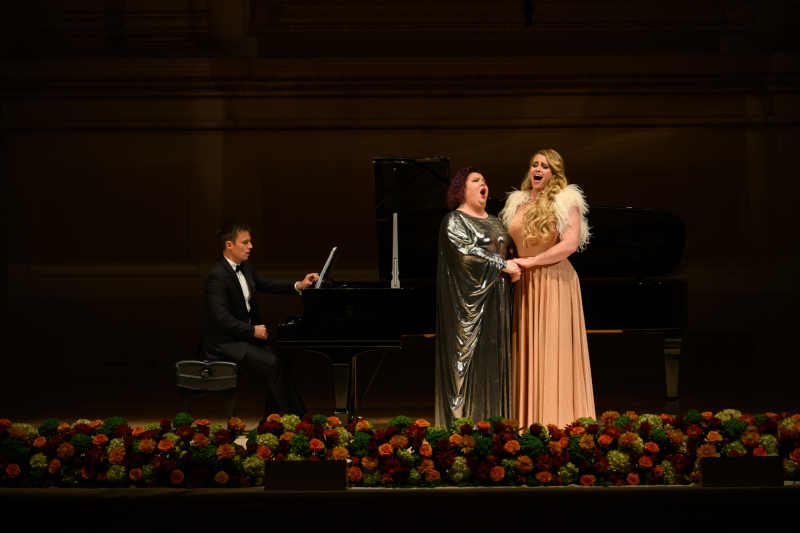
    Jamie Barton (above, photo by Dario Acosta), looking like an errant Valkyrie in her metallic-silver frock, was hilarious in the Witch’s aria from HANSEL & GRETEL. Mr. Watkins at the piano was a perfect accomplice to Jamie’s rowdy, riotous performance. Later, we would hear Jamie in bel canto mode, and finally as a top-flight songstress.

    071-RICHARD_TUCKER_GALA_2024-0704

    Rachel Willis-Sorenson (above, photo by Dario Acosta), who the day before had joined Jamie Barton and Michael Fabiano in a rousing Met matinee of TROVATORE, today gave us the immortal “Casta viva” from Bellini’s NORMA. Although this bel canto jewel really needs an orchestra-and-chorus setting, Ms. Willis-Soremson and Mr. Wagorn were so persuasive that such concerns became irrelevant. With her impressive breath control, the soprano commanded the long phrases, introducing subtle nuances along the way. She concluded the aria with a gorgeous cadenza and then spun out an incredible inverted trill before sustaining the final note.

    082-RICHARD_TUCKER_GALA_2024-0805

    Above: Michael Fabiano, photo by Dario Acosta

    At yesterday’s Met TROVATORE, a commotion in the wings after “Di quella pira” had raised questions; this evening they were answered: Michael Fabiano had fallen on exiting the stage and sustained an injury; he had managed to finish his Manrico – but, as anyone who has taken a fall knows – it’s the day after that the soreness manifests itself. The poor tenor – heroic, but obviously in deep pain – was slowly helped onto the stage by Mr. Watkins. Michael spoke briefly of the incident, then regaled us with a sublime rendering of Henri Duparc’s “Phidylé“, displaying his lyrical side after yesterday’s powerhouse Manrico.

    096-RICHARD_TUCKER_GALA_2024-0910

    Above: Elena Villalón, photo by Dario Acosta

    Giving us some the most delightful singing of the evening was the soprano Elena Villalón, a Tucker Grant winner and currently at The Met in the Golijov AINADAMAR, having debuted there in the previous season as a charming Amor in ORFEO ED EURIDICE. Tonight, looking ravishing in her deep blue gown, the Cuban-American soprano sang Manon’s double aria from the Cours la Reine scene from the Massenet opera, with Mr. Watkins a gallant companion. The Villalón Manon is captivating, and she won my heart just as Patricia Brooks, Jeannette Pilou, and Lisette Oropesa have done in the role over the years.

    115-RICHARD_TUCKER_GALA_2024-1040

    Anthony Roth Costanzo (above, photo by Dario Acosta), in a sparkly shirt, was simply magnificent in Handel’s Stille amare from TOLOMEO. The voice is so delectable to hear in the Carnegie acoustic. Anthony’s emotional connection to the music – and his sublime pianissimi – were truly touching to experience.

    140-RICHARD_TUCKER_GALA_2024-1241

    Above: J’nai Bridges, photo by Dario Acosta

    Til tonight, I’d never heard Sapho’s grand final aria from the Gounod opera named after her sung live; but I’ve thrilled to its sense of grandeur and doom since by chance hearing a recording of Heather Begg singing it in English many, many moons ago. Thank you, J’nai Bridges, for bringing this splendid aria to currency. Mr. Wagorn was again simply perfect as the mezzo, resplendent in a mint green gown, delivered the poignant recit and majestic aria – which ends on a thrilling top note that Ms. Bridges sustained mightily – so convincingly that the vision of the heroine hurling herself into the ocean at the end was palpable.

    156-RICHARD_TUCKER_GALA_2024-1369

    Above: Anthony León, photo by Dario Acosta

    Anthony León, 2022 1st prize and the Zarauela prize winner at the Operalia competition, sang a poetic “Una furtiva lagrima” from ELISIR D’AMORE with Mr. Watkins giving the youthful tenor wings on which to fly. The voice is sweet and clear, the singing so sincere, the words lovingly set forth, and the final phrase finely controlled. 

    166-RICHARD_TUCKER_GALA_2024-1406

    Above: Ryan Speedo Green, photo by Dario Acosta

    After hearing his Serenade this evening, we must have Ryan Speedo Green’s Don Giovanni in the next Met revival of the Mozart masterpiece: such a suave singer, with charisma to burn. Ryan had sung a commanding Ferrando in yesterday’s TROVATORE, and I look forward his Spirit Messenger in the upcoming Met revival of FRAU OHNE SCHATTEN…to say nothing of his impending Zankel Hall recital on January 22nd, 2025…check out the program here!

    190-RICHARD_TUCKER_GALA_2024-1590

    Above: Nadine Sierra and Quinn Kelsey; photo by Dario Acosta

    In the great duet of Gilda and her father from RIGOLETTO, Nadine Serra and Quinn Kelsey seemed to give us the very essence of opera. With perfect musical support from Mr. Watkins, the two singers wandered about the stage, seemingly unable to face one another after the jester’s beloved Gilda’s had been defiled at the hands of the Duke. From “Piangi, piangi fanciulla…”on, Quinn held Nadine in his consoling arms. Their singing was so compelling, and Mr. Watkins’ playing so true to the music, that for a brief time we were transported to that poetic place that only opera can carry us up. By the end, Nadine was weeping. The audience response was delirious, and rightfully so.

    216-RICHARD_TUCKER_GALA_2024-1725

    Mlles. Willis-Sorenson and Barton (above, photo by Dario Acosta) brought bel canto to the fore with “Mira, O Norma” from the Bellini opera, Mr. Wagorn playing a key role in this beloved duet of rivals who become – if only briefly – fast friends. The voices made for a very congenial blend, the harmonies lingering so endearingly in he ear. Following the slow section, a dramatic exchange between the women was resolved with Ms. Willis-Sorenson’s “Trovo un’amica ancor”. and then they set off the vocal fireworks “Si, fino all’ore estreme”, even etching is some delicious harmonized turns before joining together on the penultimate note. 

    227-RICHARD_TUCKER_GALA_2024-1799

    Above: Angel Blue, photo by Dario Acosta

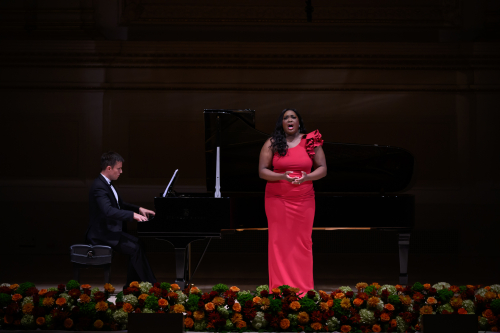
    The previously unannounced Angel Blue made a striking entrance in her red diva-gown. With Mr. Wagorn, she sounded like a goddess; she sang “America The Beautiful” with great ardor, then moved directly to Lee Hoiby’s touching “Lady of the Harbor”, a hymn to the Statue of Liberty. Angel sang with mythic power and pride, an iconic presence as she sang of the hope and the blessings of the American dream.

    Encores now commenced with Anthony Roth Costanzo duetting with himself in the cat-and-mouse scene of Susanna and Count Almaviva from NOZZE DI FIGARO

    As a child, I had a Swiss music box that played Stephen Foster’s “Beautiful Dreamer”; I was thinking of this when Nadine Serra and her college pal Bryan Wagorn gave the song a glowing lustre. They ended with a hug of genuine affection.

    Mr. Leon was affectionately welcomed back for an ardent, “Non puede ser” with Mr Watkins; and then – singing unaccompanied – Ryan Speedo Green sang “Deep River” straight from the heart. Ms. Bridges returned for a passionate “My man’s gone now” from PORGY AND BESS, and then Jamie Barton sang “It’s You I Like”: a Jake Heggie charmer that mixes Chopin and Fred Rogers.

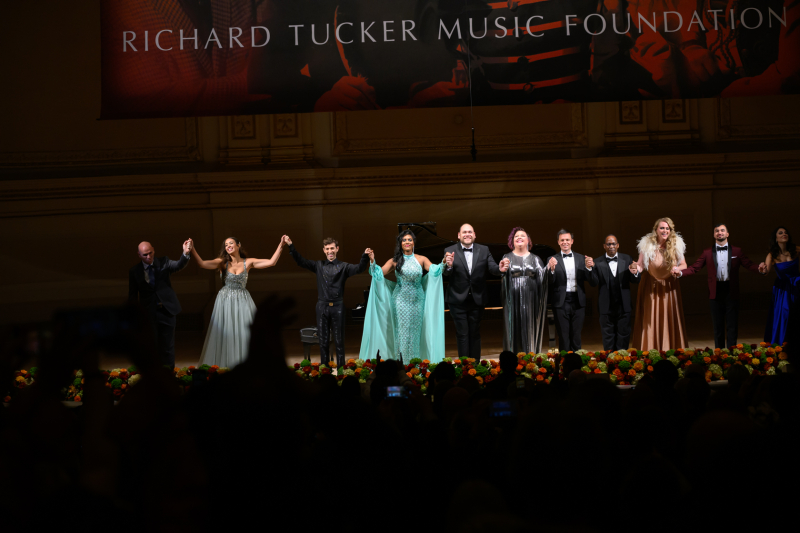
    The evening ended with Nadine, Anthony, and Mr. Wagorn in a musical three-way spoof that was pretty silly, but the audience loved it. 

    313-RICHARD_TUCKER_GALA_2024-2145

    Final bow. This, and all performance photos, by Dario Acosta.

    My thanks to Mallory McFarland of Morahan Arts and Media for arranging things for me.

    ~ Oberon