
The Dutch mezzo-soprano Jard van Nes (above) sings Wagner’s Wesendonck Lieder with the Northern Symphony conducted by Richard Hickox.
Listen here.
The Dutch mezzo-soprano Jard van Nes (above) sings Wagner’s Wesendonck Lieder with the Northern Symphony conducted by Richard Hickox.
Listen here.
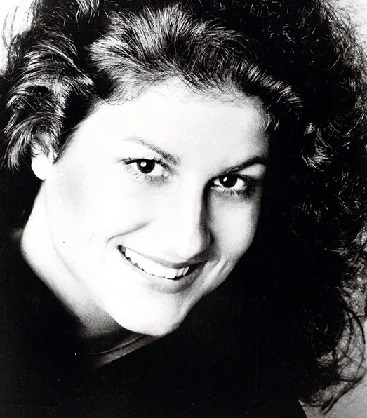
The American soprano Pamela Coburn (above) sings the Four Last Songs of Richard Strauss from a 1994 concert given by the Munich Radio Orchestra, with Roberto Abbado conducting.
Watch and listen here.

In 1982, I had the great pleasure of seeing Ms. Coburn in Beni Montresor’s gorgeous staging of Cavalli’s L’ORMINDO given by the Chamber Opera Theatre of New York. In the above production photo, Ronald Naldi is Ormindo and Ms. Coburn is Erisbe. Click on the photo to enlarge.
José Luis Luri sings Tosti’s “Non t’amo piu” with Shlomo Rodríguez at the piano, from a recital given in 2019. I came upon this voice by chance and was very taken with his lovely sound and style.
Watch and listen here.
You can read about the tenor, a native of Alicante, and also about the pianist, in an article from 2022 here.
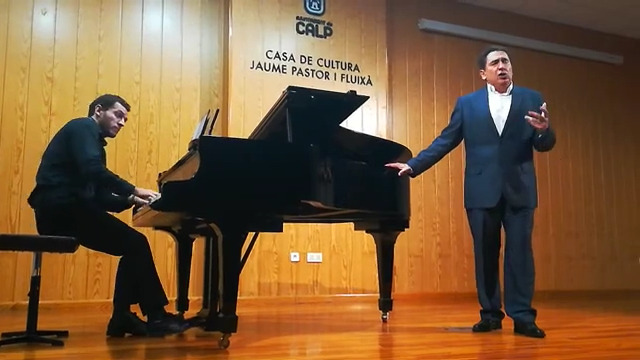
José Luis Luri sings Tosti’s “Non t’amo piu” with Shlomo Rodríguez at the piano, from a recital given in 2019. I came upon this voice by chance and was very taken with his lovely sound and style.
Watch and listen here.
You can read about the tenor, a native of Alicante, and also about the pianist, in an article from 2022 here.

~ Author: Oberon
Saturday July 27th, 2024 – The final offering of Chamber Music Society of Lincoln Center’s 2024 Summer Evenings series took place tonight at Alice Tully Hall. After a long lunch with friends, where some very serious topics were discussed, I was in a pensive mood when we arrived at the hall. The light, decorative music of Ludwig van Beethoven’s Serenade in D-major for Flute, Violin, and Viola, Op. 25, written in 1801, was not a good match for me today, feeling a need for something darker and more soulful.
Nevertheless, the playing was charming and, as the piece progressed, there was much to admire. It kicks off with a reveille, only it’s Tara Helen O’Connor’s flute that’s sending out a wake-up call rather than a bugle. Ms. O’Connor’s playing was at its most limpid throughout the suite. ln the songlike second movement, a minuet, her playing was elegant, whilst violinist Aaron Boyd and violist James Thompson provided echo effects. The Allegro molto shifts between major and minor modes.
Sweet harmonies fill the Andante, with its contrasting animated interlude, following by a scurrying Allegro scherzando. The final movement begins as an Adagio but soon transforms into an Allegro vivace, with lively playing from the three artists.
Sean Lee’s playing was spot-on, with touches of rubato, and the ensemble cushioned his playing perfectly, grounded by Nick Canellakis’s ever-velvety tone.
Following the interval, Heinrich Wilhelm Ernst‘s demanding Grand Caprice on Schubert’s “Erlkönig” for Violin, Op. 26, was given a spirited rendering by Sean Lee, though perfect clarity was sometimes missing.
So ended an unusual experience for me, wherein I strove to adjust my own state of mind to the program on offer; this had only happened to me a few times over the years – and mainly at the opera – where you have a ticket for ELISIR D’AMORE but are really in the mood for WOZZECK…or vice versa.
~ Oberon
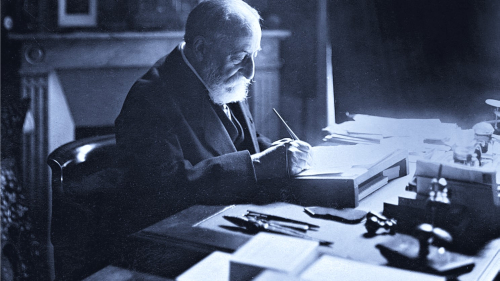
Above: Camille Saint-Saëns
A performance of Camille Saint-Saëns’ Piano Quartet, Opus 41, by members of the WDR Symphony Orchestra in 2022.
Watch and listen here.
The artists are Caroline Kunfalvi, violin; Katharina Arnold, viola; Martin Leo Schmidt, cello; and Nenad Lečić, piano.
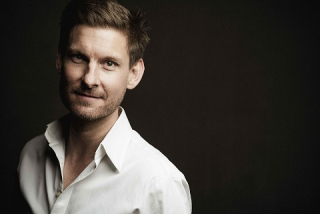
Above: Kristian Bezuidenhout, photo by Marco Borggreve
~ Author: Oberon
Tuesday June 25th, 2024 – The Orchestra of St. Luke’s brought their Bach Festival 2024 to a close tonight at Zankel Hall with a program titled Bach and Sons. Kristian Bezuidenhout (above) was conductor and soloist. The concert was sold out, with audience enthusiasm running high. The popularity of the series has prompted to OSL to announce a 4-performance festival for next year.
This evening’s program featured works by J S Bach and two of his sons, and ended with Mozart. The opener, Johann Christian Bach’s Symphony in G-Minor, Op. 6, No. 6, immediately engaged the audience. From the scurrying start of the opening Allegro, the music sounded thoroughly fresh and inviting. Horns and oboes join the strings, and the OSL’s bass player, John Feeney, marked the epicenter of the entire evening. The Andante opens with a unison passage, leading to a steady, pulsing beat decorated with stealthy trills. A lovely violin theme is heard. An urgent start to the concluding Allegro molto develops into roller coaster up-and-down scale passages, hunting horns, and exaggerated string tremolos.
Next, Mr. Bezuidenhout at the pianoforte commenced J. S. Bach’s Contrapunctus XIV from The Art of Fugue, BWV 1080, performed in an adaptation for strings. The cello, viola, and bass – and eventually the violins, seemingly one by one – join in this lament-like work. Poignant harmonies abound, the music gradually becoming somewhat animated.
Music of C. P. E. Bach came next, with Maestro Bezuidenhout taking up the Keyboard Concerto in D-Minor, Wq.17, H 420. The energetic opening Allegro was masterfully played, with a cadenza that displayed Mr. Bezuidenhout’s technical assurance and intriguing subtlety. The ensuing Adagio has a dreamy feeling, with periodic interjections of drama. Gracious harmonies invite the keyboard to join, with enticing turns and trills woven in. The turbulent opening of the final Allegro has a trace of a Spanish feel. Delicious playing from Mr. Bezuidenhout kept the audience entranced.
Following the interval, more from C.P.E. Bach: his String Symphony No. 3 in C-Major, Wq. 182, H. 659. From its speedy start, swirling violin motifs come to a sudden change of mood when the Adagio suddenly takes over: here, an interlude of affecting violin passages is interrupted by urgent stabbing tones from the bass. In the final Allegretto, melodic phrases are intruded upon by insistent bass and cello comments.
What finer end for a Bach Festival than music of Mozart! While Bach and his progeny are the source from which all musical blessings flow, their music – so meaningful to the mind and spirit – seldom touches heart. Thus, Mr. Bezuidenhout’s outstanding rendering of the Mozart’s Piano Concerto No. 9 in E-flat Major, K. 271, “Jeunehomme”, reached me on an altogether different level.
The 9th, composed in 1777, is considered Mozart’s first truly mature piano concerto. In terms of musical scope, technical demands, and depth of feeling, it seems to signal a new phase for the composer. The string ensemble, reinforced with horns and oboes, plays a unison introductory passage, and then Mr. Bezuidenhout immediately captivates us with a sustained trill. His playing throughout is remarkable for its dynamic range, with a delicacy of touch that charms the ear.
Having been a frustrated horn player in my teens, a brief horn solo reminds me of the fact that I didn’t take it seriously until my senior year: a lesson too late for the learning. Mr. Feeney’s bass resonance – such a pleasure to hear all evening – was of special appeal here. The piano cadenza, a jewel in the musical diadem of the evening, included spine-tingling nuances and hushed pianissimi which were vastly pleasing to the ear.
Dolorous might be too heavy a word for the concerto’s Andantino…wistful is perhaps more apt. All I know is, this music went straight to my heart…which has been in a tormented state of late. A full-bodied theme, brief but later repeated, was impactful. And the Bezuidenhout cadenza was immaculate and engrossing: a series of trills was a joy in and of itself.
But…no time for reverie. The pianist commences the concluding Rondo as a solo, which will recur; of particular charm was a keyboard cantabile played over plucked accompaniment.
Mr. Bezuidenhout has always been a prince among pianists, and with the redoubtable artists of St. Luke’s all on such fine form, the evening was a balm to the ear and the soul. I simply did not want this concert to end; it was the final live musical event of my seventy-fifth year; next week, the fourth act of my life/opera commences. For the moment – like Alceste – “Je sens une force nouvelle.”
~ Oberon
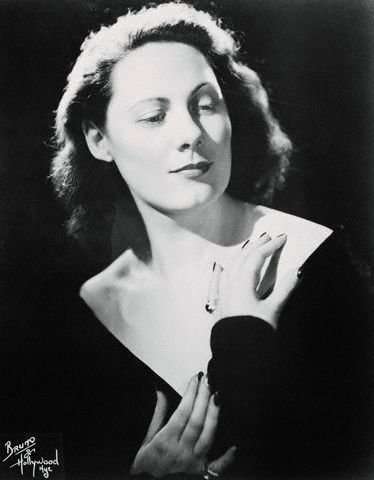
Renata Tebaldi is at her most sumptuous in arias from two concerts given at Buenos Ares in 1953.
Listen here.

~ Author: Lili Tobias
Friday June 21st, 2024 – The opening night concert of the 2024 Chelsea Music Festival was held in by far the most surprising venue I’ve ever been to. It took place in Genesis House, which is a restaurant/car showroom/performance venue associated with the luxury car brand, Genesis. In fact, the audience walked into the building through the showroom, so we were surrounded by new cars as the event staff offered glasses of wine. We then descended down a flight of stairs, through a lounge area, to the performance space.
The stage floor was actually a large screen itself, as were the back wall and the ceiling. This concert featured not only music but visual art completely surrounding the musicians as they played. While I thought the visuals were beautiful and intriguing, I didn’t quite see how they were connected to each specific piece. I think both the music and the visual art could have stood on their own just as well as together!
The concert opened with two pieces by Augusta Read Thomas: Bebop Riddle V and Dancing Stars. Both were very joyful and bouncy! I particularly enjoyed the juxtaposition of staccato and legato moments in Dancing Stars. This piece was primarily staccato throughout, but there were brief moments when more legato phrases rose up and then dissipated. These moments got more expansive as the piece progressed, and culminated in one bright pluck, followed by its echo in the resonance of the piano strings.
Wooden Bodies, by Tebogo Monnakgotla, was next on the program, performed by the Aizuri Quartet. Beginning with a slow melody in the lowest register of the viola, this motif was then explored by the other instruments in turn. In general, this piece was very fugue-like with all the motifs that got passed around within the quartet. My favorite moment was when the two violins traded off short, choppy phrases, creating a sort of panning effect between them. As a nice contrast to the explorative nature of the previous piece, Augusta Read Thomas’s next piece, Clara’s Ascent, felt calmer and more relaxed. The music stayed slow and legato for most of the time, punctuated by a fun pizzicato solo for the cello near the very end.
Next was a beautiful string quartet arrangement of Clara Schumann’s song, Die stille lotosblume. Having played the original piano and voice version myself, I really appreciated the liberties Miho Saegusa took in adapting the music for strings. First of all, the vocal melody is traded between string instruments which creates fun contrasts within one performance of the piece. And second, Saegusa added some delicate arpeggios which don’t exist in the piano part. These added interesting variety to the texture which the piano part just doesn’t have, and the half cadence ending left me wanting more!
To end the first half of the program was the world premiere of Nicky Sohn’s wind quintet, A Night at Birdland. Despite being accompanied by images of birds, this piece has nothing to do with birds, but rather is inspired by Charlie Parker, who is known as “Bird.” It was a really wonderful piece, and WindSync performed it so well. The music traversed many different musical textures, often featuring a consistent bouncy rhythm and really lush chords.
Beginning the second half of the program were two solo piano pieces, first the theme from the 2022 movie, The Fabelmans, composed by John Williams. Melinda Lee Masur, one of the artistic directors of the festival, performed this piece herself. It was a beautiful progression of a melody through different accompanying textures. Next was Against Time, written and performed by 2024 composer-in-residence Ania Vu. Starting with a single barely-there note, the music evolved into an exploration of different piano textures and techniques: full chords vs single notes, clusters vs octaves, steady pulses vs filigree. I’d love to try out playing this one myself!
The concert ended with Poulenc’s Sextuor (1931-32, performed impeccably by WindSync and pianist Andrea Lam. After the music, the audience was invited back upstairs to the Genesis House Restaurant for more drinks and canapés. This opening night concert featured such a wide variety of artistic ideas, and I’m sure the rest of the festival will live up to that as there’s a full week of performances ahead—from Bach to jazz to Brazilian forró. Congratulations to the Chelsea Music Festival on their 15th season!
~ Lili Tobias
Fedora Barbieri sings Dalila’s “Mon coeur souvre a ta voix” at a concert given in 1952 at the War Memorial Opera House in San Francisco.
Listen here.

 Oberon's Glade