
Fedora Barbieri sings Dalila’s “Mon coeur souvre a ta voix” at a concert given in 1952 at the War Memorial Opera House in San Francisco.
Listen here.
Fedora Barbieri sings Dalila’s “Mon coeur souvre a ta voix” at a concert given in 1952 at the War Memorial Opera House in San Francisco.
Listen here.
Angela Gheorghiu sings “Depuis le jour” from Charpentier’s LOUISE from a televised concert concert given at Radio Hall Bucharest in 1988.
Watch and listen here.

Angela Gheorghiu sings “Depuis le jour” from Charpentier’s LOUISE from a televised concert concert given at Radio Hall Bucharest in 1988.
Watch and listen here.

Above, Yvgeny Kissin at Carnegie Hall; performance photo by Steve J Sherman
~ Author: Ben Weaver
Friday May, 24th, 2024 – Evgeny Kissin is giving back-to-back concerts of the same program at Carnegie Hall this month. I attended the first one this evening, and it was a magnificent night of music, one of the best things I have heard in a concert hall this season. Kissin’s program is so popular, in fact, that not only were additional seats added on the stage (more about that later), but he will repeat this program on May 29th.
Surprisingly this was my first time hearing Kissin live, though I have admired his many recordings over the years. He is a very unaffected performer, seemingly almost shy. His very sincere physical presence and unpretentious playing made an enormously positive impression throughout the night.
Kissin began the program with Beethoven’s Piano Sonata No. 27 in E minor, Op. 90, composed in 1814. It reflects Kissin’s overall demeanor that he began with one of Beethoven’s least performed piano sonatas. Made up of only two movements – unusual for Beethoven – it open with a familiar Beethovenian bombast, but that falls away almost immediately and an achingly lovely melody takes over; it will return throughout the movement. The tonal contrasts throughout the the work can be hard to weave together. Kissin’s cleared those hurdles effortlessly. His playing was very clean and unfussy, each note etched like a diamond. Despite the Sonata’s Romanticism, Kissin seemed to be connecting it to Haydn and Mozart.
Throughout the night one noticed Kissin’s very judicious use of the pedal, never letting the sound get murky and messy. This gave a great clarity to Chopin’s Nocturne in F-sharp minor, Op. 48, No. 2 and Fantasy in F minor, Op. 49 (both composed in 1841.) The long, melancholic melodies of the Nocturne – a particular specialty of Chopin’s – was played gently and without undue sentimentality. At each carefully built climax, Kissin pulled back just in time before falling into schmaltz. He launched into the Fantasy’s opening march right away. It felt like another example of Kissin not milking the crowd for affection.
With Brahms’ Four Ballades, Op. 10 (composed in 1854) Kissin again reigned in much bombast, reminding us that Brahms, though composing at the height of Romanticism, was more of a classicist in temper. Which is not to suggest that his playing was lacking in brimstone. But Kissin’s very carefully chosen moments of when to let things blow up were fascinating to hear. The focus was always on the music and not the individual at the keyboard.
Prokofiev’s Piano Sonata No. 2 in D-minor, Op. 14 (composed in 1912) is an early composition for the young composer (he was still a student at the St. Petersburg Conservatory), and it shows him trying out new ideas that would become trademarks in his future works. The Scherzo in particular sounds like echt Prokofiev: a playful melody played with demonic speed and attitude. Kissin’s hands were flying over the keyboard in a blur. With Prokofiev, Kissin ended the official program with the most outwardly virtuosic piece played as dazzlingly as one can imagine.
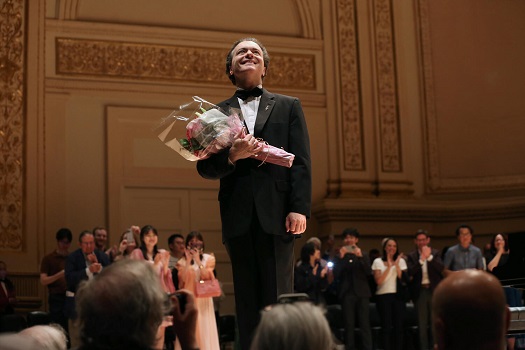
Photo by Steve J Sherman
The audience response was predictably wild. Kissin quickly offered 3 encores, all played superbly and all connected to the main program. A Mazurka by Chopin, March from Prokofiev’s opera “The Love for Three Oranges,” and Brahms’ gentle Waltz, Op. 39, No. 15.
During the opening Beethoven piece, the audience had been remarkably quiet. Perhaps making a note of this in my head jinxed the situation because what followed during the rest of the program was people repeatedly dropping things (probably their cell phones) and ringing cell phones. There is also always a risk in placing members of the audience onstage: one young girl in a white dress, sitting near the edge of the stage, was very bored and was swinging her legs the entire 1st half of the program. Thankfully her father probably took her home during intermission because they did not return. And just as Kissin launched into Prokofiev’s sonata, an elderly couple decided to exit the stage, down the steps, and out the door. Audience etiquette remains an untamable beast.
~ Ben Weaver
Performance photos by Steve J Sherman courtesy of Carnegie Hall
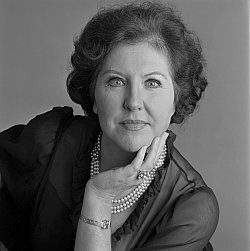
The Dutch mezzo-soprano Sophia van Sante and pianist Gérard van Blerk perform three songs by Gustav Mahler at a 1974 recital at The Hague.
Listen here.
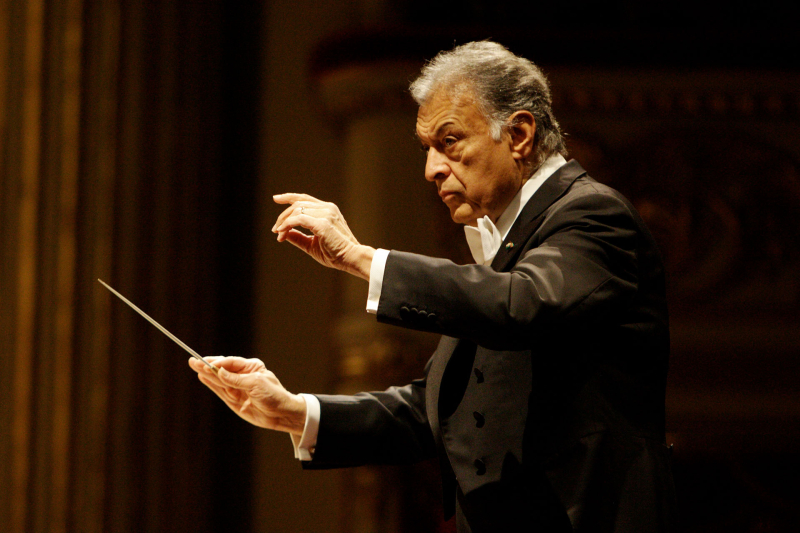
Maestro Zubin Mehta (above) leads a gala concert of music by Giuseppe Verdi featuring an impressive lineup of stars.
Watch and listen here.

~ Author: Oberon
Wednesday April 24th, 2024 matinee – This was my third time hearing the Chinese violinist Lun Li. My first encounter was at Merkin Hall when he gave his NY debut as a Young Concert Artist. Soon after, he played the Prokofiev second violin concerto – most impressively – with the Riverside Symphony at Alice Tully Hall.
This afternoon, Lun Li offered a distinctive program at The Morgan Library, and he played thrillingly from start to finish. I very much liked his idea of having the house lights completely darkened throughout the concert; the only drawback to this was: it was impossible to take anything more than the most rudimentary notes. In the long run, though, notes became superfluous because this was some of the greatest violin playing I have ever heard. After a while, I stopped trying to write anything down and just let the music transfix me.
Lun Li’s presentation was simple: clad all in black, he stood in a pool of light on the stage, casting a quadruple shadow. The darkness in hall seemed to make the audience more attentive and more focused on the music; there was a resolute stillness in the air, making the charismatic violinist’s extraordinary playing even more compelling.
The program was devised in three segments followed by a sort of built-in encore. Each segment consisted of a short ‘prelude’, followed by a longer work.
Music by Henry Eccles – his brief Prelude in A-minor – opened the concert, followed immediately by Nicola Matteis’ Alia Fantasia. The two pieces were written about fifteen years apart and are similar in feeling. Lun Li’s playing was elegant, and technically immaculate.
Continuing in a Baroque mode, music by Giovanni Bononcini, came next: his Prelude in D-minor led on to the celebrated Chaconne from Partita No. 2 in D-minor, BWV 1004, by Johann Sebastian Bach. This long work offers endless opportunities for brilliant playing, and Lun Li gave as astounding, passionate performance, holding the audience under a spell with his virtuosity. The ensuing ovation was inevitable after such a glorious rendition.
Following Philip Glass’s Book of Longing, which has a Baroque flavor, but with a tinge of timelessness, Lun Li gave a monumental performance of Béla Bartók’s Sonata for Solo Violin. The sonata was composed in 1944 on a commission from the American violinist Yehudi Menuhin; it was one of the composer’s last works. This solo sonata is in three – or maybe four – movements: Tempo di ciaccona, Fuga, Melodia, and Adagio – the last two being inseparable.
The sonata places extraordinary demands on the violinist as the music veers from searing, to luminous, to poignant. The sheer number of notes is uncanny, and they were all sewn together in an intense, unforgettable musical experience by our remarkable soloist. If the reaction to the Bach seemed massive, the ovation after the Bartók was simply off the charts.
Lun Li polished off his program with Tessa Lark’s Jig and Pop, a lively piece with a mile-a-minute swirls of notes. The violinist was called back for numerous bows.
The near-total darkness in hall today certainly worked in this particular instance, but if it becomes a trend – it’s been that way for years at The Joyce – people like me will be out of a job.
~ Oberon

Above: tenor Benjamin Bernheim as Romeo
~ Author: Oberon
Saturday March 30th, 2024 matinee – Earlier this season, I renewed my acquaintance with Bizet’s CARMEN at The Met, an opera I had not seen for many years. Musically, I enjoyed it thoroughly, and so this afternoon I was hoping for a similar experience with Gounod’s ROMEO & JULIETTE.
My first encounter with the Gounod opera was an unforgettable matinee in October of 1967, when Jeannette Pilou made a last-minute Met debut as Juliette opposite Franco Corelli’s matinee idol Romeo. I fell in love with Ms. Pilou that afternoon, and made many trips to New York from the little town specifically to see her in her many Met roles in the ensuing seasons. I saw Jeannette as Juliette a second time, and since then I have seen only Colette Boky and Hei-Kyung Hong in the role.
Today’s matinee started the same way as my first-ever ROMEO in 1967: the news that Nadine Sierra had canceled and was being replaced by So Young Park, whose Met credentials to date have been a handful of recitals with piano in the NY Parks, and a single Queen of the Night in 2019.
The Met Orchestra played with its accustomed polish, and the chorus has a lot to do in this opera…and they did it very well. For the most part, Yannick Nézet-Séguin resisted his usual temptation to have the orchestra play too loudly…though there were moments…
The orchestral opening was heavy-handed, followed by a chorale, and then the poignant love theme sounds from the strings. The first solo voices to be heard are those of Frederick Ballentine as Tybalt and Daniel Rich as Paris; Mr. Ballentine would have more to do later, in the duel scene…and he made a strong impression there.
Nathan Berg was a fine Capulet; his ‘aria’ at the ball was subtly done, and his scene with Juliet prior to her taking the potion was excellent, as was his expression of remorse over her supposed death. Eve Gigliotti was an impressive Gertrude, making the most of her part in the wedding quartet, and in her scene with the the characterful Grigorio of Jeongcheol Cha. Richard Bernstein’s Duke of Verona made his anger at the dueling factions palpable, and his sentencing of Romeo to exile is a pivotal moment in the story.
Alfred Walker’s Frère Laurent brought the basso’s warmth of timbre and eloquence of feeling to the scene of the wedding, and his consoling singing gives Juliette the courage to take the sleeping potion. Will Liverman delivered Mercutio’s tricky Queen Mab aria with complete assurance – a highlight of the evening for sure. Will’s handsome timbre is always so appealing, and his delivery was light and lively in the aria’s swift phrases, turning more lyrical in the central, more reflective passages. Bravo! Samantha Hankey’s singing of Stephano’s “Que fais tu blanche tourterelle” was a vocal treat. Melodious in the opening tune, the page chides the Capulet men with her insouciant teasing at “Gardez bien la belle”, finishing off with a mini-cadenza up to a perfectly placed top note which she sustained to brilliant effect. This aria was an early-career success for the great Frederica von Stade; may it bring Ms. Hankey similar good fortune!
So Young Park has a girlish, clear voice which captured the innocence of the teen-aged Juliette right from her opening lines. At first, the voice was a bit tremulous, but she bravely shimmered up to a sprightly top note in her cadenza. Soon after, she was breezing thru the delectable waltz, in which she had all the coloratura well in-hand; the lovely pensive passage “Loin de l”Hiver morose…” was beautifully sung, and then the soprano sailed up to neat top-C, and lingered there.
She and Mr. Bernheim were sweetly playful in their first encounter, Mr. Bernheim so persuasive in his gentle flirtation which is dressed up as poetry. Ms. Park’s delight at being so charmed by the handsome stranger vanished into sadness when she learns who he is: an enemy of her family.
The balcony duet was alive with the fascination of young love; Ms. Park, now settled-in vocally, brought sweet lyricism to her lines – and the voice bloomed lovingly in response to the tenor’s ardent “O nuit divine…”. Then they harmonized to ravishing effect with “De cet adieu si douce e la tristesse“, and then Mr. Bernheim melted all hearts with his hushed, gorgeous “Va, repose en paix…” For me, die-hard romantic that I am, this entire scene was enthralling.
Ms. Park’s voice sailed over the wedding scene quartet, where Ms. Gigliotti and Mssrs. Bernheim and Walker were all vocally aglow. The spine-tingling prelude to the bridal night duet was magically played by the Met Orchestra, and then Ms. Park and Mr. Bernheim gave us some of the most captivating singing imaginable with “Nuit d’hyménée! Ô douce nuit d’amour!”, their voices entwining in quiet rapture. The call of the lark – “the harbinger of the dawn” – draws them out of their reverie: thrillingly, they bid each other farewell. Romeo rushes to his fate, as Juliette sings a quiet blessing. This is the end of their happiness, though they do not know it.
Ms. Park sang the dramatic Potion Aria effectively, though the conductor’s sudden need to pump up the volume elicited a rather brassy climactic top note from the soprano: so predictable with him on the podium. But such things only matter to a handful of listeners. The soprano finished the opera with her touching farewell to her beloved as they ask god to forgive them.
The afternoon was a total triumph for Benjamin Bernheim. It is a great pleasure to hear this voice, which is both elegant and passionate. Following the sublime ‘lullaby” of the entr’acte leading up to the balcony scene, the tenor’s “O nuit!” marked the start of Bernheim’s dreamy recitative which carries us to a gorgeous clarinet solo before he takes up greatest love song in all opera: “Ah! Lève–toi, soleil!” I have heard many
superb interpretations of his aria – from the likes of Franco Corelli, Alfredo Kraus, and Neil Shicoff – but none has moved me quite as deeply as M. Bernheim’s. Sung with deep tenderness, and ending with a thrilling B-flat, the tenor was vociferously hailed by the audience. Listen to a brief clip here.
Following his anguish at being exiled, the Bernheim Romeo capped the duel scene’s final ensemble with a bold top-C. Yet, for all the excitement of hearing a tenor deploy such golden high notes, it was in the quiet despair of the final scene that Bernheim achingly conveyed the pain of a broken heart: the sublime tenderness of his pianissimo farewell to Juliet, which was followed by the heart-rending echo of “No, ce n’est pas le jour…”, recalling the lovers’ moments of their brief happiness.
Benjamin Bernheim’s Romeo brought some of the finest tenor singing I’ve heard at The Met in the last half-century. His voice has an innate poetic quality that cannot be taught; it is a voice that touches my heart. Thru the years, I have sometimes felt my deeply romantic soul to be a curse, but today I realized that it’s a gift.
Now I have rambled on long enough. I went to the stage door after the curtain calls and met Eve, Benjamin, Will, and Richard. They were so kind…I love them all. What intrigues me so much about opera singers is that they can do things we mere mortals can only dream of. I admire their devotion and their courage, putting themselves on the line night after night so that we can bask in the glory of the greatest art form ever.
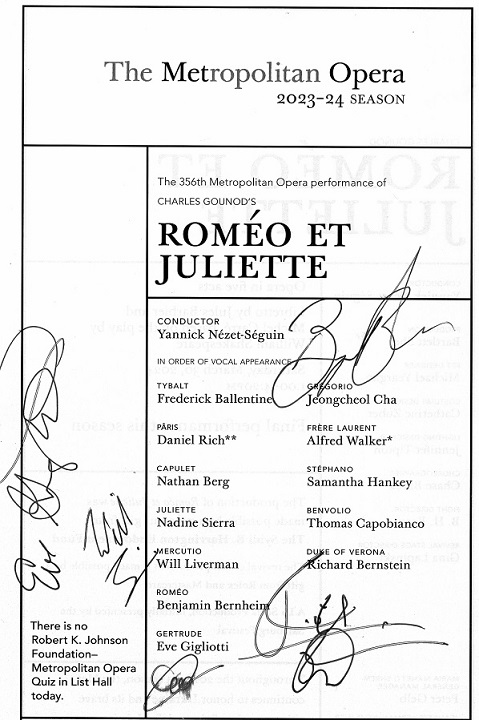
And here are the curtain calls!
~ Oberon

Above: Ema Nikolovska, photo by Kaupo Kikkas
Author: Oberon
Thursday March 28th, 2024 – Earlier this year, I was looking to add a vocal recital – by a singer I had never previously heard, in an intimate setting, including some songs that would be brand new to me – to my late-winter calendar. Flipping thru the Carnegie Hall brochure, I zeroed in on tonight’s offering at Weill Hall: Macedonian-Canadian mezzo-soprano Ema Nikolovska, with Howard Watkins at the piano. I listened to about ten seconds of her singing on YouTube and requested a ticket. I’m so glad I was there.
I must say at the start that it was a recital wherein the encore proved the highest highlight of the evening. Ms. Nikolovska announced this work, which she had commissioned, prior to singing it, and now I am casting about, trying to find more information about it, since I did not catch the name of the composer.
But to begin at the beginning, the mezzo-soprano and her collaborating pianist offered four songs by Franz Schubert. She chose songs somewhat off the well-trodden Schubert path, some of which were brand new to me.
“Im Frühling” was the most familiar. From its opening phrases, I sensed a large voice that had been tamed and polished. It took a few warm-up measures before things began to flow, but within seconds Ms. Nikolovska was ravishing the ear with her keen sense of nuance, and her expressive diction.

In “Dass sie hier gewesen” it became clear that Mr. Watkins (above) was so much more than an accompanist: his artistry is deep, and he plays from the heart. Ms. Nikolovska here displayed her gift for introducing straight tone into her singing, and the effect was enchanting. Mr. Watkins opened “Herbst” with a rippling restlessness, and then the music took on a sense of urgency. The song has an Erlkönig feel to it. Ms. Nikolovska’s subtle inflections and Mr. Watkins’ marvelous playing drew us deeper and deeper into the music.
The Schubert set ended with the longest of the songs, “Der Unglückliche” which felt like an intimate mini-opera. The piano opens with a darkish sense of doom, and the voice moves from pensive to intense. We pass thru many moods in this dramatic and engrossing song.
Ms. Nikolovska then spoke, rather at length, about the program. When the music resumed, it was Richard Strauss’ very brief “Nichts” that re-established the mood with its big piano intro and its final vocal outburst. A thoughtful atmosphere is established in “Gefunden“, which turns melodic and ends with Ms. Nikolovska on a gorgeously sustained, dreamy final note. We remain in dreamland with the opening of “Das Rosenband“, which soon gives way to rapture. Ms. Nikolovska was simply sublime here, her soft singing so engaging, and so beautifully controlled. The straight tone moments were spine-tingling, with awesome dynamic control, and a high-lying passage near the end which was magical. Mr. Watkins, in the piano postlude, was equally impressive.
Songs of the Seasons, by Margaret Bonds, sets four poems of Lankston Hughes. A touch of jazz inflects Autumn, while a slow sway and dreamily sustained pianissimi evoke a cozy afternoon before the fire as snow falls outside in Winter. Mr. Watkins sets a music hall mood with sparkling motifs for Spring; this song has a big finish, and leaves it to Ms. Nikolovska to spin out a delectable diminuendo. The pianist introduces Summer with animated playing which becomes an infectious rhythm.
An over-long intermission threatened to break the spell, but at last we were drawn back into the alternate universe by Debussy’s atmospheric Ariettes oubliées. The first song, “C’est l’extase langoureuse“, is aptly named, as its sense of languor is so finely evoked by the composer…and so perfectly captured by pianist and singer. The sweet sadness of “Il pleure dans mon coeur” was immediately conjured up by our two musicians: Ms. Nikolovska exploring the wide vocal range with uncanny dynamic control, and Mr. Watkins at his most poetic. The pianist was exceptional in “L’ombre des arbres“, while the singing was tinged with a sensual glow.
In a mighty mood-swing. we are suddenly on a carousel for “Chevaux de Bois“; yet even here, the excitement and energy winds down as the circling horses slow their pace. Ms. Nikolovska followed the pianist’s delicate introduction to “Green” with some of her most delicious singing of the evening, finding heaven in her final phrase. For the concluding “Spleen“, the pianist creates a mysterious mood, and the singer ‘speaks’ on one note before a moody melody emerges, which the Nikolovska voice caresses with uncanny pianisssimi.
Another treat follows with two songs by Nicolas Medtner: “Twilight” and “Sleeplessness“. The first is a hymn to nature, introduced by descending motifs from the keyboard. The song has a lovely lyrical feel, and Ms. Nikolovska’s sustained tones were again an outstanding feature. “Sleeplessness” has a dirge-like start; the singing grows more urgent, then recedes to resignation and ends with a vocalise.
In a total change of atmosphere, Ms. Nikolovska introduced Nicolas Slominsky’s Five Advertising Songs: cabaret-type numbers that extol, in turn, bed linens, bran muffins, face powder, Fletcher’s Castoria, and Pepsodent toothpaste – the last two very familiar to me from my childhood in the Little Town. Ms. Nikolovska proved a sporting, lively comedienne, moving about the stage and playing to the crowd like a carnival huckster. It was all in good fun, but the best was yet to come.
The encore – and I will find out its title and composer as soon as I can – was commissioned by Ms. Novolovska and draws on a Macedonian song. The Sun, The Moon, and The Forest are each evoked in turn. The music has an improvisational air, with melismas and winding melodies for the voice. Meanwhile, Mr. Watkins often reaches into the piano to place glissandi like a harp. The vocal line ranges from the subtlety to powerful passion, and it all ends in a whisper.
UPDATE: I now have details of the encore. The song, Zajdi, zajdi, jasno sonce, was composed by Aleksandar Sarievski, and arranged for Ms. Nikolovska by Darija Andovska.
I also found that Ms. Nikolovska gave a second encore at her recital, after I had slipped out to catch my train, Incredibly, it was the Composer’s aria from Strauss’s ARIADNE AUF NAXOS…my favorite opera. I can’t believe I missed it!
May I suggest to Ms Nikolovska that she make the arrangement of Zajdi, zajdi, jasno sonce an integral part of her recital programs. Everyone should hear it!
So now, I am in hopes that Ms. Nikolovska will return to our City before too long, and that we might hear her Wesendonck Lieder.
~ Oberon
Angela Gheorghiu and Placido Domingo sing the great love duet, “Gia nella notte densa“, from Act I of Verdi’s OTELLO at a concert given at Innsbruck in 1995. Eugene Kohn conducts.
Watch and listen here.

 Oberon's Glade