
Angela Gheorghiu and Placido Domingo sing the great love duet, “Gia nella notte densa“, from Act I of Verdi’s OTELLO at a concert given at Innsbruck in 1995. Eugene Kohn conducts.
Watch and listen here.
Angela Gheorghiu and Placido Domingo sing the great love duet, “Gia nella notte densa“, from Act I of Verdi’s OTELLO at a concert given at Innsbruck in 1995. Eugene Kohn conducts.
Watch and listen here.
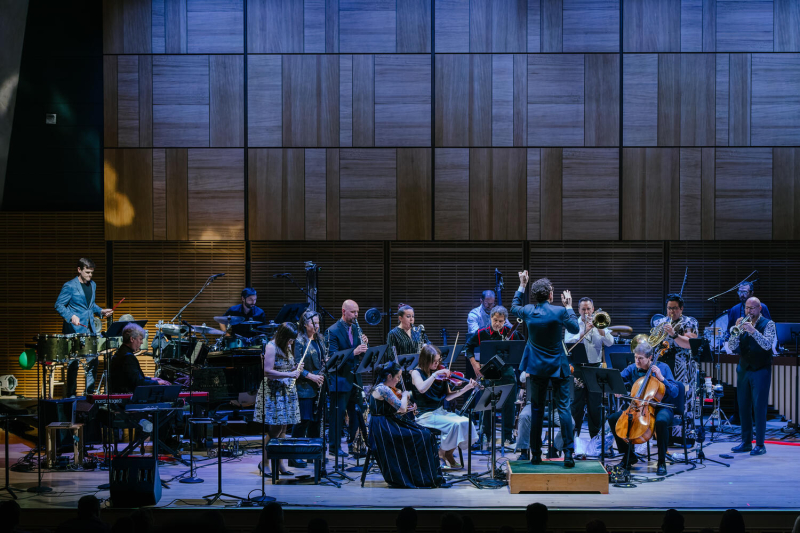
Above: concert photo by Fadi Kheir
~ Author: Shoshana Klein
Tuesday March 26th, 2024 – Though this concert started with slight technical difficulties, after about 3 minutes, the whole rest of the show went on without a hitch. The pieces were played with minimal breaks and the show could have gone on with no applause, except that everyone was so excited about the pieces that there was a lot of excitement in between.
There were audio introductions from each composer, and sometimes they even overlapped with the beginnings of the pieces. This created a really good flow that made the concert seem a little more connected and seamless than a normal program. This was actually my first official Alarm Will Sound concert despite being a fan of them for years. I’ve seen them in other contexts but not a fully programmed concert – it was a real treat!
The concert started with a piece by Tania León, who curated the concert in her capacity as the Richard and Barbara Debs Composer’s Chair of Carnegie Hall. Her piece was cool, groovy and fun, scored for small ensemble.
The second piece, by Chris P. Thompson, had some basis in drum corps, as explained by his introduction. It was really cool to hear about marching band in the context of “classical music”. I think it often gets ignored as an art form or a rigorous type of music when it’s actually pretty difficult in a way that was contextualized really well by the introduction to this piece, which was also really fun. The piece had a lot of rhythmic complexity and was really upbeat. One effect that was used was these tubes that are swung around by various musicians to create a pitch (and the pitch changes based on how quickly you swing the tube). I’ve been seeing this used in new music spaces more often recently and in this particular instance it did evoke the marching band – the coordination and visual aspects, or maybe more specifically the color guard spinning flags around on the field.
The next piece was by Christian Quiñones (who I worked with a couple of years ago but we’d never met in person!) His piece was really cool and also had lighting effects attached to the electronic sounds, which was an interesting though slightly jarring experience. The sounds were a little glitchy but rhythmic in a way that sounded really cool. The piece was based on the sound of hearing loss – sounds becoming obscured and distorted throughout.
The last piece on the first half, in my opinion, was definitely the show stealer. It was an excerpt of an opera by Damon Davis and he called it in his introduction a “black rap space opera”. I had moments of feeling like some of the music was familiar to the point where I wondered if I’d heard it before – but I think it was just that type of music, kind of magical in its familiarity as well as its novelty. It was well orchestrated, interesting in the way it used members of the ensemble as characters or kind of as set pieces. The songs were beautiful but also definitely post-genre, almost more similar to musical theater than anything. The music and the story were optimistic in a mythological way, almost like Disney or Miyazaki. Everybody seemed to want to hear the whole thing. This was a fragment of a larger work that will hopefully be performed soon!
The second half started with a piece by Elijah Daniel Smith which had a different tone – more subdued and introspective than the first half. It had a lot of really interesting sound worlds accompanying a narration that was interesting and impactful.
Next was a piece by Texu Kim that was rhythmic and upbeat and ended a frenzy of rhythm that was perhaps intentionally impossible to keep completely together, which was a nicely unconventional end to the piece.
Next was a five movement piece by Bora Yoon that was eclectic. There were moments of poetry, moments that felt conversational, and really interesting sound worlds including a prepared piano and an instrument she seemed to have made out of bicycle bells. The last movement particularly struck me – it was really really beautiful around an ocean theme. I wish I had more to say about this piece – it was delightful and brought us through many emotional spaces in a short time.


Mara Zampieri and Jose Carreras (above) in a scene from Act I of TOSCA, from a 1981 concert; Anton Guadagno conducts.
Listen here.
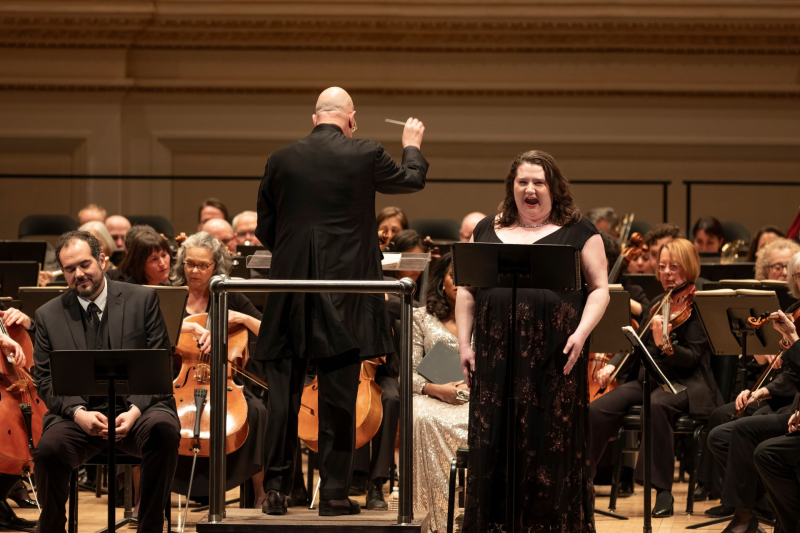
Above: tenor Dominic Armstrong (seated), conductor Leon Botstein, and soprano Felicia Moore onstage at Carnegie Hall; photo by Matt Dine
~ Author: Ben Weaver
Friday March 22nd, 2024 – Arnold Schoenberg’s gargantuan Gurre-Lieder, composed in 1900-03 (revised 1910-11), is unlike anything else in his catalog. With this lush and highly melodic work – for soloists, chorus and orchestra – he reached the ceiling of Romanticism and the only way out was to shatter it to smithereens. For Schoenberg, a mix of musical philosophy and observing the ravages of WWI signaled that music could not continue on the path laid out by his predecessors (Bach, Haydn, Mozart, Beethoven, Brahms, Wagner, etc. etc.) Schoenberg may have overreacted quite a bit, but, at a least with Gurre-Lieder, he left us with a grand finale of sorts to the excesses of 19th century music.
Gurre-Lieder’s libretto is adapted from Jens Peter Jacobsen’s dramatic poem Gurresange, written in 1868. It tells the story of King Waldemar and his love for the beautiful Tove, who is murdered by Waldemar’s jealous wife. Enraged, Waldemar curses God and is condemned to roam every night on wild hunts with his ghostly vassals. Waldemar is redeemed with arrival of Spring, and he and Tove are reunited as they become one with nature. Performances of this work are extremely rare, no doubt because Schoenberg calls for more than 150 musicians, an extravagance few organizations can afford, and none can afford frequently.
Part I opens with what Gabriel Adorno called “fairy land” music, a shimmering tapestry of harps, celesta, flutes, piccolo and some strings. Waldemar and Tove exchange declarations of love in extended monologues, set to ravishing Wagnerian and Straussian sounds.
Tenor Dominic Armstrong (above) took on the – let’s face it – impossible role of Waldemar. Schoenberg wrote the part for at least three different voices; not many singers have been able to possess them all. This is a Tristan/Parsifal/Tannhäuser part, with Tamino thrown in for good measure. I honestly don’t know who can really sing all this in a live performance. Dominic Armstrong is a lyrical tenor with a strong top, but sadly the voice disappears in the lower registers. And conductor Leon Botstein was not very kind, allowing the orchestra to cover Mr. Armstrong all evening. Armstrong’s strongest moments were in the lighter passages; his best singing came late in Part 3, in his final aria “Mit Toves Stimme flüstert der Wald”, when Schoenberg’s orchestration relaxed, allowing Waldemar to finally emerge.
Soprano Felicia Moore (above) possesses a large, blooming voice, that managed to break through the orchestral cacophony, in spite of an insensitive conductor. Her Tove was exotic and warm.

Mezzo-soprano Krysty Swann (above, in a Matt Dine photo), as the Wood-Dove who describes the terrifying details of Tove’s murder, was exciting in her long monologue. The voice is large and steely, the vibrato a bit loose at the top, but Ms. Swann possessed an excellent sense of drama, managing to build to thrilling and hair-raising final moments of the Wood-Dove’s narrative.
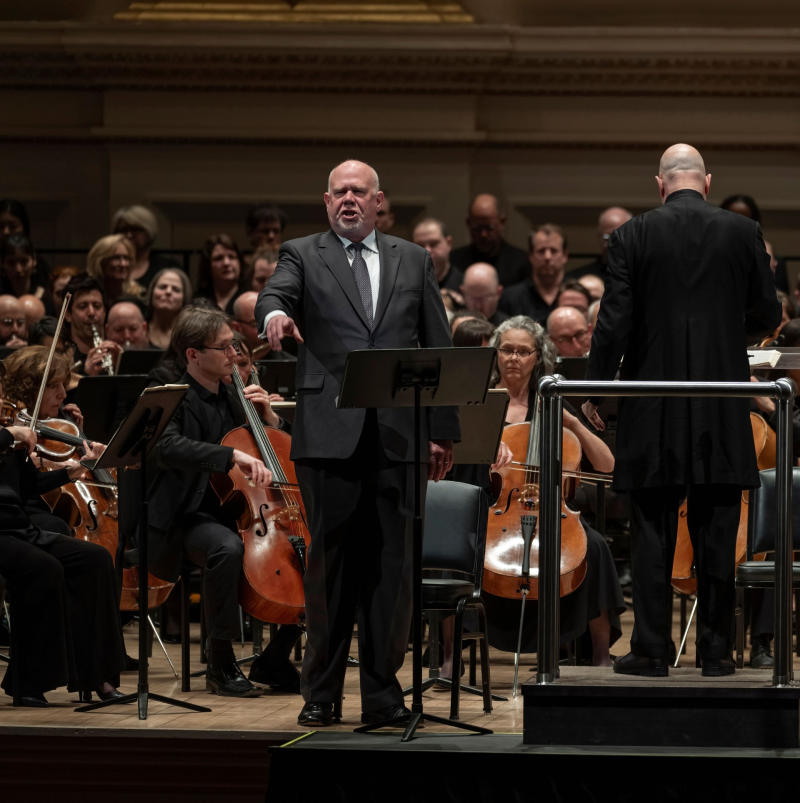
Bass-baritone Alan Held (above, photo by Matt Dine) has been a favorite of mine for many years. Though it seemed like James Levine always kept Mr. Held back at the Metropolitan Opera, where he should have been singing Wotan among many other roles, I still vividly recall a searing Wozzeck Mr. Held sang at the Met in 2011. It was wonderful to hear him once again, his large voice easily filling Carnegie Hall as the Peasant who is terrified by Waldemar and his men’s nightly processions.

Tenor Brenton Ryan (photo above by Matt Dine) was a very memorable Klaus the Jester, starting his long monologue from the house floor, then jumping on to the stage. Mr. Ryan possesses a strong, characterful tenor that made me think he might have been a better choice to sing Waldemar.
And German bass-baritone Carsten Wittmoser was a magnificent Narrator, his crystal clear diction perfect for the sprechstimme part, which is usually given to older singers nearing retirement or even non-singer actors (Karl Maria Brandauer and Barbara Sukowa, for example.) So it was nice to hear a singer still in his prime take on this role.
The American Symphony Orchestra was founded by Leopold Stokowski – who conducted the US Premiere of Gurre-Lieder in 1932, so it has a direct connection to this work, and they played quite beautifully, and certainly loudly. Here I must fault Leon Botstein for not being more considerate of his singers. Even the Bard Festival Chorale found itself drowned out by the orchestra, occasionally becoming just a mass of garbled sounds coming from somewhere at the back of the stage.
Still, any live performance – flaws aside – of this supremely difficult work is was a special treat to be able to experience. How long before another performance is organized in New York City?
~ Ben Weaver
Performance photos by Matt Dine, courtesy of Carnegie Hall

~ Author: Oberon
Thursday February 22nd, 2024 – American composer Amy Williams (photo above by John Mazlish) was the guest at this evening’s Composer Portrait, a popular ‘interview and performance’ series offered by the Miller Theatre at Columbia University. Read the composer’s bio here.
Tonight the illustrious JACK Quartet were with us to perform Tangled Madrigal (the world premiere of a Miller Theatre commission) and other works by the composer, who, as an accomplished pianist, joined them for a trio and a quintet.
The evening opened with Cineshape 2 for piano and string quartet, composed in 2007. This was a compelling introduction to the composer’s music. It starts off with a sizzling motif from John Pickford Richards’ viola; as the music turns somber, the viola is joined by Jay Campbell’s distinctive cello, with the composer providing pizzicati from the piano. Suddenly there’s an explosive crash, followed by a passage for skittering piano and chirping violins. Another crash, and then the music turns dreamy, becomes agitated, and stutters before a third crash. The strings descend, the music pulsing, then shivering, before it fades magically away.
For Bells and Whistles (2022) the composer was joined by violinist Christopher Otto and Mr. Campbell. The gentlemen tap their strings whilst Ms. Williams reaches into the piano to pluck the strings. It’s quite hypnotic! The music grows louder and becomes turbulent, the piano part is very active, with swirls of notes running up and down the keyboard. A trudging motif arises, churning and relentless. An eerie postlude ensues, develops a dense quality, and then turns other-worldly.
One of Ms. Williams’ most highly regarded works, Richter Textures (2011), was inspired by the paintings of Gerhard Richter. Listed as being in seven movements, my companion and I both detected five: some of the subtle transitions seem to have eluded us.
From an agitato start, the music turns high and spacey, with brilliant interjectory phrases from Jay Campbell’s cello. As the cello goes low and ominous, the unison violins and viola take up a slow, descending theme, which the cello eventually joins. Then things ascend to the heights.
Slashing bows evoke a painter’s aggressive brush strokes; these are quietened, and the cello sings low, whist the violins linger on high. Insectuous, insistent buzzings give way to ethereal, kozmic high harmonies. The music becomes driven – and rather jazzy – before a sudden stop.
Following the customary interview of the composer, the world premiere of Tangled Madrigal was magnificently played by the JACK Quartet. Early Music influences colour this music, which is so beautifully written…and written with these specific players in mind. From a high, squeaky start, the composer takes us on a time-warp journey back to the Renaissance. Mr. Richards’ viola is gorgeously prominent, Mr. Otto’s violin shines, Jay’s cello has a song to sing, and violinist Austin Wullmans floats in the high register. There is a cadenza from the viola, but it’s the cello that has the last word. I think I could have derived even more pleasure from this piece had not the two girls sitting in front of kept whispering and checking their phones.
The program was a fine introduction to the composer’s work, though a certain sameness prevailed as the evening progressed. It would have been interesting to hear Ms. Williams in a solo piano work, since her playing is truly captivating. So…the Miller will have to have her back at some point. Meanwhile, having the JACK Quartet for the whole evening was its own reward.
~ Oberon

Above: Judith Forst
I attended this exciting concert performance of Donizetti’s ANNA BOLENA in 1975 at Avery Fisher Hall. Dame Joan Sutherland, Judith Forst, Cynthia Clarey, Jerry Hadley, and Greg Yurisich sang the principal roles, and Richard Bonynge was on the podium.
Watch and listen here.

The final scene of Verdi’s DON CARLO, performed in concert at the Musikvereinsaal in Vienna in 1988. The soloists are soprano Mara Zampieri, tenor Giacomo Aragall, and bass Kurt Rydl. Mr. Rydl sings the lines of Philip II, the Grand Inquisitor, and the Ghost of Charles V. Very sporting of him!
Watch and listen here.
~ Author: Oberon
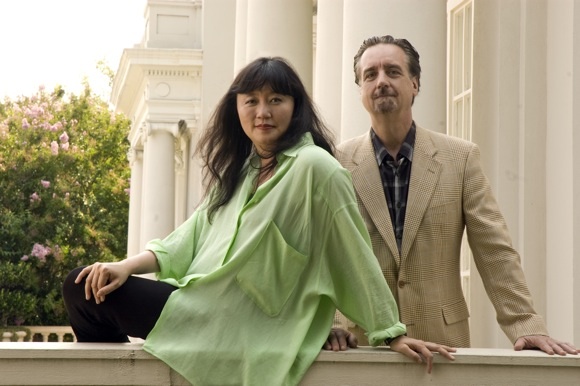
Sunday January 28th, 2024 – Pianist Wu Han and her husband, cellist David Finckel (photo above), are the co-Artistic Directors of Chamber Music Society of Lincoln Center. This evening at Alice Tully Hall, they shared the stage to present a well-devised program of works by Debussy, Bruce Adolphe, Shostakovich, and Dvořák.
Claude Debussy’s Sonata for Cello and Piano, composed in 1915, was initially subtitled “Pierrot is angry at the moon“. It is a charming piece in three brief movements. The opening Prologue calls for very subtle piano playing, which Wu Han is always so good at. Skittering music is heard, followed by an awakening of tenderness. The music then goes deep. Plucking cello and staccato notes from the piano decorate the Serenade, which has a jazzy feel. For the Final, swirls of notes from the keyboard and appealing melodic fragments carry the players to a fast finish.
In 1998, Bruce Adolphe wrote Couple for Cello and Piano for Wu Han and David Finckel. The four movements suggest different aspects of an evolving relationship: the first begins dreamily, then accelerates before fading away. A warm, nostalgic feeling arises in the second movement, with the cello digging in. The slow third movement has a sentimental air, and the final section is animated and light-hearted. The composer joined the artists for a bow at the end.
Dmitri Shostakovich’s Sonata in D-minor for Cello and Piano, Op. 40 dates from 1934. A beautiful feeling of restlessness runs thru the opening Allegro moderato; the piano glitters on high, and a lovely cello theme is heard. Plucked notes and staccati spring up, and then the music slows. The following Allegro is a kind of scherzo: a swirling dance with music that slips and slides into an insistent rhythm. The songful Largo commences with a wistful cello theme that sinks to the depths; the piano sounds a steady heartbeat. The music turns dreamy, with the piano evoking feelings of peace. The cello carries us into the minor mode, seeking a quiet ending. At last we reach the final Allegro: a big, folksy dance, full of animation. There is a grand piano ‘cadenza’ which develops a sense of irony. The sprightly cello joins, and all seems well with the world. Wu Han and David Finckel basked in a sustained standing ovation, called back for a second bow as the packed hall resounded with shouts of approval.
In 1889, Antonín Dvořák wrote his Quartet in E-flat major for Piano, Violin, Viola, and Cello, Op. 87. For this finale to the evening’s program, pianist and cellist were joined by Richard Lin (violin) and Timothy Ridout (viola). These two young gentlemen looked very dapper, and they played superbly.
The opening Allegro con fuoco has an urgent start. The piano takes over, leading to an anxious passage before a joyous melody arrives. We hear colorful playing from the violin and viola as they exchange phrases or harmonize, The Finckel cello adds depth to the textures. Mr Lin’s violin sings on high, and Wu Han offers luminous piano phrases. A buzzy tremelo exchange between violin and viola is a delightful touch. Brilliant playing from all!
With a simply gorgeous cello motif, David Finckel opens the Lento, and there is magical duetting here from Mssrs. Lin and Ridout. The music turns passionate…and then charming. Achingly beautiful harmonies tug at our souls; Mr. Finckel then resumes his poignant melody, amiably supported by pizzicati from the violin and viola. There is a marvelous sheen to the sound as a progression of modulations leads us onward and Wu Han’s hypnotic playing casts a heavenly spell.
Now comes the waltz-like opening of the Allegro moderato, grazioso with its gypsy tinge. This movement contains and endless supply of marvels, including sizzling tremelos and rhythmic tapping of the strings. Melodious, dancing phrases carry us onward.
The gypsy spirit prevails into the final Allegro ma non troppo: a veritable celebration of Czech folk dance. Mssrs. Lin and Ridout were simply incredible here, for their beauty of tone and of expression. Together with Wu Han and David Finckel, they made this Dvořák masterpiece an exuberant statement about the power of music to inspire and reassure us in dark times. Tonight, these four artists gave us one of the outstanding musical experiences of recent seasons, reaffirming yet again the invaluable role Chamber Music Society of Lincoln Center plays in the life of the City.
~ Oberon

The magnificent Polish contralto Ewa Podleś (above) passed away on January 19, 2024, at the age of 71. Hers was one of the most remarkable voices I ever heard, but ironically I only saw her live one time: she sang Mahler’s Kindertotenlieder with the American Symphony Orchestra under Leon Botstein’s baton at a concert given at Alice Tully Hall in 1999.
That evening, the Mahler cycle was the last thing on the program. Ms. Podleś walked onstage, a short and rather plump woman. She took a stance on the stage and, as, the music commenced, she tipped her head back slightly and began to pour the music forth as if from the depths of her soul. The richness of the voice, with its cavernous lower register, was like nothing else I had ever heard. For one magical half-hour, she had the audience completely under her spell. A the end, she took a couple of bows, nodding to us slightly.
Back in those days, Alice Tully Hall still had its cozy greenroom, and I went there to greet Maestro Botstein and the evening’s two soloists: soprano Edith Wiens, and Ms. Podleś. Of course, I was too shy to say anything, so Ms. Podleś signed my program, and nodded to me with a slight smile. I will always recall that evening as one of the most profound musical experiences of my life.

You can read all about the Podleś career here, and listen to her unique voice in Wagner…
The Norns~GOTTERDAMMERUNG – Eva Podles – Stephanie Blythe – Margaret Jane Wray – Seattle 2006
…and Rossini:
Ewa Podles – scena d’Arsace – SEMIRAMIDE
And her monumental rendering of “Cara sposa” from Handel’s RINALDO can be savored here.
Spoczywaj w pokoju, beloved Ewa.

 Oberon's Glade
