Category: Opera

  • Christmas Eve 2023 @ Carnegie Hall

    Laredo hristova Milena Pajaro-van de Stadt

    Above: Jaime Laredo, Bella Hristova, and Milena Pajaro-van de Stadt 

    ~ Author: Oberon

    Sunday December 24th, 2023 – The New York String Orchestra’s Christmas Eve concert at Carnegie Hall this year was an all-Mozart program which featured soloists Bella Hristova (violin) and violist Milena Pajaro–van de Stadt (viola) with Jaime Laredo on the podium. I invited my long-time friend Rob Scott to join me; Rob was one of the very first people I met on moving to NYC twenty-five years ago. Later, he became Lisette Oropesa’s first manager, helping her to launch her brilliant career.

    I learned the overture to The Marriage of Figaro long before I heard the complete opera: we played a transcription of it in my high-school band (we also played the prelude to Lohengrin Act III!). Tonight, the young players of the New York String Orchestra gave a lively and immaculately-played rendering of the Figaro, immediately setting the mood of the evening.  There were many young children among the audience tonight, and this brisk music seemed to draw them in.

    A wonderful sense of attentive silence was sustained in the hall throughout the playing of the Sinfonia concertante in E-flat Major, K. 364, which I was – incredibly enough – hearing “live” for the first time. Dating from 1779, this is simply a great piece of music. The two soloists chose striking gowns that brought a glamorous touch to the evening: Ms Hristova in an elegant, one-shoulder forest green frock, and Ms. Pajaro–van de Stadt in shimmering gold and silver.

    In the Sinfonia‘s opening Allegro maestoso, duetting motifs for two horns are picked up by two oboes, with the orchestra’s basses sound velvety. Now the soloists join, their timbres ideally matched as they exchange phrases; displaying their fluent techniques; the two seem to converse whilst gracious horn harmonies are heard. In Mozart’s day, cadenzas were usually improvised by the performers, but in the Sinfonia Concertante’s first and second movements, the composer specifically wrote out the cadenzas. And what magical cadenzas they are, played tonight with great finesse and charm.

    The ensuing Andante takes on a feeling of mournful lyricism, with Ms. Hristova’s beautifully sustained tone singing a lament that is then taken up by the duskier colours of Ms. Pajaro–van de Stadt’s viola. A sense of exquisite sadness slowly gives way to tender harmonies  A rich tutti passage leads to the cadenza of the entwining solo voices, underscored by sustained horn tones. Bella’s enchanting trills take us to a sublimely poignant finish.

    Maestro Laredo let the hushed atmosphere linger by keeping his arms poised before delving into the concluding Presto wherein the horns and oboes are again welcome, with the basses sounding so appealing to my ear. In a spirit of friendly competition, Mlles. Hristova and Pajaro–van de Stadt regaled us with their virtuosity, clearly savoring every phrase that Mozart offered them. A roar of applause rang out as the final note hung on the air, and our gracious soloists embraced one another. For this precious half-hour, the woes of the world had been forgotten.

    The familiar Symphony No. 35, “Haffner“, made for a perfect end to the evening; despite the fact that some of the children in the crowd became a bit restive, the power of Mozart’s spirit prevailed. The young musicians handled all of the music’s demands with assurance, and I especially loved hearing the timpani lending an air of nobility to the concluding Presto

    ~ Oberon

  • Eduardo Villa Has Passed Away

    Villa

    Tenor Eduardo Villa, a native of Santa Barbara, California, has passed away at the age of 70. Originally interested in musicals, he appeared in productions of Oliver!, West Side Story, and Paint Your Wagon before deciding to develop his voice further by studying at the University of Southern California, where his teachers included such luminaries as Martial Singher and Margaret Harshaw.

    Upon winning the Metropolitan Opera Auditions in 1982, alongside Hei-Kyung Hong, Sylvia McNair, and Nancy Gustafson, Villa departed for Switzerland, where sang with Basel Opera Theater between 1983 and 1987. In 1986, he made his debut at the Paris Opéra as Verdi’s Don Carlo, and from 1987 to 1991 he appeared at the Munich State Opera.

    When Villa began getting offers in the USA and Canada, he left Munich. Among his many contracts were appearances with Connecticut Opera at The Bushnell in Hartford, where I first heard his warm, passionate singing in BALLO IN MASCHERA, and later as an ardent suitor to Mary Dunleavy’s captivating Lucia di Lammermoor.

    In 1992, Eduardo sang Jacopo in a concert performance of Verdi’s I DUE FOSCARI given by Eve Queler’s Opera Orchestra of New York. It was a very exciting evening, with soprano Martile Rowland and baritone Vladimir Chernov sharing enthusiastic ovations with the tenor.

    Mr. Villa joined the Metropolitan Opera in 2002, debuting as Don Carlo and going on to make two dozen Met appearances (thru 2008) as Pinkerton, Don Jose, Calaf, Turiddu, Rodolfo in LUISA  MILLER, Cavaradossi, Enzo Grimaldi, and Ernani.

    I saw him at The Met as Radames in 2002 opposite Michelle Crider, and he was really impressive: a Met-sized voice with a nice Italianate ring to the tone. In my diary, I praised his vocal generosity, his ability to cut thru ensembles, and his sustained “Sacerdote! Io resto a te!!” at the end of the Nile Scene. 

    There is not a lot of Eduardo Villa’s singing on YouTube but there is an OTELLO duet with baritone Mark Rucker that gives a you a good idea of what kind of singer Mr. Villa was…watch and listen here.

    ~ Oberon

  • Golden Gate Gala ~ 1997

    Fvs

    Frederica von Stade (above) and a host of other stars gathered to celebrate the 75th anniversary of San Francisco Opera with a televised gala in 1997.

    Watch and listen to highlights from the concert here.

  • 60 Years Ago @ The Old Met

    Old met

    November 27th, 2023 – Sixty years ago this evening, I attended my first Metropolitan Opera performance: DON GIOVANNI, at the Old Met. I was in my fourth year of hardcore opera fandom, tuning in for every Met broadcast on Saturday afternoons, and building my record collection.

    I’d been to some opera performances at the Cincinnati Zoo, at Syracuse, and even in Oswego, NY, just a few miles from home. But The Met was my goal, and on this late Autumn evening, just a few days after the assassination of John F. Kennedy, I finally found myself in the now rather dilapidated Hall that Milton Cross had described so many times over the airwaves; it was like a dream come true.

    Read about my unforgettable experience here.

  • Biancamaria Casoni ~ Dalila in Italian

    Casoni copy

    Biancamaria Casoni sings Dalila’s seduction aria from SAMSON & DALILA in Italian. Ms. Casoni was my first-ever Cherubino in NOZZE DI FIGARO when the Rome Opera came to the (then) New Met in 1968.

    I love the subtleties in Ms. Casoni’s interpretation; she makes Dalila’s aria intimately persuasive. Her phrasing and the softness of her timbre are alluring, and her long line and vocal control are impressive…especially as it’s a live performance.

    Listen here

  • Victoria de los Angeles sings Chausson

    De los angeles

    The beloved Spanish soprano Victoria de los Angeles (above) sings Ernest Chausson’s Poème de l’amour et de la mer with the Orchestre de l”Association des Concerts Lamoureux, conducted by Jean-Pierre Jacquillat. The recording dates from 1969.

    Listen here.

  • Tormis/Britten/Prokofiev @ The NY Phil

    ALENA-BAEVA-c-Andrej-Grilc

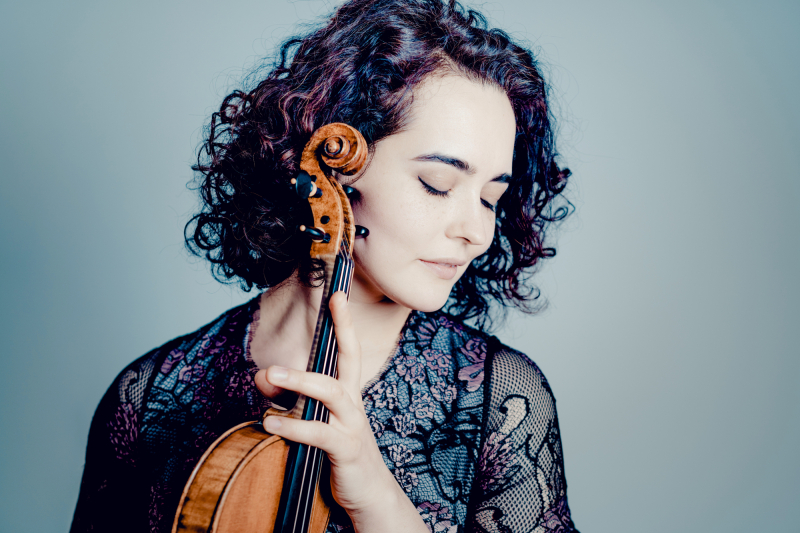
    Above: violinist Alena Baeva, photo by Andrej Grilc

    Author: Ben Weaver

    Friday November 17th, 2023 – Maestro Paavo Järvi returned to the New York Philharmonic’s David Geffen Hall for concerts featuring less familiar works by two of 20th Century’s greatest composers: Benjamin Britten and Sergei Prokofiev.

    Benjamin Britten’s Violin Concerto, Op. 15 – the only work he composed in that genre – was written in 1938-39, soon after Britten heard the world premiere performance of Alban Berg’s Violin Concerto in 1936. Indeed, the soloist who premiered Berg’s work, Antonio Brosa, would premiere Britten’s Concerto in 1940 conducted by Sir John Barbirolli, and do so with the New York Philharmonic in NYC. (In another bit of trivia, Britten composed some of the concerto while staying with Aaron Copland.) Britten revised the composition as late as 1965 (when he heard that Jascha Heifetz was considering performing it, though Heifetz would supposedly go on to declare the work “unplayable”), and it was this final edition that violinist Alena Baeva performed in these concerts. (It’s playable after all.)

    Opening with a series of timpani strokes can only evoke Beethoven’s Violin Concerto from more than a century earlier. The violin enters with a lament in the instrument’s highest registers – something Britten does often in the concerto. The second half of the first movement is taken over by a sort of a march, a persistent distant thumping, which reminded me of the villagers hunting Peter Grimes in Britten’s opera, composed a few years later.

    Ms. Baeva, in her New York Philharmonic debut, makes a rather small and tinny sound that struggled to make an impression in the concerto’s dramatic moments. To Maestro Järvi’s credit, he kept the orchestra under control, so as not to cover the soloist altogether. But in the more intimate parts, Ms. Baeva was a deeply moving narrator, which makes me want to hear her in a chamber music setting. In the extended cadenza that concludes the second movement, Ms. Baeva was mesmerizing and dazzling. The final movement is a series of variations in the form of a passacaglia, and it concludes with a lament (movement is marked Andante lento), and here Ms. Baeva’s lyrical side was wonderfully moving.

    Sergei Prokofiev’s Symphony No. 6 in E-flat minor, Op. 111 lives – unfairly – in the shadow of his more famous Fifth. Composed in 1945-47, and premiered later that year by Evgeny Mravinsky and the Leningrad Philharmonic, it is a magnificent work that never drags despite its roughly 45-minute run time.

    The Sixth’s fortunes changed over the years. Despite an acclaimed premiere in 1947, it was soon condemned by all the usual Stalinist suspects and disappeared from Soviet concert halls until the 1960s. (It was more popular in the West; Leopold Stokowski first conducted it with the NY Philharmonic in 1949). One of the complaints against the work was that it was not cheerful enough to inspire the Soviet people. Which is perhaps fair enough, but Prokofiev was not trying to cheer anyone up with this particular symphony. It opens darkly in the low strings before moving on to more lyrical themes. The second movement is the most emotional part of the symphony, woodwinds shrieking in agony. And the third movement is the most cheerful of the three, but not cheerful enough to appease Stalin.

    The Sixth sounds to me like the most mature of Prokofiev’s work. It never disintegrates into circus music, which – no matter how ironically – can on occasion be tiresome. Paavo Järvi certainly has this music in his bones and the NY Philharmonic delivered a stupendous performance. I ended up taking almost no notes as the music played because I was so hypnotized by what we heard. This is the sort of music the New York Philharmonic plays as well as anyone, and better than most. 

    Also included on the program was an unknown to most of us Overture No. 2 by the Estonian composer Veljo Tormis. Composed in 1958-59 it is a thrilling, expertly crafted work. Its highly dramatic, driven, almost cinematic opening (it would fit many movie chases beautifully), gives way to a lovely, if brief, cello solo (Patric Jee as the principal cellist in this performance). The middle section of the overture is reduced to a wonderful chamber-scale (just three violins at one point) before the breathless opening section returns. The work ends with three chords, long pauses between each one. Frequently, an audience will applaud prematurely, and certainly with an unfamiliar composition such as this, the risks were high. And yet – the silence held, Paavo Järvi controlling not just the orchestra, but, however briefly, the audience as well.

    Which brings me to a brief point about audience behavior and etiquette; we all know that both have degraded seriously over the years. At this performance, sitting just an empty seat away myself and my companion, a young woman played Candy Crush on her phone the entire evening. She was there with two friends, who seemed more interested in the music than she was…but they did not ask her to stop. I am reminded how, some years ago, the actor and playwright Wallace Shawn got in trouble at a Carnegie Hall concert for yelling at another audience member for behaving badly. Perhaps we should have been celebrating Mr. Shawn instead.

    ~ Ben Weaver

  • The Tucker Gala @ Carnegie Hall 2023

    08-TUCKER_GALA_2023-7573

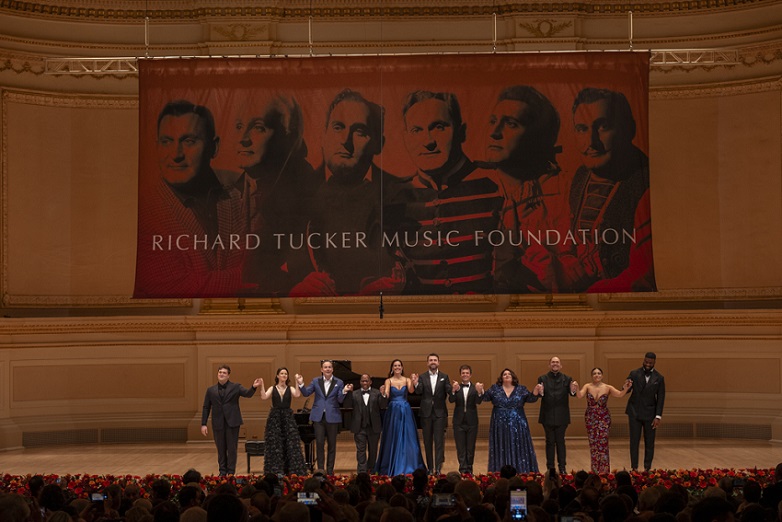
    Above, the artists take a bow at the end of the 2023 Tucker Gala: Sean Michael Plumb, Liv Redpath, Stephen Costello, Howard Watkins, Federica Lombardi, Ben Bliss, Bryan Wagorn, Angela Meade, Quinn Kelsey, Ailyn Pérez, and Soloman Howard. Photo by Dario Acosta.

    Author: Oberon

    Sunday October 29th, 2023 – The annual Richard Tucker Foundation gala took place this evening at Carnegie Hall. Barry Tucker, son of the illustrious tenor, greeted us and explained that financial considerations had compelled the Foundation to present this year’s concert without an orchestra. But soon after the program began, concerns about the lack of an orchestra were assuaged by the excellence of the two pianists who took turns at the Steinway: Bryan Wagorn and Howard Watkins. Bravo, bravo, bravo gentlemen!

    Of the announced roster of artists, Angel Blue, Matthew Polenzani, and Christian van Horn had withdrawn, and basso Soloman Howard joined the line-up on short notice.
    08-TUCKER_GALA_2023-2314

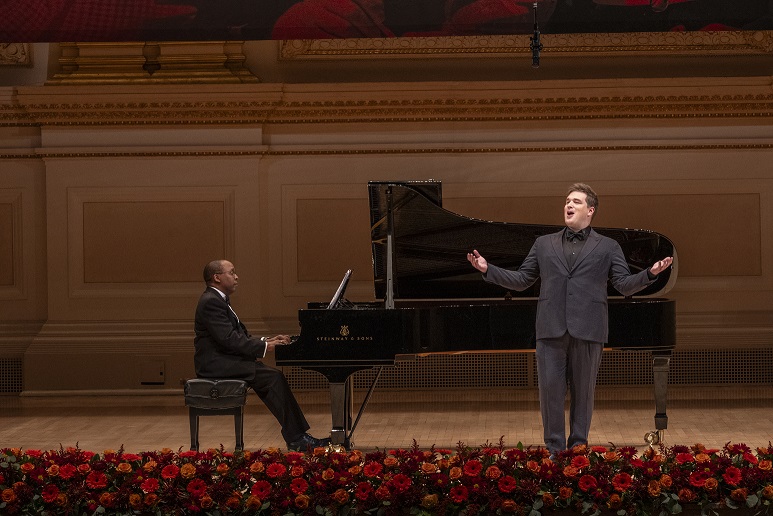
    The program opened with Sean Michael Plumb, a 2022 Tucker Career Grant recipient, giving an excellent rendering of Figaro’s  “Largo al factotum“, with Howard Watkins at the keyboard providing brilliant support. Mr. Plumb’s voice, wide-ranging and handsome of timbre, sounded great in the great Hall. 

    31-TUCKER_GALA_2023-2423

    Bryan Wagorn played beautifully the Catalani aria “Ebben, ne andro lontana” from LA WALLY, sung by  Angela Meade. The pervasive flutter of the Meade voice has never been to my liking, but this aria suited her far better than some of the roles she has sung at The Met. She sang passionately, summoning some chesty resonances; the singing was mostly unrelentingly loud, missing the nuances that can make the aria so personal. She was very much an audience favorite, both here and – later – in a duet from TROVATORE.  

    65-TUCKER_GALA_2023-2518

    Soloman Howard, a tall and charismatic basso, offered Fiesco’s great aria “Il lacerato spirito” from Verdi’s SIMON BOCCANEGRA. His singing was powerful: an emotion-ladened outpouring of a father’s despair which becomes poignantly reflective at “Il serto a lei de’ martiri pietoso il cielo diè…”; so engaged was Mr. Howard in the character that one could almost hear the chanting of the mourners from the chapel, even though no chorus was present. The moving final descent at “Prega, Maria, per me…” was heart-breaking in its expressiveness. And Mr. Wagorn at the piano captured the music’s atmosphere to perfection.  

    97-TUCKER_GALA_2023-2640

    New to me, soprano Liv Redpath looked fetching in a ruffled black frock. Rather than the announced Act I aria from LUCIA DI LAMMERMOOR, Ms. Redpath intrigued us with a sterling performance of Ophélie’s mad scene from Ambroise Thomas’s HAMLET. Assured of technique, with a lovely array of pastels in her colour palette – as well as a silvery, limpid quality to her coloratura – the comely soprano had the Carnegie crowd fully engaged. Mr. Watkins at the piano created the scene’s atmosphere from note one.
    119-TUCKER_GALA_2023-2773

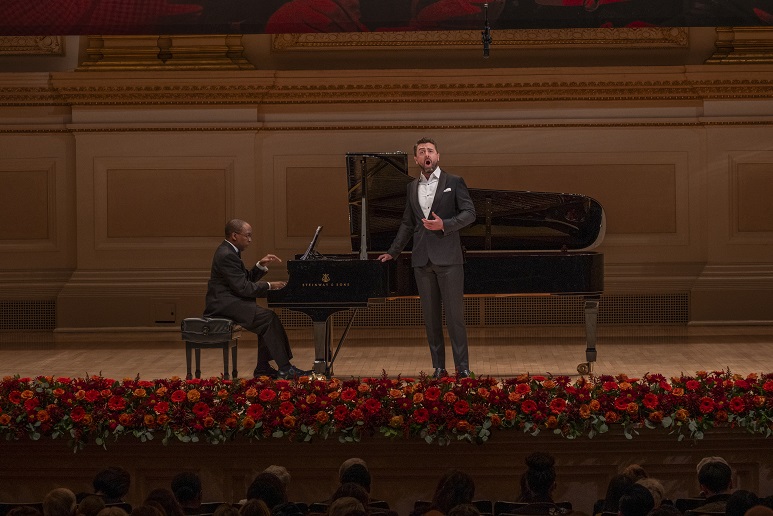
    Bringing his lovely timbre and engaging style to the Duke of Mantua’s aria “Parmi veder le lagrime” was the tall, slender tenor Ben Bliss. A Mozart specialist, Ben always manages to combine passion and elegance in his singing. Mr. Watkins was again perfect, setting a properly impatient pace for the cabaletta, “Possente amor mi chiama” (‘A powerful love calls me!’).
    135-TUCKER_GALA_2023-2856

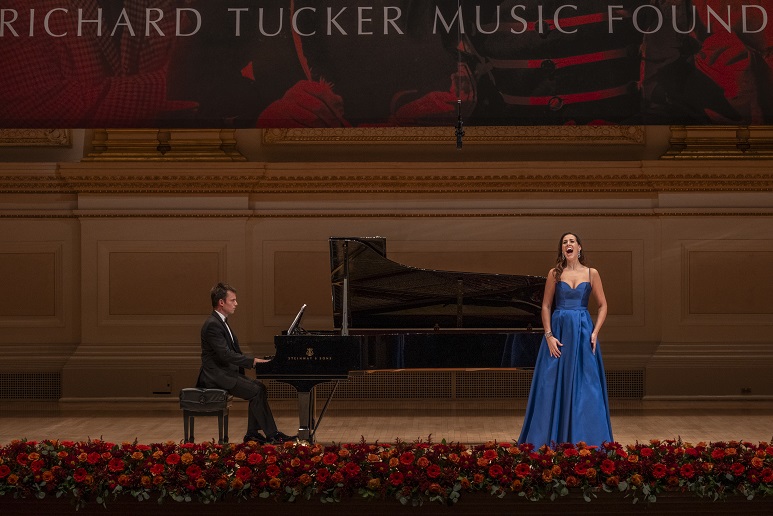
    The tall and striking Italian soprano Federica Lombardi, who has won a lot of hearts at The Met with her superb singing of Mozart’s Contessa Almaviva, Elettra, and Donna Anna, tonight offered a spellbinding performance of Anna Bolena’s mad scene from the Donizetti opera. Clad in an elegant blue gown, the soprano looked queenly indeed, and her long arms and expressive hands seemed to shape the music to touching effect. Following a ravishing “Al dolce guidami“, she sang a single verse of the cabalettaCoppia iniqua!” which was taken a bit too fast and which really needs both verses (and the chorus’s interjections) to be really meaningful. Nevertheless, the overall effect of Ms. Lombardi’s performance was fascinating.

    169-TUCKER_GALA_2023-3114

    The next two selections were thrilling: Quinn Kelsey’s sustained, gorgeously phrased singing of Macbeth’s “Pieta, rispetta, amore” is everything you want from a Verdi baritone. The voice is huge, warm, and awash with a sense of the human spirit: singing that simply reduced me to tears.

    185-TUCKER_GALA_2023-3255

    Stephen Costello followed Mr. Kelsey with a magnificent rendering of the haunting aria “Deserto in terra” from Donizetti’s DON SEBASTIANO. In this aria, Don Sebastiano, king of Portugal, stands alone on a battlefield strewn with corpses and longs for the consolation of his beloved. Mr. Costello’s depth of feeling, his passion, and his poignantly styled phrasing went straight to my heart, and his top notes were amazingly clear and sustained. Luciano Pavarotti and John Osborn have given us glorious voicings of this aria, and Mr. Costello’s can stand proudly alongside them.
    217-TUCKER_GALA_2023-3502

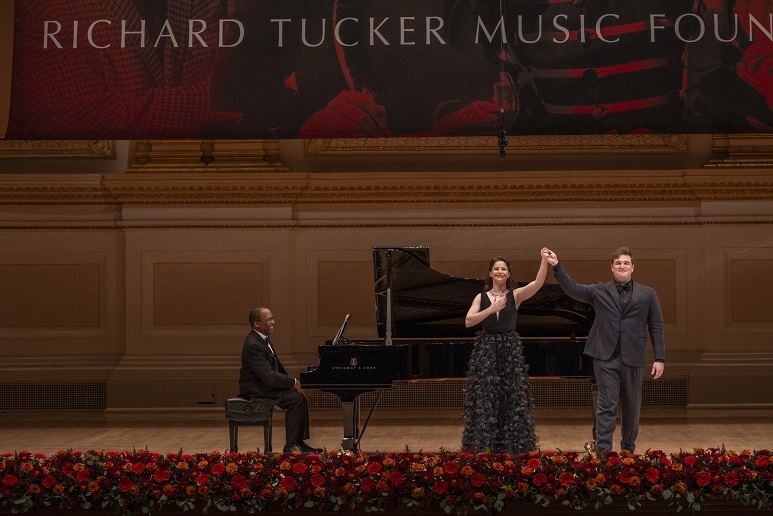
    More Donizetti, on a cheerier note, brought us Ms. Redpath and Mr. Plumb in the charming duet of Norina and Dr. Malatesta from DON PASQUALE. They sang it beautifully, not over-doing the comic effects.

    03-TUCKER_GALA_2023-3660

    Ailyn Pérez sang Butterly’s “Un bel di” most attractively, though for me it is an aria that doesn’t work very well in concert, being too narrative. Ms. Pérez produced some silky piano moments, exploring the character’s vulnerability beneath her steadfast belief in her husband’s return. The soprano’s gown was something else.
    247-TUCKER_GALA_2023-3797

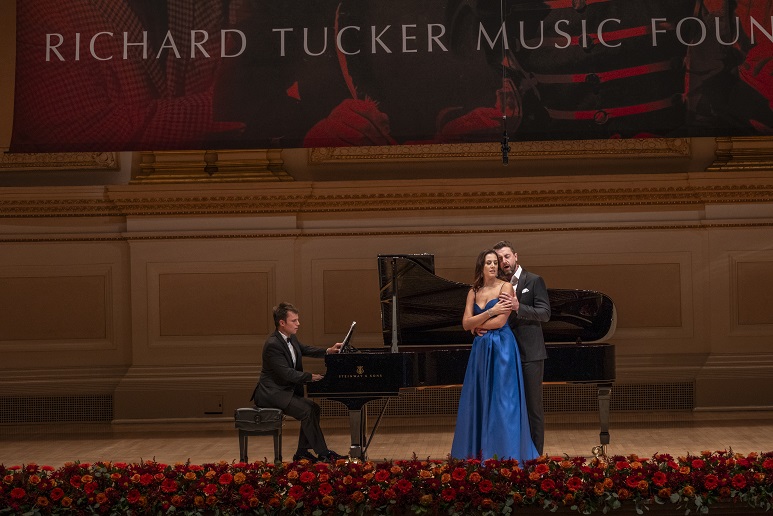
    Ms. Lombardi and Mr. Bliss made a very attractive couple – both physically and vocally – in the duet “Parigi o cara” from TRAVIATA. They are well matched in height, and they established an instant rapport, their timbres blending to perfection, their ardent phrasing so savourable. Bravi!  Could we have them together in the Met’s next TRAVIATA revival?

    279-TUCKER_GALA_2023-4051

    Ms. Meade and Mr. Kelsey gave a full-tilt performance of the Leonora/Di Luna duet from TROVATORE

    299-TUCKER_GALA_2023-4164

    …and then Mr. Costello (stepping in for the absent Matthew Polenzani) and Sean Michael Plumb sang the affecting, brotherly duet “Au fond du temple saint” from LES PECHEURS DES PERLES with its heartfelt harmonies. The two brought poetic ardor to their singing, their timbres entwining persuasively. They embraced at the end. 

    There were encores: Ms. Lombardi in a zarzuela aria which was a bit too long, though finely sung, and Mr. Bliss in a song that was too small-scaled for the big space. Ms. Pérez gave a sensual touch to Manuel Ponce’s “Estrillita“, with some ravishing pianissimi. Mr. Kelsey and Mr. Costello added further laurels to their vocal triumphs earlier in the evening, the baritone with a mind-bogglingly perfect “If ever I would leave you” from CAMELOT, and Mr. Costello pouring out his heart and soul in a thrilling “Corengrato“.

    All photos by Dario Acosta, courtesy of the Richard Tucker Foundation. 

    ~ Oberon
  • Coming Out ~ 50 Years Ago Today

    Troyens jpg

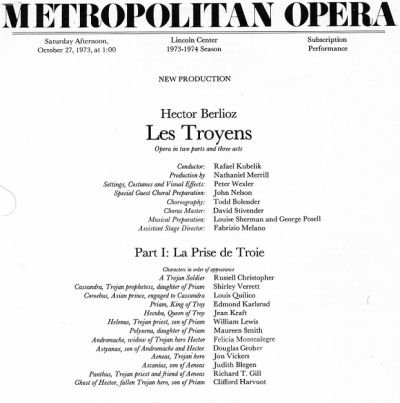
    On October 27th, 1973, after spending a very long time in the closet, I had my first gay sexual experience. It was both thrilling and a bit frightening, but what I remember most was a great feeling of relief…and then wondering why it had taken me so long to do it.

    That day, I had spent the long afternoon with several of my opera-friends at The Met watching LES TROYENS  It was my first time seeing this monumental work, and it was unbearably exciting. Among the group was Z, the boy I had set my sights on since moving back home from Houston earlier in the year.

    Looking back, it all seemed pre-arranged, but at the time it felt spontaneous. After the Berlioz matinee, our friends all went their separate ways. But Z and I had 5th Ring tickets for an evening performance of FAUST at the New York City Opera. He sat in front of me in the single seats, whilst I was aching with desire; at this point, nothing had been said about spending the night together. 

    After Marguerite had succumbed to Faust’s poetic charms in the Garden Scene, we mutually decided it was time to leave. Z looked at his watch and announced that he’d missed the “last bus” home. Haltingly I said, “You can stay with me at the hotel.”

    We walked over to the Henry Hudson; nothing much was being said. We stayed up for a while, talking opera, and then it was time. He sat on the twin bed, undressing. “Should I sleep in the chair?” he asked. “I’ve slept in smaller beds with bigger people…” I replied. (This was a lie; I had only ever slept with my girlfriend, and always in big beds).

    So, keeping our briefs on, we got under the covers and turned out the lights. For what felt like an eternity, nothing happened. I began to think that maybe I had mis-read the situation and that we were simply going to sleep together. He had his back to me; the warmth and smell of his body were killing me. Suddenly, I put my arms around him, and several wonderful things happened. 

    After a while, we grew drowsy. “I’ve never done this before,” I said sleepily. “Me neither!” he replied. Keeping him in my arms, we drifted off.

    Waking to daylight, I got quickly out of bed and got dressed: I was meeting friends for breakfast. Z was groggy; he dressed slowly. I assumed he would head home, but – without saying anything – he tagged along to the diner.

    Our friends were obviously intrigued when we showed up together, but nothing was said. Only the quiet, bookish TJ looked at me knowingly. The conversation turned to the inevitable topic – opera – and my magical “morning after” became just another day.

    The aftermath: in the ensuing weeks, whenever I was in New York City, Z was friendly on the surface, but evasive on a personal level. He stood me up for a couple of lunch dates. I was naive enough to think that, because we had shared a sweet experience, we would become lovers. I became distraught.

    Unhappy to the core, I confided in TJ. He listened to my story patiently, then told me that Z already had a boyfriend and that he was unlikely to become the lover I was looking for. TJ and I spent more and more time together, and I became very comfortable with him as my confidante. Finally, I invited him to visit me in the little town. Our first night was awkward: I was such a novice, but he – who was four years younger than me – was already pretty experienced, starting with having been raped by his college roommate. 

    Over time, TJ and I developed a deep relationship; he invited me to spend the summer of 1974 with him on Cape Cod, working for a small-time ballet company. At summer’s end, I drove him to Sarah Lawrence where his senior year was about to begin.

    Our unspoken plan was to resume our lives – he at school and me back in the little town – and see each other whenever I came to the City. As we sat in the car saying goodbye, he suddenly started crying; it was then that I realized how strong our attachment was. Instead of leaving, I spent the night in the dorm with him. I left the next morning, but a few days later I received a letter from him, asking me to come and live with him in the dorm.

    This was the beginning of my life, really. When TJ had finished school, we moved to Hartford, where I spent the next 22 years. After a year, our domestic life faltered when I became smitten with someone else. TJ and I had a bad break-up, and he never spoke to me again. I embarked on a long and promiscuous journey, having a strange tendency to fall in love with everyone I slept with. 

    Meanwhile, my ultimate goal – to be living in New York City before my 50th birthday – loomed before me. At times, I thought it would never happen; but by a simple twist of fate, I moved to My City three months before the date I had set for myself.

    ~ Oberon

  • Susan Dunn as Desdemona

    Susan Dunn Soprano

    American soprano Susan Dunn (above) made her Opera Australia debut in 1988 as Desdemona in Verdi’s OTELLO. Here she is heard in the Willow Song and Ave Maria from Act IV. Mezzo-soprano Heather Begg sings Emilia, and the conductor is Carlo Felice Cillario.

    Listen here.