Category: Opera

  • Bach’s Matthäus-Passion @ The NY Philharmonic

    Bach

    Author: Ben Weaver

    Saturday March 25th, 2023 – J.S. Bach’s Matthäus-Passion, composed around 1724-27 (and revised through 1742), is arguably Bach’s greatest composition. Personally, I’d place it in the top ten greatest works of Western music. The NY Philharmonic performs it infrequently; the last time was in 2008 under the baton of Kurt Masur. Running at roughly 2:45 hours, the Matthäus-Passion is a work filled with passion and drama…more drama than most church music. Anyone mocking Verdi’s Requiem as being more opera than mass perhaps should take a closer look Bach’s greatest work. Verdi was following in Bach’s mighty footsteps. I was very glad to see it on the program this year, finally! I quite literally got chills as the work started and the chorus (Musica Sacra) sang the opening words: “Kommt, ihr Töchter, helft mir klagen.” Alas, the thrills did not last; I was sadly disappointed with tonight’s performance.

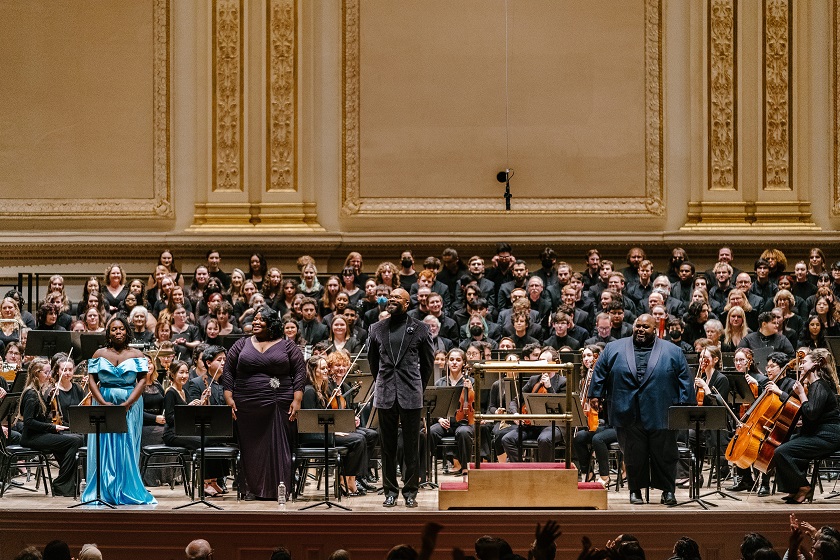
    Tenor Nicholas Phan sang the very difficult part of the Evangelist, who narrates the story of Jesus’ arrest, the debate over what his fate should be, his execution, and its immediate aftermath (the Passion ends before the resurrection.) Much of the drama of the work flows through the Evangelist’s words. Mr. Phan managed the difficult music very admirably, but the part can be a trap dramatically: there are many proclamations like “And Jesus said unto him.” How does one make each one sound fresh? I don’t have a clear answer. I suppose if it was easy, anyone would be able to do it. 

    Bass-baritone Davóne Tines’ Jesus (Mr. Tines was the only person on stage wearing a costume: a white, sleeveless robe) possesses a large voice; but it’s a voice with a guttural quality, which seldom opens or blooms.

    Mezzo-soprano Tamara Mumford, a favorite at the Metropolitan Opera across the Plaza, sang nicely. “Buß und Reu” in Part I was vocally steady and clear. But in Part II, Maestro Jaap van Zweden robbed Ms. Mumford and concertmaster Frank Huang of an opportunity to give their all in “Erbarme dich”, perhaps  the Passion’s most famous aria; certainly its most emotional and devastating piece. Written for solo voice, solo violin, and orchestra, this breathtaking music has the ability to stop time. Alas, Maestro van Zweden took it at a preposterous Allegro tempo; he absolutely wrecked it by turning it into a cabaletta. If your tempo is faster than John Eliot Gardiner’s, Nikolaus Harnoncourt’s, Trevor Pinnock’s, and Gustav Leonhard’s – you may consider looking at the score again.

    Amanda forsythe

    Soprano Amanda Forsythe (above), making her Philharmonic subscription concert debut with these performances, was sublime. Her ability to float pianissimi high notes was indeed spine-tingling. The aria “Aus Liebe will mein Heiland sterben,” which also includes a flute solo by Robert Langevin, was the highlight of the evening. 

    The Philharmonic’s Principal Associate Concertmaster, Sheryl Staples, had a chance to shine in “Gebt mir meinen Jesum wieder,” with a difficult solo. Unfortunately, bass Philippe Sly, making his Philharmonic debut with these performances, had pitch difficulties which offset Ms. Staples fine playing. Tenor Paul Appleby was superb all evening, the high tessitura of the aria “Geduld” presenting no difficulties for him.

    The Choral group Musica Sacra was in excellent form all evening, from the Chorales to dramatic exchanges representing specific characters. The Brooklyn Youth Chorus sang the opening and closing choruses of Part I, but did not return for Part II. Can’t say if that was intentional or if something kept them from returning.

    I do hope the Matthäus-Passion returns to the Philharmonic again soon – under a more caring conductor.

    ~ Ben Weaver

  • Bach’s Matthäus-Passion @ The NY Philharmonic

    Bach

    Author: Ben Weaver

    Saturday March 25th, 2023 – J.S. Bach’s Matthäus-Passion, composed around 1724-27 (and revised through 1742), is arguably Bach’s greatest composition. Personally, I’d place it in the top ten greatest works of Western music. The NY Philharmonic performs it infrequently; the last time was in 2008 under the baton of Kurt Masur. Running at roughly 2:45 hours, the Matthäus-Passion is a work filled with passion and drama…more drama than most church music. Anyone mocking Verdi’s Requiem as being more opera than mass perhaps should take a closer look Bach’s greatest work. Verdi was following in Bach’s mighty footsteps. I was very glad to see it on the program this year, finally! I quite literally got chills as the work started and the chorus (Musica Sacra) sang the opening words: “Kommt, ihr Töchter, helft mir klagen.” Alas, the thrills did not last; I was sadly disappointed with tonight’s performance.

    Tenor Nicholas Phan sang the very difficult part of the Evangelist, who narrates the story of Jesus’ arrest, the debate over what his fate should be, his execution, and its immediate aftermath (the Passion ends before the resurrection.) Much of the drama of the work flows through the Evangelist’s words. Mr. Phan managed the difficult music very admirably, but the part can be a trap dramatically: there are many proclamations like “And Jesus said unto him.” How does one make each one sound fresh? I don’t have a clear answer. I suppose if it was easy, anyone would be able to do it. 

    Bass-baritone Davóne Tines’ Jesus (Mr. Tines was the only person on stage wearing a costume: a white, sleeveless robe) possesses a large voice; but it’s a voice with a guttural quality, which seldom opens or blooms.

    Mezzo-soprano Tamara Mumford, a favorite at the Metropolitan Opera across the Plaza, sang nicely. “Buß und Reu” in Part I was vocally steady and clear. But in Part II, Maestro Jaap van Zweden robbed Ms. Mumford and concertmaster Frank Huang of an opportunity to give their all in “Erbarme dich”, perhaps  the Passion’s most famous aria; certainly its most emotional and devastating piece. Written for solo voice, solo violin, and orchestra, this breathtaking music has the ability to stop time. Alas, Maestro van Zweden took it at a preposterous Allegro tempo; he absolutely wrecked it by turning it into a cabaletta. If your tempo is faster than John Eliot Gardiner’s, Nikolaus Harnoncourt’s, Trevor Pinnock’s, and Gustav Leonhard’s – you may consider looking at the score again.

    Amanda forsythe

    Soprano Amanda Forsythe (above), making her Philharmonic subscription concert debut with these performances, was sublime. Her ability to float pianissimi high notes was indeed spine-tingling. The aria “Aus Liebe will mein Heiland sterben,” which also includes a flute solo by Robert Langevin, was the highlight of the evening. 

    The Philharmonic’s Principal Associate Concertmaster, Sheryl Staples, had a chance to shine in “Gebt mir meinen Jesum wieder,” with a difficult solo. Unfortunately, bass Philippe Sly, making his Philharmonic debut with these performances, had pitch difficulties which offset Ms. Staples fine playing. Tenor Paul Appleby was superb all evening, the high tessitura of the aria “Geduld” presenting no difficulties for him.

    The Choral group Musica Sacra was in excellent form all evening, from the Chorales to dramatic exchanges representing specific characters. The Brooklyn Youth Chorus sang the opening and closing choruses of Part I, but did not return for Part II. Can’t say if that was intentional or if something kept them from returning.

    I do hope the Matthäus-Passion returns to the Philharmonic again soon – under a more caring conductor.

    ~ Ben Weaver

  • Helena Dix in Bellini’s NORMA @ The Met

    Dix norma

    Above: Helena Dix, costumed as Norma, in her Met dressing room; I borrowed this image from the soprano’s Facebook page

    Author: Oberon

    Saturday March 25th, 2023 matinee – The three great peaks of the bel canto repertoire are – for me – Donizetti’s LUCIA DI LAMMERMOOR, Rossini’s SEMIRAMIDE, and Bellini’s NORMA. This afternoon I was at The Met to see the season’s final performance of the Bellini. The casting of Sonya Yoncheva in the title-role turned out to be pretty controversial, and the soprano took to social media to complain that people were comparing her Norma to recordings and remembered performances from decades ago.

    I guess she is unaware that this has always been a favorite pastime of serious opera-lovers…something that I learned early on in my opera-going career. Examples: during the enormous ovation after the Mad Scene of Beverly Sllls’ first New York Lucia, Maria Grimaldi waltzed up behind me and growled in my ear: “Not as good as Lily Pons!”. And while I was yelling “brava” at the Met for Birgit Nilsson’s 1971 Isolde triumph, the fellow next to me, who was applauding feebly, said: “I guess you are too young to have heard Flagstad!” 

    Anyway, the problem became moot when Ms. Yoncheva (who was wonderful as Giordano’s Fedora earlier this season) took ill and withdrew from the final three NORMAs, one by one. Angela Meade was called in for the first Yoncheva cancellation, and the cover – Helena Dix – stepped in for the second. Everyone was waiting to see if Yoncheva would come back with a vengeance for today’s final NORMA, which was being broadcast.

    In truth, I was hoping for a cast change, and that Ms. Dix would be singing today. I’d started following the plucky Aussie soprano on Facebook a few weeks ago when I began to see her postings about what it’s like to cover a major role at The Met. She had covered Norma here in 2017, and had also covered Alice Ford in FALSTAFF in 2019, going on at one performance for her Met debut.

    This year, as it happened, she ended up singing quite a few of the NORMA rehearsals. But Ms. Yoncheva sang the prima, and the next two performances. When she became ill, Peter Gelb applied his frequent tactic: he located a “star” to step in rather than relying on the cover. Thus, Ms. Meade returned to a production in which she has previously appeared.

    This morning, as I was getting ready to leave for the noontime matinee, an e-mail from a soprano/friend of mine popped up: “Helena Dix is singing Norma today!” This elevated my mood considerably.

    The house was nearly full as Maurizio Benini took his place on the podium. Benini has frustrated me in the past with his eccentric tempi in operas like LUCIA DI LAMMERMOOR, MARIA STUARDA, and MANON. As the afternoon progressed, he upheld his reputation as a routinier. 

    Christian van Horn as Oroveso was simply superb in the opera’s opening scene, and he remained so throughout the afternoon: a potent vocal force and an imposing stage figure. His “Ah, del Tebro” later in the evening was gorgeously sung, and his shock at Norma’s revelation of her motherhood was a lightning bolt. Together with Ms. Dix and Mr. Spyres, Mr. van Horn made the opera’s poignantly dramatic finale, “Deh! Non volerli vittime…” heart-rendingly moving.

    Meanwhile, back in Act I, as the Druids withdraw from the forest clearing, the Romans appear: Michael Spyres as Pollione and Yongzhao Yu as Flavio. The latter showed a fine voice and was an alert actor, whilst Mr. Spyres – a marvelous Met Idomeneo earlier this season – was sounding more baritonal today. The Spyres voice has great immediacy and, despite a hoarse high-C in “Meco all’ altar di Venere” his singing and dramatic engagement (all afternoon, really) was a potent experience. The tenor was having a rousing go at the cabaletta “Me protegge, me difende“, reaching the final phrase with a penultimate A-flat which he then elevated to the more customary B-flat, at which moment Benini decided to amp up the orchestra, ruining the effect.

    When Ekaterina Gubanova was announced as Adalgisa, I admit I had misgivings; her Act II Brangaene at Geffen Hall at 2019 showed some unease in the music’s upper reaches, and Adalgisa is quite demanding in that regard. But Ms. Gubanova seemed today to have solved (for the most part) that problem. She was wonderfully expressive in her opening monologue, and she matched Mr. Spyres in passion and tonal appeal in their long duet where Adalgisa finally succumbs to Pollione’s pleadings.

    The opera’s sixth character, Norma’s confidante Clothilde, was the excellent Brittany Olivia Logan, who we need to hear in larger roles.

    Ms. Dix appeared onstage as the chorus hailed the coming of their high priestess. The soprano carefully mounted the pointless platform from which she must sing opera’s most demanding entrance aria, the immortal “Casta diva”. The Dix voice is not large, but it’s well-projected. Her opening address was authoritatively declaimed, ending with a shimmering softness at “Il sacro vischio io mieto…

    Benini set a slow pace for the “Casta diva…” which Ms. Dix sang as a spellbound invocation. As her soft tones flowed thru the vocal line, a hush fell over the house; in the second verse, a tiny embellishment on the phrase “Che regnar tu fai nel ciel” sent a frisson thru me…a delightful feeling that would be experienced several times as the opera progressed. For this is Ms. Dix’s signature vocal attribute: these delicate pianissimi that are woven into phrases at just the right moment, putting an individual stamp on the music. I came to anticipate them, and she never let me down.

    But we were jarred out of reverie when Benini set up a tempo for the cabaletta, “Ah! bello a me ritorna” that only a Sills or a Bartoli could have coped with. Ms. Dix went at it gamely, but to little avail.

    Things settled in after that, and the soprano’s confidence increased – though through no help from the conductor. Mlles. Dix and Gubanova formed a sisterly duetting society, and Mr. Spyres’ bristling anger at finding that his secret love had unwittingly betrayed him stirred up a fiery finish to the first act, polished off with a Dix top-D. 

    Ms. Dix’s contemplating the murder of her children was effectively done, and then Ms. Gubanova appeared and the two women got to the heart of the matter with a finely-matched “Mira O Norma” filled with lovely, expressive singing from both. Benini then luckily set a perfect tempo for “Sì, fino all’ore estreme” wherein the singers indulged in a bit of rubato, harmonized the scale passages to fine effect, and Adalgisa took her leave in a fit of optimism, unaware that they will never see each other again.

    The final scene of NORMA is a masterpiece all on its own: Norma’s hopes are dashed, but when she has Pollione in her power, she cannot kill him. Ms. Dix and Mr. Spyres excelled in a super-charged “In mia man alfin tu sei” but despite his defiance, she still cannot bring herself to slit his throat. About to reveal Adalgisa’s crime of breaking her sacred vows, Norma is overcome with guilt and names herself instead. Ms. Dix spins out more delicate suspended tones at “Io son la rea!“, and, later, at “O padre!” as she prepares to beg her father to spare her children. The tragedy moves towards its end with the devastating “Deh! Non volerli vittime” and a last haunting piano plea from Ms. Dix: “Ah! Padre, abbi di lor pietà!“.  Norma and Pollione go to their deaths, scorned and spat upon by the Druids.

    I went to the stage door to greet Mr. van Horn, and to meet Ms. Dix, who is a delightful person. A sizeable crowd had gathered; people, intrigued by her “cover” story, wanted to meet her. She gave me a special autograph before joining the young boys who had portrayed her sons, Axel and Magnus Newville, to pose for photos.

    Norma - helena  jpg

    You can get an idea of what makes Helena Dix an intriguing singer in this brief clip from the Verdi REQUIEM.

    ~ Oberon

  • ASO Presents Strauss’s DAPHNE

    Daphne

    Thursday March 23rd, 2023 – The American Symphony Orchestra performing Richard Strauss’s rarely-heard DAPHNE in concert form at Carnegie Hall, with Maestro Leon Botstein on the podium. The Bard Festival Chorale, under the direction of James Bagwell, had a big part to play in the proceedings.

    The one-act opera, written in 1936-1937, comes late in Strauss’s composing career, when ELEKTRA, SALOME, ROSENKAVALIER, DIE FRAU OHNE SCHATTEN and ARIADNE AUF NAXOS were already established in the world’s opera houses. 

    The story of DAPHNE in a nutshell: Shepherds anticipate the feast of Dionysus, with Daphne’s parents, Peneios and Gaea, presiding over the preparations. Daphne, in love with nature, shuns the ways of men. Her childhood playmate, the shepherd Leukippos, tries to embrace her lovingly, but she repels him and renounces the coming festivities. She refuses to don the clothing her mother has lovingly prepared for her, and runs away. Playfully, the women persuade Leukippos to wear the clothes instead. Apollo arrives, in a peasant’s disguise, and is immediately drawn to Daphne, who rebuffs him. The feast begins, and the disguised Leukippos offers Daphne a cup of wine, arousing the jealousy of Apollo. The heavens respond to the god’s anger with rumbles of thunder, which cause the sheep to run away; the shepherds chase after the flock, leaving Apollo, Daphne, and Leukippos alone. Leukippos reveals his true identity, and challenges Apollo to reveal his. Instead, Apollo shoots Leukippos dead with his bow. Apollo begs Daphne’s forgiveness, saying he will grant her wish to join the natural world and will then love her in the form of a laurel tree. Her transformation begins, and her disembodied voice is heard among the rustling leaves.

    About tonight: The evening got off to a rather stodgy start as a large phalanx of choristers slowly filled the stage space to sing An den Baum Daphne, an a cappella choral epilogue to the opera which Strauss composed in 1943. This seemed like a nice idea on paper, but the music overall is not terribly interesting,  consisting of numerous repeats of a five-note theme familiar to me from DIE FRAU OHNE SCHATTEN. It seemed to go on and on, and while there were many appealing individual voices among the chorus, they did not always blend well. There were some pitch issues along the way, and a feeling that the piece was a bit under-rehearsed.

    Then came an intermission, which completely killed the Straussian atmosphere that had been established, with people chatting blithely and wandering up and down the aisles. At last the opera itself commenced, but it took time for the crowd to re-settle.

    DAPHNE is a gorgeous opera: a veritable feast of melody…there is never a dull moment musically. The vocal writing is extremely demanding; a very fine cast had been assembled, but their work was often undermined by over-loud playing from the orchestra. At the climaxes, voices were being forced in order to stay afloat, This has been happening at The Met a lot this season too, where conductors seem to think loud = exciting. Yes, there is a superficial thrill to it, but in the end it doesn’t do anyone any good.

    That being the case, the singers could only be admired for holding steadfast and getting thru these taxing moments…especially when an orchestra is onstage behind you rather than in the pit.

    The opera got off to an excellent start with baritone Kenneth Overton’s handsome singing as the 1st Shepherd. The voice is fresh and warm, and he cuts a fine figure to boot. Later in the opera, a trio of choristers come forward to portray his fellow shepherds: Jack Cottrell, Paul Holmes, and Blake Austin Brooks.

    In the title-role, so ravishingly sung on the esteemed EMI recording by the great Mozartean Lucia Popp, Jana McIntyre displayed a clear, soaring lyrical sound that deftly encompassed the role’s wide range. It is a girlish timbre, perfect for expressing youthful vulnerability and impetuosity, but Ms. McIntyre also summoned considerable power when needed. In one especially lovely passage, her voice entwined with an obbligato from the ASO’s concertmaster, Cyrus Beroukhim. There were a few spots when the orchestra pressured the soprano, but she held her own and emerged unfazed. Daphne is a “big sing” and without a persuasive interpreter, the opera is not worth reviving. Ms. McIntyre not only sang beautifully, but she looked fetching in her pale lime-green frock, and she used her expressive hands with the grace of a ballerina to shape the music and send it out to us.

    As two maids, Marlen Nahhas and Ashley Dixon were much more than supporting players: both have luscious voices, sounding very much at home in the Carnegie Hall space. In solo phrases, they were each truly appealing to hear, and then they duetted to charming effect. Their scene was not mere filler, but a musical treat all on its own. 

    Strauss hated tenors: that is what people say when listening to an otherwise fine tenor struggle with the demands of Bacchus or the Emperor in FRAU OHNE SCHATTEN,  Tonight, both the leading tenors – rivals in the story – fared well, despite the assaults of the orchestra at certain inconvenient moments. Kyle Van Schoonhoven as Apollo (sometimes deemed Strauss’s cruelest tenor role) had the scope of the role, and the testing top notes were successfully attained. A more thoughtful conductor could have made the singer’s job easier but Mr. Van Schoonhoven was always impressive. And, in the more lyrical stretches, he displayed a very appealing timbre…and a sense of poetry. 

    As Daphne’s admiring swain, Leukippos, Aaron Blake made a striking impression. Slender of frame, and intense of presence, the tenor’s lyrical sound contains a vein of metal (aligned to crisp diction) that he can call upon to cut thru when needed. By turns playful and cocky, the character was portrayed to perfection, and the tenor unleashed a laser-beam  sustained note as fate closed in on him.

    Magnificent singing came from contralto Ronnita Miller (Gaea) and basso Stefan Egerstrom (Peneios), as Daphne’s parents. Ms. Miller, whose 1st Norn at The Met simply dazzled me a few seasons back, sings like a goddess with earthy chest tones of unusual richness. Stunning in her every note and word, the contralto looked like a fashion icon gowned all in black, and she shed her blessèd maternal light over the proceedings, even when sitting silently while others sang. Stefan Egerstrom, where have have you been al my life? What a powerful, resonant voice this man commands. He delivered his music with great authority: each note was rounded and true, and everything compellingly phrased. And yet, for all the strength of their voices, even Ms. Miller and Mr. Egerstrom were not immune to the effects of the encroaching orchestra.

    Daphne Matthew Dine 1

    Above, onstage at Carnegie Hall (from left): Stefan Egerstrom, Ronnita Miller, Aaron Blake, Kyle Van Schoonhoven, Jana McIntyre, Leon Botstein (back to camera), and Ashley Dixon. Photo by Matthew Dine.

    ~ Oberon

  • Claire Watson as Elisabeth de Valois ~ DON CARLO

    Claire watson

    The wonderful American soprano sings Elisabeth’s great aria from Act IV of Verdi’s DON CARLO from a German-language performance given at Hamburg in 1968.

    Claire Watson as Elisabeth de Valois – DON CARLO – in German – Hamburg 1968

  • A New LOHENGRIN @ The Met

    Screenshot 2023-02-24 at 12-49-51 Videos

    Above: Piotr Beczala and Tamara Wilson in LOHENGRIN at The Met

    Author: Oberon

    Sunday February 26th, 2023 matinee – The premiere of a new production of Wagner’s LOHENGRIN at The Met; this marks the fourth production of this magnificent opera that I have experienced at The Met. My first encounter with the opera was in Wieland Wagner’s production in 1967 – a performance that featured the Met debut of the marvelous soprano Elisabeth Grümmer. In 1976, August Everding’s production – with designs by the great Ming Cho Lee – was first given; I saw it several times, with incredible singers like Rene Kollo, Placido Domingo, Pilar Lorengar, Mignon Dunn, Anna Tomowa-Sintow, Eva Marton, and Leonie Rysanek in the leading roles.

    In 1998, Ben Heppner and Deborah Voigt headlined the cast of Robert Wilson’s fascinating, stylized production; Karita Mattila and Rene Pape later sang Elsa and King Henry respectively in this production, and two very sharply contrasted but equally exciting tenors made their Met debuts in the title-role of the Wilson production: Johan Botha and Klaus Florian Vogt.

    This afternoon, director François Girard followed up his fascinating Met debut production of PARSIFAL with a LOHENGRIN that follows Parsifal’s son to the banks of the River Scheldt to protect the virtuous Elsa. With stunning sets by Tim Yip, this afternoon’s performance gathered together a strong cast whose hard work was sometimes nullified by Yannick Nézet-Séguin’s brassy conducting.

    In a large underground bunker in the ruins of a haunted castle near Antwerp, we find the people of Brabant huddled among the tree roots. Aside from the threat of the invading Hungarian forces, they are a community struggling with the disappearance of young Gottfried, whose sister Elsa is alleged to have killed the boy. In opposition to Elsa are Count Telramund and his sorceress-wife, Ortrud. The divided populace all wear black hooded cloaks which we soon find have colour-coded linings: green for the good guys, red for the baddies, and white for supporters of Elsa, who is either a murderess or a blameless virgin/victim. Throughout the opera, the populace open their capes to show where their loyalties lie; this unison ‘flashing’ gesture grew tiresome – even hilarious – over time.

    Joining the large Met chorus – who sang splendidly all afternoon – were a group of dance artists who performed in-sync stylized movements; among them, my beautiful friend Willy Laury brought his own personal magnetism to every gesture.

    LOHENGRIN is a big sing for the six principal artists; they need a very thoughtful and alert conductor at the helm to make the most of their magnificent music. But today, the singers were frequently jinxed by the blasts of sound coming up from the pit. In those climactic passages where the voices need cushioning support, the singers instead found themselves having to force their tone in order to stay afloat. This trend of ramping up the orchestral volume has been in frequent evidence this season where conductors like Armiliato, Rizzi, and Scapucci have sometimes seemed to have been on a joyride, using decibels to make the music more superficially “exciting”. In a Wagner opera, the balance between voices and orchestra is even more crucial; Nézet-Séguin should have learned this by now.

    Despite this imbalance, the orchestra played gorgeously, most especially in Elsa’s Procession to the Cathedral in Act II, where the featured wind soloists were especially lovely to hear. The prelude to Act III – where the orchestra has the music all to itself – was suitably grand; the director used this music for a solo pantomime for Christine Goerke’s vividly over-the-top (in a good way) Ortrud.

    Brian Mulligan’s noble, calming presence and expressive face, aligned to his warm and attractive voice, made the role of the Herald more prominent than is often the case. In this production, the character is not just an ‘announcer’ but also a confidante of the king. Mr. Mulligan was first-rate, despite having to cope with the onslaughts from the pit at times. 

    Günther Groissböck’s dignified King Henry was an excellent portrait of a leader who has come to this land with a purpose, only to find himself playing judge and jury in a local conflict. Mr. Groissböck is not a helden-basso, possessed, as he is, of a handsome lyrical timbre of ample power for this music…under normal circumstances. The brassy blasts arising from the pit did him no favors, but he held to his own, with much impressive vocalism.

    Yevgeny Nikitin as the sinister Telramund managed to out-shout the orchestra in a couple of spots, but it should not have been necessary; beyond that, he offered many creepily subtle passages. Sparks flew in his scene with Ortrud at the start of Act II, which was one of the highlights of the afternoon…in part because the orchestra playing here was thoroughly supportive. Later in the act, as the wedding procession began to move onward, Nikitin’s Telramund stepped out of the crowd and menaced Elsa to striking effect.

    Having seen several marvelous Elsas in my day – in addition to those named above, there were Sabine Hass and Arlene Saunders – this afternoon I was happy to add Tamara Wilson to the list. This soprano, whose Met debut as Aida in 2014 was superb, should be singing here far more frequently. She has a house-filling sound, grounded in lyricism, with an appealing vulnerable streak to her timbre, and high notes that can soar or float at will. Her ‘dream’ aria in Act I and her Song to the Breezes in Act II were vocal highlights of the afternoon, and in her Act II confrontation with Ortrud, Ms. Wilson and Christine Goerke made sparks fly. Ms. Goerke first backed her victim all the way across the stage, taunting the would-be bride menacingly. But Ms. Wilson summoned Elsa’s courage, and turned the tables: soon it was Goerke who was retreating as Wilson advanced. The agitated strings that provide the undercurrent for this encounter gave perfect support. Tamara Wilson went on to sing thrillingly in the bridal chamber scene, and she was given a spirited ovation at her bows. 

    Goerke ortrud

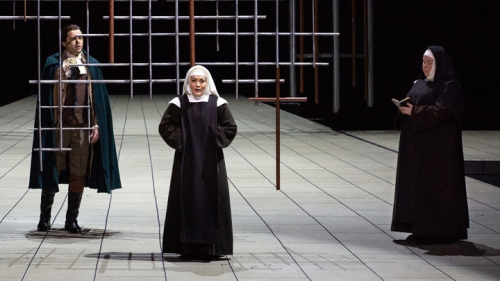
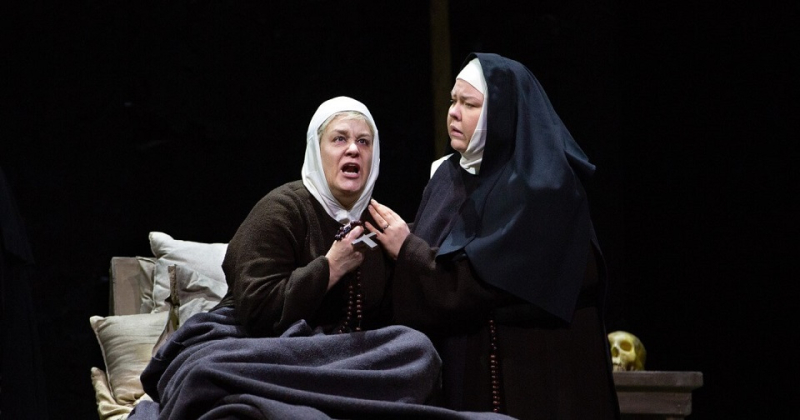
    You’ve got to love Christine Goerke’s Ortrud. Although in recent seasons her top register has become unreliable, the sheer force of her personality and the inherent power of her singing can work wonders. In the span of a few weeks, she has given us an incredibly touching Madame Lidoine in DIALOGUES DES CARMELITES and has now turned in an epic Ortrud, suitably grand-scale theatrically, and vocally firing on all cylinders, despite the random stray note.

    In this production, Ortrud appears during the prelude: a silent and imposing figure with red hair, clad all in blood-red and gold. The character has little to sing in Act I, but Goerke made Act II all about Ortrud. First comes the tremendous duet with Telramund, in which the Goerke voice simply dripped with evil intent and conniving insinuation; this is followed soon enough by her deceitful, servile plea to Elsa to grant her amnesty. Waiting for Elsa to descend from her balcony, Goerke launches Ortrud’s diabolical invocation to the pagan gods. Sung with blistering passion and commitment, Goerke made a meal out of it, sustaining the climatic passage with fierce intensity. In the ensuing duet, Ortrud eventually wins Elsa over, and they harmonize in an almost bel canto passage, leaving the orchestra to take up the gorgeous melody (my favorite part of the entire score) as they enter the castle. In the later confrontation between the two women before the wedding ceremony, mentioned above, Goerke showed off some chesty resonances.

    Ms. Goerke entered spiritedly into M. Girard’s somewhat hokey mime scene for Ortrud at the start of Act III: preening herself whilst casting spells to destroy the marriage of Elsa and Lohengrin, Goerke seemed larger than life.

    Enjoying a huge and well-deserved triumph, the Polish tenor Piotr Beczala was everything you want in a Lohengrin, and more. As if arriving out of a time warp, the character is clad in contemporary style: white shirt and black trousers. From note one, Mr. Beczala’s expressive singing seemed made for role of the mysterious visitor. Hauntingly lyrical, with refined piano turns of phrase woven in, he put me in mind of Nicolai Gedda’s only Wagnerian excursion. Every word and note seemed to mean something to the tenor, and his handsome presence made him as appealing to watch as to hear. Especially pleasing was his singing in the bridal chamber scene, blending timbres luminously with Ms. Wilson. Mr. Beczala then rose beautifully to the demands of the opera’s finale, where “In fernem land” and the poignant tenderness of “Mein lieber Schwan!” were so beautifully voiced. It was a thrill to hear (and to be part of) the massive wave of applause and cheers that greeted the tenor’s solo bow.

    As the ovation continued, there were boos for the production team; this was understandable – even inevitable – I suppose, yet overall it was an inoffensive and at times engaging take on the opera.

    Watch the final ovation and curtain calls here.

    ~ Oberon

  • Verdi REQUIEM @ La Fenice ~ 1972

    Requiem la fenice

    Many, many years ago, my fellow opera-lover Susan Gould sent me a poster from a performance of the Verdi REQUIEM given at the Teatro La Fenice in Venice in 1972. With her usual thoughtfulness, Susan very kindly took the time to have it autographed for me by the four soloists – Katia Ricciarelli, Beverly Wolff, Nicolai Gedda, and Bonaldo Giaiotti – and by Maestro Thomas Schippers. It’s one of my treasures.

    Today, completely by chance, I found the performance on YouTube. Listen to it here. 

  • Stutzmann/Weilerstein/NY Philharmonic

    Stutzmann

    Author: Ben Weaver

    Thursday February 23rd, 2023 – For many years,  Nathalie Stutzmann (photo above) has been a highly accomplished singer, with numerous operatic and lieder recordings under her belt, and many awards, too. In recent years she has begun to spend more time on the conductor’s podium. I am always skeptical of performers transitioning to conducting because these are all highly specialized crafts. There have, certainly, been many extremely successful switch-overs, but mostly coming from the instrumentalist sides (people like Vladimir Ashkenazy and Christoph Eschenbach come to mind). It’s rare for singers to make the jump, and while someone like Plácido Domingo has conducted many operas over decades, he has never become more than passable in the pit. Which brings me back to Nathalie Stutzmann, who made her New York Philharmonic debut with these concerts, conducting a varied program of Wagner, Prokofiev, and Dvořák. Based on what I heard, Maestro Stutzmann is a phenomenal musician and she would have been a far more interesting new Artistic Director for the Philharmonic than the flashy but vapid Gustavo Dudamel.

    The concert opened with a superb overture to Wagner’s Tannhäuser – an opera Stutzmann will conduct at the Bayreuth Festival this summer. The mournful strings that open the work were lovingly molded as the drama built, the Philharmonic’s wonderful string section matching Stutzmann’s passion at every step. The rock solid wall of horns, trombones, and tuba was heavenly. Appearance of Venus had a magical, light sound that – perhaps for the first time for me – sounded like a Mendelssohn fairy got lost in Wagnerland. The explosive, thrilling climax of the work brought down the house. I suspect Maestro Stutzmann’s Tannhäuser in Bayreuth will be very special indeed.

    Weilerstein jpg

    Above: Alisa Weilerstein

    One of my favorite musicians, cellist Alisa Weilerstein (in a glorious red pantsuit) played Prokofiev’s Sinfonia concertante, Op. 125. Composed for (and with the help of) a very young Mstislav Rostropovich, this is a supremely difficult piece, which posed no difficulties for Weilerstein. The playful opening – like a ticking clock – is echt Prokofiev, and the cello enters almost immediately. Weilerstein’s gorgeous, mellow, glowing tone is always a balm to the ear. Even the crazed, breathless opening of the second movement sounded like the most romantic love song. Weilerstein’s passion and commitment never wavered; even when not playing, she gently swayed to the music. Prokofiev’s kaleidoscopic music – sweepingly romantic one moment, mockingly blowzy the next – can be tricky to navigate, but Weilerstein and Stutzmann had a deep connection and made everything whole. Stutzmann’s history of singing for conductors no doubt make her deeply sensitive to her soloists. She was careful to let Weilerstein room to breathe and to never let the orchestra overpower the cello. I hope Weilerstein and Stutzmann enjoyed working together because they make wonderful, deeply sympathetic music together; may their partnership continue and grow.

    Antonin Dvořák’s Symphony No. 9 in E-minor, Op. 95 (subtitled hastily by the composer “From the New World” as he handed the score off to be copied for the world premiere performance by the NY Philharmonic in 1893) is easily one of the most standard works in the classical repertoire: a warhorse as popular as Beethoven’s  5th and Tchaikovsky’s Nutcracker. It’s easy to get jaded and cynical, and roll our eyes when another performance is on the program. These works can be played by any orchestra with their eyes closed, and the audience will dutifully applaud. But sometimes you hear a performance that makes you sit up and rethink your cynicism, and reevaluate why these works are warhorses in the first place. It’s not pure chance that some of these compositions have been played more than others, and will continue to be played.

    This evening’s performance of Dvořák’s 9th was such a performance: Maestro Stutzmann led a revelatory, fresh, thrilling interpretation of a work we’ve all heard countless times. She struck a perfect balance between embracing the familiarity of the melodies while not lingering on them for their own sake. Harking back to Mendelssohn’s fairies dropping in on Wagner’s Tannhäuser, many moments of Dvořák symphony sounded like his beloved Slavonic Dances of decades earlier, effortlessly swirling and swaying. The second movement was perhaps the most wonderful music making of the evening from all involved. It’s chamber music-like orchestration, with small sections of the orchestra handing off music to one another, was wondrously coordinated. I was reminded of that famous speech Salieri delivers in Peter Shaffer’s “Amadeus” about Mozart’s Serenade for Thirteen Wind Instruments: “A single note, hanging there, unwavering. Until a clarinet took it over, sweetened it into a phrase of such delight!” That’s what the entire Largo felt like tonight: every note being sweetened into phrases of delight. The opening notes of the final movement have never sounded more like the theme from “Jaws” (wouldn’t be even a little bit surprised if that’s where John Williams got the idea considering how many of his ideas were directly lifted from existing works). The swirling rhythms and melodies have seldom sounded this fresh and exhilarating.

    The ovation that greeted the performance was huge, people leaving the theater were buzzing about the debuting conductor. I hope we see and hear much more of Maestro Stutzmann at David Geffen Hall.

    ~ Ben Weaver

  • Fifty Years Ago Today

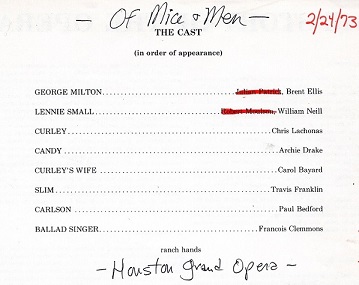
    Of mice and men-1

    Fifty years ago, on this date, I was in Houston, Texas, attending a Houston Grand Opera performance of Carlisle Floyd’s OF MICE AND MEN with my friends the Humeniuk sisters – Ann(e) and Helen – and Larry Knickerbocker.

    Helen, Larry, and I had moved down to Texas in January 1973 where Ann(e) was attending the University of Houston and working as a waitress. Helen started taking courses, and Larry got a job as an auto mechanic; they had fallen in love and they would eventually marry.

    I was working in a drugstore at the Astroworld Hotel. We went to basketball games and to the roller derby, but we were poor so we spent most evenings at the apartment, singing folk songs while passing a joint and a bottle of Boone’s Farm Strawberry Hill. At night, we’d fall asleep with Jackson Browne’s first album, Saturate Before Using, playing on endless repeat:

    “Well, I looked into a house I once lived in
    Around the time I first went on my own
    When the roads were as many as the places I had dreamed of,
    And my friends and I were one…”

    Pg

    It was a peaceful, laid-back life I was leading, and it could have gone on indefinitely. But I often found myself thinking of New York City, of The Met and New York City Opera, and of my opera-loving friends. And there was also this restlessness: a feeling that time was passing me by and that a different life was meant for me.

    I was very attracted to one of Ann(e)’s male friends, but he was married to a woman and they had a daughter. A couple of times I got a vibe that the feeling was mutual, but I simply didn’t know how to go about making something happen. 

    By March, I was getting weary of the situation. A falling out with my boss at the drugstore prompted me to quit my job. For a couple of days I looked at some job ads, but nothing appealed to me. Then one day I got up, feeling that something had to give; Ann(e) and Larry were at work, and Helen was studying. I began packing my stuff into my car. Helen asked, “Are you leaving us?” but she didn’t try to persuade me to stay.  I left a note for Ann(e) and took off.

    On the 1,600-mile journey, I spent two nights in motels and finally arrived back in the little town. I hadn’t let my parents know I was returning; I walked into the kitchen where my mom was puttering around, and asked: “What’s for supper?”

    After a few days, I got a job in a pharmaceutical supply warehouse in Syracuse and took a tiny apartment nearby. But there were some crazies in the building, and after a few weeks, I moved back home and made the hour-long drive to work every morning.

    Meanwhile, New York City was calling me. It wasn’t until June that I got back to the City, for an AIDA with my beloved diva, Gilda Cruz-Romo. I loved seeing all my old friends again; during the intermission, we were standing about, gossiping.  Z, a boy I was attracted to, was standing next to me. He was wearing a maroon sweater-vest and on his chest a stray bit of white thread caught my eye. I reached out and picked the thread off; he gave me a big smile. For the first time, everything felt right. But it wasn’t until October that anything actually happened between us. 

    I often think back to the interlude in Houston, and what might have happened had I stayed on there. But in time, Ann{e), Helen, and Larry moved back to Syracuse and our friendship picked up where it had left off. Helen and Larry married and raised a family; Ann{e) also got married.

    Meanwhile, in the City, after my hopeless love for Z sputtered out, I took up with TJ: my first domesticated gay relationship. After I moved to join TJ at Sarah Lawrence College, I began to lose touch with my Syracuse friends. After TJ finished school, we moved to Hartford and, after spending 22 years there, I finally moved to my dream City in 1998, just shy of my 50th birthday.

    One sad story that came out of the weeks I spent in Houston was that D, the married boy I had a crush on, did eventually leave his wife and enter into a gay relationship. But it was terribly difficult being gay in those years, especially deep in the heart of Texas. I eventually heard that D had committed suicide, and I found myself regretting that I had not responded to his shy flirting; like so many of life’s possibilities, it remains a troubling enigma. When the Facebook era arrived, I became friends with his wife and daughter.

    In 2017, I received news that Helen had passed away; although I had not seen or heard from her for many years, her death upset me deeply. I found Helen and Larry’s two eldest daughters, Katherine and Rebecca, on Facebook where I see them often and keep tabs on their kids, being constantly reminded of those close friendships from so long ago.

  • Bernadette Greevy

    Bernadette-Greevy

    Bernadette Greevy (above), the Irish contralto, was born in Clontarf, a coastal suburb of Dublin.  She studied voice with Jean Nolan and at the Guildhall School of Music and Drama, in London, with Helene Isepp. Her operatic debut was at Dublin, as Siebel in Gounod’s FAUST; she was 18 years old. At the Wexford Festival in 1962, she debuted as  Beppe in Mascagni’s L’AMICO FRITZ, returning often to Wexford in the ensuing seasons to sing operas by Verdi, Massenet, Haydn, and Handel.

    Ms. Greevy appeared with Scottish Opera and at Covent Garden, as well as in Buenos Aires, Oslo, and Ottawa, and made concert tours of China (in 1985), the USA, and throughout Europe. She became best-known for her recital and concert work. Her performances of Elgar’s Sea Pictures and the great Mahler vocal works – Songs of a Wayfarer, the Rückert Lieder, the Kindertotenlieder, and Das Lied von der Erde – were highly acclaimed.

    Bernadette Greevy passed away in 2008 at the age of 68, leaving us with some very fine recordings of her Elgar and Mahler specialties as well as music of Bach, Handel, Berlioz, Brahms, and Duparc. Below are some samplings of the Greevy voice; it takes a few seconds for the Handel to start.

    Bernadette Greevy – Lascia ch`io pianga ~ Handel’s RINALDO

    Bernadette Greevy – Mahler ~ Ich bin der Welt abhanden gekommen