
Soprano Olga Mykytenko and pianist Anastasiya Titovych in a 2016 performance of Robert Schumann’s Frauenliebe und -leben.
Watch and listen here.
Soprano Olga Mykytenko and pianist Anastasiya Titovych in a 2016 performance of Robert Schumann’s Frauenliebe und -leben.
Watch and listen here.
Above: soprano Heather Buck
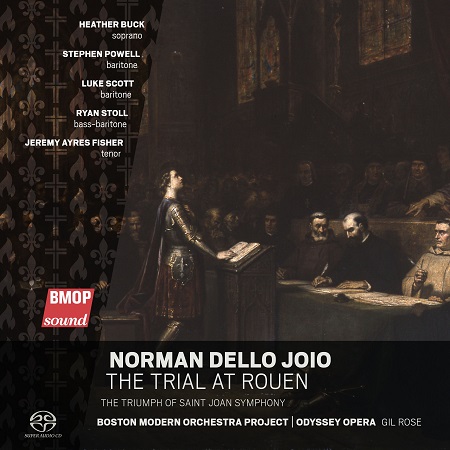
Boston Modern Orchestra Project (BMOP) and Odyssey Opera have just released a recording of Norman Dello Joio’s 1956 opera The Trial at Rouen.
Actually, Dello Joio had been inspired even earlier by the story of Joan of Arc, writing an opera about her that he later came to feel did not do the subject justice. Nevertheless, drawing from that now-forgotten work, he prepared a symphonic adaptation, entitled The Triumph of Saint Joan, in 1951, which enjoyed considerable success.
This orchestral work opens the current recording; the piece is presented in three movements. The first, The Maid, has a pensive, darkish start. The music soon takes on a cinematic feel – which will be sustained throughout the entire work. Quietened, the gentle voices of flue and oboe mingle, with strings providing a lyrical counter-song. The music turns lilting, then animated. Brass voices arise, and a feeling of grandeur evolves. After a full stop, a brooding passage gives way to a rustic episode. A deep pulse leads on to a somber finish,
The second movement, The Warrior, opens with timpani and summoning brass. A beat springs up, woodwinds swirl, and the horns sing out: we are on the march. Rhythmic variety and mixes of instrumentation sustain us to another full stop. Insistent brass motifs then carry on to an epic finish.
The work culminates with The Saint, introduced by gentle winds in sorrowing mode. The flute sings a forlorn tune; the mood is pensive with an ominous undercurrent. A clarinet solo leads to a more propulsive passage, which calms. The music slowly recedes, like a memory, with a haunting final chord.
Feeling a strong connection to the subject matter, the composer wrote a new opera, The Trial at Roeun, in 1956 on commission from the NBC Television Opera Theatre. Of this work, Dello Joio wrote: “The Trial at Rouen is not a version of my first opera but is a completely new statement, both musically and dramatically; though the temptation to use the old material was great.”
The seventy-five minute opera, in two scenes, premiered to a large television audience in 1956, but was thereafter neglected. The opera was never performed in a live theatrical setting until BMOP and Odyssey Opera staged it in 2017.
The performers in The Trial at Rouen are soprano Heather Buck as Joan, baritone Stephen Powell as Pierre Cauchon, bass-baritone Luke Scott as Father Julien, bass-baritone Ryan Stoll as The Jailer, and tenor Jeremy Ayres-Fisher as A Soldier; Gil Rose is the conductor.
The opera opens with a prelude (apparently omitted for the televised version), which commences with gentle winds and strings and slowly builds to fanfare-like brass. The pleasing voice of tenor Jeremy Ayres Fisher as the Soldier is heard, at first tra-la-la-ing; his song soon becomes one of longing for home. The tenor is joined in sung dialogue by Father Julien (Luke Scott – another handsome voice). We hear “the Maid” mentioned, and of their concern for her; crystal clear diction from both men enhances their singing.
Now we meet Joan’s nemesis, Pierre Cauchon, the English-leaning Bishop of Beauvais, portrayed by Stephen Powell. The Bishop and Father Julien have a chant-like passage, after which we can relish Mr. Powell’s beautiful tone (this singer has long been a great favourite of mine). The Bishop expects Joan to recant her claim that she has been hearing voices from Heaven, and to don female garb as a symbol of her capitulation.
The Jailer (Ryan Stoll, yet another fine voice) attempts to force himself on Joan, but Father Julien comes to her rescue. The kindly Father advises the girl to put on the dress, in deference to the Inquisitors. Now we hear the lovely lyrical soprano of Heather Buck, who in Joan’s music shows both the assurance and the vulnerability of the character in perfect measure.
Mr. Scott as Father Julien makes a highlight out of “O good Maid, my heart is with you.” This turns into a duet with Ms. Buck, which becomes quite dramatic. Both singers relish the composer’s melodic line, and his orchestration deftly underscores their singing. Their voices join in a call to Christ.
Now Ms. Buck has an evocative solo, “Are you the price of life’s sweet breath?“, which is sung to the dress she has been told to wear. Ms. Buck’s vivid vocalism becomes urgent, before turning poignantly reflective; then a hushed postlude marks the end of the opera’s first scene.
Scene 2 is the trial itself. After a somber prelude, a sonic outburst announces the crowd, demanding to be let in to the proceedings. Mr. Powell and Ms. Buck now have a great deal of singing to do, and both are admirable. Mr. Powell’s diction is perfect as he scolds the crowd and instructs the inquisitors. He then sings – magnificently – “I Call on Thee, Eternal God” – which could enter the solo baritone repertoire as a free-standing aria. Powell’s rendering of it is thrilling, and as the chorus joins him at the end…perhaps the most ‘operatic’ passage of the work.
Joan is led in, in chains, and the crowd seems sympathetic to her plight. Powell, as Cauchon, begins to interrogate her, saying her sin is heresy. Ms. Buck, as Joan, sings “In Our Time of Trouble“, recalling her childhood; the soprano’s dynamics and verbal inflections are soothing. Cauchon then poses a question: “Was Saint Michael clothed when he appeared before you?” As he baits her further, a propulsive beat develops. The chorus calls on the Maid to repent.
Joan states that she does not know why she was “chosen”; as tension builds, she calls on God to come to her aid. Cauchon summons the executioner and – to an eerily bouncy rhythm, rather daemonic – says Joan is condemned to death and will be burned.
Joan begs to be spared a fiery death; Ms. Buck excels here, asking why God has abandoned her. Then, recalling her glory in battle, the soprano soars to a high climactic tone.
The Maid becomes desperate, but – after a full stop – offstage a cappella voices sing “Be brave, daughter of France!” Joan recants, but Cauchon rejects her words. After Joan’s high-lying phrases of defense, Cauchon consigns her to Hell. The victim speaks pleadingly, “Jesus…my Jesus!”
Ms. Buck now has the final moments of the opera to herself, making a beautiful effect with “Your final will be done“: an aria of resignation which gives way to Joan’s transfiguration. A timpani beats quietly, and the music fades away.
The excellence of the recording, and its impressive cast, put The Trial at Rouen in the best possible light; it’s an opera that deserves to be widely heard. For me, “cinematic” remains the word that best describes the music, and the roles of Joan and Cauchon provide ample opportunity for the human voice; Ms. Buck and Mr. Powell have set the bar high for future candidates.
To purchase the recording, go here.
Listening to The Trial at Rouen, I was recalling meeting soprano Heather Buck while I was working at Tower Records a few years ago. She was then a young singer seizing her first career opportunities; we had a very nice chat. In the ensuing months, I would sometimes see her on the train going home, always with a score on her lap, singing to herself.
~ Oberon
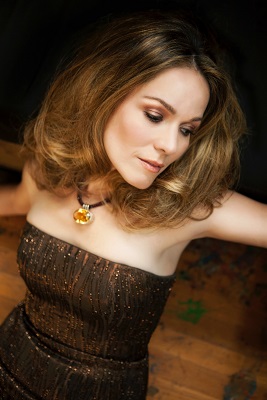
Above: soprano Heather Buck
Boston Modern Orchestra Project (BMOP) and Odyssey Opera have just released a recording of Norman Dello Joio’s 1956 opera The Trial at Rouen.
Actually, Dello Joio had been inspired even earlier by the story of Joan of Arc, writing an opera about her that he later came to feel did not do the subject justice. Nevertheless, drawing from that now-forgotten work, he prepared a symphonic adaptation, entitled The Triumph of Saint Joan, in 1951, which enjoyed considerable success.
This orchestral work opens the current recording; the piece is presented in three movements. The first, The Maid, has a pensive, darkish start. The music soon takes on a cinematic feel – which will be sustained throughout the entire work. Quietened, the gentle voices of flue and oboe mingle, with strings providing a lyrical counter-song. The music turns lilting, then animated. Brass voices arise, and a feeling of grandeur evolves. After a full stop, a brooding passage gives way to a rustic episode. A deep pulse leads on to a somber finish,
The second movement, The Warrior, opens with timpani and summoning brass. A beat springs up, woodwinds swirl, and the horns sing out: we are on the march. Rhythmic variety and mixes of instrumentation sustain us to another full stop. Insistent brass motifs then carry on to an epic finish.
The work culminates with The Saint, introduced by gentle winds in sorrowing mode. The flute sings a forlorn tune; the mood is pensive with an ominous undercurrent. A clarinet solo leads to a more propulsive passage, which calms. The music slowly recedes, like a memory, with a haunting final chord.
Feeling a strong connection to the subject matter, the composer wrote a new opera, The Trial at Roeun, in 1956 on commission from the NBC Television Opera Theatre. Of this work, Dello Joio wrote: “The Trial at Rouen is not a version of my first opera but is a completely new statement, both musically and dramatically; though the temptation to use the old material was great.”
The seventy-five minute opera, in two scenes, premiered to a large television audience in 1956, but was thereafter neglected. The opera was never performed in a live theatrical setting until BMOP and Odyssey Opera staged it in 2017.
The performers in The Trial at Rouen are soprano Heather Buck as Joan, baritone Stephen Powell as Pierre Cauchon, bass-baritone Luke Scott as Father Julien, bass-baritone Ryan Stoll as The Jailer, and tenor Jeremy Ayres-Fisher as A Soldier; Gil Rose is the conductor.
The opera opens with a prelude (apparently omitted for the televised version), which commences with gentle winds and strings and slowly builds to fanfare-like brass. The pleasing voice of tenor Jeremy Ayres Fisher as the Soldier is heard, at first tra-la-la-ing; his song soon becomes one of longing for home. The tenor is joined in sung dialogue by Father Julien (Luke Scott – another handsome voice). We hear “the Maid” mentioned, and of their concern for her; crystal clear diction from both men enhances their singing.
Now we meet Joan’s nemesis, Pierre Cauchon, the English-leaning Bishop of Beauvais, portrayed by Stephen Powell. The Bishop and Father Julien have a chant-like passage, after which we can relish Mr. Powell’s beautiful tone (this singer has long been a great favourite of mine). The Bishop expects Joan to recant her claim that she has been hearing voices from Heaven, and to don female garb as a symbol of her capitulation.
The Jailer (Ryan Stoll, yet another fine voice) attempts to force himself on Joan, but Father Julien comes to her rescue. The kindly Father advises the girl to put on the dress, in deference to the Inquisitors. Now we hear the lovely lyrical soprano of Heather Buck, who in Joan’s music shows both the assurance and the vulnerability of the character in perfect measure.
Mr. Scott as Father Julien makes a highlight out of “O good Maid, my heart is with you.” This turns into a duet with Ms. Buck, which becomes quite dramatic. Both singers relish the composer’s melodic line, and his orchestration deftly underscores their singing. Their voices join in a call to Christ.
Now Ms. Buck has an evocative solo, “Are you the price of life’s sweet breath?“, which is sung to the dress she has been told to wear. Ms. Buck’s vivid vocalism becomes urgent, before turning poignantly reflective; then a hushed postlude marks the end of the opera’s first scene.
Scene 2 is the trial itself. After a somber prelude, a sonic outburst announces the crowd, demanding to be let in to the proceedings. Mr. Powell and Ms. Buck now have a great deal of singing to do, and both are admirable. Mr. Powell’s diction is perfect as he scolds the crowd and instructs the inquisitors. He then sings – magnificently – “I Call on Thee, Eternal God” – which could enter the solo baritone repertoire as a free-standing aria. Powell’s rendering of it is thrilling, and as the chorus joins him at the end…perhaps the most ‘operatic’ passage of the work.
Joan is led in, in chains, and the crowd seems sympathetic to her plight. Powell, as Cauchon, begins to interrogate her, saying her sin is heresy. Ms. Buck, as Joan, sings “In Our Time of Trouble“, recalling her childhood; the soprano’s dynamics and verbal inflections are soothing. Cauchon then poses a question: “Was Saint Michael clothed when he appeared before you?” As he baits her further, a propulsive beat develops. The chorus calls on the Maid to repent.
Joan states that she does not know why she was “chosen”; as tension builds, she calls on God to come to her aid. Cauchon summons the executioner and – to an eerily bouncy rhythm, rather daemonic – says Joan is condemned to death and will be burned.
Joan begs to be spared a fiery death; Ms. Buck excels here, asking why God has abandoned her. Then, recalling her glory in battle, the soprano soars to a high climactic tone.
The Maid becomes desperate, but – after a full stop – offstage a cappella voices sing “Be brave, daughter of France!” Joan recants, but Cauchon rejects her words. After Joan’s high-lying phrases of defense, Cauchon consigns her to Hell. The victim speaks pleadingly, “Jesus…my Jesus!”
Ms. Buck now has the final moments of the opera to herself, making a beautiful effect with “Your final will be done“: an aria of resignation which gives way to Joan’s transfiguration. A timpani beats quietly, and the music fades away.
The excellence of the recording, and its impressive cast, put The Trial at Rouen in the best possible light; it’s an opera that deserves to be widely heard. For me, “cinematic” remains the word that best describes the music, and the roles of Joan and Cauchon provide ample opportunity for the human voice; Ms. Buck and Mr. Powell have set the bar high for future candidates.
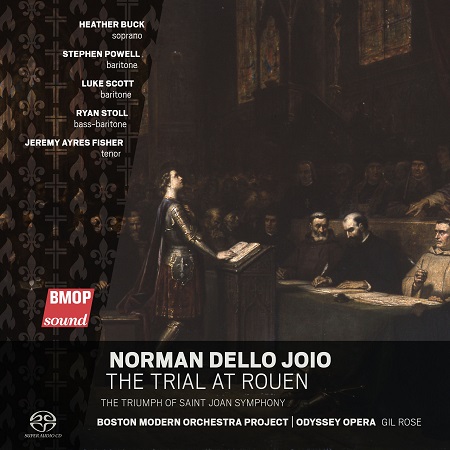
To purchase the recording, go here.
Listening to The Trial at Rouen, I was recalling meeting soprano Heather Buck while I was working at Tower Records a few years ago. She was then a young singer seizing her first career opportunities; we had a very nice chat. In the ensuing months, I would sometimes see her on the train going home, always with a score on her lap, singing to herself.
~ Oberon
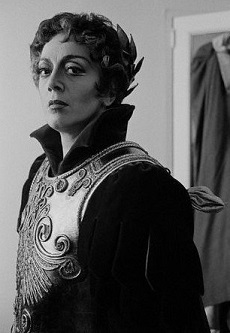
Tatiana Troyanos ~ GIULIO CESARE arias – San Francisco 1982 – in English
I wonder: has any other singer in the history of opera sung both the title-role and Cleopatra in Handel’s masterpiece?
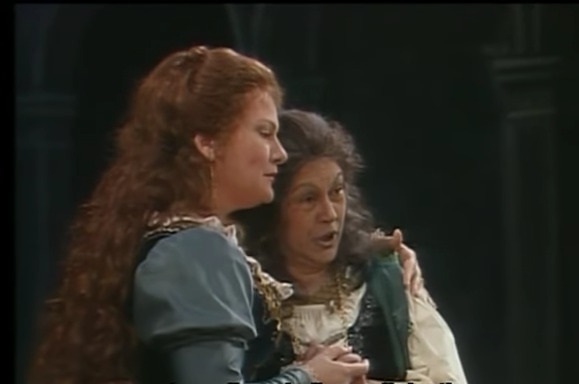
Above: Eva Marton and Margarita Lilowa in the opening scene of LA GIOCONDA
A rather odd collection of excerpts from a performance of Ponchielli’s LA GIOCONDA given at Vienna in 1986 is available on YouTube. The principal roles are sung by Eva Marton (Gioconda), Ludmila Sementshuk (Laura), Margarita Lilowa (Cieca), Placido Domingo (Enzo), Matteo Manuguerra (Barnaba), and Kurt Rydl (Alvise). Adam Fischer conducts.
Watch and listen here.
I am not sure why some scenes were included, and others – more interesting – were not; the editing is haphazard. But it’s nice to have a souvenir that recalls the performances of the opera at The Met with Marton and Domingo during the 1982-1983 season. Marton was a passionate Gioconda, and Domingo’s dreamy falsetto at “…o sogni d’or” in his great aria is so pleasing to hear.

Above: Margarita Lilowa
And I always enjoy Margarita Lilowa‘s performances.
Actually, as I watched the excerpts included in this YouTube presentation, I remembered that this performance was previously available on VHS, and later on DVD and BluRay. For now, the YouTube highlights will suffice.
Natalia Makarova and Ivan Nagy dance the White Swan pas de deux from SWAN LAKE at the 100th anniversary celebration of the Metropolitan Opera in New York City in 1984. Ivan Nagy came out of retirement to dance with Ms. Makarova on this occasion. The dancers are accompanied on-stage by violinist Itzhak Perlman and cellist Lynn Harrell.
Watch and listen here.

Natalia Makarova and Ivan Nagy dance the White Swan pas de deux from SWAN LAKE at the 100th anniversary celebration of the Metropolitan Opera in New York City in 1984. Ivan Nagy came out of retirement to dance with Ms. Makarova on this occasion. The dancers are accompanied on-stage by violinist Itzhak Perlman and cellist Lynn Harrell.
Watch and listen here.
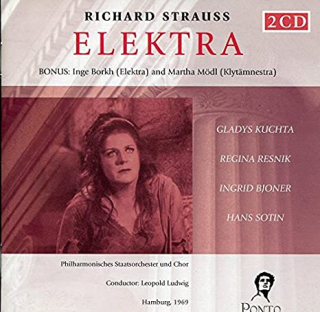
This recording of ELEKTRA – a very impressive performance – is the soundtrack of a Rolf Liebermann film (released in 1970 but now apparently out-of-print). Klytemnestra’s manic laughter and her horrific death cries are not part of the recording; I suppose they were dubbed in later for the film.
Leopold Ludwig paces the opera marvelously, and the orchestra plays very well. The cast is a strong one, right from the start when Cvetka Ahlin asks “Wo bleibt Elektra?” with her rich, ripe contralto tones. Her fellow serving maids are a classy lot: Inger Paustian, Ursula Boese, Regina Marheineke, and Ingeborg Kreger. Edith Lang (who I saw as Mother Goose when Hamburg brought THE RAKE’S PROGRESS to The Met in 1967) is the Overseer. Together, these six singers make the most of the opera’s opening scene, which I used to hate, but I’ve come to love.

Franz Grundheber, who went on to a great career, takes the small role of the Old Servant, and Helmut Melchert is a strong-voiced, vivid Aegisth. Hans Sotin, who was my first full-Cycle Wotan in 1989, is a very bass-oriented Orestes and is very effective in the recognition scene. I’ve always loved Ingrid Bjoner, and she’s a very fine Chrysothemis here, her voice silvery and powerful.

Gladys Kuchta (above) is one of the most impressive Elektras I have ever heard. Her monolog is superbly delivered, with the top notes clean, clear, and sustained. Later in the opera, some of the highest notes are approached from just slightly below; but they always tonalize…and are exciting. The Kuchta voice is powerful, and her occasional nods to subtlety are telling. Overall, Kuchta’s Elektra – on this evidence – is one of the best.

Regina Resnik (above) gives one of her greatest performances ever here as Klytemnestra. She’s in perfect voice, and really sings the music (some of which is incredibly beautiful) without resorting to cackling or other sound effects. Her way with the words is wonderfully canny, and the lyricism that can be found in the vocal writing of the part is engagingly brought forth; we can begin to understand this woman and what she has gone thru. The trademark Resnik chest voice is on vivid display, In sum, a magnificent interpretation. ~~~~~
~ Oberon

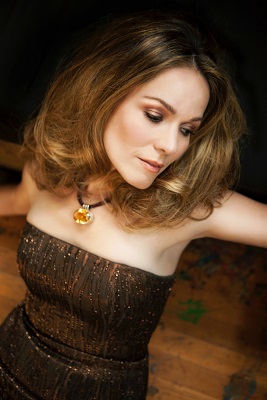
Mezzo-soprano Sasha Cooke (above, in a Stephanie Girard portrait) sings Maurice Ravel’s Shéhérazade with the Radio Philharmonic Orchestra, conducted by James Gaffigan. The performance was recorded in September 2019, at Utrecht.
Watch and listen here.

My friend Ben Weaver has devoted a great deal of time over the years listening to the music of Ludwig van Beethoven. Here he writes about recordings of the nine symphonies that have particularly captured his interest:
“With the 250th anniversary since Ludwig van Beethoven’s birth celebrations curtailed by a worldwide pandemic, what’s a Beethoven lover to do but try to make the best of semi-voluntary home imprisonment by turning to recordings of Beethoven. I have previously taken a stroll through recordings of Wagner’s Tristan und Isolde; why not go back to some of my favorite recordings of Beethoven’s Nine. THE Nine that started the count and turned the world of music on its head. (Mahler and Bruckner both feared the number 9 and that they would not be able to out-do Beethoven and compose a symphony beyond that number – and both turned out to be correct: Bruckner never finished his Ninth and Mahler only completed one movement of his Tenth.) I will only go through some of the finest sets of the complete Symphonies – this is not intended to be a study of every recorded cycle and I’m only looking at complete sets of the Symphonies. (I will honorably mention some stand-alone recordings at the end.)
So where does one begin a traversal of Beethoven’s recorded Symphonies? Naturally, with Herbert von Karajan – the Dean of recorded sound who left behind 4 complete studio sets: one from the 1950s with the Philharmonia Orchestra of London on EMI and three with the Berlin Philharmonic, one for each subsequent decade. (There are also at least two complete sets recorded by Japanese radio during Karajan’s concert tours with the Berliners.)
Karajan’s Philharmonia set (in mono) is unjustly neglected: produced by Walter Legge it captures the great vintage Philharmonia (arguably a better orchestra in the 1950s than even the Berliners were) in all its warm virtuosic glory and the young(er) Karajan, still not the domineering force he would become later, in a more playful mood than he would be in his Berlin recordings. This is especially noticeable in the “non-heroic” symphonies: One and Two sizzle with excitement and Seven, which Wagner called “the apotheosis of dance,” zooms out of the speakers and around the room. Of course the fact that it’s in mono will deter many listeners. The current issue of the EMI (now Warner) set includes two versions of the Ninth Symphony, one in mono and one in Legge’s experimental stereo (Legge preferred mono); the stereo version has never been available before.
Of Karajan’s three Berlin sets – recorded 1961-62, 1975-76, and finally 1982-84 – interpretively there was not a great change in Karajan’s approach over the years. Since the London days he would become a more “serious” musician, maybe wiser, with what one would call a Germanic (he was actually Austrian) sense of humor. And for all his stürm und drang, Beethoven was certainly a man of humor. Karajan’s firmer grasp of the music and structure grew, and he now had complete control over his Berlin Philharmonic, wrestled from Wilhelm Furtwängler’s cold, dead hands and remade in his own image. The teutonic sound of Karajan’s Berliners would become firmer over the years, its granite-like wall of sound could level buildings, its virtuosity would be second-to-none. (The roster of principals over the years has given birth to more star soloists than perhaps any other band, including the likes of flautist Sir James Galway who played for Karajan from 1969 to 1975 and clarinetist Sabine Meyer’s very unhappy stint as the Orchestra’s first female principal in 1982. The orchestra voted her out after her “trial period” over Karajan’s objections, angering the maestro who insisted the male-dominated orchestra objected to Meyer’s gender, not musicianship; the incident caused a serious rift in their relationship and saw Karajan perform with the Vienna Philharmonic more in his final years. Berlin’s star soloists today include flautist Emanuel Pahud, oboist Albrecht Meyer, and clarinetist/model Andreas Ottensamer. But I digress…)
So what sets all that Karajan Beethoven apart from one another? The 1961-62 set is one of the most famous classical recordings ever made; it has never been out of the catalog and has been reissued a bazillion times. (There is a new 2020 remastering being issued on SACD in Japan only and it does sound spectacular.) But there is a separatist group of listeners, which includes myself, that consider the 1970s cycle to be superior. There’s something a little rough in the 1960s set; maybe it’s Karajan still fighting the ghost of Furtwängler, or the orchestra still resisting Karajan’s attempts to possess them, but for me the cycle doesn’t register as extraordinary and the Ninth is a disappointment: the over-large and poorly recorded choir is an aural mess and sounds like they were singing in an empty subway station. By the late 1970s recording techniques had been improved and Karajan’s takeover of the orchestra was complete: they were now an extension of himself, with no ensemble lapses, no hesitations. And the recorded sound is gorgeous: warm, from the softest to the loudest moments. Listen to the Storm of the Pastoral Symphony: it’s all encompassing in sound and terror, as if we are hearing God’s flood for Noah. But then the romantic sweep of the Shepherd’s Call is overwhelming too in its depth of feeling and beauty of sound.
Claudio Abbado took the reins of the Berlin Philharmonic after Karajan’s death and though Abbado recorded the Symphonies with the Vienna Philharmonic in the 1980s, he took another stab with his new orchestra in the 1990s. The results were electrifying. Paring down Berliners’ big and saturated sound favored by Karajan and echoed by many others over the years, Abbado brought Beethoven down from Mount Olympus and gave the symphonies a fresh, more Classical sound, reducing the number of players and exploiting Berliners’ newfound energy without gratuitous rushing. Deutsche Grammophon released Abbado’s recordings in two different versions: first came a cycle recorded at the Philharmonie in 1999-2000 and then a cycle recorded in concert in Rome in 2001. (Except the Ninth, which exists only from its Philharmonie performance, but re-edited in 2001 from original recordings according to Abbado’s new wishes.) DG says the Rome cycle is intended to replace the earlier Berlin one. Many argue that the Rome performances are the real jewels: I don’t know if I personally hear a huge difference in Abbado’s take or the orchestra’s performances, but I’m glad to have both. (To add to the confusion, the Rome cycle was also issued on DVD, but with a different Berlin recording of the Ninth, this one with bass Eike Wilm Schulte replacing Quasthoff, who remains the bass on the audio-only recording.)
With Abbado’s many years of experience with these works and having had time to cleanse the orchestra of Karajan’s late-career excesses, everything sizzles. The Fifth reminds us why the first movement has had the world ta-ta-ta-taming for centuries and the rest reminds us why this is an extraordinary, world-changing work and is more than just 4 chords. The Eroica is exceptional in its nobility and the Fourth makes you wonder why it’s not as famous as the two Symphonies bracketing it. The Pastoral is a gorgeous, gentle giant and the Seventh an exuberant dance. A superb quartet of soloists in the Ninth (Mattila, Urmana, Moser and Quasthoff) dominate the grand finale.
Perhaps no orchestra has recorded Beethoven’s symphonies more frequently than the Vienna Philharmonic over the years. Leonard Bernstein’s Vienna cycle from the late 1970s not only leaves his 1960s New York recordings in the dust, but it leaves almost everyone else in the dust too. The playing is stupendous and Bernstein finds threads and sounds that nobody else has unearthed. The is nothing gratuitous about the interpretations, no odd Bernsteinisms, nothing willful. Bernstein doesn’t pull the music in any perverse direction, like his New York Fifth’s preposterous tempos: and yet he and the orchestra create sounds and discover ideas that nobody has before or since. Inspired by Lenny’s fertile imagination the Viennese play like gods. From beginning to end it feels like you hearing these works for the first time. No matter what others have done with these works or will do, these lovingly shaped performances will always belong near the top of recommendations.
The late 1980s/early 1990s brought two exceptional sets: Nikolaus Harnoncourt’s and John Eliot Gardiner’s. Harnoncourt – with the Chamber Orchestra of Europe – brought his decades of period instruments experience to a modern instruments orchestra (except natural horns) and the results were electrifying, except a disappointing, shapeless Ninth. The rest of the cycle – a surprisingly big boned Eroica, cheerful Pastoral, delirious Seventh – can stand proudly along with the best. The blaring, natural horns, over smooth modern strings, is an inspired and attention-grabbing touch.
John Eliot Gardiner’s cycle with the newly created Orchestre Révolutionnaire et Romantique (an expanded English Baroque Soloists, specifically created to perform music of the Romantics) was not the first period instruments cycle of the Symphonies. Roger Norrington and Christopher Hogwood, among others, preceded him. But nothing could have prepared the world for the barnstorming, hair-raising Gardiner set. For reasons unclear to me the earlier period instrument sets can often sound anemic and unsteady. For years people seem to have accepted that as the nature of period instruments. Sir John turned all that on its head: the Orchestre Révolutionnaire et Romantique comes at you like a category 5 hurricane. Suddenly the terror, confusion and wonder people felt at hearing Beethoven in his own time started to make sense. Yes the tempos are fast, but never feel rushed. Gardiner makes it all feel completely organic: from the opening chords of the First Symphony – no longer just a fluffy Mozart tribute, but a foreshadowing of something never heard before – all the way to the awe-inspiring choral conclusion of the Ninth, no one has done more to show the truly revolutionary Beethoven than John Eliot Gardiner. The Eroica is truly worthy of Napoleon and the Fifth is like a bat out of hell. The Pastoral transitions perfectly from sunshine to a storm of epic proportions, and Seven and Eight are dizzying. The Ninth is a crowning glory of the set: you can see how and why this work, above all else, changed the course of music. The extraordinary Monteverdi Choir levels all competition in its path and four exceptional soloists (Luba Orgonasova, Anne Sofie von Otter, Anthony Rolfe Johnson and Gilles Cachemaille) cover themselves in glory. This is essential listening.
With the celebrations in full swing, everybody and their mother is issuing a new Beethoven Symphonies cycle. What is there left to say that hasn’t been said yet? Well, turns out a good conductor can still send a tingle up your leg.
Among the highlights of the new cycles are Philippe Jordan’s exhilarating recordings with the Vienna Symphony Orchestra (an orchestra that lives in the shadow of the Vienna Philharmonic and unjustly so.) Jordan’s tight rhythms and mostly quick tempos – along with the orchestra’s virtuosity and beautiful sound – create numerous thrilling moments: the early symphonies are full of exuberance. With the Eroica Jordan manages to create something remarkable: a balance that melds the unmistakable early, Mozartian, youthful Beethoven with the forward-looking revolutionary. The Pastoral, a symphony that can be tedious in the wrong hands, is truly one of the most perfect performances of this work I’ve ever heard. There’s not a note or feeling out of place. These are carefully thought out and prepared performances, well recorded by Vienna Symphony’s home label.
THE TOP CHOICES:
Herbert von Karajan – Philharmonia Orchestra – EMI – Elisabeth Schwarzkopf, Marga Höffgen, Ernst Haefliger, Otto Edelmann
Herbert von Karajan – Berlin Philharmonic – DG – Anna Tomowa-Sintow, Agnes Baltsa, Peter Schreier, José van Dam.
Leonard Bernstein – Vienna Philharmonic – DG – Dame Gwyneth Jones, Hanna Schwarz, René Kollo, Kurt Moll.
Claudio Abbado – Berlin Philharmonic – DG – Karita Mattila, Violeta Urmana, Thomas Moser, Thomas Quasthoff.
Nikolaus Harnoncourt – Chamber Orchestra of Europe – Teldec – Charlotte Margiono, Birgit Remmert, Rudolf Schasching, Robert Holl.
Sir John Eliot Gardiner – Orchestre Révolutionnaire et Romantique – Archiv – Luba Orgonasova, Anne Sofie von Otter, Anthony Rolfe Johnson, Gilles Cachemaille.
Philippe Jordan – Vienna Symphony Orchestra – VS – Anja Kampe, Daniela Sindram, Burkhard Fritz, René Pape
HONORABLE MENTIONS:
André Cluytens’ 1959 Berlin Philharmonic cycle (in stereo for EMI) predates Karajan’s and has Furtwängler’s orchestra at his disposal. These are very noble readings from the old school. With Gré Brouwenstijn, Kerstin Meyer, Nicolai Gedda, Frederick Guthrie.
Another terrific old-school set with a vintage Vienna Philharmonic can be heard under Hans Schmidt-Isserstedt on Decca in the late 1960s. And his quartet of soloists is an unbeatable all-star: Joan Sutherland, Marilyn Horne, James King, Martti Talvela.
A glowing Staatskapelle Berlin can be heard under Daniel Barenboim from 1999 for Teldec. With Soile Isokoski, Rosemarie Lang, Robert Gambill, René Pape.
A warm, ravishing Gewandhausorchester Leipzig plays for Herbert Blomstedt’s in a terrific set from Accentus Music. This recording shows off Blomstedt’s wonderful Beethoven to better effect than his Staatskapelle Dresden set from 40 years earlier. With Simona Šaturová, Mihoko Fujimura, Christian Elsner, Christian Gerhaher.
Early music specialist Jan Willem de Vriend’s often surprising period instruments approach with modern instruments galvanizes the Netherlands Symphony Orchestra for Challenge Records. With Annemarie Kremer, Wilke te Brummelstroete, Geert Smits, Marcel Reijans.
Paavo Järvi and the Deutsche Kammerphilharmonie Bremen set the music world buzzing with their fleet-footed, exciting cycle on RCA. With Christiane Oelze, Petra Lang, Klaus Florian Vogt, Matthias Goerne.
Sir Simon Rattle’s exciting Berlin Philharmonic set – after he took over from Abbado, also having recorded a mediocre cycle in Vienna earlier – is great, old-school fun, released by Berlin’s own in-house label. With Annette Dasch, Eva Vogel, Christian Elsner, Dimitry Ivashchenko.
Sir Bernard Haitink’s autumnal London Symphony Orchestra recordings from 2005-06 on the LSO Live label are old-fashioned, yet full of surprising touches and warmth. With Twyla Robinson, Karen Cargill, John Mac Master, Gerald Finley.
Kent Nagano’s big, Romantic set with the Orchestre Symphonique de Montréal features beautiful, warm playing. With Erin Wall, Mihoko Fujimura, Simon O’Neill, Mikhail Petrenko. (Also includes excerpts from “Egmont” sung by Adrianne Pieczonka.)
Period instrument specialist Jos van Immerseel presents a warm, sunny cycle with the Anima Eterna ensemble. With Anna-Kristiina Kaapola, Marianne Beate Kielland, Markus Schäfer, Thomas Bauer.
George Szell’s vintage recordings on Sony with the Cleveland Orchestra are brilliant and brash. With Adele Addison, Jane Hobson, Richard Lewis, Donald Bell.
Ádám Fischer’s recent strange, idiosyncratic set with the Danish Chamber Orchestra is full of surprises – some of which you may enjoy, some not so much – is worth exploring. With Sara Switlicki, male alto Morten Grove Frandsen, Ilker Arcayürek, Lars Møller.
Japanese composer and conductor Joe Hisaishi’s new recording with a Japanese youth orchestra, Future Orchestra Classics, bring an exuberance only young people who have never played these works before can bring. A too-resonant acoustic takes getting used to, but the performances are fresh and engrossing. On the Exton label. With Yoko Yasui, Makiko Yamashita, Kei Fukui, Koji Yamashita.
RECOMMENDED INDIVIDUAL SYMPHONIES:
Ferenc Fricsay’s stereo recordings with the Berlin Philharmonic from the 1950s and 60’s is among the glories of the gramophone. Tight, thrilling, driven, insightful. A must own for any collector. Symphonies Nos. 3, 5, 7 and 9 (with Irmgard Seefried, Maureen Forrester, Ernst Haefliger, Dietrich Fischer-Dieskau) on DG.
Carlos Kleiber’s legendary recordings of Symphonies Nos. 5 & 7 with the Vienna Philharmonic on DG are among the most beloved of all recordings. But also don’t miss his exhilarating live performances of Symphonies Nos. 4, 6 and 7 with the Bayerisches Staatsorchester on the Orfeo label.
István Kertész died too young and left behind exciting recordings of Symphonies Nos. 2 and 4, plus some Overtures with the Bamberg Symphony Orchestra. (Plus a stunning Piano Concerto No. 3 with Conrad Hanson.)
Sir John Eliot Gardiner, in addition to his complete cycle, more recently recorded Symphonies Nos. 2 & 8 (live at Cadogan Hall) and Nos. 5 & 7 (live at Carnegie Hall) with the Orchestre Révolutionnaire et Romantique and these are, if anything, even more exhilarating than his original recordings. On his own Soli Deo Gloria label.
Kurt Masur’s NY Philharmonic recordings of Symphony No. 5 and the complete “Egmont” from the 1990s (with soprano Sylvia McNair and narrator Will Quadflieg) are first rate.
Seiji Ozawa 1970 Symphony No. 5 (with Chicago Symphony Orchestra) and 1976 Symphony No. 3 (with San Francisco Symphony) are wonderfully old fashioned and exciting.
Enfant terrible Teodor Currentzis – a modern agent of chaos – twists a lot of music into unrecognizable shapes. But sometimes the result are electrifying, even if they would send the composer spinning in his grave. Currentzis’ recent Symphony No. 5 for Sony with his Russian-based MusicAeterna orchestra is one of those performances. You may like it. Or you may want to throw your stereo out the window.
Masaaki Suzuki, having completed his Bach Cantatas project, turns his gaze to Beethoven with an exciting Symphony No. 9 on period instruments. On Bis with Ann-Helen Moen, Marianne Beate Kielland, Allan Clayton, Neal Davies.
Wilhelm Furtwängler recorded the Ninth Symphony a number of times. Famously in Bayreuth (twice) and in Lucerne just three months before his death in 1954 with the Philharmonia Orchestra (many consider this to be his best version.) But I don’t think anything quite comes close to the infamous March 1942 performance in Berlin recorded for German radio. (A few minutes of the finale were also filmed.) Consider the time and the place, consider who is in the audience and what is happening in the world. This performance – all fire, brimstone, rage bordering on hysteria and the most wrenching slow movement of this Symphony ever recorded – will put you through the wringer. Nobody will walk away unscathed. If you are not shell-shocked when it’s over, you are not human. With Tilla Briem, Elisabeth Höngen, Peter Anders, Rudolf Waltzke.
~ Ben Weaver

 Oberon's Glade