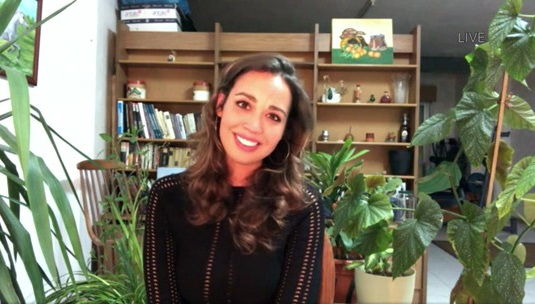
Nadine Sierra sang Mimi’s narrative “Mi chiamano Mimí” from LA BOHEME for the Metropolitan Opera’s At-Home Gala on April 25th, 2020. Watch and listen here.
Category: Opera
-
Nadine Sierra @ The Met’s At-Home Gala

Nadine Sierra sang Mimi’s narrative “Mi chiamano Mimí” from LA BOHEME for the Metropolitan Opera’s At-Home Gala on April 25th, 2020. Watch and listen here.
-
Souvenirs from Cardiff ~ Part III

Erin Wall, a native of Calgary, Canada, was a finalist at the 2003 Cardiff Singer of the World competition. She had made her international debut the previous year singing Britten’s War Requiem in London. She spent three seasons building repertoire at Lyric Opera of Chicago, and made her Met debut in 2009 as Donna Anna. In 2014, I had the pleasure of hearing her as Strauss’s Arabella at The Met.
Erin Wall’s repertoire includes Freia, the 3rd Norn, Strauss’s Daphne, Marguerite in Faust, Ellen Orford, Chrysothemis, Helena in Britten’s Midsummer Night’s Dream, Thais, and Mozart’s Contessa Almaviva. She does a lot of concert work, most notably the Mahler symphonies 2, 4, and 8, and Strauss’s Vier Letze Lieder.
Erin Wall – Vier letzte Lieder ~ Frühling

Counter-tenor Matthias Rexroth was born in Nuremberg and made his debut in Purcell’s King Arthur at Stuttgart in 1999. Having won major voice competitions at Barcelona and Vienna, Mr. Rexroth was soon performing Bach and Baroque works all over Europe, and he represented Germany at the 2003 Cardiff Competition. He sang often with conductor Nikolaus Harnoncourt, and also with Riccardo Muti and Rafael Frühbeck de Burgos. His operatic repertory covers numerous Handel roles and ranges from Monteverdi to Britten.
Watch Mr. Rexroth singing at the the 37th Concurso Francisco Viñas in Barcelona here.
Since 2014, Mr. Rexroth has been professor of voice at the Opera Academy of Warsaw; he also gives masterclasses internationally.
Parts of Ms. Wall’s and Mr. Rexroth’s 2003 Cardiff performances are heard here:
Cardiff 2003 – Matthias Rexroth – Erin Wall
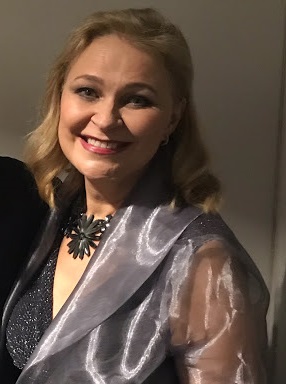
Bucharest-born Ruxandra Donose came to prominence following an impressive showing at a voice competition at Munich in 1990. She soon joined the opera company at Basel, and – thereafter – the Vienna State Opera. Her international career has since continued apace, and lately she has taken on roles like Kundry and Sieglinde.

Above: Ruxandra Donose as Nicklausse in Contes d’Hoffmann; a Marty Sohl/Met Opera photo
I met Ruxandra in 2004 while I was working at Tower Records; she was singing Nicklausse at The Met and she stopped by at the opera room. We had a lovely chat.
Here’s Ruxandra at the 1993 Cardiff competition:
Ruxandra Donose – Allerseelen – Cardiff 1993
And Roger Vignoles is the pianist for Ruxandra’s lovely singing of Dalila’s seduction aria from a 2014 London recital here.
~ Oberon
-
Gianni Raimondi

Above: Gianni Raimondi as Rodolfo in LA BOHEME
Tenor Gianni Raimondi was born at Bologna in 1923. He made his operatic debut in 1947 as the Duke in RIGOLETTO and was soon singing in opera houses throughout Italy. His career expanded to Nice, Marseille, Monte Carlo, Paris, London…

…and La Scala, where, in 1956, Mr. Raimondi made his debut in Luchino Visconti now-legendary production of LA TRAVIATA starring Maria Callas.
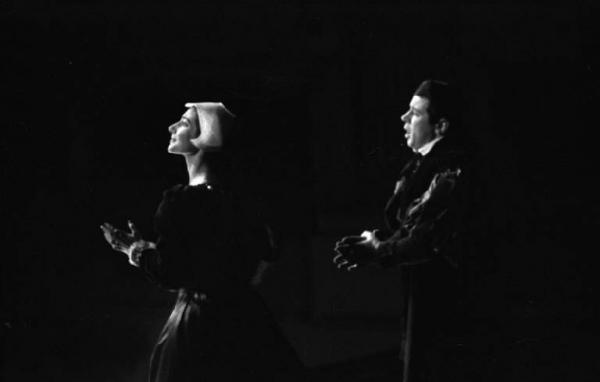
Callas and Raimondi (above) reunited the following year as Anna and Percy in Donizetti’s ANNA BOLENA. 1957 also marked the tenor’s debut at Vienna, where he was to appear regularly for twenty seasons.
In 1963, the Vienna State Opera’s production of LA BOHEME, under the direction of Herbert von Karajan, was filmed for posterity; Mirella Freni and Gianni Raimondi appeared as Mimi and Rodolfo. The performance is available on DVD.
Having debuted at San Francisco (1957) and the Teatro Colon (1959), Mr. Raimondi made his Metropolitan Opera debut as Rodolfo in BOHEME in 1965, opposite Ms. Freni.
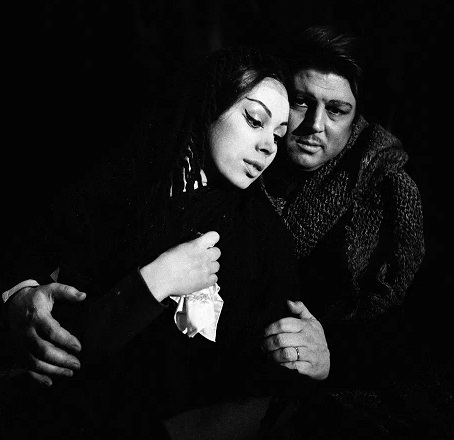
Above: Freni and Raimondi in BOHEME
BOHEME was the only opera I saw Raimondi in at The Met. The performance was in September 1968, and his Mimi was Teresa Stratas; they were among the most moving of all the many interpreters of these roles I have seen thru the decades. My diary says the tenor was “…terrific…great upper range…beautiful portrayal…”
Mr. Raimondi remained at the Met until 1969; his other roles there were Pinkerton, Donizetti’s Edgardo, Faust, the Duke of Mantua, and Mario Cavaradossi. In 1968, the tenor joined Regine Crespin and Gabriel Bacquier in a thrilling broadcast performance of TOSCA, with Zubin Mehta conducting.
In the 1970s, Raimondi took on the spinto tenor roles in NORMA, I MASNADIERI, I VESPRI SIVILIANI, and SIMON BOCCANEGRA.
Following his retirement from the stage, the tenor lived in his villa by the sea at Riccione. He passed away in 2008.
Here is a collection of arias sung by Gianni Raimondi…some of these take a few seconds to start:
Gianni Raimondi – GIOCONDA aria
Gianni Raimondi – Recondita armonia ~ TOSCA
Gianni Raimondi ~ Nessun dorma – TURANDOT
~ Oberon
-
Premiere: Levine/Schenk GÖTTERDÄMMERUNG
During these endless days of being at home, I’ve been reading thru my opera diary, a hand-written document I started in 1962 and which now fills numerous file folders. So many wonderful memories of the great performances I saw over the years were stirred up by reading about them.One such exciting night was the 1988 premiere of the Otto Schenk GÖTTERDÄMMERUNG, the closing opera of Wagner’s epic RING Cycle. Often referred to affectionately as “the Levine RING”, full cycles of the production in the ensuing seasons created a great international buzz; Wagnerites from all over the globe gathered in New York City to witness this classic staging.
Having already seen the RHEINGOLD, WALKURE and SIEGFRIED, I had a pretty good idea of what to expect; still, when the Gibichung Hall loomed into view, it took my breath away. Levine was mostly magnificent, though there were moments when he let things drag a bit; his orchestra gave it their all, and the chorus sounded sensational as they gathered in lusty expectation of the double wedding.
As to the singers, here’s what I wrote upon returning to my room at the Colonial House after the performance:
“Casting was strong, with pretty singing from the Rhinemaidens – Joyce Guyer (in her Met debut), Diane Kesling, and Meredith Parsons – and Franz Mazura made an astoundingly vivid Alberich, singing with oily malice. The opening scene of Act II, with Alberich pawing at the sleeping Hagen, was very atmospheric.
The Gibichung brother and sister were rather curiously cast: as Gunther, Anthony Raffell’s voice sounded veiled and throaty, and Kathryn Harries’ beautiful (and beautifully acted) Gutrune was undone by effortful singing and a prominent vibrato. [I mentioned that Cornell MacNeil and Lucine Amara could have made for far more interesting casting in these roles!].
The Norn Scene, which I have always loved, benefited from the super casting of Mignon Dunn as 1st Norn, sung with richly doom-ladened tone. Hanna Schwarz (2nd Norn) had a couple of husky moments, but overall sang vividly, with excellent diction. As the 3rd Norn, Marita Napier sometimes sounded a bit insecure, but she did not let down the side. These three really made something of their opening discussion.
Toni Kramer sang erratically but acceptably in the torturous role of Siegfried. He seemed to be husbanding his powers, doing his best singing in Act III.
Above: Christa Ludwig as Waltraute and Hildegard Behrens as Brunnhilde
The divine Christa Ludwig made a thrilling Waltraute, singing with great clarity and verbal point. The distinctive Ludwig tone – that cherished sound – drew the audience in to her every phrase. Add to this the anguished urgency of her delivery, and the result was a veritable triumph.
The Ludwig Waltraute produced one of my all-time favorite curtain calls: stepping before the gold curtain for her first solo bow, she was greeted by such a din of applause and shouting that she halted in her tracks; her eyes opened wide in amazement, and she broke into a huge smile. It seemed to me that she had not expected such an avalanche of affection. She bowed deeply, clearly savoring this outpouring of love from the crowd.
The towering magnificence of Matti Salminen as Hagen (above) produced tremendous excitement in the House. His huge voice was at peak form, effortlessly filling the hall with sinister sound. In the scene where Hagen’s father appears to him in a dream, Salminen and Franz Mazura matched one another in both power and eerily expressive subtlety: thoroughly engrossing. The basso’s portrayal as the drama of Act II unfolded was towering in its epic nastiness and in his manipulation of the situation to attain the character’s sole goal: to regain the ring. This was a performance thrilling to behold, and to hear.
The roar of applause for each of Salminen’s solo bows was thunderous, and I was so excited to be part of it, shouting myself hoarse.
~ Sample the Salminen Hagen, from a later broadcast…it gives me he chills:
Matti Salminen as Hagen – Met 1993
Hildegard Behrens (above) was a Brunnhilde of terrifying intensity and incredible feminine strength. This was an overwhelming interpretation, in which voice and physicality combined to transcend operatic convention, reaching me on the deepest possible level. Behrens lived the part, in no uncertain terms.
The Dawn Duet found Behrens portraying the tamed warrior maid to perfection, savoring her domestic bliss but eager that Siegfried should go out into the world and do great deeds. Her unconventional beauty and her inhabiting of the character were so absorbing to behold. Later, In the scene with Waltraute, Behrens as Brunnhilde listened anxiously to all her sister’s words and she began to grasp the first signs of the downward spiral that would culminate with Siegfried’s betrayal and her own sacrifice. Even so, she dismissed Waltraute with fierce disdain. Behrens’ vivid depiction of Brunnhilde’s terror and helpless dejection as the false Siegfried wrested the ring from her was palpable.
In one of the evening’s most gripping moments, Behrens – having become possessed by Brunnhilde’s plight in Act II – responded to Siegfried’s oath by snatching Hagen’s spear away him and singing her own oath with blistering abandon. Totally immersed in the character, her pain was painful to behold. In the powerful trio that ends Act II, Behrens, Raffell, and Salminen were splendid.
Above: Hildegard Behrens as Brunnhilde ~ Immolation Scene
In the Immolation Scene, the great strength of Brunnhilde’s love for Siegfried, and her determination to perish in the flames of his funeral pyre, marked the culmination of Hildegard Behrens’ sensational performance. Her singing was powerful, with unstinting use of chest voice and flaming top notes; there were moments when expressionistic effects crept in but it all seemed so right. The amazing thing about Behrens’ singing and acting here was that it all seemed spontaneous…she seemed to be living it all in the moment. One cannot ask more of an operatic portrayal.
The curtain calls went on and on, the audience eager to show their appreciation with volleys of bravos as the singers stepped forward time and again. Here we must also thank James Levine, whose grand design underlies the great success to date of the individual operas. Ahead, in the Spring, seeing the full cycle in a week’s time is already on my calendar. My dream will come true!”
~ Oberon
-
Jeannette Pilou Has Passed Away
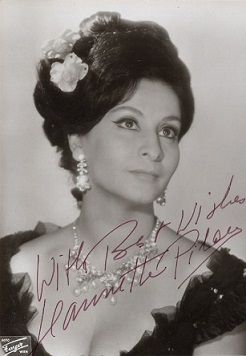
My beloved soprano Jeannette Pilou has passed away at the age of 83. By chance, I was at her last-minute Metropolitan Opera debut as Juliette on October 7, 1967, and it was love at first sight…and first hearing.
I have so many beautiful memories of Mlle. Pilou: not only of her expressive and wonderfully detailed portrayals of such iconic roles as Violetta, Mimi, Mélisande, and Mozart’s Susanna, but also of her great kindness to me as a young and ardent admirer.
In 2007, I wrote a long appreciation of Jeannette Pilou which includes details of her performances as well as many pictures – for she was a great beauty.
Her voice was a masterpiece of pastels, with a vein of stainless steel which allowed her to penetrate the orchestra in the heavier passages of FAUST and MADAMA BUTTTERFLY. She could turn the most familiar phrases in a role into something distinctly personal. Singing Mimi’s narrative in Act I of LA BOHEME, Jeannette sang: “Non vado sempre a messa, ma prego assai al Signor” (“I don’t always go to Mass, but I pray often to the Lord”), putting an emphasis on “assai” that gave the statement a charming tongue-in-cheek feeling. Over time, she developed a lovely gift for threading piani/pianissimi into a vocal line. Mlle. Pilou was a singer who could draw the listener in; this made her Mélisande a particular treasure.
Jeannette was extremely photogenic; I have a whole folder of photos of her. If she were singing today, everyone would want a selfie with her.
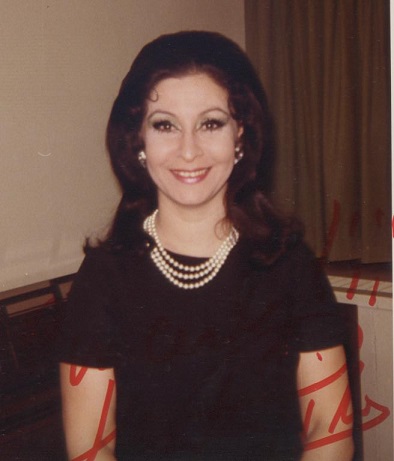
She especially loved the above photo that I took of her. After having it developed and blown up, I presented it to her to sign (you can see her exclamations marks), and she asked if I could send her a copy. I did, of course.
Despite my shyness, I managed to have several conversations with Ms. Pilou; her speaking voice was so enchanting, and so very intimate.
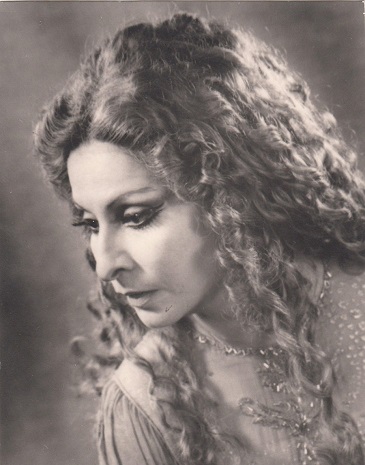
Above: Jeannette Pilou as Thaïs
~ Oberon
-
Lisette Oropesa @ The Met’s At-Home Gala

On April 24, 2020, Lisette Oropesa was one of several Met Opera stars to perform on a special webcast concert wherein everyone sang from their homes. Lisette sang an aria from Meyerbeer’s ROBERT LE DIABLE, live from her hometown: Baton Rouge, Louisiana. Michael Borowitz is the pianist.
Watch and listen here.
-
Joy Davidson
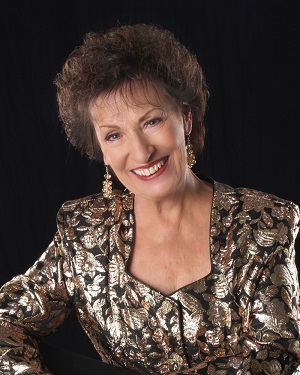
Mezzo-soprano Joy Davidson was born at Fort Collins, Colorado. She studied voice with Elena Nikolaidi at Florida State University and made her operatic debut at Miami as Rossini’s Cenerentola in 1965.
Ms. Davidson joined the short-lived Metropolitan Opera National Company from 1965-1967 where her roles included Britten’s Lucretia. She won the Sofia International Opera Singers Competition in 1967, and in 1969 made her debut at New York City Opera as Kontchakovna in PRINCE IGOR, a role in which I saw her three times..and met her after one of them:
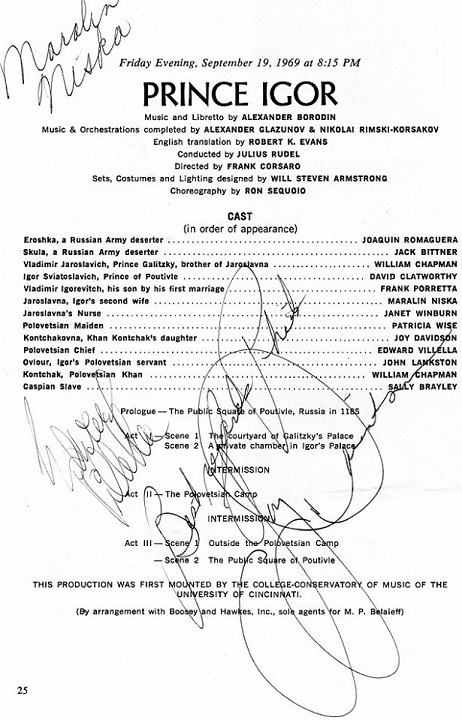
(Note: NYC Ballet star Edward Villella danced in the PRINCE IGOR production, and Maralin Niska had one of her best roles as Yaroslavna).
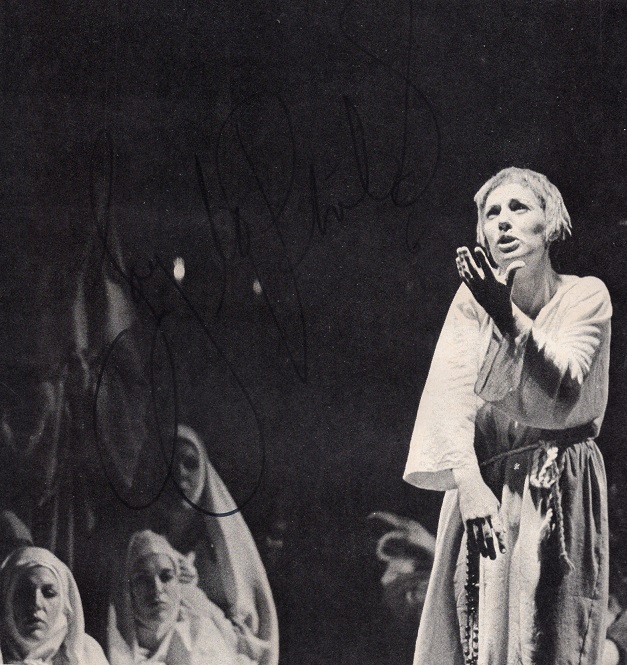
In 1969, Joy Davidson made her Santa Fe debut as Jeanne in Penderecki’s DEVILS OF LOUDON (above photo, which she signed for me), the opera’s US premiere performances. In the same year, she made her San Francisco Opera debut as the Secretary in Menotti’s THE COUNSEL, and in 1971 she made her La Scala debut as Dalila.
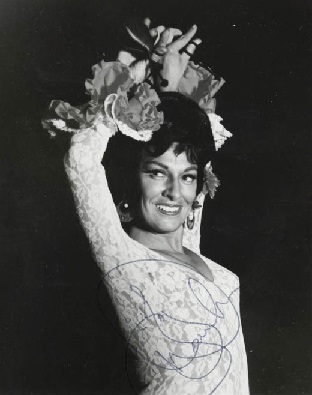
1971 also brought Joy Davidson back to the New York City Opera to star as Carmen (above) in a new production. In the ensuing seasons, she appeared in Vienna, Munich, Dallas, Barcelona, Turin, Lyon, at the Maggio Musicale and at the Spoleto Festival.
Joining the Metropolitan Opera on tour in 1976, Ms. Davidson sang Adalgisa opposite Shirley Verrett’s Norma in Boston and Cleveland. These were Verrett’s first Normas, and TJ and I traveled from Hartford to Boston for the occasion. Verrett had a great triumph; Ms. Davidson was taxed by some of the high notes in Act I, but fared much better in Act II. In 1978, the Joy Davidson was again cast as Adalgisa, in performances at the Bushnell in Hartford, opposite Cristina Deutekom’s Norma, which I attended. Here, Ms. Davidson enjoyed a thorough success.
There are very few recorded souvenirs of Joy Davidson, unfortunately. Here she is in a German-language DON CARLO from Munich, 1968:
Joy Davidson – O don fatale – DON CARLO – in German – Munich 1968
She sang Jane Seymour in Donizetti’s ANNA BOLENA at Santa Fe in 1970; here is Seymour’s great scene of remorse, with Donald Gramm as Henry VIII.
A rather remarkable document, which took me a great deal of searching to locate and verify, is a complete 1977 telecast of Massenet’s WERTHER from Teatro de la Zarzuela, Madrid. The mezzo’s name is listed as “Davison”, so this item does not readily appear in searches. Though the visuals are rather dated, it is a very attractive performance, and both Ms. Davidson and Alfredo Kraus give passionate portrayals. Watch it here, it’s really quite wonderful.
~ Oberon
-
Arlene Saunders Has Passed Away

Above: Arlene Saunders as Eva in DIE MEISTERSINNGER
It’s so sad to read of the death of soprano Arlene Saunders, who I saw in four different roles over the course of her career. She died on April 17th, 2020, of complications associated with COVID-19.
Just last Summer, I discovered a series of films made in the 1970s by the Hamburg State Opera and truly enjoyed watching Ms. Saunders as the Countess in NOZZE DI FIGARO, Agathe in FREISCHUTZ, and most especially her Eva in DIE MEISTERSINGER. The Hamburg film of the Wagner opera can in fact be watched in its entirety on YouTube here.
It was as Eva that Arlene Saunders sang her only performances with the Metropolitan Opera, in 1976. But I had the good fortune to see her on the Met stage earlier, when the Hamburg company brought Stravinsky’s RAKE’S PROGRESS to Lincoln Center in 1967. She was an ideal Anne Trulove.

In the years to come, I saw Ms. Saunders as the Marschallin (Opera Company of Boston), as Minnie in FANCIULLA DEL WEST (New York City Opera), and as Elsa in LOHENGRIN (at The Bushnell in Hartford). As each of these vastly different characters, she seemed perfect.In 2007, I attended a solo recital attended by a young American tenor; during the interval, a woman came over to speak to the people seated in front of me. I was pretty sure it was Arlene Saunders, and sure enough, the couple greeted her as “Arlene…!” I so wanted to speak to her and thank her for the wonderful performances I’d seen her give, but my innate shyness took over. I always regretted that missed opportunity…now, more than ever.
And here’s Ms. Saunders in music from my favorite opera, ARIADNE AUF NAXOS:
Arlene Saunders – Ariadne Monolog Part II ~ ARIADNE AUF NAXOS – Hamburg 1968
~ Oberon
-
John Aylward’s ANGELUS
Above: Paul Klee’s Angelus Novus (1920)
A New Focus Recordings release of John Aylward’s Angelus, performed by the Ecce Ensemble, has come my way. In the pre-dawn hours of yet another day of pandemic isolation, I put on my headphones and listened to the 40-minute work; I found it to be an engrossing sonic experience.
Above: composer John Aylward
Among the composer’s sources of inspiration for this work were the Paul Klee painting Angelus Novus, the stories of his mother’s experiences of fleeing Europe during World War II, and the words of great writer-philosophers from which the monodrama’s texts are drawn.
Adrienne Rich’s “What is Possible” is the first of the work’s ten movements, and also the longest. A setting of the poem by Adrienne Rich, it calls for both spoken and sung passages from the singer. Nina Guo has a wonderfully natural speaking voice, devoid of theatricality or affectation. The sung lines reveal Ms. Guo’s wide range, and her mastery of it. Coloristic writing for the instrumentalists will be a notable feature throughout the entire work; in this first section, the wind soloists dazzle. From this single track omward, the watchword of the enterprise seems to be clarity: it is perfectly recorded.
For the second track, the composer turns to Walter Benjamin’s “Angelus Novus”, a description of the Klee painting. The music is insectuous, the vocal line sometimes has a melting quality.
“Dream Images“, drawn from Nietzsche, opens with lecture-like spoken words, and an undercurrent of muzzled speech. Ms. Guo’s rhetoric can suddenly transform into flights of song. She speaks of the “…need for untruths…” and goes into a repetitious loop at “…our eyes glide only over the surface of things…”
Deft instrumentation sets forth in “The Abstract“, inspired by Schopenhauer’s The World as Will and Representation. The concrete (cello) contrasts with the abstract (oboe), mixing with Ms. Guo’s voice. The singer steps back for the closing lines (“…you are like an actor who has played your part…), spoken in a state of detachment.
Percussion and voice mesh in the miniature “Supreme Triumph” to a D.H. Lawrence text. This flows directly into “Secret Memory“, from Carl Jung’s Aion: Researches into the Phenomenology of the Self. The oboe is prominent and the voice flies high, with some uncanny sustained tones. The flute then joins the soprano in a kind of cadenza, ending with a wispy swoop.
This carries us into the seventh movement, Anima, a setting which blends words by the composer and Thomas Mann. As the flute warbles, the vocal line becomes quirky indeed – with clicks, hisses, and shushings. The text morph to German, with more vocal sound effects.
Plato’s Phaedrus, and phrases from the Catholic Angelus prayer, are sources for “Truth“. with its evocative instrumentation as the singer embarks on a sort of fantastical mad scene. Strings, winds, and percussion swirl along before subsiding to underpin the singer’s chanted prayer.
Plato holds his place for the ninth movement, the voice in lyrical flights interspersed with fragmented spoken lines. The music becomes intense, with ominous drums and screaming winds, as bells signal a warning before fading to stillness.
The final movement of Angelus is the most marvelous of all. A brooding prelude for the woodwinds emerges to a setting of excerpts from Weldon Kees’ A Distance from the Sea. The speech/song is pensive and illusive, with Ms. Guo in a reflective lyrical state. “Nothing will be the same…” she sings, in a moment now so strangely timely. “The night comes down…” she speaks, as the music turns soft and hazy, and then vanishes into air.
Above: Nina Guo
Nina Guo’s performance of Angelus is so impressive, and her colleagues from the Ecce Ensemble make the music truly vivid. The players are Emi Ferguson (flutes), Hassan Anderson (oboe), Barret Ham (clarinets), Pala Garcia (violin), John Popham (cello), and Sam Budish (percussion). Jean-Philippe Wurtz conducts.
The release date is April 24th, 2020. Look for it here, or (digitally) here.
~ Oberon





 Oberon's Glade