Category: Opera

  • Cecil Coles, Composer

    CecilFrederickGottliebColesa

    The name Cecil Coles was completely unknown to me when, at a recent Musica Viva NY concert, one of his works, Cortège, was performed as an organ solo. This sent me on a search for more information about the composer, who served in the Great War and who was killed by a sniper while on active duty in France, in April of 1918.

    Born in Scotland, Coles became an assistant conductor at the Stuttgart Opera, and was the organist at St. Katherine’s Church in that city. At the onset of the Great War, he signed up immediately and joined the Queen’s Victoria Rifles, serving as the regimental band-leader. Coles did not let the war stall his composing career; during his time at the Western Front, he would send his manuscripts back to his friend, composer Gustav Holst, in England. 

    There’s a wonderful page about Cecil Coles on the BBC Scottish Symphony Orchestra’s website here. Conductor Martyn Brabbins talks about the many Coles compositions that languished, forgotten, for decades, and of his own efforts in orchestrating some of them.

    British mezzo-soprano Fiona Kimm sings one of Cecil Coles’ most beautiful songs, A Benediction:

    Fiona Kimm – Cecil Coles ~ A Benediction

    56039937_1498123276

    Cecil Coles is buried at the Crouy British Cemetery in France.

    ~ Oberon

  • Bychkov|Czech Philharmonic ~ Mahler 2nd

    3jb9qd-semyonbych-master

    Above: Maestro Semyon Bychkov

    Author: Oberon

    Sunday October 28th, 2019 matinee – Attending a performance of the Mahler 2nd invariably fills me with memories of past performances of the work that I have experienced. By far the most meaningful of these came at Carnegie Hall in December 2001 when my late friend Makiko Narumi sang the solo alto part in a performance by the Juilliard Orchestra. She was suffering from a rare form of cancer, but heroically she sang…and moved everyone to tears with her “Urlicht“. She left Carnegie Hall in a wheelchair that night, and never sang in public again. She flew to Japan in March 2002 to seek treatment there, but she died at her parents’ home in Aomori within a month.

    This afternoon, back at Carnegie, the great conductor Semyon Bychkov led the Czech Philharmonic in a rendering of this Mahler masterpiece that was not quite the soul-stirring experience I had been anticipating; the reasons for this were mainly extra-musical.

    The conductor’s pacing of the work was flawless, and there were long paragraphs of superbly layered sound from the orchestra. The symphony’s epic climaxes and their ensuing ebbing away were impeccably judged by the Maestro. The courtly opening of the second movement, and the ‘Halloween’ dance of the third reminded me yet again of what a great work the Mahler 2nd truly is. Full-bodied strings and expert solo woodwind playing gave a great deal of pleasure, and the chorus played their part in the proceedings to wonderful effect.

    These positive elements were somewhat offset by some fluffed brass playing, and by vocal soloists who were more serviceable than inspiring. Mezzo-Soprano Elisabeth Kulman sounded lovely in the very quiet start of the Urlicht; later, a trace of flatness crept in, and the concluding rising phrase of the song seemed a bit unsupported. She sounded fine, though, in the later O glaube! Soprano Christiane Karg’s upper notes were somewhat tremulous, though overall her sound is appealing.

    But it was a series of noises in the hall that eventually took on a comic aspect – due to their frequency and timing – which made concentrating on the music next to impossible. It started during a dead silence midway thru the symphony’s opening Allegro maestoso; and it happened again during the Andante moderato. Then, just as Ms. Kulman was starting the Urlicht, there was a loud thud. And something else was dropped during an offstage brass passage.

    In the final movement, everything at last seemed to be going smoothly – aside from some wonky brass notes and yet another dropped item – until the chorus made their hushed entrance. Here, atmosphere is everything. But the sound of a door closing somewhere ruined it.

    When so many earth-bound distractions occur in the course of a single symphony, one feels battered down. My high expectations for this concert were slowly frittered away as the afternoon wore on. 

    Considering my abiding love for the Mahler 2nd, this is not at all the type of article I thought I’d be writing this evening. But an accumulation of ordinary annoyances – there were others that I haven’t mentioned – got the upper hand today.

    NOTE: Ben Weaver writes about the Czech Philharmonic’s opening performance at Carnegie Hall, which took place on Saturday evening, October 27th, here. Ben was with me at the Mahler matinee, and said that the blips in the brass playing on Sunday were nowhere evident in the Dvořák program. He felt in general that the orchestra players might have been experiencing some fatigue on Sunday afternoon following a big program on Saturday night. He also said that the Dvořák program was free of audience distractions and extraneous noises. 

    ~ Oberon

  • Shaham|Sokhiev @ The New York Philharmonic

    43631700_10158224011972293_9087441948343533568_n

    Above: violinist Gil Shaham and conductor Tugan Sokhiev, photo by Chris Lee/NY Philharmonic

    ~ Author: Oberon

    Thursday October 25th, 2018 – An all-Russian evening at The New York Philharmonic. Tugan Sokhiev, Music Director of Orchestre National du Capitole de Toulouse, was making his Philharmonic debut on the podium, with Gil Shaham as violin soloist.

    Alexander Borodin composed In the Steppes of Central Asia to honor Tsar Alexander II on the 25th anniversary of his coronation. The eight-minute work has an ethereal start, from which emerges a plaintive clarinet solo played by Pascual Martínez-Forteza; this artist’s sumptuous tone was a joy to hear throughout the evening. Maestro Sokhiev held sway over the music, which was gorgeously played – especially by the celli. Solos for English Horn and flute, a rich passage for the horns, and the violins in a tutti of cinematic sweep kept the ear constantly allured. The music becomes majestic, worthy of a venerable Tsar.

    As the work progressed, I was very much put in mind of the composer’s opera Prince Igor, and found myself wondering where Peter Gelb’s expensive poppy field might be languishing.

    Mr. Shaham then joined the orchestra for Prokofiev’s Violin Concerto No. 1. This work was choreographed by Jerome Robbins in 1979; the ballet, Opus 19/The Dreamer, is by far my favorite from the Robbins catalog, and is frequently performed by the New York City Ballet.  It’s always wonderful to experience music I’ve come to know at the ballet in its original concert setting, and it goes without saying that the choreography danced in my mind during Mr. Shaham’s marvelous performance.

    Prokofiev’s knack for blending lyricism and irony was a continual source of pleasure in tonight’s performance by Mssrs. Shaham and Sokhiev. The concerto’s haunting opening, with the shining, silver – almost astringent – sound of Mr. Shaham’s violin draws us into a dreamlike state. Everything is magical, with the violas pulsing as the soloist engages in shimmering fiorature. The music becomes driven, only to meld into a slow cadenza. Then a chill sets in, with the flute shimmering. Mr. Shaham, returning to the original melody, lets the sound vanish into thin air.

    In the ensuing Scherzo, the music abounds in sarcasm; Mr. Shaham met all the technical demands with impetuous energy, including some really gritty playing. This is such amazing music to experience, right up to its sudden end.

    The the work’s final movement commences with a moderate-tempo, march-like theme, first played by the bassoon, and later by the brass.  Mr. Shaham’s playing of the songful melodies Prokofiev gifts him was luxuriantly modulated. His tone taking on a nocturnal iridescence, the violinist made the concerto’s final moments pure heaven.

    Mr. Shaham played a 30-second delight of an encore his announcement of which I could not hear. It was witty little treat, but a cellphone interjection at the start was not welcome.

    Sokhiev-8-crdit-Patrice-Nin-1024x680

    Above: Maestro Tugan Sokhiev, photo by Patrice Nin

    I last heard Tchaikovsky’s Symphony No. 4 played by the Philharmonic in 2016 in at performance that impressed and even thrilled me sonically, without reaching me on a spiritual level. Tonight, Maestro Sokhiev achieved that last distinction in a performance of soaring lyricism and searing passion, played splendidly by the orchestra. Perhaps it is true that it takes a conductor with a Russian soul to find the deepest resonances of Russian music.

    Tchaikovsky’s fourth symphony grew out of a highly emotional period of the composer’s life. After a disastrous attempt at marriage, he suffered from writer’s block whilst also struggling with depression and pondering his sexuality. He finished the symphony in 1877 and it was premiered in 1888.  The the opening bars of music stand as a metaphor for Fate; in Tchaikovsky’s own words: “…the fatal power which prevents one from attaining the goal of happiness”.

    This evening’s performance was thrilling in every way. From the splendid opening and straight thru to the end, the orchestra were on peak form. The depth of sound from the ensemble – and the numerous solo passages that frequently sing forth – constantly impressed, and the Maestro had everything under fingertip control. From the grandest imperial passages to the uncanny delicacy of the more restrained moments, his mastery of colour and balance seemed ideal. My companion for the evening, Ben Weaver, who knows this music inside out, was very taken with Sokhiev’s pacing ,which made the symphony seem fresh to him.

    The Philharmonic’s soloists produced an endless flow of enchanting playing: Mr. Forteza and his colleagues – Robert Langevin (flute), Sherry Sylar (oboe), and Judith LeClair (bassoon) – seized upon the generous melodic gifts which Tchaikovsky lavished upon them. The horns were plush, the trumpets and trombones commanding in their fanfares. The timpanist was a marvel of velvet touch is the waltzy passage of the first movement, and in the ‘interlude’ of the otherwise Allegro finale, the triangle sounded with a pristine glimmer.

    There seemed to be a particular sheen on the string playing tonight, and they made the pizzicati of the Scherzo dazzlingly alive. Watching Maestro Sokhiev cue them and entice their keen manipulation of the dynamic range during this captivating movement was a treat in itself.

    In recent days, the feeling that we are poised now of the edge of an abyss makes music, poetry, art, and Nature seem more vivid and essential than ever. A beautiful face among the crowd tonight captured my imagination, but filled me with apprehension that such innocence may soon be swept away in a tide of hatred.

    ~ Oberon

  • Hilary Hahn @ White Light Festival

    ~Author: Scoresby

    Tuesday October 23 2018 – Lincoln Center’s White Light Festival every October/November is always an interdisciplinary highlight of the season that offers a variety of different events. This year’s ranges from the upcoming US Premiere of Kaija Saariaho’s new opera Only the Sound Remains to a music with dance performance of Feldman’s Triadic Memories featuring pianist Pedja Muzijevic and choreographer Cesc Gelabert. Part of this celebration of spiritual/communal art featured the genial violinist Hilary Hahn in all too rare NY concert. She performed two of the three of the Bach Sonatas and Partitas that she just released on recording. The last work was one of the other three she recorded as her debut album, and it seems will perform them this Spring in Europe. According to Ms. Hahn’s Instagram, this was her first solo concert in the US in her career.

    Screen Shot 2018-10-25 at 12.38.40 PM
    Above: Violinist Hilary Hahn playing Bach; Photo by Kevin Yatarola Courtesy of Lincoln Center

    Ms. Hahn was performing to a sold out, enthusiastic audience in the intimate Alice Tully Hall yesterday evening. It should be said that all six of these pieces are extremely difficult to play well and yet at the core of the violin repertoire. The first work on the program was Sonata No. 1 in G minor. Ms. Hahn coaxed a large, beautiful sound out of her violin in the opening Adagio. Her sound was reminiscent of a purer Arthur Grumiaux (different intepratively). In the Fugue, Ms. Hahn took a more aggressive sounding virtuosic as she traversed each of the many double and triple stops. Out of the many live performances I’ve seen of this work, this is the first time I’ve heard this movement sound almost as clean as a recording – a near impossible feat. In addition to her accuracy, it was striking to be able to hear the countermelodies in the bass that usually disappear in the dense textures rang with clarity. In Ms. Hahn’s rendering, the intricate contrapuntal structure was easy to hear. While she was retuning before the third movement, the audience gave a hearty applause. After the gorgeous Sciliano, Ms. Hahn gave a brisk, full-bodied account of the presto. Her use of a quick tempo and her interesting finger work let the entire bass line ring through the movement letting the entirety of the piece shine.

    In the opening Allemende of the Partita No. 1 in B minor Ms. Hahn took her time and employed small cells of melodic phrases that were punctuated by the larger chords. It was a unique take on this movement, make it sound angular – almost in the vein of Stravinsky. She seemed to take a similar approach in Courante that when moving into the Double expanded into a carefully coordinated flash of notes that was always clear. Part of that clarity came from giving almost every note its own bowing, making each shine in its own way. The audience applauded here too before the final four movements. Another highlight was the careful pacing of the Sarabande. As in other areas, Ms. Hahn’s preternatural ability of voicing every line let the music sing.

    Screen Shot 2018-10-25 at 12.41.23 PM

    Above: Violinist Hilary Hahn

    After intermission was Partita No. 2 in D minor. Ms. Hahn continued with the same big sound and near orchestral quality of playing. While beautifully rendered and intellectual satisfying, I couldn’t help but feel that her performance felt lacking in intimacy. As encore to the Partita, Ms. Hahn opted to replay the massive Chaconne. While I felt it was quite a bit odd at first to play a 15 minute encore of music just performed earlier, this was her best playing of the night. Perhaps relieved to be over with her first US solo concert, she seemed relaxed and personal with this second reading. Phrases that had been burly had a softer edge to them, the lyrical parts of the work had more space, and Ms. Hahn seemed to use quieter dynamics than she had the rest of the evening. It was thrilling to hear such a change in performance style from the rest of the concert and the crowd seemed to be just as enthralled.

    Scoresby

  • Mignon Dunn as Dalila

    Mignon-dunn-01

    In the aftermath of the opening night performance of a new SAMSON ET DALILA at The Met, the folks on The List and at Parterre are discussing favorite interpreters of the opera’s title roles; the name of Mignon Dunn came up.  

    Mignon was a great favorite of mine and her performances in such roles as Laura in GIOCONDA, Fricka in the RING Cycle, Anna in TROYENS, Brangaene in TRISTAN UND ISOLDE, and Ortrud in LOHENGRIN are among my fondest operatic memories.

    In 1985, I had the good fortune to see Mignon Dunn as Dalila in a production by the Connecticut Opera Association at The Bushnell in Hartford. She and her co-stars, Jon Frederic West and Charles Karel, sang powerfully whilst doing what they could dramatically in an old-style, rather campy setting.

    In the course of my two-year project of rescuing music from my vast cassette collection, I was able to preserve this recording of Mignon singing Dalila’s opening aria from Act II with piano from a radio program in 1975 which I taped off the air:

    Mignon Dunn – Amour viens aider ma faiblesse – SAMSON & DALILA – Met Marathon 1975

    I’ll be seeing the Met’s new SAMSON ET DALILA twice in the coming weeks: once with each cast.

    ~ Oberon

  • Miro’s New Wolfgang Rihm Ballet

    Mirophotoarnaudfalchier

    Above photo by Arnaud Falchier

    ~ Author: Oberon

    Saturday September 22nd, 2018 – A new ballet choreographed by Miro Magloire to music by Wolfgang Rihm was presented as part of New Chamber Ballet‘s 2018-2019 season opener tonight at City Center Studios. Also on the program were three works from the NCB repertory: AMITY (from 2017, to music of Mozart), MEMORIES (JS Bach), and THE LETTER (a narrative work, set to Haydn).

    Just before heading out to Miro’s, I received some bad news on the family front. I thought briefly of just staying home, but then: what could I do at home but brood helplessly? Better to be where there is music and dancing.

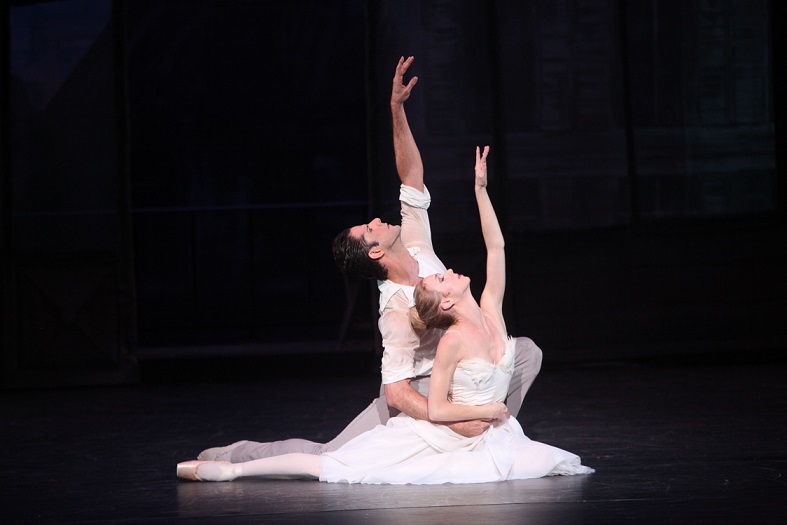
    The music of Bach is ever an antidote to daily cares. Pianist Melody Fader’s playing of the selections from The Well-Tempered Klavier that form the score of Miro’s ballet MEMORIES had both spirit and grace. Four dancers – Elizabeth Brown, Kristine Butler, Amber Neff, and Madeleine Williams – appear in Sarah Thea’s sleek, colour-vision costumes.

    Thumbnail_S_2018_02_16_Magloire_043

    Above: Kristine Butler in MEMORIES, photo by Arnaud Falchier

    In the opening moments of this ballet, varying trios of women seem to shut out the fourth. A solo for Elizabeth Brown highlights this dancer’s beautiful arms and hands. Amber Neff and Kristy Butler have an animated duet that evolves into a slow, stretchy, intimate partnership. Elizabeth and Madeleine dance in sync, then Elizabeth and Amber team up.

    The tall women – Kristy and Madeleine – dance fast, followed by a vivid solo from Amber Neff. In this, Amber’s striking port de bras, and a hint that her ‘character’ might be wounded, give a narrative feeling. A floor-based trio for Amber, Kristy, and Madeleine follows, and then another solo passage from Elizabeth shows her special gift for illuminating the music. The foursome bring the ballet to an allegro finish.

    Earlier this Summer, I spent two afternoons watching and re-watching a DVD of Rihm’s opera OEDIPUS, which I found quite engrossing. Yet even with that preparation, I was totally unprepared for the effect the composer’s Über die Linie VII, as played by Doori Na, would have on me. This made for an unusual experience: the music came to increasingly dominate my mind – to the extent that the dancing seemed more like an accompanying dream.

    The ballet, entitled FEEL YOUR FALL, danced by Amber Neff, Madeleine Williams, and Rachele Perla, is rather floor-oriented, with the girls leaning upon one another in encircling embraces, their bodies and spirits enmeshed and entwined. As they rise and dance, one captivating motif stood out: a repeated gathering gesture from the dark-eyed, lovely Ms. Perla which created for me a link to Isadora’s port de bras language.

    “So enthralled by the music!” I scrawled across my notes. From tonal depths of passion to hair’s-breath pianissimi, Doori gave a truly compelling performance of this long and demanding piece. I’ve come to think of Doori as a violinist who can play anything, and this evening his remarkable playing served as confirmation. He called his preparation of the piece “a journey”, and he repays his listeners by taking us on a journey of our own. Simply extraordinary.

    I did have two thoughts on the overall effect of this ballet: I feel it could benefit from having more dancers involved – if for no other reason than that they could dance to this music, which must be a revelation. And I think darker, more dramatic costumes would be fantastic: this actually could be a proverbial ‘black’ ballet. But these are simply idle thoughts: FEEL YOUR FALL is fine just as it stands.

    It took a few minutes for me to return to Earth from this cosmic experience. As a diversion, Melody Fader played Haydn for THE LETTER, a ballet in which Elizabeth Brown and Traci Finch might be viewed as mistress and maid. It has its comic aspects, but the mystery remains to the end: we never learn the contents of the letter.

    The evening concluded with AMITY, Miro’s graceful, golden ballet set to Mozart’s violin sonata K. 296 which Doori and Melody played with distinction. Mlles. Butler, Finch, Neff, and Williams floated and flitted about the space, dancing Miro’s combinations with joyous abandon, so close we could almost reach out and touch them. AMITY was commissioned by dance-lover Edward Petrou in memory of his wife Rachel; this evening, Miro added a further dedication: to the great Arthur Mitchell, who passed away on September 19th.

    ~ Oberon

  • Miro’s New Wolfgang Rihm Ballet

    Mirophotoarnaudfalchier

    Above photo by Arnaud Falchier

    ~ Author: Oberon

    Saturday September 22nd, 2018 – A new ballet choreographed by Miro Magloire to music by Wolfgang Rihm was presented as part of New Chamber Ballet‘s 2018-2019 season opener tonight at City Center Studios. Also on the program were three works from the NCB repertory: AMITY (from 2017, to music of Mozart), MEMORIES (JS Bach), and THE LETTER (a narrative work, set to Haydn).

    Just before heading out to Miro’s, I received some bad news on the family front. I thought briefly of just staying home, but then: what could I do at home but brood helplessly? Better to be where there is music and dancing.

    The music of Bach is ever an antidote to daily cares. Pianist Melody Fader’s playing of the selections from The Well-Tempered Klavier that form the score of Miro’s ballet MEMORIES had both spirit and grace. Four dancers – Elizabeth Brown, Kristine Butler, Amber Neff, and Madeleine Williams – appear in Sarah Thea’s sleek, colour-vision costumes.

    Thumbnail_S_2018_02_16_Magloire_043

    Above: Kristine Butler in MEMORIES, photo by Arnaud Falchier

    In the opening moments of this ballet, varying trios of women seem to shut out the fourth. A solo for Elizabeth Brown highlights this dancer’s beautiful arms and hands. Amber Neff and Kristy Butler have an animated duet that evolves into a slow, stretchy, intimate partnership. Elizabeth and Madeleine dance in sync, then Elizabeth and Amber team up.

    The tall women – Kristy and Madeleine – dance fast, followed by a vivid solo from Amber Neff. In this, Amber’s striking port de bras, and a hint that her ‘character’ might be wounded, give a narrative feeling. A floor-based trio for Amber, Kristy, and Madeleine follows, and then another solo passage from Elizabeth shows her special gift for illuminating the music. The foursome bring the ballet to an allegro finish.

    Earlier this Summer, I spent two afternoons watching and re-watching a DVD of Rihm’s opera OEDIPUS, which I found quite engrossing. Yet even with that preparation, I was totally unprepared for the effect the composer’s Über die Linie VII, as played by Doori Na, would have on me. This made for an unusual experience: the music came to increasingly dominate my mind – to the extent that the dancing seemed more like an accompanying dream.

    The ballet, entitled FEEL YOUR FALL, danced by Amber Neff, Madeleine Williams, and Rachele Perla, is rather floor-oriented, with the girls leaning upon one another in encircling embraces, their bodies and spirits enmeshed and entwined. As they rise and dance, one captivating motif stood out: a repeated gathering gesture from the dark-eyed, lovely Ms. Perla which created for me a link to Isadora’s port de bras language.

    “So enthralled by the music!” I scrawled across my notes. From tonal depths of passion to hair’s-breath pianissimi, Doori gave a truly compelling performance of this long and demanding piece. I’ve come to think of Doori as a violinist who can play anything, and this evening his remarkable playing served as confirmation. He called his preparation of the piece “a journey”, and he repays his listeners by taking us on a journey of our own. Simply extraordinary.

    I did have two thoughts on the overall effect of this ballet: I feel it could benefit from having more dancers involved – if for no other reason than that they could dance to this music, which must be a revelation. And I think darker, more dramatic costumes would be fantastic: this actually could be a proverbial ‘black’ ballet. But these are simply idle thoughts: FEEL YOUR FALL is fine just as it stands.

    It took a few minutes for me to return to Earth from this cosmic experience. As a diversion, Melody Fader played Haydn for THE LETTER, a ballet in which Elizabeth Brown and Traci Finch might be viewed as mistress and maid. It has its comic aspects, but the mystery remains to the end: we never learn the contents of the letter.

    The evening concluded with AMITY, Miro’s graceful, golden ballet set to Mozart’s violin sonata K. 296 which Doori and Melody played with distinction. Mlles. Butler, Finch, Neff, and Williams floated and flitted about the space, dancing Miro’s combinations with joyous abandon, so close we could almost reach out and touch them. AMITY was commissioned by dance-lover Edward Petrou in memory of his wife Rachel; this evening, Miro added a further dedication: to the great Arthur Mitchell, who passed away on September 19th.

    ~ Oberon

  • Übermächte sind im Spiel!

    312px-Amme_van_Alfred_Rollerkopie

    Above: Alfred Roller design for Die Amme (the Nurse) in DIE FRAU OHNE SCHATTEN

    DIE FRAU OHNE SCHATTEN (The Woman Without a Shadow) is Richard Strauss’s massive fairy tale of an opera. The “schatten” (shadow) of the opera’s title symbolizes a woman’s ability to bear children. The Empress, a half-human half-spirit creature, is shadowless; thus her marriage to the human Emperor is childless. As the opera opens, the Empress’s nurse receives word that Keikobad, the spirit-king and father of the Empress, will re-claim his daughter for the spirit world if she cannot cast a shadow within three days; and in addition, her husband will be turned to stone.

    Die Amme, the Nurse, is the Empress’s faithful companion. She grudgingly agrees to help her mistress obtain a shadow from the human world; their quest settles on the wife of the lowly dyer, Barak. Promising the unhappily-married Dyer’s Wife untold riches and a handsome youth to be her lover, The Nurse arranges that the shadow of the Wife will be transferred to the Empress.

    After bitterly renouncing Barak, the Wife submits to the Nurse’s magic spell of transference. Suddenly a magic sword flies into Barak’s hands; his brothers urge him to kill the deranged, possessed Wife. Overwhelmed by the situation, the Wife relents at the last moment and begs her husband to slay her; Barak raises the sword, but Keikobad intervenes: the sword is shattered, the house begins to crumble. Crying out “Higher powers are in play! Hither, to me!”, the Nurse leads the Empress away from the destruction.

    The brief scene of the Wife’s change of heart is excitingly sung here by Marilyn Zschau, and the Nurse’s spectacular cry of “Übermächte sind im Spiel! Her zu mir!” climaxes on a sustained high B-flat from Mignon Dunn in this, one of the most thrilling “curtains” in all opera.

    Marilyn Zschau & Mignon Dunn – FRAU OHNE SCHATTEN ~ finale Act II – Chicago 1984

  • M.N. as E.M.

    6a00d8341c4e3853ef00e5550e0ebc8834

    Soprano Maralin Niska in the final scene of Leoš Janáček’s The Makropoulos Affair. The role of Emilia Marty, in Frank Corsaro’s multi-media production for New York City Opera, was one of the great triumphs of the Niska career.

    Maralin Niska as Emilia Marty – finale of The Makropoulos Affair – NYCO 9~5~71

  • Audrey Stottler Has Passed Away

    AudreyStottler

    September 15th, 2018 – I’ve learned of the death of Audrey Stottler (above), who I met in 2003 when she was in New York City to cover – and sing a single performance of – the Dyer’s Wife in FRAU OHNE SCHATTEN at The Met.

    Audrey came in the opera room at Tower Records where I was working at the time, and my boss Bryan and I chatted her up. Bryan had seen her as Turandot at Virginia Opera in 1993. and I’d seen her 2002 Met Turandot – a role she sang worldwide – and we were looking forward to the FRAU. She was most gracious during our long conversation.

    Audrey had a notable success as the Dyer’s Wife; I recall being especially impressed by her juicy upper tones, the unusual richness of her lower range, and the sense of lyricism in her singing.

    This scene from WALKURE displays her vocal attributes quite well:

    Audrey Stottler – Die Walküre ~ Der manner sippe

    And this is thrilling, grand-scale Wagner singing:

    Audrey Stottler – Tristan und Isolde ~ Isolde’s Narration & Curse

    At the time of her unexpected death, Audrey was running a popular voice studio in Minneapolis.

    Scanned Section 2-1 (3)

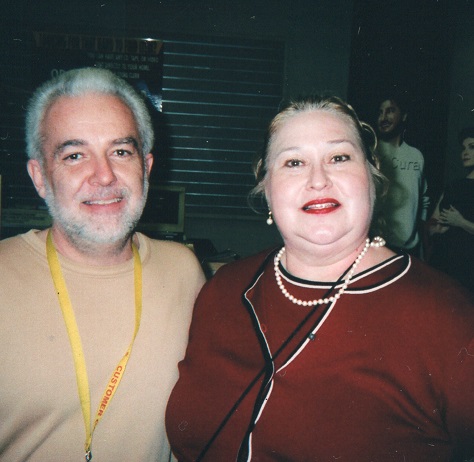
    Bryan took this photo of me with Audrey the day we met her. There are some lovely tributes to her on Norman Lebrecht’s blog.

    ~ Oberon